From the free course Precalculus 2e on Lykke
Exponential and Logarithmic Functions
Key concepts: Exponential Growth · The Natural Base (e) · Logarithmic Properties · Exponential Modeling
A deep dive into non-linear growth and decay, the properties of logarithms, and solving exponential equations.
Exponential and Logarithmic Functions
Exponential and logarithmic functions represent a fundamental shift in mathematical modeling, moving from additive change (linear functions) to multiplicative change. While linear models describe systems that grow by a constant amount per unit of time, exponential models describe systems where the rate of change is proportional to the current value. This characteristic makes them the primary language for describing biological growth, financial interest, radioactive decay, and information theory.
1. Foundations of Exponential Growth
An exponential function is a function of the form $f(x) = ab^x$, where $a$ is a non-zero constant (the initial value), $b$ is a positive real number not equal to 1 (the base), and $x$ is any real number. Unlike power functions (e.g., $x^2$), where the base is the variable, exponential functions place the variable in the exponent.
1.1 Growth vs. Decay
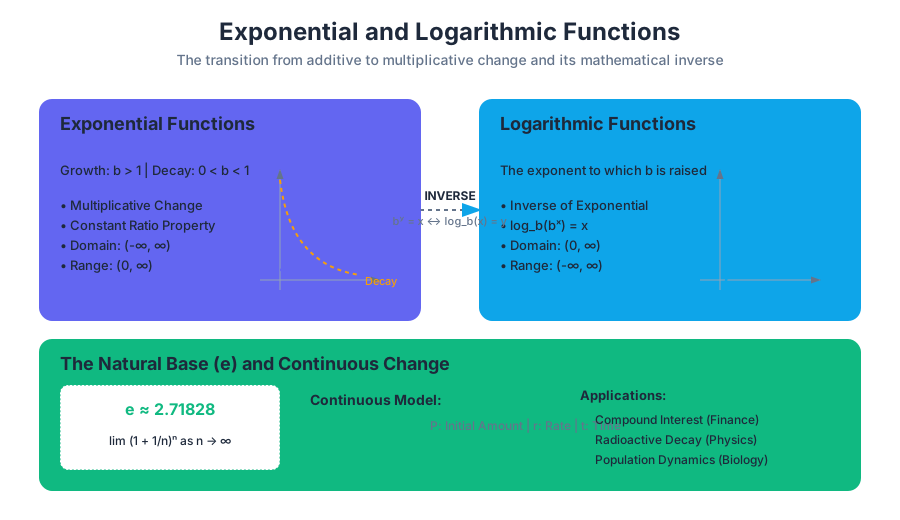
The behavior of the function is dictated by the base $b$. If $b > 1$, the function represents exponential growth. If $0 < b < 1$, the function represents exponential decay.
| Feature | Exponential Growth ($b > 1$) | Exponential Decay ($0 < b < 1$) |
|---|---|---|
| Horizontal Asymptote | $y = 0$ as $x \to -\infty$ | $y = 0$ as $x \to \infty$ |
| Domain | $(-\infty, \infty)$ | $(-\infty, \infty)$ |
| Range | $(0, \infty)$ | $(0, \infty)$ |
| $y$-intercept | $(0, a)$ | $(0, a)$ |
| End Behavior | $f(x) \to \infty$ as $x \to \infty$ | $f(x) \to 0$ as $x \to \infty$ |
1.2 The Constant Ratio Property
The defining characteristic of an exponential function is that for any equal-sized increment in the input $x$, the output $f(x)$ changes by a constant ratio. If we increase $x$ by 1, the new value is $f(x+1) = ab^{x+1} = b(ab^x) = b \cdot f(x)$.
Theorem: The Characterization of Exponential Functions A function $f$ is exponential if and only if the ratio of outputs for equally spaced inputs is constant. That is, $\frac{f(x+h)}{f(x)} = b^h$ for all $x$.
2. The Natural Base (e)
In many real-world applications, growth does not happen in discrete intervals (like annual interest) but occurs continuously. This leads to the discovery of the natural base, denoted by the letter $e$.
2.1 Derivation from Compound Interest
Consider the formula for compound interest: $A = P(1 + \frac{r}{n})^{nt}$, where $n$ is the number of times interest is compounded per year. As $n$ approaches infinity (continuous compounding), the expression $(1 + \frac{1}{n})^n$ approaches a specific mathematical constant.
e = \lim_{n \to \infty} \left(1 + \frac{1}{n}\right)^n \approx 2.718281828459...
The number $e$ is an irrational and transcendental number. It is "natural" because it arises spontaneously in calculus; the derivative of $f(x) = e^x$ is simply $f'(x) = e^x$. This unique property makes it the standard base for almost all advanced mathematical modeling.
2.2 Continuous Growth and Decay Models
The general form for continuous change is: $A(t) = Ae^{rt}$
- $A$: Final amount
- $a$: Initial amount
- $r$: Continuous growth rate (if $r > 0$) or decay rate (if $r < 0$)
- $t$: Time
| Context | Application | Formula Variation |
|---|---|---|
| Finance | Continuous Compounding | $A = Pe^{rt}$ |
| Biology | Population Growth | $P(t) = P_0 e^{kt}$ |
| Physics | Radioactive Decay | $N(t) = N_0 e^{-\lambda t}$ |
| Statistics | Normal Distribution | $f(x) = \frac{1}{\sigma\sqrt{2\pi}} e^{-\frac{1}{2}(\frac{x-\mu}{\sigma})^2}$ |
3. Logarithmic Functions
A logarithm is the inverse of an exponential function. If $b^y = x$, then $\log_b(x) = y$. In essence, a logarithm answers the question: "To what power must we raise the base $b$ to get the value $x$?"
3.1 Definitions and Domains
Since exponential functions have a range of $(0, \infty)$, the domain of a logarithmic function is restricted to $(0, \infty)$. You cannot take the logarithm of a negative number or zero in the real number system.
- Common Logarithm: $\log(x)$ implies base 10.
- Natural Logarithm: $\ln(x)$ implies base $e$.
The Inverse Property
- $\log_b(b^x) = x$
- $b^{\log_b(x)} = x$
3.2 Logarithmic Properties
Logarithms transform multiplicative operations into additive ones, which historically made them essential for complex manual calculations and currently makes them vital for simplifying equations.
| Rule Name | Mathematical Statement | Logic |
|---|---|---|
| Product Rule | $\log_b(MN) = \log_b(M) + \log_b(N)$ | Adding exponents when multiplying bases |
| Quotient Rule | $\log_b(\frac{M}{N}) = \log_b(M) - \log_b(N)$ | Subtracting exponents when dividing bases |
| Power Rule | $\log_b(M^p) = p \log_b(M)$ | Exponent of an exponent results in multiplication |
| Change of Base | $\log_b(M) = \frac{\log_a(M)}{\log_a(b)}$ | Converting to a base your calculator supports |
4. Solving Exponential and Logarithmic Equations
Solving these equations typically involves using the inverse relationship to "isolate" the variable.
4.1 Strategies for Exponential Equations
- Common Base: If both sides can be written with the same base, set the exponents equal ($b^S = b^T \implies S = T$).
- Logarithmic Isolation: If bases differ (e.g., $2^x = 5$), take the natural log of both sides: $\ln(2^x) = \ln(5) \implies x \ln(2) = \ln(5) \implies x = \frac{\ln(5)}{\ln(2)}$.
4.2 Strategies for Logarithmic Equations
- Exponentiation: Convert the log equation to its exponential form. $\log_b(x) = y \implies b^y = x$.
- One-to-One Property: If $\log_b(S) = \log_b(T)$, then $S = T$.
- Condensing: Use log properties to combine multiple log terms into one before solving.
4.3 Extraneous Solutions
When solving logarithmic equations, it is mandatory to check solutions against the original domain. Algebraic manipulations can sometimes produce "solutions" that would require taking the log of a negative number, which must be discarded.
5. Advanced Modeling and Applications
Beyond simple growth, exponential and logarithmic functions appear in more nuanced systems.
5.1 Logistic Growth
Pure exponential growth is often unrealistic because it assumes infinite resources. The Logistic Growth Model introduces a carrying capacity ($K$), representing the maximum population an environment can sustain.
$P(t) = \frac{K}{1 + Ae^{-rt}}$
As $t \to \infty$, $P(t) \to K$. The graph forms an "S-curve" (sigmoid), starting with exponential growth and leveling off as it approaches the carrying capacity.
5.2 Newton's Law of Cooling
The temperature $T$ of an object changes at a rate proportional to the difference between its temperature and the surrounding environment's temperature $T_s$.
$T(t) = T_s + (T_0 - T_s)e^{-kt}$
5.3 Logarithmic Scales
In many physical phenomena, the range of values is so vast that a linear scale is impractical. Logarithmic scales compress this range.
- pH Scale: $pH = -\log[H^+]$. A change of 1 pH unit represents a 10-fold change in hydrogen ion concentration.
- Richter Scale: Measures earthquake intensity. An increase of 1 on the scale represents a 10-fold increase in amplitude and approximately 31.6 times more energy release.
- Decibels (dB): Measures sound intensity relative to a reference level.
6. Common Pitfalls and Misconceptions
- Distributing Logs: A common error is thinking $\log(A + B) = \log(A) + \log(B)$. This is false. Logarithms distribute over multiplication, not addition.
- Base Confusion: Forgetting that $\ln$ is base $e$ and $\log$ is base 10. Using the wrong base in the Change of Base formula is a frequent source of calculation errors.
- Negative Bases: The base $b$ of an exponential function must be positive. If $b$ were negative, the function would oscillate between real and imaginary numbers for fractional exponents, which is outside the scope of standard precalculus.
- Order of Operations: In the expression $ab^x$, the exponent applies only to $b$, not $a$. To apply it to both, you must write $(ab)^x$.
| Incorrect | Correct | Reason |
|---|---|---|
| $\log(x) + \log(y) = \log(x+y)$ | $\log(x) + \log(y) = \log(xy)$ | Product Rule |
| $\frac{\log(x)}{\log(y)} = \log(x-y)$ | $\log(x) - \log(y) = \log(\frac{x}{y})$ | Quotient Rule |
| $(\ln x)^k = k \ln x$ | $\ln(x^k) = k \ln x$ | Power Rule applies to the argument, not the function |
Source Materials
Study Precalculus 2e on Lykke
This course page is free to open: signed out, you can read its first two sections, and signing in, on any plan, opens the rest. The free Lykke Chrome extension syncs your own Canvas courses, so ChatGPT, Claude and Muse can answer from your classes and deadlines. It only reads Canvas.
Add the free extensionSign in to open every section