From the free course Overview of Social Science and Professional Disciplines on Lykke
Introduction to LibreTexts Bookshelves
Key concepts: LibreTexts Bookshelves · Content Remixing · Curated Academic Texts · Course Shells
An overview of the LibreTexts Bookshelves as a central repository for curated academic texts and the process of content remixing.
Introduction to LibreTexts Bookshelves
The LibreTexts Bookshelves represent the architectural backbone of the world’s most visited open-access textbook project. Far more than a simple repository of PDFs, the Bookshelves function as a dynamic, multi-layered "Living Library." This ecosystem is designed to solve the "static content problem" inherent in traditional publishing by providing a modular, interoperable framework where academic content is treated as data rather than a fixed product.
At its core, the Bookshelves system is a curated environment where high-quality, peer-reviewed content is organized by discipline. These resources serve as the "source of truth" for educators who wish to build custom learning paths. By decoupling the content (the Bookshelf) from the delivery vehicle (the Course Shell), LibreTexts allows for unprecedented pedagogical agility.
The Architecture of the Commons
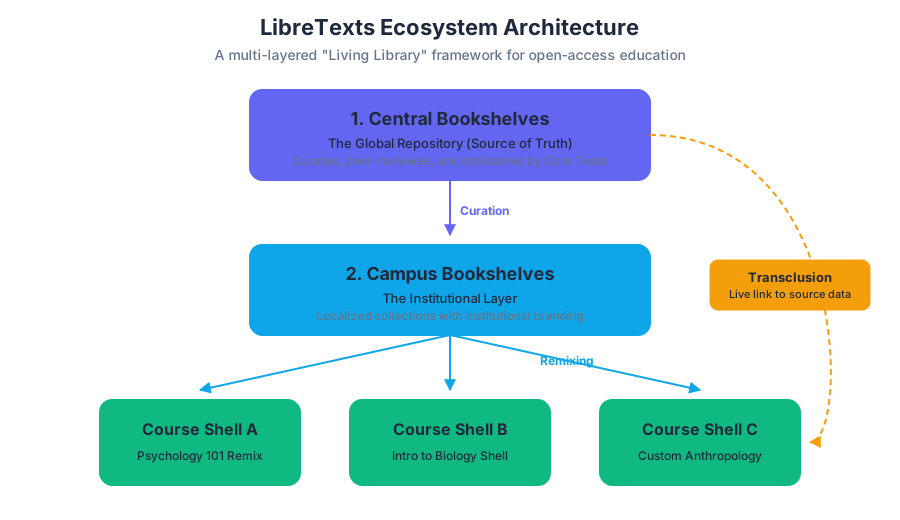
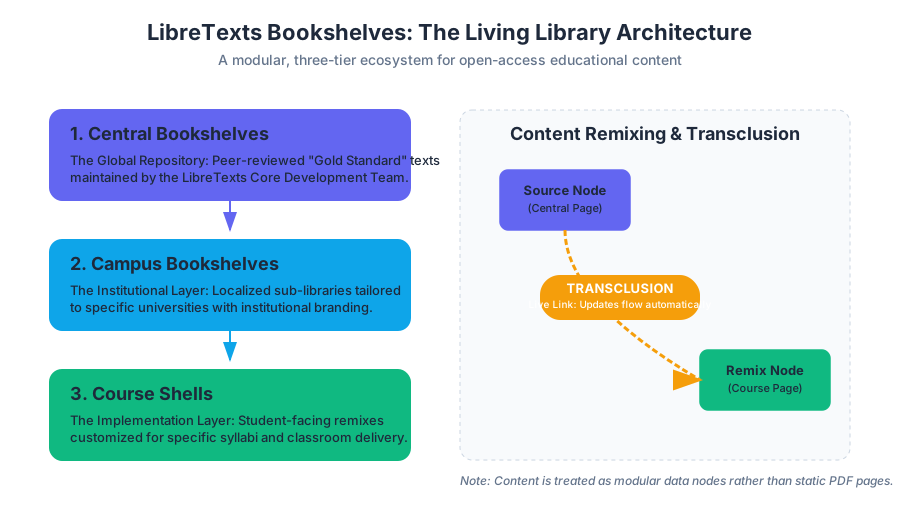
The LibreTexts ecosystem is structured into three primary tiers: the Central Bookshelves, the Campus Bookshelves, and the Course Shells. Understanding the relationship between these tiers is critical for any educator or developer looking to leverage the platform.
1. Central Bookshelves (The Global Repository)
The Central Bookshelves are curated by the LibreTexts Development team. These are the "gold standard" texts—comprehensive, peer-reviewed, and maintained for accuracy. They are organized by broad disciplinary categories such as Social Sciences, Humanities, and Natural Sciences.
2. Campus Bookshelves (The Institutional Layer)
Campus Bookshelves are localized sub-libraries tailored to specific institutions. When a university adopts LibreTexts, they often establish a Campus Bookshelf to house the specific versions of texts used by their faculty. This provides a sense of institutional "ownership" and allows for local branding and specific curricular alignment.
3. Course Shells (The Implementation Layer)
A Course Shell is the final, student-facing version of the material. It is often a "Remix" of various chapters from the Central Bookshelves, tailored to a specific syllabus.
| Feature | Central Bookshelves | Campus Bookshelves | Course Shells |
|---|---|---|---|
| Primary Purpose | Global reference & curation | Institutional identity | Classroom delivery |
| Maintenance | LibreTexts Core Team | Institutional Leads | Individual Instructors |
| Scope | Disciplinary-wide | University-wide | Section-specific |
| Editability | Restricted (to ensure quality) | Moderate | High (Full customization) |
| Visibility | Public/Global | Public/Institutional | Student-centric |
Content Remixing: The Engine of Customization
The most powerful feature of the LibreTexts platform is Content Remixing. This is the process of synthesizing new educational resources from existing "bricks" of content found across the Bookshelves.
Definition: Content Remixing The algorithmic and pedagogical process of aggregating, reordering, and editing modular content nodes (pages or chapters) from disparate sources into a unified, coherent "Remix" that follows a specific instructional design.
The Mechanics of Transclusion
Unlike traditional "copy-pasting," LibreTexts utilizes a concept called Transclusion. When an instructor remixes a page, the system does not necessarily create a new, disconnected copy of the text. Instead, it creates a "live link" to the source material. If the original author in the Central Bookshelf updates a typo or adds a new scientific discovery, that update automatically flows through to all remixed versions that use transclusion.
Disciplinary Deep Dives: Curated Content Examples
The Bookshelves are populated with rich, interdisciplinary content. By examining specific fields, we can see how the Bookshelf structure accommodates different academic epistemologies.
Anthropology: The Holistic Approach
Anthropology in the LibreTexts Bookshelves is organized around the Holistic Approach, which posits that to understand humanity, one must integrate biological, social, and historical data.
| Subfield | Focus Area | Key Concepts in Bookshelves |
|---|---|---|
| Cultural Anthropology | Social structures & practices | Ethnography, Kinship, Globalization |
| Biological Anthropology | Human evolution & biology | Paleoanthropology, Genetics, Primatology |
| Archaeology | Material remains of past cultures | Stratigraphy, Radiocarbon dating, Cultural Heritage |
| Linguistic Anthropology | Language and social life | Semiotics, Sociolinguistics, Language Revitalization |
Communication Studies: The Triad of Interaction
The Communication Studies bookshelf categorizes human behavior into three primary modes of transmission. This taxonomy allows instructors to remix specific modules based on whether their course focuses on technical writing, public speaking, or digital media.
- Verbal Communication: Focuses on the auditory and semantic meaning of messages.
- Written Communication: Covers the mechanics of reading, technical documentation, and journalism.
- Nonverbal Communication: Analyzes body language, proxemics, and haptics.
Criminology and Criminal Justice: Theory vs. Practice
The Bookshelves maintain a critical distinction between Criminology (the "why" of crime) and Criminal Justice (the "how" of the system).
The Criminological Equation Let $C$ be the occurrence of crime, $M$ be the motivation of the offender, $S$ be the social structure/inequality, and $P$ be the perceived opportunity. $$C = f(M, S, P)$$ Criminology Bookshelves focus on the variables $M$ and $S$, while Criminal Justice Bookshelves focus on the institutional response to $C$.
| Concept | Criminology (Theoretical) | Criminal Justice (Applied) |
|---|---|---|
| Primary Goal | Understanding causes of crime | Administering law and order |
| Core Topics | Urban inequality, Psychology of crime | Policing, Courts, Corrections |
| Methodology | Sociological research | Policy analysis, Legal procedure |
Disability Studies and the Social Model
The Disability Studies bookshelf is a prime example of Curated Content that challenges traditional paradigms. It explicitly distinguishes between Impairment (a medical condition) and Disability (a social construct).
- Impairment: A physical or mental loss of function (e.g., inability to walk).
- Disability: The social barriers that prevent a person with an impairment from participating in society (e.g., a building without a ramp).
By hosting these texts, LibreTexts provides a platform for Systems Change, moving the academic conversation from "fixing the individual" to "fixing the environment."
Early Childhood Education (ECE): Foundations of Development
The ECE bookshelf focuses on the critical window from birth to age eight. The content is structured around Holistic Development, which integrates four key pillars:
- Cognitive: Language acquisition, numeracy, and problem-solving.
- Social: Peer interaction and conflict resolution.
- Emotional: Self-regulation and trauma-informed care.
- Physical: Gross and fine motor skills.
Common Pitfalls in Bookshelf Navigation
While the system is robust, new users often encounter specific hurdles:
- Over-Customization: Instructors may create "forks" (detached copies) instead of "transclusions." This breaks the link to the Central Bookshelf, meaning the instructor must manually update the text for the rest of time.
- Licensing Incompatibility: Mixing a
CC-BY(Attribution) text with aCC-BY-NC-SA(Non-Commercial, Share-Alike) text requires careful legal handling to ensure the resulting Remix is properly licensed. - Broken Transclusion Chains: If a source page in the Central Bookshelf is moved or renamed without a redirect, the "Remix" may show a 404 error. The LibreTexts team uses automated bots to mitigate this, but it remains a technical edge case.
Summary of the Bookshelf Ecosystem
The LibreTexts Bookshelves represent a shift from "Textbook as a Product" to "Textbook as a Service" (TaaS). By providing a centralized, curated repository that is both human-readable and machine-interoperable, the project ensures that high-quality education remains a public good. Whether it is a deep dive into the four subfields of Anthropology or a practical guide to Addictions Counseling, the Bookshelves provide the raw materials for the next generation of open education.
- LibreTexts Bookshelves: The central repository of curated, peer-reviewed academic texts.
- Content Remixing: The process of assembling a custom textbook from existing modular pages.
- Transclusion: A method of displaying content from one page on another while maintaining a live link to the source.
- Course Shell: The specific, student-facing version of a text tailored to a syllabus.
- Campus Bookshelves: Institutional sub-libraries that house localized versions of OER materials.
- Holistic Approach: An anthropological perspective that integrates biological, cultural, and linguistic data.
- Social Model of Disability: The theory that disability is caused by societal barriers rather than individual impairments.
- ECE (Early Childhood Education): The study of developmental growth in children from birth to age eight.
-
What is the primary technical advantage of 'Transclusion' over 'Copy-Pasting' in the LibreTexts ecosystem?
- A) It reduces the file size of the textbook.
- B) It allows updates in the source text to automatically reflect in the remixed version.
- C) It bypasses Creative Commons licensing requirements.
- D) It makes the text compatible with mobile devices. (Correct: B)
-
In the context of Criminology, which subfield focuses on the 'how' of the legal system (policing, courts, and corrections)?
- A) Criminological Theory
- B) Urban Sociology
- C) Criminal Justice
- D) Forensic Psychology (Correct: C)
-
Which tier of the LibreTexts architecture is most likely to be managed by an individual instructor for a specific semester?
- A) Central Bookshelves
- B) Campus Bookshelves
- C) Course Shells
- D) Global Commons (Correct: C)
-
The 'Social Model of Disability' argues that disability is primarily a result of:
- A) Biological impairments and medical conditions.
- B) Lack of personal motivation.
- C) Social constructs and environmental barriers.
- D) Genetic predispositions. (Correct: C)
-
Which subfield of Anthropology focuses on the material remains (pottery, tools, ruins) of past societies?
- A) Linguistic Anthropology
- B) Biological Anthropology
- C) Cultural Anthropology
- D) Archaeology (Correct: D)
Study Guide: LibreTexts Bookshelves & Content Strategy
1. The Hierarchy of Content
- Central Bookshelves: Think of this as the "Master Library." It is curated by experts and serves as the source for all other versions.
- Campus Bookshelves: Think of this as the "University Branch." It contains books specifically vetted or authored by faculty at a particular school.
- Course Shells: Think of this as the "Syllabus." It is the specific subset of chapters a student reads for a specific class.
2. The Remixing Workflow
- Identify Needs: Determine which chapters from which books fit your learning objectives.
- Use the OER Remixer: A drag-and-drop tool that allows you to pull pages from different Bookshelves into a new "Shell."
- Edit and Localize: Add your own examples, remove irrelevant sections, and ensure the flow is logical.
- Publish: Make the Course Shell available to students via a URL or PDF export.
3. Key Disciplinary Themes
- Anthropology: Always look for the "four-field approach."
- Communication: Distinguish between verbal, non-verbal, and written modes.
- Disability Studies: Focus on the shift from medical models to social models.
- Counseling: Look for "Blueprints" that focus on student success and career development.
4. Technical Best Practices
- Maintain Transclusion: Only "detach" a page if you intend to make significant changes that shouldn't be updated by the master source.
- Check Licenses: Ensure your remix complies with the most restrictive license in your collection (usually the "Share-Alike" or "Non-Commercial" clauses).
- Accessibility: Use the built-in accessibility checker to ensure your remix is readable by screen readers.
Source Materials
Study Overview of Social Science and Professional Disciplines on Lykke
This course page is free to open: signed out, you can read its first two sections, and signing in, on any plan, opens the rest. The free Lykke Chrome extension syncs your own Canvas courses, so ChatGPT, Claude and Muse can answer from your classes and deadlines. It only reads Canvas.
Add the free extensionSign in to open every sectionAll sections of Overview of Social Science and Professional Disciplines · Browse more course pages