Overview of Social Science and Professional Disciplines
Institution: MIT
44 study materials · 15 sections
The Bookshelves area in the LibreTexts Library serves as a centralized repository for curated academic texts across a wide array of social science and professional disciplines. Managed by the LibreTexts Development team, these resources are designed for direct use or as modular content for building customized course remixes tailored to specific campus needs. This course provides an overview of the diverse fields represented in the library, ranging from foundational social sciences like Anthropology and Economics to professional fields such as Education, Counseling, and Library Science.
Course Sections
Introduction to LibreTexts Bookshelves
Key concepts: LibreTexts Bookshelves · Content Remixing · Curated Academic Texts · Course Shells
An overview of the LibreTexts Bookshelves as a central repository for curated academic texts and the process of content remixing.
Introduction to LibreTexts Bookshelves
The LibreTexts Bookshelves represent the architectural backbone of the world’s most visited open-access textbook project. Far more than a simple repository of PDFs, the Bookshelves function as a dynamic, multi-layered "Living Library." This ecosystem is designed to solve the "static content problem" inherent in traditional publishing by providing a modular, interoperable framework where academic content is treated as data rather than a fixed product.
At its core, the Bookshelves system is a curated environment where high-quality, peer-reviewed content is organized by discipline. These resources serve as the "source of truth" for educators who wish to build custom learning paths. By decoupling the content (the Bookshelf) from the delivery vehicle (the Course Shell), LibreTexts allows for unprecedented pedagogical agility.
The Architecture of the Commons
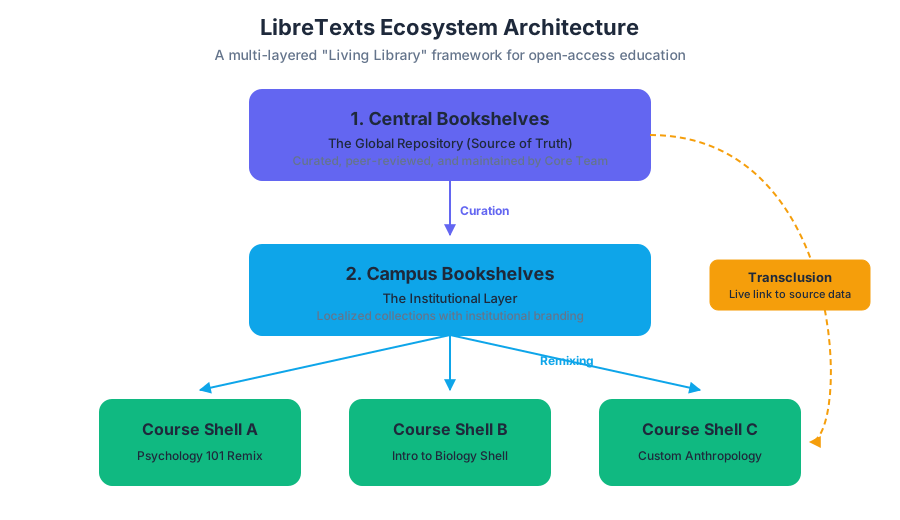
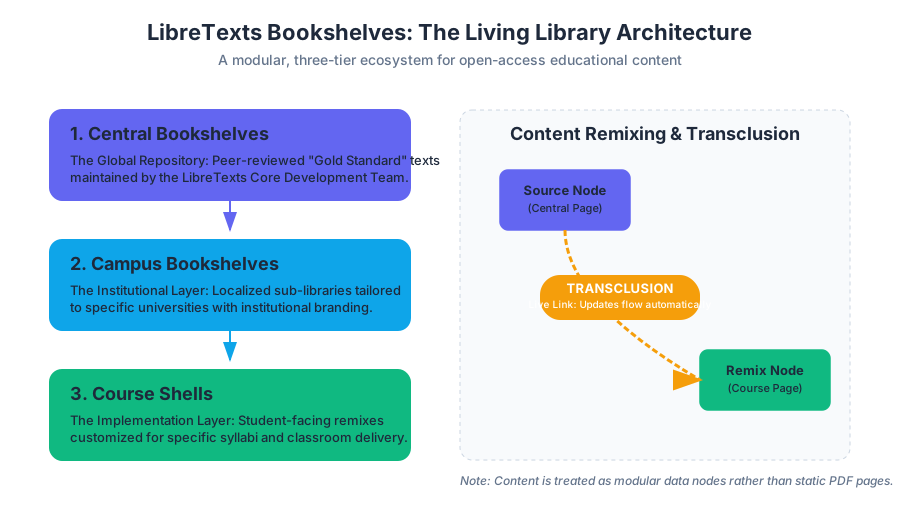
The LibreTexts ecosystem is structured into three primary tiers: the Central Bookshelves, the Campus Bookshelves, and the Course Shells. Understanding the relationship between these tiers is critical for any educator or developer looking to leverage the platform.
1. Central Bookshelves (The Global Repository)
The Central Bookshelves are curated by the LibreTexts Development team. These are the "gold standard" texts—comprehensive, peer-reviewed, and maintained for accuracy. They are organized by broad disciplinary categories such as Social Sciences, Humanities, and Natural Sciences.
2. Campus Bookshelves (The Institutional Layer)
Campus Bookshelves are localized sub-libraries tailored to specific institutions. When a university adopts LibreTexts, they often establish a Campus Bookshelf to house the specific versions of texts used by their faculty. This provides a sense of institutional "ownership" and allows for local branding and specific curricular alignment.
3. Course Shells (The Implementation Layer)
A Course Shell is the final, student-facing version of the material. It is often a "Remix" of various chapters from the Central Bookshelves, tailored to a specific syllabus.
| Feature | Central Bookshelves | Campus Bookshelves | Course Shells |
|---|---|---|---|
| Primary Purpose | Global reference & curation | Institutional identity | Classroom delivery |
| Maintenance | LibreTexts Core Team | Institutional Leads | Individual Instructors |
| Scope | Disciplinary-wide | University-wide | Section-specific |
| Editability | Restricted (to ensure quality) | Moderate | High (Full customization) |
| Visibility | Public/Global | Public/Institutional | Student-centric |
Content Remixing: The Engine of Customization
The most powerful feature of the LibreTexts platform is Content Remixing. This is the process of synthesizing new educational resources from existing "bricks" of content found across the Bookshelves.
Definition: Content Remixing The algorithmic and pedagogical process of aggregating, reordering, and editing modular content nodes (pages or chapters) from disparate sources into a unified, coherent "Remix" that follows a specific instructional design.
The Mechanics of Transclusion
Unlike traditional "copy-pasting," LibreTexts utilizes a concept called Transclusion. When an instructor remixes a page, the system does not necessarily create a new, disconnected copy of the text. Instead, it creates a "live link" to the source material. If the original author in the Central Bookshelf updates a typo or adds a new scientific discovery, that update automatically flows through to all remixed versions that use transclusion.
Technical Implementation of a Remix Manifest
From a data perspective, a Remix can be modeled as an ordered tree of pointers to content nodes. Below is a conceptual representation of how a Remixing engine might structure a new textbook's metadata.
/**
 * Represents a customized LibreTexts Remix structure.
 * This models how a Course Shell points to various Bookshelf nodes.
 */
interface LibreRemix {
  remixId: string;
  targetCourse: string;
  metadata: {
    author: string;
    institution: string;
    license: "CC-BY-NC-SA" | "CC-BY" | "Public Domain";
  };
  tableOfContents: RemixNode[];
}

interface RemixNode {
  title: string;
  level: number; // 1 for Chapter, 2 for Section
  sourceUrl: string; // The pointer to the Central Bookshelf
  isTranscluded: boolean;
  customOverrides?: {
    titleAlias?: string;
    hiddenElements?: string[]; // CSS selectors to hide specific parts
  };
}

const myPsychologyRemix: LibreRemix = {
  remixId: "PSYCH-101-FALL-2024",
  targetCourse: "Introduction to Psychology",
  metadata: {
    author: "Dr. Jane Smith",
    institution: "Libre University",
    license: "CC-BY",
  },
  tableOfContents: [
    {
      title: "The Biological Basis of Behavior",
      level: 1,
      sourceUrl: "socialsci.libretexts.org/Bookshelves/Psychology/Biological_Psych",
      isTranscluded: true
    },
    {
      title: "Neural Communication",
      level: 2,
      sourceUrl: "socialsci.libretexts.org/Bookshelves/Psychology/Neuroscience_1.1",
      isTranscluded: true,
      customOverrides: { titleAlias: "How Neurons Talk" }
    }
  ]
};
Disciplinary Deep Dives: Curated Content Examples
The Bookshelves are populated with rich, interdisciplinary content. By examining specific fields, we can see how the Bookshelf structure accommodates different academic epistemologies.
Anthropology: The Holistic Approach
Anthropology in the LibreTexts Bookshelves is organized around the Holistic Approach, which posits that to understand humanity, one must integrate biological, social, and historical data.
| Subfield | Focus Area | Key Concepts in Bookshelves |
|---|---|---|
| Cultural Anthropology | Social structures & practices | Ethnography, Kinship, Globalization |
| Biological Anthropology | Human evolution & biology | Paleoanthropology, Genetics, Primatology |
| Archaeology | Material remains of past cultures | Stratigraphy, Radiocarbon dating, Cultural Heritage |
| Linguistic Anthropology | Language and social life | Semiotics, Sociolinguistics, Language Revitalization |
Communication Studies: The Triad of Interaction
The Communication Studies bookshelf categorizes human behavior into three primary modes of transmission. This taxonomy allows instructors to remix specific modules based on whether their course focuses on technical writing, public speaking, or digital media.
- Verbal Communication: Focuses on the auditory and semantic meaning of messages.
- Written Communication: Covers the mechanics of reading, technical documentation, and journalism.
- Nonverbal Communication: Analyzes body language, proxemics, and haptics.
Criminology and Criminal Justice: Theory vs. Practice
The Bookshelves maintain a critical distinction between Criminology (the "why" of crime) and Criminal Justice (the "how" of the system).
The Criminological Equation Let $C$ be the occurrence of crime, $M$ be the motivation of the offender, $S$ be the social structure/inequality, and $P$ be the perceived opportunity. $$C = f(M, S, P)$$ Criminology Bookshelves focus on the variables $M$ and $S$, while Criminal Justice Bookshelves focus on the institutional response to $C$.
| Concept | Criminology (Theoretical) | Criminal Justice (Applied) |
|---|---|---|
| Primary Goal | Understanding causes of crime | Administering law and order |
| Core Topics | Urban inequality, Psychology of crime | Policing, Courts, Corrections |
| Methodology | Sociological research | Policy analysis, Legal procedure |
Disability Studies and the Social Model
The Disability Studies bookshelf is a prime example of Curated Content that challenges traditional paradigms. It explicitly distinguishes between Impairment (a medical condition) and Disability (a social construct).
- Impairment: A physical or mental loss of function (e.g., inability to walk).
- Disability: The social barriers that prevent a person with an impairment from participating in society (e.g., a building without a ramp).
By hosting these texts, LibreTexts provides a platform for Systems Change, moving the academic conversation from "fixing the individual" to "fixing the environment."
Early Childhood Education (ECE): Foundations of Development
The ECE bookshelf focuses on the critical window from birth to age eight. The content is structured around Holistic Development, which integrates four key pillars:
- Cognitive: Language acquisition, numeracy, and problem-solving.
- Social: Peer interaction and conflict resolution.
- Emotional: Self-regulation and trauma-informed care.
- Physical: Gross and fine motor skills.
Technical Implementation: Interacting with the Library API
For developers, the LibreTexts Bookshelves are accessible via an API (built on the DekiScript/MindTouch framework). This allows for automated content auditing, link checking, and bulk remixing.
# Example: Fetching the properties of a specific Bookshelf page
# Replace {domain} with 'socialsci' and {pageID} with the target ID

curl -X GET "https://socialsci.libretexts.org/@api/deki/pages/{pageID}/properties" \
     -H "Accept: application/json" \
     -u "username:password"

# Example: Searching for all pages tagged with "Cultural Anthropology"
curl -X GET "https://socialsci.libretexts.org/@api/deki/pages/search?q=tag:Cultural+Anthropology" \
     -H "Accept: application/json"
Common Pitfalls in Bookshelf Navigation
While the system is robust, new users often encounter specific hurdles:
- Over-Customization: Instructors may create "forks" (detached copies) instead of "transclusions." This breaks the link to the Central Bookshelf, meaning the instructor must manually update the text for the rest of time.
- Licensing Incompatibility: Mixing a
CC-BY(Attribution) text with aCC-BY-NC-SA(Non-Commercial, Share-Alike) text requires careful legal handling to ensure the resulting Remix is properly licensed. - Broken Transclusion Chains: If a source page in the Central Bookshelf is moved or renamed without a redirect, the "Remix" may show a 404 error. The LibreTexts team uses automated bots to mitigate this, but it remains a technical edge case.
Summary of the Bookshelf Ecosystem
The LibreTexts Bookshelves represent a shift from "Textbook as a Product" to "Textbook as a Service" (TaaS). By providing a centralized, curated repository that is both human-readable and machine-interoperable, the project ensures that high-quality education remains a public good. Whether it is a deep dive into the four subfields of Anthropology or a practical guide to Addictions Counseling, the Bookshelves provide the raw materials for the next generation of open education.
- LibreTexts Bookshelves: The central repository of curated, peer-reviewed academic texts.
- Content Remixing: The process of assembling a custom textbook from existing modular pages.
- Transclusion: A method of displaying content from one page on another while maintaining a live link to the source.
- Course Shell: The specific, student-facing version of a text tailored to a syllabus.
- Campus Bookshelves: Institutional sub-libraries that house localized versions of OER materials.
- Holistic Approach: An anthropological perspective that integrates biological, cultural, and linguistic data.
- Social Model of Disability: The theory that disability is caused by societal barriers rather than individual impairments.
- ECE (Early Childhood Education): The study of developmental growth in children from birth to age eight.
-
What is the primary technical advantage of 'Transclusion' over 'Copy-Pasting' in the LibreTexts ecosystem?
- A) It reduces the file size of the textbook.
- B) It allows updates in the source text to automatically reflect in the remixed version.
- C) It bypasses Creative Commons licensing requirements.
- D) It makes the text compatible with mobile devices. (Correct: B)
-
In the context of Criminology, which subfield focuses on the 'how' of the legal system (policing, courts, and corrections)?
- A) Criminological Theory
- B) Urban Sociology
- C) Criminal Justice
- D) Forensic Psychology (Correct: C)
-
Which tier of the LibreTexts architecture is most likely to be managed by an individual instructor for a specific semester?
- A) Central Bookshelves
- B) Campus Bookshelves
- C) Course Shells
- D) Global Commons (Correct: C)
-
The 'Social Model of Disability' argues that disability is primarily a result of:
- A) Biological impairments and medical conditions.
- B) Lack of personal motivation.
- C) Social constructs and environmental barriers.
- D) Genetic predispositions. (Correct: C)
-
Which subfield of Anthropology focuses on the material remains (pottery, tools, ruins) of past societies?
- A) Linguistic Anthropology
- B) Biological Anthropology
- C) Cultural Anthropology
- D) Archaeology (Correct: D)
Study Guide: LibreTexts Bookshelves & Content Strategy
1. The Hierarchy of Content
- Central Bookshelves: Think of this as the "Master Library." It is curated by experts and serves as the source for all other versions.
- Campus Bookshelves: Think of this as the "University Branch." It contains books specifically vetted or authored by faculty at a particular school.
- Course Shells: Think of this as the "Syllabus." It is the specific subset of chapters a student reads for a specific class.
2. The Remixing Workflow
- Identify Needs: Determine which chapters from which books fit your learning objectives.
- Use the OER Remixer: A drag-and-drop tool that allows you to pull pages from different Bookshelves into a new "Shell."
- Edit and Localize: Add your own examples, remove irrelevant sections, and ensure the flow is logical.
- Publish: Make the Course Shell available to students via a URL or PDF export.
3. Key Disciplinary Themes
- Anthropology: Always look for the "four-field approach."
- Communication: Distinguish between verbal, non-verbal, and written modes.
- Disability Studies: Focus on the shift from medical models to social models.
- Counseling: Look for "Blueprints" that focus on student success and career development.
4. Technical Best Practices
- Maintain Transclusion: Only "detach" a page if you intend to make significant changes that shouldn't be updated by the master source.
- Check Licenses: Ensure your remix complies with the most restrictive license in your collection (usually the "Share-Alike" or "Non-Commercial" clauses).
- Accessibility: Use the built-in accessibility checker to ensure your remix is readable by screen readers.
Anthropology
Key concepts: Cultural Anthropology · Biological Anthropology · Archaeology · Linguistic Anthropology · Holistic Approach
Exploration of the holistic study of humankind through its four primary subfields.
Anthropology: The Holistic Science of Humankind
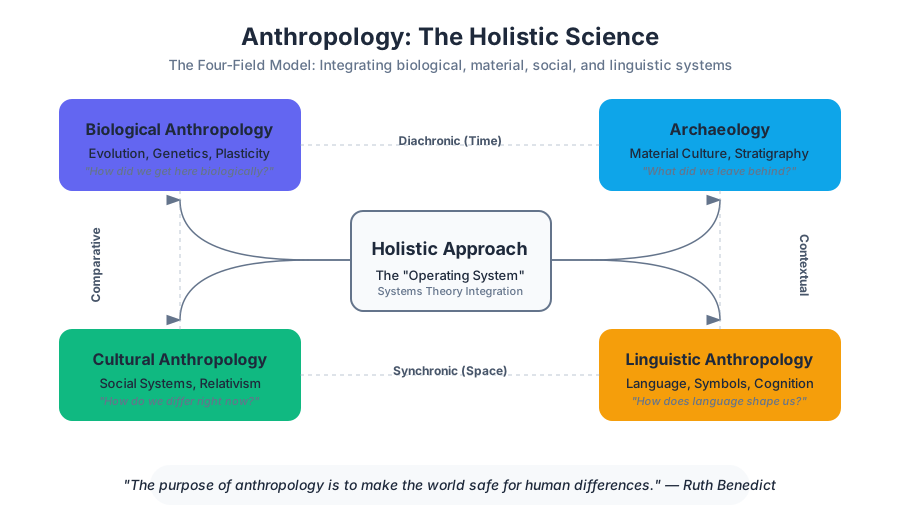
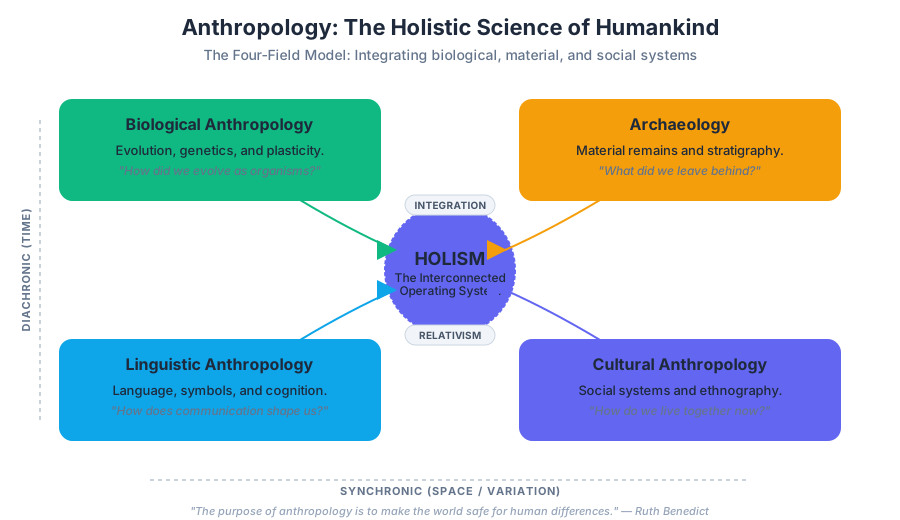
Anthropology is the comprehensive, interdisciplinary study of humanity across time and space. Unlike specialized social sciences that isolate specific variables (such as economics focusing on markets or political science on governance), anthropology employs a Holistic Approach. This methodology posits that the human experience cannot be understood by looking at a single component; rather, biological evolution, linguistic development, material remains, and cultural practices are deeply interconnected systems.
The discipline is traditionally organized into the "Four-Field Model," a structural framework that allows researchers to pivot between deep evolutionary time and the nuances of contemporary social interaction. By synthesizing data from these disparate fields, anthropology seeks to answer the fundamental question: What does it mean to be human?
The Holistic Approach: Systems Theory in Human Study
The Holistic Approach is the foundational "operating system" of anthropology. It functions as a meta-theory, asserting that any given aspect of a culture or biological trait is contingent upon a web of other factors.
Why it matters
Without holism, researchers risk Reductionism—the error of attributing complex human behavior to a single cause (e.g., "biology is destiny" or "culture is purely economic"). Holism allows anthropologists to see how a change in environment (Biological) leads to a change in food procurement (Archaeological), which alters social hierarchy (Cultural) and creates new terminologies for status (Linguistic).
Mechanics of Holism
- Integration: Combining data from all four subfields.
- Comparison: Using the Cross-Cultural Perspective to ensure theories aren't biased toward Western "WEIRD" (Western, Educated, Industrialized, Rich, Democratic) societies.
- Relativism: Employing Cultural Relativism—the principle that a culture’s beliefs and activities should be understood based on that culture’s own standards, rather than be judged against the criteria of another.
| Component | Focus | Primary Question |
|---|---|---|
| Diachronic | Change over time | How did we get here? |
| Synchronic | Variations across space | How do we differ right now? |
| Comparative | Cross-cultural analysis | What is universal vs. specific? |
| Contextual | Environmental/Social setting | Why does this behavior make sense here? |
The Anthropological Axiom: "The purpose of anthropology is to make the world safe for human differences." — Ruth Benedict
Biological Anthropology: The Architecture of the Hominin
Biological Anthropology (also known as Physical Anthropology) is the study of human biological evolution and variation. It treats humans as biological organisms while acknowledging that our primary adaptive mechanism is culture.
How it works: The Hardy-Weinberg Principle
To understand how human populations evolve, anthropologists use the Hardy-Weinberg Equilibrium (HWE). This mathematical model provides a "null hypothesis" for evolution. If the allele frequencies in a population deviate from the HWE, we know that evolutionary forces (mutation, gene flow, genetic drift, or natural selection) are at work.
# Simulation of Genetic Drift in a Small Human Population
import random

def simulate_genetic_drift(population_size, p_allele_freq, generations):
    """
    Simulates the change in allele frequency (p) over time due to
    stochastic sampling error (Genetic Drift).
    """
    history = [p_allele_freq]
    current_p = p_allele_freq

    for _ in range(generations):
        # Create a new generation by sampling from the current gene pool
        alleles = []
        for _ in range(2 * population_size):
            if random.random() < current_p:
                alleles.append(1) # Allele A
            else:
                alleles.append(0) # Allele a

        # Calculate new frequency of p
        if len(alleles) > 0:
            current_p = sum(alleles) / len(alleles)
        else:
            current_p = 0

        history.append(current_p)
        if current_p == 0 or current_p == 1: # Fixation or Loss
            break

    return history

# Example: 50 individuals, starting p=0.5, over 100 generations
drift_results = simulate_genetic_drift(50, 0.5, 100)
print(f"Final Allele Frequency: {drift_results[-1]:.4f}")
Key Sub-specialties
- Paleoanthropology: The study of the fossil record to reconstruct the hominin lineage (e.g., Australopithecus, Homo erectus).
- Primatology: The study of non-human primates to find analogies for early human behavior.
- Forensic Anthropology: The application of skeletal analysis to legal contexts.
Common Pitfalls
A common mistake is Biological Determinism, the belief that complex behaviors (like aggression or intelligence) are controlled entirely by genes. Modern biological anthropology emphasizes Plasticity—the ability of the human body to change in response to environmental stressors (e.g., high-altitude adaptation).
Archaeology: The Systematics of Material Culture
Archaeology is the investigation of the human past through Material Remains. It is not "treasure hunting"; it is the rigorous reconstruction of extinct social systems using the garbage, tools, and structures left behind.
The Mechanics of Stratigraphy
Archaeologists rely on the Law of Superposition, which states that in an undisturbed sequence of strata (layers of earth), the oldest layers are at the bottom. By analyzing the Context (the exact three-dimensional position of an artifact), researchers can determine its relationship to other objects.
Chronometric Dating
To move from relative dating (older/younger) to absolute dating (years before present), archaeologists use isotopic decay models.
% Radiocarbon Dating Derivation
% The decay of Carbon-14 follows a first-order kinetic equation:
N(t) = N_0 \cdot e^{-\lambda t}

% Where:
% N(t) = remaining amount of C-14
% N_0 = initial amount of C-14
% \lambda = decay constant (ln(2) / half-life)
% t = time elapsed

% Given the half-life of C-14 is 5730 years:
\lambda = \frac{0.693}{5730} \approx 1.209 \times 10^{-4} \text{ year}^{-1}

% Solving for t (the age of the sample):
t = \frac{\ln(N_0 / N(t))}{\lambda}
Variations in Archaeology
| Type | Focus | Example |
|---|---|---|
| Prehistoric | Societies without written records | Clovis points in North America |
| Historical | Societies with written records | Excavating a 19th-century plantation |
| Ethnoarchaeology | Studying living people to understand the past | Watching modern potters to interpret ancient kilns |
| CRM | Cultural Resource Management | Salvage archaeology before a highway is built |
Cultural Anthropology: The Ethnographic Method
Cultural Anthropology is the study of living human societies. Its primary methodology is Ethnography, which involves long-term, immersive fieldwork.
Participant Observation
The hallmark of cultural anthropology is Participant Observation. Unlike a sociologist who might use surveys, the anthropologist lives within the community, speaks the language, and participates in daily life. This allows for the collection of Thick Description—a term coined by Clifford Geertz to describe data that includes not just the behavior, but the context and meaning behind it.
Emic vs. Etic Perspectives
A critical tension in cultural anthropology is the balance between two viewpoints:
- Emic: The "insider’s" perspective. How the people being studied perceive and categorize their own world.
- Etic: The "outsider’s" perspective. The application of scientific or cross-cultural categories to the data.
| Feature | Emic Perspective | Etic Perspective |
|---|---|---|
| Source of Logic | Internal to the culture | External (Scientific/Universal) |
| Goal | Understand local meaning | Find patterns/laws |
| Example | "We perform this dance to bring rain." | "The dance serves as a social cohesion mechanism." |
| Risk | Subjectivity / Lack of comparison | Ethnocentrism / Imposing categories |
Variations: Kinship and Exchange
Cultural anthropologists often focus on Kinship Systems (how people define family) and Economic Exchange. They distinguish between Reciprocity (giving without immediate expectation of return), Redistribution (pooling resources), and Market Exchange.
Linguistic Anthropology: Language as Social Action
Linguistic Anthropology explores how language shapes social life. It views language not just as a set of grammatical rules, but as a Cultural Resource and a form of Social Action.
The Sapir-Whorf Hypothesis
One of the most debated concepts is Linguistic Relativity (the Sapir-Whorf Hypothesis), which suggests that the structure of a language affects its speakers' world view or cognition.
- Strong Version (Determinism): Language determines thought (largely rejected).
- Weak Version (Relativity): Language influences thought and predisposes speakers to certain interpretations of reality.
Sociolinguistics and Power
Linguistic anthropologists study Code-Switching—the practice of alternating between two or more languages or dialects depending on the social context. This is often tied to power dynamics, as certain "prestige dialects" are associated with economic and political authority.
Data Processing in Linguistics
Modern linguistic anthropologists use computational tools to analyze large corpora of field recordings to identify patterns in discourse.
#!/bin/bash
# A simple pipeline for processing ethnographic audio recordings
# Requires: ffmpeg, sox, and a transcription engine like Whisper

INPUT_DIR="./field_recordings/village_A"
OUTPUT_DIR="./processed_data"

mkdir -p "$OUTPUT_DIR"

for file in "$INPUT_DIR"/*.wav; do
    echo "Processing $file..."

    # 1. Normalize audio levels
    sox "$file" "$OUTPUT_DIR/$(basename "$file" .wav)_norm.wav" norm -3

    # 2. Extract metadata (Duration, Sample Rate)
    ffprobe -v quiet -show_format -show_streams "$file" > "$OUTPUT_DIR/$(basename "$file" .wav)_meta.txt"

    # 3. Run transcription (Pseudo-command for a CLI transcription tool)
    # whisper "$OUTPUT_DIR/$(basename "$file" .wav)_norm.wav" --model medium --output_dir "$OUTPUT_DIR"
done

echo "Batch processing complete."
Applied Anthropology: The "Fifth Field"
While the four subfields provide the theoretical backbone, Applied Anthropology uses these insights to solve real-world problems. This is the fastest-growing sector of the discipline.
Applications
- Medical Anthropology: Studying how different cultures perceive health and illness to improve healthcare delivery.
- Corporate Anthropology: Using ethnographic methods to understand consumer behavior or improve organizational culture.
- Development Anthropology: Ensuring that international aid projects are culturally appropriate and sustainable.
Ethics in Anthropology
Because anthropologists often work with marginalized or vulnerable populations, ethics are paramount. The American Anthropological Association (AAA) maintains a strict code of ethics:
- Do No Harm: The safety and dignity of the people studied come first.
- Informed Consent: Participants must understand the nature and risks of the research.
- Anonymity: Protecting the identities of informants in published work.
Key Insight: Anthropology is not just about "the other." By studying different ways of being human, we gain a "mirror for humanity," allowing us to see our own cultural assumptions as just one possibility among many.
Comparison of Theoretical Paradigms
Anthropology has evolved through several major theoretical shifts, moving from colonial-era "evolutionism" to modern "post-modernism."
| Paradigm | Key Figure | Core Idea | Critique |
|---|---|---|---|
| Unilineal Evolutionism | E.B. Tylor | All cultures pass through stages: Savagery → Barbarism → Civilization. | Ethnocentric; assumes Western superiority. |
| Historical Particularism | Franz Boas | Each culture is a unique product of its own history and environment. | Lacks a unifying theory of human behavior. |
| Structural Functionalism | Radcliffe-Brown | Cultural practices exist to maintain the social structure and stability. | Ignores social change and individual agency. |
| Cultural Materialism | Marvin Harris | Infrastructure (technology/environment) determines social and mental structure. | Too deterministic; ignores the power of ideas. |
| Interpretive Anthropology | Clifford Geertz | Culture is a "web of significance" that must be interpreted like a text. | Can be overly subjective and unscientific. |
Study Guide: Mastering Anthropology
Core Definitions to Memorize
- Holism: The perspective that all aspects of human life are interconnected.
- Ethnography: The primary method of cultural anthropology involving long-term fieldwork.
- Artifact: Any portable object made or modified by humans.
- Hominin: Humans and their extinct ancestors since the split from the chimpanzee lineage.
- Communicative Competence: The ability to use language appropriately in social contexts.
Critical Thinking Questions
- How does the Holistic Approach prevent the "siloing" of knowledge found in other academic disciplines?
- In what ways can Biological Anthropology debunk myths about "race" as a biological category?
- How does Archaeology provide a "check" on historical records written by the winners of conflicts?
- Why is Cultural Relativism a methodological tool rather than a moral stance?
Recommended Reading
- Guns, Germs, and Steel by Jared Diamond (for a materialist/environmental perspective).
- The Interpretation of Cultures by Clifford Geertz (for a symbolic/interpretive perspective).
- Coming of Age in Samoa by Margaret Mead (a classic, though debated, ethnographic study).
Communication Studies
Key concepts: Verbal Communication · Nonverbal Communication · Interpersonal Communication · Mass Media · Intercultural Communication
Examination of human interaction across verbal, written, and nonverbal channels in various contexts.
Communication Studies: The Architecture of Human Interaction
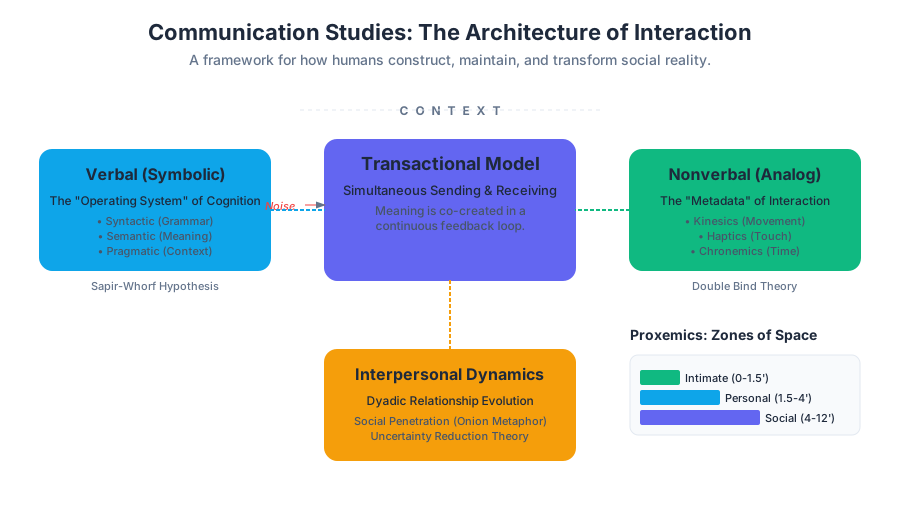
Communication Studies is the systematic inquiry into how humans use symbols to create and interpret meaning within and across various contexts, cultures, and media. Far from being a "soft" discipline, modern communication theory integrates linguistics, sociology, psychology, and information theory to model the complex protocols that govern social stability and change. At its core, the field treats communication not merely as the transmission of information, but as the fundamental process through which social reality is constructed, maintained, and transformed.
The Fundamental Mechanics of Communication
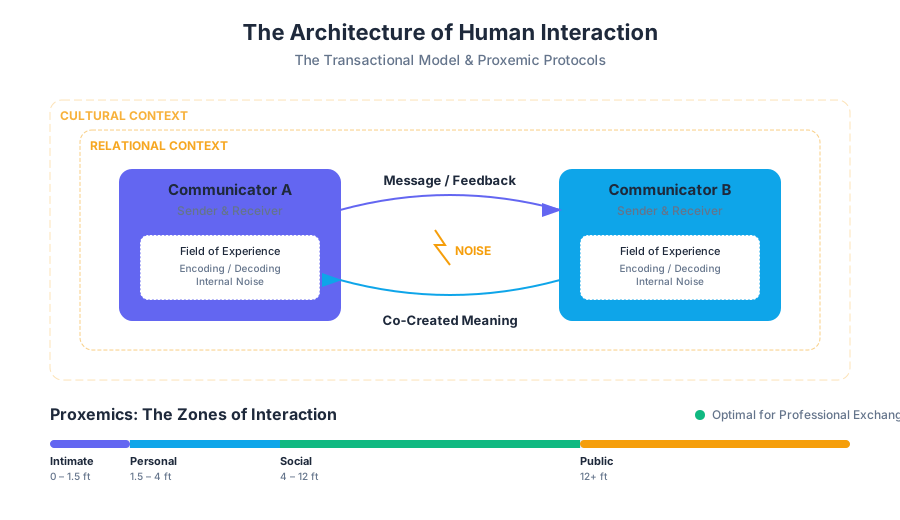
To understand communication, one must first distinguish between the Linear Model, the Interactional Model, and the Transactional Model. While early models (like Shannon-Weaver) viewed communication as a one-way pipeline from sender to receiver, contemporary theory views it as a simultaneous, multi-layered exchange where "noise" is not just physical interference, but psychological and cultural friction.
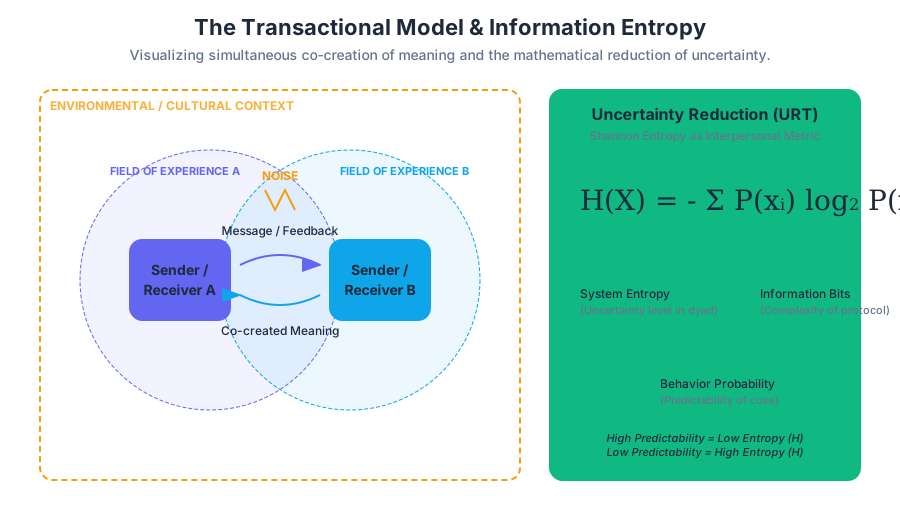
The Transactional Model: A framework asserting that individuals are simultaneously senders and receivers of messages. In this model, communication is a continuous process where meaning is co-created through the feedback loop, and the context (physical, relational, and cultural) actively shapes the message.
Comparison of Communication Models
| Model Type | Primary Focus | Directionality | Key Limitation |
|---|---|---|---|
| Linear | Transmission | One-way (S -> R) | Ignores feedback and context. |
| Interactional | Exchange | Two-way (S <-> R) | Views communication as discrete turns. |
| Transactional | Co-creation | Simultaneous | High complexity; difficult to isolate variables. |
Verbal Communication: The Symbolic Protocol
Verbal Communication is the use of arbitrary symbol systems—language—to convey abstract concepts and concrete data. It is governed by three primary rule sets: Syntactic (grammar), Semantic (meaning), and Pragmatic (contextual usage).
A critical concept here is the Sapir-Whorf Hypothesis, which suggests that the structure of a language determines or greatly influences the modes of thought and behavior characteristic of the culture in which it is spoken. In technical terms, language acts as the "operating system" for human cognition.
Computational Analysis of Verbal Communication
In modern communication studies, we often use Natural Language Processing (NLP) to quantify verbal patterns. The following Python example demonstrates a basic sentiment and complexity analysis of a verbal transcript.
import nltk
from textblob import TextBlob

def analyze_verbal_protocol(transcript):
    """
    Analyzes a verbal communication string for sentiment polarity
    and lexical diversity.
    """
    blob = TextBlob(transcript)

    # Sentiment: -1.0 (negative) to 1.0 (positive)
    sentiment = blob.sentiment.polarity

    # Lexical Diversity: Ratio of unique words to total words
    words = nltk.word_tokenize(transcript.lower())
    diversity = len(set(words)) / len(words) if words else 0

    return {
        "sentiment_score": round(sentiment, 4),
        "lexical_diversity": round(diversity, 4),
        "word_count": len(words)
    }

# Example: A high-stakes negotiation snippet
negotiation_text = "We appreciate your offer, but the current valuation is unacceptable."
results = analyze_verbal_protocol(negotiation_text)
print(f"Metrics: {results}")
Nonverbal Communication: The Analog Substrate
While verbal communication is discrete and symbolic, Nonverbal Communication is continuous and often iconic. It encompasses all messages sent without words, including Kinesics (body movement), Proxemics (use of space), Haptics (touch), and Chronemics (use of time).
Nonverbal cues often function as the "metadata" of an interaction. When verbal and nonverbal messages conflict—a state known as Double Bind—receivers almost universally rely on the nonverbal channel for "truth," as it is perceived to be less subject to conscious manipulation.
Proxemics: The Zones of Interaction
Edward T. Hall’s research into proxemics defines how physical distance correlates with social relationship status.
| Zone | Distance | Typical Context |
|---|---|---|
| Intimate | 0–18 inches | Close relationships, high trust. |
| Personal | 1.5–4 feet | Friends and family; "bubble" space. |
| Social | 4–12 feet | Professional interactions, business meetings. |
| Public | 12+ feet | Lectures, public speaking, strangers. |
Interpersonal Communication: Dyadic Dynamics
Interpersonal Communication focuses on the exchange between a small number of people (usually two, known as a dyad) who have an identifiable relationship. The primary goal of studying interpersonal communication is to understand how relationships are initiated, maintained, and dissolved.
Two foundational theories dominate this subfield:
- Social Penetration Theory: The "Onion Metaphor," suggesting that relationships develop through systematic changes in communication from superficial to intimate levels (breadth vs. depth).
- Uncertainty Reduction Theory (URT): The premise that when strangers meet, their primary concern is to reduce uncertainty and increase predictability about each other.
The Mathematical Foundation of Information Exchange
In the context of URT, we can view communication as the reduction of entropy. Claude Shannon’s formula for entropy ($H$) can be adapted to represent the "uncertainty" in an interpersonal system.
H(X) = -\sum_{i=1}^{n} P(x_i) \log_2 P(x_i)
Where:
- $H(X)$ is the uncertainty (entropy) of the interaction.
- $P(x_i)$ is the probability of a specific communicative behavior $x_i$ occurring.
- As the probability of predicting a partner's behavior increases, $H(X)$ decreases, indicating a more stable relationship.
Mass Media: Scaled Information Architecture
Mass Media refers to the technologies and organizations through which messages are disseminated to large, heterogeneous, and often anonymous audiences. Unlike interpersonal communication, mass media is characterized by a high degree of asynchronicity and a lack of immediate feedback.
Key Theoretical Frameworks in Mass Media
- Agenda-Setting Theory: The media doesn't tell people what to think, but rather what to think about. By selecting specific stories, media outlets signal the importance of certain issues.
- Cultivation Theory: Long-term exposure to media (specifically television) "cultivates" a viewer's perception of reality, often leading to "Mean World Syndrome."
- Uses and Gratifications: A shift from "what media does to people" to "what people do with media," focusing on why individuals seek out specific content (e.g., surveillance, personal identity, social integration).
Media Analytics Schema
To analyze mass media impact, researchers often track engagement metrics across different demographics. Below is a SQL schema representing a simplified media tracking database.
-- Schema for Mass Media Engagement Tracking
CREATE TABLE media_content (
    content_id INT PRIMARY KEY,
    title VARCHAR(255),
    medium_type ENUM('Broadcast', 'Digital', 'Print'),
    publish_date TIMESTAMP
);

CREATE TABLE audience_engagement (
    engagement_id SERIAL PRIMARY KEY,
    content_id INT REFERENCES media_content(content_id),
    demographic_group VARCHAR(50),
    interaction_type ENUM('View', 'Share', 'Comment'),
    dwell_time_seconds INT,
    sentiment_score FLOAT,
    FOREIGN KEY (content_id) REFERENCES media_content(content_id)
);

-- Query to find high-impact digital content among Gen Z
SELECT title, AVG(dwell_time_seconds) as avg_engagement
FROM media_content mc
JOIN audience_engagement ae ON mc.content_id = ae.content_id
WHERE ae.demographic_group = 'Gen Z' AND mc.medium_type = 'Digital'
GROUP BY title
ORDER BY avg_engagement DESC;
Intercultural Communication: Navigating the Global Grid
Intercultural Communication examines how cultural variability—values, norms, and worldviews—affects the communication process. As globalization increases, the ability to decode "high-context" vs. "low-context" signals becomes a critical professional competency.
High-Context vs. Low-Context Cultures
Coined by Edward T. Hall, this distinction describes how much information is embedded in the environment versus the explicit verbal message.
| Feature | Low-Context (e.g., Germany, USA) | High-Context (e.g., Japan, China) |
|---|---|---|
| Communication Style | Explicit, direct, verbal. | Implicit, indirect, nonverbal. |
| Focus | Task-oriented; "Get to the point." | Relationship-oriented; "Read the room." |
| Conflict | Depersonalized; addressed openly. | Personalized; avoided to "save face." |
| Information Flow | Structured and compartmentalized. | Fluid and diffused through networks. |
Face-Negotiation Theory
Developed by Stella Ting-Toomey, this theory explains how people from different cultures manage conflict. Face refers to one's self-image in the presence of others. Collectivist cultures tend to prioritize "other-face" or "mutual-face," while individualist cultures prioritize "self-face."
Insight: Effective intercultural communication requires Mindfulness—the conscious awareness of one's own communication biases and the active effort to adapt to the partner's cultural protocol.
Common Pitfalls in Communication Analysis
- The Transmission Myth: Assuming that if a message was "sent," it was "received" exactly as intended. This ignores the encoding/decoding gap.
- Over-reliance on Nonverbal "Cheat Sheets": Believing that a single gesture (like crossed arms) always means one thing (defensiveness). Nonverbal cues must be interpreted in clusters and within context.
- Ethnocentrism: Evaluating other cultures' communication styles through the lens of one's own culture, often leading to the "deficiency" model rather than a "difference" model.
- Technological Determinism: The belief that the medium itself (e.g., the internet) will automatically improve or degrade communication quality without considering human agency.
Summary of Interdisciplinary Connections
Communication Studies does not exist in a vacuum. It is the bridge between the Social Sciences (understanding human behavior) and the Applied Sciences (designing systems for information flow).
- Anthropology: Provides the cultural context for symbolic meaning.
- Criminology: Uses interpersonal communication theory for interrogation and victim advocacy.
- Early Childhood Education: Relies on verbal and nonverbal developmental milestones to assess cognitive growth.
- Counseling: Utilizes active listening and empathy protocols to facilitate personal exploration.
Study Guide: Communication Studies
I. Core Definitions
- Communication: The process of generating meaning by sending and receiving verbal and nonverbal symbols and signs that are influenced by multiple contexts.
- Noise: Any interference in the communication process (Physical, Physiological, Psychological, Semantic).
- Feedback: The response to a message that allows the sender to evaluate the effectiveness of the communication.
II. Key Theories to Master
- Social Penetration Theory: The "peeling the onion" process of self-disclosure.
- Agenda-Setting: The media's power to influence the importance of topics on the public agenda.
- Hofstede’s Cultural Dimensions: Power Distance, Individualism vs. Collectivism, Masculinity vs. Femininity, Uncertainty Avoidance, Long-term Orientation.
III. Practical Application Steps
- Identify the Context: Is the interaction interpersonal, group, public, or mass-mediated?
- Analyze the Channel: Is the medium appropriate for the message (e.g., don't fire an employee via text)?
- Decode the Nonverbals: Look for congruence between what is said and how it is said.
- Adjust for Culture: Determine if the environment is high-context or low-context before proceeding with a negotiation.
IV. Recommended Reading
- The Silent Language by Edward T. Hall
- Understanding Media by Marshall McLuhan
- Communication Theory: Epistemological Foundations by James A. Anderson
Counseling & Guidance
Key concepts: Academic Success Strategies · Career Development · Study Skills · Addictions Counseling · Professional Internship Preparation
Resources for academic success, career development, and specialized counseling areas.
Counseling & Guidance: A Systems Approach to Human Development
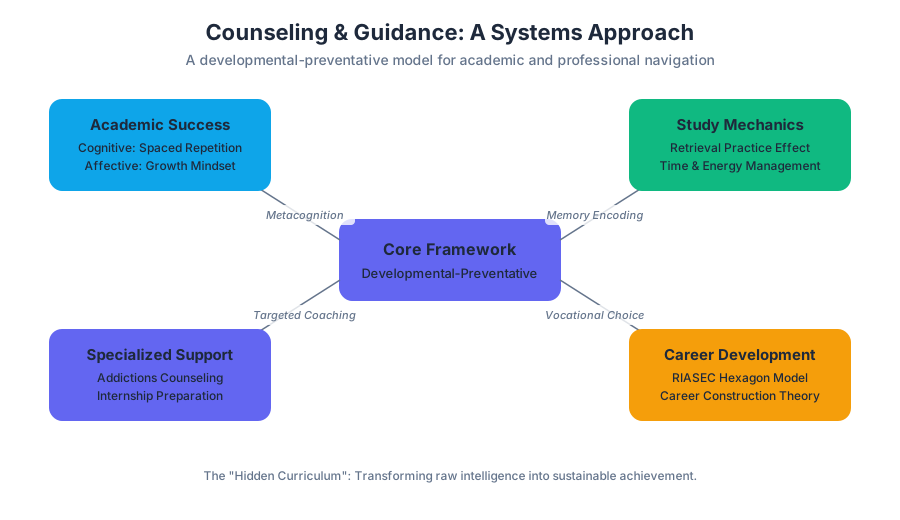
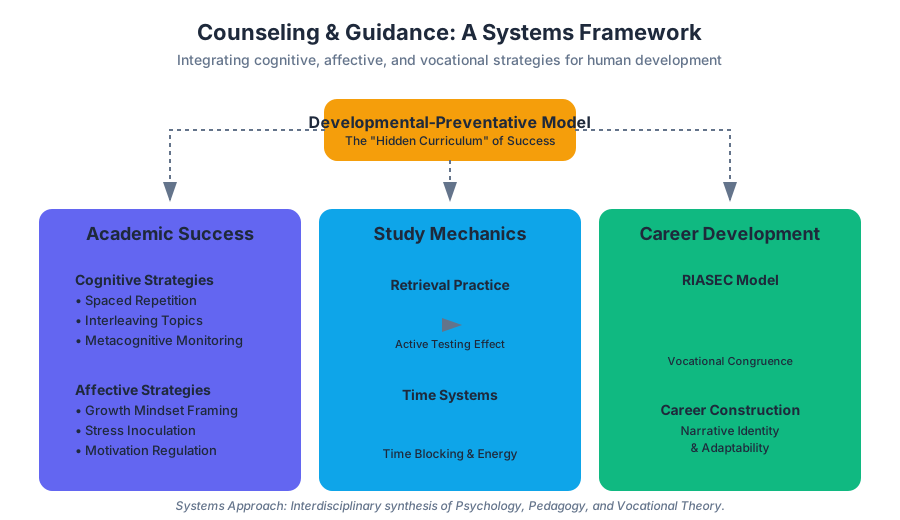
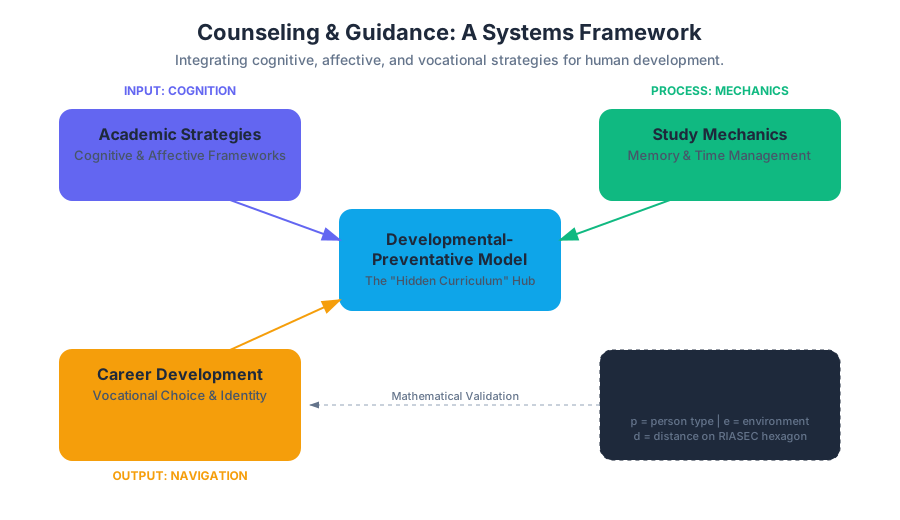
Counseling and Guidance is an interdisciplinary field that synthesizes psychology, pedagogy, sociology, and vocational theory to facilitate human growth and institutional navigation. Unlike purely clinical psychology, which often focuses on pathology, Counseling & Guidance operates on a developmental-preventative model. It seeks to equip individuals with the cognitive frameworks, emotional resilience, and strategic toolsets required to navigate complex academic and professional ecosystems.
At its core, the discipline addresses the "hidden curriculum" of success—the meta-skills that allow a student to transform raw intelligence into academic achievement, and a graduate to transform a degree into a sustainable career. This involves a multi-modal approach encompassing Academic Success Strategies, Career Development, Study Skills, and specialized interventions like Addictions Counseling and Professional Internship Preparation.
Academic Success Strategies: The Architecture of Achievement
Academic success is not a static trait but an emergent property of a well-regulated learning system. It involves the transition from passive consumption of information to active, metacognitive engagement.
The Transition Framework
The shift from secondary to higher education (or from undergraduate to professional study) requires a fundamental recalibration of the "Student-Institutional Contract." In secondary education, the burden of monitoring progress often lies with the institution; in higher education, this burden shifts to the individual.
Metacognition: The process of "thinking about thinking." In a counseling context, this refers to a student's ability to monitor their own comprehension, evaluate their learning strategies, and adjust their cognitive load in real-time.
Strategic Interventions
Counselors utilize various frameworks to help students optimize their academic performance. These are often categorized into Cognitive Strategies (how we process info) and Affective Strategies (how we manage stress and motivation).
| Strategy Category | Method | Objective | Complexity |
|---|---|---|---|
| Cognitive | Spaced Repetition | Combat the Ebbinghaus Forgetting Curve | High (Requires planning) |
| Cognitive | Interleaving | Mixing different topics to improve discrimination | Moderate |
| Affective | Growth Mindset | Re-framing failure as a data point for growth | Low (Conceptual) |
| Affective | Stress Inoculation | Controlled exposure to academic pressure | High (Requires coaching) |
Study Skills and Time Management: The Mechanics of Learning
While academic strategies provide the "why," study skills provide the "how." Effective study skills are rooted in cognitive science, specifically the mechanics of memory encoding and retrieval.
The Retrieval Practice Effect
One of the most robust findings in educational psychology is that testing oneself is a more effective learning tool than re-studying material. This is known as the Retrieval Practice Effect.
Time Management Systems
Time management is often the primary bottleneck for students. Counselors advocate for systems that move beyond simple "to-do lists" toward Time Blocking and Energy Management.
# A programmatic representation of the Spaced Repetition Algorithm (SM-2)
# used in modern study tools to optimize memory retention.

import datetime

class Flashcard:
    def __init__(self, question, answer):
        self.question = question
        self.answer = answer
        self.interval = 1  # Days until next review
        self.repetition = 0
        self.easiness_factor = 2.5
        self.next_review = datetime.date.today()

    def update_schedule(self, quality_of_recall):
        """
        quality_of_recall: 0 (forgot) to 5 (perfect)
        """
        if quality_of_recall >= 3:
            if self.repetition == 0:
                self.interval = 1
            elif self.repetition == 1:
                self.interval = 6
            else:
                self.interval = round(self.interval * self.easiness_factor)
            self.repetition += 1
        else:
            self.repetition = 0
            self.interval = 1

        self.easiness_factor = max(1.3, self.easiness_factor + (0.1 - (5 - quality_of_recall) * (0.08 + (5 - quality_of_recall) * 0.02)))
        self.next_review = datetime.date.today() + datetime.timedelta(days=self.interval)

# Example usage:
card = Flashcard("What is Metacognition?", "Thinking about thinking.")
card.update_schedule(quality_of_recall=4)
print(f"Next review scheduled for: {card.next_review}")
Career Development: Navigating the Professional Landscape
Career development is a lifelong process of managing learning, work, leisure, and transitions. Modern counseling has moved away from "trait-and-factor" matching (finding the one "perfect" job) toward Career Construction Theory, which emphasizes adaptability and narrative identity.
Holland’s Theory of Vocational Choice (RIASEC)
A cornerstone of career counseling, John Holland’s model suggests that people and work environments can be categorized into six themes. The "congruence" between a person's type and their environment predicts job satisfaction.
The RIASEC Hexagon: Realistic (R), Investigative (I), Artistic (A), Social (S), Enterprising (E), and Conventional (C).
Mathematical Representation of Congruence
Congruence ($C$) can be calculated using the distance between the primary interest type of the individual ($p$) and the primary requirement of the environment ($e$) on the RIASEC hexagon.
C = \sum_{i=1}^{n} w_i \cdot d(p_i, e_i)
Where:
- $d$ is the distance function on the hexagonal graph.
- $w$ is the weight assigned to the primary, secondary, and tertiary types.
- $n$ is the number of types considered (usually 3, the "Holland Code").
Career Decision-Making Models
Counselors often distinguish between Prescriptive models (how decisions should be made) and Descriptive models (how they are made).
| Model Type | Focus | Key Concept |
|---|---|---|
| Rational/Linear | Optimization | Gathering all data to find the "best" fit. |
| Planned Happenstance | Opportunity | Transforming unplanned events into career opportunities. |
| Social Cognitive | Self-Efficacy | How belief in one's ability affects career choice. |
| Narrative | Meaning | Viewing career as a story the individual is writing. |
Professional Internship Preparation: The Theory-Practice Bridge
Internships serve as the "clinical" component of general education. Preparation for these experiences is a critical counseling function, involving the translation of academic knowledge into professional competencies.
The Internship Lifecycle
- Self-Assessment: Identifying skill gaps and professional goals.
- Targeting: Researching organizations that align with the student's "Holland Code."
- Acquisition: Navigating the application, interview, and negotiation phase.
- Integration: The "Onboarding" phase where the student learns the organizational culture.
- Reflection: Post-internship analysis of learned skills and career alignment.
Competency Mapping
Counselors help students map academic coursework to the NACE (National Association of Colleges and Employers) Career Readiness Competencies:
- Critical Thinking/Problem Solving
- Oral/Written Communications
- Teamwork/Collaboration
- Digital Technology
- Leadership
- Professionalism/Work Ethic
- Career Management
- Global/Intercultural Fluency
Addictions Counseling: Fundamentals of Behavioral Change
Addictions counseling within a guidance framework often focuses on the Biopsychosocial Model. It recognizes that addiction is not merely a biological failure or a moral lapse, but a complex interaction between brain chemistry, psychological state, and social environment.
The Transtheoretical Model (Stages of Change)
Counselors use this model to tailor their interventions to the client's current state of readiness.
| Stage | Definition | Counselor's Role |
|---|---|---|
| Pre-contemplation | Not intending to take action. | Raise awareness of risks/doubts. |
| Contemplation | Acknowledging the problem but ambivalent. | Tip the "decisional balance" toward change. |
| Preparation | Intending to take action in the immediate future. | Help develop a concrete action plan. |
| Action | Making specific overt modifications in lifestyle. | Provide support and help with problem-solving. |
| Maintenance | Working to prevent relapse. | Develop relapse prevention strategies. |
Relapse Prevention and Harm Reduction
In a guidance context, the focus is often on Harm Reduction—minimizing the negative consequences of substance use—and identifying "High-Risk Situations" (HRS).
-- Schema for a Counseling Management System (CMS)
-- to track student progress and intervention efficacy.

CREATE TABLE Students (
    student_id INT PRIMARY KEY,
    name VARCHAR(100),
    major VARCHAR(50),
    holland_code CHAR(3), -- e.g., 'SAE'
    risk_level ENUM('Low', 'Medium', 'High')
);

CREATE TABLE Interventions (
    intervention_id INT PRIMARY KEY,
    student_id INT,
    type ENUM('Academic', 'Career', 'Addiction', 'Internship'),
    session_date DATE,
    notes TEXT,
    readiness_stage ENUM('Pre-contemplation', 'Contemplation', 'Preparation', 'Action', 'Maintenance'),
    FOREIGN KEY (student_id) REFERENCES Students(student_id)
);

CREATE TABLE Outcomes (
    outcome_id INT PRIMARY KEY,
    intervention_id INT,
    gpa_change DECIMAL(3,2),
    internship_secured BOOLEAN,
    employment_status ENUM('Seeking', 'Employed', 'Grad_School'),
    FOREIGN KEY (intervention_id) REFERENCES Interventions(intervention_id)
);
Specialized Support: Non-Traditional and Holistic Perspectives
Modern Counseling & Guidance must be inclusive of diverse student populations. This includes Non-traditional Students (adult learners, parents, veterans) and those with disabilities.
Disability Studies in Counseling
Counseling has shifted from the Medical Model (fixing the individual) to the Social Model of disability. In the social model, "disability" is viewed as a mismatch between the individual's impairment and the barriers created by society/institutions.
Impairment vs. Disability: An impairment is a physical or mental condition (e.g., being unable to walk), while a disability is the social consequence (e.g., a building without a ramp).
Holistic Anthropology and Communication
As noted in the broader social science literature, counseling is deeply rooted in Anthropology (understanding cultural context) and Communication Studies (the mechanics of the therapeutic alliance). A counselor must understand the cultural scripts their clients are following and use verbal, non-verbal, and written communication to build trust.
Common Pitfalls in Counseling & Guidance
- The "Advice-Giving" Trap: Counselors often feel pressured to provide answers. However, effective guidance focuses on Empowerment, helping the client develop the skills to find their own answers.
- Ignoring the System: Focusing solely on the individual's "lack of grit" without addressing systemic barriers (e.g., lack of childcare for a non-traditional student) leads to ineffective interventions.
- Over-reliance on Assessment: Tools like the RIASEC or Myers-Briggs are starting points for conversation, not definitive labels.
- The "One-Size-Fits-All" Fallacy: Assuming that a study strategy that works for a neurotypical student will work for a student with ADHD or dyslexia.
Conclusion
Counseling & Guidance is the "operating system" of the educational and professional experience. By integrating academic strategies, career planning, and behavioral health, it provides a comprehensive framework for navigating the complexities of modern life. Whether it is through the application of a spaced-repetition algorithm to master organic chemistry or the use of the Transtheoretical Model to overcome a behavioral addiction, the field remains dedicated to the holistic development of the human potential.
Criminology and Criminal Justice
Key concepts: Criminological Theory · Criminal Justice Systems · Policing and Law Enforcement · Corrections and Reentry · Systemic Reform
Distinguishing between the theoretical study of crime and the practical application of legal systems.
Criminology and Criminal Justice
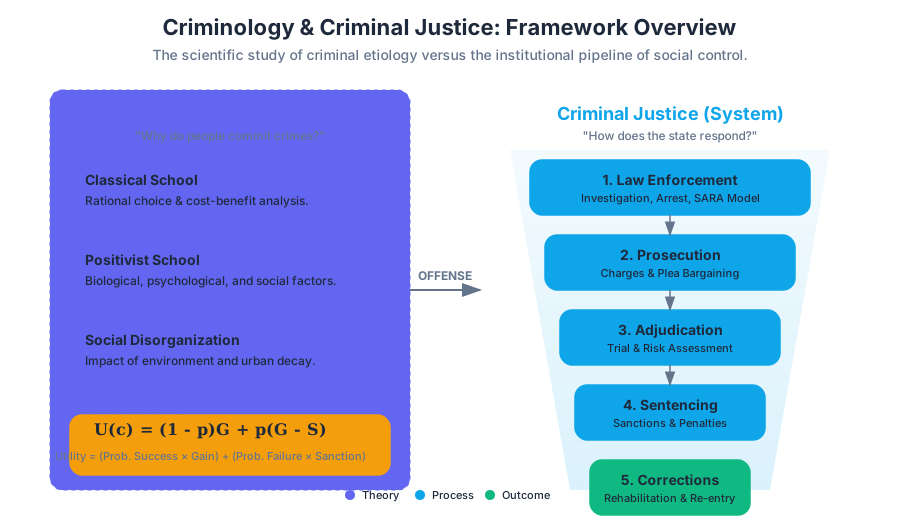
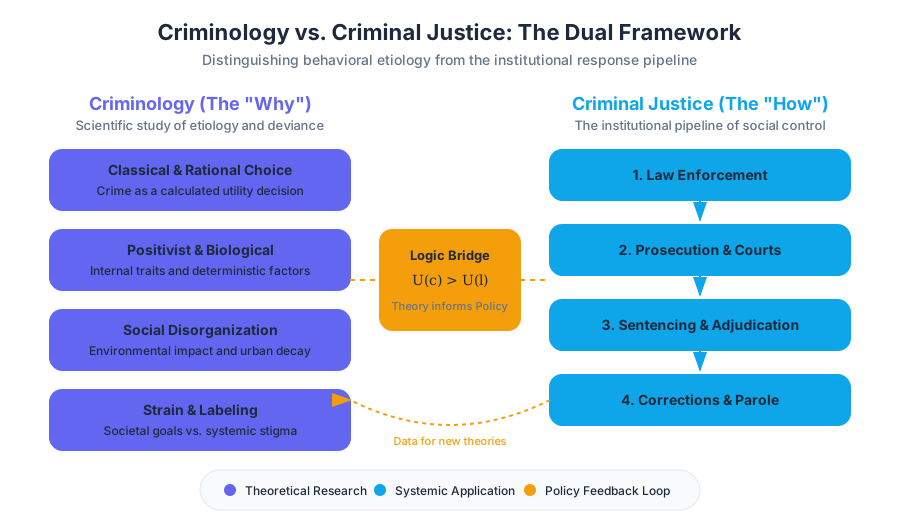
Criminology and Criminal Justice represent two distinct but deeply intertwined disciplines. While Criminology is the scientific study of the nature, extent, causes, and control of criminal behavior in both the individual and society, Criminal Justice refers to the system of practices and institutions of governments directed at upholding social control, deterring and mitigating crime, or sanctioning those who violate laws with criminal penalties and rehabilitation efforts.
The Fundamental Distinction: Criminology asks "Why do people commit crimes?" (Etiology), whereas Criminal Justice asks "How does the state respond to crime?" (Systemic Application).
Criminological Theory: The Mechanics of Deviance
Criminological theory provides the conceptual framework for understanding the "why" behind law-breaking. These theories have evolved from early spiritual explanations to rigorous, data-driven models that incorporate biology, psychology, and sociology.
Major Theoretical Schools
| School of Thought | Core Premise | Key Proponents | Policy Implication |
|---|---|---|---|
| Classical | Crime is a rational choice based on a cost-benefit analysis. | Cesare Beccaria, Jeremy Bentham | Deterrence through swift, certain, and proportionate punishment. |
| Positivist | Criminal behavior is determined by internal/external factors (biological, psychological). | Cesare Lombroso, Auguste Comte | Treatment and rehabilitation; focus on the offender rather than the act. |
| Social Disorganization | Crime is a product of the environment (poverty, residential instability). | Shaw and McKay (Chicago School) | Community investment, urban renewal, and social cohesion. |
| Strain Theory | Crime occurs when there is a gap between societal goals and the means to achieve them. | Robert Merton | Expanding economic opportunities and educational access. |
| Labeling Theory | Deviance is not a quality of the act, but a consequence of the application of rules. | Howard Becker | Diversion programs to avoid the "criminal" stigma for minor offenses. |
The Rational Choice Equation
In the Classical tradition, the decision to commit a crime can be modeled as a utility function where an individual weighs the expected utility $U(c)$ of a crime against the utility of legal activity.
$$U(c) = (1 - p)G + p(G - S)$$
Where:
- $p$ = Probability of apprehension and conviction.
- $G$ = Gain from the criminal act.
- $S$ = Severity of the legal sanction.
If $U(c) > U(l)$ (Utility of legal work), the individual is theoretically incentivized to offend. Modern criminology expands this by adding "moral costs" and "informal sanctions" (social shame) to the equation.
The Criminal Justice System: The Institutional Pipeline
The Criminal Justice System (CJS) functions as a pipeline or "funnel," where a vast number of reported crimes enter at the top, but only a small fraction result in incarceration. This system is traditionally divided into three primary pillars: Law Enforcement, The Courts, and Corrections.
The Pipeline Stages
- Entry: Investigation and Arrest.
- Prosecution and Pretrial: Charges filed, bail hearings, and plea bargaining.
- Adjudication: Trial or guilty plea.
- Sentencing and Sanctions: Determination of punishment.
- Corrections: Incarceration, probation, or parole.
Data-Driven Risk Assessment
Modern systems increasingly use algorithmic tools to assist in bail and sentencing decisions. Below is a low-level Python implementation of a simplified Risk Assessment Matrix used to categorize defendants based on prior history and offense severity.
import numpy as np

class RiskAssessmentEngine:
    def __init__(self, weights):
        """
        Weights represent the impact of different factors:
        [prior_felonies, age_at_first_arrest, employment_status, current_offense_severity]
        """
        self.weights = np.array(weights)

    def calculate_risk_score(self, defendant_data):
        """
        defendant_data: list of numerical features
        Returns a score between 0 and 10
        """
        raw_score = np.dot(defendant_data, self.weights)
        # Normalize score to a 1-10 scale using a sigmoid-like squashing function
        normalized_score = 10 / (1 + np.exp(-0.5 * (raw_score - 5)))
        return round(normalized_score, 2)

# Example Usage:
# Weights: Prior Felonies (1.5), Youth (1.2), Unemployed (0.8), Severity (2.0)
engine = RiskAssessmentEngine(weights=[1.5, 1.2, 0.8, 2.0])

# Defendant: 2 priors, 18 at first arrest (encoded as 1), unemployed (1), high severity (4)
score = engine.calculate_risk_score([2, 1, 1, 4])
print(f"Defendant Risk Score: {score}/10")
Policing and Law Enforcement
Policing is the "front door" of the criminal justice system. Its evolution has moved from a reactive model (responding to calls) to proactive and predictive models.
Models of Policing
- Community Policing: Focuses on building ties and working closely with members of the communities.
- Broken Windows Policing: Suggests that policing minor crimes (vandalism, public drinking) prevents more serious crimes by maintaining social order.
- Predictive Policing (PredPol): Uses mathematical models to anticipate where and when crimes are likely to occur.
Operational Logic: The SARA Model
Law enforcement agencies often use the SARA model for problem-oriented policing:
- Scanning: Identifying recurring problems.
- Analysis: Identifying the causes and conditions of the problem.
- Response: Implementing a tailored intervention.
- Assessment: Evaluating the effectiveness of the response.
Judicial Systems and Sentencing
The judicial branch is responsible for the legal processing of the accused. A central tension in this stage is the balance between Due Process (protecting individual rights) and Crime Control (efficiently processing offenders).
Sentencing Structures
Sentencing varies significantly based on jurisdiction and the philosophy of the court.
| Feature | Indeterminate Sentencing | Determinate Sentencing |
|---|---|---|
| Philosophy | Rehabilitation | Retribution / Incapacitation |
| Structure | Range of years (e.g., 5 to 10 years) | Fixed term (e.g., 8 years) |
| Release Authority | Parole Board | Statutory law / Judge |
| Discretion | High judicial and administrative discretion | Low discretion; often follows "Sentencing Guidelines" |
SQL Implementation: Tracking Case Disposition
In a high-scale judicial database, tracking the flow of cases is critical for identifying bottlenecks in the "speedy trial" requirement.
-- Query to identify cases exceeding the 180-day 'Speedy Trial' threshold
SELECT
    case_id,
    defendant_name,
    filing_date,
    DATEDIFF(CURRENT_DATE, filing_date) AS days_pending,
    current_status
FROM
    court_docket
WHERE
    disposition_date IS NULL
    AND DATEDIFF(CURRENT_DATE, filing_date) > 180
ORDER BY
    days_pending DESC;
Corrections and Reentry
Corrections encompasses the management of individuals convicted of crimes, including jails, prisons, probation, and parole. The modern focus has shifted toward Reentry, recognizing that over 95% of incarcerated individuals will eventually return to society.
The Recidivism Cycle
Recidivism is the tendency of a convicted criminal to reoffend. High recidivism rates suggest a failure in the "correctional" aspect of the system.
Key Metric: Recidivism Rate $R = \frac{N_{re}}{N_{total}} \times 100$ Where $N_{re}$ is the number of released individuals who are rearrested/reconvicted within a specific timeframe (usually 3 years).
Barriers to Successful Reentry
- Collateral Consequences: Legal restrictions on housing, employment, and voting.
- Social Capital: Loss of family ties and professional networks during incarceration.
- Mental Health: High prevalence of untreated trauma and substance abuse disorders within prison populations.
Systemic Reform and Modern Challenges
The 21st century has brought intense scrutiny to the criminal justice system, focusing on disparities and the "criminalization" of social issues.
1. Urban Inequality and Disparities
Criminological research consistently shows that crime is concentrated in specific "hot spots" characterized by high poverty and low collective efficacy. Reformers argue that "over-policing" these areas leads to systemic racial and economic disparities in the prison population.
2. Mental Health in Justice
The de-institutionalization of mental health facilities in the late 20th century led to the "trans-institutionalization" of the mentally ill into jails and prisons. Jails like Los Angeles County and Cook County are now effectively the largest mental health providers in the United States.
3. Juvenile Justice
The juvenile system operates on the principle of parens patriae (the state as parent). It emphasizes rehabilitation over punishment, recognizing that the adolescent brain is not fully developed, particularly in areas related to impulse control and risk assessment.
4. Technology and Surveillance
The use of Body-Worn Cameras (BWCs), facial recognition, and electronic monitoring (EM) represents a double-edged sword: increasing accountability while expanding the "carceral net" into the private lives of citizens.
# Example: Interacting with an Open Justice Data API (e.g., California OpenJustice)
# This script fetches arrest statistics for a specific year and filters for 'Felony' offenses.

curl -X GET "https://api.openjustice.gov/v1/arrests?year=2023&county=San_Francisco" \
     -H "Accept: application/json" | \
     jq '.data[] | select(.offense_level == "Felony") | {offense: .offense_type, count: .count}'
Common Pitfalls in Understanding the System
- The "CSI Effect": The misconception that forensic evidence is available and definitive in every case. In reality, most cases are settled via plea bargains without a trial.
- Correlation vs. Causation: Assuming that because two variables (e.g., ice cream sales and crime) rise together, one causes the other. In criminology, "lurking variables" like temperature or socio-economic status are often the true drivers.
- The Myth of the "Monolithic System": The U.S. does not have one "Criminal Justice System." It has thousands of independent local, state, federal, and tribal systems with varying laws and procedures.
Disability Studies
Key concepts: Impairment vs. Disability · Social Construct · Critical Disability · Systems Change · Power Dynamics
An academic field exploring the social, cultural, and political dimensions of disability.
Disability Studies: Frameworks, Power Dynamics, and Systems Change
Disability Studies (DS) is a rigorous interdisciplinary field that interrogates the social, cultural, political, and economic factors that define disability. Unlike clinical or rehabilitative approaches—often categorized under the Medical Model—Disability Studies shifts the analytical lens from the individual’s biological "deficit" to the societal structures that create exclusion. It posits that disability is not an inherent trait of a person, but a complex interaction between a person’s body/mind and a society designed for a specific "normative" standard.
The Ontological Shift: Impairment vs. Disability
The foundational breakthrough of Disability Studies is the distinction between impairment and disability. This distinction, pioneered by the Union of the Physically Impaired Against Segregation (UPIAS) in the 1970s, serves as the "First Principle" of the Social Model.
Definition: The Social Model of Disability Disability is the disadvantage or restriction of activity caused by a contemporary social organization which takes no or little account of people who have physical impairments and thus excludes them from participation in the mainstream of social activities.
Conceptual Breakdown
| Concept | Domain | Definition | Example |
|---|---|---|---|
| Impairment | Biological / Functional | A physical, sensory, or cognitive difference (e.g., lack of a limb, neurodivergence, blindness). | A person with a spinal cord injury who cannot walk. |
| Disability | Societal / Structural | The loss or limitation of opportunities to take part in society on an equal level due to barriers. | A person in a wheelchair being unable to enter a building because there are only stairs. |
In this framework, the "problem" is the stairs, not the wheelchair. By reclassifying disability as a social construct rather than a biological fate, the field enables a move toward Systems Change and civil rights.
Mathematical Representation of the Social Model
We can represent the "Disability State" ($D$) as a function of the individual's functional impairment ($I$) and the environmental/attitudinal barriers ($B$) present in a given system ($S$).
D(S) = \sum_{i=1}^{n} B_i \cdot I_i
Where:
- $I_i$ represents a specific functional variation.
- $B_i$ represents the coefficient of friction (barriers) provided by the environment.
- If $B_i \to 0$ (Universal Design), then $D(S) \to 0$, regardless of the magnitude of $I$.
Critical Disability Theory (CDT) and Power Dynamics
Critical Disability Theory (CDT) extends the social model by incorporating an analysis of Power Dynamics. It argues that the definition of "normalcy" is a tool of social control used to marginalize those who do not contribute to the "productive" demands of a capitalist or industrial society.
The Hegemony of Normalcy
CDT examines how the "bell curve" of human variation was historically used to pathologize differences. This involves:
- Medicalization: The process by which human conditions are defined and treated as medical problems to be "cured" or "fixed."
- Ableism: A system of beliefs and practices that devalues and discriminates against people with disabilities, often assuming that "able-bodiedness" is the superior and preferred way of being.
- Internalized Ableism: When disabled individuals internalize societal prejudices, leading to a diminished sense of self-worth.
Intersectionality in Disability
Disability does not exist in a vacuum. A person’s experience of disability is profoundly shaped by their race, gender, class, and sexuality. For instance, the "school-to-prison pipeline" disproportionately affects Black students with disabilities, demonstrating how systemic racism and ableism intersect to create unique forms of oppression.
Implementing Accessibility: A Technical Perspective
In the digital and built environment, the transition from theory to practice requires rigorous implementation of standards. In software engineering, this is often handled through an Accessibility Tree, which sits between the DOM (Document Object Model) and the Assistive Technology (AT).
Low-Level Implementation: The Accessibility Node
In a systems-level context (e.g., a browser engine or OS UI framework), an accessibility node must map raw data to semantic meanings that a screen reader or switch-control device can interpret.
/* Low-level C-style representation of an Accessibility Node in a UI Tree */
typedef enum {
    ROLE_BUTTON,
    ROLE_HEADING,
    ROLE_LINK,
    ROLE_CHECKBOX
} AccessibilityRole;

typedef struct AccNode {
    uint32_t id;
    AccessibilityRole role;
    char* label;          /* Equivalent to aria-label */
    char* description;    /* Equivalent to aria-describedby */
    bool focusable;
    bool is_hidden;
    struct AccNode** children;
    size_t children_count;
} AccNode;

/* Function to compute the "Effective Name" of a node for a Screen Reader */
void compute_accessible_name(AccNode* node, char* buffer) {
    if (node->label != NULL) {
        strcpy(buffer, node->label);
    } else {
        // Fallback to searching children or description
        strcpy(buffer, "Unlabeled Element");
    }
}
High-Level Implementation: Semantic Web Components
Modern web development uses ARIA (Accessible Rich Internet Applications) to bridge the gap between complex UI patterns and the Social Model's requirement for inclusion.
// React/TypeScript: A robust, accessible Modal component
import React, { useEffect, useRef } from 'react';

interface ModalProps {
  isOpen: boolean;
  onClose: () => void;
  title: string;
  children: React.ReactNode;
}

const AccessibleModal: React.FC<ModalProps> = ({ isOpen, onClose, title, children }) => {
  const modalRef = useRef<HTMLDivElement>(null);

  // Focus Trap: Essential for keyboard users (Systems Change at the UI level)
  useEffect(() => {
    if (isOpen) {
      modalRef.current?.focus();
      document.body.style.overflow = 'hidden'; // Prevent background scroll
    }
    return () => { document.body.style.overflow = 'unset'; };
  }, [isOpen]);

  if (!isOpen) return null;

  return (
    <div className="modal-overlay" onClick={onClose}>
      <div
        role="dialog"
        aria-modal="true"
        aria-labelledby="modal-title"
        ref={modalRef}
        tabIndex={-1}
        className="modal-content"
        onClick={(e) => e.stopPropagation()}
      >
        <h2 id="modal-title">{title}</h2>
        <div className="modal-body">{children}</div>
        <button onClick={onClose} aria-label="Close modal">×</button>
      </div>
    </div>
  );
};
Systems Change and Universal Design
Systems Change refers to the intentional process of altering the underlying structures, policies, and mindsets that perpetuate exclusion. In Disability Studies, this is often operationalized through Universal Design (UD).
The 7 Principles of Universal Design
Universal Design is the design of products and environments to be usable by all people, to the greatest extent possible, without the need for adaptation or specialized design.
| Principle | Description | Real-World Example |
|---|---|---|
| Equitable Use | The design is useful and marketable to people with diverse abilities. | Automatic sliding doors at a grocery store. |
| Flexibility in Use | The design accommodates a wide range of individual preferences and abilities. | Scissors designed for both right- and left-handed users. |
| Simple and Intuitive | Use of the design is easy to understand, regardless of experience or language. | Icons used for international airport signage. |
| Perceptible Information | The design communicates necessary information effectively to the user. | Tactile paving on subway platforms for the visually impaired. |
| Tolerance for Error | The design minimizes hazards and the adverse consequences of accidental actions. | An "Undo" function in software or a "dead-man's switch." |
| Low Physical Effort | The design can be used efficiently and comfortably with minimum fatigue. | Lever handles on doors instead of round knobs. |
| Size and Space | Appropriate size and space is provided for approach, reach, and manipulation. | Wide turnstiles that accommodate strollers and wheelchairs. |
Policy as Code: Automated Accessibility Auditing
Systems change is often enforced through automated pipelines that ensure compliance with standards like WCAG (Web Content Accessibility Guidelines).
# GitHub Actions workflow for automated accessibility testing using Pa11y
name: Accessibility Audit

on: [push, pull_request]

jobs:
  a11y-check:
    runs-on: ubuntu-latest
    steps:
      - name: Checkout code
        uses: actions/checkout@v3

      - name: Install Dependencies
        run: npm install

      - name: Run Pa11y CI
        run: |
          npx pa11y-ci --sitemap http://localhost:3000/sitemap.xml \
          --threshold 0 \
          --ext-config .pa11yci.json
        # The threshold 0 ensures the build FAILS if any accessibility errors are found.
        # This is a concrete implementation of "Systems Change" in a DevOps lifecycle.
Comparative Frameworks: Models of Disability
To understand the evolution of Disability Studies, one must compare the competing perspectives that have historically dominated the field.
| Model | Locus of Problem | Goal | Power Holder |
|---|---|---|---|
| Medical Model | The individual's body/mind. | Cure, rehabilitation, or "normalization." | Doctors and medical professionals. |
| Charity Model | The individual's "tragic" situation. | Pity, fundraising, and custodial care. | Non-disabled benefactors. |
| Social Model | The environment and society. | Removal of barriers and structural change. | Disabled people and advocates. |
| Critical Disability | Power structures and norms. | Deconstruction of "normalcy" and intersectional justice. | The marginalized community. |
Common Pitfalls and Misconceptions
- The "Supercrip" Narrative: A common trope in media where a disabled person is celebrated for doing "normal" things, or for "overcoming" their disability. Disability Studies critiques this because it reinforces the idea that disability is an individual hurdle to be cleared rather than a systemic issue.
- Accessibility as an "Add-on": Treating accessibility as a post-production feature rather than a core requirement. This leads to "separate but equal" solutions (e.g., a back-door ramp) which violate the principle of Equitable Use.
- Conflating Impairment with Illness: While some impairments involve chronic illness, many do not. Treating a deaf person or an autistic person as "sick" is a fundamental category error within the Social Model.
- Ignoring Cognitive Accessibility: Many systems focus heavily on physical or sensory access (ramps, screen readers) but ignore cognitive access (plain language, reduced sensory load, predictable navigation).
Future Directions: Crip Theory and Post-Humanism
The cutting edge of Disability Studies involves Crip Theory, which draws from Queer Theory to "crip" (disrupt) normative expectations of time and productivity. "Crip Time" refers to a flexible approach to time that accommodates the needs of disabled bodies, challenging the rigid schedules of industrial capitalism.
Furthermore, as we move into an era of human augmentation and AI, Disability Studies provides the ethical framework to ensure that "enhancement" technologies do not become new tools for eugenics, but rather tools for liberation that respect the inherent dignity of human variation.
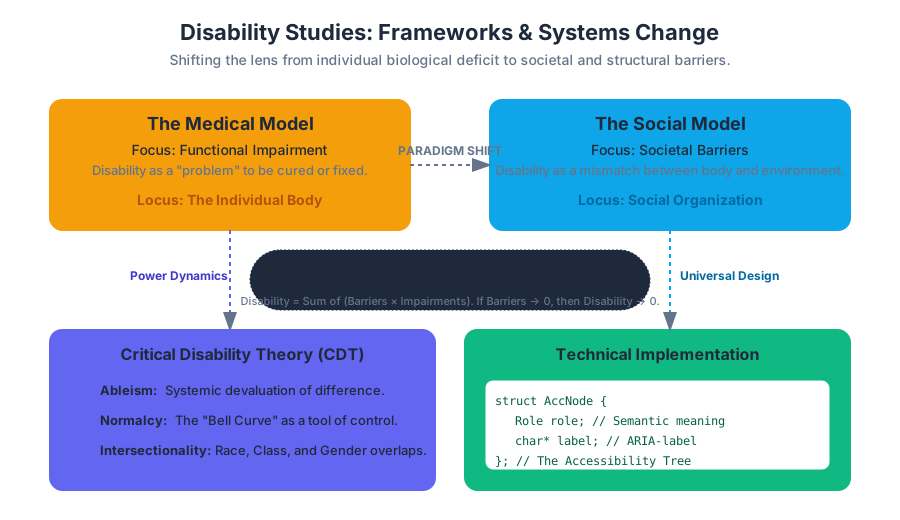
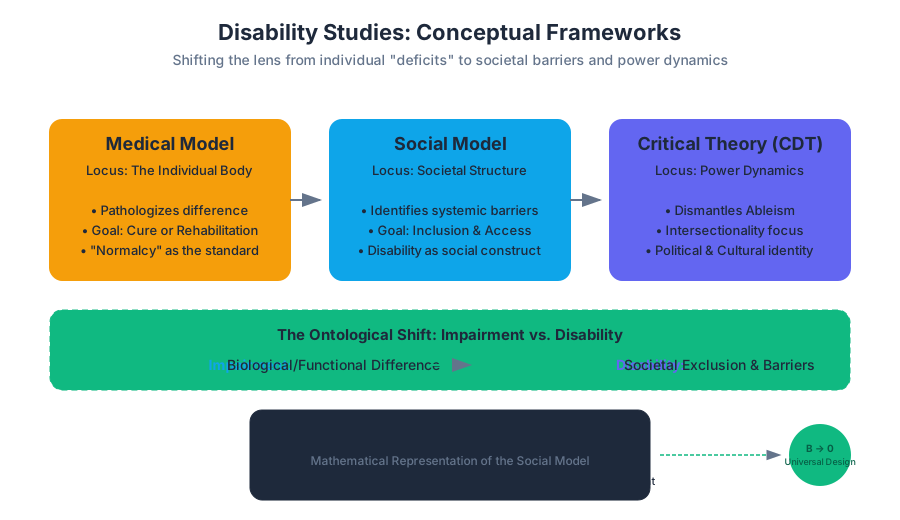
Early Childhood Education
Key concepts: Holistic Development · Play-Based Learning · Trauma-Informed Education · Equity and Diversity · Family Engagement
Focus on the holistic development of children from birth to age eight.
Early Childhood Education
Early Childhood Education (ECE) is the formal and informal pedagogical framework designed for children from birth to age eight. This period represents the most significant window of neuroplasticity in the human lifespan, during which the brain forms upwards of one million new neural connections every second. ECE is not merely a precursor to "real" schooling; it is the foundational architecture upon which all future cognitive, social, and emotional structures are built.
Holistic Development
Holistic Development is an integrated approach to child growth that posits that the cognitive, social, emotional, and physical domains are not discrete silos but interconnected systems. In this framework, a deficit in one domain (e.g., chronic malnutrition affecting physical growth) directly impacts the efficiency of another (e.g., the metabolic cost of cognitive processing).
The Four Domains of Development
- Cognitive Development: The evolution of thought processes, including memory, problem-solving, and decision-making. This is often measured through the lens of Executive Function—the mental processes that enable us to plan, focus attention, and juggle multiple tasks.
- Social Development: The ability to form relationships, navigate group dynamics, and understand social cues.
- Emotional Development: The capacity to identify, express, and regulate feelings, as well as the development of empathy (Self-Regulation).
- Physical Development: Encompasses both gross motor skills (large muscle movements) and fine motor skills (dexterity), alongside general health and nutrition.
| Domain | Key Indicators | Theoretical Anchor |
|---|---|---|
| Cognitive | Symbolic thought, object permanence, executive function | Jean Piaget (Constructivism) |
| Social | Cooperative play, conflict resolution, theory of mind | Lev Vygotsky (Social Development) |
| Emotional | Self-soothing, empathy, emotional literacy | Erik Erikson (Psychosocial Stages) |
| Physical | Proprioception, hand-eye coordination, sensory integration | Arnold Gesell (Maturational-Physical) |
Why It Matters: The Interdependency Principle
The "Whole Child" approach recognizes that academic success is a downstream effect of holistic health. For instance, a child experiencing "toxic stress" (emotional domain) will have an overactive HPA axis, flooding the brain with cortisol, which inhibits the prefrontal cortex's ability to engage in logical reasoning (cognitive domain).
How It Works: The Scaffolding Algorithm
Educators use Scaffolding—a term coined by Jerome Bruner based on Vygotsky’s Zone of Proximal Development (ZPD). The ZPD is the distance between what a learner can do without help and what they can do with support.
# A simplified Python representation of the Scaffolding Logic in ECE
class Child:
    def __init__(self, skill_level):
        self.skill_level = skill_level  # Current independent ability

class Task:
    def __init__(self, difficulty):
        self.difficulty = difficulty

def provide_instruction(child, task):
    zpd_upper_bound = child.skill_level + 2.0  # Theoretical limit with support

    if task.difficulty <= child.skill_level:
        return "Boredom: Task is too easy. No growth."
    elif task.difficulty > zpd_upper_bound:
        return "Frustration: Task is too hard. High anxiety, no growth."
    else:
        # Scaffolding occurs here
        support_required = task.difficulty - child.skill_level
        return f"Learning: Scaffolding provided at level {support_required:.2f}."

# Example Usage
student = Child(skill_level=5.0)
math_puzzle = Task(difficulty=6.5)
print(provide_instruction(student, math_puzzle))
Play-Based Learning
Play-Based Learning is a pedagogical strategy where play is the primary context for learning. It is often misunderstood as "unstructured free time," but in a professional ECE setting, it is a highly intentional "laboratory" for social and cognitive experimentation.
The Mechanics of Play
Play allows children to engage in Metacommunication (communicating about the communication) and Symbolic Representation (using a block to represent a phone). These are the precursors to abstract mathematical and literacy skills.
Variations of Play
Play exists on a continuum from child-directed to adult-led.
| Play Type | Description | Adult Role |
|---|---|---|
| Unstructured Play | Child-led, spontaneous, open-ended. | Observer / Safety Monitor |
| Guided Play | Child-led but with adult-scaffolded environments. | Facilitator / Questioner |
| Co-operative Play | Children work together toward a common goal. | Mediator |
| Object Play | Exploration of the physical properties of items. | Provider of diverse materials |
Common Pitfall: The Play-Work Dichotomy
A frequent misconception is that "play" and "learning" are opposites. In reality, for a developing brain, play is work. High-quality ECE programs avoid "drill-and-kill" worksheets in favor of "inquiry-based" play, which builds higher-order thinking skills.
Trauma-Informed Education
Trauma-Informed Education is a framework that recognizes the prevalence of Adverse Childhood Experiences (ACEs) and seeks to create a "culture of safety" that prevents re-traumatization.
The Neurobiology of Trauma
Trauma impacts the Amygdala (the brain's alarm system), making it hypersensitive. When a child is in a "fight, flight, or freeze" state, the "learning brain" (prefrontal cortex) goes offline. Trauma-informed care shifts the question from "What is wrong with this child?" to "What happened to this child?"
The 4 R's of Trauma-Informed Care
- Realize: Understand the widespread impact of trauma.
- Recognize: Identify the signs of trauma in children and families.
- Respond: Integrate knowledge about trauma into policies and practices.
- Resist Re-traumatization: Avoid triggers and punitive measures that mirror past trauma.
"The brain is a social organ. Its physiological and neurological health is dependent on the quality of the relationships it experiences." — Key Insight in Trauma-Informed Pedagogy
Implementation: The Heckman Equation
Nobel Laureate James Heckman demonstrated that the ROI (Return on Investment) for ECE is highest for children from disadvantaged or traumatized backgrounds.
\text{The Heckman Equation:} \\
\text{Invest} + \text{Develop} + \text{Sustain} = \text{Gain} \\
\rho = \frac{\Delta \text{Human Capital}}{\Delta \text{Investment Cost}}
Where $\rho$ (Return) is significantly higher when investment occurs in the $0-5$ age range compared to later interventions.
Equity and Diversity
Equity and Diversity in ECE refers to the intentional practice of creating inclusive environments that honor the various identities (race, culture, ability, gender, language) children bring to the classroom.
Anti-Bias Education (ABE)
ABE is a proactive approach to addressing social identity and unfairness. It is built on four core goals:
- Identity: Each child will demonstrate self-awareness and confidence.
- Diversity: Each child will express comfort and joy with human diversity.
- Justice: Each child will increasingly recognize unfairness (bias).
- Action: Each child will demonstrate empowerment and the skills to act against prejudice.
Culturally Responsive Teaching (CRT)
CRT involves using the cultural knowledge, prior experiences, and performance styles of diverse students to make learning more appropriate and effective for them.
| Concept | Definition | Practical Application |
|---|---|---|
| Inclusion | Ensuring children with disabilities learn alongside peers. | Universal Design for Learning (UDL) |
| Cultural Capital | The non-financial social assets that promote mobility. | Valuing "Home Languages" in the classroom |
| Implicit Bias | Unconscious attitudes that affect our understanding. | Reflective practice and peer-review for teachers |
Family and Community Engagement
Family Engagement is a collaborative relationship between families and educators that is continuous across a child’s life. It moves beyond "involvement" (e.g., attending a bake sale) to "engagement" (e.g., co-constructing the child's learning goals).
Bronfenbrenner’s Ecological Systems Theory
To understand a child, one must understand the entire ecosystem.
- Microsystem: Immediate environment (Family, Classroom).
- Mesosystem: Connections between microsystems (Parent-Teacher relationship).
- Exosystem: External settings that indirectly affect the child (Parent’s workplace).
- Macrosystem: Cultural values, laws, and customs.
Data Standards for Engagement
In modern ECE systems, family data and student progress are often tracked via structured schemas to ensure continuity of care during transitions (e.g., moving from Head Start to Kindergarten).
{
  "student_id": "ECE-2024-9981",
  "developmental_profile": {
    "social_emotional": "Developing - Level 3",
    "language_literacy": "Emergent - Level 2",
    "physical_health": "Proficient - Level 4"
  },
  "family_engagement_log": [
    {
      "date": "2023-11-15",
      "type": "Home Visit",
      "focus": "Transition to Kindergarten",
      "outcomes": ["IEP reviewed", "Language goals aligned"]
    },
    {
      "date": "2024-01-10",
      "type": "Conference",
      "focus": "Social-Emotional Regulation",
      "outcomes": ["Shared breathing techniques for home/school"]
    }
  ]
}
Reflective Practice
Reflective Practice is the "meta-skill" of ECE. It is the continuous process of educators thinking about their own teaching, analyzing their interactions, and adjusting their strategies based on evidence and observation.
The Cycle of Reflection
- Observe: Watch the child's interactions without judgment.
- Record: Document the observation (Anecdotal notes, photos).
- Interpret: Connect the observation to developmental theory.
- Plan: Adjust the environment or curriculum based on the interpretation.
Common Pitfall: The "Expert" Fallacy
Educators sometimes believe they are the sole experts on a child's learning. Reflective practice requires the humility to see the family as the primary expert and the child as a co-constructor of knowledge.
Technical Summary of ECE Metrics
To measure the efficacy of ECE programs, administrators use several standardized tools.
| Tool | Focus Area | Methodology |
|---|---|---|
| DRDP (Desired Results Developmental Profile) | Holistic Growth | Naturalistic observation over 6 months |
| CLASS (Classroom Assessment Scoring System) | Teacher-Child Interaction | External observation of emotional/instructional support |
| ASQ-3 (Ages & Stages Questionnaires) | Developmental Screening | Parent-completed developmental milestones |
| ECERS-3 (Early Childhood Environment Rating Scale) | Physical Environment | Assessment of space, materials, and routines |
Administrative Data Management
For large-scale ECE systems, data must be migrated and synced across various state and federal databases.
# Example: Syncing local student assessment data to a state-wide ECE database
# Usage: ./sync_ece_data.sh --year 2024 --district "NORTH_01"

echo "Initiating ECE Data Sync..."
DATA_PATH="/local/ece/assessments/2024/"

for file in $DATA_PATH/*.json; do
    echo "Processing $file..."
    # Validate schema against DRDP standards
    validate_schema "$file" --schema "drdp_v2.1.json"

    # Upload to secure state endpoint
    curl -X POST -H "Content-Type: application/json" \
         -d @"$file" \
         "https://api.state-education.gov/v1/ece/upload?key=$ECE_API_KEY"
done

echo "Sync Complete. 452 records processed."
- Neuroplasticity: The brain's ability to reorganize itself by forming new neural connections throughout life, peaking in early childhood.
- Executive Function: A set of cognitive processes (working memory, flexible thinking, self-control) that are necessary for the cognitive control of behavior.
- Zone of Proximal Development (ZPD): The range of tasks that are too difficult for a person to learn alone but can be learned with guidance.
- Toxic Stress: Strong, frequent, or prolonged activation of the body's stress management system in the absence of buffering protection from adults.
- Scaffolding: Support mechanisms provided by an educator to help a child reach the next level of development.
- Anti-Bias Education: A framework for teaching that encourages children to value diversity and challenge prejudice.
- HPA Axis: The Hypothalamic-Pituitary-Adrenal axis; the body's central stress response system.
- Theory of Mind: The understanding that others have beliefs, desires, intentions, and perspectives that are different from one's own.
-
Which domain of development is primarily concerned with "Theory of Mind"?
- A) Physical
- B) Cognitive
- C) Social
- D) Emotional (Correct: C - Social, though it overlaps with Cognitive, it is the basis for social interaction.)
-
According to the Heckman Equation, where is the highest return on investment in education found?
- A) University Research
- B) High School Vocational Training
- C) Early Childhood (0-5)
- D) Adult Literacy Programs (Correct: C)
-
In the context of Trauma-Informed Care, what does the "4th R" (Resist Re-traumatization) specifically aim to prevent?
- A) Children forgetting their lessons
- B) Punitive practices that trigger past trauma responses
- C) Parents missing meetings
- D) Excessive play time (Correct: B)
-
Which theorist is most closely associated with the "Ecological Systems Theory"?
- A) Jean Piaget
- B) Urie Bronfenbrenner
- C) Lev Vygotsky
- D) B.F. Skinner (Correct: B)
-
What is the primary difference between "Involvement" and "Engagement" in family relations?
- A) Involvement is mandatory, Engagement is optional.
- B) Involvement is teacher-led; Engagement is a collaborative partnership.
- C) Involvement only happens at school; Engagement only happens at home.
- D) There is no difference. (Correct: B)
Early Childhood Education Study Guide
Core Philosophy
- The Window of Opportunity: Birth to age 8 is the critical period for brain architecture.
- The Whole Child: Academic readiness is impossible without social-emotional stability and physical health.
Key Theories to Master
- Constructivism (Piaget): Children build knowledge through active exploration.
- Social Constructivism (Vygotsky): Learning is a social process; look for the ZPD.
- Ecological Systems (Bronfenbrenner): A child is a product of nested environments.
Practical Application
- Play as Pedagogy: Identify the difference between "Guided Play" and "Direct Instruction."
- Trauma Sensitivity: Focus on regulation before reasoning.
- Equity: Move beyond "celebrating holidays" to deep Anti-Bias Education goals.
Assessment Tools
- Know the purpose of the DRDP (observational assessment) vs. the ASQ-3 (developmental screening).
- Understand the CLASS tool's focus on the quality of interactions rather than just the physical environment.
Critical Thinking Question
- How does the "Achievement Gap" relate to the "Opportunity Gap" in the context of ECE funding and access?
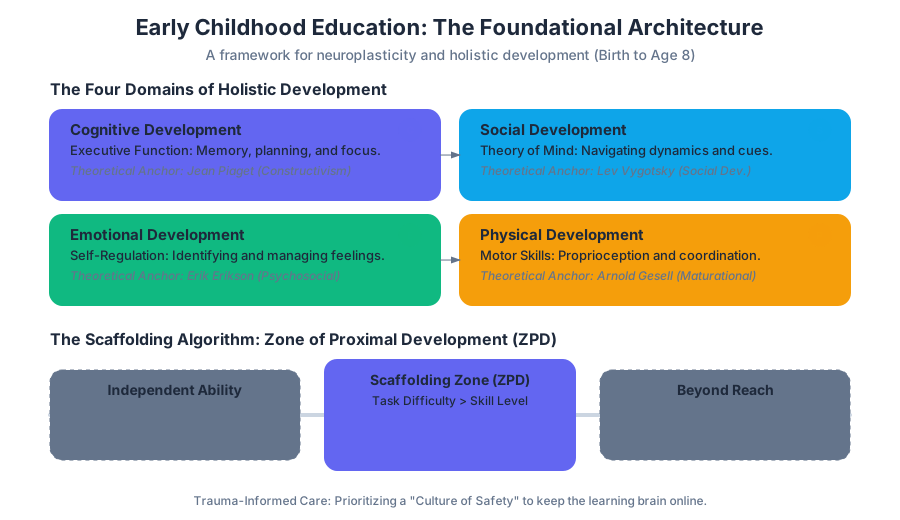
Economics
Key concepts: Microeconomics · Macroeconomics · Economic Agents · Fiscal and Monetary Policy · Public Policy
The study of production, distribution, and consumption of goods and services.
Economics
Economics is the foundational social science concerned with the production, distribution, and consumption of goods and services. At its core, it is the study of scarcity—the fundamental tension between limited resources and unlimited human wants. By analyzing how economic agents make choices, economics provides a rigorous framework for understanding everything from individual purchasing decisions to the complex global systems that dictate the wealth of nations.
The Foundations of Economic Thought
Economics operates on the premise that resources—land, labor, capital, and entrepreneurship—are finite. This necessitates opportunity cost, the value of the next best alternative foregone when a choice is made. Unlike purely physical sciences, economics must account for human behavior, making it a "social science" that frequently intersects with anthropology, psychology, and public policy.
The Dual Pillars: Micro and Macro
The discipline is traditionally bifurcated into two primary scales of analysis:
| Feature | Microeconomics | Macroeconomics |
|---|---|---|
| Focus | Individual agents (households, firms) | Aggregate economy (nations, global systems) |
| Primary Variables | Price, Quantity, Elasticity, Utility | GDP, Inflation, Unemployment, Interest Rates |
| Core Question | How do specific markets reach equilibrium? | How do we achieve stable growth and full employment? |
| Policy Tool | Regulation, Subsidies, Antitrust Law | Fiscal Policy, Monetary Policy |
| Analogy | Examining individual trees in a forest | Examining the health of the entire ecosystem |
Microeconomics: The Mechanics of Individual Choice
Microeconomics examines the "bottom-up" behavior of consumers and producers. It assumes that agents are generally rational, seeking to maximize utility (for consumers) or profit (for firms) subject to constraints like budget or technology.
Supply, Demand, and Equilibrium
The most fundamental model in microeconomics is the Supply and Demand framework.
- The Law of Demand: Ceteris paribus (all other things being equal), as the price of a good increases ($P \uparrow$), the quantity demanded decreases ($Q_d \downarrow$).
- The Law of Supply: As the price increases ($P \uparrow$), the quantity supplied by producers increases ($Q_s \uparrow$).
The point where $Q_d = Q_s$ is the Market Equilibrium. At this price ($P^*$), the market clears, and there is neither a surplus nor a shortage.
Market Structures
Economic agents do not operate in a vacuum; the "rules of the game" are defined by the market structure:
| Structure | Number of Firms | Product Differentiation | Barriers to Entry | Price Control |
|---|---|---|---|---|
| Perfect Competition | Infinite | Homogeneous | None | None (Price Taker) |
| Monopolistic Competition | Many | Differentiated | Low | Some |
| Oligopoly | Few | High or Low | High | Significant (Interdependent) |
| Monopoly | One | Unique | Very High | Absolute (Price Maker) |
Elasticity
Elasticity measures the responsiveness of one variable to changes in another. For example, Price Elasticity of Demand (PED) calculates how much the quantity demanded changes when the price changes:
$$E_d = \frac{% \Delta Q_d}{% \Delta P}$$
If $|E_d| > 1$, the good is elastic (consumers are sensitive to price changes, like luxury cars). If $|E_d| < 1$, the good is inelastic (consumers buy it regardless of price, like insulin).
import numpy as np
from scipy.optimize import fsolve

# Low-level implementation: Finding Market Equilibrium
# Demand Function: Qd = a - bP
# Supply Function: Qs = c + dP

def market_equilibrium(params):
    a, b, c, d = params

    # Define the system: Qd - Qs = 0
    func = lambda p: (a - b * p) - (c + d * p)

    # Solve for Price (P)
    p_equil = fsolve(func, x0=10)[0]
    q_equil = a - b * p_equil

    return p_equil, q_equil

# Example parameters: a=100, b=2 (Demand), c=10, d=1 (Supply)
params = (100, 2, 10, 1)
p_star, q_star = market_equilibrium(params)

print(f"Equilibrium Price: {p_star:.2f}")
print(f"Equilibrium Quantity: {q_star:.2f}")
Macroeconomics: The Aggregate View
Macroeconomics shifts the lens to the "top-down" performance of the economy. It focuses on the Business Cycle—the fluctuations in economic activity over time, characterized by periods of expansion and recession.
Key Macroeconomic Indicators
- Gross Domestic Product (GDP): The total market value of all final goods and services produced within a country in a given period.
- Formula: $GDP = C + I + G + (X - M)$ (Consumption + Investment + Government Spending + Net Exports).
- Inflation: The rate at which the general level of prices for goods and services is rising. It is typically measured via the Consumer Price Index (CPI).
- Unemployment Rate: The percentage of the labor force that is jobless and actively seeking work.
Aggregate Demand (AD) and Aggregate Supply (AS)
The AD-AS model explains fluctuations in the price level and real GDP.
- AD represents the total spending in the economy.
- AS represents the total production. Shifts in these curves (due to shocks like a pandemic or a technological breakthrough) lead to changes in the equilibrium level of national income and prices.
The Phillips Curve: A historical inverse relationship between the rate of unemployment and the corresponding rate of inflation within an economy. Stated simply, the lower the unemployment, the higher the inflation (and vice versa) in the short run.
\text{Taylor Rule for Monetary Policy:} \\
i_t = \pi_t + r_t^* + a_\pi(\pi_t - \pi_t^*) + a_y(y_t - \bar{y}_t)
Where:
- $i_t$: Target short-term nominal interest rate
- $\pi_t$: Rate of inflation
- $\pi_t^*$: Desired inflation target
- $r_t^*$: Assumed equilibrium real interest rate
- $y_t$: Log of real GDP
- $\bar{y}_t$: Log of potential output
Economic Agents and Behavioral Reality
In classical theory, the Economic Agent is often modeled as Homo Economicus—a perfectly rational, self-interested individual with perfect information. However, modern economics, influenced by Behavioral Economics, recognizes that humans have "bounded rationality."
Types of Agents
- Households: Owners of the factors of production (labor) and consumers of final goods.
- Firms: Entities that transform inputs into outputs to generate profit.
- Governments: Regulators and providers of public goods who intervene to correct Market Failures.
- Central Banks: Independent institutions (like the Federal Reserve) that manage a nation's currency and monetary policy.
Incentives and Information
Economics is often called the "study of incentives." Asymmetric Information occurs when one party in a transaction has more or better information than the other, leading to:
- Adverse Selection: (e.g., only sick people buying health insurance).
- Moral Hazard: (e.g., taking more risks because you are insured).
Fiscal and Monetary Policy: The Levers of Power
To manage the volatility of the business cycle, authorities use two primary toolkits: Fiscal and Monetary policy.
Fiscal Policy
Managed by the executive and legislative branches of government, Fiscal Policy involves adjusting spending levels and tax rates to influence Aggregate Demand.
- Expansionary: Increasing spending or cutting taxes to fight recession.
- Contractionary: Decreasing spending or raising taxes to combat inflation.
Monetary Policy
Managed by the Central Bank, Monetary Policy involves controlling the money supply and interest rates.
- Open Market Operations (OMO): Buying or selling government bonds to inject or withdraw liquidity.
- The Discount Rate: The interest rate charged to commercial banks for loans from the central bank.
- Reserve Requirements: The portion of deposits banks must hold in reserve.
| Policy Tool | Fiscal Policy | Monetary Policy |
|---|---|---|
| Decision Maker | Parliament / Congress / Government | Central Bank (e.g., Fed, ECB) |
| Primary Tools | Taxes, Government Spending | Interest Rates, Money Supply, QE |
| Implementation Lag | Long (Political process) | Short (Immediate decision) |
| Impact Lag | Short (Direct injection) | Long (Transmission through banks) |
-- Example: A database schema for tracking National Economic Indicators
CREATE TABLE EconomicIndicators (
    indicator_id INT PRIMARY KEY,
    country_code VARCHAR(3),
    report_date DATE,
    gdp_growth_rate DECIMAL(5, 2),
    inflation_rate DECIMAL(5, 2),
    unemployment_rate DECIMAL(5, 2),
    central_bank_rate DECIMAL(5, 2),
    fiscal_balance_gdp_ratio DECIMAL(5, 2)
);

-- Query to find countries with high inflation but low interest rates (Potential Policy Lag)
SELECT country_code, report_date, inflation_rate, central_bank_rate
FROM EconomicIndicators
WHERE inflation_rate > 5.0 AND central_bank_rate < 2.0
ORDER BY inflation_rate DESC;
Public Policy and Market Failures
While markets are efficient at allocating private goods, they often fail in specific scenarios, necessitating Public Policy intervention.
1. Externalities
An externality is a cost or benefit that affects a third party who did not choose to incur that cost or benefit.
- Negative: Pollution from a factory (overproduced by the market).
- Positive: Education or vaccinations (underproduced by the market).
2. Public Goods
Goods that are non-excludable (you can't stop people from using them) and non-rivalrous (one person's use doesn't diminish another's). Examples include national defense and street lighting. These suffer from the Free Rider Problem.
3. Common Pool Resources
Goods that are non-excludable but rivalrous (e.g., fish stocks in the ocean). This leads to the Tragedy of the Commons, where individual rational use leads to collective ruin.
Interdisciplinary Connections: The "Bookshelves" of Economics
Economics does not exist in isolation. As noted in the LibreTexts philosophy, knowledge is a "remix" of various disciplines.
- Anthropology: Economic systems are culturally embedded. While Western economics focuses on markets, anthropology explores gift economies and the social structures of exchange.
- Criminology: The "Economic Theory of Crime" (pioneered by Gary Becker) suggests that individuals commit crimes when the expected utility of the crime exceeds the expected cost (probability of being caught $\times$ severity of punishment).
- Early Childhood Education: Economists like James Heckman have shown that the Return on Investment (ROI) for early childhood education is among the highest of any public policy, significantly reducing future costs in the criminal justice system.
- Communication Studies: Markets rely on the flow of information. Signaling Theory explains how agents communicate "hidden" qualities (e.g., a college degree signals productivity to an employer).
Common Pitfalls in Economic Reasoning
- The Sunk Cost Fallacy: Continuing an endeavor because of past investments (money, time) rather than current utility. Correct approach: Only marginal costs and benefits should matter.
- Correlation vs. Causation: Assuming that because two variables move together (e.g., money supply and inflation), one must cause the other without accounting for lags or third variables.
- The Fallacy of Composition: Assuming that what is true for one individual must be true for the whole group. (e.g., if one person stands up at a concert, they see better; if everyone stands up, no one sees better).
- Ignoring Secondary Effects: Focussing only on the immediate visible impact of a policy (e.g., rent control helping current tenants) while ignoring long-term consequences (e.g., reduced housing supply and quality).
Summary of Key Parameters in Economic Modeling
| Parameter | Symbol | Definition | Significance |
|---|---|---|---|
| Marginal Propensity to Consume | $MPC$ | The fraction of additional income spent on consumption. | Determines the strength of the Fiscal Multiplier. |
| Discount Rate | $r$ | The rate used to determine the present value of future cash flows. | Influences investment decisions and capital allocation. |
| Gini Coefficient | $G$ | A measure of statistical dispersion representing income inequality. | 0 = Perfect equality; 1 = Perfect inequality. |
| Natural Rate of Unemployment | $u^*$ | The level of unemployment when the labor market is in equilibrium. | The "floor" of unemployment without triggering inflation. |
Economics remains a dynamic field, constantly evolving as new data and computational methods allow us to model human behavior with increasing precision. Whether through the lens of a micro-level consumer choice or a macro-level fiscal stimulus, the core objective remains the same: optimizing the use of our world's limited resources to improve human welfare.
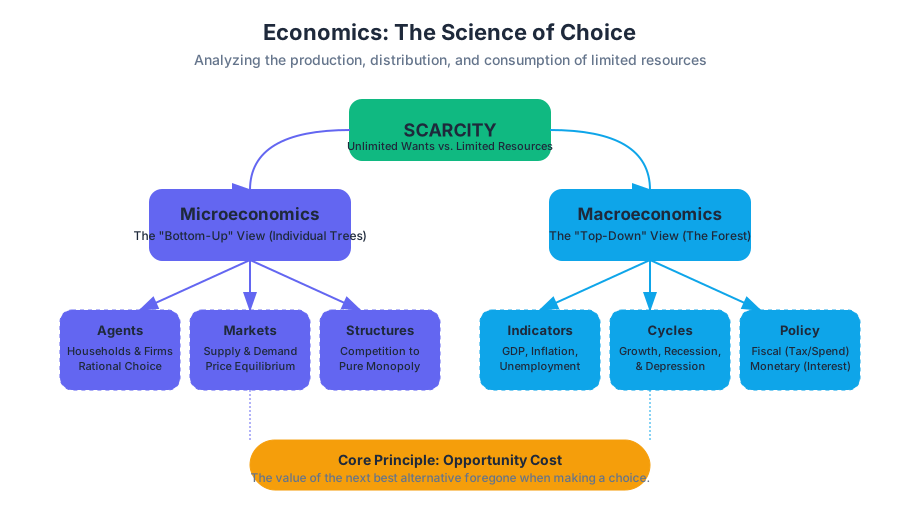
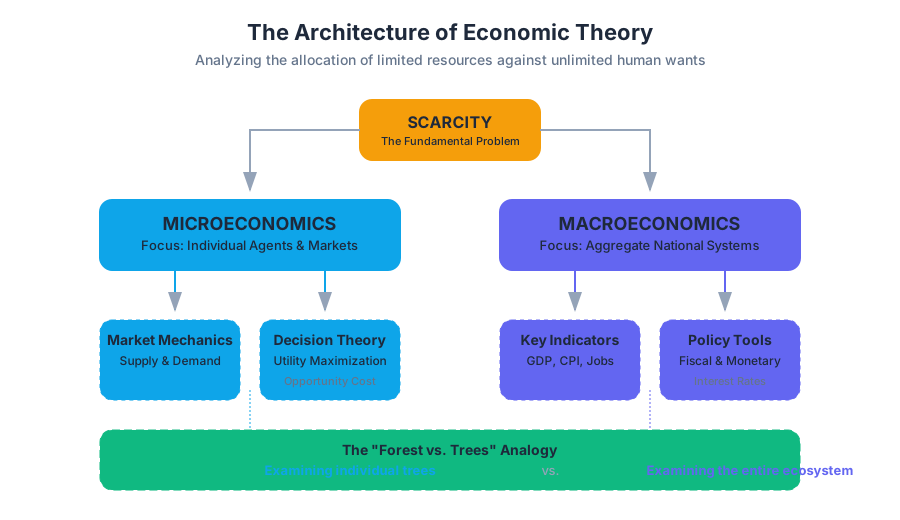
Education & Professional Development
Key concepts: Instructional Design · Educational Technology · Inclusive Pedagogy · Formal and Informal Education · Professional Development
Methods of facilitating learning across formal and informal settings.
Education & Professional Development
Education and Professional Development (EPD) represents the systematic architecture of knowledge acquisition, skill refinement, and behavioral modification across the human lifespan. In the modern era, this field has evolved from a static "transmission of facts" model into a high-precision discipline that synthesizes cognitive science, instructional design, and advanced technology. At its core, EPD seeks to optimize the "learning loop"—the iterative process of exposure, encoding, application, and feedback.
The Architecture of Learning: Instructional Design (ID)
Instructional Design is the "systems engineering" of the educational world. It is the practice of creating instructional experiences which make the acquisition of knowledge and skill more efficient, effective, and appealing. Rather than relying on intuition, ID utilizes evidence-based frameworks to map learning objectives to specific cognitive outcomes.
The ADDIE Framework and Its Successors
The ADDIE Model (Analysis, Design, Development, Implementation, Evaluation) remains the industry standard for structured course development. However, modern environments often shift toward more iterative models like SAM (Successive Approximation Model) to account for the rapid pace of technological change.
| Phase | Objective | Key Deliverables |
|---|---|---|
| Analysis | Identify the "performance gap" and learner profile. | Needs Analysis Report, Learner Personas. |
| Design | Map the logical flow and instructional strategy. | Storyboards, Learning Objectives (SMART). |
| Development | Build the actual assets and technology stack. | SCORM Packages, Video Lectures, Quiz Engines. |
| Implementation | Launch the training to the target audience. | LMS Deployment, Instructor Training. |
| Evaluation | Measure effectiveness via Kirkpatrick’s Levels. | Data Analytics, Survey Results, ROI Analysis. |
Cognitive Load Theory (CLT)
A critical component of ID is managing Cognitive Load. Formulated by John Sweller, CLT suggests that since working memory is limited, instructional materials should avoid "extraneous load" (unnecessary distractions) and maximize "germane load" (the mental effort required to build schemas).
Definition: Schema Acquisition is the process of integrating new information into existing mental structures. Effective instructional design facilitates this by "scaffolding" information—presenting complex tasks in manageable increments.
Educational Technology (EdTech) and Digital Infrastructure
Educational Technology is the ethical practice of facilitating learning and improving performance by creating, using, and managing appropriate technological processes and resources. It is not merely about "using computers" but about the interoperability of systems that allow for personalized learning at scale.
Interoperability Standards: SCORM, xAPI, and LTI
To ensure that a "remix" of content (such as those found in LibreTexts Bookshelves) can function across different platforms, the industry relies on standardized protocols.
- SCORM (Sharable Content Object Reference Model): The legacy standard for packaging web-based learning content so it can be tracked by a Learning Management System (LMS).
- xAPI (Experience API / Tin Can): A modern specification that allows for the tracking of learning experiences across multiple platforms (e.g., mobile apps, simulations, offline learning).
- LTI (Learning Tools Interoperability): A standard that allows an LMS to "plug in" external tools (like a specialized chemistry simulator) as if they were native features.
Implementation Example: Item Analysis in Python
In professional development and formal education, we must validate that our assessments are actually measuring what they claim to. The following Python script demonstrates a low-level implementation of Item Difficulty and Item Discrimination indices.
import numpy as np

def analyze_assessment_items(scores_matrix):
    """
    Calculates Item Difficulty (p) and Item Discrimination (D).
    scores_matrix: 2D array where rows are students and columns are questions (1=correct, 0=incorrect).
    """
    n_students, n_items = scores_matrix.shape

    # 1. Item Difficulty (p-value): Proportion of students who got the item right.
    # p = (Number of correct responses) / (Total responses)
    difficulty_indices = np.mean(scores_matrix, axis=0)

    # 2. Item Discrimination (D): How well the item distinguishes between high and low performers.
    # We compare the top 27% of students to the bottom 27%.
    total_scores = np.sum(scores_matrix, axis=1)
    sorted_indices = np.argsort(total_scores)

    slice_size = int(0.27 * n_students)
    upper_group = scores_matrix[sorted_indices[-slice_size:]]
    lower_group = scores_matrix[sorted_indices[:slice_size]]

    upper_p = np.mean(upper_group, axis=0)
    lower_p = np.mean(lower_group, axis=0)
    discrimination_indices = upper_p - lower_p

    return difficulty_indices, discrimination_indices

# Example Data: 10 students, 5 items
data = np.array([
    [1, 0, 1, 1, 0], [1, 1, 1, 1, 1], [0, 0, 0, 1, 0], [1, 1, 1, 0, 0],
    [1, 1, 1, 1, 1], [0, 0, 1, 0, 0], [1, 0, 1, 1, 0], [1, 1, 1, 1, 1],
    [1, 1, 0, 1, 0], [0, 0, 1, 1, 0]
])

diff, disc = analyze_assessment_items(data)
for i, (p, d) in enumerate(zip(diff, disc)):
    print(f"Item {i+1}: Difficulty={p:.2f}, Discrimination={d:.2f}")
Pedagogy and Inclusive Design
Pedagogy refers to the theory and practice of learning. In contemporary discourse, this has expanded to include Andragogy (adult learning) and Heutagogy (self-determined learning). A major shift in the field is the move toward Inclusive Pedagogy, which posits that barriers to learning are often a result of the environment rather than the student's inherent "disability."
The Social Model of Disability
In Disability Studies, the distinction between Impairment and Disability is paramount. An impairment is a biological condition (e.g., being unable to walk), whereas disability is the social consequence (e.g., a building with only stairs). Inclusive pedagogy utilizes Universal Design for Learning (UDL) to preemptively remove these barriers.
| UDL Principle | Implementation Strategy | Technical Example |
|---|---|---|
| Multiple Means of Representation | Presenting information in more than one format. | Providing a video with a synchronized .vtt transcript. |
| Multiple Means of Action & Expression | Allowing learners to demonstrate knowledge in different ways. | Choosing between an essay, a podcast, or a code repository. |
| Multiple Means of Engagement | Tapping into learners' interests and offering choices. | Gamification elements vs. traditional linear progress. |
Early Childhood Education (ECE) and Foundational Development
ECE focuses on children from birth to age eight. This period is critical for Holistic Development, encompassing cognitive, social, emotional, and physical growth. Key concepts include Play-Based Learning and Trauma-Informed Education, which recognizes that a child's neurological state (affected by external stressors) dictates their capacity to learn.
Formal and Informal Education: The Role of OER
The traditional dichotomy between Formal Education (structured, credential-based) and Informal Education (self-directed, experiential) is blurring due to Open Educational Resources (OER). Platforms like LibreTexts provide "Bookshelves" of curated academic texts that can be "remixed."
The "Remix" Workflow
A Customized Remix allows an educator to pull specific chapters from multiple "Campus Bookshelves" to create a "Course Shell" tailored to a specific syllabus. This reduces costs for students and ensures that the material is culturally and contextually relevant.
\text{Remix Efficiency} = \frac{\sum (\text{Relevant Chapters from Source } n)}{\text{Total Pages in Traditional Textbook}} \times 100
In this mathematical representation, the efficiency of a remix is measured by the density of relevant content compared to a bloated, one-size-fits-all commercial textbook.
Metadata and Content Discovery
To make OER content discoverable, it must be tagged with rich metadata. Below is an example of how an educational resource might be represented in JSON-LD (Linked Data) for search engine optimization and repository indexing.
{
  "@context": "https://schema.org",
  "@type": "Course",
  "name": "Introduction to Cultural Anthropology",
  "description": "A holistic study of humankind exploring biological origins and cultural practices.",
  "provider": {
    "@type": "Organization",
    "name": "LibreTexts",
    "sameAs": "https://socialsci.libretexts.org"
  },
  "courseCode": "ANTH101",
  "hasCourseInstance": {
    "@type": "CourseInstance",
    "courseMode": "online",
    "instructor": "Dr. Jane Doe"
  },
  "educationalCredentialAwarded": "Certificate of Completion",
  "isAccessibleForFree": true
}
Professional Development and Counseling
Professional development is the process of improving and increasing capabilities of staff through access to education and training opportunities. In the context of Counseling & Guidance, this involves not just technical skills but Academic Success Strategies and Career Development.
Communication Studies in Professional Contexts
Effective professional development relies heavily on Communication Studies. Understanding the nuances between Verbal, Nonverbal, and Written communication is essential for leadership and collaboration.
- Interpersonal Communication: The exchange of information between two or more people.
- Mass Media: The diversification of message delivery (e.g., internal company-wide broadcasts vs. Slack messages).
- Intercultural Communication: Essential in a globalized workforce to avoid "cultural noise" that distorts the intended message.
Criminology and Criminal Justice Education
Professional development in specialized fields like Criminology requires a deep understanding of the "Justice System." This includes training in Policing, Judicial Systems, and Corrections. A key area of focus is Urban Inequality and Mental Health in Justice, requiring officers and legal professionals to undergo continuous training in de-escalation and social disparities.
Common Pitfalls in Education and Development
- The "Expert Blindness" Fallacy: Designing content for beginners that assumes "common sense" knowledge that only experts possess.
- Technological Determinism: The belief that adding a new tool (e.g., VR headsets) will automatically improve learning outcomes without a change in pedagogy.
- Ignoring the "Forgetting Curve": Providing "one-and-done" training sessions without spaced repetition or opportunities for application.
- Conflating Accessibility with Inclusion: Making a PDF screen-reader friendly (accessibility) is not the same as designing a curriculum that reflects the diverse lived experiences of the students (inclusion).
Real-World Usage: Automating Content Retrieval
For a senior educator managing a large "Course Shell," manually updating links is inefficient. A simple shell script can be used to audit or fetch OER assets from a repository.
#!/bin/bash
# OER Asset Auditor: Checks if PDF versions of chapters are available

BOOKS_API="https://api.libretexts.org/v1/bookshelves"
COURSE_ID="anthropology-101"

echo "Auditing assets for Course: $COURSE_ID..."

# Fetch chapter list (hypothetical JSON response)
chapters=$(curl -s "$BOOKS_API/$COURSE_ID/chapters" | jq -r '.[].id')

for id in $chapters; do
    status_code=$(curl -o /dev/null -s -w "%{http_code}" "$BOOKS_API/download/$id.pdf")
    if [ "$status_code" -eq 200 ]; then
        echo "Chapter $id: [OK]"
    else
        echo "Chapter $id: [MISSING PDF] - Status $status_code"
    fi
done
Synthesis: The Future of the Learning Ecosystem
The convergence of Instructional Design, EdTech, and Inclusive Pedagogy is creating a more democratic educational landscape. By leveraging LibreTexts for content, LMS for delivery, and Data Analytics for evaluation, institutions can move away from rigid, expensive models toward a fluid, "just-in-time" learning paradigm. Whether it is a child in an Early Childhood program or a professional in Addictions Counseling, the principles of structured, inclusive, and technologically-supported education remain the same: reduce friction, maximize engagement, and ensure that knowledge is a public good rather than a private commodity.
- Instructional Design: The systematic development of instructional specifications.
- ADDIE: Analysis, Design, Development, Implementation, Evaluation.
- SCORM: Sharable Content Object Reference Model (e-learning standard).
- Inclusive Pedagogy: Teaching methods designed to serve all students effectively.
- Social Model of Disability: The view that disability is caused by the way society is organized.
- OER: Open Educational Resources (freely accessible learning materials).
- Andragogy: The method and practice of teaching adult learners.
- Schema: A mental structure of preconceived ideas.
- Question: How does Cognitive Load Theory influence the "Development" phase of the ADDIE model?
- Answer: It dictates that instructional materials should minimize extraneous load (e.g., distracting graphics) and focus on germane load (building mental schemas) to prevent memory overload.
- Question: What is the primary difference between the Medical Model and the Social Model of disability in an educational context?
- Answer: The Medical Model focuses on "fixing" the individual's impairment, while the Social Model focuses on "fixing" the environment (e.g., curriculum design) to remove barriers.
- Question: Why is "Remixing" a significant feature of the LibreTexts platform?
- Answer: It allows educators to aggregate content from multiple sources into a single, cohesive "Course Shell," reducing student costs and increasing the relevance of the material.
- Question: In Item Analysis, what does a "Discrimination Index" of 0.0 indicate?
- Answer: It indicates that the question does not distinguish between high-performing and low-performing students; both groups are equally likely to get it right or wrong.
Core Objectives:
- Understand the 5 phases of the ADDIE model and how they apply to professional development.
- Differentiate between formal, informal, and non-formal education.
- Identify the three main principles of Universal Design for Learning (UDL).
- Explain the role of interoperability standards (SCORM/xAPI) in educational technology.
Key Readings:
- LibreTexts Bookshelves: Focus on "Remixing" and "Campus Bookshelves."
- Disability Studies: Contrast the social construct of disability with physical impairment.
- Communication Studies: Review the impact of nonverbal cues in instructional delivery.
Critical Thinking Task: Design a high-level "Course Shell" for a 4-week professional development seminar on "Trauma-Informed Education." Which OER resources would you remix, and what "Multiple Means of Expression" would you offer your learners for their final assessment?
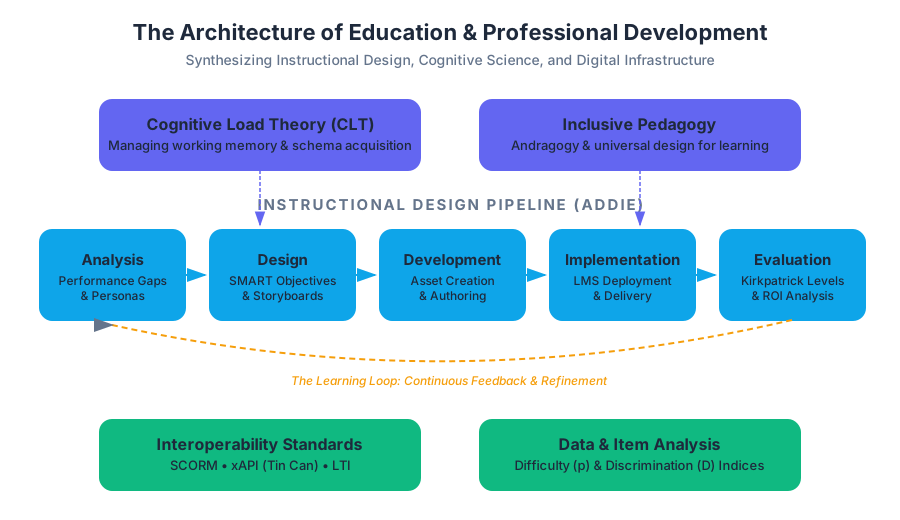
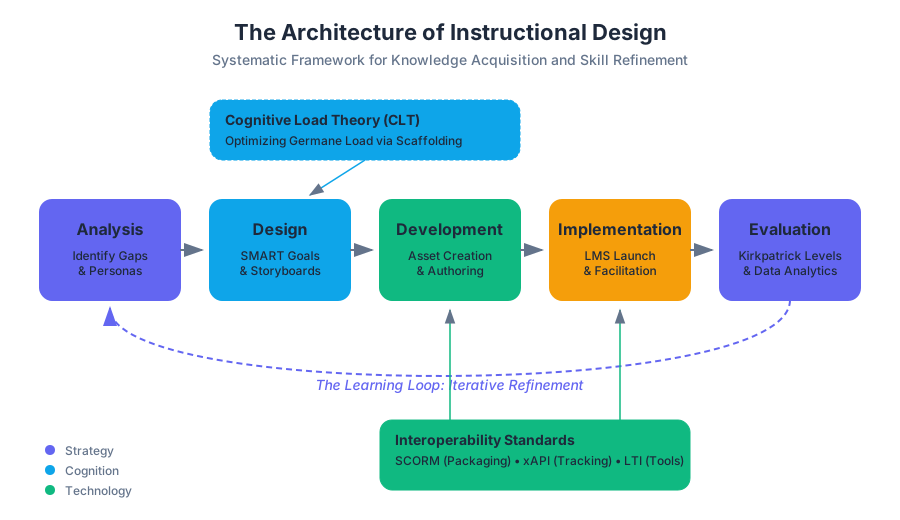
Ethnic Studies
Key concepts: Africana/Black Studies · Asian American Studies · Chicanx/Latinx Studies · Native American Studies · Eurocentrism
Interdisciplinary study centering the histories and narratives of BIPOC communities.
Ethnic Studies
Ethnic Studies is the interdisciplinary, comparative, and relational study of race, ethnicity, and indigeneity with a primary focus on the experiences and perspectives of Black, Indigenous, and People of Color (BIPOC) in the United States and globally. Unlike traditional social sciences that often observe marginalized communities as "objects" of study, Ethnic Studies operates as an epistemological intervention, positioning these communities as "subjects" who produce knowledge, history, and culture.
The Genesis of the Discipline: From Strike to System
The field emerged not from the quiet halls of academia, but from the 1968-1969 Third World Liberation Front (TWLF) strikes at San Francisco State College and UC Berkeley. These student-led movements demanded a curriculum that reflected their own histories and addressed the systemic inequalities of the era.
Definition: Ethnic Studies An interdisciplinary academic field that critiques the structures of power, racialization, and Eurocentrism. It utilizes a "decolonial" lens to analyze how race intersects with class, gender, and sexuality to shape the human experience.
| Feature | Traditional Social Science (Pre-1960s) | Ethnic Studies Framework |
|---|---|---|
| Primary Lens | Eurocentric / Universalist | Relational / Pluriversal |
| Subjectivity | Researcher as "Objective" Observer | Researcher as "Positioned" Participant |
| Goal | Description and Classification | Liberation and Social Justice |
| Unit of Analysis | The Individual or State | The Community and Power Structures |
| Knowledge Source | Western Canon / Empirical Data | Oral Histories, Counter-Narratives, Archives |
Core Concept: Eurocentrism and the "Default" State
At the heart of Ethnic Studies is a critique of Eurocentrism. This is the conscious or unconscious practice of placing European and Western history, values, and perspectives at the center of the global experience, treating them as the "universal" standard against which all other cultures are measured.
The Mechanics of Eurocentrism
Eurocentrism functions as a "root directory" in the operating system of Western knowledge. It filters information through:
- Universalism: The idea that Western values (e.g., individualism, Enlightenment rationalism) are the peak of human development.
- Linear Progress: The belief that history moves in a straight line toward Western-style "modernity."
- Othering: The categorization of non-Western cultures as "primitive," "exotic," or "developing."
The Four Pillars of Ethnic Studies
While the field is inherently intersectional, it is traditionally organized into four foundational sub-disciplines. Each has its own distinct methodology, historical trajectory, and theoretical "stack."
1. Africana / Black Studies
Africana Studies (also known as Black Studies or African American Studies) focuses on the history, culture, and politics of the African diaspora. It originated as a challenge to the "pathology" model of Black life in sociology.
- Key Concept: Double Consciousness: Coined by W.E.B. Du Bois, describing the internal conflict experienced by subordinated groups in an oppressive society.
- Methodology: Utilizing the "Black Radical Tradition" to analyze capitalism and racialization.
2. Asian American and Pacific Islander (AAPI) Studies
AAPI Studies examines the diverse experiences of people of Asian descent in the Americas. It critiques the Model Minority Myth—a sociopolitical construct used to minimize the effects of racism and drive a wedge between different BIPOC groups.
- Key Concept: Pan-ethnicity: The process by which various distinct ethnic groups (e.g., Chinese, Hmong, Filipino, Indian) forge a collective identity for political mobilization.
- Methodology: Analysis of immigration policy, labor history, and "Orientalism."
3. Chicanx / Latinx Studies
This field explores the experiences of people of Mexican, Central American, South American, and Caribbean descent. A central theme is the Borderlands—both as a physical geography and a psychological space.
- Key Concept: Mestizaje: The racial and cultural mixing that occurred in the Americas, often analyzed through the lens of colonial violence and resistance.
- Methodology: Decolonial theory and the study of "Aztlán" (the ancestral home of the Aztecs).
4. Native American / Indigenous Studies
Unlike other sub-fields, Native American Studies is centered on Sovereignty. It is not merely about "inclusion" into the U.S. state, but about the inherent rights of Indigenous nations to self-determination and land.
- Key Concept: Settler Colonialism: A persistent social and political structure where the colonizer stays, seeking to replace the original population on the land.
- Methodology: Indigenous Knowledge Systems (IKS) and the critique of the "Doctrine of Discovery."
Technical Implementation: Modeling Intersectionality
In Ethnic Studies, identity is not a single variable; it is a multi-dimensional array. Intersectionality, a term coined by Kimberlé Crenshaw, provides the "algorithm" for understanding how different forms of discrimination (racism, sexism, classism) overlap.
To understand this technically, we can model identity not as an additive property (Race + Gender), but as a multiplicative or relational function where the output is unique to the specific intersection.
# A simplified Pythonic representation of Intersectional Analysis
# This models how privilege and oppression are not just 'sums' but unique states.

class IdentityVector:
    def __init__(self, race, gender, class_status, ability):
        self.attributes = {
            "race": race,
            "gender": gender,
            "class": class_status,
            "ability": ability
        }

    def calculate_social_position(self, power_matrix):
        """
        Calculates the 'Social Position' based on a power matrix.
        Note: This is non-linear. The intersection of 'Black' and 'Woman'
        produces unique outcomes (Misogynoir) not found in 'Black' or 'Woman' alone.
        """
        position_score = 1.0
        for attr, value in self.attributes.items():
            # Power matrix defines the weight of specific traits in a given context
            weight = power_matrix.get_weight(attr, value)
            position_score *= weight # Multiplicative effect of intersectionality

        return position_score

# Example Usage:
# power_matrix_us_1950 = PowerMatrix("US_Jim_Crow_Era")
# subject_a = IdentityVector("Black", "Female", "Working", "Able-bodied")
# print(subject_a.calculate_social_position(power_matrix_us_1950))
Comparative Methodologies: Ethnic Studies vs. Anthropology
While Anthropology has evolved toward a "holistic approach" (integrating biological, cultural, and linguistic data), Ethnic Studies often critiques the historical "gaze" of Anthropology.
| Aspect | Anthropology | Ethnic Studies |
|---|---|---|
| Origin | Colonial administration/exploration | Civil Rights/Social Justice movements |
| Focus | "Humanity" as a broad species category | Specific racialized power dynamics |
| View of Race | Biological/Cultural variation | A social construct used for power |
| Language | Descriptive/Ethnographic | Critical/Transformative |
The "Remix" Culture: Open Education and Ethnic Studies
As highlighted in the LibreTexts ecosystem, Ethnic Studies materials are frequently "remixed." Because the field is dynamic and responsive to current events (e.g., Black Lives Matter, Stop AAPI Hate), static textbooks are often insufficient.
The Remixing Algorithm
- Curated Content: Pulling from "Bookshelves" (e.g., Anthropology, Communication Studies, Sociology).
- De-centering: Stripping away Eurocentric framing from traditional texts.
- Localizing: Adding "Campus Bookshelves" content that reflects the specific demographics of a student body.
- Deployment: Creating a "Course Shell" that is open-access and peer-reviewed.
\text{Curriculum}_{\text{EthnicStudies}} = \sum_{i=1}^{n} (\text{PrimarySource}_i \times \text{CriticalLens}) - \text{EurocentricBias}
# Example: Using a CLI tool to 'remix' a curriculum manifest (Conceptual)
# This represents the modular nature of modern Open Educational Resources (OER).

libre-remix --base "Sociology_101" \
            --add-module "Africana_Studies_Civil_Rights" \
            --add-module "Chicanx_Labor_History" \
            --filter "eurocentric_bias" \
            --output "./Ethnic_Studies_Intro_Custom.pdf"

# Result: A customized, decolonized textbook generated from open-source repositories.
Common Pitfalls and Misconceptions
- "It's just history": Ethnic Studies is not just "adding more names" to a history book. It is a change in how we analyze that history (the "Why" and "How" vs. just the "Who").
- "It's anti-Western": It is not an attack on the West, but a critique of Hegemony—the dominance of one perspective to the exclusion of all others.
- The "Model Minority" Trap: In AAPI studies, failing to recognize the vast class and educational disparities between different Asian subgroups (e.g., wealthy expats vs. refugees).
The Epistemological Pipeline
How knowledge is processed in an Ethnic Studies framework can be visualized as a pipeline that transforms "Raw History" into "Critical Consciousness."
- Ingestion: Recovery of suppressed archives and oral histories.
- Normalization: Contextualizing events within global systems (Colonialism, Capitalism).
- Analysis: Applying intersectional lenses to identify power imbalances.
- Praxis: Translating theory into social action or policy change.
# Curriculum Configuration for an Ethnic Studies Course Shell
course_id: ES201
title: "Introduction to Chicanx Studies"
framework: "Decolonial"
modules:
  - unit: 1
    topic: "Indigenous Roots and the Spanish Conquest"
    readings: ["Anzaldua", "Leon-Portilla"]
    pedagogy: "Reflective Practice"
  - unit: 2
    topic: "The Mexican-American War and the Treaty of Guadalupe Hidalgo"
    focus: "Land Dispossession"
  - unit: 3
    topic: "The Chicano Movement (1960s-70s)"
    connection: "Third World Liberation Front"
Summary of Interdisciplinary Connections
Ethnic Studies does not exist in a vacuum. It draws from and contributes to:
- Communication Studies: Analyzing how media reinforces racial stereotypes.
- Criminology: Examining the "School-to-Prison Pipeline" and urban inequality.
- Counseling & Guidance: Developing "Trauma-Informed" approaches for BIPOC students.
- Early Childhood Education: Implementing "Equity and Diversity" frameworks in play-based learning.
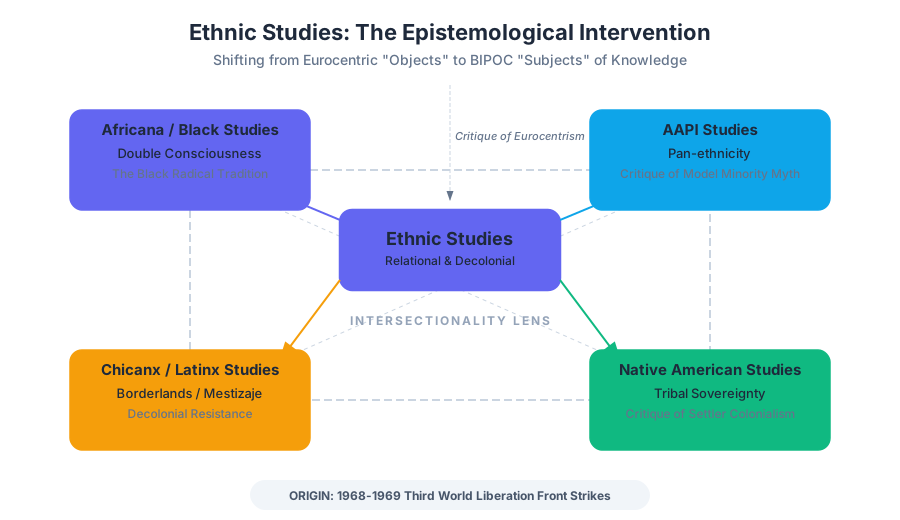
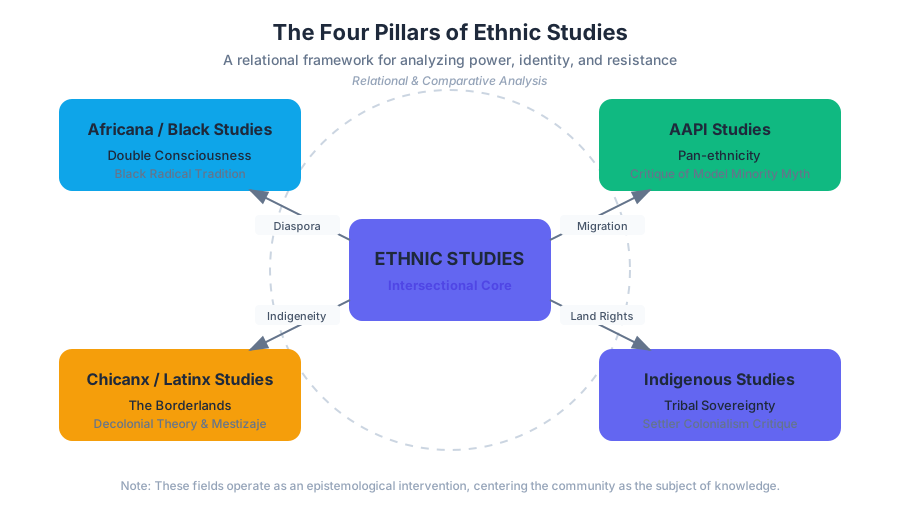
Gender Studies
Key concepts: Social Construction of Gender · Intersectionality · Feminist Theory · LGBTQ+ Studies · Human Sexuality
Examination of gender as a social construct and its intersection with race, sexuality, and power.
Gender Studies
Gender Studies is an interdisciplinary academic field dedicated to analyzing gender as a fundamental axis of social organization, power, and individual identity. Far from being a mere study of "men" and "women," it functions as a critical lens through which we examine how biological sex is transformed into social categories, how these categories intersect with other variables like race and class, and how they are maintained through discourse, performance, and institutional policy.
The Social Construction of Gender
The foundational premise of modern Gender Studies is the distinction between sex (biological attributes such as chromosomes, hormones, and anatomy) and gender (the social, cultural, and psychological meanings assigned to those attributes). Social constructionism posits that gender is not an innate "essence" but a product of human interaction and cultural history.
The "Doing Gender" Framework
Sociologists West and Zimmerman (1987) argued that gender is not something a person is, but something a person does. It is a routine accomplishment embedded in everyday interaction. This "performance" is monitored by others and held accountable to societal norms.
Key Insight: The Performativity of Gender Judith Butler expanded this by proposing that gender is performative. It is not a singular act, but a repetition of rituals and behaviors that create the illusion of a stable, internal gender identity. There is no "gender core" behind the expression; the expression is the gender.
| Feature | Sex | Gender |
|---|---|---|
| Origin | Biological / Physiological | Social / Cultural |
| Categorization | Male, Female, Intersex | Masculine, Feminine, Non-binary, etc. |
| Stability | Generally static (barring medical intervention) | Fluid across time, culture, and individual life |
| Mechanism | Genetics, Hormones, Anatomy | Socialization, Discourse, Performance |
| Example | Presence of XX or XY chromosomes | Expectation that "men don't cry" |
Socialization Feedback Loops
Gender is reinforced through feedback loops starting at birth (or even pre-birth via "gender reveals"). These loops function similarly to reinforcement learning in computational models, where "correct" gender performance is rewarded and "incorrect" performance is sanctioned.
import numpy as np

class SocializationAgent:
    """
    A simulation of how social reinforcement shapes gendered behavior.
    The agent learns to optimize its 'social_acceptance' score by
    aligning its behavior with external expectations.
    """
    def __init__(self, gender_norm_vector):
        self.norms = gender_norm_vector  # Target behaviors (e.g., [0.9, 0.1])
        self.behavior = np.random.rand(2) # Initial random behavior
        self.learning_rate = 0.05

    def receive_feedback(self):
        # Calculate 'social friction' as the distance from the norm
        friction = np.linalg.norm(self.norms - self.behavior)
        # Social reward is inversely proportional to friction
        reward = 1.0 / (1.0 + friction)

        # Update behavior via gradient descent toward the norm
        gradient = self.norms - self.behavior
        self.behavior += self.learning_rate * gradient * reward
        return reward, self.behavior

# Example: A society where 'Masculinity' norm is [0.9 (Stoicism), 0.1 (Nurturance)]
agent = SocializationAgent(np.array([0.9, 0.1]))
for epoch in range(100):
    r, b = agent.receive_feedback()
    if epoch % 20 == 0:
        print(f"Epoch {epoch}: Behavior={b}, Social Reward={r:.4f}")
Intersectionality
Developed by Kimberlé Crenshaw in 1989, Intersectionality is a framework for understanding how various social identities—such as race, gender, sexual orientation, disability, and class—overlap to create unique modes of discrimination and privilege.
The Matrix of Domination
Patricia Hill Collins conceptualized this as the Matrix of Domination, which describes how power is organized across multiple levels: the personal (biographical), the group (cultural), and the institutional (structural). Intersectionality rejects "additive" models (e.g., being a Black woman is not simply "Blackness + Womanhood") and instead argues for a multiplicative, qualitative shift in experience.
Formalizing Intersectionality
In a formal sense, we can view intersectional identity as a non-linear function where the experience $E$ is not the sum of its parts, but a result of their interaction within a specific power structure $P$.
E(identity) = \Phi(Race \otimes Gender \otimes Class, P)
Where $\otimes$ denotes a tensor product, implying that the dimensions are inextricably linked and modify one another.
| Axis of Identity | Dominant Group | Subordinated Group |
|---|---|---|
| Gender | Cisgender Men | Women, Trans, Non-binary |
| Race | White / Eurocentric | BIPOC (Black, Indigenous, People of Color) |
| Class | Owning Class / Wealthy | Working Class / Poor |
| Ability | Able-bodied | Persons with Disabilities |
| Sexuality | Heterosexual | LGBTQ+ |
Feminist Theory
Feminist theory provides the analytical tools to critique the "patriarchy"—a social system in which men hold primary power and predominate in roles of political leadership, moral authority, social privilege, and control of property.
Major Frameworks
- Liberal Feminism: Focuses on individual rights and legal reform. It seeks equality within the existing social structure (e.g., suffrage, equal pay).
- Radical Feminism: Views patriarchy as the root cause of all social inequality. It calls for a radical reordering of society to eliminate male supremacy in all social and economic contexts.
- Marxist/Socialist Feminism: Analyzes how capitalism and patriarchy work together to exploit women’s labor, particularly "reproductive labor" (housework, childcare).
- Post-structuralist Feminism: Challenges the very category of "woman," arguing that language and discourse construct our understanding of gender and power.
The Three Waves (and beyond)
The history of feminism is often categorized into "waves," though this metaphor is increasingly criticized for oversimplifying the continuous struggle for rights.
| Wave | Primary Focus | Key Outcomes |
|---|---|---|
| First Wave (19th-early 20th c.) | Suffrage, property rights, legal personhood. | Right to vote (19th Amendment in US). |
| Second Wave (1960s-1980s) | Workplace equality, reproductive rights, domestic violence. | Title IX, Roe v. Wade, "The Personal is Political." |
| Third Wave (1990s-2010s) | Intersectionality, Queer theory, deconstructing gender roles. | Greater focus on diverse identities and micro-politics. |
| Fourth Wave (2010s-Present) | Digital activism, #MeToo, systemic harassment, body positivity. | Global awareness of sexual misconduct, trans-inclusive feminism. |
LGBTQ+ Studies and Queer Theory
LGBTQ+ Studies (Lesbian, Gay, Bisexual, Transgender, and Queer Studies) examines the lives, histories, and cultures of sexual and gender minorities. It evolved from early "Gay and Lesbian Studies" into the more expansive Queer Theory.
Deconstructing Heteronormativity
Heteronormativity is the assumption that heterosexuality is the default or "normal" sexual orientation and that there are only two distinct, complementary genders. Queer Theory seeks to "trouble" these binaries, arguing that both gender and sexuality exist on a fluid spectrum rather than in discrete boxes.
Definition: The Kinsey Scale Developed by Alfred Kinsey, this 7-point scale (0 to 6) was one of the first scientific attempts to quantify sexual orientation, moving away from a binary "Gay/Straight" model to a continuum of behavior and attraction.
Implementation in Modern Systems
In technical systems, the shift from binary to fluid gender models requires a change in data architecture. Moving away from bool is_male to more inclusive schemas is a practical application of LGBTQ+ studies in software engineering.
-- A normalized schema for inclusive gender and identity management
CREATE TABLE Users (
    user_id UUID PRIMARY KEY,
    legal_name VARCHAR(255),
    preferred_name VARCHAR(255),
    -- Avoid ENUMs for gender to allow for future-proofing
    gender_identity_id INT REFERENCES GenderIdentities(id)
);

CREATE TABLE GenderIdentities (
    id SERIAL PRIMARY KEY,
    label VARCHAR(50) UNIQUE -- 'Non-binary', 'Trans-Woman', 'Agender', etc.
);

CREATE TABLE Pronouns (
    id SERIAL PRIMARY KEY,
    subjective VARCHAR(20), -- 'They'
    objective VARCHAR(20),  -- 'Them'
    possessive VARCHAR(20)  -- 'Theirs'
);

CREATE TABLE UserPronouns (
    user_id UUID REFERENCES Users(user_id),
    pronoun_id INT REFERENCES Pronouns(id),
    PRIMARY KEY (user_id, pronoun_id)
);
Human Sexuality
Human sexuality is the capacity to have erotic experiences and responses. In Gender Studies, sexuality is viewed as a complex interplay of biological drives and social "scripts."
Sexual Script Theory
Proposed by Simon and Gagnon (1973), this theory suggests that human sexual behavior is not "natural" or "instinctual" but is guided by scripts learned from culture.
- Cultural Scenarios: Broad societal norms (e.g., what is considered "sexy" in a given decade).
- Interpersonal Scripts: How we negotiate encounters with others.
- Intrapsychic Scripts: Our internal fantasies and desires.
The Bio-Psycho-Social Model
Sexuality is best understood through a multi-layered approach:
- Biological: Hormonal cycles, neurobiology of arousal, reproductive health.
- Psychological: Individual attachment styles, past experiences, self-image.
- Social: Legal frameworks, religious influences, media representations.
Common Pitfalls and Misconceptions
- Biological Essentialism: The mistake of assuming that because a behavior has a biological correlate (e.g., testosterone), it is "natural" and unchangeable. Gender Studies highlights how social environments can trigger or suppress biological expressions.
- Conflating Gender Identity and Sexual Orientation: One's internal sense of being a man, woman, or non-binary person (Gender Identity) is distinct from whom one is attracted to (Sexual Orientation). A trans man can be gay, straight, or bisexual.
- Universalizing "Womanhood": Early feminist theory was criticized for assuming the experiences of white, middle-class Western women represented all women. Intersectionality is the corrective to this mistake.
- The "Nature vs. Nurture" Binary: Modern scholarship views this as a false dichotomy. Instead, we look at Epigenetics and Social-Biological Interactionism, where social conditions literally get "under the skin" to affect biology.
Interdisciplinary Connections
Gender Studies does not exist in a vacuum; it draws from and informs several other fields:
- Anthropology: Examining "Third Genders" in non-Western cultures (e.g., the Hijra in South Asia or Two-Spirit individuals in Indigenous North American cultures) to prove that the Western gender binary is not a human universal.
- Communication Studies: Analyzing how non-verbal cues (posture, "manspreading," vocal fry) and verbal patterns (hedging, interrupting) reinforce gendered power dynamics.
- Criminology: Investigating the "gender gap" in crime—why men are more likely to commit violent crimes and how the justice system treats women offenders differently.
- Early Childhood Education: Studying how play-based learning and teacher expectations can either reinforce or challenge gender stereotypes in children as young as three.
Summary of Core Methodologies
To conclude, Gender Studies utilizes a variety of methodologies to unpack these complex systems:
| Method | Application |
|---|---|
| Discourse Analysis | Examining how language in media or law creates "truths" about gender. |
| Ethnography | Immersive study of specific subcultures (e.g., drag balls, corporate boardrooms) to see gender "in action." |
| Quantitative Analysis | Using large datasets to track the gender pay gap, representation in STEM, or health disparities. |
| Archival Research | Recovering the "hidden histories" of women and LGBTQ+ individuals who were erased from traditional historical narratives. |
By synthesizing these perspectives, Gender Studies provides a rigorous framework for understanding one of the most pervasive and influential structures of the human experience.
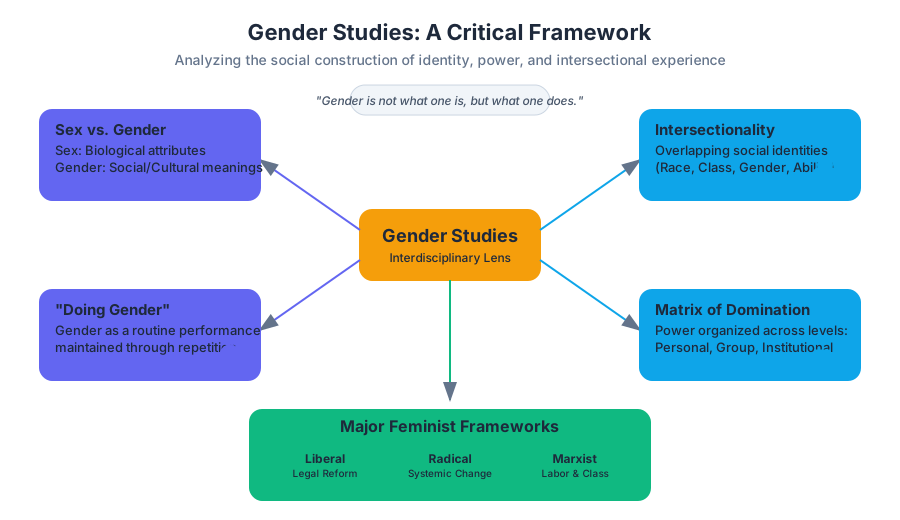
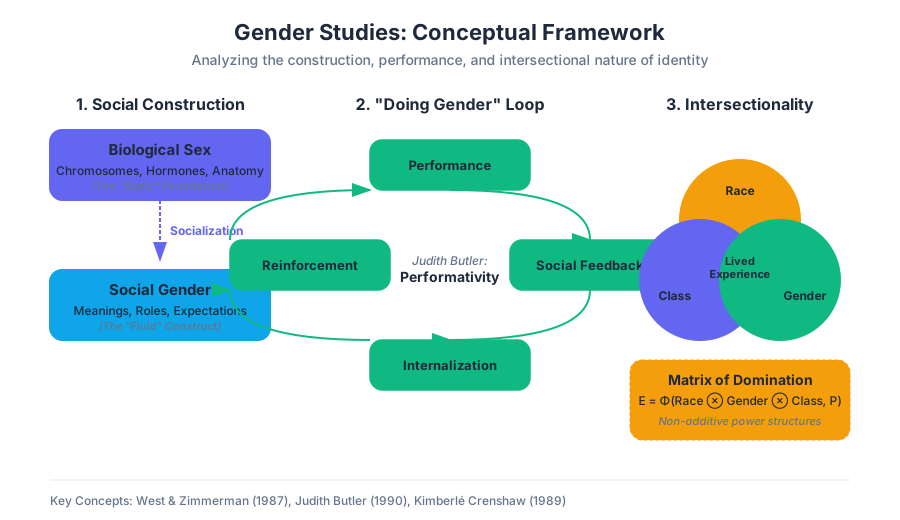
Geography (Human)
Key concepts: Space and Place · Human-Environment Interaction · Cultural Geography · Spatial Relations · Global Studies
Study of the relationships between people, communities, and their environments across space and place.
Geography (Human)
Human geography is the analytical study of the patterns and processes that shape human interaction with the Earth's surface. Unlike physical geography, which focuses on geomorphology and climatology, human geography treats the Earth as a canvas for social, cultural, economic, and political phenomena. It is an inherently interdisciplinary field, synthesizing insights from Anthropology (the holistic study of humankind), Communication Studies (the mechanics of interaction), and Sociology to decode why things happen where they happen.
At its core, human geography seeks to answer the "why of where." It moves beyond simple cartography to investigate the spatial logic of human existence. Whether analyzing the diffusion of a new dialect, the structural inequality of urban "food deserts," or the geopolitical implications of global supply chains, human geography provides the spatial framework necessary to understand a globalized world.
Space and Place: The Ontological Foundations
The distinction between Space and Place is the most fundamental concept in the discipline. While often used interchangeably in colloquial speech, they represent distinct modes of geographical understanding.
- Space: Refers to an abstract, objective, and mathematical area. It is defined by coordinates, distance, and geometric relationships. In the context of Spatial Relations, space is the container in which human activity occurs.
- Place: Refers to a space that has been endowed with meaning, value, and human emotion. Place is experiential and subjective. As geographer Yi-Fu Tuan famously noted, "Space is freedom, place is security; we are attached to the one and longed for the other."
The Mechanics of Spatial Analysis
To analyze space, geographers use several key metrics to describe the relationship between objects:
- Density: The frequency with which something occurs in a specific area.
- Concentration: The extent of a feature's spread over space (clustered vs. dispersed).
- Pattern: The geometric arrangement of objects in space (linear, centralized, or random).
Definition: Tobler's First Law of Geography "Everything is related to everything else, but near things are more related than distant things." This principle forms the basis of Spatial Autocorrelation and the concept of Distance Decay.
| Concept | Definition | Mathematical/Logical Representation | Human Example |
|---|---|---|---|
| Absolute Space | Fixed coordinate systems (Lat/Long). | $S = {x, y, z}$ | A GPS coordinate in the Sahara. |
| Relative Space | Defined by connectivity and time-cost. | $S_{rel} = f(Time, Cost)$ | "20 minutes away by train." |
| Sense of Place | The emotional bond to a location. | $P = Space + Meaning$ | A childhood home or a sacred site. |
| Placelessness | Loss of uniqueness in the landscape. | $P \rightarrow 0$ | A generic suburban strip mall. |
Implementation: Calculating Spatial Proximity
In modern human geography, spatial relations are often calculated using the Haversine Formula to account for the Earth's curvature when determining the distance between two human settlements.
/*
 * Low-level implementation of Haversine Distance
 * Used in GIS backends to calculate 'Space' between coordinates.
 */
#include <stdio.h>
#include <math.h>

#define EARTH_RADIUS 6371.0 // Radius in kilometers

typedef struct {
    double lat;
    double lon;
} Coordinate;

double to_radians(double degree) {
    return degree * (M_PI / 180.0);
}

double calculate_distance(Coordinate c1, Coordinate c2) {
    double dLat = to_radians(c2.lat - c1.lat);
    double dLon = to_radians(c2.lon - c1.lon);

    double a = sin(dLat / 2) * sin(dLat / 2) +
               cos(to_radians(c1.lat)) * cos(to_radians(c2.lat)) *
               sin(dLon / 2) * sin(dLon / 2);

    double c = 2 * atan2(sqrt(a), sqrt(1 - a));
    return EARTH_RADIUS * c;
}

int main() {
    Coordinate cityA = {40.7128, -74.0060}; // New York
    Coordinate cityB = {34.0522, -118.2437}; // Los Angeles

    double dist = calculate_distance(cityA, cityB);
    printf("Spatial Distance: %.2f km\n", dist);
    return 0;
}
Human-Environment Interaction
Human-Environment Interaction (HEI) examines the reciprocal relationship between human social systems and the ecosystem. Historically, this subfield was dominated by Environmental Determinism, the now-discredited theory that physical environment (especially climate) dictates human social development and "character."
Modern geography favors Possibilism, which argues that while the environment sets certain constraints, human culture and technology provide the agency to overcome them.
The Three Pillars of HEI
- Adaptation: Changing human behavior to fit the environment (e.g., building stilt houses in flood-prone regions).
- Modification: Changing the environment to fit human needs (e.g., the Dutch Polder system or the Hoover Dam).
- Dependency: The reliance on natural resources for survival (e.g., the proximity of early civilizations to river valleys).
The Anthropocene and Sustainability
We have entered the Anthropocene, a proposed geological epoch where human activity is the primary driver of planetary change. This has shifted the focus of HEI toward Sustainability and Resilience. Geographers now use complex models to predict how urban sprawl affects local microclimates (the Urban Heat Island effect) and how global warming triggers mass migration.
| Paradigm | Core Belief | Key Figure/Context | Modern Status |
|---|---|---|---|
| Environmental Determinism | Nature controls human fate. | Friedrich Ratzel | Discredited (often used to justify colonialism). |
| Possibilism | Humans have agency within limits. | Paul Vidal de la Blache | Dominant perspective. |
| Cultural Ecology | Culture is a tool for environmental adaptation. | Julian Steward | Integrated into Anthropology. |
| Political Ecology | Environmental issues are inseparable from political/economic power. | Piers Blaikie | Critical for Global Studies. |
Cultural Geography: The Spatialization of Identity
Cultural Geography explores how cultural values, practices, and artifacts vary across space and how they create distinct Cultural Landscapes. A landscape is not just a physical view; it is a "text" that can be read to understand the power structures, history, and identity of the people who inhabit it.
Key Mechanisms of Culture
- Cultural Hearth: The origin point of a specific cultural innovation (e.g., the Nile Valley for agriculture or Silicon Valley for digital culture).
- Diffusion: The spread of ideas, people, or goods across space.
- Relocation Diffusion: Physical movement of people (Migration).
- Expansion Diffusion: Spread through a population (Contagious, Hierarchical, or Stimulus).
- Cultural Palimpsest: A landscape that bears the layers of successive societies, where the old is not entirely erased by the new (e.g., a modern European city with Roman foundations and Medieval walls).
Modeling Cultural Diffusion
The spread of information or culture can be modeled using the Gravity Model, which predicts the level of interaction between two places based on their size and distance.
I_{ij} = G \frac{P_i P_j}{d_{ij}^\beta}
Where:
- $I_{ij}$ is the interaction between place $i$ and place $j$.
- $P$ is the population (or "cultural mass").
- $d$ is the distance.
- $G$ is a constant.
- $\beta$ is the friction of distance (distance decay factor).
Spatial Relations and Global Studies
In the era of Global Studies, human geography examines the "shrinking" of the world through Time-Space Compression. Technological advances in communication and transportation have effectively reduced the functional distance between points on the globe, leading to Globalization.
The World Systems Theory
Geographer Immanuel Wallerstein proposed a spatial model of the global economy that divides the world into a hierarchy:
- Core: High-income, industrialized nations that control global markets (e.g., USA, EU, Japan).
- Periphery: Low-income nations providing raw materials and cheap labor (e.g., much of Sub-Saharan Africa).
- Semi-Periphery: Industrializing nations that mediate between the core and periphery (e.g., Brazil, India, China).
Urbanization and Global Cities
The 21st century is the century of the city. For the first time in history, more than 50% of the human population lives in urban areas. Global Cities (or World Cities) like London, New York, and Tokyo act as the command-and-control nodes of the global economy, more connected to each other than to their own rural hinterlands.
| Urban Concept | Definition | Significance |
|---|---|---|
| Megacity | A metropolitan area with >10 million people. | Hubs of innovation but also extreme inequality. |
| Primate City | A city more than twice as large as the next biggest city in a country. | Indicates centralized power (e.g., Paris, Bangkok). |
| Gentrification | Reinvestment in low-income urban areas. | Causes displacement and changes the "Sense of Place." |
| Edge City | A concentration of business/shopping outside a traditional downtown. | Result of automobile-centric spatial planning. |
Advanced Spatial Analysis: GIS and Data Science
Modern human geography is increasingly quantitative, relying on Geographic Information Systems (GIS) to layer data and find hidden correlations. This is where the discipline meets Data Science.
Spatial Joins and Overlays
A spatial join allows a researcher to combine two datasets based on their location. For example, a geographer might join a dataset of "Criminal Justice" records with a dataset of "Urban Inequality" (from the source materials) to see if policing patterns correlate with socioeconomic indicators.
# Example: Using GeoPandas to analyze spatial relations
import geopandas as gpd
from shapely.geometry import Point

# 1. Load spatial data (e.g., city neighborhoods)
neighborhoods = gpd.read_file('city_neighborhoods.geojson')

# 2. Create points for specific events (e.g., community centers)
data = {'name': ['Center A', 'Center B'], 'lat': [34.05, 34.06], 'lon': [-118.24, -118.25]}
geometry = [Point(xy) for xy in zip(data['lon'], data['lat'])]
centers = gpd.GeoDataFrame(data, geometry=geometry, crs="EPSG:4326")

# 3. Spatial Join: Find which neighborhood each center is in
joined_data = gpd.sjoin(centers, neighborhoods, how="inner", predicate="within")

# 4. Calculate Density (Spatial Relation)
neighborhood_counts = joined_data.groupby('neighborhood_name').size()
print(neighborhood_counts)
Critical Perspectives: Disability and Social Justice
Human geography is not neutral; it is a tool for understanding power. Disability Studies in geography examines how the built environment "disables" individuals through inaccessible design. A staircase is not just an architectural feature; it is a spatial barrier that reflects a society's priorities.
Similarly, Criminology and Criminal Justice are deeply spatial. The "Broken Windows Theory" suggests that the physical state of a neighborhood (the landscape) influences human behavior and crime rates. Geographers critique these theories by looking at the underlying Urban Inequality—the "Redlining" maps of the past that still dictate the wealth and safety of neighborhoods today.
Key Insight: The Social Construction of Space Space is not just "there." It is produced by social processes. A border is a social construct that becomes a physical reality through walls, checkpoints, and laws, fundamentally altering the spatial relations of everyone near it.
Common Pitfalls in Human Geography
- The Ecological Fallacy: Assuming that a trend seen at a large scale (e.g., a whole country) applies to every individual or local area within it.
- Spatial Determinism: Over-attributing human behavior to spatial factors while ignoring historical, political, or individual agency.
- Map Projection Bias: Forgetting that all maps are distortions. The Mercator projection, for instance, makes the Global North appear much larger than it is, subtly reinforcing Eurocentric worldviews.
Summary of Interdisciplinary Connections
Human Geography acts as the "spatial glue" for the social sciences:
- Anthropology: Provides the deep cultural context for the "Place" geographers study.
- Communication Studies: Explains the "Diffusion" of ideas across space.
- Criminology: Uses "Spatial Relations" to understand and prevent crime.
- Early Childhood Education: Looks at the "Geography of Play" and how environment affects cognitive development.
Author's Note: This article serves as a foundational remix of curated academic materials from the LibreTexts Bookshelves. For further exploration into specific sub-disciplines like Linguistic Anthropology or Urban Inequality, users are encouraged to consult the specialized course shells and campus bookshelves within the library.
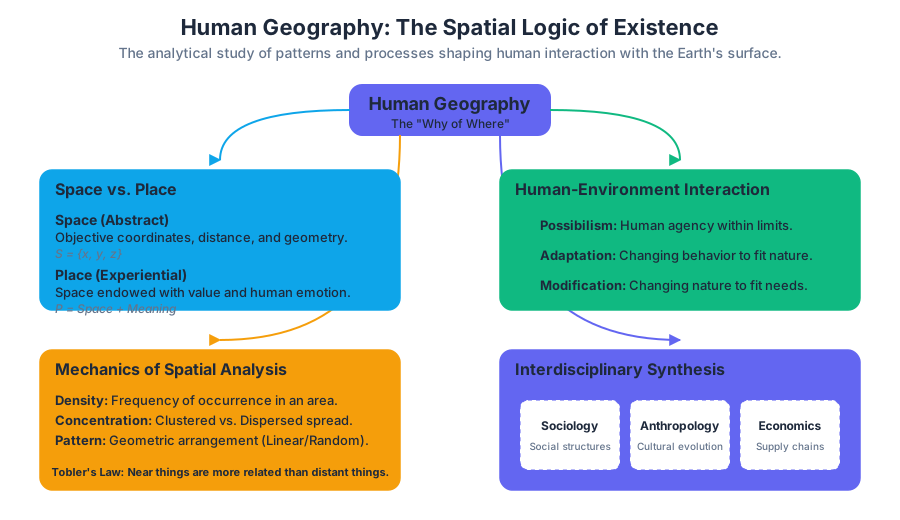
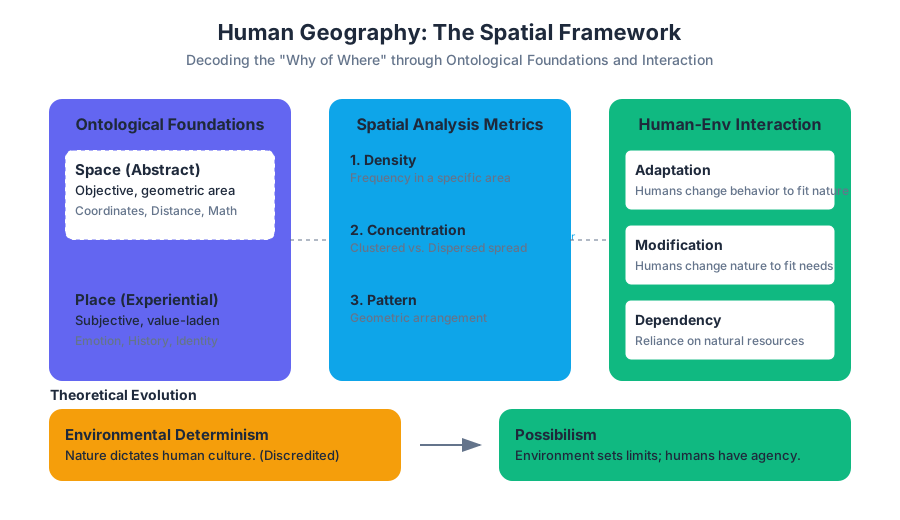
Human Development
Key concepts: Developmental Psychology · Lifespan Development · Physical Development · Cognitive Development · Socioemotional Development
Scientific study of how individuals change across the entire lifespan.
Human Development
Overview
Human Development, often categorized under Developmental Psychology, is the multi-disciplinary scientific study of the patterns of growth, change, and stability that occur throughout the entire human lifespan. It is not merely the study of childhood; rather, it is a "womb to tomb" investigation into the biological, psychological, and social transformations that define the human experience.
The field operates on the fundamental premise that development is cumulative, multidimensional, and plastic. It seeks to answer the "Nature vs. Nurture" question—how much of our behavior is a result of genetic inheritance (nature) versus the environment and culture in which we were raised (nurture).
Definition: Lifespan Development The perspective that development is a lifelong process of multidirectional change, characterized by high levels of plasticity and influenced by multiple interacting forces including biological, historical, and social contexts.
The Lifespan Perspective
Developed largely by Paul Baltes, the lifespan perspective provides a meta-theoretical framework for understanding how individuals change. It rejects the notion that development "peaks" in adolescence and "declines" in old age, suggesting instead that every age period involves both gains and losses.
| Principle | Description | Technical Implication |
|---|---|---|
| Lifespan Process | No age period is supreme; development occurs from conception to death. | Requires longitudinal data structures for analysis. |
| Multidimensional | Involves biological, cognitive, and socioemotional dimensions. | Systems must account for cross-domain covariance. |
| Multidirectional | Some components grow while others decline (e.g., fluid vs. crystallized intelligence). | Non-linear modeling is required for accurate prediction. |
| Plasticity | The capacity for change exists at all ages. | Neural pathways can be rerouted via intervention (Neuroplasticity). |
| Contextualism | Development is influenced by normative age-graded, history-graded, and non-normative life events. | Requires metadata on historical and environmental variables. |
Physical Development
Physical development encompasses the maturation of the body, including the brain, sensory capacities, motor skills, and health-related behaviors. This domain is heavily influenced by genetics and epigenetics—the study of how environmental factors can turn genes "on" or "off."
The Biological Foundation
At the core of physical development is the genetic code. The Heritability Index ($h^2$) is a statistical measure used to estimate how much of the variation in a trait within a population is due to genetic differences.
Implementation: Simulating Heritability
The following Python script demonstrates a simplified simulation of phenotypic variance based on genetic and environmental inputs, illustrating how researchers quantify "Nature vs. Nurture."
import numpy as np

def simulate_phenotype(n_samples=1000, heritability=0.5):
    """
    Simulates phenotypic variance based on a specified heritability index.
    P = G + E (Phenotype = Genetics + Environment)
    """
    # Variance of Phenotype is normalized to 1.0
    var_p = 1.0
    var_g = heritability * var_p
    var_e = (1 - heritability) * var_p

    # Generate genetic and environmental components
    genetics = np.random.normal(0, np.sqrt(var_g), n_samples)
    environment = np.random.normal(0, np.sqrt(var_e), n_samples)

    # Calculate Phenotype
    phenotype = genetics + environment

    # Calculate observed heritability in the sample
    observed_h2 = np.var(genetics) / np.var(phenotype)

    return phenotype, observed_h2

# Example: Intelligence (often cited around 0.5 to 0.7 heritability)
scores, h2_actual = simulate_phenotype(n_samples=10000, heritability=0.65)
print(f"Target Heritability: 0.65 | Observed: {h2_actual:.4f}")
Growth Patterns and the Brain
Physical growth follows two primary patterns:
- Cephalocaudal: Growth from the head downward.
- Proximodistal: Growth from the center of the body outward.
In the brain, development is characterized by Synaptogenesis (the creation of new connections) followed by Synaptic Pruning (the elimination of unused connections to increase efficiency). This process is the biological basis for the "critical periods" in learning, such as language acquisition.
Cognitive Development
Cognitive development refers to the evolution of thought processes, including perception, memory, problem-solving, and language. The two most influential figures in this domain are Jean Piaget and Lev Vygotsky.
Piaget’s Constructivism
Piaget proposed that children are "little scientists" who construct their understanding of the world through Schemas (mental frameworks). When new information is encountered, it is either Assimilated (fitted into an existing schema) or Accommodated (the schema is changed to fit the new info).
| Stage | Age Range | Key Characteristics | Major Achievement |
|---|---|---|---|
| Sensorimotor | 0–2 years | Coordination of senses with motor response. | Object Permanence |
| Preoperational | 2–7 years | Symbolic thinking; use of proper syntax. | Imagination/Intuition |
| Concrete Operational | 7–11 years | Concepts attached to concrete situations. | Conservation |
| Formal Operational | 11+ years | Theoretical, hypothetical, and counterfactual thinking. | Abstract Logic |
Vygotsky’s Socio-Cultural Theory
Unlike Piaget, Vygotsky emphasized the role of social interaction and culture. His most famous concept is the Zone of Proximal Development (ZPD).
Mathematical Representation of ZPD
The ZPD can be modeled as the delta between an individual's independent performance and their performance with "scaffolding" (assistance from a More Knowledgeable Other, or MKO).
ZPD = \Psi_{assisted} - \Psi_{independent}
Where:
- $\Psi_{assisted}$ is the cognitive output achieved with social scaffolding.
- $\Psi_{independent}$ is the cognitive output achieved in isolation.
- Effective instruction occurs specifically within the range $(\Psi_{independent}, \Psi_{assisted})$.
Socioemotional Development
Socioemotional development involves changes in emotions, personality, and social relationships. It addresses how we develop an identity, how we relate to others, and how we navigate moral dilemmas.
Erikson’s Psychosocial Stages
Erik Erikson expanded on Freudian theory to create eight stages of development, each defined by a "crisis" that must be resolved.
| Stage | Crisis | Virtue Developed |
|---|---|---|
| Infancy | Trust vs. Mistrust | Hope |
| Early Childhood | Autonomy vs. Shame/Doubt | Will |
| Preschool | Initiative vs. Guilt | Purpose |
| School Age | Industry vs. Inferiority | Competency |
| Adolescence | Identity vs. Role Confusion | Fidelity |
| Young Adulthood | Intimacy vs. Isolation | Love |
| Middle Adulthood | Generativity vs. Stagnation | Care |
| Maturity | Ego Integrity vs. Despair | Wisdom |
Attachment Theory
John Bowlby and Mary Ainsworth pioneered the study of Attachment, the deep emotional bond between an infant and their primary caregiver. Using the "Strange Situation" protocol, Ainsworth identified four primary attachment styles:
- Secure: Child uses parent as a "secure base" for exploration.
- Anxious-Resistant: Child is clingy and difficult to comfort upon return.
- Anxious-Avoidant: Child ignores the parent and shows no preference over a stranger.
- Disorganized: Child shows inconsistent or erratic behavior (often linked to trauma).
Implementation: Standardized Milestone Tracking
In modern clinical settings, socioemotional and cognitive milestones are tracked using standardized data formats to ensure interoperability between pediatricians and specialists.
{
  "subject_id": "DEV-99283",
  "assessment_type": "ASQ-3",
  "chronological_age_months": 24,
  "domains": {
    "communication": {
      "score": 45,
      "threshold": 35,
      "status": "above_cutoff"
    },
    "gross_motor": {
      "score": 55,
      "threshold": 40,
      "status": "above_cutoff"
    },
    "socio_emotional": {
      "score": 25,
      "threshold": 30,
      "status": "monitoring_required",
      "observations": ["Limited eye contact", "Delayed parallel play"]
    }
  },
  "metadata": {
    "examiner_id": "DR_SMITH_77",
    "timestamp": "2023-10-27T10:00:00Z"
  }
}
Research Methodologies in Development
Studying change over time requires specific research designs that go beyond standard experimental methods.
Longitudinal vs. Cross-Sectional Designs
- Longitudinal: Following the same group of individuals over many years.
- Cross-Sectional: Comparing different age groups at a single point in time.
- Sequential: A hybrid approach that follows multiple age cohorts over time to disentangle age effects from cohort effects.
| Method | Pros | Cons |
|---|---|---|
| Cross-Sectional | Fast, inexpensive, no attrition. | Susceptible to Cohort Effects (generational differences). |
| Longitudinal | Measures actual change/stability. | Expensive, time-consuming, high attrition rate. |
| Sequential | Identifies cohort effects; high validity. | Extremely complex and resource-intensive. |
Data Modeling: Longitudinal Cohorts
To manage the data from a sequential study, a relational database must handle multiple "waves" of data collection across different birth cohorts.
-- Schema for a Longitudinal Developmental Study
CREATE TABLE Cohorts (
    cohort_id INT PRIMARY KEY,
    birth_year_range VARCHAR(50)
);

CREATE TABLE Participants (
    participant_id UUID PRIMARY KEY,
    cohort_id INT REFERENCES Cohorts(cohort_id),
    birth_date DATE,
    socioeconomic_status_index FLOAT
);

CREATE TABLE Assessment_Waves (
    wave_id INT PRIMARY KEY,
    wave_year INT,
    description TEXT
);

CREATE TABLE Observations (
    observation_id SERIAL PRIMARY KEY,
    participant_id UUID REFERENCES Participants(participant_id),
    wave_id INT REFERENCES Assessment_Waves(wave_id),
    cognitive_score INT,
    physical_height_cm FLOAT,
    stress_hormone_level FLOAT
);
Interdisciplinary Connections
Human development does not exist in a vacuum. It is deeply intertwined with other fields of study provided in the LibreTexts library:
- Anthropology: Provides the cultural context for development. While Piaget’s stages are largely universal, the timing and valuation of specific milestones (like independence) vary across cultures (Cultural vs. Biological Anthropology).
- Communication Studies: Explores how verbal and non-verbal communication skills develop. The transition from "babbling" to complex syntax is a primary marker of cognitive maturation.
- Criminology: Investigates how developmental disruptions (e.g., trauma, lack of attachment) can lead to "Life-Course Persistent" offending patterns versus "Adolescence-Limited" delinquency.
- Early Childhood Education: Applies developmental theories to classroom practice, emphasizing Play-Based Learning and Trauma-Informed Care.
- Counseling & Guidance: Uses lifespan development to help individuals navigate transitions, such as career changes in middle adulthood or grief in late adulthood.
Common Pitfalls and Misconceptions
- The "Average" Fallacy: Developmental milestones (e.g., walking at 12 months) are averages. Significant variance is normal and does not always indicate a pathology.
- Nature vs. Nurture Dichotomy: It is rarely "one or the other." Modern science focuses on Gene-Environment Interaction ($G \times E$). A child may have a genetic predisposition for high intelligence, but without an enriched environment, that potential may not be realized.
- Stability Myth: While early childhood is critical, it is not "destiny." Due to neuroplasticity and social support, individuals can overcome early adversity (Resilience).
Conclusion
Human development is a complex, multi-layered process that requires a holistic lens to fully comprehend. By synthesizing physical maturation, cognitive evolution, and socioemotional shifts, we gain a comprehensive understanding of what it means to be human. Whether we are designing educational curricula, developing public policy, or providing clinical counseling, the principles of developmental psychology provide the essential roadmap for supporting human flourishing at every stage of life.
Library and Information Science
Key concepts: Information Organization · Search Strategies · Resource Evaluation · Information Ethics · Information Retrieval
Focus on information organization, retrieval, and ethical application.
Library and Information Science (LIS)
Library and Information Science (LIS) is the meta-discipline concerned with the lifecycle of information: its creation, organization, retrieval, evaluation, and ethical dissemination. While often associated with physical libraries, modern LIS is the "operating system" of the knowledge economy. It provides the theoretical and practical framework for navigating the vast repositories of human thought—from the holistic study of humankind in Anthropology to the systemic complexities of Criminology and Criminal Justice.
At its core, LIS bridges the gap between a user’s "information need" and the "information resource." This involves not just the storage of data, but the architectural design of knowledge spaces, whether they are digital "Bookshelves" in an Open Educational Resource (OER) platform like LibreTexts or the curated archives of Early Childhood Education research.
Information Organization (IO)
Information Organization is the process of describing, structuring, and categorizing information objects to make them discoverable. Without IO, a library is merely a pile of books, and a database is just a "data swamp."
The Mechanics of Organization
Organization relies on Metadata—data about data. In LIS, we distinguish between three primary types of metadata:
- Descriptive: Identification (Title, Author, ISBN).
- Structural: How objects are put together (e.g., how chapters in a Communication Studies textbook form a cohesive unit).
- Administrative: Rights management, preservation data, and technical requirements.
In the context of the LibreTexts ecosystem, organization is manifested through Campus Bookshelves and Central Bookshelves. This hierarchy allows for "Customized Remixes," where educators can reorder information to fit specific "Course Shells."
Classification Systems
LIS employs various taxonomies to categorize knowledge. The table below compares the most prevalent systems used in academic and public spheres.
| System | Primary Use Case | Structure | Key Feature |
|---|---|---|---|
| Dewey Decimal (DDC) | Public/School Libraries | Numeric, Hierarchical | Universal, but western-centric |
| Library of Congress (LCC) | Academic/Research | Alphanumeric | Highly granular for deep research |
| Dublin Core | Digital Repositories | 15 Core Elements | Lightweight, web-standard |
| Taxonomies | Corporate/Niche | Hierarchical/Tree | Domain-specific (e.g., "Addictions Counseling") |
Key Insight: Organization is never neutral. The way we categorize a field like Disability Studies—whether we place it under "Medicine" (impairment focus) or "Social Sciences" (social construct focus)—fundamentally changes how users perceive and interact with the topic.
{
  "@context": "https://schema.org",
  "@type": "Book",
  "name": "Introduction to Cultural Anthropology",
  "author": {
    "@type": "Person",
    "name": "Dr. Jane Doe"
  },
  "genre": "Social Sciences",
  "keywords": "Holistic Approach, Human Evolution, Ethnography",
  "publisher": {
    "@type": "Organization",
    "name": "LibreTexts"
  },
  "license": "https://creativecommons.org/licenses/by/4.0/",
  "mainEntityOfPage": "https://socialsci.libretexts.org/Bookshelves/Anthropology"
}
Information Retrieval (IR)
Information Retrieval is the science of searching for documents, for information within documents, and for metadata about documents. It is the technical counterpart to Information Organization.
The IR Pipeline
- Indexing: The system parses the content (e.g., a PDF on Criminal Law and Policy) and creates an inverted index.
- Querying: The user inputs a search string.
- Matching: The system compares the query against the index using algorithms like TF-IDF (Term Frequency-Inverse Document Frequency).
- Ranking: Results are returned based on relevance scores.
Precision vs. Recall
In IR, there is an inherent trade-off between Precision (how many of the returned results are relevant) and Recall (how many of the total relevant results in the database were found).
- High Precision: "I want only the three best articles on Linguistic Anthropology."
- High Recall: "I am writing a dissertation and need every mention of Urban Inequality in the justice system."
import math

def calculate_tfidf(term_count, total_terms, total_docs, docs_with_term):
    """
    Calculates the TF-IDF weight for a specific term in a document.
    Used in ranking search results for LIS databases.
    """
    # Term Frequency: How often the word appears in this doc
    tf = term_count / total_terms

    # Inverse Document Frequency: How unique the word is across the library
    # We add 1 to avoid division by zero
    idf = math.log(total_docs / (1 + docs_with_term))

    return tf * idf

# Example: Searching for 'Holistic' in an Anthropology collection
# Doc 1: 100 words, 'Holistic' appears 5 times.
# Library: 1000 docs total, 50 docs contain 'Holistic'.
score = calculate_tfidf(5, 100, 1000, 50)
print(f"TF-IDF Score: {score:.4f}")
Search Strategies
Effective information retrieval requires sophisticated Search Strategies. These are the heuristics and logical operations used to navigate complex databases, such as those used in Criminology or Counseling & Guidance.
Boolean Logic
The foundation of most search engines is Boolean algebra, using operators to expand or limit results.
| Operator | Function | Effect | Example |
|---|---|---|---|
AND |
Intersection | Narrows results | Anthropology AND Evolution |
OR |
Union | Broadens results | Criminology OR "Criminal Justice" |
NOT |
Exclusion | Filters results | Communication NOT "Mass Media" |
"" |
Phrase Search | Exact match | "Trauma-Informed Education" |
* |
Truncation | Finds variations | Counsel* (finds Counsel, Counseling, Counselor) |
Advanced Heuristics
- Building Blocks: Breaking a complex topic (e.g., "The impact of play-based learning on early literacy") into separate facets and joining them with
AND. - Pearl Growing: Finding one perfect "seed" article and using its bibliography and subject headings to find more.
- Successive Fractions: Starting with a very broad search and adding limiters (date, peer-review status, geography) until the set is manageable.
Resource Evaluation
In an era of information overload and "fake news," Resource Evaluation is a critical LIS skill. It is the process of determining if a source is appropriate for a specific need.
The SIFT Method
While many are familiar with the CRAAP test (Currency, Relevance, Authority, Accuracy, Purpose), the SIFT method (developed by Mike Caulfield) is increasingly preferred for digital-first evaluation:
- Stop: Check your emotions and the reputation of the site.
- Investigate the source: Who wrote it? What is their expertise in Human Behavior or Social Work?
- Find better coverage: Look for consensus across multiple reputable outlets.
- Trace claims to the original context: Did the news report accurately reflect the original Archaeology study?
Evaluating Interdisciplinary Content
Fields like Disability Studies or Communication Studies often sit at the intersection of multiple disciplines. Evaluation here requires checking if the author respects the "Holistic Approach" or if they are applying a narrow lens to a broad social issue.
| Factor | High Quality | Low Quality / Warning |
|---|---|---|
| Authority | Peer-reviewed, institutional affiliation | Self-published, anonymous, or "think tank" funded |
| Bias | Acknowledges multiple perspectives | One-sided, uses inflammatory language |
| Evidence | Citations to primary data, clear methodology | Anecdotal evidence, circular citations |
| Currency | Recent (especially in fields like Addictions Counseling) | Outdated, dead links, "classic" but superseded |
Information Ethics
Information Ethics governs the moral relationship between the creation, organization, dissemination, and use of information. It addresses the tensions between the right to access and the right to privacy or ownership.
Intellectual Property and Open Access
The LibreTexts project is a prime example of Open Educational Resources (OER). OER ethics prioritize the "5 Rs":
- Retain: The right to make, own, and control copies.
- Reuse: The right to use the content in a wide range of ways.
- Revise: The right to adapt, adjust, or alter the content (e.g., translating an Anthropology text).
- Remix: The right to combine the original or revised content with other material.
- Redistribute: The right to share copies of the original, revisions, or remixes.
Privacy and Confidentiality
In fields like Criminology and Counseling, information ethics also involves the protection of sensitive data. LIS professionals must navigate the "Right to be Forgotten" versus the historical importance of the "Public Record."
Theorem of Information Equity: Access to high-quality, organized information is a prerequisite for social justice. Disparities in "information literacy" lead to systemic inequalities in education and career success.
# Example: Interacting with a library API (e.g., Open Library)
# to check for the availability of a specific resource.
# This demonstrates the technical side of Information Retrieval and Ethics.

curl "https://openlibrary.org/search.json?q=criminology+theory&limit=1" \
     -H "Accept: application/json" | jq '.docs[0] | {title, author_name, first_publish_year, seed}'

# Output might show the title, author, and OER status.
Integration: LIS in the Social Sciences
LIS does not exist in a vacuum; it is the scaffolding for all other disciplines.
Anthropology and Archaeology
LIS provides the standards for Archaeological site records and the preservation of Linguistic Anthropology recordings. Without proper metadata, these artifacts lose their context and scientific value.
Criminology and Criminal Justice
Information retrieval in Criminology involves searching across legal databases, police records, and sociological journals. The "Information Ethics" of handling juvenile justice records is a major subfield of LIS.
Counseling and Early Childhood Education
For students in Counseling & Guidance, LIS skills are essential for finding evidence-based "Academic Success Strategies." In Early Childhood Education, LIS principles help educators organize "Play-Based Learning" resources into accessible "Campus Bookshelves."
Common Pitfalls in LIS
- The "Google" Fallacy: Assuming that a general search engine is a substitute for a curated database. Google prioritizes popularity (PageRank), while LIS databases prioritize relevance and authority.
- Confirmation Bias in Search: Using only search terms that confirm your existing beliefs (e.g., searching "benefits of X" instead of "effects of X").
- Ignoring Metadata: Failing to use "Subject Headings" in a library catalog, which are more powerful than keyword searches because they are "controlled vocabularies."
- Copyright Confusion: Assuming that because something is "Open Access," it has no license. Most OER requires attribution (CC-BY).
Summary of Key Formulas and Concepts
- Precision = $TP / (TP + FP)$
- Recall = $TP / (TP + FN)$
- F1-Score (Harmonic Mean) = $2 \times \frac{Precision \times Recall}{Precision + Recall}$
- The 5 Rs of OER: Retain, Reuse, Revise, Remix, Redistribute.
- SIFT: Stop, Investigate, Find, Trace.
Final Thought
Library and Information Science is the discipline that makes all other learning possible. Whether you are exploring Human Evolution or developing a Modern Blueprint for College Success, the ability to organize, find, and ethically use information is the ultimate "power skill" of the 21st century.
Linguistics
Key concepts: Phonetics and Phonology · Morphology and Syntax · Semantics and Pragmatics · Psycholinguistics · Corpus Linguistics
The scientific study of language form, meaning, and context.
Linguistics
Linguistics is the scientific study of language, encompassing the analysis of language form, language meaning, and language in context. Far from being merely the study of individual languages, linguistics seeks to uncover the universal properties that govern the human capacity for communication. It is a profoundly interdisciplinary field, sitting at the intersection of the social sciences, cognitive psychology, and computational science.
As highlighted in the Holistic Approach of anthropology, linguistics serves as a primary pillar for understanding the human experience. It bridges the gap between biological evolution (the physical capacity for speech) and cultural practice (the diversity of social expression).
Phonetics and Phonology: The Architecture of Sound
The study of speech sounds is divided into two distinct but overlapping domains: Phonetics, the physical properties of sounds, and Phonology, the mental organization of those sounds into systems.
Phonetics: The Physical Signal
Phonetics investigates the production, transmission, and perception of speech sounds. It is categorized into three main branches:
- Articulatory Phonetics: How the vocal tract (tongue, lips, larynx) produces sounds.
- Acoustic Phonetics: The physical properties of sound waves (frequency, amplitude, duration).
- Auditory Phonetics: How the ear and brain perceive and process these signals.
Phonology: The Mental Grammar
Phonology is concerned with the abstract rules that govern how sounds function within a specific language. The fundamental unit is the Phoneme, the smallest unit of sound that can change the meaning of a word (e.g., the /p/ and /b/ in pat vs. bat).
| Feature | Phonetics | Phonology |
|---|---|---|
| Unit of Analysis | Phone (actual sound produced) | Phoneme (mental category) |
| Notation | Brackets [p] |
Slashes /p/ |
| Focus | Physical, physiological, acoustic | Cognitive, systematic, functional |
| Universality | Universal (human vocal capacity) | Language-specific (rules of a system) |
The Contrastive Principle: Two sounds are phonemically distinct if replacing one with the other creates a different word. These are known as Minimal Pairs.
Implementation: Acoustic Analysis
In modern linguistics, phonetics is often analyzed computationally using signal processing to extract features like Formants (resonant frequencies of the vocal tract).
import parselmouth
import numpy as np
import matplotlib.pyplot as plt

# Load a speech signal (e.g., a vowel sound)
snd = parselmouth.Sound("vowel_sample.wav")

# Extract Formants using the Burg method
formants = snd.to_formant_burg(time_step=0.01, max_number_of_formants=5,
                               maximum_formant=5500, window_length=0.025)

def get_average_formants(formant_obj, f_number):
    """Calculates the mean frequency for a specific formant (F1, F2, etc.)"""
    values = [formant_obj.get_value_at_time(f_number, t)
              for t in np.arange(0, snd.duration, 0.01)]
    return np.nanmean(values)

f1 = get_average_formants(formants, 1)
f2 = get_average_formants(formants, 2)

print(f"Detected Vowel Space: F1={f1:.2f}Hz, F2={f2:.2f}Hz")
# F1 correlates with vowel height; F2 correlates with vowel backness.
Morphology and Syntax: The Mechanics of Structure
If phonology provides the "bricks," morphology and syntax provide the "blueprints" for building complex meaning.
Morphology: Word Formation
Morphology is the study of Morphemes, the smallest units of language that carry meaning or grammatical function.
- Free Morphemes: Can stand alone (e.g.,
cat,run). - Bound Morphemes: Must be attached to another morpheme (e.g., the
-sincatsor theun-inunhappy).
Languages vary significantly in their morphological complexity, categorized by their Morphological Typology:
| Typology | Description | Example Languages |
|---|---|---|
| Isolating | Low morpheme-to-word ratio; words rarely change form. | Mandarin Chinese, Vietnamese |
| Agglutinating | Morphemes are "glued" together; each has a single meaning. | Turkish, Finnish, Swahili |
| Fusional | Morphemes are fused; one affix may carry multiple meanings. | Latin, Russian, Spanish |
| Polysynthetic | Extremely high complexity; a single word can represent a sentence. | Inuktitut, Navajo |
Syntax: The Generative Engine
Syntax is the set of rules, principles, and processes that govern the structure of sentences. Modern syntax is heavily influenced by Generative Grammar, the theory that humans possess an innate "Universal Grammar" (UG).
The core of syntax is Recursion: the ability to place one discrete structure inside another of the same type, allowing for the creation of infinitely long sentences.
\begin{aligned}
&\text{S (Sentence)} \rightarrow \text{NP (Noun Phrase) VP (Verb Phrase)} \\
&\text{NP} \rightarrow \text{(Det) (Adj*) N (PP)} \\
&\text{VP} \rightarrow \text{V (NP) (PP) (Adv)} \\
&\text{PP (Prepositional Phrase)} \rightarrow \text{P NP}
\end{aligned}
Structural Representation
Syntactic structures are typically represented as Tree Diagrams (Phrase Markers). These diagrams visualize the hierarchical relationship between constituents.
       S
     /   \
   NP     VP
  /  \   /  \
Det   N V    NP
 |    | |   /  \
The  cat ate Det  N
              |   |
             the fish
Semantics and Pragmatics: The Logic of Meaning
While syntax handles the form, semantics and pragmatics handle the content.
Semantics: Literal Meaning
Semantics focuses on the relationship between signifiers (words, phrases) and what they stand for.
- Lexical Semantics: The meaning of individual words (synonymy, antonymy, hyponymy).
- Compositional Semantics: How the meaning of a sentence is built from the meaning of its parts.
Pragmatics: Meaning in Context
Pragmatics is the study of how context contributes to meaning. It explains why "It's cold in here" can be interpreted as a request to close a window, rather than just a meteorological observation.
A key concept in pragmatics is Grice’s Maxims, which describe the "Cooperative Principle" in human conversation:
| Maxim | Definition | Violation Example |
|---|---|---|
| Quantity | Be as informative as required, but no more. | Giving a 10-minute answer to "What time is it?" |
| Quality | Do not say what you believe to be false or lack evidence for. | Lying or making baseless claims. |
| Relation | Be relevant to the topic at hand. | Answering "How is the weather?" with "I like pie." |
| Manner | Be clear, brief, and orderly; avoid ambiguity. | Using overly technical jargon with a layperson. |
Speech Act Theory: Proposed by J.L. Austin, this theory suggests that many utterances do not just describe things but do things (e.g., promising, betting, marrying).
Psycholinguistics: Language and the Mind
Psycholinguistics investigates how language is processed in the human brain. It asks: How do we acquire language? How do we produce and comprehend it in real-time?
Language Acquisition
One of the most debated topics is the Critical Period Hypothesis, which suggests there is a biological window (usually ending around puberty) during which a first language must be acquired to reach native-level fluency. This distinguishes first-language acquisition from second-language learning in adults.
Neurological Foundations
Language processing is primarily localized in the left hemisphere for most individuals:
- Broca’s Area: Located in the frontal lobe; associated with speech production and syntactic processing. Damage results in Broca's Aphasia (broken, non-fluent speech).
- Wernicke’s Area: Located in the temporal lobe; associated with speech comprehension and lexical retrieval. Damage results in Wernicke's Aphasia (fluent but nonsensical "word salad").
Corpus Linguistics: The Empirical Turn
Corpus Linguistics is the study of language as expressed in Corpora (large, structured sets of texts). It has revolutionized the field by moving from intuition-based analysis to data-driven evidence.
Methodology and Metrics
Researchers use computational tools to identify patterns that are invisible to the naked eye.
- Concordancing: Finding every instance of a specific word and its immediate context.
- Collocation: The habitual juxtaposition of a particular word with another word(s) with a frequency greater than chance (e.g., "crystal clear" vs. "glass clear").
- N-grams: Contiguous sequences of $n$ items from a given sample of text.
Real-World Usage: Pipeline for Frequency Analysis
The following shell script demonstrates a basic corpus linguistics pipeline: cleaning a text file, tokenizing it, and generating a frequency list of bigrams (2-word sequences).
#!/bin/bash
# A simple pipeline to extract top 10 bigrams from a text corpus

FILE=$1

if [ -z "$FILE" ]; then
    echo "Usage: ./analyze_corpus.sh <filename.txt>"
    exit 1
fi

echo "Processing $FILE..."

# 1. Convert to lowercase
# 2. Remove punctuation
# 3. Tokenize (one word per line)
# 4. Generate bigrams by offsetting the list and pasting it to itself
# 5. Count and sort
cat "$FILE" | \
    tr '[:upper:]' '[:lower:]' | \
    tr -d '[:punct:]' | \
    grep -oE '\w+' > tokens.tmp

tail -n +2 tokens.tmp > tokens_offset.tmp

paste tokens.tmp tokens_offset.tmp | \
    head -n -1 | \
    sort | \
    uniq -c | \
    sort -rn | \
    head -n 10

rm tokens.tmp tokens_offset.tmp
Common Pitfalls in Linguistic Analysis
- Prescriptivism vs. Descriptivism: A common mistake is thinking linguistics is about telling people how they should speak (Prescriptivism). Modern linguistics is Descriptivist; it seeks to describe how people actually speak without passing judgment.
- Confusing Language and Writing: Writing is a technology developed to represent language; language itself is the primary biological/cognitive system. Many languages exist without a writing system, but no human society exists without a spoken or signed language.
- The "Eskimo Words for Snow" Myth: A frequent misconception is that the number of words for a concept limits or determines thought (Linguistic Determinism). While language influences thought (Linguistic Relativity), humans are capable of conceptualizing ideas even if their language lacks a specific single word for them.
Source Materials
Study Overview of Social Science and Professional Disciplines with AI — Free on Lykke
Sign up for free to generate personalized flashcards, quizzes, and study guides from this course. Chat with an AI tutor that knows the material.
Get Started FreeView this course wiki on Lykke · Browse all public course wikis