From the free course Overview of Social Science and Professional Disciplines on Lykke
Gender Studies
Key concepts: Social Construction of Gender · Intersectionality · Feminist Theory · LGBTQ+ Studies · Human Sexuality
Examination of gender as a social construct and its intersection with race, sexuality, and power.
Gender Studies
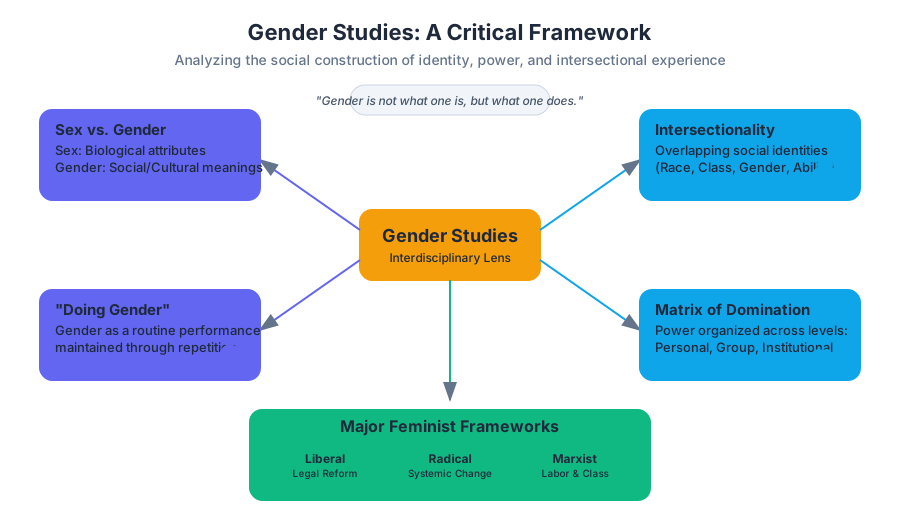
Gender Studies is an interdisciplinary academic field dedicated to analyzing gender as a fundamental axis of social organization, power, and individual identity. Far from being a mere study of "men" and "women," it functions as a critical lens through which we examine how biological sex is transformed into social categories, how these categories intersect with other variables like race and class, and how they are maintained through discourse, performance, and institutional policy.
The Social Construction of Gender
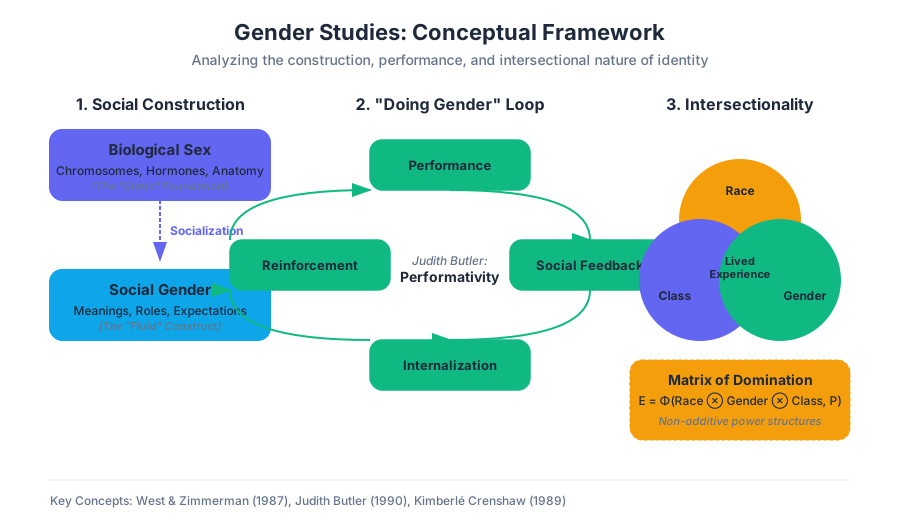
The foundational premise of modern Gender Studies is the distinction between sex (biological attributes such as chromosomes, hormones, and anatomy) and gender (the social, cultural, and psychological meanings assigned to those attributes). Social constructionism posits that gender is not an innate "essence" but a product of human interaction and cultural history.
The "Doing Gender" Framework
Sociologists West and Zimmerman (1987) argued that gender is not something a person is, but something a person does. It is a routine accomplishment embedded in everyday interaction. This "performance" is monitored by others and held accountable to societal norms.
Key Insight: The Performativity of Gender Judith Butler expanded this by proposing that gender is performative. It is not a singular act, but a repetition of rituals and behaviors that create the illusion of a stable, internal gender identity. There is no "gender core" behind the expression; the expression is the gender.
| Feature | Sex | Gender |
|---|---|---|
| Origin | Biological / Physiological | Social / Cultural |
| Categorization | Male, Female, Intersex | Masculine, Feminine, Non-binary, etc. |
| Stability | Generally static (barring medical intervention) | Fluid across time, culture, and individual life |
| Mechanism | Genetics, Hormones, Anatomy | Socialization, Discourse, Performance |
| Example | Presence of XX or XY chromosomes | Expectation that "men don't cry" |
Socialization Feedback Loops
Gender is reinforced through feedback loops starting at birth (or even pre-birth via "gender reveals").
Intersectionality
Developed by Kimberlé Crenshaw in 1989, Intersectionality is a framework for understanding how various social identities—such as race, gender, sexual orientation, disability, and class—overlap to create unique modes of discrimination and privilege.
The Matrix of Domination
Patricia Hill Collins conceptualized this as the Matrix of Domination, which describes how power is organized across multiple levels: the personal (biographical), the group (cultural), and the institutional (structural). Intersectionality rejects "additive" models (e.g., being a Black woman is not simply "Blackness + Womanhood") and instead argues for a multiplicative, qualitative shift in experience.
Formalizing Intersectionality
In a formal sense, we can view intersectional identity as a non-linear function where the experience $E$ is not the sum of its parts, but a result of their interaction within a specific power structure $P$.
E(identity) = \Phi(Race \otimes Gender \otimes Class, P)
Where $\otimes$ denotes a tensor product, implying that the dimensions are inextricably linked and modify one another.
| Axis of Identity | Dominant Group | Subordinated Group |
|---|---|---|
| Gender | Cisgender Men | Women, Trans, Non-binary |
| Race | White / Eurocentric | BIPOC (Black, Indigenous, People of Color) |
| Class | Owning Class / Wealthy | Working Class / Poor |
| Ability | Able-bodied | Persons with Disabilities |
| Sexuality | Heterosexual | LGBTQ+ |
Feminist Theory
Feminist theory provides the analytical tools to critique the "patriarchy"—a social system in which men hold primary power and predominate in roles of political leadership, moral authority, social privilege, and control of property.
Major Frameworks
- Liberal Feminism: Focuses on individual rights and legal reform. It seeks equality within the existing social structure (e.g., suffrage, equal pay).
- Radical Feminism: Views patriarchy as the root cause of all social inequality. It calls for a radical reordering of society to eliminate male supremacy in all social and economic contexts.
- Marxist/Socialist Feminism: Analyzes how capitalism and patriarchy work together to exploit women’s labor, particularly "reproductive labor" (housework, childcare).
- Post-structuralist Feminism: Challenges the very category of "woman," arguing that language and discourse construct our understanding of gender and power.
The Three Waves (and beyond)
The history of feminism is often categorized into "waves," though this metaphor is increasingly criticized for oversimplifying the continuous struggle for rights.
| Wave | Primary Focus | Key Outcomes |
|---|---|---|
| First Wave (19th-early 20th c.) | Suffrage, property rights, legal personhood. | Right to vote (19th Amendment in US). |
| Second Wave (1960s-1980s) | Workplace equality, reproductive rights, domestic violence. | Title IX, Roe v. Wade, "The Personal is Political." |
| Third Wave (1990s-2010s) | Intersectionality, Queer theory, deconstructing gender roles. | Greater focus on diverse identities and micro-politics. |
| Fourth Wave (2010s-Present) | Digital activism, #MeToo, systemic harassment, body positivity. | Global awareness of sexual misconduct, trans-inclusive feminism. |
LGBTQ+ Studies and Queer Theory
LGBTQ+ Studies (Lesbian, Gay, Bisexual, Transgender, and Queer Studies) examines the lives, histories, and cultures of sexual and gender minorities. It evolved from early "Gay and Lesbian Studies" into the more expansive Queer Theory.
Deconstructing Heteronormativity
Heteronormativity is the assumption that heterosexuality is the default or "normal" sexual orientation and that there are only two distinct, complementary genders. Queer Theory seeks to "trouble" these binaries, arguing that both gender and sexuality exist on a fluid spectrum rather than in discrete boxes.
Definition: The Kinsey Scale Developed by Alfred Kinsey, this 7-point scale (0 to 6) was one of the first scientific attempts to quantify sexual orientation, moving away from a binary "Gay/Straight" model to a continuum of behavior and attraction.
Human Sexuality
Human sexuality is the capacity to have erotic experiences and responses. In Gender Studies, sexuality is viewed as a complex interplay of biological drives and social "scripts."
Sexual Script Theory
Proposed by Simon and Gagnon (1973), this theory suggests that human sexual behavior is not "natural" or "instinctual" but is guided by scripts learned from culture.
- Cultural Scenarios: Broad societal norms (e.g., what is considered "sexy" in a given decade).
- Interpersonal Scripts: How we negotiate encounters with others.
- Intrapsychic Scripts: Our internal fantasies and desires.
The Bio-Psycho-Social Model
Sexuality is best understood through a multi-layered approach:
- Biological: Hormonal cycles, neurobiology of arousal, reproductive health.
- Psychological: Individual attachment styles, past experiences, self-image.
- Social: Legal frameworks, religious influences, media representations.
Common Pitfalls and Misconceptions
- Biological Essentialism: The mistake of assuming that because a behavior has a biological correlate (e.g., testosterone), it is "natural" and unchangeable. Gender Studies highlights how social environments can trigger or suppress biological expressions.
- Conflating Gender Identity and Sexual Orientation: One's internal sense of being a man, woman, or non-binary person (Gender Identity) is distinct from whom one is attracted to (Sexual Orientation). A trans man can be gay, straight, or bisexual.
- Universalizing "Womanhood": Early feminist theory was criticized for assuming the experiences of white, middle-class Western women represented all women. Intersectionality is the corrective to this mistake.
- The "Nature vs. Nurture" Binary: Modern scholarship views this as a false dichotomy. Instead, we look at Epigenetics and Social-Biological Interactionism, where social conditions literally get "under the skin" to affect biology.
Interdisciplinary Connections
Gender Studies does not exist in a vacuum; it draws from and informs several other fields:
- Anthropology: Examining "Third Genders" in non-Western cultures (e.g., the Hijra in South Asia or Two-Spirit individuals in Indigenous North American cultures) to prove that the Western gender binary is not a human universal.
- Communication Studies: Analyzing how non-verbal cues (posture, "manspreading," vocal fry) and verbal patterns (hedging, interrupting) reinforce gendered power dynamics.
- Criminology: Investigating the "gender gap" in crime—why men are more likely to commit violent crimes and how the justice system treats women offenders differently.
- Early Childhood Education: Studying how play-based learning and teacher expectations can either reinforce or challenge gender stereotypes in children as young as three.
Summary of Core Methodologies
To conclude, Gender Studies utilizes a variety of methodologies to unpack these complex systems:
| Method | Application |
|---|---|
| Discourse Analysis | Examining how language in media or law creates "truths" about gender. |
| Ethnography | Immersive study of specific subcultures (e.g., drag balls, corporate boardrooms) to see gender "in action." |
| Quantitative Analysis | Using large datasets to track the gender pay gap, representation in STEM, or health disparities. |
| Archival Research | Recovering the "hidden histories" of women and LGBTQ+ individuals who were erased from traditional historical narratives. |
By synthesizing these perspectives, Gender Studies provides a rigorous framework for understanding one of the most pervasive and influential structures of the human experience.
Source Materials
Study Overview of Social Science and Professional Disciplines on Lykke
This course page is free to open: signed out, you can read its first two sections, and signing in, on any plan, opens the rest. The free Lykke Chrome extension syncs your own Canvas courses, so ChatGPT, Claude and Muse can answer from your classes and deadlines. It only reads Canvas.
Add the free extensionSign in to open every sectionAll sections of Overview of Social Science and Professional Disciplines · Browse more course pages