From the free course Overview of Social Science and Professional Disciplines on Lykke
Ethnic Studies
Key concepts: Africana/Black Studies · Asian American Studies · Chicanx/Latinx Studies · Native American Studies · Eurocentrism
Interdisciplinary study centering the histories and narratives of BIPOC communities.
Ethnic Studies
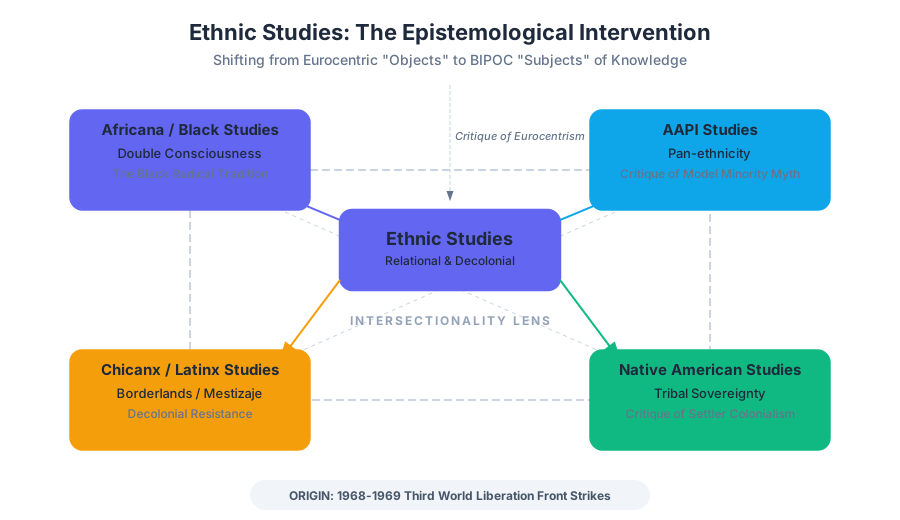
Ethnic Studies is the interdisciplinary, comparative, and relational study of race, ethnicity, and indigeneity with a primary focus on the experiences and perspectives of Black, Indigenous, and People of Color (BIPOC) in the United States and globally. Unlike traditional social sciences that often observe marginalized communities as "objects" of study, Ethnic Studies operates as an epistemological intervention, positioning these communities as "subjects" who produce knowledge, history, and culture.
The Genesis of the Discipline: From Strike to System
The field emerged not from the quiet halls of academia, but from the 1968-1969 Third World Liberation Front (TWLF) strikes at San Francisco State College and UC Berkeley. These student-led movements demanded a curriculum that reflected their own histories and addressed the systemic inequalities of the era.
Definition: Ethnic Studies An interdisciplinary academic field that critiques the structures of power, racialization, and Eurocentrism. It utilizes a "decolonial" lens to analyze how race intersects with class, gender, and sexuality to shape the human experience.
| Feature | Traditional Social Science (Pre-1960s) | Ethnic Studies Framework |
|---|---|---|
| Primary Lens | Eurocentric / Universalist | Relational / Pluriversal |
| Subjectivity | Researcher as "Objective" Observer | Researcher as "Positioned" Participant |
| Goal | Description and Classification | Liberation and Social Justice |
| Unit of Analysis | The Individual or State | The Community and Power Structures |
| Knowledge Source | Western Canon / Empirical Data | Oral Histories, Counter-Narratives, Archives |
Core Concept: Eurocentrism and the "Default" State
At the heart of Ethnic Studies is a critique of Eurocentrism. This is the conscious or unconscious practice of placing European and Western history, values, and perspectives at the center of the global experience, treating them as the "universal" standard against which all other cultures are measured.
The Mechanics of Eurocentrism
Eurocentrism functions as a "root directory" in the operating system of Western knowledge. It filters information through:
- Universalism: The idea that Western values (e.g., individualism, Enlightenment rationalism) are the peak of human development.
- Linear Progress: The belief that history moves in a straight line toward Western-style "modernity."
- Othering: The categorization of non-Western cultures as "primitive," "exotic," or "developing."
The Four Pillars of Ethnic Studies
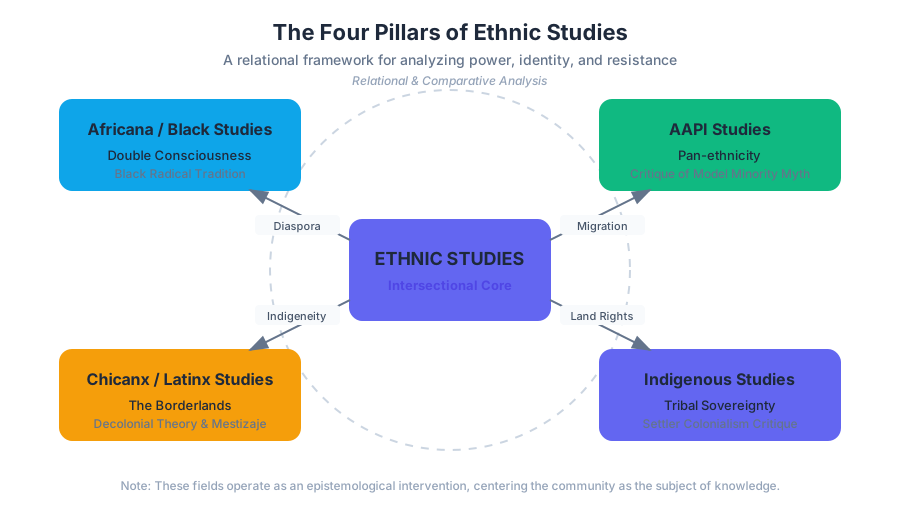
While the field is inherently intersectional, it is traditionally organized into four foundational sub-disciplines. Each has its own distinct methodology, historical trajectory, and theoretical "stack."
1. Africana / Black Studies
Africana Studies (also known as Black Studies or African American Studies) focuses on the history, culture, and politics of the African diaspora. It originated as a challenge to the "pathology" model of Black life in sociology.
- Key Concept: Double Consciousness: Coined by W.E.B. Du Bois, describing the internal conflict experienced by subordinated groups in an oppressive society.
- Methodology: Utilizing the "Black Radical Tradition" to analyze capitalism and racialization.
2. Asian American and Pacific Islander (AAPI) Studies
AAPI Studies examines the diverse experiences of people of Asian descent in the Americas. It critiques the Model Minority Myth—a sociopolitical construct used to minimize the effects of racism and drive a wedge between different BIPOC groups.
- Key Concept: Pan-ethnicity: The process by which various distinct ethnic groups (e.g., Chinese, Hmong, Filipino, Indian) forge a collective identity for political mobilization.
- Methodology: Analysis of immigration policy, labor history, and "Orientalism."
3. Chicanx / Latinx Studies
This field explores the experiences of people of Mexican, Central American, South American, and Caribbean descent. A central theme is the Borderlands—both as a physical geography and a psychological space.
- Key Concept: Mestizaje: The racial and cultural mixing that occurred in the Americas, often analyzed through the lens of colonial violence and resistance.
- Methodology: Decolonial theory and the study of "Aztlán" (the ancestral home of the Aztecs).
4. Native American / Indigenous Studies
Unlike other sub-fields, Native American Studies is centered on Sovereignty. It is not merely about "inclusion" into the U.S. state, but about the inherent rights of Indigenous nations to self-determination and land.
- Key Concept: Settler Colonialism: A persistent social and political structure where the colonizer stays, seeking to replace the original population on the land.
- Methodology: Indigenous Knowledge Systems (IKS) and the critique of the "Doctrine of Discovery."
Modeling Intersectionality
In Ethnic Studies, identity is not a single variable; it is a multi-dimensional array. Intersectionality, a term coined by Kimberlé Crenshaw, provides the "algorithm" for understanding how different forms of discrimination (racism, sexism, classism) overlap.
To understand this technically, we can model identity not as an additive property (Race + Gender), but as a multiplicative or relational function where the output is unique to the specific intersection.
Comparative Methodologies: Ethnic Studies vs. Anthropology
While Anthropology has evolved toward a "holistic approach" (integrating biological, cultural, and linguistic data), Ethnic Studies often critiques the historical "gaze" of Anthropology.
| Aspect | Anthropology | Ethnic Studies |
|---|---|---|
| Origin | Colonial administration/exploration | Civil Rights/Social Justice movements |
| Focus | "Humanity" as a broad species category | Specific racialized power dynamics |
| View of Race | Biological/Cultural variation | A social construct used for power |
| Language | Descriptive/Ethnographic | Critical/Transformative |
The "Remix" Culture: Open Education and Ethnic Studies
As highlighted in the LibreTexts ecosystem, Ethnic Studies materials are frequently "remixed." Because the field is dynamic and responsive to current events (e.g., Black Lives Matter, Stop AAPI Hate), static textbooks are often insufficient.
The Remixing Algorithm
- Curated Content: Pulling from "Bookshelves" (e.g., Anthropology, Communication Studies, Sociology).
- De-centering: Stripping away Eurocentric framing from traditional texts.
- Localizing: Adding "Campus Bookshelves" content that reflects the specific demographics of a student body.
- Deployment: Creating a "Course Shell" that is open-access and peer-reviewed.
\text{Curriculum}_{\text{EthnicStudies}} = \sum_{i=1}^{n} (\text{PrimarySource}_i \times \text{CriticalLens}) - \text{EurocentricBias}
Common Pitfalls and Misconceptions
- "It's just history": Ethnic Studies is not just "adding more names" to a history book. It is a change in how we analyze that history (the "Why" and "How" vs. just the "Who").
- "It's anti-Western": It is not an attack on the West, but a critique of Hegemony—the dominance of one perspective to the exclusion of all others.
- The "Model Minority" Trap: In AAPI studies, failing to recognize the vast class and educational disparities between different Asian subgroups (e.g., wealthy expats vs. refugees).
The Epistemological Pipeline
How knowledge is processed in an Ethnic Studies framework can be visualized as a pipeline that transforms "Raw History" into "Critical Consciousness."
- Ingestion: Recovery of suppressed archives and oral histories.
- Normalization: Contextualizing events within global systems (Colonialism, Capitalism).
- Analysis: Applying intersectional lenses to identify power imbalances.
- Praxis: Translating theory into social action or policy change.
Summary of Interdisciplinary Connections
Ethnic Studies does not exist in a vacuum. It draws from and contributes to:
- Communication Studies: Analyzing how media reinforces racial stereotypes.
- Criminology: Examining the "School-to-Prison Pipeline" and urban inequality.
- Counseling & Guidance: Developing "Trauma-Informed" approaches for BIPOC students.
- Early Childhood Education: Implementing "Equity and Diversity" frameworks in play-based learning.
Source Materials
Study Overview of Social Science and Professional Disciplines on Lykke
This course page is free to open: signed out, you can read its first two sections, and signing in, on any plan, opens the rest. The free Lykke Chrome extension syncs your own Canvas courses, so ChatGPT, Claude and Muse can answer from your classes and deadlines. It only reads Canvas.
Add the free extensionSign in to open every sectionAll sections of Overview of Social Science and Professional Disciplines · Browse more course pages