From the free course Overview of Social Science and Professional Disciplines on Lykke
Education & Professional Development
Key concepts: Instructional Design · Educational Technology · Inclusive Pedagogy · Formal and Informal Education · Professional Development
Methods of facilitating learning across formal and informal settings.
Education & Professional Development
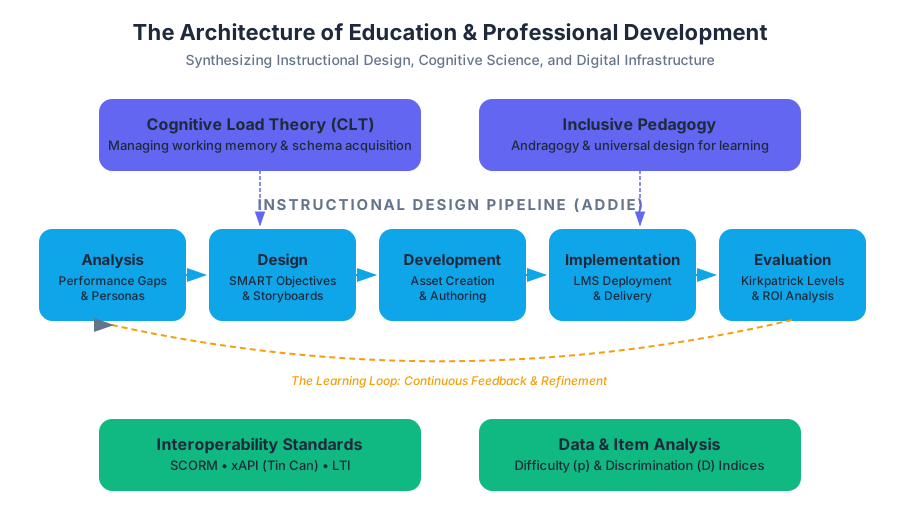
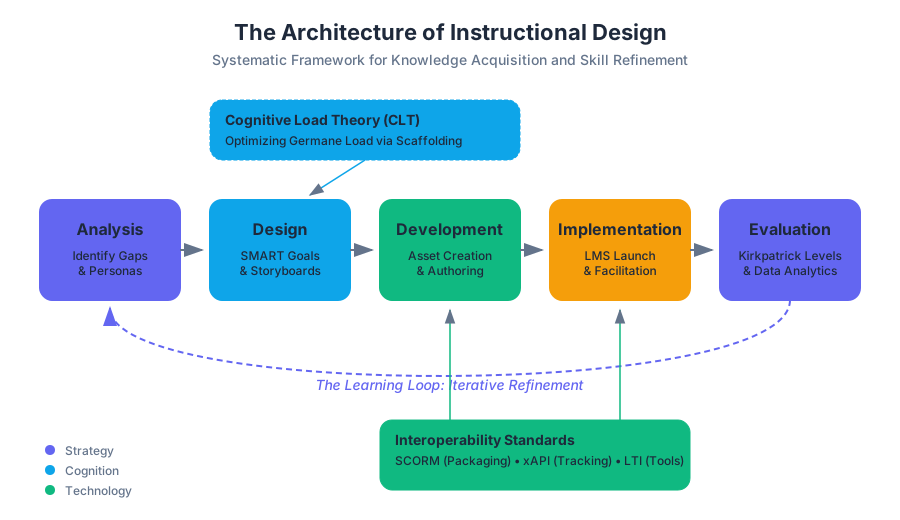
Education and Professional Development (EPD) represents the systematic architecture of knowledge acquisition, skill refinement, and behavioral modification across the human lifespan. In the modern era, this field has evolved from a static "transmission of facts" model into a high-precision discipline that synthesizes cognitive science, instructional design, and advanced technology. At its core, EPD seeks to optimize the "learning loop"—the iterative process of exposure, encoding, application, and feedback.
The Architecture of Learning: Instructional Design (ID)
Instructional Design is the "systems engineering" of the educational world. It is the practice of creating instructional experiences which make the acquisition of knowledge and skill more efficient, effective, and appealing. Rather than relying on intuition, ID utilizes evidence-based frameworks to map learning objectives to specific cognitive outcomes.
The ADDIE Framework and Its Successors
The ADDIE Model (Analysis, Design, Development, Implementation, Evaluation) remains the industry standard for structured course development. However, modern environments often shift toward more iterative models like SAM (Successive Approximation Model) to account for the rapid pace of technological change.
| Phase | Objective | Key Deliverables |
|---|---|---|
| Analysis | Identify the "performance gap" and learner profile. | Needs Analysis Report, Learner Personas. |
| Design | Map the logical flow and instructional strategy. | Storyboards, Learning Objectives (SMART). |
| Development | Build the actual assets and technology stack. | SCORM Packages, Video Lectures, Quiz Engines. |
| Implementation | Launch the training to the target audience. | LMS Deployment, Instructor Training. |
| Evaluation | Measure effectiveness via Kirkpatrick’s Levels. | Data Analytics, Survey Results, ROI Analysis. |
Cognitive Load Theory (CLT)
A critical component of ID is managing Cognitive Load. Formulated by John Sweller, CLT suggests that since working memory is limited, instructional materials should avoid "extraneous load" (unnecessary distractions) and maximize "germane load" (the mental effort required to build schemas).
Definition: Schema Acquisition is the process of integrating new information into existing mental structures. Effective instructional design facilitates this by "scaffolding" information—presenting complex tasks in manageable increments.
Educational Technology (EdTech) and Digital Infrastructure
Educational Technology is the ethical practice of facilitating learning and improving performance by creating, using, and managing appropriate technological processes and resources. It is not merely about "using computers" but about the interoperability of systems that allow for personalized learning at scale.
Interoperability Standards: SCORM, xAPI, and LTI
To ensure that a "remix" of content (such as those found in LibreTexts Bookshelves) can function across different platforms, the industry relies on standardized protocols.
- SCORM (Sharable Content Object Reference Model): The legacy standard for packaging web-based learning content so it can be tracked by a Learning Management System (LMS).
- xAPI (Experience API / Tin Can): A modern specification that allows for the tracking of learning experiences across multiple platforms (e.g., mobile apps, simulations, offline learning).
- LTI (Learning Tools Interoperability): A standard that allows an LMS to "plug in" external tools (like a specialized chemistry simulator) as if they were native features.
Pedagogy and Inclusive Design
Pedagogy refers to the theory and practice of learning. In contemporary discourse, this has expanded to include Andragogy (adult learning) and Heutagogy (self-determined learning). A major shift in the field is the move toward Inclusive Pedagogy, which posits that barriers to learning are often a result of the environment rather than the student's inherent "disability."
The Social Model of Disability
In Disability Studies, the distinction between Impairment and Disability is paramount. An impairment is a biological condition (e.g., being unable to walk), whereas disability is the social consequence (e.g., a building with only stairs). Inclusive pedagogy utilizes Universal Design for Learning (UDL) to preemptively remove these barriers.
| UDL Principle | Implementation Strategy | Technical Example |
|---|---|---|
| Multiple Means of Representation | Presenting information in more than one format. | Providing a video with a synchronized .vtt transcript. |
| Multiple Means of Action & Expression | Allowing learners to demonstrate knowledge in different ways. | Choosing between an essay, a podcast, or a code repository. |
| Multiple Means of Engagement | Tapping into learners' interests and offering choices. | Gamification elements vs. traditional linear progress. |
Early Childhood Education (ECE) and Foundational Development
ECE focuses on children from birth to age eight. This period is critical for Holistic Development, encompassing cognitive, social, emotional, and physical growth. Key concepts include Play-Based Learning and Trauma-Informed Education, which recognizes that a child's neurological state (affected by external stressors) dictates their capacity to learn.
Formal and Informal Education: The Role of OER
The traditional dichotomy between Formal Education (structured, credential-based) and Informal Education (self-directed, experiential) is blurring due to Open Educational Resources (OER). Platforms like LibreTexts provide "Bookshelves" of curated academic texts that can be "remixed."
The "Remix" Workflow
A Customized Remix allows an educator to pull specific chapters from multiple "Campus Bookshelves" to create a "Course Shell" tailored to a specific syllabus. This reduces costs for students and ensures that the material is culturally and contextually relevant.
\text{Remix Efficiency} = \frac{\sum (\text{Relevant Chapters from Source } n)}{\text{Total Pages in Traditional Textbook}} \times 100
In this mathematical representation, the efficiency of a remix is measured by the density of relevant content compared to a bloated, one-size-fits-all commercial textbook.
Metadata and Content Discovery
To make OER content discoverable, it must be tagged with rich metadata.
Professional Development and Counseling
Professional development is the process of improving and increasing capabilities of staff through access to education and training opportunities. In the context of Counseling & Guidance, this involves not just technical skills but Academic Success Strategies and Career Development.
Communication Studies in Professional Contexts
Effective professional development relies heavily on Communication Studies. Understanding the nuances between Verbal, Nonverbal, and Written communication is essential for leadership and collaboration.
- Interpersonal Communication: The exchange of information between two or more people.
- Mass Media: The diversification of message delivery (e.g., internal company-wide broadcasts vs. Slack messages).
- Intercultural Communication: Essential in a globalized workforce to avoid "cultural noise" that distorts the intended message.
Criminology and Criminal Justice Education
Professional development in specialized fields like Criminology requires a deep understanding of the "Justice System." This includes training in Policing, Judicial Systems, and Corrections. A key area of focus is Urban Inequality and Mental Health in Justice, requiring officers and legal professionals to undergo continuous training in de-escalation and social disparities.
Common Pitfalls in Education and Development
- The "Expert Blindness" Fallacy: Designing content for beginners that assumes "common sense" knowledge that only experts possess.
- Technological Determinism: The belief that adding a new tool (e.g., VR headsets) will automatically improve learning outcomes without a change in pedagogy.
- Ignoring the "Forgetting Curve": Providing "one-and-done" training sessions without spaced repetition or opportunities for application.
- Conflating Accessibility with Inclusion: Making a PDF screen-reader friendly (accessibility) is not the same as designing a curriculum that reflects the diverse lived experiences of the students (inclusion).
Synthesis: The Future of the Learning Ecosystem
The convergence of Instructional Design, EdTech, and Inclusive Pedagogy is creating a more democratic educational landscape. By leveraging LibreTexts for content, LMS for delivery, and Data Analytics for evaluation, institutions can move away from rigid, expensive models toward a fluid, "just-in-time" learning paradigm. Whether it is a child in an Early Childhood program or a professional in Addictions Counseling, the principles of structured, inclusive, and technologically-supported education remain the same: reduce friction, maximize engagement, and ensure that knowledge is a public good rather than a private commodity.
- Instructional Design: The systematic development of instructional specifications.
- ADDIE: Analysis, Design, Development, Implementation, Evaluation.
- SCORM: Sharable Content Object Reference Model (e-learning standard).
- Inclusive Pedagogy: Teaching methods designed to serve all students effectively.
- Social Model of Disability: The view that disability is caused by the way society is organized.
- OER: Open Educational Resources (freely accessible learning materials).
- Andragogy: The method and practice of teaching adult learners.
- Schema: A mental structure of preconceived ideas.
- Question: How does Cognitive Load Theory influence the "Development" phase of the ADDIE model?
- Answer: It dictates that instructional materials should minimize extraneous load (e.g., distracting graphics) and focus on germane load (building mental schemas) to prevent memory overload.
- Question: What is the primary difference between the Medical Model and the Social Model of disability in an educational context?
- Answer: The Medical Model focuses on "fixing" the individual's impairment, while the Social Model focuses on "fixing" the environment (e.g., curriculum design) to remove barriers.
- Question: Why is "Remixing" a significant feature of the LibreTexts platform?
- Answer: It allows educators to aggregate content from multiple sources into a single, cohesive "Course Shell," reducing student costs and increasing the relevance of the material.
- Question: In Item Analysis, what does a "Discrimination Index" of 0.0 indicate?
- Answer: It indicates that the question does not distinguish between high-performing and low-performing students; both groups are equally likely to get it right or wrong.
Core Objectives:
- Understand the 5 phases of the ADDIE model and how they apply to professional development.
- Differentiate between formal, informal, and non-formal education.
- Identify the three main principles of Universal Design for Learning (UDL).
- Explain the role of interoperability standards (SCORM/xAPI) in educational technology.
Key Readings:
- LibreTexts Bookshelves: Focus on "Remixing" and "Campus Bookshelves."
- Disability Studies: Contrast the social construct of disability with physical impairment.
- Communication Studies: Review the impact of nonverbal cues in instructional delivery.
Critical Thinking Task: Design a high-level "Course Shell" for a 4-week professional development seminar on "Trauma-Informed Education." Which OER resources would you remix, and what "Multiple Means of Expression" would you offer your learners for their final assessment?
Source Materials
Study Overview of Social Science and Professional Disciplines on Lykke
This course page is free to open: signed out, you can read its first two sections, and signing in, on any plan, opens the rest. The free Lykke Chrome extension syncs your own Canvas courses, so ChatGPT, Claude and Muse can answer from your classes and deadlines. It only reads Canvas.
Add the free extensionSign in to open every sectionAll sections of Overview of Social Science and Professional Disciplines · Browse more course pages