From the free course Overview of Social Science and Professional Disciplines on Lykke
Economics
Key concepts: Microeconomics · Macroeconomics · Economic Agents · Fiscal and Monetary Policy · Public Policy
The study of production, distribution, and consumption of goods and services.
Economics
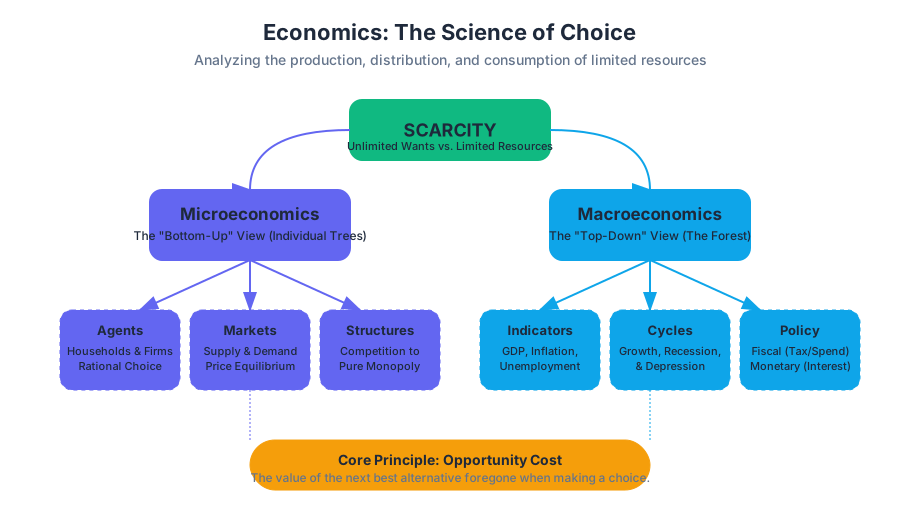
Economics is the foundational social science concerned with the production, distribution, and consumption of goods and services. At its core, it is the study of scarcity—the fundamental tension between limited resources and unlimited human wants. By analyzing how economic agents make choices, economics provides a rigorous framework for understanding everything from individual purchasing decisions to the complex global systems that dictate the wealth of nations.
The Foundations of Economic Thought
Economics operates on the premise that resources—land, labor, capital, and entrepreneurship—are finite. This necessitates opportunity cost, the value of the next best alternative foregone when a choice is made. Unlike purely physical sciences, economics must account for human behavior, making it a "social science" that frequently intersects with anthropology, psychology, and public policy.
The Dual Pillars: Micro and Macro
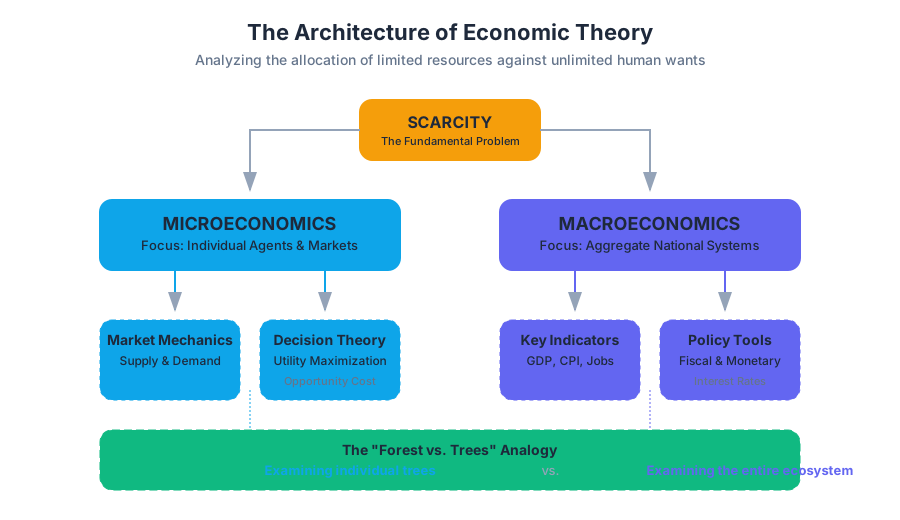
The discipline is traditionally bifurcated into two primary scales of analysis:
| Feature | Microeconomics | Macroeconomics |
|---|---|---|
| Focus | Individual agents (households, firms) | Aggregate economy (nations, global systems) |
| Primary Variables | Price, Quantity, Elasticity, Utility | GDP, Inflation, Unemployment, Interest Rates |
| Core Question | How do specific markets reach equilibrium? | How do we achieve stable growth and full employment? |
| Policy Tool | Regulation, Subsidies, Antitrust Law | Fiscal Policy, Monetary Policy |
| Analogy | Examining individual trees in a forest | Examining the health of the entire ecosystem |
Microeconomics: The Mechanics of Individual Choice
Microeconomics examines the "bottom-up" behavior of consumers and producers. It assumes that agents are generally rational, seeking to maximize utility (for consumers) or profit (for firms) subject to constraints like budget or technology.
Supply, Demand, and Equilibrium
The most fundamental model in microeconomics is the Supply and Demand framework.
- The Law of Demand: Ceteris paribus (all other things being equal), as the price of a good increases ($P \uparrow$), the quantity demanded decreases ($Q_d \downarrow$).
- The Law of Supply: As the price increases ($P \uparrow$), the quantity supplied by producers increases ($Q_s \uparrow$).
The point where $Q_d = Q_s$ is the Market Equilibrium. At this price ($P^*$), the market clears, and there is neither a surplus nor a shortage.
Market Structures
Economic agents do not operate in a vacuum; the "rules of the game" are defined by the market structure:
| Structure | Number of Firms | Product Differentiation | Barriers to Entry | Price Control |
|---|---|---|---|---|
| Perfect Competition | Infinite | Homogeneous | None | None (Price Taker) |
| Monopolistic Competition | Many | Differentiated | Low | Some |
| Oligopoly | Few | High or Low | High | Significant (Interdependent) |
| Monopoly | One | Unique | Very High | Absolute (Price Maker) |
Elasticity
Elasticity measures the responsiveness of one variable to changes in another. For example, Price Elasticity of Demand (PED) calculates how much the quantity demanded changes when the price changes:
$$E_d = \frac{% \Delta Q_d}{% \Delta P}$$
If $|E_d| > 1$, the good is elastic (consumers are sensitive to price changes, like luxury cars). If $|E_d| < 1$, the good is inelastic (consumers buy it regardless of price, like insulin).
Macroeconomics: The Aggregate View
Macroeconomics shifts the lens to the "top-down" performance of the economy. It focuses on the Business Cycle—the fluctuations in economic activity over time, characterized by periods of expansion and recession.
Key Macroeconomic Indicators
- Gross Domestic Product (GDP): The total market value of all final goods and services produced within a country in a given period.
- Formula: $GDP = C + I + G + (X - M)$ (Consumption + Investment + Government Spending + Net Exports).
- Inflation: The rate at which the general level of prices for goods and services is rising. It is typically measured via the Consumer Price Index (CPI).
- Unemployment Rate: The percentage of the labor force that is jobless and actively seeking work.
Aggregate Demand (AD) and Aggregate Supply (AS)
The AD-AS model explains fluctuations in the price level and real GDP.
- AD represents the total spending in the economy.
- AS represents the total production. Shifts in these curves (due to shocks like a pandemic or a technological breakthrough) lead to changes in the equilibrium level of national income and prices.
The Phillips Curve: A historical inverse relationship between the rate of unemployment and the corresponding rate of inflation within an economy. Stated simply, the lower the unemployment, the higher the inflation (and vice versa) in the short run.
\text{Taylor Rule for Monetary Policy:} \\
i_t = \pi_t + r_t^* + a_\pi(\pi_t - \pi_t^*) + a_y(y_t - \bar{y}_t)
Where:
- $i_t$: Target short-term nominal interest rate
- $\pi_t$: Rate of inflation
- $\pi_t^*$: Desired inflation target
- $r_t^*$: Assumed equilibrium real interest rate
- $y_t$: Log of real GDP
- $\bar{y}_t$: Log of potential output
Economic Agents and Behavioral Reality
In classical theory, the Economic Agent is often modeled as Homo Economicus—a perfectly rational, self-interested individual with perfect information. However, modern economics, influenced by Behavioral Economics, recognizes that humans have "bounded rationality."
Types of Agents
- Households: Owners of the factors of production (labor) and consumers of final goods.
- Firms: Entities that transform inputs into outputs to generate profit.
- Governments: Regulators and providers of public goods who intervene to correct Market Failures.
- Central Banks: Independent institutions (like the Federal Reserve) that manage a nation's currency and monetary policy.
Incentives and Information
Economics is often called the "study of incentives." Asymmetric Information occurs when one party in a transaction has more or better information than the other, leading to:
- Adverse Selection: (e.g., only sick people buying health insurance).
- Moral Hazard: (e.g., taking more risks because you are insured).
Fiscal and Monetary Policy: The Levers of Power
To manage the volatility of the business cycle, authorities use two primary toolkits: Fiscal and Monetary policy.
Fiscal Policy
Managed by the executive and legislative branches of government, Fiscal Policy involves adjusting spending levels and tax rates to influence Aggregate Demand.
- Expansionary: Increasing spending or cutting taxes to fight recession.
- Contractionary: Decreasing spending or raising taxes to combat inflation.
Monetary Policy
Managed by the Central Bank, Monetary Policy involves controlling the money supply and interest rates.
- Open Market Operations (OMO): Buying or selling government bonds to inject or withdraw liquidity.
- The Discount Rate: The interest rate charged to commercial banks for loans from the central bank.
- Reserve Requirements: The portion of deposits banks must hold in reserve.
| Policy Tool | Fiscal Policy | Monetary Policy |
|---|---|---|
| Decision Maker | Parliament / Congress / Government | Central Bank (e.g., Fed, ECB) |
| Primary Tools | Taxes, Government Spending | Interest Rates, Money Supply, QE |
| Implementation Lag | Long (Political process) | Short (Immediate decision) |
| Impact Lag | Short (Direct injection) | Long (Transmission through banks) |
Public Policy and Market Failures
While markets are efficient at allocating private goods, they often fail in specific scenarios, necessitating Public Policy intervention.
1. Externalities
An externality is a cost or benefit that affects a third party who did not choose to incur that cost or benefit.
- Negative: Pollution from a factory (overproduced by the market).
- Positive: Education or vaccinations (underproduced by the market).
2. Public Goods
Goods that are non-excludable (you can't stop people from using them) and non-rivalrous (one person's use doesn't diminish another's). Examples include national defense and street lighting. These suffer from the Free Rider Problem.
3. Common Pool Resources
Goods that are non-excludable but rivalrous (e.g., fish stocks in the ocean). This leads to the Tragedy of the Commons, where individual rational use leads to collective ruin.
Interdisciplinary Connections: The "Bookshelves" of Economics
Economics does not exist in isolation. As noted in the LibreTexts philosophy, knowledge is a "remix" of various disciplines.
- Anthropology: Economic systems are culturally embedded. While Western economics focuses on markets, anthropology explores gift economies and the social structures of exchange.
- Criminology: The "Economic Theory of Crime" (pioneered by Gary Becker) suggests that individuals commit crimes when the expected utility of the crime exceeds the expected cost (probability of being caught $\times$ severity of punishment).
- Early Childhood Education: Economists like James Heckman have shown that the Return on Investment (ROI) for early childhood education is among the highest of any public policy, significantly reducing future costs in the criminal justice system.
- Communication Studies: Markets rely on the flow of information. Signaling Theory explains how agents communicate "hidden" qualities (e.g., a college degree signals productivity to an employer).
Common Pitfalls in Economic Reasoning
- The Sunk Cost Fallacy: Continuing an endeavor because of past investments (money, time) rather than current utility. Correct approach: Only marginal costs and benefits should matter.
- Correlation vs. Causation: Assuming that because two variables move together (e.g., money supply and inflation), one must cause the other without accounting for lags or third variables.
- The Fallacy of Composition: Assuming that what is true for one individual must be true for the whole group. (e.g., if one person stands up at a concert, they see better; if everyone stands up, no one sees better).
- Ignoring Secondary Effects: Focussing only on the immediate visible impact of a policy (e.g., rent control helping current tenants) while ignoring long-term consequences (e.g., reduced housing supply and quality).
Summary of Key Parameters in Economic Modeling
| Parameter | Symbol | Definition | Significance |
|---|---|---|---|
| Marginal Propensity to Consume | $MPC$ | The fraction of additional income spent on consumption. | Determines the strength of the Fiscal Multiplier. |
| Discount Rate | $r$ | The rate used to determine the present value of future cash flows. | Influences investment decisions and capital allocation. |
| Gini Coefficient | $G$ | A measure of statistical dispersion representing income inequality. | 0 = Perfect equality; 1 = Perfect inequality. |
| Natural Rate of Unemployment | $u^*$ | The level of unemployment when the labor market is in equilibrium. | The "floor" of unemployment without triggering inflation. |
Economics remains a dynamic field, constantly evolving as new data and computational methods allow us to model human behavior with increasing precision. Whether through the lens of a micro-level consumer choice or a macro-level fiscal stimulus, the core objective remains the same: optimizing the use of our world's limited resources to improve human welfare.
Source Materials
Study Overview of Social Science and Professional Disciplines on Lykke
This course page is free to open: signed out, you can read its first two sections, and signing in, on any plan, opens the rest. The free Lykke Chrome extension syncs your own Canvas courses, so ChatGPT, Claude and Muse can answer from your classes and deadlines. It only reads Canvas.
Add the free extensionSign in to open every sectionAll sections of Overview of Social Science and Professional Disciplines · Browse more course pages