From the free course Overview of Social Science and Professional Disciplines on Lykke
Early Childhood Education
Key concepts: Holistic Development · Play-Based Learning · Trauma-Informed Education · Equity and Diversity · Family Engagement
Focus on the holistic development of children from birth to age eight.
Early Childhood Education
Early Childhood Education (ECE) is the formal and informal pedagogical framework designed for children from birth to age eight. This period represents the most significant window of neuroplasticity in the human lifespan, during which the brain forms upwards of one million new neural connections every second. ECE is not merely a precursor to "real" schooling; it is the foundational architecture upon which all future cognitive, social, and emotional structures are built.
Holistic Development
Holistic Development is an integrated approach to child growth that posits that the cognitive, social, emotional, and physical domains are not discrete silos but interconnected systems. In this framework, a deficit in one domain (e.g., chronic malnutrition affecting physical growth) directly impacts the efficiency of another (e.g., the metabolic cost of cognitive processing).
The Four Domains of Development
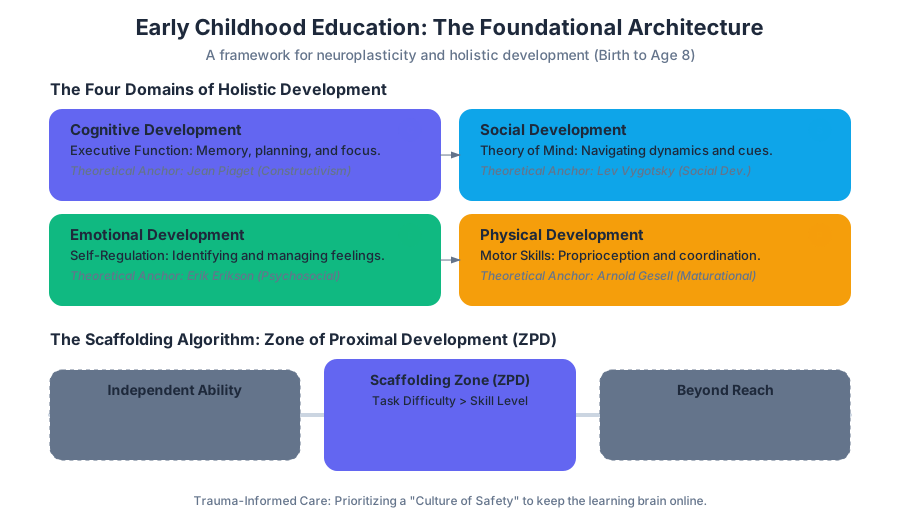
- Cognitive Development: The evolution of thought processes, including memory, problem-solving, and decision-making. This is often measured through the lens of Executive Function—the mental processes that enable us to plan, focus attention, and juggle multiple tasks.
- Social Development: The ability to form relationships, navigate group dynamics, and understand social cues.
- Emotional Development: The capacity to identify, express, and regulate feelings, as well as the development of empathy (Self-Regulation).
- Physical Development: Encompasses both gross motor skills (large muscle movements) and fine motor skills (dexterity), alongside general health and nutrition.
| Domain | Key Indicators | Theoretical Anchor |
|---|---|---|
| Cognitive | Symbolic thought, object permanence, executive function | Jean Piaget (Constructivism) |
| Social | Cooperative play, conflict resolution, theory of mind | Lev Vygotsky (Social Development) |
| Emotional | Self-soothing, empathy, emotional literacy | Erik Erikson (Psychosocial Stages) |
| Physical | Proprioception, hand-eye coordination, sensory integration | Arnold Gesell (Maturational-Physical) |
Why It Matters: The Interdependency Principle
The "Whole Child" approach recognizes that academic success is a downstream effect of holistic health. For instance, a child experiencing "toxic stress" (emotional domain) will have an overactive HPA axis, flooding the brain with cortisol, which inhibits the prefrontal cortex's ability to engage in logical reasoning (cognitive domain).
How It Works: The Scaffolding Algorithm
Educators use Scaffolding—a term coined by Jerome Bruner based on Vygotsky’s Zone of Proximal Development (ZPD). The ZPD is the distance between what a learner can do without help and what they can do with support.
Play-Based Learning
Play-Based Learning is a pedagogical strategy where play is the primary context for learning. It is often misunderstood as "unstructured free time," but in a professional ECE setting, it is a highly intentional "laboratory" for social and cognitive experimentation.
The Mechanics of Play
Play allows children to engage in Metacommunication (communicating about the communication) and Symbolic Representation (using a block to represent a phone). These are the precursors to abstract mathematical and literacy skills.
Variations of Play
Play exists on a continuum from child-directed to adult-led.
| Play Type | Description | Adult Role |
|---|---|---|
| Unstructured Play | Child-led, spontaneous, open-ended. | Observer / Safety Monitor |
| Guided Play | Child-led but with adult-scaffolded environments. | Facilitator / Questioner |
| Co-operative Play | Children work together toward a common goal. | Mediator |
| Object Play | Exploration of the physical properties of items. | Provider of diverse materials |
Common Pitfall: The Play-Work Dichotomy
A frequent misconception is that "play" and "learning" are opposites. In reality, for a developing brain, play is work. High-quality ECE programs avoid "drill-and-kill" worksheets in favor of "inquiry-based" play, which builds higher-order thinking skills.
Trauma-Informed Education
Trauma-Informed Education is a framework that recognizes the prevalence of Adverse Childhood Experiences (ACEs) and seeks to create a "culture of safety" that prevents re-traumatization.
The Neurobiology of Trauma
Trauma impacts the Amygdala (the brain's alarm system), making it hypersensitive. When a child is in a "fight, flight, or freeze" state, the "learning brain" (prefrontal cortex) goes offline. Trauma-informed care shifts the question from "What is wrong with this child?" to "What happened to this child?"
The 4 R's of Trauma-Informed Care
- Realize: Understand the widespread impact of trauma.
- Recognize: Identify the signs of trauma in children and families.
- Respond: Integrate knowledge about trauma into policies and practices.
- Resist Re-traumatization: Avoid triggers and punitive measures that mirror past trauma.
"The brain is a social organ. Its physiological and neurological health is dependent on the quality of the relationships it experiences." — Key Insight in Trauma-Informed Pedagogy
The Heckman Equation
Nobel Laureate James Heckman demonstrated that the ROI (Return on Investment) for ECE is highest for children from disadvantaged or traumatized backgrounds.
\text{The Heckman Equation:} \\
\text{Invest} + \text{Develop} + \text{Sustain} = \text{Gain} \\
\rho = \frac{\Delta \text{Human Capital}}{\Delta \text{Investment Cost}}
Where $\rho$ (Return) is significantly higher when investment occurs in the $0-5$ age range compared to later interventions.
Equity and Diversity
Equity and Diversity in ECE refers to the intentional practice of creating inclusive environments that honor the various identities (race, culture, ability, gender, language) children bring to the classroom.
Anti-Bias Education (ABE)
ABE is a proactive approach to addressing social identity and unfairness. It is built on four core goals:
- Identity: Each child will demonstrate self-awareness and confidence.
- Diversity: Each child will express comfort and joy with human diversity.
- Justice: Each child will increasingly recognize unfairness (bias).
- Action: Each child will demonstrate empowerment and the skills to act against prejudice.
Culturally Responsive Teaching (CRT)
CRT involves using the cultural knowledge, prior experiences, and performance styles of diverse students to make learning more appropriate and effective for them.
| Concept | Definition | Practical Application |
|---|---|---|
| Inclusion | Ensuring children with disabilities learn alongside peers. | Universal Design for Learning (UDL) |
| Cultural Capital | The non-financial social assets that promote mobility. | Valuing "Home Languages" in the classroom |
| Implicit Bias | Unconscious attitudes that affect our understanding. | Reflective practice and peer-review for teachers |
Family and Community Engagement
Family Engagement is a collaborative relationship between families and educators that is continuous across a child’s life. It moves beyond "involvement" (e.g., attending a bake sale) to "engagement" (e.g., co-constructing the child's learning goals).
Bronfenbrenner’s Ecological Systems Theory
To understand a child, one must understand the entire ecosystem.
- Microsystem: Immediate environment (Family, Classroom).
- Mesosystem: Connections between microsystems (Parent-Teacher relationship).
- Exosystem: External settings that indirectly affect the child (Parent’s workplace).
- Macrosystem: Cultural values, laws, and customs.
Data Standards for Engagement
In modern ECE systems, family data and student progress are often tracked via structured schemas to ensure continuity of care during transitions (e.g., moving from Head Start to Kindergarten).
Reflective Practice
Reflective Practice is the "meta-skill" of ECE. It is the continuous process of educators thinking about their own teaching, analyzing their interactions, and adjusting their strategies based on evidence and observation.
The Cycle of Reflection
- Observe: Watch the child's interactions without judgment.
- Record: Document the observation (Anecdotal notes, photos).
- Interpret: Connect the observation to developmental theory.
- Plan: Adjust the environment or curriculum based on the interpretation.
Common Pitfall: The "Expert" Fallacy
Educators sometimes believe they are the sole experts on a child's learning. Reflective practice requires the humility to see the family as the primary expert and the child as a co-constructor of knowledge.
Technical Summary of ECE Metrics
To measure the efficacy of ECE programs, administrators use several standardized tools.
| Tool | Focus Area | Methodology |
|---|---|---|
| DRDP (Desired Results Developmental Profile) | Holistic Growth | Naturalistic observation over 6 months |
| CLASS (Classroom Assessment Scoring System) | Teacher-Child Interaction | External observation of emotional/instructional support |
| ASQ-3 (Ages & Stages Questionnaires) | Developmental Screening | Parent-completed developmental milestones |
| ECERS-3 (Early Childhood Environment Rating Scale) | Physical Environment | Assessment of space, materials, and routines |
Administrative Data Management
For large-scale ECE systems, data must be migrated and synced across various state and federal databases.
- Neuroplasticity: The brain's ability to reorganize itself by forming new neural connections throughout life, peaking in early childhood.
- Executive Function: A set of cognitive processes (working memory, flexible thinking, self-control) that are necessary for the cognitive control of behavior.
- Zone of Proximal Development (ZPD): The range of tasks that are too difficult for a person to learn alone but can be learned with guidance.
- Toxic Stress: Strong, frequent, or prolonged activation of the body's stress management system in the absence of buffering protection from adults.
- Scaffolding: Support mechanisms provided by an educator to help a child reach the next level of development.
- Anti-Bias Education: A framework for teaching that encourages children to value diversity and challenge prejudice.
- HPA Axis: The Hypothalamic-Pituitary-Adrenal axis; the body's central stress response system.
- Theory of Mind: The understanding that others have beliefs, desires, intentions, and perspectives that are different from one's own.
-
Which domain of development is primarily concerned with "Theory of Mind"?
- A) Physical
- B) Cognitive
- C) Social
- D) Emotional (Correct: C - Social, though it overlaps with Cognitive, it is the basis for social interaction.)
-
According to the Heckman Equation, where is the highest return on investment in education found?
- A) University Research
- B) High School Vocational Training
- C) Early Childhood (0-5)
- D) Adult Literacy Programs (Correct: C)
-
In the context of Trauma-Informed Care, what does the "4th R" (Resist Re-traumatization) specifically aim to prevent?
- A) Children forgetting their lessons
- B) Punitive practices that trigger past trauma responses
- C) Parents missing meetings
- D) Excessive play time (Correct: B)
-
Which theorist is most closely associated with the "Ecological Systems Theory"?
- A) Jean Piaget
- B) Urie Bronfenbrenner
- C) Lev Vygotsky
- D) B.F. Skinner (Correct: B)
-
What is the primary difference between "Involvement" and "Engagement" in family relations?
- A) Involvement is mandatory, Engagement is optional.
- B) Involvement is teacher-led; Engagement is a collaborative partnership.
- C) Involvement only happens at school; Engagement only happens at home.
- D) There is no difference. (Correct: B)
Early Childhood Education Study Guide
Core Philosophy
- The Window of Opportunity: Birth to age 8 is the critical period for brain architecture.
- The Whole Child: Academic readiness is impossible without social-emotional stability and physical health.
Key Theories to Master
- Constructivism (Piaget): Children build knowledge through active exploration.
- Social Constructivism (Vygotsky): Learning is a social process; look for the ZPD.
- Ecological Systems (Bronfenbrenner): A child is a product of nested environments.
Practical Application
- Play as Pedagogy: Identify the difference between "Guided Play" and "Direct Instruction."
- Trauma Sensitivity: Focus on regulation before reasoning.
- Equity: Move beyond "celebrating holidays" to deep Anti-Bias Education goals.
Assessment Tools
- Know the purpose of the DRDP (observational assessment) vs. the ASQ-3 (developmental screening).
- Understand the CLASS tool's focus on the quality of interactions rather than just the physical environment.
Critical Thinking Question
- How does the "Achievement Gap" relate to the "Opportunity Gap" in the context of ECE funding and access?
Source Materials
Study Overview of Social Science and Professional Disciplines on Lykke
This course page is free to open: signed out, you can read its first two sections, and signing in, on any plan, opens the rest. The free Lykke Chrome extension syncs your own Canvas courses, so ChatGPT, Claude and Muse can answer from your classes and deadlines. It only reads Canvas.
Add the free extensionSign in to open every sectionAll sections of Overview of Social Science and Professional Disciplines · Browse more course pages