From the free course Overview of Social Science and Professional Disciplines on Lykke
Disability Studies
Key concepts: Impairment vs. Disability · Social Construct · Critical Disability · Systems Change · Power Dynamics
An academic field exploring the social, cultural, and political dimensions of disability.
Disability Studies: Frameworks, Power Dynamics, and Systems Change
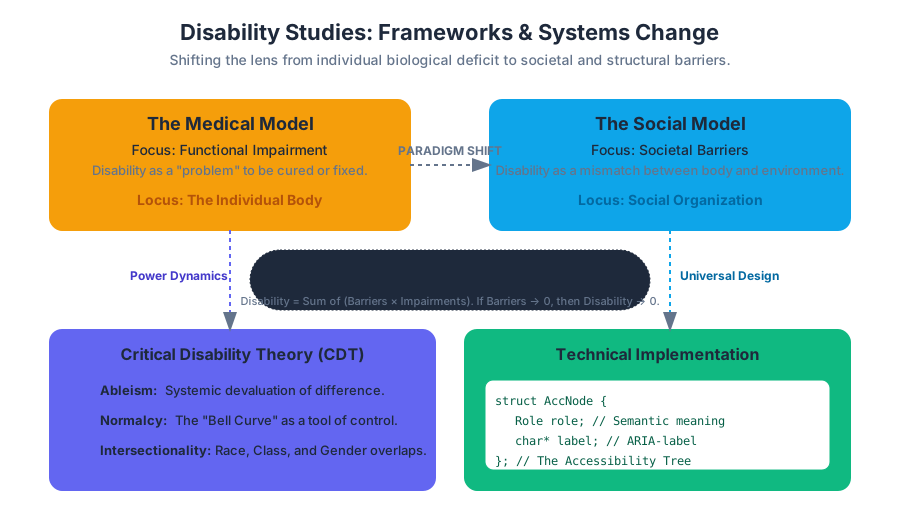
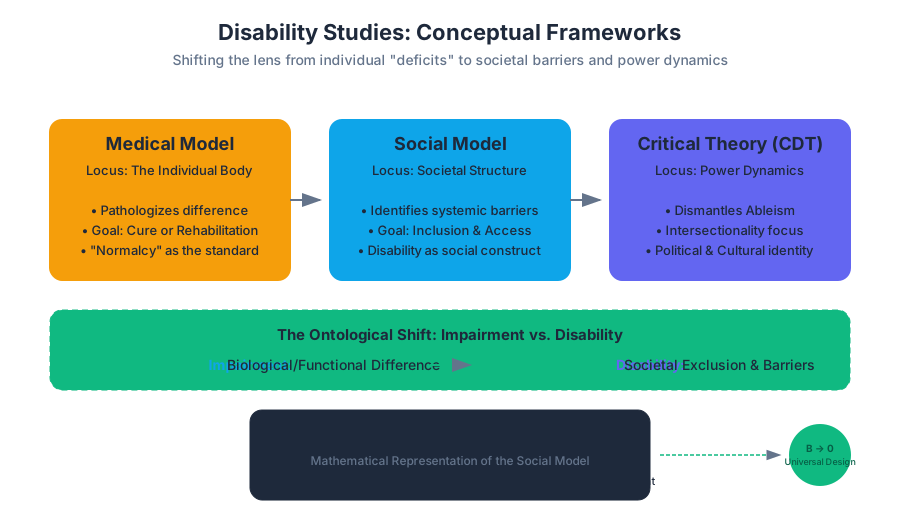
Disability Studies (DS) is a rigorous interdisciplinary field that interrogates the social, cultural, political, and economic factors that define disability. Unlike clinical or rehabilitative approaches—often categorized under the Medical Model—Disability Studies shifts the analytical lens from the individual’s biological "deficit" to the societal structures that create exclusion. It posits that disability is not an inherent trait of a person, but a complex interaction between a person’s body/mind and a society designed for a specific "normative" standard.
The Ontological Shift: Impairment vs. Disability
The foundational breakthrough of Disability Studies is the distinction between impairment and disability. This distinction, pioneered by the Union of the Physically Impaired Against Segregation (UPIAS) in the 1970s, serves as the "First Principle" of the Social Model.
Definition: The Social Model of Disability Disability is the disadvantage or restriction of activity caused by a contemporary social organization which takes no or little account of people who have physical impairments and thus excludes them from participation in the mainstream of social activities.
Conceptual Breakdown
| Concept | Domain | Definition | Example |
|---|---|---|---|
| Impairment | Biological / Functional | A physical, sensory, or cognitive difference (e.g., lack of a limb, neurodivergence, blindness). | A person with a spinal cord injury who cannot walk. |
| Disability | Societal / Structural | The loss or limitation of opportunities to take part in society on an equal level due to barriers. | A person in a wheelchair being unable to enter a building because there are only stairs. |
In this framework, the "problem" is the stairs, not the wheelchair. By reclassifying disability as a social construct rather than a biological fate, the field enables a move toward Systems Change and civil rights.
Mathematical Representation of the Social Model
We can represent the "Disability State" ($D$) as a function of the individual's functional impairment ($I$) and the environmental/attitudinal barriers ($B$) present in a given system ($S$).
D(S) = \sum_{i=1}^{n} B_i \cdot I_i
Where:
- $I_i$ represents a specific functional variation.
- $B_i$ represents the coefficient of friction (barriers) provided by the environment.
- If $B_i \to 0$ (Universal Design), then $D(S) \to 0$, regardless of the magnitude of $I$.
Critical Disability Theory (CDT) and Power Dynamics
Critical Disability Theory (CDT) extends the social model by incorporating an analysis of Power Dynamics. It argues that the definition of "normalcy" is a tool of social control used to marginalize those who do not contribute to the "productive" demands of a capitalist or industrial society.
The Hegemony of Normalcy
CDT examines how the "bell curve" of human variation was historically used to pathologize differences. This involves:
- Medicalization: The process by which human conditions are defined and treated as medical problems to be "cured" or "fixed."
- Ableism: A system of beliefs and practices that devalues and discriminates against people with disabilities, often assuming that "able-bodiedness" is the superior and preferred way of being.
- Internalized Ableism: When disabled individuals internalize societal prejudices, leading to a diminished sense of self-worth.
Intersectionality in Disability
Disability does not exist in a vacuum. A person’s experience of disability is profoundly shaped by their race, gender, class, and sexuality. For instance, the "school-to-prison pipeline" disproportionately affects Black students with disabilities, demonstrating how systemic racism and ableism intersect to create unique forms of oppression.
Implementing Accessibility: A Technical Perspective
In the digital and built environment, the transition from theory to practice requires rigorous implementation of standards. In software engineering, this is often handled through an Accessibility Tree, which sits between the DOM (Document Object Model) and the Assistive Technology (AT).
Systems Change and Universal Design
Systems Change refers to the intentional process of altering the underlying structures, policies, and mindsets that perpetuate exclusion. In Disability Studies, this is often operationalized through Universal Design (UD).
The 7 Principles of Universal Design
Universal Design is the design of products and environments to be usable by all people, to the greatest extent possible, without the need for adaptation or specialized design.
| Principle | Description | Real-World Example |
|---|---|---|
| Equitable Use | The design is useful and marketable to people with diverse abilities. | Automatic sliding doors at a grocery store. |
| Flexibility in Use | The design accommodates a wide range of individual preferences and abilities. | Scissors designed for both right- and left-handed users. |
| Simple and Intuitive | Use of the design is easy to understand, regardless of experience or language. | Icons used for international airport signage. |
| Perceptible Information | The design communicates necessary information effectively to the user. | Tactile paving on subway platforms for the visually impaired. |
| Tolerance for Error | The design minimizes hazards and the adverse consequences of accidental actions. | An "Undo" function in software or a "dead-man's switch." |
| Low Physical Effort | The design can be used efficiently and comfortably with minimum fatigue. | Lever handles on doors instead of round knobs. |
| Size and Space | Appropriate size and space is provided for approach, reach, and manipulation. | Wide turnstiles that accommodate strollers and wheelchairs. |
Policy as Code: Automated Accessibility Auditing
Systems change is often enforced through automated pipelines that ensure compliance with standards like WCAG (Web Content Accessibility Guidelines).
Comparative Frameworks: Models of Disability
To understand the evolution of Disability Studies, one must compare the competing perspectives that have historically dominated the field.
| Model | Locus of Problem | Goal | Power Holder |
|---|---|---|---|
| Medical Model | The individual's body/mind. | Cure, rehabilitation, or "normalization." | Doctors and medical professionals. |
| Charity Model | The individual's "tragic" situation. | Pity, fundraising, and custodial care. | Non-disabled benefactors. |
| Social Model | The environment and society. | Removal of barriers and structural change. | Disabled people and advocates. |
| Critical Disability | Power structures and norms. | Deconstruction of "normalcy" and intersectional justice. | The marginalized community. |
Common Pitfalls and Misconceptions
- The "Supercrip" Narrative: A common trope in media where a disabled person is celebrated for doing "normal" things, or for "overcoming" their disability. Disability Studies critiques this because it reinforces the idea that disability is an individual hurdle to be cleared rather than a systemic issue.
- Accessibility as an "Add-on": Treating accessibility as a post-production feature rather than a core requirement. This leads to "separate but equal" solutions (e.g., a back-door ramp) which violate the principle of Equitable Use.
- Conflating Impairment with Illness: While some impairments involve chronic illness, many do not. Treating a deaf person or an autistic person as "sick" is a fundamental category error within the Social Model.
- Ignoring Cognitive Accessibility: Many systems focus heavily on physical or sensory access (ramps, screen readers) but ignore cognitive access (plain language, reduced sensory load, predictable navigation).
Future Directions: Crip Theory and Post-Humanism
The cutting edge of Disability Studies involves Crip Theory, which draws from Queer Theory to "crip" (disrupt) normative expectations of time and productivity. "Crip Time" refers to a flexible approach to time that accommodates the needs of disabled bodies, challenging the rigid schedules of industrial capitalism.
Furthermore, as we move into an era of human augmentation and AI, Disability Studies provides the ethical framework to ensure that "enhancement" technologies do not become new tools for eugenics, but rather tools for liberation that respect the inherent dignity of human variation.
Source Materials
Study Overview of Social Science and Professional Disciplines on Lykke
This course page is free to open: signed out, you can read its first two sections, and signing in, on any plan, opens the rest. The free Lykke Chrome extension syncs your own Canvas courses, so ChatGPT, Claude and Muse can answer from your classes and deadlines. It only reads Canvas.
Add the free extensionSign in to open every sectionAll sections of Overview of Social Science and Professional Disciplines · Browse more course pages