From the free course Overview of Social Science and Professional Disciplines on Lykke
Criminology and Criminal Justice
Key concepts: Criminological Theory · Criminal Justice Systems · Policing and Law Enforcement · Corrections and Reentry · Systemic Reform
Distinguishing between the theoretical study of crime and the practical application of legal systems.
Criminology and Criminal Justice
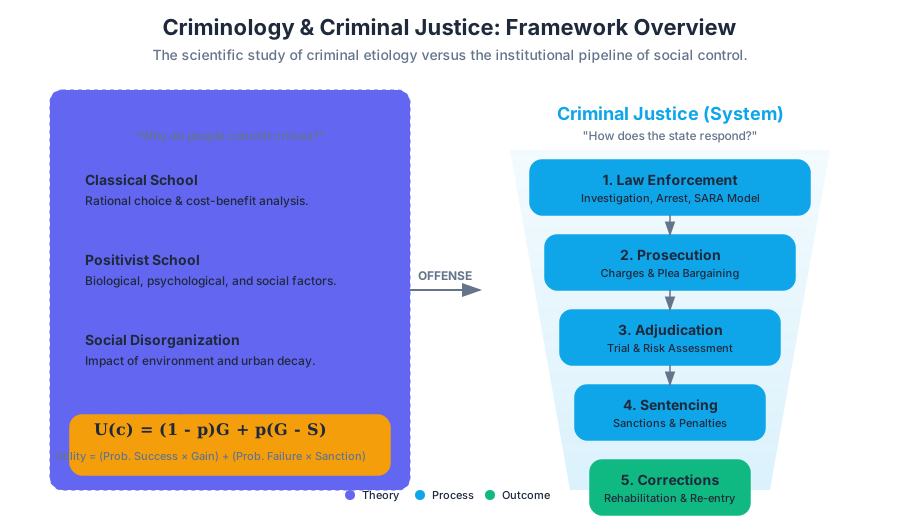
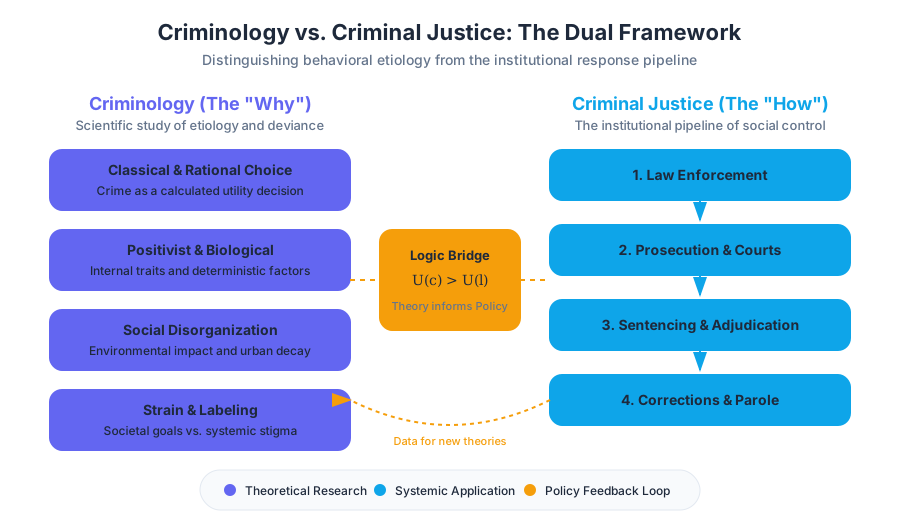
Criminology and Criminal Justice represent two distinct but deeply intertwined disciplines. While Criminology is the scientific study of the nature, extent, causes, and control of criminal behavior in both the individual and society, Criminal Justice refers to the system of practices and institutions of governments directed at upholding social control, deterring and mitigating crime, or sanctioning those who violate laws with criminal penalties and rehabilitation efforts.
The Fundamental Distinction: Criminology asks "Why do people commit crimes?" (Etiology), whereas Criminal Justice asks "How does the state respond to crime?" (Systemic Application).
Criminological Theory: The Mechanics of Deviance
Criminological theory provides the conceptual framework for understanding the "why" behind law-breaking. These theories have evolved from early spiritual explanations to rigorous, data-driven models that incorporate biology, psychology, and sociology.
Major Theoretical Schools
| School of Thought | Core Premise | Key Proponents | Policy Implication |
|---|---|---|---|
| Classical | Crime is a rational choice based on a cost-benefit analysis. | Cesare Beccaria, Jeremy Bentham | Deterrence through swift, certain, and proportionate punishment. |
| Positivist | Criminal behavior is determined by internal/external factors (biological, psychological). | Cesare Lombroso, Auguste Comte | Treatment and rehabilitation; focus on the offender rather than the act. |
| Social Disorganization | Crime is a product of the environment (poverty, residential instability). | Shaw and McKay (Chicago School) | Community investment, urban renewal, and social cohesion. |
| Strain Theory | Crime occurs when there is a gap between societal goals and the means to achieve them. | Robert Merton | Expanding economic opportunities and educational access. |
| Labeling Theory | Deviance is not a quality of the act, but a consequence of the application of rules. | Howard Becker | Diversion programs to avoid the "criminal" stigma for minor offenses. |
The Rational Choice Equation
In the Classical tradition, the decision to commit a crime can be modeled as a utility function where an individual weighs the expected utility $U(c)$ of a crime against the utility of legal activity.
$$U(c) = (1 - p)G + p(G - S)$$
Where:
- $p$ = Probability of apprehension and conviction.
- $G$ = Gain from the criminal act.
- $S$ = Severity of the legal sanction.
If $U(c) > U(l)$ (Utility of legal work), the individual is theoretically incentivized to offend. Modern criminology expands this by adding "moral costs" and "informal sanctions" (social shame) to the equation.
The Criminal Justice System: The Institutional Pipeline
The Criminal Justice System (CJS) functions as a pipeline or "funnel," where a vast number of reported crimes enter at the top, but only a small fraction result in incarceration. This system is traditionally divided into three primary pillars: Law Enforcement, The Courts, and Corrections.
The Pipeline Stages
- Entry: Investigation and Arrest.
- Prosecution and Pretrial: Charges filed, bail hearings, and plea bargaining.
- Adjudication: Trial or guilty plea.
- Sentencing and Sanctions: Determination of punishment.
- Corrections: Incarceration, probation, or parole.
Data-Driven Risk Assessment
Modern systems increasingly use algorithmic tools to assist in bail and sentencing decisions.
Policing and Law Enforcement
Policing is the "front door" of the criminal justice system. Its evolution has moved from a reactive model (responding to calls) to proactive and predictive models.
Models of Policing
- Community Policing: Focuses on building ties and working closely with members of the communities.
- Broken Windows Policing: Suggests that policing minor crimes (vandalism, public drinking) prevents more serious crimes by maintaining social order.
- Predictive Policing (PredPol): Uses mathematical models to anticipate where and when crimes are likely to occur.
Operational Logic: The SARA Model
Law enforcement agencies often use the SARA model for problem-oriented policing:
- Scanning: Identifying recurring problems.
- Analysis: Identifying the causes and conditions of the problem.
- Response: Implementing a tailored intervention.
- Assessment: Evaluating the effectiveness of the response.
Judicial Systems and Sentencing
The judicial branch is responsible for the legal processing of the accused. A central tension in this stage is the balance between Due Process (protecting individual rights) and Crime Control (efficiently processing offenders).
Sentencing Structures
Sentencing varies significantly based on jurisdiction and the philosophy of the court.
| Feature | Indeterminate Sentencing | Determinate Sentencing |
|---|---|---|
| Philosophy | Rehabilitation | Retribution / Incapacitation |
| Structure | Range of years (e.g., 5 to 10 years) | Fixed term (e.g., 8 years) |
| Release Authority | Parole Board | Statutory law / Judge |
| Discretion | High judicial and administrative discretion | Low discretion; often follows "Sentencing Guidelines" |
Corrections and Reentry
Corrections encompasses the management of individuals convicted of crimes, including jails, prisons, probation, and parole. The modern focus has shifted toward Reentry, recognizing that over 95% of incarcerated individuals will eventually return to society.
The Recidivism Cycle
Recidivism is the tendency of a convicted criminal to reoffend. High recidivism rates suggest a failure in the "correctional" aspect of the system.
Key Metric: Recidivism Rate $R = \frac{N_{re}}{N_{total}} \times 100$ Where $N_{re}$ is the number of released individuals who are rearrested/reconvicted within a specific timeframe (usually 3 years).
Barriers to Successful Reentry
- Collateral Consequences: Legal restrictions on housing, employment, and voting.
- Social Capital: Loss of family ties and professional networks during incarceration.
- Mental Health: High prevalence of untreated trauma and substance abuse disorders within prison populations.
Systemic Reform and Modern Challenges
The 21st century has brought intense scrutiny to the criminal justice system, focusing on disparities and the "criminalization" of social issues.
1. Urban Inequality and Disparities
Criminological research consistently shows that crime is concentrated in specific "hot spots" characterized by high poverty and low collective efficacy. Reformers argue that "over-policing" these areas leads to systemic racial and economic disparities in the prison population.
2. Mental Health in Justice
The de-institutionalization of mental health facilities in the late 20th century led to the "trans-institutionalization" of the mentally ill into jails and prisons. Jails like Los Angeles County and Cook County are now effectively the largest mental health providers in the United States.
3. Juvenile Justice
The juvenile system operates on the principle of parens patriae (the state as parent). It emphasizes rehabilitation over punishment, recognizing that the adolescent brain is not fully developed, particularly in areas related to impulse control and risk assessment.
4. Technology and Surveillance
The use of Body-Worn Cameras (BWCs), facial recognition, and electronic monitoring (EM) represents a double-edged sword: increasing accountability while expanding the "carceral net" into the private lives of citizens.
Common Pitfalls in Understanding the System
- The "CSI Effect": The misconception that forensic evidence is available and definitive in every case. In reality, most cases are settled via plea bargains without a trial.
- Correlation vs. Causation: Assuming that because two variables (e.g., ice cream sales and crime) rise together, one causes the other. In criminology, "lurking variables" like temperature or socio-economic status are often the true drivers.
- The Myth of the "Monolithic System": The U.S. does not have one "Criminal Justice System." It has thousands of independent local, state, federal, and tribal systems with varying laws and procedures.
Source Materials
Study Overview of Social Science and Professional Disciplines on Lykke
This course page is free to open: signed out, you can read its first two sections, and signing in, on any plan, opens the rest. The free Lykke Chrome extension syncs your own Canvas courses, so ChatGPT, Claude and Muse can answer from your classes and deadlines. It only reads Canvas.
Add the free extensionSign in to open every sectionAll sections of Overview of Social Science and Professional Disciplines · Browse more course pages