From the free course Overview of Social Science and Professional Disciplines on Lykke
Counseling & Guidance
Key concepts: Academic Success Strategies · Career Development · Study Skills · Addictions Counseling · Professional Internship Preparation
Resources for academic success, career development, and specialized counseling areas.
Counseling & Guidance: A Systems Approach to Human Development
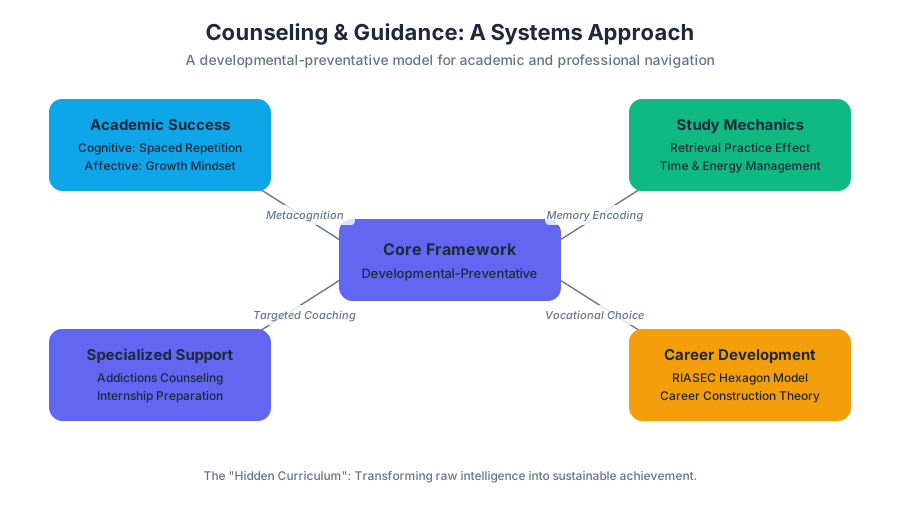
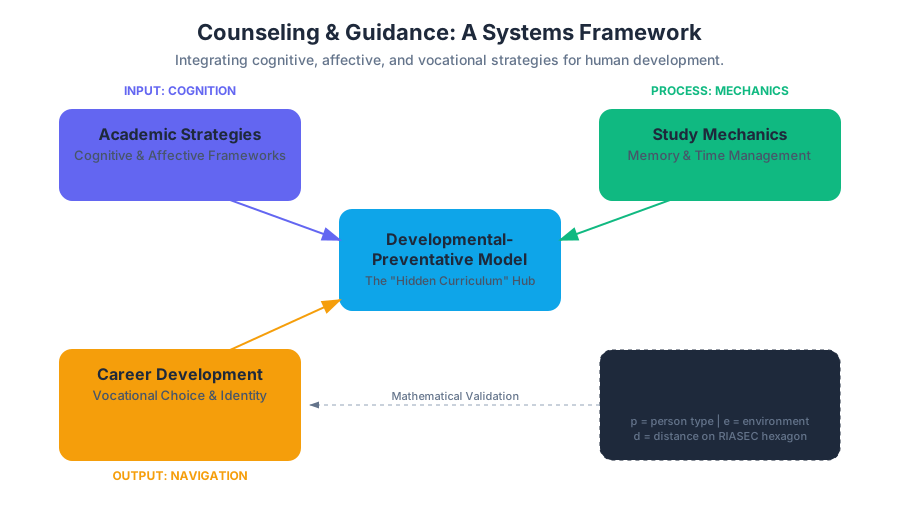
Counseling and Guidance is an interdisciplinary field that synthesizes psychology, pedagogy, sociology, and vocational theory to facilitate human growth and institutional navigation. Unlike purely clinical psychology, which often focuses on pathology, Counseling & Guidance operates on a developmental-preventative model. It seeks to equip individuals with the cognitive frameworks, emotional resilience, and strategic toolsets required to navigate complex academic and professional ecosystems.
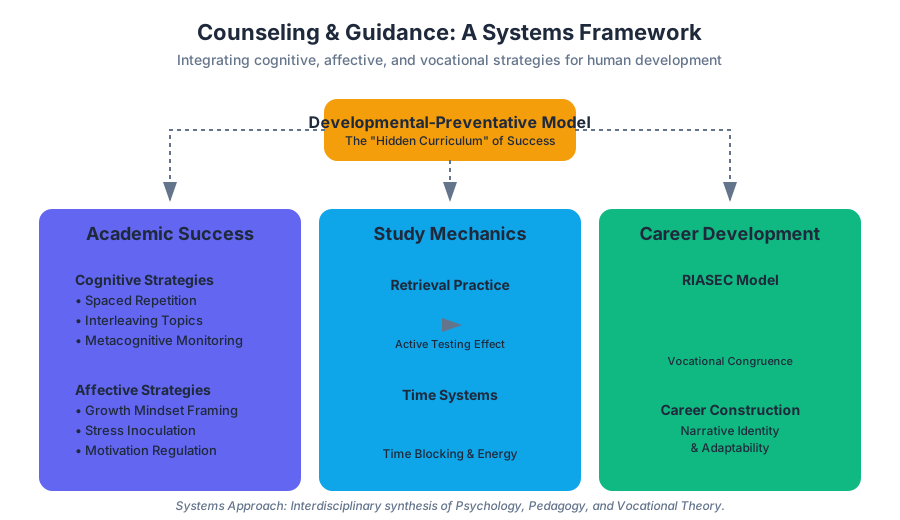
At its core, the discipline addresses the "hidden curriculum" of success—the meta-skills that allow a student to transform raw intelligence into academic achievement, and a graduate to transform a degree into a sustainable career. This involves a multi-modal approach encompassing Academic Success Strategies, Career Development, Study Skills, and specialized interventions like Addictions Counseling and Professional Internship Preparation.
Academic Success Strategies: The Architecture of Achievement
Academic success is not a static trait but an emergent property of a well-regulated learning system. It involves the transition from passive consumption of information to active, metacognitive engagement.
The Transition Framework
The shift from secondary to higher education (or from undergraduate to professional study) requires a fundamental recalibration of the "Student-Institutional Contract." In secondary education, the burden of monitoring progress often lies with the institution; in higher education, this burden shifts to the individual.
Metacognition: The process of "thinking about thinking." In a counseling context, this refers to a student's ability to monitor their own comprehension, evaluate their learning strategies, and adjust their cognitive load in real-time.
Strategic Interventions
Counselors utilize various frameworks to help students optimize their academic performance. These are often categorized into Cognitive Strategies (how we process info) and Affective Strategies (how we manage stress and motivation).
| Strategy Category | Method | Objective | Complexity |
|---|---|---|---|
| Cognitive | Spaced Repetition | Combat the Ebbinghaus Forgetting Curve | High (Requires planning) |
| Cognitive | Interleaving | Mixing different topics to improve discrimination | Moderate |
| Affective | Growth Mindset | Re-framing failure as a data point for growth | Low (Conceptual) |
| Affective | Stress Inoculation | Controlled exposure to academic pressure | High (Requires coaching) |
Study Skills and Time Management: The Mechanics of Learning
While academic strategies provide the "why," study skills provide the "how." Effective study skills are rooted in cognitive science, specifically the mechanics of memory encoding and retrieval.
The Retrieval Practice Effect
One of the most robust findings in educational psychology is that testing oneself is a more effective learning tool than re-studying material. This is known as the Retrieval Practice Effect.
Time Management Systems
Time management is often the primary bottleneck for students. Counselors advocate for systems that move beyond simple "to-do lists" toward Time Blocking and Energy Management.
Career Development: Navigating the Professional Landscape
Career development is a lifelong process of managing learning, work, leisure, and transitions. Modern counseling has moved away from "trait-and-factor" matching (finding the one "perfect" job) toward Career Construction Theory, which emphasizes adaptability and narrative identity.
Holland’s Theory of Vocational Choice (RIASEC)
A cornerstone of career counseling, John Holland’s model suggests that people and work environments can be categorized into six themes. The "congruence" between a person's type and their environment predicts job satisfaction.
The RIASEC Hexagon: Realistic (R), Investigative (I), Artistic (A), Social (S), Enterprising (E), and Conventional (C).
Mathematical Representation of Congruence
Congruence ($C$) can be calculated using the distance between the primary interest type of the individual ($p$) and the primary requirement of the environment ($e$) on the RIASEC hexagon.
C = \sum_{i=1}^{n} w_i \cdot d(p_i, e_i)
Where:
- $d$ is the distance function on the hexagonal graph.
- $w$ is the weight assigned to the primary, secondary, and tertiary types.
- $n$ is the number of types considered (usually 3, the "Holland Code").
Career Decision-Making Models
Counselors often distinguish between Prescriptive models (how decisions should be made) and Descriptive models (how they are made).
| Model Type | Focus | Key Concept |
|---|---|---|
| Rational/Linear | Optimization | Gathering all data to find the "best" fit. |
| Planned Happenstance | Opportunity | Transforming unplanned events into career opportunities. |
| Social Cognitive | Self-Efficacy | How belief in one's ability affects career choice. |
| Narrative | Meaning | Viewing career as a story the individual is writing. |
Professional Internship Preparation: The Theory-Practice Bridge
Internships serve as the "clinical" component of general education. Preparation for these experiences is a critical counseling function, involving the translation of academic knowledge into professional competencies.
The Internship Lifecycle
- Self-Assessment: Identifying skill gaps and professional goals.
- Targeting: Researching organizations that align with the student's "Holland Code."
- Acquisition: Navigating the application, interview, and negotiation phase.
- Integration: The "Onboarding" phase where the student learns the organizational culture.
- Reflection: Post-internship analysis of learned skills and career alignment.
Competency Mapping
Counselors help students map academic coursework to the NACE (National Association of Colleges and Employers) Career Readiness Competencies:
- Critical Thinking/Problem Solving
- Oral/Written Communications
- Teamwork/Collaboration
- Digital Technology
- Leadership
- Professionalism/Work Ethic
- Career Management
- Global/Intercultural Fluency
Addictions Counseling: Fundamentals of Behavioral Change
Addictions counseling within a guidance framework often focuses on the Biopsychosocial Model. It recognizes that addiction is not merely a biological failure or a moral lapse, but a complex interaction between brain chemistry, psychological state, and social environment.
The Transtheoretical Model (Stages of Change)
Counselors use this model to tailor their interventions to the client's current state of readiness.
| Stage | Definition | Counselor's Role |
|---|---|---|
| Pre-contemplation | Not intending to take action. | Raise awareness of risks/doubts. |
| Contemplation | Acknowledging the problem but ambivalent. | Tip the "decisional balance" toward change. |
| Preparation | Intending to take action in the immediate future. | Help develop a concrete action plan. |
| Action | Making specific overt modifications in lifestyle. | Provide support and help with problem-solving. |
| Maintenance | Working to prevent relapse. | Develop relapse prevention strategies. |
Relapse Prevention and Harm Reduction
In a guidance context, the focus is often on Harm Reduction—minimizing the negative consequences of substance use—and identifying "High-Risk Situations" (HRS).
Specialized Support: Non-Traditional and Holistic Perspectives
Modern Counseling & Guidance must be inclusive of diverse student populations. This includes Non-traditional Students (adult learners, parents, veterans) and those with disabilities.
Disability Studies in Counseling
Counseling has shifted from the Medical Model (fixing the individual) to the Social Model of disability. In the social model, "disability" is viewed as a mismatch between the individual's impairment and the barriers created by society/institutions.
Impairment vs. Disability: An impairment is a physical or mental condition (e.g., being unable to walk), while a disability is the social consequence (e.g., a building without a ramp).
Holistic Anthropology and Communication
As noted in the broader social science literature, counseling is deeply rooted in Anthropology (understanding cultural context) and Communication Studies (the mechanics of the therapeutic alliance). A counselor must understand the cultural scripts their clients are following and use verbal, non-verbal, and written communication to build trust.
Common Pitfalls in Counseling & Guidance
- The "Advice-Giving" Trap: Counselors often feel pressured to provide answers. However, effective guidance focuses on Empowerment, helping the client develop the skills to find their own answers.
- Ignoring the System: Focusing solely on the individual's "lack of grit" without addressing systemic barriers (e.g., lack of childcare for a non-traditional student) leads to ineffective interventions.
- Over-reliance on Assessment: Tools like the RIASEC or Myers-Briggs are starting points for conversation, not definitive labels.
- The "One-Size-Fits-All" Fallacy: Assuming that a study strategy that works for a neurotypical student will work for a student with ADHD or dyslexia.
Conclusion
Counseling & Guidance is the "operating system" of the educational and professional experience. By integrating academic strategies, career planning, and behavioral health, it provides a comprehensive framework for navigating the complexities of modern life. Whether it is through the application of a spaced-repetition algorithm to master organic chemistry or the use of the Transtheoretical Model to overcome a behavioral addiction, the field remains dedicated to the holistic development of the human potential.
Source Materials
Study Overview of Social Science and Professional Disciplines on Lykke
This course page is free to open: signed out, you can read its first two sections, and signing in, on any plan, opens the rest. The free Lykke Chrome extension syncs your own Canvas courses, so ChatGPT, Claude and Muse can answer from your classes and deadlines. It only reads Canvas.
Add the free extensionSign in to open every sectionAll sections of Overview of Social Science and Professional Disciplines · Browse more course pages