From the free course Overview of Social Science and Professional Disciplines on Lykke
Communication Studies
Key concepts: Verbal Communication · Nonverbal Communication · Interpersonal Communication · Mass Media · Intercultural Communication
Examination of human interaction across verbal, written, and nonverbal channels in various contexts.
Communication Studies: The Architecture of Human Interaction
Communication Studies is the systematic inquiry into how humans use symbols to create and interpret meaning within and across various contexts, cultures, and media. Far from being a "soft" discipline, modern communication theory integrates linguistics, sociology, psychology, and information theory to model the complex protocols that govern social stability and change. At its core, the field treats communication not merely as the transmission of information, but as the fundamental process through which social reality is constructed, maintained, and transformed.
The Fundamental Mechanics of Communication
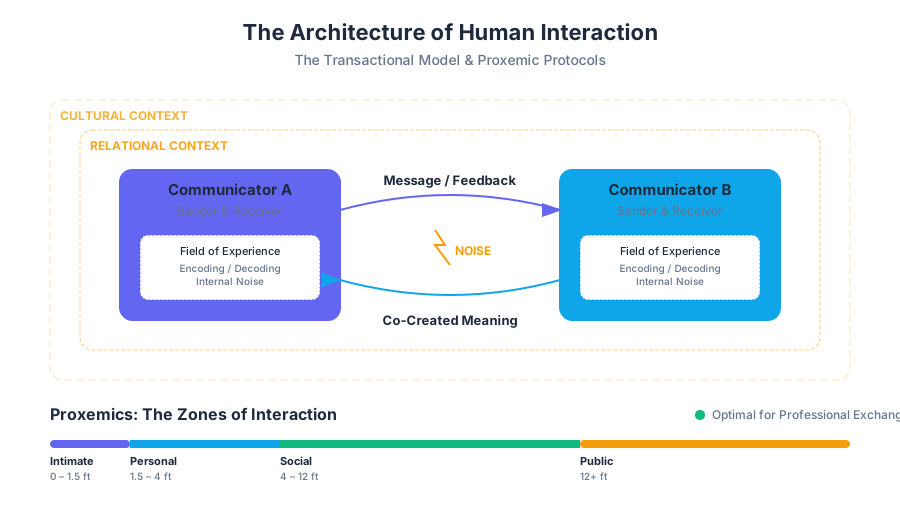
To understand communication, one must first distinguish between the Linear Model, the Interactional Model, and the Transactional Model. While early models (like Shannon-Weaver) viewed communication as a one-way pipeline from sender to receiver, contemporary theory views it as a simultaneous, multi-layered exchange where "noise" is not just physical interference, but psychological and cultural friction.
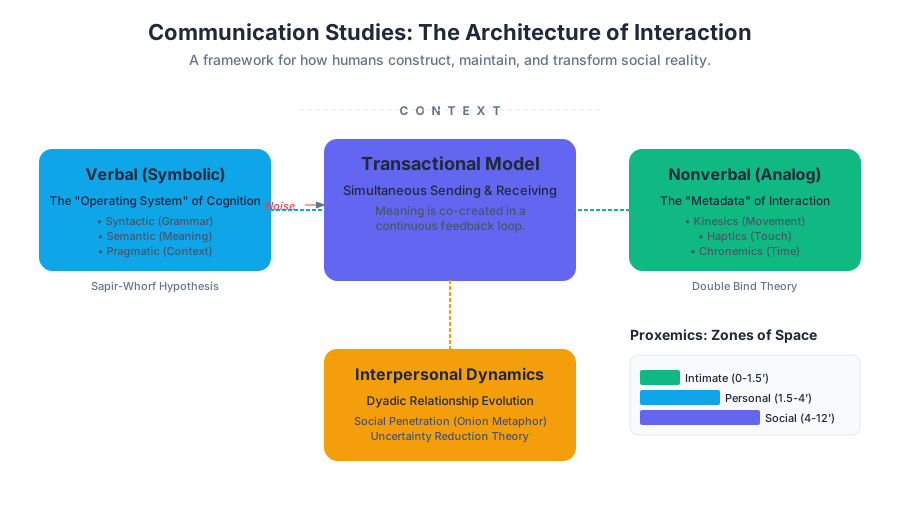
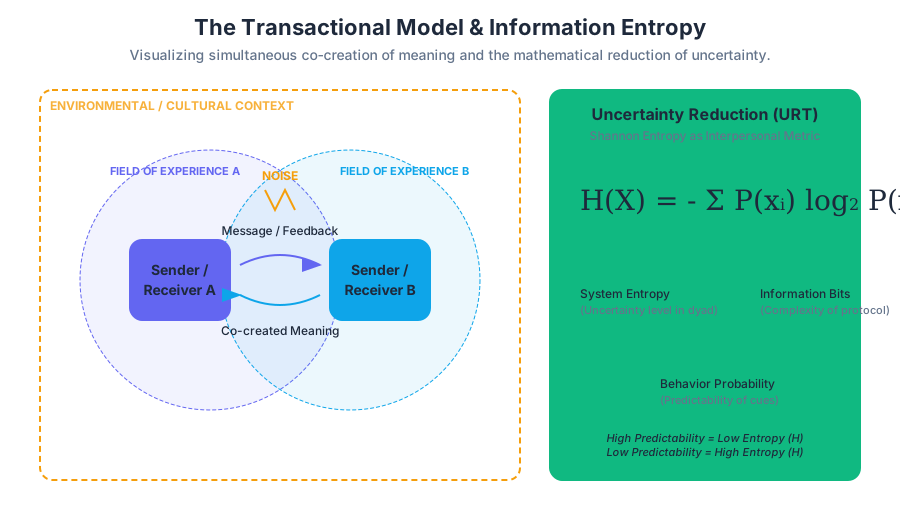
The Transactional Model: A framework asserting that individuals are simultaneously senders and receivers of messages. In this model, communication is a continuous process where meaning is co-created through the feedback loop, and the context (physical, relational, and cultural) actively shapes the message.
Comparison of Communication Models
| Model Type | Primary Focus | Directionality | Key Limitation |
|---|---|---|---|
| Linear | Transmission | One-way (S -> R) | Ignores feedback and context. |
| Interactional | Exchange | Two-way (S <-> R) | Views communication as discrete turns. |
| Transactional | Co-creation | Simultaneous | High complexity; difficult to isolate variables. |
Verbal Communication: The Symbolic Protocol
Verbal Communication is the use of arbitrary symbol systems—language—to convey abstract concepts and concrete data. It is governed by three primary rule sets: Syntactic (grammar), Semantic (meaning), and Pragmatic (contextual usage).
A critical concept here is the Sapir-Whorf Hypothesis, which suggests that the structure of a language determines or greatly influences the modes of thought and behavior characteristic of the culture in which it is spoken. In technical terms, language acts as the "operating system" for human cognition.
Nonverbal Communication: The Analog Substrate
While verbal communication is discrete and symbolic, Nonverbal Communication is continuous and often iconic. It encompasses all messages sent without words, including Kinesics (body movement), Proxemics (use of space), Haptics (touch), and Chronemics (use of time).
Nonverbal cues often function as the "metadata" of an interaction. When verbal and nonverbal messages conflict—a state known as Double Bind—receivers almost universally rely on the nonverbal channel for "truth," as it is perceived to be less subject to conscious manipulation.
Proxemics: The Zones of Interaction
Edward T. Hall’s research into proxemics defines how physical distance correlates with social relationship status.
| Zone | Distance | Typical Context |
|---|---|---|
| Intimate | 0–18 inches | Close relationships, high trust. |
| Personal | 1.5–4 feet | Friends and family; "bubble" space. |
| Social | 4–12 feet | Professional interactions, business meetings. |
| Public | 12+ feet | Lectures, public speaking, strangers. |
Interpersonal Communication: Dyadic Dynamics
Interpersonal Communication focuses on the exchange between a small number of people (usually two, known as a dyad) who have an identifiable relationship. The primary goal of studying interpersonal communication is to understand how relationships are initiated, maintained, and dissolved.
Two foundational theories dominate this subfield:
- Social Penetration Theory: The "Onion Metaphor," suggesting that relationships develop through systematic changes in communication from superficial to intimate levels (breadth vs. depth).
- Uncertainty Reduction Theory (URT): The premise that when strangers meet, their primary concern is to reduce uncertainty and increase predictability about each other.
The Mathematical Foundation of Information Exchange
In the context of URT, we can view communication as the reduction of entropy. Claude Shannon’s formula for entropy ($H$) can be adapted to represent the "uncertainty" in an interpersonal system.
H(X) = -\sum_{i=1}^{n} P(x_i) \log_2 P(x_i)
Where:
- $H(X)$ is the uncertainty (entropy) of the interaction.
- $P(x_i)$ is the probability of a specific communicative behavior $x_i$ occurring.
- As the probability of predicting a partner's behavior increases, $H(X)$ decreases, indicating a more stable relationship.
Mass Media: Scaled Information Architecture
Mass Media refers to the technologies and organizations through which messages are disseminated to large, heterogeneous, and often anonymous audiences. Unlike interpersonal communication, mass media is characterized by a high degree of asynchronicity and a lack of immediate feedback.
Key Theoretical Frameworks in Mass Media
- Agenda-Setting Theory: The media doesn't tell people what to think, but rather what to think about. By selecting specific stories, media outlets signal the importance of certain issues.
- Cultivation Theory: Long-term exposure to media (specifically television) "cultivates" a viewer's perception of reality, often leading to "Mean World Syndrome."
- Uses and Gratifications: A shift from "what media does to people" to "what people do with media," focusing on why individuals seek out specific content (e.g., surveillance, personal identity, social integration).
Media Analytics Schema
To analyze mass media impact, researchers often track engagement metrics across different demographics.
Intercultural Communication: Navigating the Global Grid
Intercultural Communication examines how cultural variability—values, norms, and worldviews—affects the communication process. As globalization increases, the ability to decode "high-context" vs. "low-context" signals becomes a critical professional competency.
High-Context vs. Low-Context Cultures
Coined by Edward T. Hall, this distinction describes how much information is embedded in the environment versus the explicit verbal message.
| Feature | Low-Context (e.g., Germany, USA) | High-Context (e.g., Japan, China) |
|---|---|---|
| Communication Style | Explicit, direct, verbal. | Implicit, indirect, nonverbal. |
| Focus | Task-oriented; "Get to the point." | Relationship-oriented; "Read the room." |
| Conflict | Depersonalized; addressed openly. | Personalized; avoided to "save face." |
| Information Flow | Structured and compartmentalized. | Fluid and diffused through networks. |
Face-Negotiation Theory
Developed by Stella Ting-Toomey, this theory explains how people from different cultures manage conflict. Face refers to one's self-image in the presence of others. Collectivist cultures tend to prioritize "other-face" or "mutual-face," while individualist cultures prioritize "self-face."
Insight: Effective intercultural communication requires Mindfulness—the conscious awareness of one's own communication biases and the active effort to adapt to the partner's cultural protocol.
Common Pitfalls in Communication Analysis
- The Transmission Myth: Assuming that if a message was "sent," it was "received" exactly as intended. This ignores the encoding/decoding gap.
- Over-reliance on Nonverbal "Cheat Sheets": Believing that a single gesture (like crossed arms) always means one thing (defensiveness). Nonverbal cues must be interpreted in clusters and within context.
- Ethnocentrism: Evaluating other cultures' communication styles through the lens of one's own culture, often leading to the "deficiency" model rather than a "difference" model.
- Technological Determinism: The belief that the medium itself (e.g., the internet) will automatically improve or degrade communication quality without considering human agency.
Summary of Interdisciplinary Connections
Communication Studies does not exist in a vacuum. It is the bridge between the Social Sciences (understanding human behavior) and the Applied Sciences (designing systems for information flow).
- Anthropology: Provides the cultural context for symbolic meaning.
- Criminology: Uses interpersonal communication theory for interrogation and victim advocacy.
- Early Childhood Education: Relies on verbal and nonverbal developmental milestones to assess cognitive growth.
- Counseling: Utilizes active listening and empathy protocols to facilitate personal exploration.
Study Guide: Communication Studies
I. Core Definitions
- Communication: The process of generating meaning by sending and receiving verbal and nonverbal symbols and signs that are influenced by multiple contexts.
- Noise: Any interference in the communication process (Physical, Physiological, Psychological, Semantic).
- Feedback: The response to a message that allows the sender to evaluate the effectiveness of the communication.
II. Key Theories to Master
- Social Penetration Theory: The "peeling the onion" process of self-disclosure.
- Agenda-Setting: The media's power to influence the importance of topics on the public agenda.
- Hofstede’s Cultural Dimensions: Power Distance, Individualism vs. Collectivism, Masculinity vs. Femininity, Uncertainty Avoidance, Long-term Orientation.
III. Practical Application Steps
- Identify the Context: Is the interaction interpersonal, group, public, or mass-mediated?
- Analyze the Channel: Is the medium appropriate for the message (e.g., don't fire an employee via text)?
- Decode the Nonverbals: Look for congruence between what is said and how it is said.
- Adjust for Culture: Determine if the environment is high-context or low-context before proceeding with a negotiation.
IV. Recommended Reading
- The Silent Language by Edward T. Hall
- Understanding Media by Marshall McLuhan
- Communication Theory: Epistemological Foundations by James A. Anderson
Source Materials
Study Overview of Social Science and Professional Disciplines on Lykke
This course page is free to open: signed out, you can read its first two sections, and signing in, on any plan, opens the rest. The free Lykke Chrome extension syncs your own Canvas courses, so ChatGPT, Claude and Muse can answer from your classes and deadlines. It only reads Canvas.
Add the free extensionSign in to open every sectionAll sections of Overview of Social Science and Professional Disciplines · Browse more course pages