From the free course Overview of Social Science and Professional Disciplines on Lykke
Anthropology
Key concepts: Cultural Anthropology · Biological Anthropology · Archaeology · Linguistic Anthropology · Holistic Approach
Exploration of the holistic study of humankind through its four primary subfields.
Anthropology: The Holistic Science of Humankind
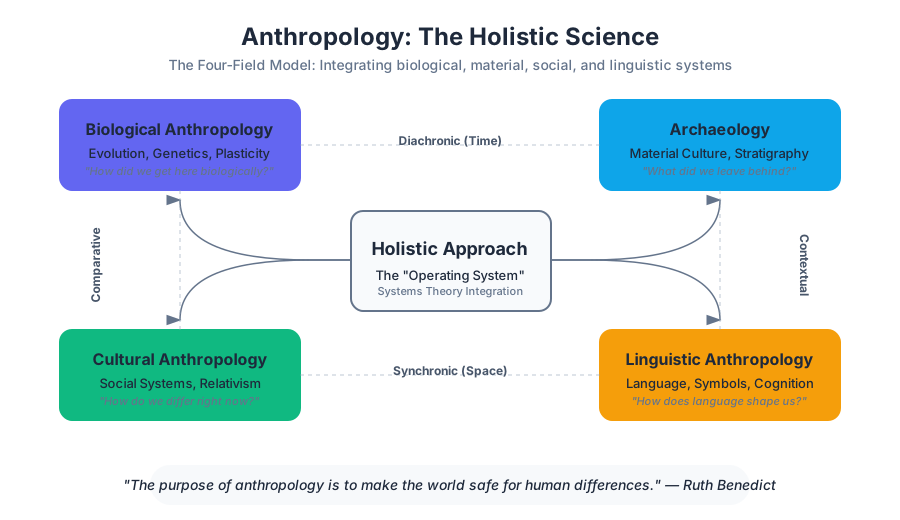
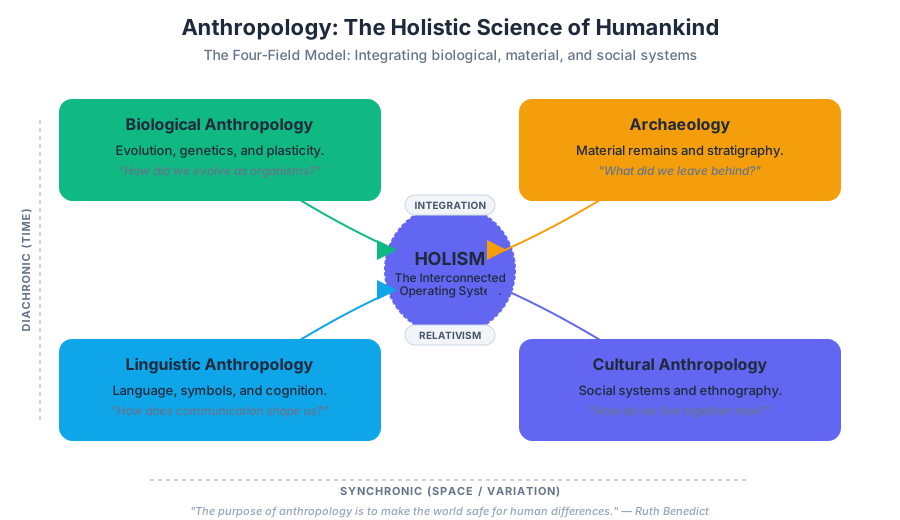
Anthropology is the comprehensive, interdisciplinary study of humanity across time and space. Unlike specialized social sciences that isolate specific variables (such as economics focusing on markets or political science on governance), anthropology employs a Holistic Approach. This methodology posits that the human experience cannot be understood by looking at a single component; rather, biological evolution, linguistic development, material remains, and cultural practices are deeply interconnected systems.
The discipline is traditionally organized into the "Four-Field Model," a structural framework that allows researchers to pivot between deep evolutionary time and the nuances of contemporary social interaction. By synthesizing data from these disparate fields, anthropology seeks to answer the fundamental question: What does it mean to be human?
The Holistic Approach: Systems Theory in Human Study
The Holistic Approach is the foundational "operating system" of anthropology. It functions as a meta-theory, asserting that any given aspect of a culture or biological trait is contingent upon a web of other factors.
Why it matters
Without holism, researchers risk Reductionism—the error of attributing complex human behavior to a single cause (e.g., "biology is destiny" or "culture is purely economic"). Holism allows anthropologists to see how a change in environment (Biological) leads to a change in food procurement (Archaeological), which alters social hierarchy (Cultural) and creates new terminologies for status (Linguistic).
Mechanics of Holism
- Integration: Combining data from all four subfields.
- Comparison: Using the Cross-Cultural Perspective to ensure theories aren't biased toward Western "WEIRD" (Western, Educated, Industrialized, Rich, Democratic) societies.
- Relativism: Employing Cultural Relativism—the principle that a culture’s beliefs and activities should be understood based on that culture’s own standards, rather than be judged against the criteria of another.
| Component | Focus | Primary Question |
|---|---|---|
| Diachronic | Change over time | How did we get here? |
| Synchronic | Variations across space | How do we differ right now? |
| Comparative | Cross-cultural analysis | What is universal vs. specific? |
| Contextual | Environmental/Social setting | Why does this behavior make sense here? |
The Anthropological Axiom: "The purpose of anthropology is to make the world safe for human differences." — Ruth Benedict
Biological Anthropology: The Architecture of the Hominin
Biological Anthropology (also known as Physical Anthropology) is the study of human biological evolution and variation. It treats humans as biological organisms while acknowledging that our primary adaptive mechanism is culture.
How it works: The Hardy-Weinberg Principle
To understand how human populations evolve, anthropologists use the Hardy-Weinberg Equilibrium (HWE). This mathematical model provides a "null hypothesis" for evolution. If the allele frequencies in a population deviate from the HWE, we know that evolutionary forces (mutation, gene flow, genetic drift, or natural selection) are at work.
Key Sub-specialties
- Paleoanthropology: The study of the fossil record to reconstruct the hominin lineage (e.g., Australopithecus, Homo erectus).
- Primatology: The study of non-human primates to find analogies for early human behavior.
- Forensic Anthropology: The application of skeletal analysis to legal contexts.
Common Pitfalls
A common mistake is Biological Determinism, the belief that complex behaviors (like aggression or intelligence) are controlled entirely by genes. Modern biological anthropology emphasizes Plasticity—the ability of the human body to change in response to environmental stressors (e.g., high-altitude adaptation).
Archaeology: The Systematics of Material Culture
Archaeology is the investigation of the human past through Material Remains. It is not "treasure hunting"; it is the rigorous reconstruction of extinct social systems using the garbage, tools, and structures left behind.
The Mechanics of Stratigraphy
Archaeologists rely on the Law of Superposition, which states that in an undisturbed sequence of strata (layers of earth), the oldest layers are at the bottom. By analyzing the Context (the exact three-dimensional position of an artifact), researchers can determine its relationship to other objects.
Chronometric Dating
To move from relative dating (older/younger) to absolute dating (years before present), archaeologists use isotopic decay models.
% Radiocarbon Dating Derivation
% The decay of Carbon-14 follows a first-order kinetic equation:
N(t) = N_0 \cdot e^{-\lambda t}

% Where:
% N(t) = remaining amount of C-14
% N_0 = initial amount of C-14
% \lambda = decay constant (ln(2) / half-life)
% t = time elapsed

% Given the half-life of C-14 is 5730 years:
\lambda = \frac{0.693}{5730} \approx 1.209 \times 10^{-4} \text{ year}^{-1}

% Solving for t (the age of the sample):
t = \frac{\ln(N_0 / N(t))}{\lambda}
Variations in Archaeology
| Type | Focus | Example |
|---|---|---|
| Prehistoric | Societies without written records | Clovis points in North America |
| Historical | Societies with written records | Excavating a 19th-century plantation |
| Ethnoarchaeology | Studying living people to understand the past | Watching modern potters to interpret ancient kilns |
| CRM | Cultural Resource Management | Salvage archaeology before a highway is built |
Cultural Anthropology: The Ethnographic Method
Cultural Anthropology is the study of living human societies. Its primary methodology is Ethnography, which involves long-term, immersive fieldwork.
Participant Observation
The hallmark of cultural anthropology is Participant Observation. Unlike a sociologist who might use surveys, the anthropologist lives within the community, speaks the language, and participates in daily life. This allows for the collection of Thick Description—a term coined by Clifford Geertz to describe data that includes not just the behavior, but the context and meaning behind it.
Emic vs. Etic Perspectives
A critical tension in cultural anthropology is the balance between two viewpoints:
- Emic: The "insider’s" perspective. How the people being studied perceive and categorize their own world.
- Etic: The "outsider’s" perspective. The application of scientific or cross-cultural categories to the data.
| Feature | Emic Perspective | Etic Perspective |
|---|---|---|
| Source of Logic | Internal to the culture | External (Scientific/Universal) |
| Goal | Understand local meaning | Find patterns/laws |
| Example | "We perform this dance to bring rain." | "The dance serves as a social cohesion mechanism." |
| Risk | Subjectivity / Lack of comparison | Ethnocentrism / Imposing categories |
Variations: Kinship and Exchange
Cultural anthropologists often focus on Kinship Systems (how people define family) and Economic Exchange. They distinguish between Reciprocity (giving without immediate expectation of return), Redistribution (pooling resources), and Market Exchange.
Linguistic Anthropology: Language as Social Action
Linguistic Anthropology explores how language shapes social life. It views language not just as a set of grammatical rules, but as a Cultural Resource and a form of Social Action.
The Sapir-Whorf Hypothesis
One of the most debated concepts is Linguistic Relativity (the Sapir-Whorf Hypothesis), which suggests that the structure of a language affects its speakers' world view or cognition.
- Strong Version (Determinism): Language determines thought (largely rejected).
- Weak Version (Relativity): Language influences thought and predisposes speakers to certain interpretations of reality.
Sociolinguistics and Power
Linguistic anthropologists study Code-Switching—the practice of alternating between two or more languages or dialects depending on the social context. This is often tied to power dynamics, as certain "prestige dialects" are associated with economic and political authority.
Data Processing in Linguistics
Modern linguistic anthropologists use computational tools to analyze large corpora of field recordings to identify patterns in discourse.
Applied Anthropology: The "Fifth Field"
While the four subfields provide the theoretical backbone, Applied Anthropology uses these insights to solve real-world problems. This is the fastest-growing sector of the discipline.
Applications
- Medical Anthropology: Studying how different cultures perceive health and illness to improve healthcare delivery.
- Corporate Anthropology: Using ethnographic methods to understand consumer behavior or improve organizational culture.
- Development Anthropology: Ensuring that international aid projects are culturally appropriate and sustainable.
Ethics in Anthropology
Because anthropologists often work with marginalized or vulnerable populations, ethics are paramount. The American Anthropological Association (AAA) maintains a strict code of ethics:
- Do No Harm: The safety and dignity of the people studied come first.
- Informed Consent: Participants must understand the nature and risks of the research.
- Anonymity: Protecting the identities of informants in published work.
Key Insight: Anthropology is not just about "the other." By studying different ways of being human, we gain a "mirror for humanity," allowing us to see our own cultural assumptions as just one possibility among many.
Comparison of Theoretical Paradigms
Anthropology has evolved through several major theoretical shifts, moving from colonial-era "evolutionism" to modern "post-modernism."
| Paradigm | Key Figure | Core Idea | Critique |
|---|---|---|---|
| Unilineal Evolutionism | E.B. Tylor | All cultures pass through stages: Savagery → Barbarism → Civilization. | Ethnocentric; assumes Western superiority. |
| Historical Particularism | Franz Boas | Each culture is a unique product of its own history and environment. | Lacks a unifying theory of human behavior. |
| Structural Functionalism | Radcliffe-Brown | Cultural practices exist to maintain the social structure and stability. | Ignores social change and individual agency. |
| Cultural Materialism | Marvin Harris | Infrastructure (technology/environment) determines social and mental structure. | Too deterministic; ignores the power of ideas. |
| Interpretive Anthropology | Clifford Geertz | Culture is a "web of significance" that must be interpreted like a text. | Can be overly subjective and unscientific. |
Study Guide: Mastering Anthropology
Core Definitions to Memorize
- Holism: The perspective that all aspects of human life are interconnected.
- Ethnography: The primary method of cultural anthropology involving long-term fieldwork.
- Artifact: Any portable object made or modified by humans.
- Hominin: Humans and their extinct ancestors since the split from the chimpanzee lineage.
- Communicative Competence: The ability to use language appropriately in social contexts.
Critical Thinking Questions
- How does the Holistic Approach prevent the "siloing" of knowledge found in other academic disciplines?
- In what ways can Biological Anthropology debunk myths about "race" as a biological category?
- How does Archaeology provide a "check" on historical records written by the winners of conflicts?
- Why is Cultural Relativism a methodological tool rather than a moral stance?
Recommended Reading
- Guns, Germs, and Steel by Jared Diamond (for a materialist/environmental perspective).
- The Interpretation of Cultures by Clifford Geertz (for a symbolic/interpretive perspective).
- Coming of Age in Samoa by Margaret Mead (a classic, though debated, ethnographic study).
Source Materials
Study Overview of Social Science and Professional Disciplines on Lykke
This course page is free to open: signed out, you can read its first two sections, and signing in, on any plan, opens the rest. The free Lykke Chrome extension syncs your own Canvas courses, so ChatGPT, Claude and Muse can answer from your classes and deadlines. It only reads Canvas.
Add the free extensionSign in to open every sectionAll sections of Overview of Social Science and Professional Disciplines · Browse more course pages