From the free course Organic Chemistry: Structure, Reactivity, and the Functional Group Approach on Lykke
Scientific Applications and Modern Updates
Key concepts: Modern Applications · Scientific Literacy · Updated Research
Exploring the 10th edition's focus on contemporary scientific applications and updated research.
Scientific Applications and Modern Updates
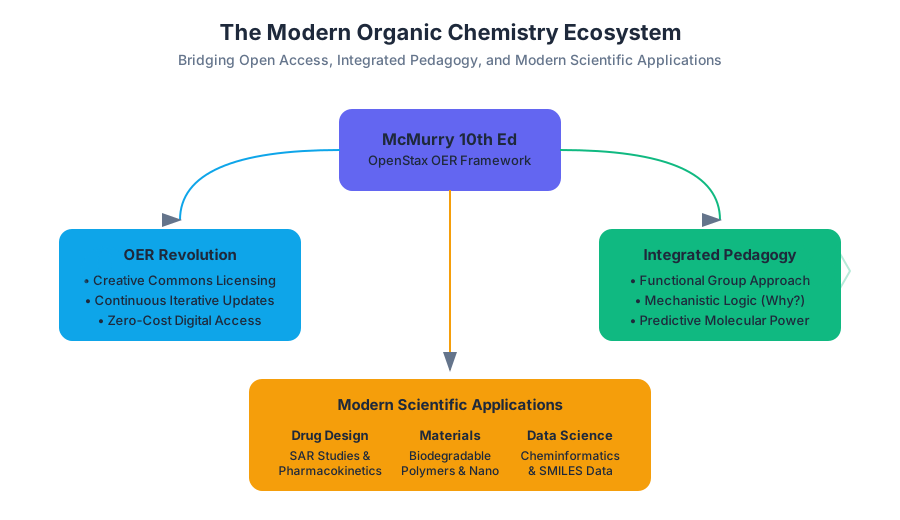
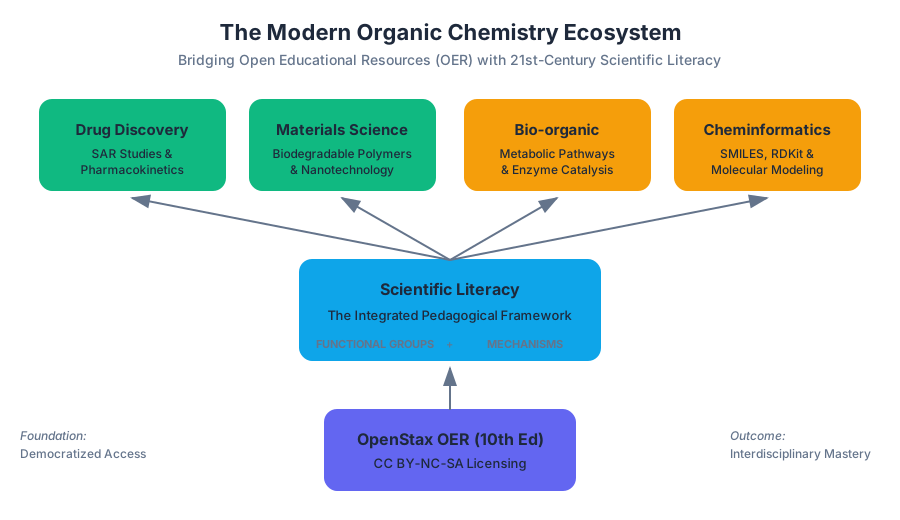
The publication of the 10th edition of John McMurry’s Organic Chemistry through OpenStax marks a pivotal moment in chemical education. This transition from a traditional proprietary model to an Open Educational Resource (OER) framework does not merely change the price tag; it fundamentally alters the delivery, accessibility, and currency of scientific information. In the modern era, organic chemistry is no longer a static collection of 19th-century reactions but a dynamic, interdisciplinary engine driving advancements in molecular biology, materials science, and green engineering.
The OER Revolution and Scientific Literacy
The shift toward Open Educational Resources (OER) is driven by the need for "Scientific Literacy" in a globalized economy. By utilizing Creative Commons Licensing, the 10th edition allows for rapid updates that traditional print cycles could not sustain. This ensures that when a new Nobel-winning reaction (such as Click Chemistry) becomes standard practice, it can be integrated into the curriculum without a five-year wait for a new edition.
Defining Scientific Literacy in Chemistry
In the context of organic chemistry, Scientific Literacy is defined as the ability to:
- Interpret Molecular Architecture: Understanding how three-dimensional structure dictates macro-scale properties.
- Evaluate Reaction Efficiency: Moving beyond "does it work?" to "how sustainable is it?" (e.g., Atom Economy).
- Navigate Digital Chemical Data: Utilizing databases, SMILES strings, and computational modeling.
| Feature | Traditional Textbooks | OpenStax OER (10th Ed) |
|---|---|---|
| Cost to Student | $200 - $400 | $0 (Digital) / Low-cost (Print) |
| Update Frequency | 4–7 years | Continuous / Iterative |
| Accessibility | Physical/Proprietary E-reader | Web, PDF, Kindle, Print, Braille |
| Customization | Fixed content | "Remixable" by instructors |
| Licensing | All Rights Reserved | Creative Commons (CC BY-NC-SA) |
"The democratization of organic chemistry knowledge via OER ensures that the next generation of researchers is limited by their imagination and effort, rather than their financial ability to access foundational texts." — Pedagogical Insight
The Functional Group Approach: Modern Refinements
McMurry’s text is famous for its Functional Group Approach. While some curricula favor a purely mechanistic approach (organizing by reaction type like "Nucleophilic Substitution"), the functional group approach organizes the study of organic chemistry by the structural motifs that govern reactivity.
Why the Functional Group Approach Persists
- Predictive Power: If a student understands the carbonyl group in an aldehyde, they can predict its behavior in a complex steroid.
- Biological Relevance: Nature organizes itself by functional groups (amino acids, lipids, carbohydrates).
- Taxonomic Clarity: It provides a "filing system" for the thousands of reactions a student must master.
Comparison of Pedagogical Frameworks
| Framework | Organization Basis | Primary Strength | Common Criticism |
|---|---|---|---|
| Functional Group | Structural units (Alkenes, Alcohols, etc.) | Excellent for synthesis and identification. | Can lead to "rote memorization" if not linked to mechanism. |
| Mechanistic | Electron movement (SN1, E2, AdE) | Deep understanding of "why" reactions happen. | Students may lose the "big picture" of molecular classes. |
| Integrated | Hybrid of structure and mechanism | Balanced; used in McMurry 10th Ed. | Requires high cognitive load from the start. |
Modern Scientific Applications: Beyond the Bench
The 10th edition places a heavy emphasis on how organic chemistry interfaces with other disciplines. This is not "extra reading" but core content designed to show the Modern Applications of the theory.
1. Drug Design and Pharmacokinetics
Modern drug discovery relies on Structure-Activity Relationship (SAR) studies. Organic chemistry provides the tools to modify a "lead compound" to increase its efficacy or decrease its toxicity.
2. Polymer Science and Nanotechnology
The transition from petroleum-based plastics to biodegradable polymers is a major focus of modern research. Understanding the mechanism of ring-opening polymerization (ROP) or radical polymerization is essential for creating sustainable materials.
3. Metabolic Pathways (Bio-organic Chemistry)
Organic chemistry is the language of metabolism. The 10th edition bridges the gap between simple laboratory reactions and the complex enzymatic reactions of the Krebs cycle or glycolysis.
Computational Integration and Data Science
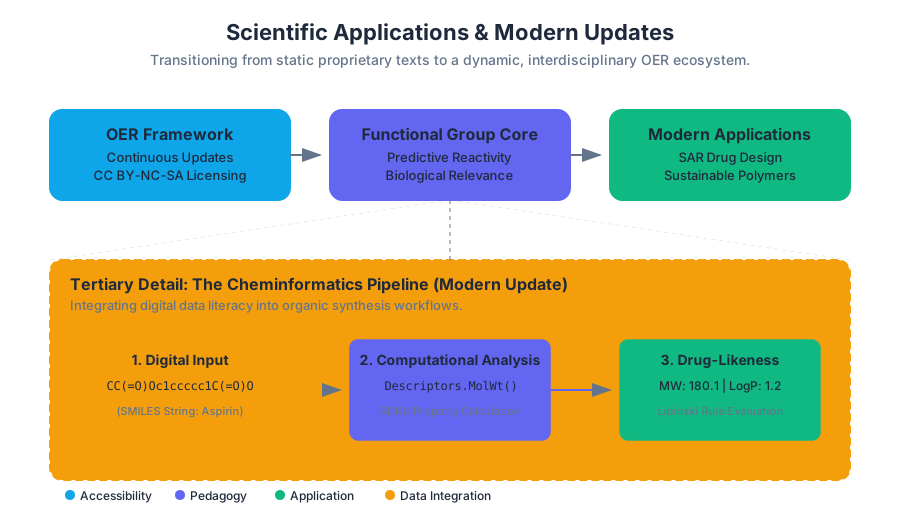
A significant "Modern Update" in the 10th edition is the acknowledgement of Cheminformatics. Modern organic chemists do not just use glassware; they use Python, R, and specialized software to predict molecular properties.
Molecular Property Calculation
In the modern lab, we often calculate the Lipinski Rule of Five parameters to determine if a molecule is "drug-like." This involves calculating molecular weight, hydrogen bond donors/acceptors, and the partition coefficient (LogP).
Green Chemistry: The Sustainability Update
One of the most critical "Modern Updates" is the integration of Green Chemistry principles. Organic chemistry has historically been a "dirty" science, involving toxic solvents and wasteful processes. The 10th edition emphasizes the 12 Principles of Green Chemistry, specifically focusing on Atom Economy.
The Mathematics of Atom Economy
Atom economy is a measure of how much of the starting material ends up in the final product. Unlike "percent yield," which only measures the efficiency of the procedure, atom economy measures the efficiency of the reaction itself.
\text{Percent Atom Economy} = \left( \frac{\text{Formula Weight of Desired Product}}{\text{Sum of Formula Weights of All Reactants}} \right) \times 100
Comparison of Reaction Efficiency
Consider a substitution reaction ($S_N2$) versus an addition reaction.
| Reaction Type | General Equation | Theoretical Atom Economy | Why? |
|---|---|---|---|
| Substitution | $A-B + C \rightarrow A-C + B$ | Moderate/Low | The leaving group ($B$) is always waste. |
| Addition | $A + B \rightarrow C$ | 100% | All reactant atoms are incorporated into the product. |
| Elimination | $A \rightarrow B + C$ | Low | Significant portions of the molecule are discarded as byproducts. |
Updated Research: Click Chemistry and Bio-orthogonal Reactions
The 10th edition incorporates research that has reached maturity in the 2020s. A prime example is Click Chemistry, popularized by K. Barry Sharpless and Carolyn Bertozzi.
What is Click Chemistry?
Click Chemistry refers to a group of reactions that are fast, versatile, high-yielding, and occur under mild conditions (often in water). The most famous is the Copper-catalyzed Azide-Alkyne Cycloaddition (CuAAC).
Why it Matters
- Bioconjugation: Attaching fluorescent tags to proteins in living cells without disrupting their function (Bio-orthogonal chemistry).
- Drug Delivery: Linking targeting ligands to nanoparticles.
- Material Science: Creating "self-healing" polymers.
Real-World Pipeline: Drug-Target Discovery
- Synthesis: Create a library of small molecules with an "alkyne" handle.
- Incubation: Allow molecules to enter a biological system (cell culture).
- Clicking: Add an "azide" fluorescent probe. The probe only "clicks" to the small molecules that have bound to their protein targets.
- Imaging: Use confocal microscopy to see where the drug is acting.
Common Pitfalls in Modern Organic Chemistry
As the field becomes more complex, students often fall into specific conceptual traps.
- The "Paper Chemistry" Trap: Assuming that because a reaction is balanced on paper, it will work in the lab. Modern updates emphasize solvation effects and steric hindrance.
- Ignoring Regiochemistry: In modern synthesis, getting the right molecule is easy; getting the right isomer is hard. The 10th edition uses updated 3D modeling to explain Enantioselectivity.
- Over-reliance on Memorization: Students often memorize the "reagents over the arrow" without understanding the Electronic Nature of the functional groups.
Troubleshooting Reaction Mechanisms
| Symptom | Likely Misconception | Modern Correction |
|---|---|---|
| No reaction occurs. | Ignoring Activation Energy ($E_a$). | Check for catalyst requirements or thermal/photochemical activation. |
| Multiple products formed. | Neglecting Regioselectivity (Markovnikov's Rule). | Analyze the stability of intermediates (carbocations/radicals). |
| Yield is 0% in water. | Ignoring Water Sensitivity. | Many modern organometallic reagents (Grignard, Li) react violently with moisture. |
Conclusion: The Future of the Field
The 10th edition of McMurry's Organic Chemistry via OpenStax is more than a textbook; it is a living document. By connecting the Functional Group Approach to Modern Applications like Click Chemistry and Green Engineering, it prepares students for a career where chemistry is the central science. The integration of digital tools and OER accessibility ensures that scientific literacy is not a luxury, but a standard for all aspiring scientists.
- Functional Group: A specific atom or group of atoms within a molecule that is responsible for a characteristic chemical reaction.
- Atom Economy: A measure of the amount of starting materials that end up as useful bits of the final product.
- SMILES: Simplified Molecular Input Line Entry System; a notation for representing chemical structures using short ASCII strings.
- Bio-orthogonal Chemistry: Chemical reactions that can occur inside living systems without interfering with native biochemical processes.
- OER (Open Educational Resources): Teaching, learning, and research materials that are in the public domain or introduced with an open license.
- SAR (Structure-Activity Relationship): The relationship between the chemical or 3D structure of a molecule and its biological activity.
- Conceptual: Why is an addition reaction generally considered "greener" than a substitution reaction? (Answer: Higher atom economy; all atoms are incorporated into the product).
- Application: In the context of drug design, what does a high LogP value indicate about a molecule? (Answer: High lipophilicity, meaning it may cross cell membranes easily but might have poor water solubility).
- Mechanism: How does the functional group approach simplify the study of millions of organic compounds? (Answer: It categorizes them into families with similar reactivity patterns).
- OER: What is the primary benefit of Creative Commons licensing for a scientific textbook? (Answer: Allows for rapid, collaborative updates and free access for students).
- Modern Research: What makes a reaction "bio-orthogonal"? (Answer: It must be highly selective and non-reactive with the functional groups naturally found in biological systems).
Key Objectives for Mastery:
- Master the Table of Functional Groups: You must be able to identify an amide, ester, and ketone instantly.
- Calculate Atom Economy: Practice with the formula provided; it is a standard metric in modern industrial chemistry.
- Link Structure to Biology: When studying alkanes or alcohols, look for their counterparts in metabolic cycles (e.g., fatty acids).
- Utilize Digital Tools: Use RDKit or ChemDraw to visualize molecules in 3D. The 10th edition's digital integration makes this easier than ever.
- Focus on Mechanisms: Don't just memorize the start and end; understand the "electron flow" (curved arrows) that defines modern organic logic.
Source Materials
Study Organic Chemistry: Structure, Reactivity, and the Functional Group Approach on Lykke
This course page is free to open: signed out, you can read its first two sections, and signing in, on any plan, opens the rest. The free Lykke Chrome extension syncs your own Canvas courses, so ChatGPT, Claude and Muse can answer from your classes and deadlines. It only reads Canvas.
Add the free extensionSign in to open every sectionAll sections of Organic Chemistry: Structure, Reactivity, and the Functional Group Approach · Browse more course pages