From the free course Organic Chemistry: Structure, Reactivity, and the Functional Group Approach on Lykke
Introduction to OpenStax and OER
Key concepts: Open Educational Resources (OER) · Accessibility · Peer-Reviewed Content
An overview of the OpenStax mission and the role of Open Educational Resources (OER) in modern higher education.
Introduction to OpenStax and OER
The landscape of higher education is currently undergoing a structural shift driven by the tension between rising tuition costs and the digital democratization of information. At the center of this movement is OpenStax, a non-profit pedagogical technology initiative based at Rice University, and the broader framework of Open Educational Resources (OER). Unlike traditional publishing models that rely on restrictive copyright and high-margin pricing, OER leverages open-source philosophy to provide high-quality, peer-reviewed instructional materials at zero cost to the end-user.
The Architecture of Open Educational Resources (OER)
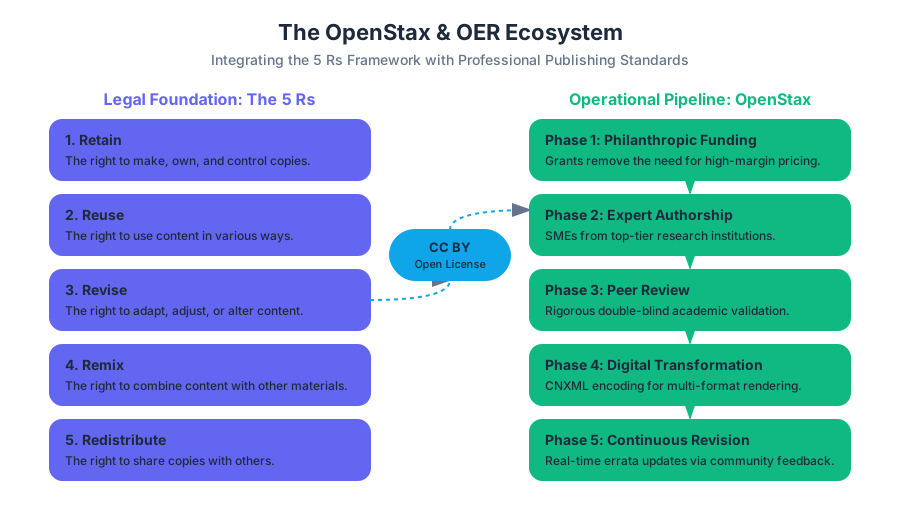
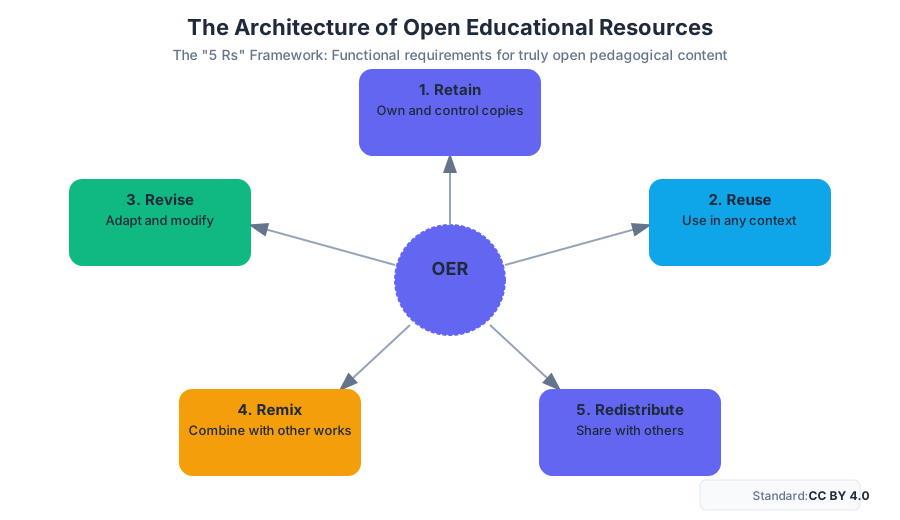
At its core, Open Educational Resources (OER) are defined not just by their price (gratis), but by the legal permissions granted to the user (libre). The conceptual foundation of OER is built upon the "5 Rs," a framework developed by David Wiley that defines the functional requirements for a resource to be considered truly "open."
The 5 Rs Framework
| Permission | Description | Technical Implication |
|---|---|---|
| Retain | The right to make, own, and control copies of the content. | Users can download and host the files locally without DRM. |
| Reuse | The right to use the content in a wide range of ways. | Content can be used in a classroom, on a website, or in a video. |
| Revise | The right to adapt, adjust, modify, or alter the content. | Source files (e.g., LaTeX, XML) must be editable. |
| Remix | The right to combine the original or revised content with other material. | Modular content structures allow for "mashups" of different books. |
| Redistribute | The right to share copies of the original content, revisions, or remixes. | Users can legally distribute the material to peers or the public. |
Definition: Open Educational Resources (OER) Teaching, learning, and research materials in any medium—digital or otherwise—that reside in the public domain or have been released under an open license that permits no-cost access, use, adaptation, and redistribution by others with no or limited restrictions.
Licensing and Legal Frameworks
The primary mechanism for OER is Creative Commons (CC) licensing. While traditional copyright functions as "all rights reserved," CC licenses function as "some rights reserved," providing a standardized way for authors to grant the public permission to use their creative work under copyright law.
Comparison of Licensing Models
| License Type | Symbol | Commercial Use | Derivative Works | Attribution Required |
|---|---|---|---|---|
| Public Domain | CC0 | Yes | Yes | No |
| Attribution | CC BY | Yes | Yes | Yes |
| Attribution-ShareAlike | CC BY-SA | Yes | Yes (must use same license) | Yes |
| Attribution-NonCommercial | CC BY-NC | No | Yes | Yes |
| Traditional Copyright | © | No | No | N/A |
OpenStax typically utilizes the CC BY license, which is the most flexible for educators, requiring only that credit be given to the original creator while allowing for commercial use and the creation of derivative works (remixes).
The OpenStax Ecosystem: A Case Study in Scale
OpenStax (formerly Connexions) was founded by Dr. Richard Baraniuk in 1999. It has since evolved from a repository of modular "bricks" of information into a sophisticated publisher of core introductory textbooks. The OpenStax model is unique because it mirrors the production quality of "Big Three" publishers (Pearson, McGraw-Hill, Cengage) while maintaining a non-profit, open-access distribution model.
The Production Pipeline
To ensure that OER is not perceived as "low quality" due to its lack of a price tag, OpenStax employs a rigorous editorial workflow.
- Grant Funding: Initial development is funded by philanthropic organizations (e.g., Bill & Melinda Gates Foundation, William and Flora Hewlett Foundation).
- Expert Recruitment: Subject Matter Experts (SMEs) and lead authors are recruited from top-tier research institutions.
- Peer Review: Content undergoes double-blind peer review by dozens of professors in the field.
- Digital Transformation: Content is encoded in CNXML (a specialized XML schema) for multi-format rendering (PDF, HTML5, iBooks).
- Continuous Revision: Errata are reported by the community and updated in real-time in the digital versions.
Case Study: Organic Chemistry and the McMurry Transition
A landmark moment in the OER movement was the transition of John McMurry’s "Organic Chemistry" to the OpenStax platform. Historically, McMurry’s text was a dominant commercial force in chemistry education. The tenth edition was published through OpenStax as a tribute to the author's late son, marking a significant shift where a high-prestige, "gold standard" academic text moved from a proprietary model to a free, open-access model.
The Functional Group Approach
McMurry’s text is famous for its Functional Group Approach, which organizes the study of organic chemistry by the reactive parts of molecules rather than by reaction types. This pedagogical strategy is preserved in the OpenStax version, demonstrating that OER can maintain sophisticated instructional design while removing financial barriers.
Accessibility and Universal Design for Learning (UDL)
Accessibility in OER refers to two distinct but related concepts: Financial Accessibility (cost) and Functional Accessibility (disability access).
Financial Impact: The Economic Derivation
The economic benefit of OER can be modeled by calculating the "Student Savings Metric." If $S$ is the number of students, $C_{avg}$ is the average cost of a commercial textbook, and $A$ is the adoption rate:
$$Total Savings = \sum_{i=1}^{n} (S_i \times C_{avg, i}) \times A_i$$
Where $n$ represents the number of courses transitioning to OER. OpenStax has saved students an estimated $1.7 billion since 2012 using this model.
Functional Accessibility: WCAG 2.1 Compliance
OpenStax textbooks are designed to meet Web Content Accessibility Guidelines (WCAG) 2.1 Level AA. This involves:
- Screen Reader Compatibility: Using semantic HTML5 and ARIA labels.
- Alt-Text: Providing descriptions for complex chemical structures and diagrams.
- Color Contrast: Ensuring that text is readable for users with visual impairments.
- Keyboard Navigation: Allowing full site navigation without a mouse.
Technical Architecture: Content Delivery and Interoperability
OpenStax does not just provide PDFs; it provides a platform. The backend infrastructure must handle massive traffic while allowing for seamless integration into Learning Management Systems (LMS) like Canvas, Blackboard, and Moodle via the LTI (Learning Tools Interoperability) standard.
Content Representation: CNXML to HTML5
The source of truth for an OpenStax book is often an XML dialect. This allows for "single-source publishing," where one file generates multiple outputs.
Integration via LTI
To integrate a textbook directly into a university's LMS, a "Tool Provider" (OpenStax) communicates with a "Tool Consumer" (the LMS).
Common Pitfalls and Misconceptions
Despite the growth of OER, several misconceptions persist among faculty and administrators.
| Misconception | Reality |
|---|---|
| "Free means low quality" | OER like OpenStax undergo the same peer-review and professional editing as commercial texts. |
| "OER is only digital" | Most OER providers offer low-cost print-on-demand versions for students who prefer physical books. |
| "I can't change the content" | The "Revise" and "Remix" rights explicitly allow instructors to tailor the book to their syllabus. |
| "OER lacks supplements" | OpenStax provides PowerPoint slides, test banks, and online homework systems (often via partners). |
The "Inclusive Access" Trap
A common pitfall in the industry is Inclusive Access, a commercial model where students are automatically charged a "discounted" fee for digital access that expires at the end of the semester. Unlike OER, Inclusive Access does not grant the student ownership of the material and does not allow for the "5 Rs."
Conclusion: The Future of Open Pedagogy
The evolution of OpenStax and OER represents more than just a change in the price of books; it represents a shift toward Open Pedagogy. This is an instructional approach where students are not just consumers of information, but creators. Because the licenses allow for modification, students can participate in "renewable assignments"—such as updating a chapter of an OER or creating a video explanation—that benefit future students, rather than "disposable assignments" that are graded and discarded.
As AI and machine learning continue to integrate with educational technology, the open nature of OER data (unencumbered by restrictive APIs or paywalls) makes it the ideal training set for the next generation of intelligent tutoring systems and personalized learning paths.
Source Materials
Study Organic Chemistry: Structure, Reactivity, and the Functional Group Approach on Lykke
This course page is free to open: signed out, you can read its first two sections, and signing in, on any plan, opens the rest. The free Lykke Chrome extension syncs your own Canvas courses, so ChatGPT, Claude and Muse can answer from your classes and deadlines. It only reads Canvas.
Add the free extensionSign in to open every sectionAll sections of Organic Chemistry: Structure, Reactivity, and the Functional Group Approach · Browse more course pages