From the free course Organic Chemistry: Structure, Reactivity, and the Functional Group Approach on Lykke
The Functional Group Approach
Key concepts: Functional Groups · Pedagogical Framework · John McMurry
Understanding the pedagogical framework used by John McMurry to organize the study of organic chemistry.
The Functional Group Approach
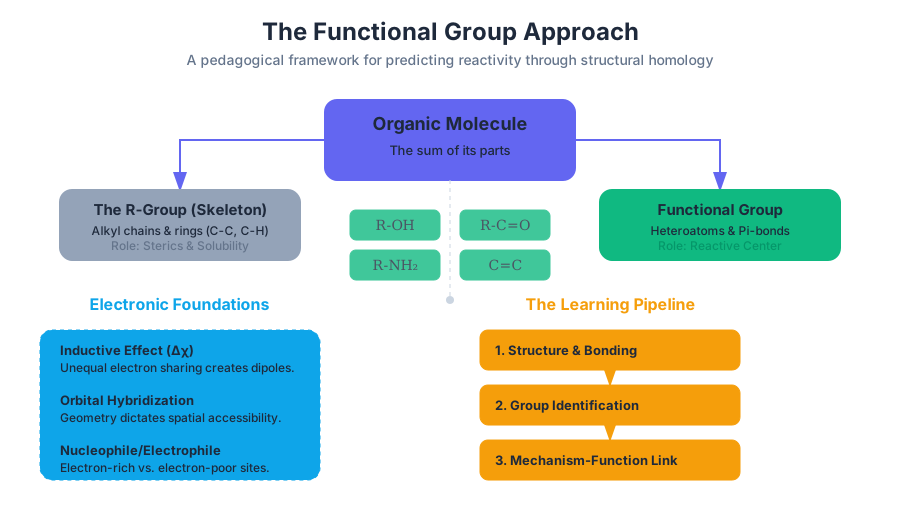
The Functional Group Approach represents the most significant pedagogical shift in the history of organic chemistry education. Pioneered and refined by educators like John McMurry, this framework moves away from the encyclopedic memorization of individual molecules and instead focuses on the "reactive centers" of organic compounds. By identifying specific clusters of atoms that exhibit consistent chemical behavior regardless of the larger molecular scaffold, students and researchers can predict the reactivity, physical properties, and spectroscopic signatures of millions of unique substances using a relatively small set of rules.
The Taxonomy of Reactivity: Defining the Functional Group
At its core, a functional group is a structural fragment within a molecule that causes the molecule's characteristic chemical reactions. While the carbon-carbon and carbon-hydrogen bonds of an alkane "skeleton" are relatively inert, the introduction of heteroatoms (like Oxygen, Nitrogen, or Halogens) or pi-bonds (double and triple bonds) creates regions of high or low electron density.
Definition: A functional group is an atom or a group of atoms that has similar chemical properties whenever it appears in various compounds. It is the site of most chemical reactivity in an organic molecule.
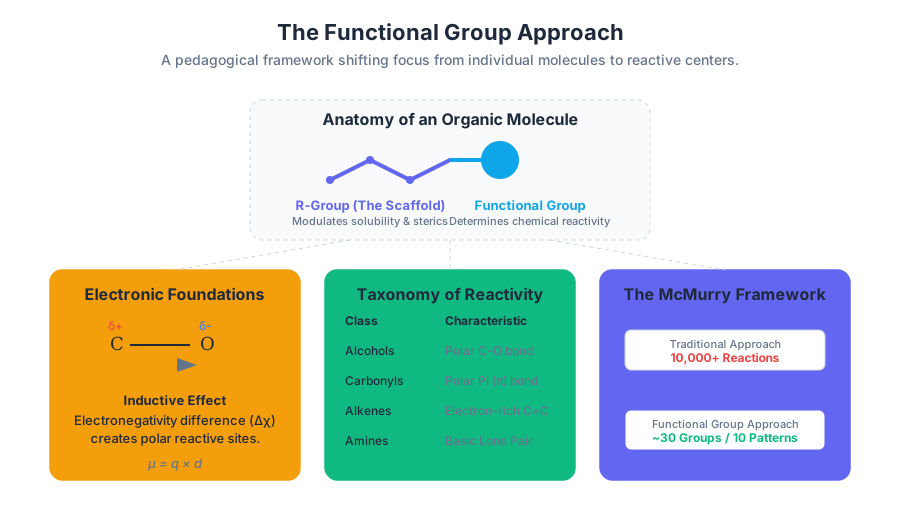
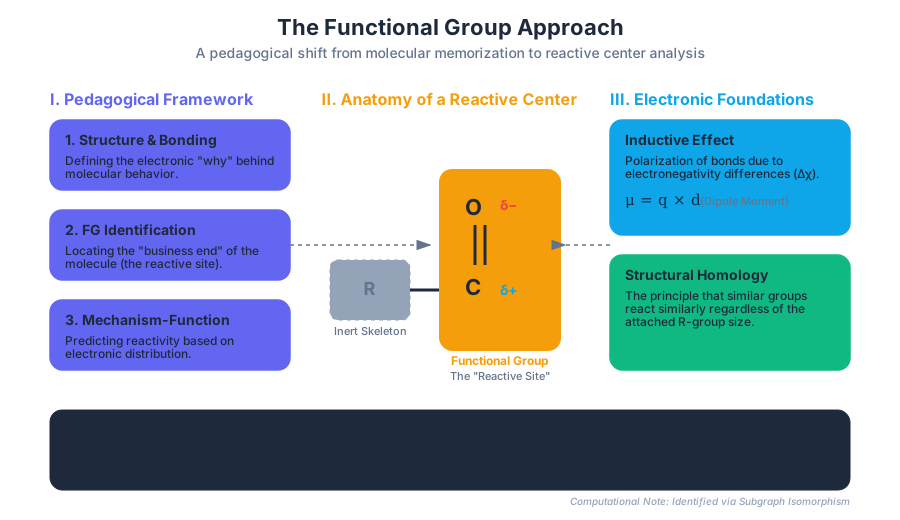
The functional group approach is governed by the principle of structural homology. This principle posits that the chemical environment of the functional group is the primary determinant of its reactivity, while the "R-group" (the rest of the molecule) serves primarily as a modulator of steric hindrance and solubility.
Table 1: Primary Functional Group Classifications
| Group Class | Structure (General) | Characteristic Bond | Typical Reactivity |
|---|---|---|---|
| Alcohols | $R-OH$ | $C-O$ (Polar) | Nucleophilic substitution, Oxidation |
| Carbonyls | $R-C(=O)-R'$ | $C=O$ (Polar Pi) | Nucleophilic addition |
| Carboxylic Acids | $R-COOH$ | $O-H$ (Acidic) | Acid-base, Nucleophilic Acyl Substitution |
| Amines | $R-NH_2$ | $C-N$ (Basic) | Nucleophilic attack, Hydrogen bonding |
| Alkenes | $R_2C=CR_2$ | $C=C$ (Pi bond) | Electrophilic addition |
The Pedagogical Framework of John McMurry
John McMurry’s Organic Chemistry (now in its 10th edition via OpenStax) codified the functional group approach as the standard for undergraduate education. Before this shift, organic chemistry was often taught by compound class (e.g., "The Chemistry of Coal Tar") or by reaction type in isolation. McMurry’s framework organizes the curriculum into a logical progression:
- Structure and Bonding: Establishing the electronic "why" behind the "what."
- Functional Group Identification: Learning to see the "business end" of the molecule.
- The Mechanism-Function Link: Demonstrating how the electronic nature of a group (e.g., the electrophilicity of a carbonyl carbon) dictates the mechanism (e.g., nucleophilic addition).
This approach reduces the cognitive load on the learner. Instead of learning 10,000 reactions, the student learns approximately 30 functional groups and 10 fundamental mechanistic patterns (nucleophilic substitution, electrophilic addition, etc.).
Electronic and Steric Foundations
The behavior of a functional group is not magic; it is the result of electronegativity and orbital hybridization.
The Inductive Effect and Dipole Moments
When atoms of different electronegativity form a covalent bond, the electrons are shared unequally. This creates a dipole moment ($\mu$), defined as:
$$\mu = q \times d$$
Where $q$ is the magnitude of the separated charge and $d$ is the distance between the charges. In a functional group like a hydroxyl group ($-OH$), the oxygen is significantly more electronegative than the carbon it is attached to ($\chi_O = 3.44$ vs $\chi_C = 2.55$). This induces a partial positive charge ($\delta+$) on the carbon, making it a target for nucleophiles.
Table 2: Electronegativity and Bond Polarity in Functional Groups
| Bond | $\Delta\chi$ (Electronegativity Diff) | Polarity Type | Common Functional Group |
|---|---|---|---|
| $C-H$ | 0.35 | Non-polar | Alkanes |
| $C-C$ | 0.00 | Non-polar | Alkanes / Skeleton |
| $C-Cl$ | 0.61 | Polar Covalent | Alkyl Halides |
| $C-O$ | 0.89 | Strongly Polar | Alcohols / Ethers |
| $C=O$ | 0.89 | Strongly Polar (Pi) | Aldehydes / Ketones |
Computational Identification of Functional Groups
In modern chemoinformatics, the functional group approach is operationalized through subgraph isomorphism algorithms. To a computer, a molecule is a graph where atoms are nodes and bonds are edges. Identifying a functional group involves searching the molecular graph for a specific pattern of nodes and edges.
The Logic of Chemical Transformation
How does the functional group approach predict a reaction? Consider the Grignard Reaction. The fundamental logic is not about the specific molecule, but about the interaction between a nucleophilic carbon (in the Grignard reagent) and an electrophilic carbon (in a carbonyl group).
Mathematical Derivation of Reactivity: The Hammett Equation
To quantify how substituents on a functional group affect reactivity, we use the Hammett Equation. This relates the equilibrium constants ($K$) or rate constants ($k$) for a series of reactions to a substituent constant ($\sigma$) and a reaction constant ($\rho$):
$$\log\left(\frac{k}{k_0}\right) = \rho\sigma$$
Where:
- $k$ is the rate constant for the substituted molecule.
- $k_0$ is the rate constant for the "reference" molecule (usually the unsubstituted benzene derivative).
- $\sigma$ measures the electron-withdrawing or donating ability of the substituent.
- $\rho$ measures the sensitivity of the reaction to those electronic effects.
\text{Reactivity Logic Example (Nucleophilic Addition):}
\begin{aligned}
1. & \quad \text{Identify Electrophile: } C=O \text{ (Carbonyl Carbon is } \delta+) \\
2. & \quad \text{Identify Nucleophile: } R-MgX \text{ (R group is } \delta-) \\
3. & \quad \text{Mechanism: } R:^- \rightarrow C=O \text{ (Nucleophilic attack)} \\
4. & \quad \text{Result: } \text{Formation of a new } C-C \text{ bond and an Alkyloxide.}
\end{aligned}
Common Pitfalls in the Functional Group Approach
While powerful, the functional group approach can lead to errors if the "R-group" is ignored entirely.
- Steric Hindrance: A functional group may be electronically "ready" to react, but physically inaccessible. For example, a tertiary alkyl halide ($R_3C-X$) cannot undergo $S_N2$ reactions because the central carbon is shielded by bulky R-groups.
- Electronic Conjugation: If a functional group is adjacent to a pi-system (like a benzene ring), its reactivity changes. An alcohol attached to benzene (a phenol) is $10^{10}$ times more acidic than a standard alcohol like ethanol.
- Solvent Effects: The "characteristic properties" of a group can be radically altered by the solvent. A carboxylate is a strong nucleophile in DMSO but a weak one in water due to hydrogen bonding.
Table 3: Steric vs. Electronic Effects
| Feature | Influence Type | Example | Impact on Reactivity |
|---|---|---|---|
| Inductive Effect | Electronic | Fluorine atom nearby | Increases acidity of -COOH |
| Resonance | Electronic | Lone pair on Nitrogen | Decreases basicity of Amides |
| Steric Bulk | Physical | tert-Butyl group | Blocks nucleophilic attack |
| Protic Solvent | Environmental | Water/Ethanol | Stabilizes ions, slows $S_N2$ |
The OpenStax Transition and Global Accessibility
The move of McMurry's Organic Chemistry to OpenStax (Rice University) marks a milestone in Open Educational Resources (OER). By releasing the 10th edition under a Creative Commons license, the "Functional Group Approach" is no longer gated by a $300 textbook price tag.
This transition ensures that the systematic logic of organic chemistry is available to a global audience. The 10th edition specifically includes updated "Chemistry in Context" modules, linking functional group behavior to metabolic pathways (biochemistry) and polymer science (materials engineering).
Summary of the Systematic Workflow
To master organic chemistry via the McMurry method, one follows a repeatable pipeline for every new molecule encountered:
- Scan for Heteroatoms: Locate O, N, S, P, or Halogens.
- Identify Pi Systems: Locate double or triple bonds.
- Assign the Group Name: Use IUPAC nomenclature rules (e.g., -one for ketones, -ol for alcohols).
- Determine Polarity: Draw the $\delta+$ and $\delta-$ vectors.
- Predict Mechanism: Match the nucleophilic/electrophilic sites with potential reagents.
Variations and Extensions: Beyond Simple Groups
As chemistry advances, the definition of a functional group expands into Bioisosteres and Protective Groups.
- Bioisosteres: These are atoms or groups that possess near-equal molecular shapes and volumes, and exhibit similar physical properties. In drug design, a carboxylic acid might be replaced with a tetrazole ring. They look different, but within the "Functional Group Approach," they serve the same purpose: providing a localized acidic proton.
- Protecting Groups: Sometimes a chemist wants to react one part of a molecule but not another. They will "mask" a functional group (e.g., turning an alcohol into a silyl ether) to temporarily change its reactivity.
Theorem of Orthogonality: In complex synthesis, two functional groups are considered orthogonal if one can be reacted or protected without affecting the other, a principle that relies entirely on the distinct electronic signatures of those groups.
Source Materials
Study Organic Chemistry: Structure, Reactivity, and the Functional Group Approach on Lykke
This course page is free to open: signed out, you can read its first two sections, and signing in, on any plan, opens the rest. The free Lykke Chrome extension syncs your own Canvas courses, so ChatGPT, Claude and Muse can answer from your classes and deadlines. It only reads Canvas.
Add the free extensionSign in to open every sectionAll sections of Organic Chemistry: Structure, Reactivity, and the Functional Group Approach · Browse more course pages