From the free course Music Appreciation 1 on Lykke
Musical Expression: Tempo and Dynamics
Key concepts: Tempo · Dynamics · BPM · Italian Terms · Metronome
The expressive elements of music that dictate speed and volume.
Musical Expression: Tempo and Dynamics
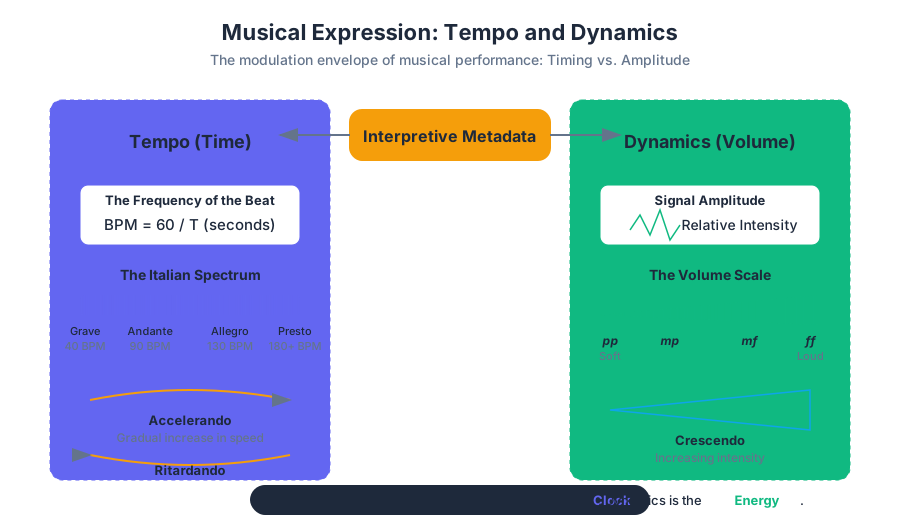
Musical expression represents the "how" of a musical performance—the layer of interpretive metadata that transforms a static sequence of pitches and durations into a communicative art form. While melody, harmony, and rhythm provide the structural blueprint, Tempo and Dynamics serve as the primary vectors for emotional affect and narrative tension. In technical terms, if pitch is the frequency and rhythm is the clock-gate, expression is the modulation envelope that defines the character of the signal.
The Architecture of Tempo
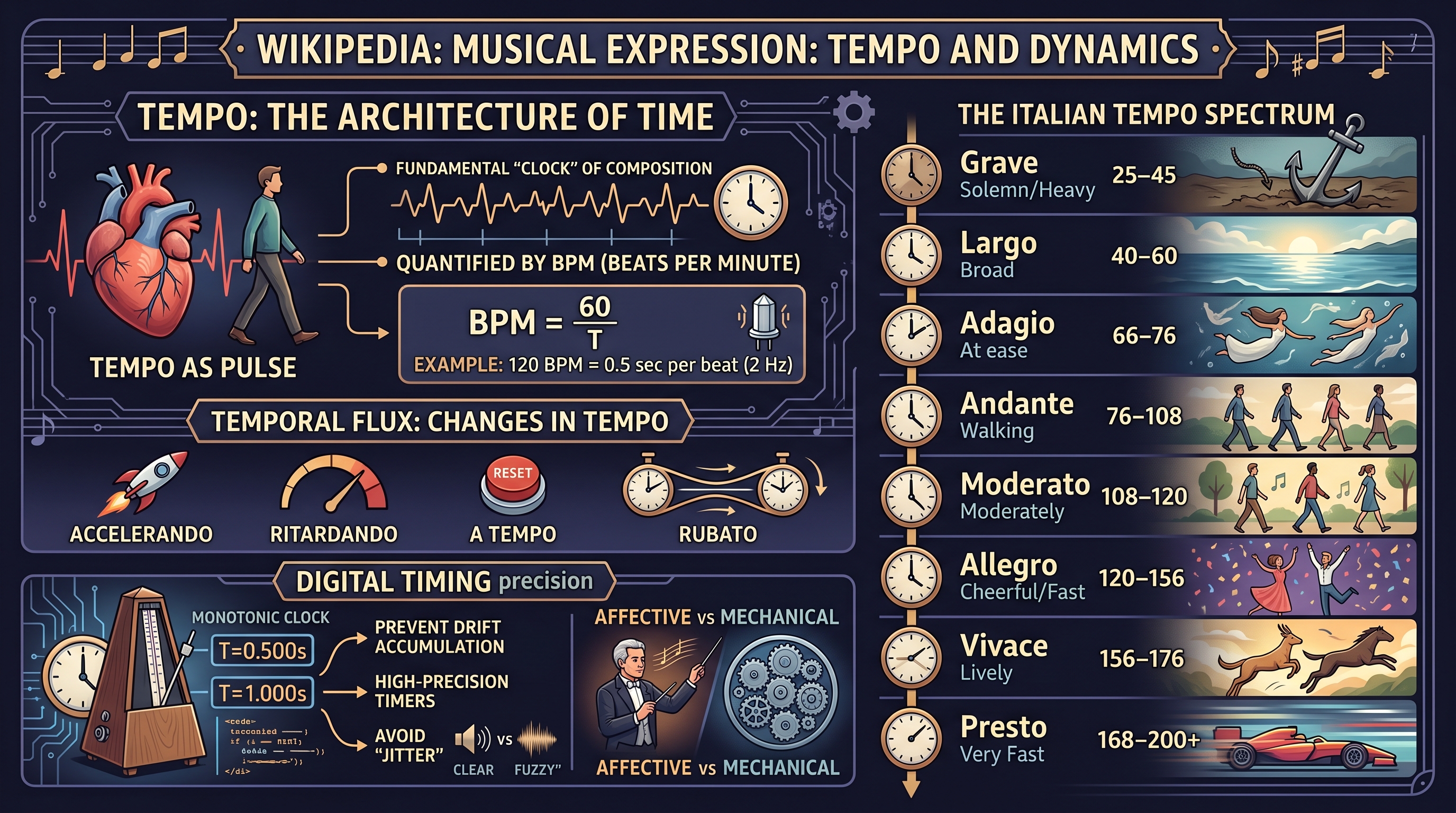
Tempo (from the Italian word for "time") is the perceived speed or pace of a given piece of music. It functions as the fundamental "clock" of the composition, establishing the rate at which the underlying pulse or beat occurs. In modern musicology and engineering, tempo is quantified through BPM (Beats Per Minute), though historically, it was communicated through subjective Italian descriptors.
Defining the Pulse: BPM and Frequency
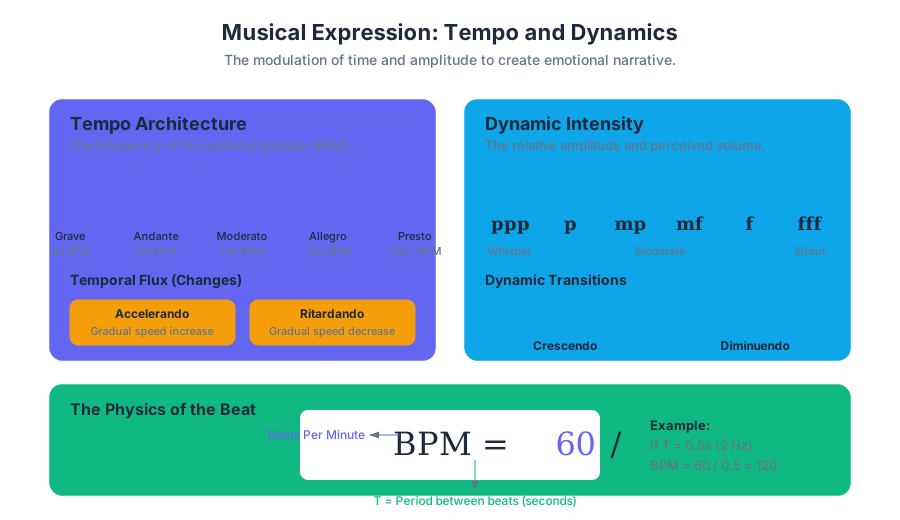
Mathematically, tempo is the frequency of the beat. If $T$ is the period between beats in seconds, the BPM is calculated as: $$BPM = \frac{60}{T}$$ A tempo of 120 BPM implies a beat every 0.5 seconds (2 Hz). This "clock" is not merely a mechanical constraint; it dictates the physiological response of the listener, often aligning with human heart rates (60–100 BPM) or walking cadences.
The Italian Tempo Spectrum
Before the invention of the metronome, composers relied on a standardized set of Italian terms to indicate both speed and character. These terms are not fixed values but rather "zones" of temporal density.
| Term | Literal Meaning | Approximate BPM | Character/Mood |
|---|---|---|---|
| Grave | Solemn/Heavy | 25–45 | Extremely slow, serious, and weighty. |
| Largo | Broad | 40–60 | Stately, expansive, and slow. |
| Adagio | At ease | 66–76 | Leisurely, often used for lyrical movements. |
| Andante | Walking | 76–108 | A moderate, flowing pace; rhythmic but relaxed. |
| Moderato | Moderately | 108–120 | Neutral speed; the "default" human pace. |
| Allegro | Cheerful/Fast | 120–156 | Bright, spirited, and energetic. |
| Vivace | Lively | 156–176 | Quick, brisk, and sharp. |
| Presto | Very Fast | 168–200+ | Rapid, driving, often the climax of a work. |
Key Insight: The transition from Italian terms to BPM markings represented a shift from affective instruction (how the music should feel) to mechanical instruction (how the clock should run). A modern performer must synthesize both: playing "Allegro" at 120 BPM requires a different articulation than playing "Moderato" at the same speed.
Temporal Flux: Changes in Tempo
Music is rarely static. The manipulation of tempo over time is a critical expressive tool used to signal the end of a section, build excitement, or provide "breath" to a melody.
- Accelerando: A gradual increase in tempo. This creates a sense of rising tension or "chase."
- Ritardando (or Rallentando): A gradual decrease in tempo. Often used at the end of a phrase or movement to provide a sense of resolution.
- A Tempo: A command to return to the original speed after a temporary change.
- Rubato: Literally "stolen time." The performer subtly speeds up and slows down within a phrase for emotional effect, "paying back" the stolen time later to keep the overall pulse intact.
Mathematical Representation of Tempo Curves
An accelerando is not typically a linear jump but a curve. In a linear tempo ramp, the BPM at time $t$ can be expressed as:
$$BPM(t) = BPM_{start} + \left( \frac{BPM_{end} - BPM_{start}}{\Delta T} \right) \cdot t$$
Where $\Delta T$ is the duration of the transition. However, most musical software uses exponential curves to make the transition feel more "natural" to the human ear.
Dynamics: The Dimension of Volume
Dynamics refer to the relative loudness or softness of the music. In physics, this corresponds to the amplitude of the sound wave. In music, dynamics are not absolute decibel (dB) levels but are relative to the instrument, the performance space, and the surrounding musical context.
The Dynamic Scale
Dynamics are indicated using abbreviations of Italian terms, ranging from a whisper to a shout.
| Symbol | Term | Meaning | Perceived Intensity |
|---|---|---|---|
| ppp | Pianississimo | Extremely soft | Barely audible; atmospheric. |
| pp | Pianissimo | Very soft | Intimate, hushed. |
| p | Piano | Soft | Gentle, relaxed. |
| mp | Mezzo-piano | Moderately soft | "Half-soft"; a neutral, quiet volume. |
| mf | Mezzo-forte | Moderately loud | "Half-loud"; standard speaking volume. |
| f | Forte | Loud | Strong, assertive. |
| ff | Fortissimo | Very loud | Powerful, commanding. |
| fff | Fortississimo | Extremely loud | Maximum intensity; often used for impact. |
The "Terraced Dynamics" Concept: In the Baroque era (approx. 1600–1750), instruments like the harpsichord could not easily produce gradual volume changes. Consequently, composers used "terraced dynamics"—sudden shifts from p to f without transition, creating a stark, architectural contrast.
Dynamic Transitions and Accents
Just as tempo can fluctuate, dynamics move between levels to create "shape."
- Crescendo (<): Gradually getting louder.
- Decrescendo / Diminuendo (>): Gradually getting softer.
- Sforzando (sfz): A sudden, strong accent on a single note or chord.
- Subito: Meaning "suddenly" (e.g., subito piano—suddenly soft).
Logarithmic Volume Scaling
In digital audio, volume is often represented by a "Gain" value. However, human hearing is logarithmic, not linear. Increasing a signal's amplitude by 2.0 does not sound "twice as loud" to a human.
The Metronome: From Mechanical Pendulum to Digital Quartz
The Metronome is the primary tool for regulating tempo. Patented by Johann Nepomuk Maelzel in 1815 (based on a design by Dietrich Nikolaus Winkel), it allowed composers to mark their scores with specific "M.M." (Maelzel's Metronome) numbers.
The Impact of the Metronome
Before the metronome, "Allegro" in London might be significantly faster than "Allegro" in Vienna. The metronome provided a universal standard. Beethoven was one of the first major composers to embrace it, though his specific markings remain a subject of intense musicological debate—many find them impossibly fast, leading to theories that his metronome was faulty or that he interpreted the markings differently.
Modern Metronomic Practice
In contemporary recording, most music is recorded to a "click track"—a digital metronome. This ensures that different takes can be edited together seamlessly and that tempo-synced effects (like delays or arpeggiators) remain in phase.
| Metronome Type | Mechanism | Precision | Use Case |
|---|---|---|---|
| Mechanical | Inverted pendulum with sliding weight | Variable (affected by gravity/leveling) | Traditional practice, visual cue. |
| Quartz/Electronic | Crystal oscillator | High | Portable practice, tuning. |
| Software/DAW | Sample-accurate CPU clock | Absolute | Professional recording, sequencing. |
Synthesis: The "Affect" of Expression
The interplay between tempo and dynamics defines the Affect (the emotional character) of a piece. High-tempo, high-dynamic music is often perceived as aggressive or jubilant. Low-tempo, low-dynamic music is often perceived as mournful or serene.
MIDI Velocity: The Digital Proxy for Dynamics
In the world of MIDI (Musical Instrument Digital Interface), dynamics are primarily handled through Velocity. When a key is pressed, the "velocity" (how fast the key was struck) is measured on a scale from 0 to 127.
In sophisticated virtual instruments, velocity doesn't just change the volume; it changes the timbre. A piano string struck harder (high velocity) has more high-frequency overtones than one struck softly.
Common Pitfalls and Misconceptions
- Tempo vs. Rhythm: A common mistake is confusing a fast tempo with a complex rhythm. A piece can have a very slow tempo (Grave) but contain many fast-moving notes (32nd notes), making it feel busy while the pulse remains slow.
- Absolute vs. Relative Dynamics: Forte on a flute is significantly quieter than forte on a pipe organ. Dynamics are instructions for the performer to reach a certain level of effort and intensity relative to their instrument's capabilities.
- The "Metronome Prison": While the metronome is a vital tool, strict adherence to it can result in "mechanical" or "soulless" performances. Professional musicians use the metronome to find the center of the beat, then utilize rubato to move around it expressively.
- Crescendo = Accelerando?: Beginners often accidentally speed up when they get louder. Maintaining a steady tempo while increasing volume is a hallmark of technical mastery.

Source Materials
Study Music Appreciation 1 on Lykke
This course page is free to open: signed out, you can read its first two sections, and signing in, on any plan, opens the rest. The free Lykke Chrome extension syncs your own Canvas courses, so ChatGPT, Claude and Muse can answer from your classes and deadlines. It only reads Canvas.
Add the free extensionSign in to open every sectionAll sections of Music Appreciation 1 · Browse more course pages