From the free course Music Appreciation 1 on Lykke
Case Studies: Score Analysis
Key concepts: Sonata Form · Adagio cantabile · Performance Markings · Beethoven · Chopin
Applying theoretical knowledge to actual musical scores by Beethoven and Chopin.
Case Studies: Score Analysis
Score analysis is the process of reverse-engineering a musical composition to understand its structural, harmonic, and expressive DNA. It is the bridge between theoretical knowledge—scales, intervals, and rhythm—and the practical realization of a performance. In this section, we move beyond the "what" of music theory into the "how" of musical architecture, focusing on the works of Ludwig van Beethoven and Frédéric Chopin.
The Analytical Framework: Structural and Semantic Layers
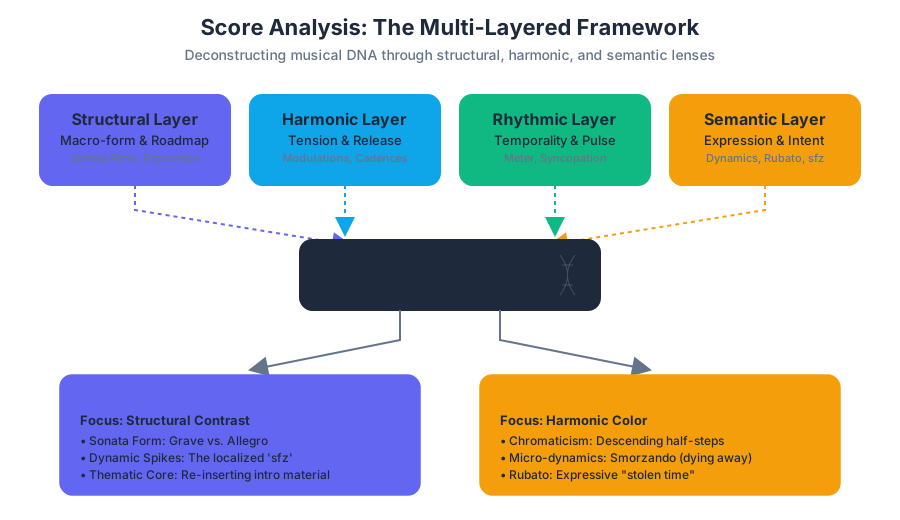
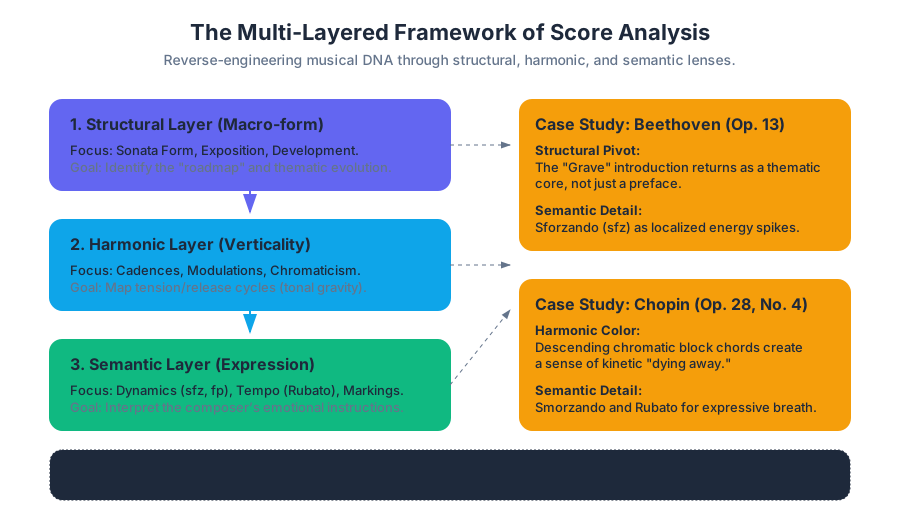
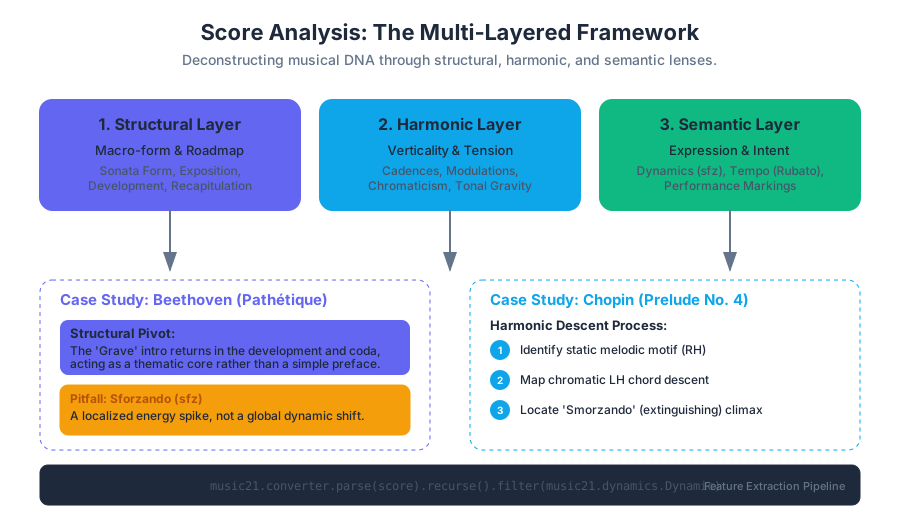
Analyzing a score requires a multi-layered approach. We distinguish between the Structural Layer (the formal architecture like Sonata Form), the Harmonic Layer (the vertical alignment of pitches), and the Semantic Layer (performance markings and expressive intent).
| Layer | Primary Focus | Key Elements | Analytical Goal |
|---|---|---|---|
| Structural | Macro-form | Exposition, Development, Recapitulation | Identify the "roadmap" and thematic evolution. |
| Harmonic | Verticality | Cadences, Modulations, Non-chord tones | Map the tension and release cycles (tonal gravity). |
| Rhythmic | Temporality | Meter, Syncopation, Hemiola | Understand the drive and "heartbeat" of the piece. |
| Semantic | Expression | p, ff, sfz, Adagio, Rubato |
Interpret the composer’s emotional instructions. |
Analysis 1: Beethoven’s Piano Sonata No. 8 in C Minor, Op. 13 ("Pathétique")
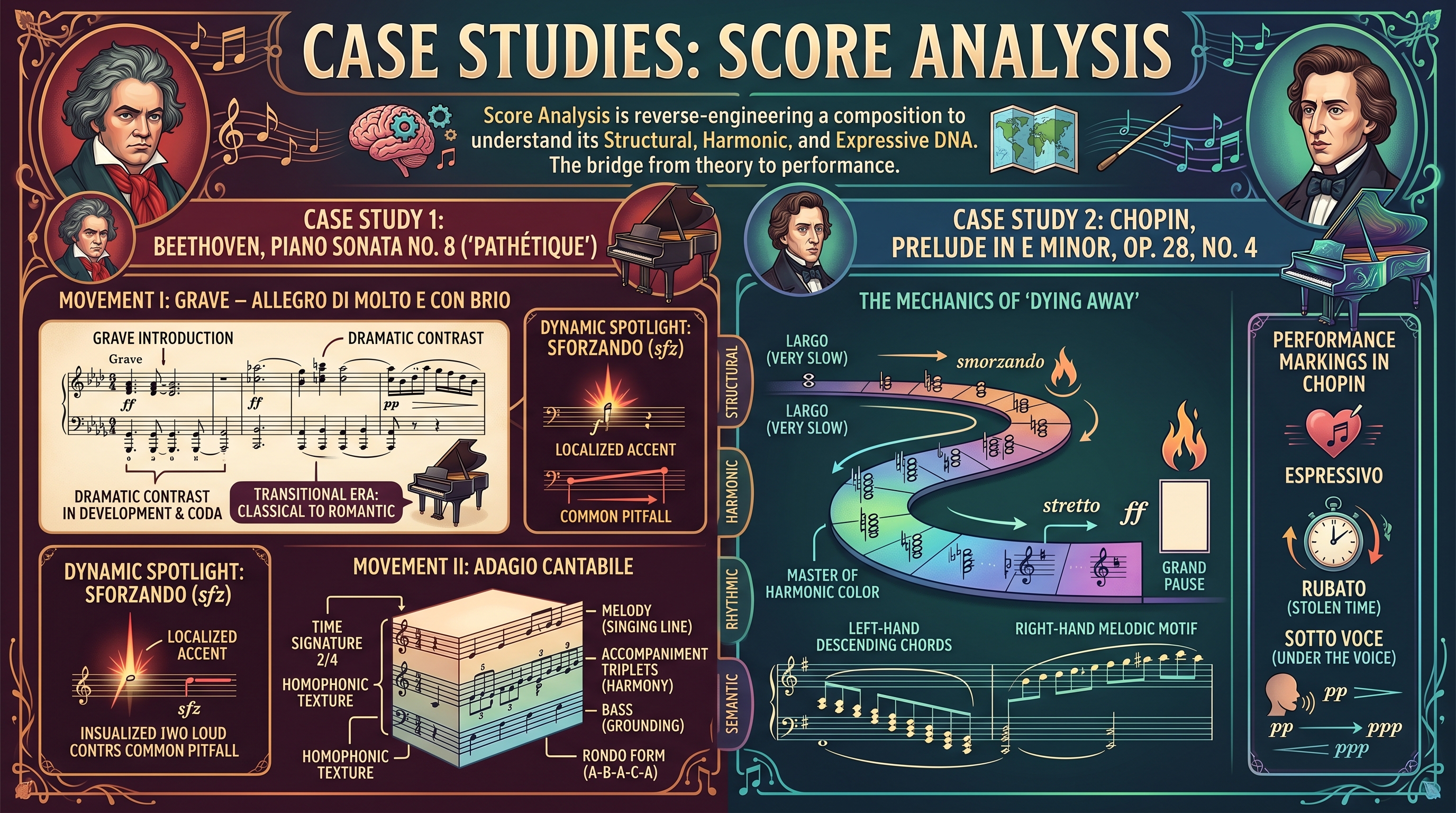
Beethoven’s Pathétique (1798) represents a pivotal moment in the transition from the Classical to the Romantic era. It challenges the traditional constraints of the Sonata Form by introducing a slow, dramatic introduction that reappears throughout the movement.
Movement I: Grave – Allegro di molto e con brio
The first movement is a masterclass in contrast. The Grave introduction is characterized by heavy, dotted rhythms and extreme dynamic shifts, specifically the fp (fortepiano) marking, which demands an immediate drop from loud to soft.
Definition: Sonata Form A structural blueprint typically consisting of three main sections: the Exposition (themes are introduced), the Development (themes are fragmented and transformed), and the Recapitulation (themes return in the home key).
The Problem-Solving Approach: Identifying the Pivot When analyzing the Pathétique, the analyst must determine if the Grave is merely an introduction or a thematic core. Beethoven proves the latter by re-inserting the Grave material at the start of the development and again in the coda.
Common Pitfall: Misinterpreting sf (Sforzando)
In Beethoven’s scores, sf or sfz indicates a sudden, strong accent on a single note or chord. A common mistake is to play the subsequent notes loudly as well. The sf is a localized "spike" in energy, not a change in the overall dynamic level.
Movement II: Adagio cantabile
The second movement shifts to A-flat major and adopts an Adagio cantabile (slow, singing style) marking. Here, the challenge is maintaining a Legato (smooth, connected) line while managing a three-layered texture:
- The Melody: The top voice, which must "sing."
- The Accompaniment: Middle-voice triplets providing harmonic movement.
- The Bass: Grounding the harmony.
| Feature | Description | Technical Requirement |
|---|---|---|
| Time Signature | 2/4 | Maintaining a slow but steady pulse without dragging. |
| Texture | Homophonic | Balancing the melody so it sits "above" the accompaniment. |
| Form | Rondo (A-B-A-C-A) | Differentiating the character of the contrasting sections. |
Analysis 2: Chopin’s Prelude in E Minor, Op. 28, No. 4
If Beethoven is the architect of structure, Chopin is the master of Harmonic Color. The Prelude No. 4 is a study in chromaticism and micro-dynamics.
The Mechanics of "Dying Away"
The piece is marked Largo (very slow) and features a repetitive melodic motif that sits atop a series of descending, chromatic block chords. The primary expressive marking here is smorzando, which literally means "extinguishing" or "dying away."
Analytical Step-by-Step: The Harmonic Descent
- Identify the Static Element: The right-hand melody consists mostly of long, sustained notes with narrow intervals.
- Analyze the Kinetic Element: The left-hand chords descend by half-steps (chromaticism).
- Locate the Climax: The
stretto(speeding up) leading to theff(fortissimo) chord near the end, followed by a sudden silence (Grand Pause).
Performance Markings in Chopin
Chopin uses specific Italian terms to dictate the "breath" of the music:
- Espressivo: Play with extra feeling, often implying a slight flexibility in tempo.
- Rubato: "Stolen time"—the practice of slightly speeding up and slowing down for expressive effect while keeping the overall pulse.
- Sotto voce: "Under the voice"—a hushed, whispered quality.
Computational Score Analysis: The "Senior Engineer" View
In modern musicology, we often use computational tools to analyze scores. This allows us to quantify "harmonic entropy" or "thematic density" across thousands of measures.
Mathematical Representation of Harmonic Tension
We can model the "tension" of a chord based on its distance from the tonic in the Circle of Fifths and its internal dissonance.
T(c) = \sum_{i=1}^{n} D(p_i, p_{i+1}) + \omega \cdot dist(k_{root}, k_{tonic})
Where:
- $T(c)$ is the tension of chord $c$.
- $D$ is the dissonance function between pitches $p$.
- $\omega$ is a weighting constant for the key distance.
- $dist(k_{root}, k_{tonic})$ is the distance on the Circle of Fifths.
Comparison: Beethoven vs. Chopin Score Characteristics
Analyzing these two composers side-by-side reveals the evolution of the piano as a medium.
| Feature | Beethoven (Op. 13) | Chopin (Op. 28, No. 4) |
|---|---|---|
| Primary Form | Strict Sonata-Allegro / Rondo | Free-form Prelude |
| Dynamic Range | Extreme (pp to ff) |
Subtle gradations within p |
| Harmonic Language | Functional, Diatonic-focused | Chromatic, Color-focused |
| Pedal Usage | Structural (often not marked) | Essential (highly specific markings) |
| Rhythmic Feel | Driving, Motoric | Fluid, Rubato-heavy |
Advanced Concept: The "False Recapitulation"
A common "trick" in score analysis is identifying the False Recapitulation. This occurs when the composer brings back the main theme in the "wrong" key during the Development section, tricking the listener into thinking the piece is ending.
How to spot it:
- Check the Key: Is the theme in the Tonic (the home key)? If it's in the Dominant or a remote key, it's likely a false recapitulation.
- Check the Instrumentation: Does the texture feel "thin" compared to the actual Exposition?
- Check the Sequence: Does the theme immediately dissolve into further development?
Insight: The "Pathétique" Pivot In the first movement of Op. 13, Beethoven uses the Grave material as a structural "gatekeeper." Every time the music becomes too chaotic or reaches a formal boundary, the Grave returns to reset the emotional state. This was a radical departure from the Mozartian "clean break" between sections.
Common Pitfalls in Score Analysis
- Over-Analyzing "Accidental" Notes: Not every sharp or flat is a modulation. Often, they are Chromatic Passing Tones used for melodic smoothness.
- Ignoring the "Tacet": Silence is a musical element. In the Chopin Prelude, the final three chords are preceded by a rest that is just as important as the notes themselves.
- Literalism with Tempo: Markings like Adagio or Allegro are relative. An Adagio in 1800 (Beethoven) might be significantly faster than an Adagio in 1890 (Mahler).
- Dynamics vs. Balance: A
p(piano) marking for the whole score doesn't mean every note is equal. The melody must always be slightly louder than the accompaniment to maintain the Homophonic texture.
Summary of Performance Markings
| Term | Category | Meaning | Execution Tip |
|---|---|---|---|
| Cantabile | Style | Singing | Use a "weighty" touch on the keys to sustain the tone. |
| Sforzando (sf) | Dynamic | Sudden force | Sharp attack followed by immediate return to previous dynamic. |
| Smorzando | Dynamic/Tempo | Dying away | Gradually decrease volume and slightly slow down. |
| Con Brio | Style | With spirit | Emphasize rhythmic precision and brightness. |
| Largo | Tempo | Very slow/Broad | Focus on the space between the notes. |
- Sonata Form: A three-part musical structure: Exposition, Development, Recapitulation.
- Adagio cantabile: A slow tempo performed in a lyrical, singing style.
- Fortepiano (fp): A dynamic marking indicating a loud attack followed immediately by a soft sustain.
- Chromaticism: The use of notes outside the standard major or minor scale for harmonic color.
- Rubato: The flexible manipulation of tempo for expressive purposes.
- Smorzando: A performance instruction to let the sound gradually fade away and the tempo slow down.
- Sforzando (sfz): A sudden, strong emphasis on a specific note or chord.
-
In Beethoven's Pathétique Movement I, what is the primary function of the Grave introduction?
- (A) To provide a simple warmup for the pianist.
- (B) To act as a structural anchor that returns at key formal transitions.
- (C) To establish a light, dance-like mood.
- (D) To modulate to a distant, unrelated key immediately. Correct: B
-
Which term best describes the left-hand movement in Chopin's Prelude Op. 28, No. 4?
- (A) Arpeggiated triads
- (B) Diatonic scales
- (C) Chromatic descent
- (D) Alberti bass Correct: C
-
What is a "False Recapitulation"?
- (A) When the pianist forgets to play the repeat sign.
- (B) When the main theme returns in a key other than the tonic during the development.
- (C) When the piece ends in a different key than it started.
- (D) A section where the melody is played upside down. Correct: B
-
How does
smorzandodiffer from a simplediminuendo?- (A) It only refers to volume.
- (B) It implies both a decrease in volume and a slowing of tempo (fading away).
- (C) It means to play as loudly as possible.
- (D) It indicates a change in the instrument's tuning. Correct: B
-
In the context of Adagio cantabile, what is the "analytical problem" of the piano?
- (A) The piano cannot play more than one note at a time.
- (B) The piano is a percussion instrument whose sound decays immediately after a string is struck.
- (C) The piano is too loud for a singing style.
- (D) The piano has no pedals. Correct: B
Core Objectives
- Master the structural components of Sonata Form (Exposition, Development, Recapitulation).
- Distinguish between the architectural rigor of Beethoven and the harmonic fluidity of Chopin.
- Interpret Italian performance markings (
sf,fp,smorzando) within their historical and stylistic contexts. - Apply computational logic to score analysis (e.g., identifying patterns and dynamic volatility).
Key Scores to Memorize
- Beethoven, Op. 13 (Pathétique): Focus on the contrast between the Grave and Allegro.
- Chopin, Op. 28, No. 4: Focus on the chromatic descent and the use of
smorzando.
Analytical Checklist
- Identify the Home Key and the Time Signature.
- Map the Macro-Structure (Is it Sonata, Rondo, or Binary?).
- Locate Pivot Points (Modulations, tempo changes, or thematic returns).
- Analyze Micro-Dynamics (Specific accents like
sforfp). - Evaluate the Texture (Is the melody clearly differentiated from the accompaniment?).
Source Materials
Study Music Appreciation 1 on Lykke
This course page is free to open: signed out, you can read its first two sections, and signing in, on any plan, opens the rest. The free Lykke Chrome extension syncs your own Canvas courses, so ChatGPT, Claude and Muse can answer from your classes and deadlines. It only reads Canvas.
Add the free extensionSign in to open every sectionAll sections of Music Appreciation 1 · Browse more course pages