Music Appreciation 1
Institution: MIT
53 study materials · 12 sections
Music Appreciation 1 provides a comprehensive introduction to the fundamental building blocks of music theory, instrumentation, and historical analysis. The course covers essential elements such as melody, harmony, rhythm, and scales, while exploring how these components combine to create complex musical textures and forms. Students will learn to read Western musical notation, understand expressive markings like tempo and dynamics, and apply these skills to analyze the works of master composers like Beethoven and Chopin.
Course Sections
Introduction to Melody, Harmony, and Scales
Key concepts: Melody · Harmony · Scales · Musical Organization
An overview of the foundational elements of musical structure and how sounds are organized into recognizable patterns.
Introduction to Melody, Harmony, and Scales
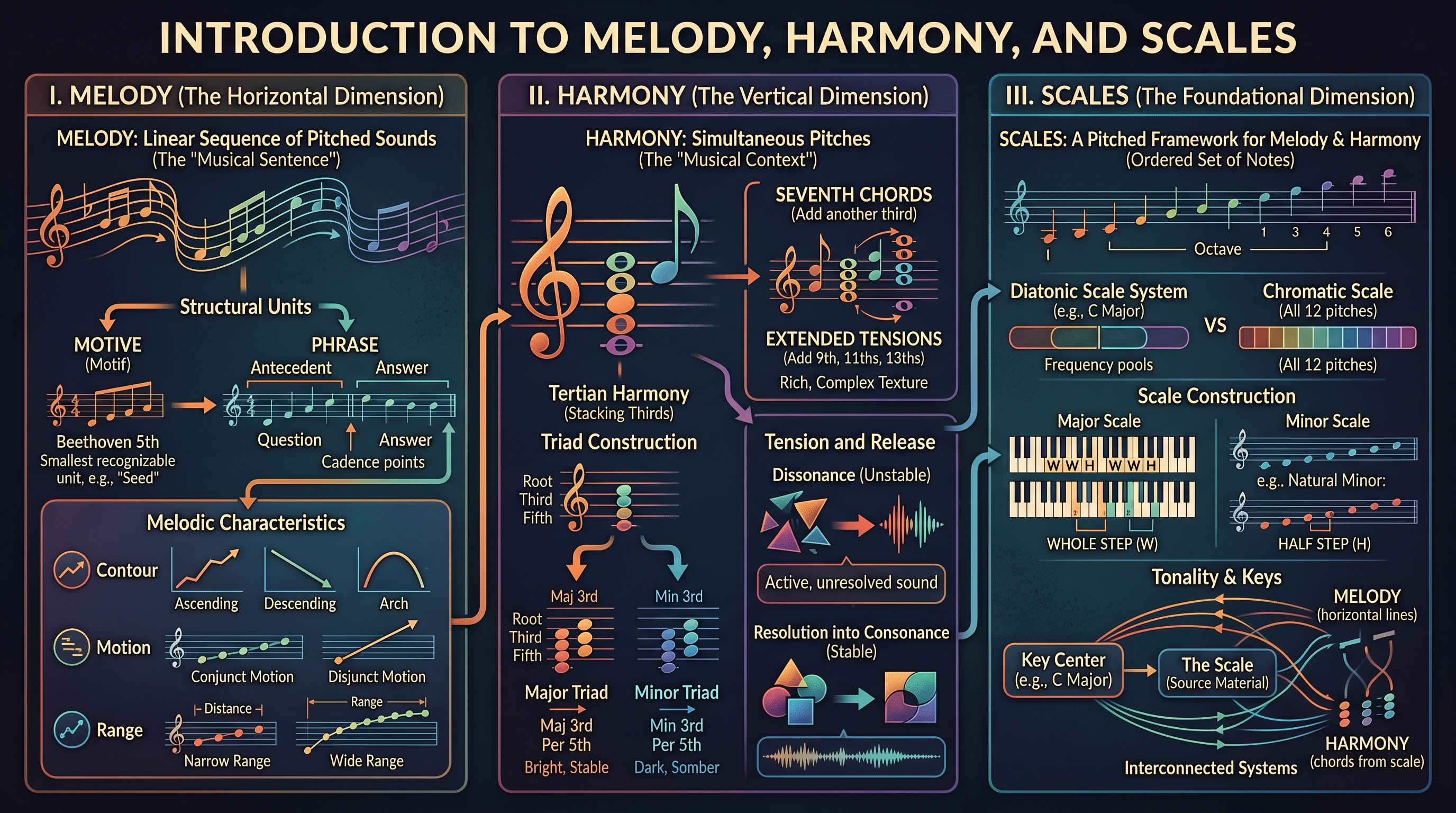
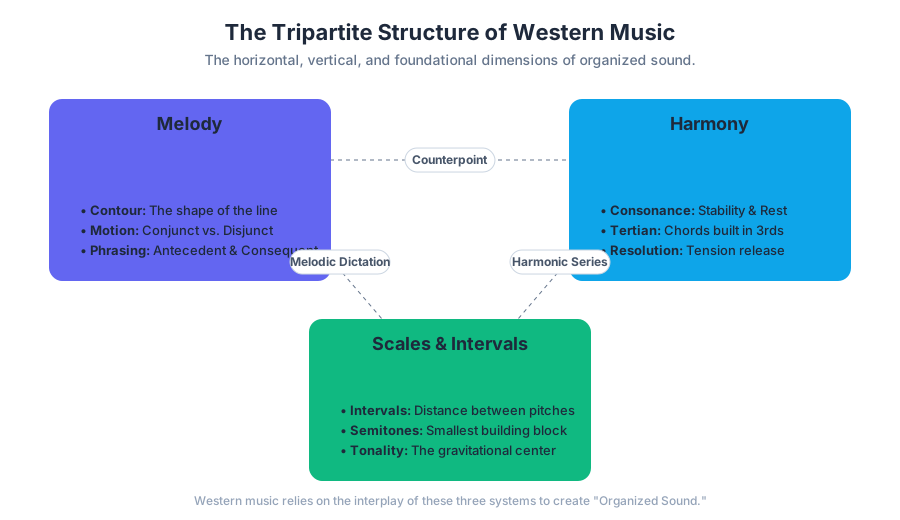
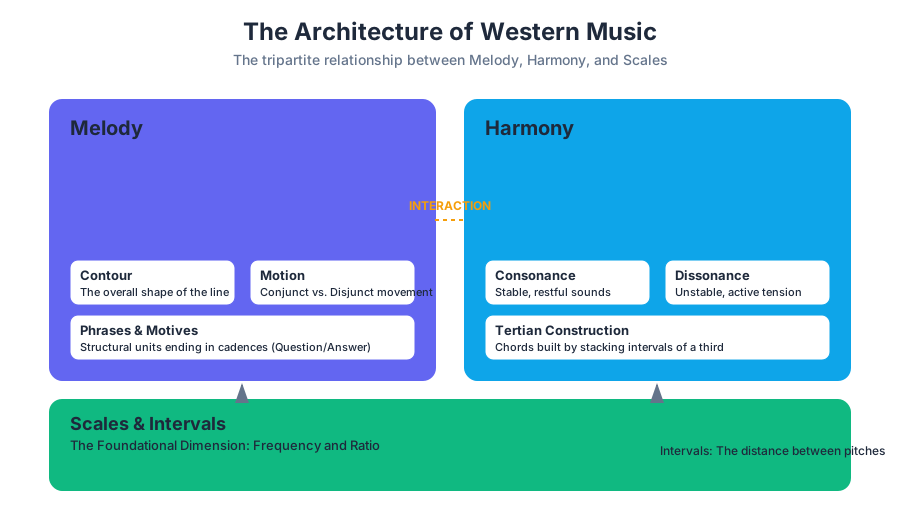
Music is frequently defined as "organized sound." While rhythm provides the temporal framework, the structural integrity of Western music relies on the tripartite relationship between Melody, Harmony, and Scales. These elements represent the horizontal, vertical, and foundational dimensions of musical composition, respectively. To understand music at an expert level is to recognize that these are not isolated silos but interconnected systems of frequency, ratio, and perception.
The Horizontal Dimension: Melody and Melodic Line
A Melody is a timely arranged linear sequence of pitched sounds that the listener perceives as a single, cohesive entity. If music were a language, the melody would be the sentence—a succession of "words" (notes) that conveys a specific thought or emotion.
1. Melodic Characteristics
Melodies are defined by their shape and the way they move through pitch-space. We categorize these movements using several parameters:
- Contour: The overall "shape" of the melodic line.
- Ascending: Moving from lower to higher pitches, often associated with rising tension.
- Descending: Moving from higher to lower pitches, often suggesting resolution or relaxation.
- Arch: A melody that rises to a peak and then descends.
- Motion: The distance between successive notes.
- Conjunct Motion: Smooth, stepwise movement (e.g., "Joy to the World").
- Disjunct Motion: Movement characterized by large leaps or intervals (e.g., "The Star-Spangled Banner").
- Range: The distance between the lowest and highest notes of a melody. A "narrow" range is easy to sing (folk songs), while a "wide" range requires technical virtuosity (operatic arias).
| Parameter | Type | Description | Perceptual Effect |
|---|---|---|---|
| Contour | Arch | Rises to a climax and falls | Balanced, symmetrical |
| Motion | Conjunct | Stepwise (intervals of a 2nd) | Flowing, lyrical, easy to follow |
| Motion | Disjunct | Leaping (intervals of a 3rd or more) | Angular, dramatic, energetic |
| Range | Wide | Spans two octaves or more | Expansive, technically demanding |
| Range | Narrow | Spans less than an octave | Intimate, folk-like |
2. Structural Units: Phrases and Motives
Melodies are rarely continuous streams; they are broken into digestible units.
- Phrase: A musical "clause" that ends with a sense of pause, known as a cadence. In many classical structures, phrases work in pairs: the Antecedent (the "question" phrase, ending with unresolved tension) and the Consequent (the "answer" phrase, providing resolution).
- Motive (Motif): The smallest recognizable melodic or rhythmic unit. A motive is a "seed" from which a larger work grows (e.g., the four-note opening of Beethoven’s 5th Symphony).
- Leitmotif: A recurring motive associated with a specific person, place, or idea, popularized by Richard Wagner and ubiquitous in modern film scoring.
Definition: The Melodic Theme A Theme is a complete melodic idea that serves as the basis for an entire musical composition or section. Unlike a motive, which is a fragment, a theme is a fully realized musical "subject."
The Vertical Dimension: Harmony and Tonality
While melody moves horizontally across time, Harmony occurs when two or more pitches sound simultaneously. This is the "vertical" aspect of music. Harmony provides the color, depth, and emotional context for a melody.
1. Consonance and Dissonance
The core of harmonic movement is the interplay between tension and release.
- Consonance: Intervals or chords that sound stable, restful, and pleasing to the ear.
- Dissonance: Intervals or chords that sound unstable, harsh, or "active." Dissonance creates a psychological need for Resolution into a consonant sound.
2. Chord Construction: Tertian Harmony
In Western music, harmony is primarily Tertian, meaning chords are built by stacking intervals of a third.
- Triad: The basic unit of Western harmony, consisting of three notes: the Root, the Third, and the Fifth.
- Seventh Chords: A triad with an additional third stacked on top (a 7th above the root), adding complexity and "drive" toward resolution.
- Extended Tensions: In jazz and modern classical music, composers add 9ths, 11ths, and 13ths to create rich, dense harmonic textures.
| Chord Type | Structure (Intervals from Root) | Example (in C) | Character |
|---|---|---|---|
| Major Triad | Major 3rd, Perfect 5th | C - E - G | Bright, stable |
| Minor Triad | Minor 3rd, Perfect 5th | C - Eb - G | Dark, somber |
| Diminished | Minor 3rd, Diminished 5th | C - Eb - Gb | Highly unstable, tense |
| Dominant 7th | Maj 3rd, P5th, Min 7th | C - E - G - Bb | Strong pull to resolve |
3. Harmonic Perspectives: Coordinate vs. Subordinate
Historically, harmony evolved from Polyphony (multiple independent melodies) to Homophony (a single melody supported by chords).
- Coordinate Harmony: Found in early counterpoint, where harmony is a byproduct of intersecting melodic lines (horizontal focus).
- Subordinate Harmony: Found in the Common Practice Period, where the melody is clearly supported by a functional chord progression (vertical focus).
The Building Blocks: Intervals and the Overtone Series
To understand how melodies and harmonies are built, we must look at the Interval—the distance between two pitches.
1. The Semitone and the Staff
The smallest interval in Western music is the Semitone (or half-step). On a piano, this is the distance between any two adjacent keys.
- Accidentals: Symbols used to modify pitch. A Sharp (
#) raises a pitch by a semitone; a Flat (b) lowers it. - The Staff: A system of five lines and four spaces used to represent pitch. Clefs (Treble/G, Bass/F, Alto/C) calibrate the staff to specific pitch ranges.
2. The Physics of Consonance: The Overtone Series
Why do some intervals sound "perfect" while others sound "clashing"? The answer lies in physics. When a string vibrates, it doesn't just vibrate at its fundamental frequency ($f$); it also vibrates in halves ($2f$), thirds ($3f$), fourths ($4f$), and so on.
f_n = n \cdot f_0
Where $f_0$ is the fundamental frequency and $n$ is the harmonic number.
- Octave (2:1 ratio): The most fundamental interval. Two notes an octave apart sound like the "same" note at different registers.
- Perfect Fifth (3:2 ratio): The most stable non-octave interval, found early in the overtone series.
3. Interval Classification
Intervals are classified by their quantity (number of staff positions) and quality (Major, Minor, Perfect, Augmented, Diminished).
| Interval Name | Semitones | Ratio | Classification |
|---|---|---|---|
| Unison | 0 | 1:1 | Perfect Consonance |
| Minor 2nd | 1 | 16:15 | Sharp Dissonance |
| Major 3rd | 4 | 5:4 | Imperfect Consonance |
| Perfect 5th | 7 | 3:2 | Perfect Consonance |
| Tritone | 6 | 45:32 | "Diabolus in Musica" (Dissonance) |
The Palette: Scales and Tonality
A Scale is an orderly arrangement of pitches within an octave that provides the raw material for a piece of music. The choice of scale determines the "flavor" or Key of the music.
1. The Diatonic System
The most common scales in Western music are Diatonic, consisting of seven notes.
- Major Scale: Associated with happiness or stability. It follows the pattern: W-W-H-W-W-W-H (Whole step, Half step).
- Minor Scale: Associated with sadness or drama. It features a lowered third degree.
2. Other Scale Types
- Chromatic Scale: Uses all twelve available semitones. It lacks a tonal center and feels "shifting" or "unstable."
- Pentatonic Scale: A five-note scale common in folk music and blues. It is highly consonant and lacks the "tension" notes of the major scale.
3. The Tonic and Tonal Center
Most music is Tonal, meaning it revolves around a central note called the Tonic. The tonic acts as a "home base." No matter how far the melody or harmony wanders, the listener expects a return to the tonic for a sense of finality.
Technical Implementation: Algorithmic Music Theory
In modern computational musicology, we represent these concepts using mathematical models. Below are examples of how melody, harmony, and scales are handled in software.
1. Low-Level Implementation: Frequency and Scale Generation
This Python snippet demonstrates how to generate the frequencies for a Major scale based on a fundamental frequency using the standard 12-tone equal temperament (12-TET) formula: $f = f_0 \cdot 2^{n/12}$.
import numpy as np

def generate_major_scale(root_freq):
    """
    Generates the frequencies for a major scale starting from root_freq.
    Pattern: W-W-H-W-W-W-H (2, 2, 1, 2, 2, 2, 1 semitones)
    """
    major_steps = [0, 2, 4, 5, 7, 9, 11, 12]
    scale_frequencies = []

    for step in major_steps:
        # Calculate frequency using 12-TET formula
        freq = root_freq * (2 ** (step / 12))
        scale_frequencies.append(round(freq, 2))

    return scale_frequencies

# Example: C4 (Middle C) is approximately 261.63 Hz
c_major_freqs = generate_major_scale(261.63)
print(f"C Major Scale Frequencies: {c_major_freqs}")
# Output: [261.63, 293.66, 329.63, 349.23, 392.0, 440.0, 493.88, 523.25]
2. Mathematical Representation: Interval Ratios
Intervals can be viewed as frequency ratios. In Just Intonation (based on the overtone series), these are simple fractions. In Equal Temperament (modern standard), they are powers of the 12th root of 2.
% Just Intonation Ratios vs Equal Temperament
\text{Perfect 5th (Just)} = \frac{3}{2} = 1.5
\text{Perfect 5th (12-TET)} = 2^{7/12} \approx 1.4983

\text{Major 3rd (Just)} = \frac{5}{4} = 1.25
\text{Major 3rd (12-TET)} = 2^{4/12} \approx 1.2599
3. High-Level Library Usage: Music21
The music21 library (developed by MIT) is the industry standard for computer-aided musicology. Here is how we define a chord and analyze its consonance.
from music21 import chord, interval

# Define a C Major Seventh chord
c_maj_7 = chord.Chord(['C4', 'E4', 'G4', 'B4'])

print(f"Chord Name: {c_maj_7.pitchedCommonName}")
print(f"Is Consonant: {c_maj_7.isConsonant()}") # Returns False because of the Major 7th interval

# Identify the intervals within the chord
intervals = [interval.Interval(c_maj_7[0], p) for p in c_maj_7[1:]]
print(f"Intervals from root: {[i.name for i in intervals]}")
# Output: ['M3', 'P5', 'M7']
4. Database Schema: Representing Musical Relationships
In a digital music library or DAW (Digital Audio Workstation) backend, we might store scale and chord definitions in a relational database to allow for fast lookups and transposition.
-- Schema for a Musical Theory Reference Database
CREATE TABLE scales (
    scale_id INTEGER PRIMARY KEY,
    name VARCHAR(50),
    intervals_from_root JSONB -- e.g., [0, 2, 4, 5, 7, 9, 11]
);

CREATE TABLE chords (
    chord_id INTEGER PRIMARY KEY,
    quality VARCHAR(20), -- Major, Minor, Dominant, etc.
    semitones JSONB -- e.g., [0, 4, 7] for Major
);

-- Query to find all chords that "fit" within a C Major Scale
SELECT c.quality
FROM chords c
WHERE c.semitones <@ (SELECT intervals_from_root FROM scales WHERE name = 'Major');
Common Pitfalls and Misconceptions
- Melody vs. Harmony: A common mistake is thinking they are separate entities. In reality, a melody often "implies" a harmony. For example, if a melody outlines the notes C, E, and G, the listener's brain automatically fills in the C Major harmony.
- The "Sad" Minor Scale: While minor scales are often associated with sadness, this is a cultural convention, not a physical law. Many cultures use minor-sounding scales for celebratory music, and many "happy" songs use minor chords for depth.
- Perfect Pitch vs. Relative Pitch: Many believe great musicians must have Perfect Pitch (the ability to identify a note in isolation). However, Relative Pitch (the ability to identify the relationship/interval between notes) is far more critical for understanding melody and harmony.
- Consonance is Subjective: What was considered a "dissonance" in the 1400s (like the Major 3rd) became a "consonance" by the 1700s. Musical "rules" are actually descriptions of stylistic trends, not immutable laws of nature.
Summary of Musical Organization
Musical organization is the process of selecting specific frequencies (Scales), arranging them in a sequence (Melody), and layering them for depth (Harmony).
- Melody provides the narrative and identity.
- Harmony provides the emotional environment and structural support.
- Scales provide the linguistic constraints and tonal "gravity."
When these three elements are synchronized with Rhythm and Meter, the result is a complex, multi-dimensional system capable of expressing the full range of human experience.
Melody: Characteristics and Structure
Key concepts: Contour · Conjunct vs. Disjunct · Range · Phrases · Motives
Detailed exploration of melodic lines, including contour, motion, and the units that form a melody.
Melody: Characteristics and Structure
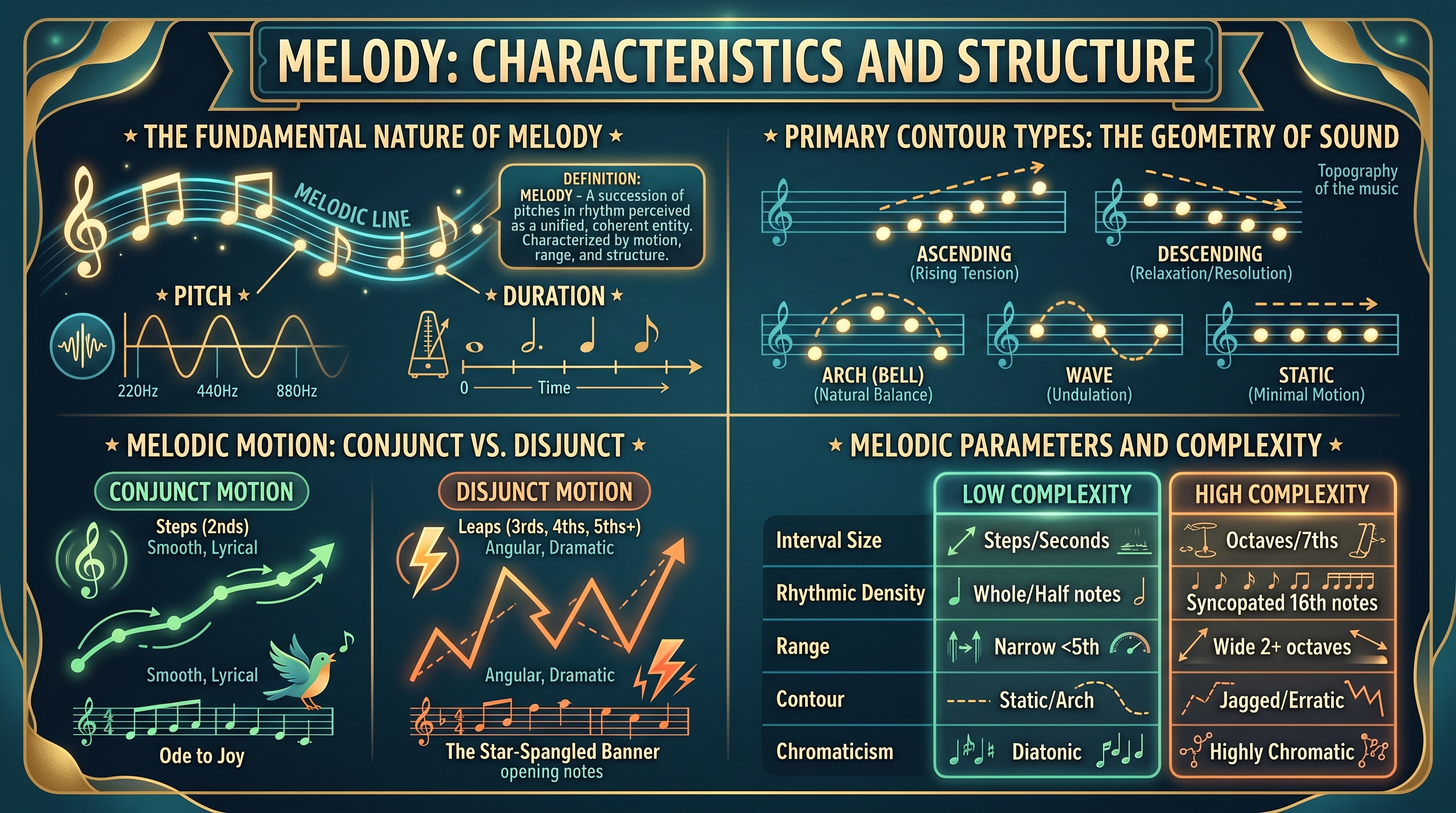
Melody is the primary "horizontal" axis of musical organization. While harmony deals with the vertical stacking of pitches (chords), melody is a timely arranged linear sequence of pitched sounds that the listener perceives as a single, coherent entity. It is the "identity" of a musical work—the element most easily remembered, hummed, or whistled. From a structural perspective, a melody is not merely a random string of notes; it is a sophisticated system of intervals, rhythms, and shapes that follow specific psychological and physical constraints.
The Fundamental Nature of Melody
At its most basic level, a melody consists of two variables: pitch (the frequency of the sound) and duration (the length of time the sound lasts). When these are strung together, the human brain performs "auditory scene analysis," grouping these individual events into a continuous "line." This is why we refer to a "melodic line"—it implies a physical path through musical space.
Definition: Melody A melody is a succession of pitches in rhythm that the mind perceives as a unified whole. It is characterized by its motion, range, and structural organization into phrases and motives.
Melodic Parameters and Complexity
The complexity of a melody can be quantified by several parameters, which determine its "singability" and emotional character.
| Parameter | Low Complexity | High Complexity |
|---|---|---|
| Interval Size | Seconds (Steps) | Octaves, 7ths (Leaps) |
| Rhythmic Density | Whole/Half notes | Syncopated 16th notes |
| Range | Narrow (within a 5th) | Wide (2+ octaves) |
| Contour | Static or Arch | Jagged/Erratic |
| Chromaticism | Diatonic (within the scale) | Highly Chromatic |
Melodic Contour: The Geometry of Sound
Contour refers to the overall shape of the melodic line as it moves up and down in pitch. It is the "topography" of the music. When we visualize a melody on a staff, the contour is the line created by connecting the noteheads.
Primary Contour Types
- Ascending: The melody moves from lower pitches to higher pitches. This often creates a sense of rising tension or expectation.
- Descending: The melody moves from higher to lower pitches. This is frequently associated with relaxation, resolution, or "sighing" (the lamento motif).
- Arch (Bell): The melody rises to a peak (climax) and then descends. This is the most common structure in Western classical music, providing a natural sense of balance.
- Wave: A melody that rises and falls repeatedly, creating a sense of undulation.
- Static: The melody stays around a single pitch or moves very little (e.g., a "reciting tone").
Mathematical Representation of Contour
In computational musicology, contour is often represented as a Pitch Contour Vector, where the relationship between successive notes is reduced to a simple directional change (+1 for up, -1 for down, 0 for same).
import numpy as np

def calculate_melodic_contour(pitches):
    """
    Calculates the contour vector of a melody.
    Pitches are provided as MIDI note numbers.
    Returns a list of directions: 1 (Up), -1 (Down), 0 (Same).
    """
    contour = []
    for i in range(len(pitches) - 1):
        diff = pitches[i+1] - pitches[i]
        if diff > 0:
            contour.append(1)
        elif diff < 0:
            contour.append(-1)
        else:
            contour.append(0)
    return contour

# Example: C4 -> E4 -> G4 -> F4 -> E4 (Arch Shape)
melody = [60, 64, 67, 65, 64]
print(f"Contour Vector: {calculate_melodic_contour(melody)}")
# Output: [1, 1, -1, -1]
Melodic Motion: Conjunct vs. Disjunct
Melodic motion describes the distance between individual notes in the sequence. This is the "texture" of the movement.
Conjunct Motion
Conjunct motion occurs when a melody moves in small, connected intervals—primarily steps (major or minor seconds).
- Why it matters: Conjunct melodies are easier to sing because they mimic the natural limitations of the human voice.
- Example: "Ode to Joy" (Beethoven) or "Mary Had a Little Lamb."
Disjunct Motion
Disjunct motion occurs when a melody moves by leaps (intervals larger than a second, such as thirds, fifths, or octaves).
- Why it matters: Disjunct motion adds drama, energy, and virtuosity. It is often used to signal a change in emotional state or to highlight a specific word in vocal music.
- Example: "The Star-Spangled Banner" (which begins with a disjunct downward leap and continues with wide intervals).
| Feature | Conjunct Motion | Disjunct Motion |
|---|---|---|
| Intervals | Steps (2nds) | Leaps (3rds, 4ths, 5ths, etc.) |
| Feel | Smooth, flowing, lyrical | Jagged, angular, dramatic |
| Vocal Ease | High (Natural) | Low (Requires training) |
| Function | Stability, folk-like simplicity | Tension, climax, instrumental brilliance |
Melodic Range: The Vertical Span
The Range of a melody is the total distance between its lowest and highest notes. This is often described in terms of intervals (e.g., "a range of an octave").
- Narrow Range: Common in nursery rhymes, folk songs, and chants. These melodies usually stay within a 5th or 6th.
- Wide Range: Common in operatic arias and instrumental solos. These melodies may span two or three octaves, requiring significant technical skill to perform.
Tessitura vs. Range
While range defines the absolute boundaries, tessitura refers to where the melody "lies" most of the time. A melody might have a wide range but a low tessitura, meaning it occasionally hits high notes but mostly stays in the lower register.
Structural Units: Phrases, Motives, and Themes
Melodies are hierarchical. Just as a book is divided into chapters, paragraphs, and sentences, a melody is divided into structural units that provide logic and "breath."
1. Phrases
A phrase is a musical sentence. It is a unit of meaning within a larger melody that ends with a sense of pause, known as a cadence.
- Antecedent Phrase: The "question" phrase. It usually ends on a note that feels unfinished (often the 5th scale degree).
- Consequent Phrase: The "answer" phrase. It resolves the tension of the antecedent, usually ending on the tonic (the 1st scale degree).
2. Motives (Motifs)
A motive is the smallest recognizable structural unit of a melody. It is a short melodic or rhythmic fragment that is repeated and transformed throughout a piece.
- The "DNA" of Music: A motive can be as short as two notes.
- Example: The famous four-note opening of Beethoven’s Symphony No. 5 (Short-Short-Short-Long).
3. Themes
A theme is a longer melodic idea that serves as the basis for an entire movement or work. It is more complete than a motive but can be broken down into motives for development.
4. Leitmotif
A leitmotif is a specific type of motive associated with a particular person, place, thing, or idea. This concept was popularized by Richard Wagner and is the foundation of modern film scoring (e.g., the "Imperial March" in Star Wars).
Mathematical Derivation of Melodic Intervals
To understand the "distance" in melody, we must look at the frequency ratios. An interval is the ratio between two frequencies $f_1$ and $f_2$.
$$Interval (cents) = 1200 \cdot \log_2\left(\frac{f_2}{f_1}\right)$$
In Western Equal Temperament, every semitone is exactly $100$ cents. A melody can be viewed as a vector of semitone distances from a starting reference point.
\text{Melody Vector } M = \{n_0, n_1, n_2, \dots, n_k\}
\text{Interval Vector } I = \{n_1 - n_0, n_2 - n_1, \dots, n_k - n_{k-1}\}
Where $n$ represents the pitch in semitones. A positive value in the Interval Vector indicates ascending motion, while a negative value indicates descending motion.
Ornaments and Embellishments
Ornaments are "extra" notes added to a melody to provide decoration, expressiveness, or to showcase a performer's virtuosity. They are often notated with small symbols rather than full-sized notes.
| Ornament | Symbol/Name | Description |
|---|---|---|
| Trill | tr | Rapid alternation between the written note and the note above it. |
| Mordent | $\sim$ | A single rapid alternation with the note below (lower) or above (upper). |
| Turn | $S$ | A "wrap-around" the note: above, principal, below, principal. |
| Appoggiatura | Lean | A "leaning" note that takes half the value of the main note, creating dissonance. |
| Glissando | Slide | A continuous slide from one pitch to another. |
Encoding Melody with ABC Notation
ABC notation is a shorthand for representing melodies in a text-based format, often used in folk music databases and web applications.
X:1
T:Simple Arch Melody
M:4/4
L:1/4
K:C
C E G F | E2 D2 | C4 |]
% This encodes:
% C (Start) -> E (Step/Leap up) -> G (Peak) -> F (Step down)
% E (Step down) -> D (Step down) -> C (Resolution)
Common Pitfalls in Melodic Analysis
- Confusing Melody with Range: A melody with many notes is not necessarily a "wide range" melody. If all those notes are within the same octave, the range is narrow.
- Ignoring Rhythm: A melody is not just a sequence of pitches. Changing the rhythm of a melody can make it unrecognizable, even if the pitches remain the same.
- Misidentifying Phrases: Listeners often mistake a motive for a phrase. A phrase must have a "breath" or a sense of completion (cadence) at the end. A motive is usually too short to stand alone as a complete thought.
- Overlooking Implied Harmony: In many melodies, the notes chosen "outline" a chord. This is called arpeggiation. Even without accompaniment, a melody can suggest its own harmony.
Real-World Usage: The Melodic API
In modern software engineering, particularly in Music Information Retrieval (MIR), melodies are often handled as JSON objects or MIDI streams. Below is a representation of how a melody "motive" might be structured for a procedural music generation engine.
{
  "motive_id": "motive_001",
  "metadata": {
    "key": "C_Major",
    "tempo": 120,
    "style": "classical"
  },
  "sequence": [
    {"pitch": 60, "duration": "4n", "velocity": 80, "label": "tonic"},
    {"pitch": 62, "duration": "4n", "velocity": 85, "label": "supertonic"},
    {"pitch": 64, "duration": "4n", "velocity": 90, "label": "mediant"},
    {"pitch": 67, "duration": "2n", "velocity": 100, "label": "dominant_peak"}
  ],
  "analysis": {
    "contour": "ascending",
    "motion": "mostly_conjunct",
    "range_semitones": 7
  }
}
Summary of Melodic Structure
Melody is the "story" of the music. By manipulating contour, motion, and range, composers create emotional arcs. By organizing these lines into motives and phrases, they create a logical structure that the human ear can follow. Whether it is a simple folk tune or a complex symphonic theme, the principles of melodic construction remain the same: a balance between repetition (to provide familiarity) and variation (to provide interest).
Key Terms for Review
- Tonic: The "home" note of a melody.
- Cadence: The resting point at the end of a phrase.
- Sequence: The repetition of a melodic motive at a higher or lower pitch level.
- Inversion: Turning a melody upside down (intervals that went up now go down).
- Retrograde: Playing a melody backward.
- Augmentation: Lengthening the rhythmic values of a melody.
- Diminution: Shortening the rhythmic values of a melody.
Harmony and Intervals
Key concepts: Intervals · Consonance · Dissonance · Triads · Seventh Chords
Understanding the vertical relationship between pitches, from basic intervals to complex chords.
Harmony and Intervals
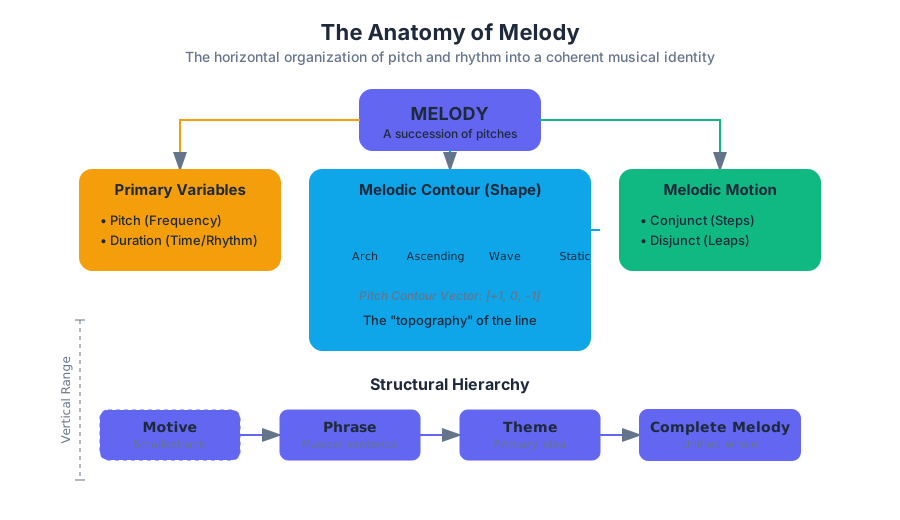
Harmony is the vertical dimension of music. While melody represents the horizontal traversal of pitches over time, harmony is the simultaneous occurrence of two or more frequencies. It provides the "color," emotional depth, and structural foundation for Western musical traditions. At its core, harmony is the study of intervals—the distance between pitches—and how those distances combine to form chords, creating a cycle of tension and resolution that drives a composition forward.
The Fundamental Unit: Intervals
An interval is the measurement of the distance in pitch between two notes. In Western music, the smallest standard unit of measurement is the semitone (or half-step). The relationship between two pitches is not merely a matter of distance, but of frequency ratios, which determines how the human ear perceives the quality of the sound.
Interval Classification and Measurement
Intervals are classified by two primary metrics: number (the distance on the staff) and quality (the specific number of semitones).
- Number: Determined by counting the lines and spaces on a staff from the lower note to the higher note, including both endpoints.
- Quality: Describes the specific harmonic "flavor" (Major, Minor, Perfect, Augmented, or Diminished).
| Interval Name | Semitones | Frequency Ratio (Just) | Quality Category |
|---|---|---|---|
| Unison | 0 | 1:1 | Perfect |
| Minor Second | 1 | 16:15 | Dissonant |
| Major Second | 2 | 9:8 | Dissonant |
| Minor Third | 3 | 6:5 | Imperfect Consonant |
| Major Third | 4 | 5:4 | Imperfect Consonant |
| Perfect Fourth | 5 | 4:3 | Perfect Consonant |
| Tritone | 6 | 45:32 | Dissonant (Diabolus in Musica) |
| Perfect Fifth | 7 | 3:2 | Perfect Consonant |
| Minor Sixth | 8 | 8:5 | Imperfect Consonant |
| Major Sixth | 9 | 5:3 | Imperfect Consonant |
| Minor Seventh | 10 | 16:9 | Dissonant |
| Major Seventh | 11 | 15:8 | Dissonant |
| Octave | 12 | 2:1 | Perfect Consonant |
Compound Intervals
When an interval exceeds the range of an octave (12 semitones), it is referred to as a compound interval. For example, a "Ninth" is functionally a Major Second plus an octave. In harmonic analysis, these are often reduced to their "simple" equivalents unless discussing specific chord extensions like 9ths, 11ths, or 13ths.
The Physics of Sound: Consonance and Dissonance
The distinction between consonance and dissonance is the engine of musical motion.
Consonance refers to intervals that are perceived as stable, restful, and complete. They require no resolution. Dissonance refers to intervals that create "interference" or "beating" in the ear, resulting in a sense of tension that seeks resolution to a consonant interval.
The Overtone Series
The hierarchy of consonance is rooted in the Natural Overtone Series. When a string vibrates, it does not just vibrate at its fundamental frequency ($f$); it also vibrates in halves ($2f$), thirds ($3f$), fourths ($4f$), and so on.
- The first partial is the Octave (2:1 ratio).
- The second partial is the Perfect Fifth (3:2 ratio).
- The third partial is the Perfect Fourth (4:3 ratio).
Because these intervals appear early in the physical harmonic series, the human brain perceives them as the most "perfect" and stable. As we move higher up the series, the intervals become smaller and more complex, leading to the "harshness" associated with dissonance.
Tertian Harmony: The Construction of Triads
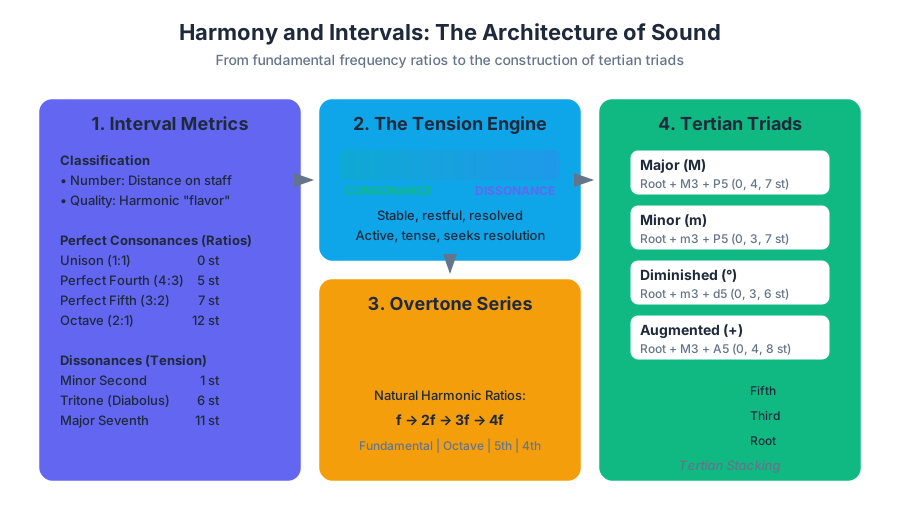
Western harmony is primarily tertian, meaning it is built by stacking intervals of a third. The most basic functional unit of this system is the triad, a three-note chord consisting of a Root, a Third, and a Fifth.
Triad Qualities
The quality of a triad is determined by the specific intervals between the root and the other two members.
| Triad Type | Structure (Intervals from Root) | Emotional Character | Symbol |
|---|---|---|---|
| Major | Major 3rd + Perfect 5th | Bright, Stable | C, M, maj |
| Minor | Minor 3rd + Perfect 5th | Dark, Somber | Cm, m, min |
| Diminished | Minor 3rd + Diminished 5th | Tense, Unstable | C°, dim |
| Augmented | Major 3rd + Augmented 5th | Ethereal, Suspended | C+, aug |
Implementation: Algorithmic Chord Generation
In computational musicology, we can represent these relationships mathematically. The following Python example demonstrates a low-level implementation of triad generation based on semitone offsets.
class ChordGenerator:
    """
    Generates frequency sets for standard tertian triads
    based on a root frequency and semitone intervals.
    """
    SEMITONE_RATIO = 2 ** (1/12)

    def __init__(self, root_freq):
        self.root = root_freq

    def get_freq(self, semitones):
        return self.root * (self.SEMITONE_RATIO ** semitones)

    def generate_triad(self, quality="major"):
        # Semitone offsets: (Root, Third, Fifth)
        qualities = {
            "major": (0, 4, 7),
            "minor": (0, 3, 7),
            "diminished": (0, 3, 6),
            "augmented": (0, 4, 8)
        }

        intervals = qualities.get(quality.lower())
        return [round(self.get_freq(i), 2) for i in intervals]

# Usage: Generate a C Major triad (Root C4 ≈ 261.63 Hz)
c_major = ChordGenerator(261.63)
print(f"C Major Triad Frequencies: {c_major.generate_triad('major')}")
# Output: [261.63, 329.63, 392.0]
Advanced Structures: Seventh Chords and Beyond
As music evolved from the Renaissance to the Baroque and eventually into the Jazz era, composers sought more "color" and "tension." This led to the Seventh Chord, created by adding another third on top of a triad (a seventh interval from the root).
Common Seventh Chords
Seventh chords are essential because they contain a "built-in" dissonance that demands resolution, particularly the Dominant Seventh.
| Chord Name | Structure | Function |
|---|---|---|
| Major Seventh (maj7) | Major Triad + Major 7th | Lush, "Jazz" sound, stable |
| Dominant Seventh (7) | Major Triad + Minor 7th | High tension; resolves to Tonic |
| Minor Seventh (m7) | Minor Triad + Minor 7th | Soft, moody, prevalent in Pop/Jazz |
| Half-Diminished (m7b5) | Diminished Triad + Minor 7th | Leading tone function in minor keys |
Mathematical Derivation of Just Intonation vs. Equal Temperament
The discrepancy between the "pure" mathematical ratios of the overtone series and the practical needs of keyboard instruments led to Equal Temperament. In this system, the octave is divided into 12 exactly equal semitones.
f_n = f_0 \cdot (2^{1/12})^n
Where:
- $f_n$ is the frequency of the target note.
- $f_0$ is the frequency of the fixed reference note (e.g., A4 = 440Hz).
- $n$ is the number of semitones away from the reference.
This formula ensures that a piano can play in any key without sounding out of tune, though it sacrifices the "perfect" purity of the 3:2 Fifth ratio (which becomes 1.498 instead of 1.5).
Harmonic Motion: Tension and Resolution
Harmony is not static; it is a narrative of Tension and Resolution. This is often described through the lens of Tonality, where one note (the Tonic) acts as a gravitational center.
- Preparation: A stable chord (usually the Tonic, I).
- Departure/Tension: Moving to a dissonant chord (the Dominant, V7). The presence of the "Tritone" within the V7 chord creates a psychological need for the notes to move to the nearest stable pitches.
- Resolution: Returning to the Tonic, releasing the accumulated energy.
Notation and the Staff
To communicate these complex vertical structures, musicians use the Staff—a system of five lines and four spaces.
- Clefs: The Treble Clef (G-clef) and Bass Clef (F-clef) define the pitch range.
- Accidentals: Symbols like Sharps (#), Flats (b), and Naturals (♮) modify the pitch of a note by a semitone to create the specific intervals required for different chord qualities.
- Ledger Lines: Used to extend the range of the staff above or below the standard five lines.
Real-World Usage: MIDI and Digital Audio Workstations (DAWs)
In modern music production, harmony is often handled via MIDI (Musical Instrument Digital Interface). Instead of note names, pitches are represented by integers (0-127).
# Example: Sending a MIDI Note On message for a C Major Triad
# Format: [Status Byte, Note Number, Velocity]
# C4 = 60, E4 = 64, G4 = 67

amidi -p hw:1,0 -S "90 3C 64" # Note On C4
amidi -p hw:1,0 -S "90 40 64" # Note On E4
amidi -p hw:1,0 -S "90 43 64" # Note On G4
Common Pitfalls and Misconceptions
- Consonance is Subjective: While the physics of the overtone series is objective, the perception of consonance has changed. In the 13th century, a Major Third was considered a dissonance. Today, it is the definition of stability.
- Enharmonic Equivalents: A G# and an Ab sound the same in Equal Temperament but serve different harmonic functions. Labeling a C Major chord as
C - E - Abis a "spelling" error that obscures the functional relationship of the Major Third. - The "Perfect" Fourth: The Perfect Fourth is a unique case. In isolation, it sounds consonant, but in the context of common-practice counterpoint, it is often treated as a dissonance that must resolve downward to a third.
Summary of Harmonic Evolution
| Era | Primary Harmonic Focus | Key Innovation |
|---|---|---|
| Medieval | Monophony / Perfect Intervals | Parallel Organum (Fifths/Fourths) |
| Renaissance | Polyphony / Triads | Introduction of "Imperfect" Consonances (3rds/6rds) |
| Baroque | Functional Tonality | The Basso Continuo and the V-I Cadence |
| Classical | Structural Clarity | Homophony (Melody + Chordal Accompaniment) |
| Romantic | Chromaticism | Extended chords and delayed resolutions |
| Modern/Jazz | Atonality / Extensions | 9ths, 11ths, 13ths, and Quartal Harmony |
Core Vocabulary
- Interval: The distance between two pitches.
- Semitone: The smallest interval in Western music.
- Tertian: Harmony built on intervals of a third.
- Triad: A three-note chord (Root, 3rd, 5th).
- Consonance: Stable, restful sound.
- Dissonance: Tense, unstable sound requiring resolution.
- Tonic: The "home" note or chord of a key.
- Dominant: The chord built on the 5th scale degree, providing maximum tension.
Key Formulas
- Major Triad: Root + 4 semitones + 3 semitones.
- Minor Triad: Root + 3 semitones + 4 semitones.
- Frequency of Octave: $f \times 2$.
- Frequency of Perfect Fifth: $f \times 1.5$.
Critical Thinking Questions
- How does the natural overtone series explain why some intervals sound "cleaner" than others?
- Why is the Dominant Seventh chord (V7) the most important chord for creating a sense of "ending" in a piece of music?
- What is the difference between horizontal melody and vertical harmony, and how do they interact in a standard pop song?
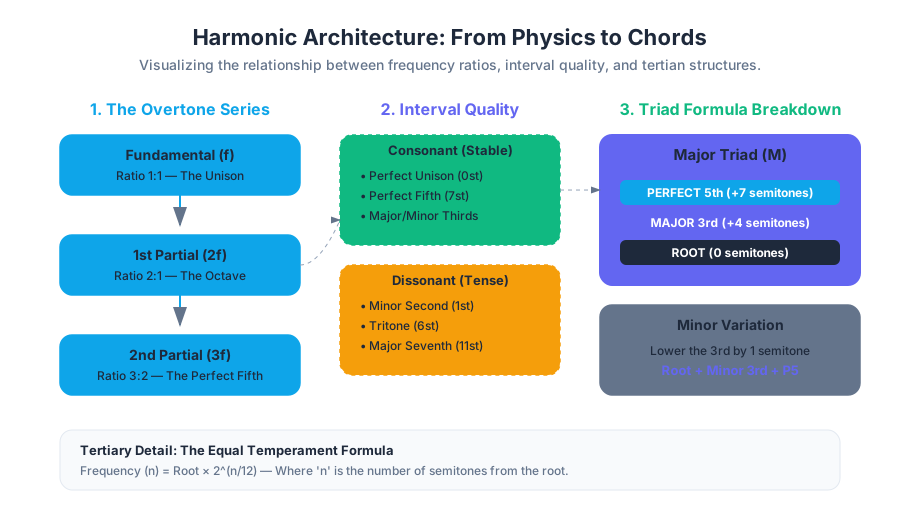
Scales and Tonality
Key concepts: Major Scale · Minor Scale · Tonic · Chromatic Scale · Pentatonic Scale
Exploring the different types of scales and the concept of a tonal center or 'key'.
Scales and Tonality
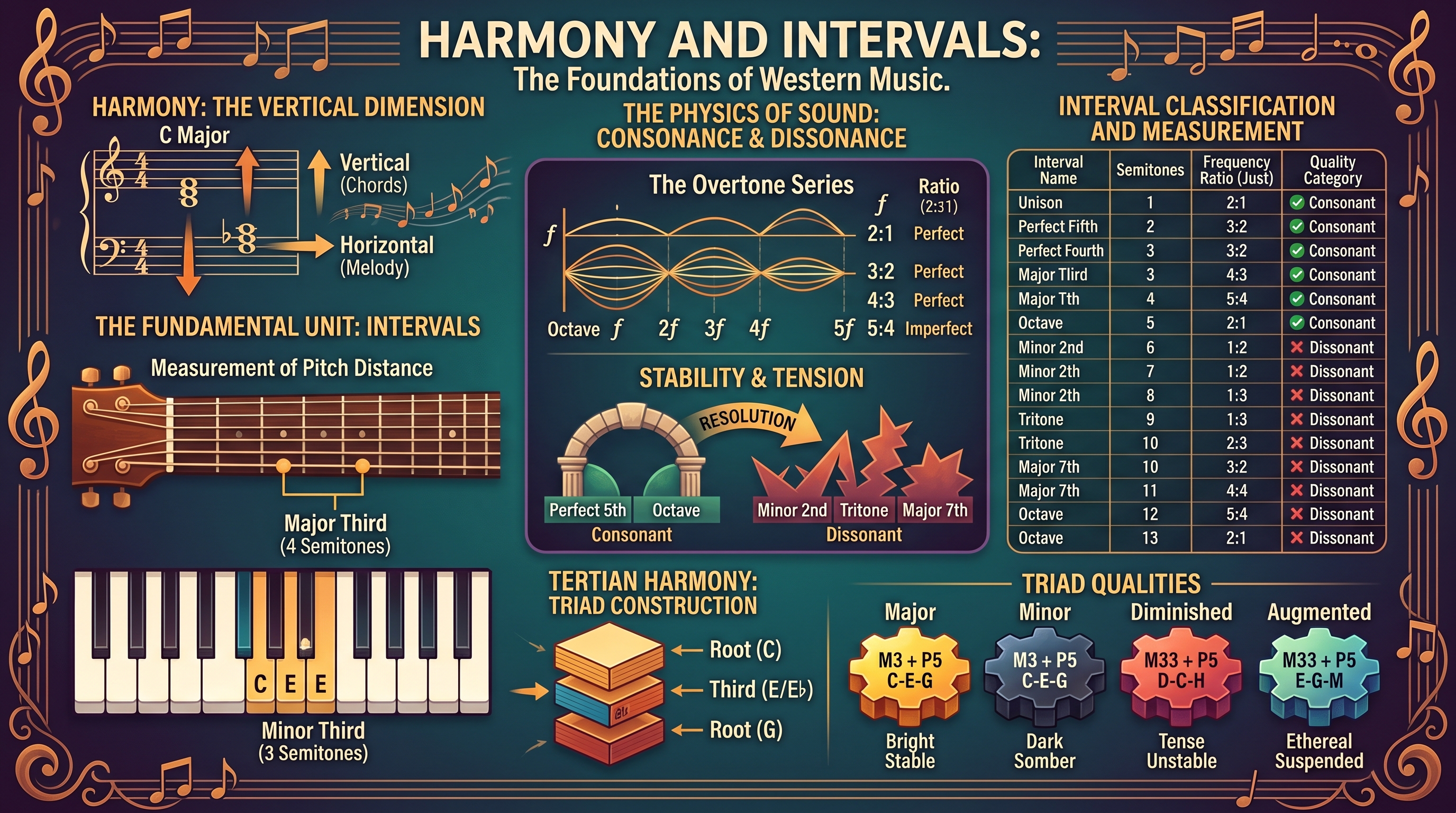
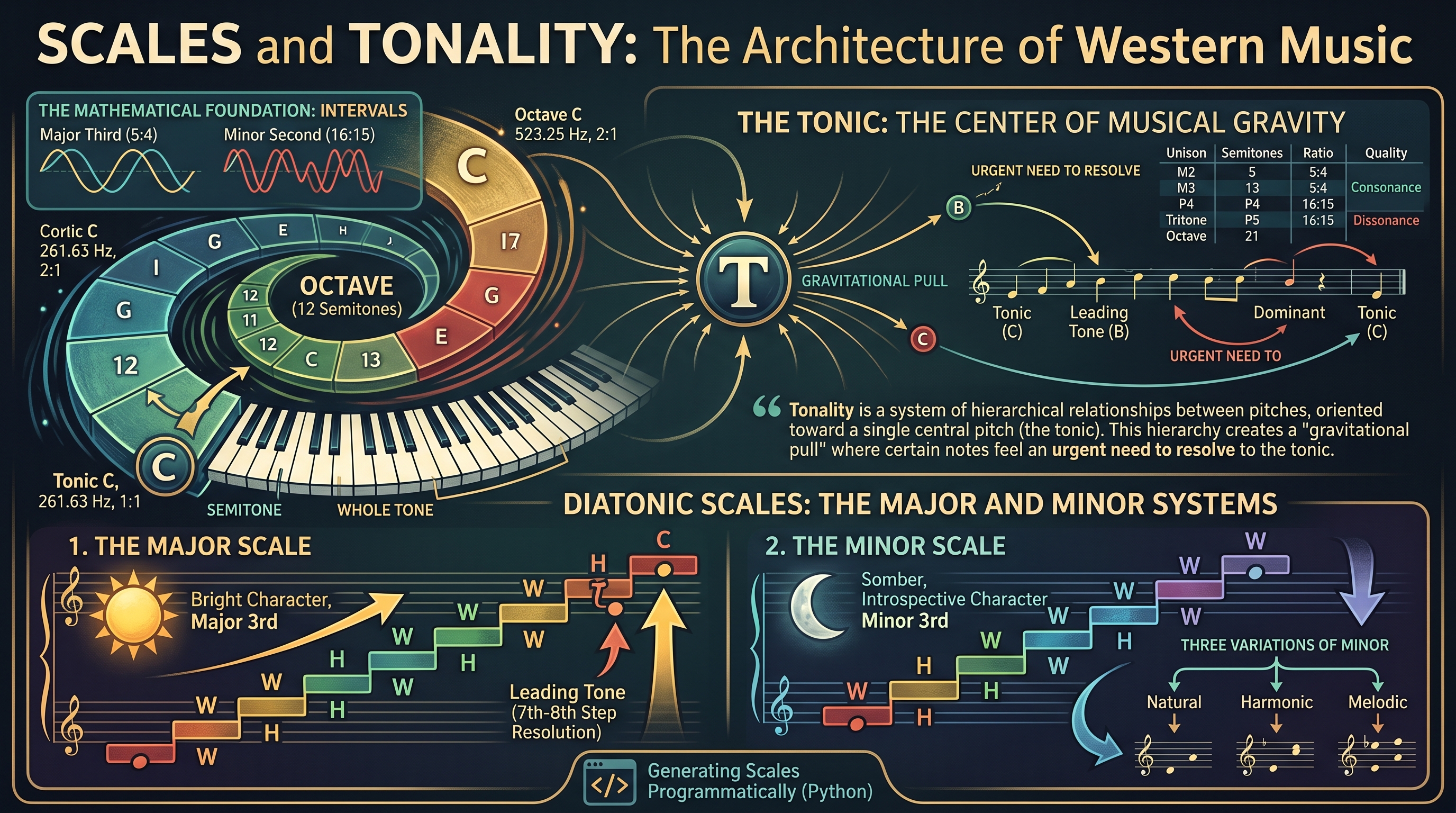
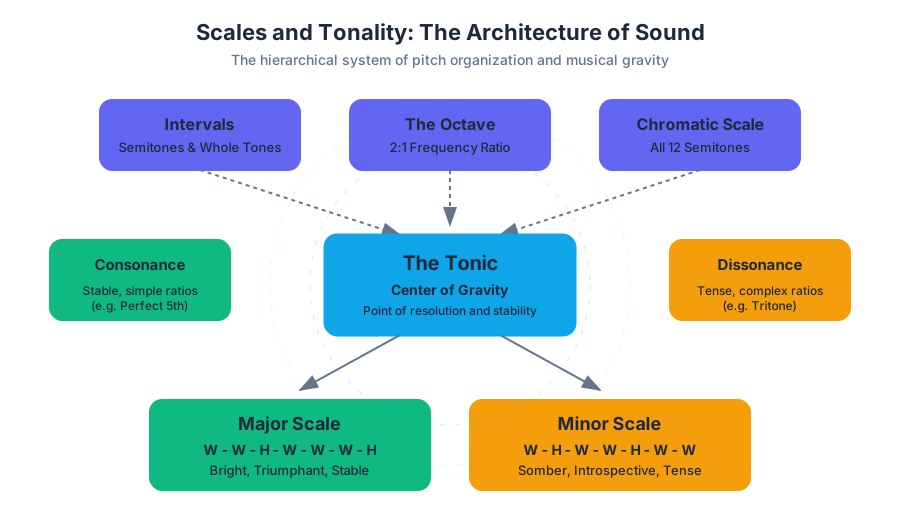
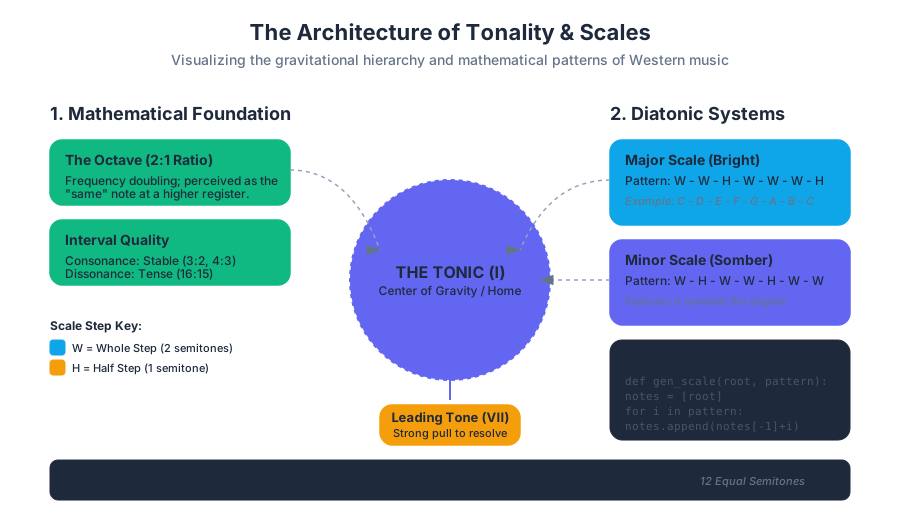
In the architecture of Western music, Scales and Tonality function as both the raw materials and the gravitational laws that govern their interaction. If melody is the narrative and harmony is the setting, then scales are the alphabet from which these structures are built. Tonality, specifically, refers to the hierarchical system where a single pitch—the Tonic—serves as the focal point of stability, toward which all other pitches gravitate.
The Mathematical Foundation: Intervals and the Octave
Before analyzing specific scales, one must understand the Interval: the distance in pitch between two notes. The fundamental unit of Western music is the Semitone (or half-step), the smallest interval on a standard piano. Two semitones constitute a Whole Tone (or whole step).
The most significant interval is the Octave, representing a 2:1 frequency ratio. When a pitch’s frequency is doubled, the human ear perceives it as the "same" note at a higher register. This phenomenon, known as octave equivalence, allows us to organize the infinite spectrum of sound into repeating cycles of twelve distinct semitones.
The Physics of Consonance and Dissonance
The relationship between pitches is often categorized by its perceived stability:
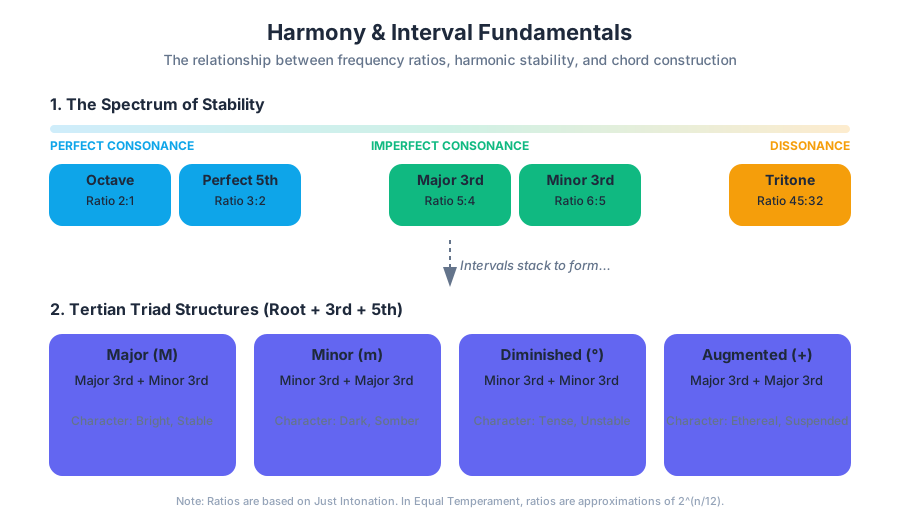
- Consonance: Intervals that sound stable, restful, and "pleasant." These typically correspond to simple mathematical ratios (e.g., 2:1 for an octave, 3:2 for a perfect fifth).
- Dissonance: Intervals that sound tense, unstable, or "clashing" (e.g., the minor second or the tritone). Dissonance creates the "tension" in music that demands "resolution" into consonance.
| Interval Name | Semitones | Frequency Ratio (Just) | Quality |
|---|---|---|---|
| Unison | 0 | 1:1 | Perfect Consonance |
| Minor Second | 1 | 16:15 | Sharp Dissonance |
| Major Second | 2 | 9:8 | Mild Dissonance |
| Major Third | 4 | 5:4 | Imperfect Consonance |
| Perfect Fourth | 5 | 4:3 | Perfect Consonance |
| Tritone | 6 | 45:32 (approx) | Sharp Dissonance |
| Perfect Fifth | 7 | 3:2 | Perfect Consonance |
| Octave | 12 | 2:1 | Perfect Consonance |
The Tonic: The Center of Musical Gravity
The Tonic (or tonal center) is the "home" note of a piece. In tonal music, every note and chord is heard in relation to this central pitch. The tonic provides a sense of finality and resolution; a piece of music that ends on the tonic feels "complete," whereas ending on any other note creates a sense of "hanging" or suspense.
The Principle of Tonality: A system of musical organization in which specific hierarchical relationships exist between pitches, all oriented toward a single central pitch (the tonic). This hierarchy creates a "gravitational pull" where certain notes (like the leading tone) feel an urgent need to resolve to the tonic.
Diatonic Scales: The Major and Minor Systems
The word Diatonic refers to scales constructed from a specific mix of seven whole and half steps. These are the primary building blocks of Western classical, pop, and folk music.
1. The Major Scale
The Major Scale is characterized by its "bright" or "happy" character. Its structure is rigid: a sequence of whole (W) and half (H) steps that must follow the pattern W-W-H-W-W-W-H.
For example, the C Major scale consists of:
C (W) D (W) E (H) F (W) G (W) A (W) B (H) C
The crucial elements of the Major scale are the half-steps between the 3rd/4th degrees and the 7th/8th degrees. The 7th degree is called the Leading Tone because it sits just a semitone below the tonic, creating a powerful magnetic pull to resolve upward.
2. The Minor Scale
The Minor Scale is often associated with "sadness," "mystery," or "tension." While it also contains seven notes, its interval pattern differs, most notably featuring a "lowered" or "flatted" third degree. There are three primary variations of the minor scale used to manage different harmonic and melodic needs:
- Natural Minor: The basic form (W-H-W-W-H-W-W).
- Harmonic Minor: Raises the 7th note to create a leading tone, facilitating stronger harmonic resolutions.
- Melodic Minor: Raises both the 6th and 7th notes when ascending to smooth out the melodic line, but reverts to natural minor when descending.
| Scale Type | Step Pattern | Characteristic Interval | Emotional Context |
|---|---|---|---|
| Major | W-W-H-W-W-W-H | Major 3rd | Bright, Triumphant |
| Natural Minor | W-H-W-W-H-W-W | Minor 3rd | Somber, Introspective |
| Harmonic Minor | W-H-W-W-H-m3-H | Augmented 2nd (6-7) | Exotic, Tense |
Implementation: Generating Scales Programmatically
In computational musicology, we represent these patterns as offsets from a root frequency or MIDI note number.
def generate_scale(root_midi, pattern):
    """
    Generates a list of MIDI note numbers for a given scale pattern.
    :param root_midi: The starting note (e.g., 60 for Middle C)
    :param pattern: List of intervals (2 for Whole, 1 for Half)
    :return: List of MIDI notes in the scale
    """
    scale = [root_midi]
    current_note = root_midi
    for interval in pattern:
        current_note += interval
        scale.append(current_note)
    return scale

# Constants for patterns
MAJOR_PATTERN = [2, 2, 1, 2, 2, 2, 1]
NATURAL_MINOR_PATTERN = [2, 1, 2, 2, 1, 2, 2]

# Example: Generate C Major (Root 60)
c_major = generate_scale(60, MAJOR_PATTERN)
# Output: [60, 62, 64, 65, 67, 69, 71, 72]
The Chromatic Scale: The Total Palette
The Chromatic Scale consists of all twelve semitones within an octave. Unlike diatonic scales, it has no "home" note by itself; it is entirely symmetrical, with every interval being a half-step.
In tonal music, chromatic notes are often used as "color" (the Greek word chroma means color) to embellish a diatonic melody. However, in the 20th century, composers like Arnold Schoenberg developed Atonality and Twelve-Tone Serialism, where the chromatic scale is used as a primary structure, deliberately avoiding a tonic center.
Mathematical Representation of the Chromatic Scale
In Equal Temperament (the standard tuning system), the frequency of any note $f_n$ can be calculated relative to a reference frequency $f_0$ (usually A4 = 440Hz):
f_n = f_0 \cdot (2^{1/12})^n
Where:
- $f_n$ is the frequency of the note $n$ semitones away from the reference.
- $2^{1/12}$ is the "Twelfth Root of Two," the constant ratio between every semitone.
The Pentatonic Scale: Universality and Efficiency
The Pentatonic Scale uses only five notes per octave. It is perhaps the most universal scale in human history, appearing in the folk music of nearly every culture, from ancient China to the Mississippi Delta.
The most common version is the Major Pentatonic, which removes the 4th and 7th degrees of the major scale. By removing these notes, the scale eliminates the "harsh" half-step intervals. This makes the pentatonic scale incredibly "safe"—almost any combination of its notes will sound harmonious together.
Why the Pentatonic Scale Works
Because it lacks the "leading tones" (the 4th and 7th), the pentatonic scale lacks the strong directional drive of the major scale. This gives it an open, floating quality often used in:
- Blues and Rock: For improvisation, as it fits over many different chords.
- Folk Music: For its ease of singing and memorization.
- Film Scoring: To evoke a sense of nature or ancient times.
| Scale Name | Notes (in C) | Intervals (Steps) | Common Use |
|---|---|---|---|
| Major Pentatonic | C, D, E, G, A | 2 - 2 - 3 - 2 - 3 | Country, Pop, Chinese Folk |
| Minor Pentatonic | C, Eb, F, G, Bb | 3 - 2 - 2 - 3 - 2 | Blues, Rock, Jazz |
Harmony: From Scales to Chords
Harmony occurs when two or more pitches sound simultaneously. In Western music, harmony is primarily Tertian, meaning it is built by stacking intervals of a third.
The Triad
The most basic chord is the Triad, consisting of three notes: the Root, a Third, and a Fifth.
- Major Triad: Root + Major 3rd + Perfect 5th (e.g., C-E-G).
- Minor Triad: Root + Minor 3rd + Perfect 5th (e.g., C-Eb-G).
Extended Harmony
Modern music often adds more "tensions" to these triads:
- Seventh Chords: Adding a 7th interval (e.g., C-E-G-Bb). Common in Jazz and Blues.
- Extended Chords: Adding the 9th, 11th, or 13th. These create dense, complex textures used in film scores and R&B.
Real-World Data Representation: MIDI and JSON
In modern digital audio workstations (DAWs), scale and chord data are often handled as JSON objects to allow for "Snap-to-Key" features.
{
  "key": "G",
  "mode": "Major",
  "tonic_frequency": 392.00,
  "scale_degrees": [
    {"name": "Tonic", "midi_offset": 0},
    {"name": "Supertonic", "midi_offset": 2},
    {"name": "Mediant", "midi_offset": 4},
    {"name": "Subdominant", "midi_offset": 5},
    {"name": "Dominant", "midi_offset": 7},
    {"name": "Submediant", "midi_offset": 9},
    {"name": "Leading Tone", "midi_offset": 11}
  ],
  "common_chords": [
    {"type": "I", "notes": [0, 4, 7]},
    {"type": "IV", "notes": [5, 9, 12]},
    {"type": "V", "notes": [7, 11, 14]}
  ]
}
Common Pitfalls and Misconceptions
1. Confusing "Key" with "Scale"
A Scale is an ordered set of notes (the palette). A Key is a broader system that includes the scale, the chords derived from it, and the functional relationships between them. You can play a "C Major Scale," but you compose a piece "in the Key of C Major."
2. The "Minor equals Sad" Fallacy
While minor scales are culturally associated with sadness in the West, this is not a universal law of physics. Many fast, upbeat dance tracks are in minor keys, and many somber, funeral marches can be in major keys. The tempo, rhythm, and timbre are just as important as the scale in conveying emotion.
3. Enharmonic Equivalence
A common mistake in notation is mislabeling notes like G# and Ab. While they sound the same on a piano (Enharmonic), their function depends on the scale. In an E Major scale, the note must be written as G# (the 3rd degree), never Ab, to maintain the "one letter per degree" rule of diatonic scales.
Summary of Scale Relationships
The relationship between these scales can be viewed as a spectrum of "density" and "directionality."
| Scale | Note Count | Directional Pull | Complexity |
|---|---|---|---|
| Pentatonic | 5 | Low (No half-steps) | Simple / Universal |
| Major/Minor | 7 | High (Leading tones) | Standard / Functional |
| Chromatic | 12 | Neutral (Symmetrical) | Maximum / Complex |
Core Definitions to Remember
- Tonic: The "home" note or tonal center.
- Interval: The distance between two pitches.
- Diatonic: A seven-note scale using a specific pattern of whole and half steps.
- Consonance: Intervals that feel stable and resolved.
- Dissonance: Intervals that create tension and require resolution.
Key Patterns
- Major Scale: W-W-H-W-W-W-H
- Natural Minor: W-H-W-W-H-W-W
- Major Pentatonic: 1-2-3-5-6 (Degrees of the Major scale)
Critical Thinking Questions
- How does the presence of a "leading tone" (the 7th degree) change the way a listener perceives the end of a musical phrase?
- Why might a composer choose a pentatonic scale over a chromatic scale for a simple folk melody?
- In what ways does the mathematical ratio of an interval (e.g., 3:2) influence our emotional response to it?
Musical Notation and the Staff
Key concepts: Staff · Clefs · Ledger Lines · Accidentals
The visual representation of music, including the staff, clefs, and accidentals.
Musical Notation and the Staff: The Architecture of Sound
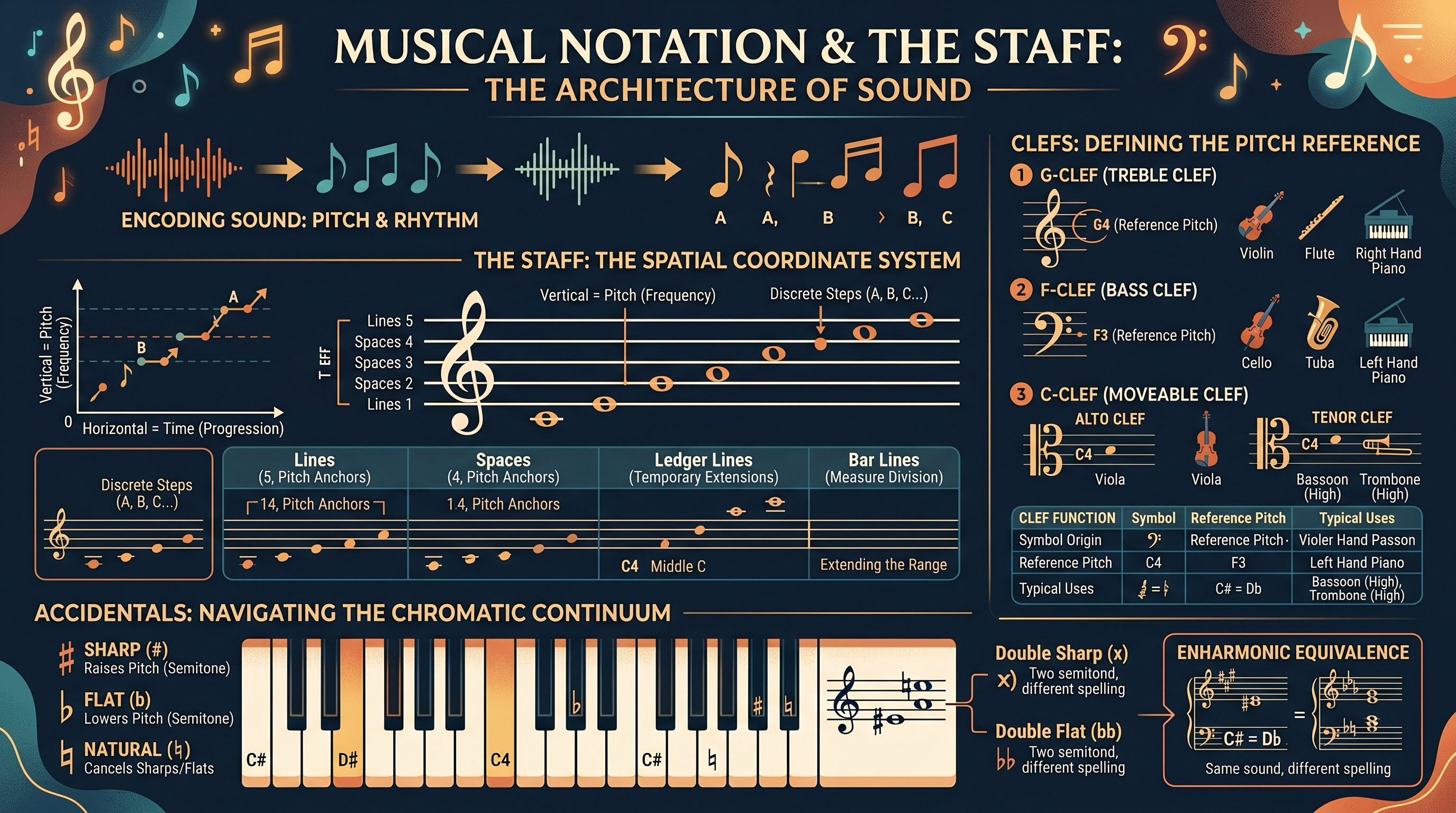
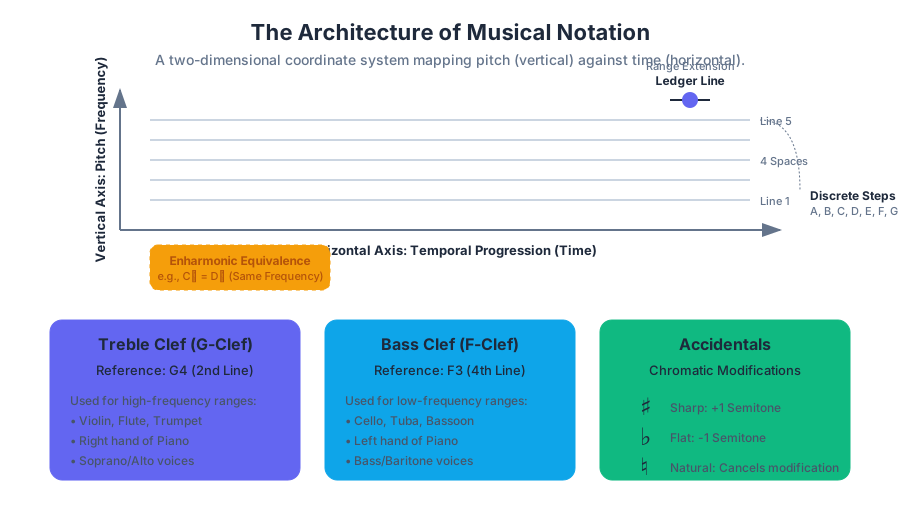
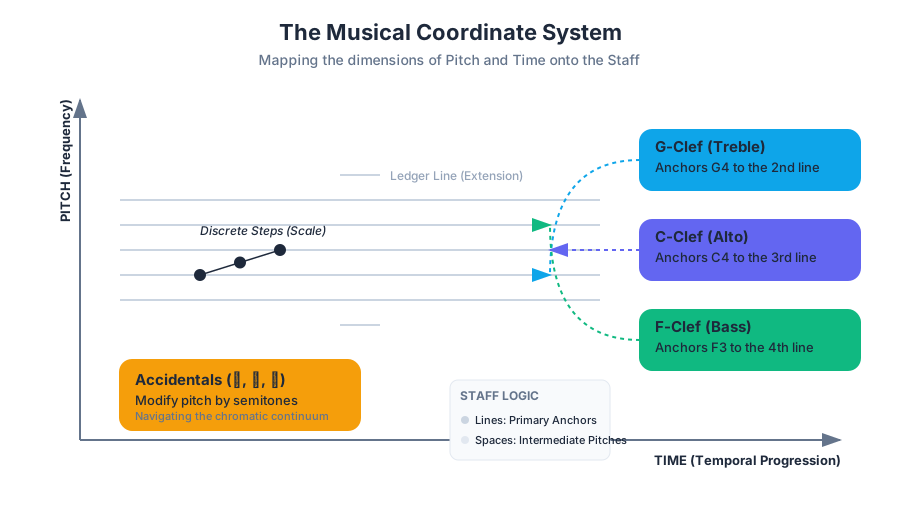
Musical notation is a sophisticated symbolic language designed to encode the two primary dimensions of sound: pitch (frequency) and rhythm (time). At its core, Western notation functions as a two-dimensional coordinate system where the vertical axis represents pitch height and the horizontal axis represents temporal progression. By standardizing these elements, notation allows for the preservation, transmission, and complex synchronization of musical ideas across time and geography.
Definition: Musical notation is a discrete representation of a continuous acoustic spectrum. It transforms the fluid nature of sound into a set of actionable instructions for performers, balancing precision with the interpretive flexibility required for artistic expression.
The Staff: The Spatial Coordinate System
The staff (plural: staves) is the foundational grid of Western music. It consists of five equidistant horizontal lines and the four intervening spaces. Each line and space represents a specific pitch within a given musical scale.
Mechanics of the Staff
The staff operates on a relative-pitch basis until a clef is applied. Without a clef, a note on the middle line is simply "the middle line." Once a clef is assigned, that line is mapped to a specific frequency.
- Verticality: Moving upward on the staff corresponds to an increase in frequency (higher pitch).
- Horizontality: Moving from left to right corresponds to the passage of time.
- Discrete Steps: Each adjacent line and space represents a "step" in the musical alphabet (A, B, C, D, E, F, G).
| Component | Function | Capacity |
|---|---|---|
| Lines | Primary pitch anchors | 5 lines per staff |
| Spaces | Intermediate pitch anchors | 4 spaces per staff |
| Ledger Lines | Temporary extensions | Infinite (theoretically), typically 1-5 |
| Bar Lines | Temporal grouping | Divides staff into measures (bars) |
Ledger Lines: Extending the Range
Because the human hearing range and instrument capabilities far exceed the nine pitches available on a single five-line staff, ledger lines are employed. These are short, horizontal lines drawn above or below the staff to accommodate notes that fall outside its primary boundaries. They function as "virtual" extensions of the staff, maintaining the same spacing and logic as the permanent lines.
Clefs: Defining the Pitch Reference
A clef is a graphical symbol placed at the beginning of a staff that assigns a specific pitch to one of the lines, thereby "locking" the entire staff into a specific frequency range.
The Three Primary Clef Families
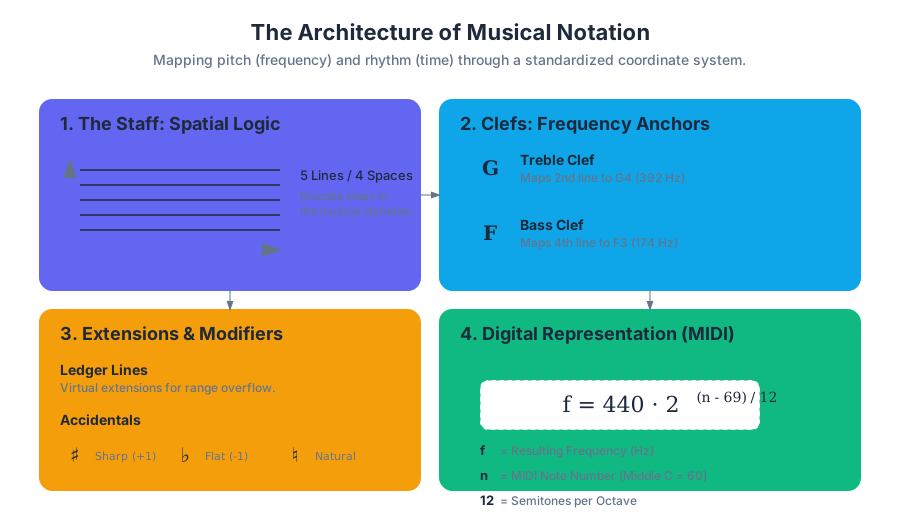
- G-Clef (Treble Clef): The curl of the G-clef circles the second line from the bottom, designating it as G4 (the G above middle C). It is used for high-range instruments like the violin, flute, and the right hand of the piano.
- F-Clef (Bass Clef): The two dots of the F-clef surround the fourth line from the bottom, designating it as F3 (the F below middle C). It is used for low-range instruments like the cello, tuba, and the left hand of the piano.
- C-Clef (Moveable Clef): The center of the C-clef points to Middle C (C4). Unlike G and F clefs, the C-clef is "moveable." When centered on the third line, it is the Alto Clef (used by the viola); when on the fourth line, it is the Tenor Clef (used by bassoons and trombones in their upper registers).
| Clef Name | Symbol Origin | Reference Pitch | Primary Use Cases |
|---|---|---|---|
| Treble | Stylized 'G' | G4 (2nd line) | Soprano voices, Guitar, Trumpet |
| Bass | Stylized 'F' | F3 (4th line) | Bass voices, Double Bass, Timpani |
| Alto | Stylized 'C' | C4 (3rd line) | Viola, Alto Trombone |
| Tenor | Stylized 'C' | C4 (4th line) | Cello (high), Bassoon (high) |
Accidentals: Navigating the Chromatic Continuum
While the staff and clef define the "natural" notes (the white keys on a piano), music frequently requires pitches that fall between these steps. Accidentals are symbols placed to the left of a note head to modify its pitch by a semitone (half-step).
Types of Accidentals
- Sharp (#): Raises the pitch by one semitone.
- Flat (b): Lowers the pitch by one semitone.
- Natural (♮): Cancels a previous sharp or flat, returning the note to its "natural" state.
- Double Sharp (x) / Double Flat (bb): Raises or lowers the pitch by two semitones (a whole step).
The Principle of Enharmonic Equivalence
Because Western music typically uses Equal Temperament, some pitches can be "spelled" in different ways despite sounding the same frequency. For example, C# and Db are enharmonically equivalent. The choice of spelling depends on the musical context (the key signature or the direction of the melodic line).
Key Insight: Accidentals follow a "measure-wide" scope. An accidental applied to a note remains in effect for that specific pitch for the remainder of the measure, unless cancelled by another accidental or a bar line.
Implementation: Pitch Logic in Code
In digital music systems, pitches are often represented as integer MIDI values where Middle C (C4) is 60. This allows for easy calculation of accidentals and intervals.
/*
 * Low-level C implementation of a pitch-to-frequency converter.
 * This demonstrates how notation (MIDI index) maps to physical reality (Hz).
 */

#include <math.h>
#include <stdio.h>

#define REFERENCE_FREQ 440.0 // A4 = 440Hz
#define REFERENCE_MIDI 69    // MIDI index for A4

double midi_to_frequency(int midi_note) {
    // Formula: f = 440 * 2^((n-69)/12)
    return REFERENCE_FREQ * pow(2.0, (midi_note - REFERENCE_MIDI) / 12.0);
}

int main() {
    int middle_c = 60;
    int c_sharp = 61; // Middle C + Sharp accidental

    printf("Middle C Frequency: %.2f Hz\n", midi_to_frequency(middle_c));
    printf("C# Frequency: %.2f Hz\n", midi_to_frequency(c_sharp));

    return 0;
}
Intervals: The Distance Between Pitches
An interval is the measurement of the distance in pitch between two notes. Intervals are the building blocks of both melody (horizontal) and harmony (vertical).
Classification and Quality
Intervals are defined by two components:
- Quantity (Number): The number of staff positions (lines and spaces) the interval spans.
- Quality: The specific character of the interval (Major, Minor, Perfect, Augmented, Diminished), determined by the exact number of semitones.
The Overtone Series and Consonance
The concept of consonance (stability) and dissonance (tension) is rooted in the physics of the Natural Overtone Series. When a string vibrates, it produces a fundamental frequency plus a series of higher partials. Intervals with simple mathematical ratios (e.g., Octave 2:1, Perfect Fifth 3:2) are perceived as more consonant.
| Interval Name | Semitones | Frequency Ratio | Consonance Level |
|---|---|---|---|
| Unison | 0 | 1:1 | Perfect Consonance |
| Octave | 12 | 2:1 | Perfect Consonance |
| Perfect 5th | 7 | 3:2 | Perfect Consonance |
| Major 3rd | 4 | 5:4 | Imperfect Consonance |
| Minor 2nd | 1 | 16:15 | Sharp Dissonance |
| Tritone | 6 | √2:1 | Ambiguous/Dissonant |
Scales and Tonality: The Pitch Set
A scale is an ordered collection of pitches that provides the raw material for a piece of music. Most Western music is tonal, meaning it revolves around a central pitch called the tonic.
The Diatonic Framework
The most common scales are diatonic, consisting of seven notes. The structure of these scales is defined by a specific pattern of Whole steps (W) and Half steps (H).
- Major Scale Pattern: W - W - H - W - W - W - H
- Natural Minor Scale Pattern: W - H - W - W - H - W - W
Mathematical Derivation of Scales
We can represent the construction of a Major scale as a sequence of semitone offsets from the tonic $P_0$.
$$P_{scale} = {P_0, P_0+2, P_0+4, P_0+5, P_0+7, P_0+9, P_0+11, P_0+12}$$
Where $P_0$ is the MIDI index of the starting note.
% LilyPond notation representation
% This is a domain-specific language for music engraving.
\relative c' {
  \clef treble
  \key c \major
  \time 4/4
  % C Major Scale
  c d e f | g a b c |
  % C Minor Scale (with accidentals)
  c, d es f | g as bes c |
}
Melody and Harmony: Linear vs. Vertical Organization
Music organizes pitches in two directions:
- Melody (Horizontal): A sequence of notes perceived as a single entity. Melodies are characterized by their contour (ascending, descending, arch-shaped) and motion (conjunct/stepwise vs. disjunct/leaping).
- Harmony (Vertical): The simultaneous sounding of two or more pitches. In Western music, harmony is primarily tertian, meaning it is built by stacking intervals of a third.
Chords and Triads
The most basic unit of harmony is the triad, a three-note chord consisting of a root, a third, and a fifth.
- Major Triad: Root + Major 3rd + Perfect 5th (Bright, stable)
- Minor Triad: Root + Minor 3rd + Perfect 5th (Dark, somber)
- Diminished Triad: Root + Minor 3rd + Diminished 5th (Tense, unstable)
Structural Units
- Motive: A short, recurring musical fragment (e.g., the four-note opening of Beethoven's 5th).
- Phrase: A musical "sentence" ending in a cadence (a point of rest).
- Theme: A longer melodic idea that serves as the basis for a composition.
Rhythm and Meter: The Temporal Grid
While the staff handles pitch, the time signature and meter handle the organization of time.
Time Signatures
A time signature consists of two numbers:
- Top Number: How many beats are in each measure.
- Bottom Number: Which note value receives one beat (4 = quarter note, 8 = eighth note, etc.).
Meter Types
- Simple Meter: The beat is divided into two equal parts (e.g., 2/4, 3/4, 4/4).
- Compound Meter: The beat is divided into three equal parts (e.g., 6/8, 9/8, 12/8).
- Duple, Triple, and Quadruple: Refers to the number of beats per measure (2, 3, or 4).
| Meter Type | Time Signature | Beat Division | Stress Pattern |
|---|---|---|---|
| Simple Duple | 2/4 | 1 & 2 & | Strong - weak |
| Simple Triple | 3/4 | 1 & 2 & 3 & | Strong - weak - weak |
| Compound Duple | 6/8 | 1-2-3, 4-5-6 | Strong - weak |
| Common Time | 4/4 (C) | 1 & 2 & 3 & 4 & | Strong - weak - Semi-strong - weak |
Analyzing Notation with Python
Modern musicology often uses programmatic tools to analyze these structures. The music21 library is the industry standard for this type of "Music Informatics."
# Real-world usage: Analyzing a score for pitch distribution
from music21 import corpus, analysis

# Load a built-in piece (e.g., a Bach Chorale)
score = corpus.parse('bach/bwv66.6')

# Analyze the frequency of different pitches
p_stats = analysis.discrete.PitchClassCount()
results = p_stats.analyze(score)

print("Pitch Class Distribution (C=0, C#=1, etc.):")
for pitch_class, count in sorted(results.items()):
    print(f"Pitch {pitch_class}: {count} occurrences")

# Identify the key of the piece
key = score.analyze('key')
print(f"\nInferred Key: {key.tonic.name} {key.mode}")
Common Pitfalls and Misconceptions
- Clef Misreading: A common error for beginners is forgetting that the same line on a Treble staff is a different pitch on a Bass staff. Always check the clef first.
- Accidental Scope: Forgetting that an accidental persists through the measure. If a C# appears in beat 1, any C in beat 3 of the same measure is also C# unless marked with a natural sign.
- Enharmonic Confusion: Writing a D# in the key of F Major. While D# and Eb sound the same, F Major requires an Eb to maintain the correct "alphabetical" sequence of the scale (F-G-A-Bb-C-D-E).
- Beat vs. Rhythm: Rhythm is the actual pattern of durations; meter is the underlying "pulse" or grid. You can have a complex rhythm over a very simple meter.
Conclusion: The Unified Protocol
Musical notation is more than just "dots on a page." It is a highly optimized data protocol that has evolved over a millennium to solve the problem of synchronizing human performance. By combining the spatial logic of the staff, the frequency-locking power of clefs, the chromatic flexibility of accidentals, and the temporal discipline of meter, notation provides a complete framework for the most complex of human expressions.
Rhythm, Meter, and Duration
Key concepts: Rhythm · Meter · Note Duration · Rests · Beats
How music is organized in time through beats, rests, and patterns of stress.
Rhythm, Meter, and Duration
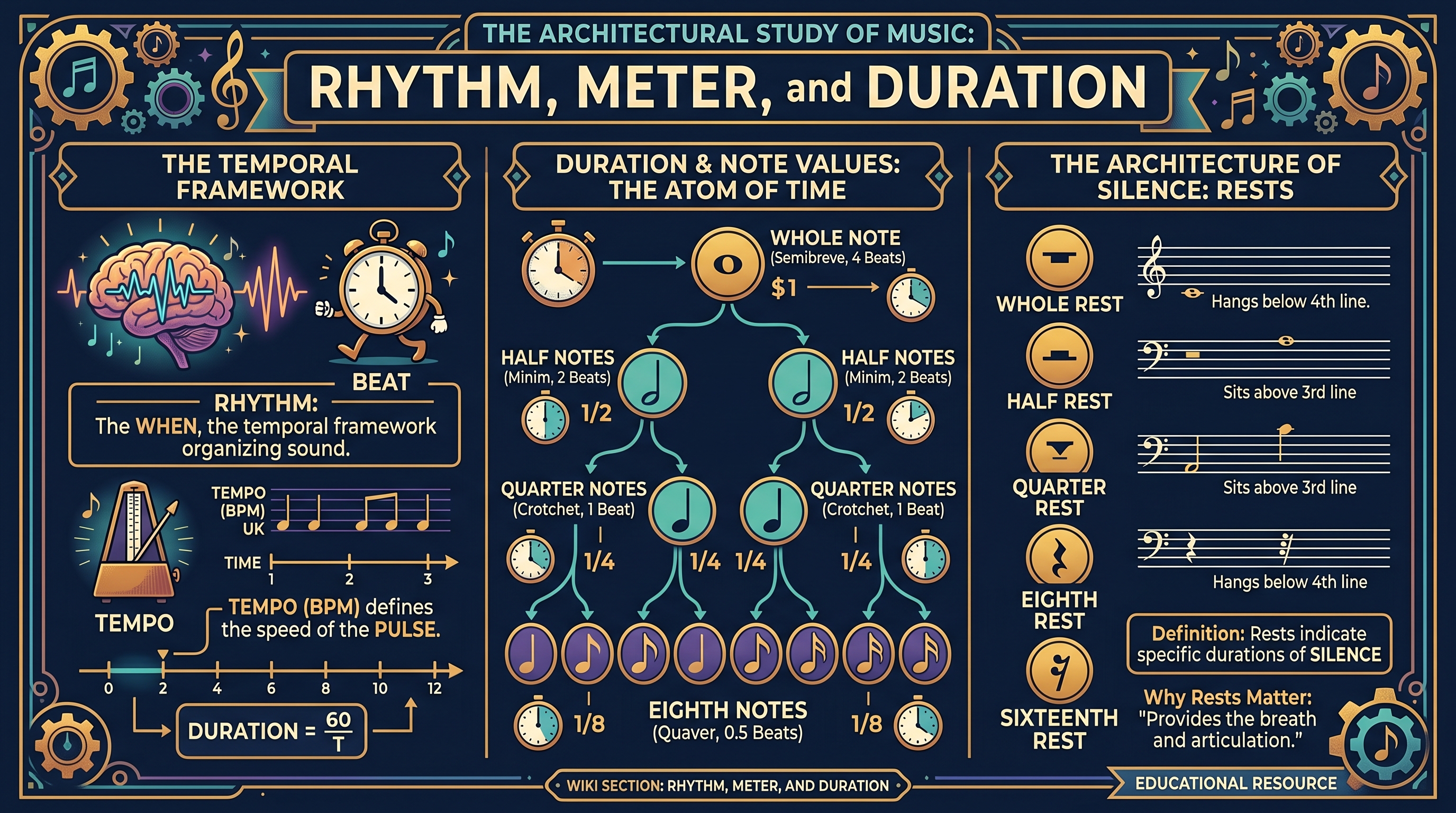
In the architectural study of music, if melody represents the "what" (the pitch) and harmony represents the "depth" (the vertical stack), then rhythm is the "when"—the fundamental temporal framework that organizes sound across the horizontal axis of time. Without rhythm, music is merely a static frequency; with it, music becomes a dynamic, moving force.
This section explores the mechanics of musical time, from the atomic level of duration to the structural level of meter. We will examine how silence is quantified through rests, how the beat serves as the isochronous pulse of a composition, and how complex rhythmic patterns are derived from simple mathematical subdivisions.
The Atom of Time: Duration and Note Values
Duration is the specific length of time a sound (or silence) persists. In Western music theory, duration is not measured in absolute units like seconds or milliseconds, but in relative units. This relative system allows a piece of music to be performed at different speeds (tempos) while maintaining the proportional relationships between the notes.
The Binary Hierarchy
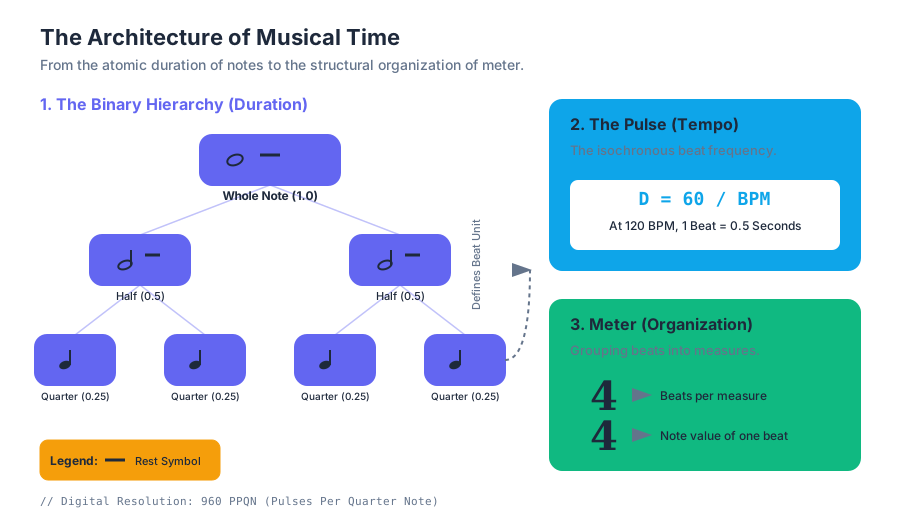
The standard system of note values is based on a power-of-two subdivision. Each successive note value is exactly half the duration of the one preceding it.
Definition: The Whole Note (Semibreve) The reference unit for duration in a standard measure of 4/4 time. All other note values are expressed as fractions of the whole note ($1, 1/2, 1/4, 1/8, 1/16, 1/32$).
| Note Name (US) | Note Name (UK) | Relative Duration | Logic/Division |
|---|---|---|---|
| Whole Note | Semibreve | 1.0 | The fundamental unit ($2^0$) |
| Half Note | Minim | 0.5 | $1/2$ of a whole note ($2^{-1}$) |
| Quarter Note | Crotchet | 0.25 | $1/4$ of a whole note ($2^{-2}$) |
| Eighth Note | Quaver | 0.125 | $1/8$ of a whole note ($2^{-3}$) |
| Sixteenth Note | Semiquaver | 0.0625 | $1/16$ of a whole note ($2^{-4}$) |
| Thirty-second Note | Demisemiquaver | 0.03125 | $1/32$ of a whole note ($2^{-5}$) |
Implementation: Rhythmic Scheduling in Low-Level Systems
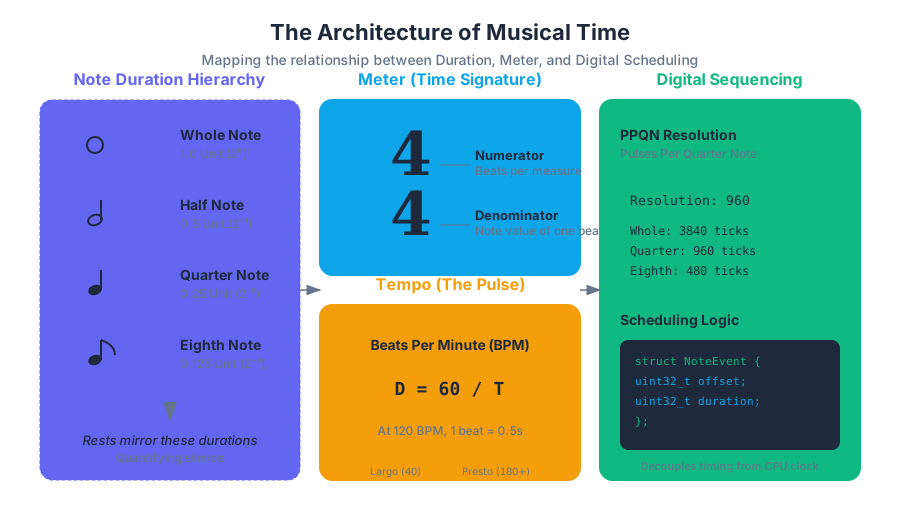
In digital audio workstations (DAWs) or embedded musical systems, duration is often handled via "ticks" or "pulses per quarter note" (PPQN). This allows for high-resolution timing that remains decoupled from the CPU clock.
// A low-level representation of a rhythmic event in a C++ sequencer
#include <stdint.h>

typedef struct {
    uint32_t tick_offset;   // Time since start of sequence in PPQN
    uint32_t duration;      // Length of note in PPQN
    uint8_t  pitch;         // MIDI pitch (0-127)
    uint8_t  velocity;      // Amplitude/Force (0-127)
} NoteEvent;

// Example: Scheduling a Quarter Note at 960 PPQN
// If the resolution is 960 ticks per quarter note:
// Whole Note = 3840 ticks
// Quarter Note = 960 ticks
// Eighth Note = 480 ticks

void schedule_pattern(NoteEvent* buffer) {
    // Note 1: Quarter note at the start
    buffer[0] = { .tick_offset = 0, .duration = 960, .pitch = 60, .velocity = 100 };

    // Note 2: Two eighth notes following
    buffer[1] = { .tick_offset = 960, .duration = 480, .pitch = 62, .velocity = 90 };
    buffer[2] = { .tick_offset = 1440, .duration = 480, .pitch = 64, .velocity = 90 };
}
The Architecture of Silence: Rests
Music is as much about the absence of sound as it is about its presence. Rests are symbols used to indicate specific durations of silence. They follow the exact same hierarchical logic as note values.
Why Rests Matter
Rests provide the "breath" in a musical phrase. In vocal music, they indicate where a singer should inhale; in instrumental music, they provide the necessary separation (articulation) that allows a melody to be perceived as a series of distinct ideas rather than a continuous drone.
| Rest Type | Symbol Equivalent | Duration (in 4/4) | Visual Description |
|---|---|---|---|
| Whole Rest | Whole Note | 4 Beats | Hangs below the 4th staff line |
| Half Rest | Half Note | 2 Beats | Sits above the 3rd staff line |
| Quarter Rest | Quarter Note | 1 Beat | A squiggly vertical line |
| Eighth Rest | Eighth Note | 0.5 Beats | A diagonal stroke with one flag |
| Sixteenth Rest | Sixteenth Note | 0.25 Beats | A diagonal stroke with two flags |
The Pulse: Beats and Tempo
The beat is the basic unit of time in music—the underlying pulse that listeners tap their feet to. While rhythm can be irregular and syncopated, the beat is typically isochronous (evenly spaced).
Tempo: The Speed of the Pulse
Tempo defines the frequency of the beat, usually measured in Beats Per Minute (BPM).
The Tempo Formula To calculate the duration ($D$) of a single beat in seconds given a tempo ($T$) in BPM: $$D = \frac{60}{T}$$ For example, at 120 BPM, each beat lasts exactly $0.5$ seconds.
Common Tempo Markings
Historically, composers used Italian terms to describe tempo, which provide both a speed and a "mood" or character.
| Term | Meaning | Approximate BPM |
|---|---|---|
| Largo | Broad, very slow | 40–60 |
| Adagio | Slow, at ease | 66–76 |
| Andante | At a walking pace | 76–108 |
| Moderato | Moderately | 108–120 |
| Allegro | Fast, quickly, bright | 120–168 |
| Presto | Very, very fast | 168–200+ |
Meter: The Organization of Beats
Meter is the grouping of beats into regular patterns of strong and weak pulses. This grouping creates a sense of "measure" or "bar" in music.
Time Signatures
Meter is denoted by a time signature at the beginning of a piece. It consists of two numbers stacked vertically:
- Top Number (Numerator): Indicates how many beats are in each measure.
- Bottom Number (Denominator): Indicates which note value receives one beat.
Classification of Meters
Meters are classified by the number of beats per measure:
- Duple Meter: Two beats per measure (Strong-weak). Example: 2/4.
- Triple Meter: Three beats per measure (Strong-weak-weak). Example: 3/4 (Waltz).
- Quadruple Meter: Four beats per measure (Strong-weak-less strong-weak). Example: 4/4 (Common time).
Simple vs. Compound Meter
- Simple Meter: The beat is subdivided into two equal parts (e.g., a quarter note divides into two eighth notes).
- Compound Meter: The beat is subdivided into three equal parts (e.g., a dotted quarter note divides into three eighth notes). 6/8 is the most common compound meter.
\text{Simple Quadruple (4/4): } \underbrace{\bullet \circ}_{\text{Beat 1}} \underbrace{\bullet \circ}_{\text{Beat 2}} \underbrace{\bullet \circ}_{\text{Beat 3}} \underbrace{\bullet \circ}_{\text{Beat 4}}
\\
\text{Compound Duple (6/8): } \underbrace{\bullet \circ \circ}_{\text{Beat 1}} \underbrace{\bullet \circ \circ}_{\text{Beat 2}}
Advanced Rhythmic Concepts: Beyond the Grid
While the basic hierarchy covers most Western music, advanced rhythm involves breaking or stretching the grid.
1. Tuplets (Triplets, Quintuplets)
A tuplet is a rhythm that plays a certain number of notes in the time usually occupied by a different number of notes. The most common is the triplet, where three notes are played in the space of two.
2. Syncopation
Syncopation involves placing emphasis (accents) on the "off-beats" or weak parts of the pulse. This creates a sense of surprise and drive, foundational to Jazz, Funk, and Afro-Cuban music.
3. Polyrhythm
A polyrhythm occurs when two different rhythmic subdivisions happen simultaneously. A "3 against 2" polyrhythm features one part playing triplets while another plays eighth notes over the same duration.
Rhythmic Analysis: A Worked Example
Consider a measure of 4/4 time containing:
- One Quarter Note (Beat 1)
- Two Eighth Notes (Beat 2)
- One Quarter Rest (Beat 3)
- Four Sixteenth Notes (Beat 4)
Derivation of Total Duration:
- Beat 1: $1 \times 0.25 = 0.25$
- Beat 2: $2 \times 0.125 = 0.25$
- Beat 3: $1 \times 0.25 = 0.25$ (Silence)
- Beat 4: $4 \times 0.0625 = 0.25$ Total: $0.25 + 0.25 + 0.25 + 0.25 = 1.0$ (One full measure)
Computational Analysis with Python
Using the music21 library, we can programmatically analyze the rhythmic density of a score.
from music21 import stream, note, meter

# Create a stream (a container for musical elements)
s = stream.Stream()
s.append(meter.TimeSignature('4/4'))

# Add the notes from our worked example
s.append(note.Note('C4', quarterLength=1.0))  # Quarter note
s.append(note.Note('D4', quarterLength=0.5))  # Eighth note
s.append(note.Note('E4', quarterLength=0.5))  # Eighth note
s.append(note.Rest(quarterLength=1.0))        # Quarter rest
s.append(note.Note('F4', quarterLength=0.25)) # 4 Sixteenths
s.append(note.Note('G4', quarterLength=0.25))
s.append(note.Note('A4', quarterLength=0.25))
s.append(note.Note('B4', quarterLength=0.25))

# Calculate total duration in quarter notes
total_duration = s.duration.quarterLength
print(f"Total measure duration: {total_duration} quarter notes")

# Check for rhythmic offset of the last note
last_note = s.notes[-1]
print(f"The last note starts at offset: {last_note.offset}")
Common Pitfalls and Misconceptions
- Confusing Rhythm with Meter: Rhythm is the specific pattern of long and short sounds. Meter is the theoretical grid those sounds sit on. You can play many different rhythms within the same meter.
- The "6/8 vs 3/4" Fallacy: Both time signatures contain six eighth notes. However, 3/4 is Simple Triple (3 beats of 2 eighths each: 1-and-2-and-3-and), while 6/8 is Compound Duple (2 beats of 3 eighths each: 1-and-a-2-and-a). Mixing these up changes the "feel" or "lilt" of the music entirely.
- Ignoring the Tactus: The tactus is the perceived level of the beat. Beginners often focus on the smallest note value (the sixteenth notes) and lose track of the larger pulse (the quarter note). Always practice with a metronome to internalize the tactus.
- Quantization Errors: In digital production, "quantizing" snaps notes to a perfect grid. While this fixes timing errors, it can remove the "human" element—the micro-variations in timing (rubato) that give music its emotional resonance.
Time Signatures and Conducting
Key concepts: Time Signature · Simple vs. Compound Meter · Conducting Patterns · Syncopation
Notating meter and the role of the conductor in directing musical ensembles.
Time Signatures and Conducting
Overview
This section covers how we write down meter and how a conductor communicates that meter to an orchestra or choir.
Key Concepts
- Time Signature: Two numbers at the start of a piece. The top number tells you how many beats are in a measure; the bottom tells you which note value gets the beat.
- Simple Meter: Beats are subdivided into two (e.g., 2/4, 3/4, 4/4).
- Compound Meter: Beats are subdivided into three (e.g., 6/8, 9/8).
- Conducting: The art of using non-verbal gestures to set tempo and unify performers. Common patterns include Duple (down-up), Triple (down-right-up), and Quadruple (down-left-right-up).
- Syncopation: Deliberately upsetting the normal pulse by accenting 'off-beats'.
Musical Texture
Key concepts: Monophony · Homophony · Polyphony · Heterophony · Counterpoint
The layers of sound in a piece and how they interact with one another.
Musical Texture
Musical texture is the specific manner in which melodic, rhythmic, and harmonic materials are combined in a composition, determining the overall quality of the sound and the "density" of the musical fabric. If melody is the horizontal thread and harmony is the vertical stack, texture is the resulting weave. In technical terms, texture describes the relationship between various layers of a musical ensemble: how many layers exist, what their individual functions are, and how they interact with one another.
Understanding texture is critical for both analysis and composition because it dictates how a listener’s attention is partitioned. A dense polyphonic texture requires the brain to track multiple independent streams, whereas a homophonic texture allows the listener to focus on a singular "lead" while processing the accompaniment as a unified background.
The Dimensionality of Texture
Texture is often analyzed through two primary axes:
- The Horizontal Axis (Linearity): The independence and movement of individual melodic lines over time.
- The Vertical Axis (Density): The simultaneous occurrence of different pitches and the harmonic thickness created by chords.
| Texture Type | Number of Voices | Relationship Between Voices | Primary Focus |
|---|---|---|---|
| Monophony | One | N/A (Single line) | Pure Melodic Line |
| Homophony | Multiple | Subordinate (Melody + Support) | Vertical Harmony / Lead Melody |
| Polyphony | Multiple | Independent (Interweaving lines) | Horizontal Interaction |
| Heterophony | Multiple | Variations of the same line | Ornamental Detail |
Monophony: The Singular Line
Monophony is the simplest musical texture, consisting of a single melodic line without any accompaniment or harmonic support. The term is derived from the Greek mono (one) and phōnē (sound/voice).
Mechanics and Characteristics
In a monophonic texture, every performer plays or sings the exact same pitches and rhythms. It is important to note that monophony is not limited to a solo performer. A choir of 100 people singing the same melody in unison—or in octaves—is still considered monophonic.
Definition: Monophony is a texture comprising a single, unaccompanied melodic line. Doubling at the octave does not change the texture to polyphony, as the melodic content remains functionally identical.
Historical and Cultural Context
- Gregorian Chant: The foundational music of the Western Christian Church was almost exclusively monophonic for centuries.
- Traditional Folk Music: Many indigenous singing traditions rely on pure monophony to emphasize the narrative of the lyrics.
- Solo Instruments: A solo flute or cello suite (like those by J.S. Bach) often utilizes monophony, though they may use "implied harmony" by arpeggiating chords quickly.
Common Pitfalls
A common mistake is assuming that "one instrument" equals monophony. A piano playing a melody with the right hand and chords with the left is homophonic, not monophonic, because there are multiple distinct pitches sounding simultaneously to create harmony.
Homophony: Melody and Support
Homophony is the most prevalent texture in Western music, particularly in Classical, Pop, Rock, and Jazz. It features one clear, dominant melodic line (the "tune") supported by an accompaniment that provides harmonic context.
The Hierarchy of Voices
In homophony, there is a clear distinction between the primary voice and the subordinate voices. The accompaniment's role is to fill out the harmony using triads, seventh chords, and other vertical structures, often following the "Tertian" (built on thirds) system.
Sub-types of Homophony
- Melody-Dominated Homophony: A distinct melody with a rhythmically different accompaniment (e.g., a singer with a strumming guitar).
- Homorhythm (Chorale Texture): All voices move with the same, or very similar, rhythm. This creates a "block chord" effect. This is common in church hymns and barbershop quartets.
| Parameter | Melody-Dominated | Homorhythmic (Chorale) |
|---|---|---|
| Rhythmic Independence | High (Melody differs from backing) | Low (All voices move together) |
| Focus | Linear (The "Lead") | Vertical (The "Chord") |
| Typical Example | Pop Song / Violin Concerto | Protestant Hymn |
Implementation: Harmonic Support in Code
To represent homophony computationally, we often define a lead melody and a set of chordal transformations that provide the "vertical" support.
# Low-level representation of Homophonic Texture Generation
# Goal: Generate a triad accompaniment for a given melody note

def generate_homophonic_support(melody_pitch, scale, style='triad'):
    """
    Given a melody pitch, returns a list of pitches forming a chordal support.
    Assumes melody_pitch is an integer (MIDI note).
    """
    root_index = scale.index(melody_pitch % 12)

    if style == 'triad':
        # Simple tertian harmony: Root, 3rd, 5th
        chord = [
            scale[root_index],
            scale[(root_index + 2) % len(scale)],
            scale[(root_index + 4) % len(scale)]
        ]
    elif style == 'seventh':
        # Extended tension: Root, 3rd, 5th, 7th
        chord = [
            scale[root_index],
            scale[(root_index + 2) % len(scale)],
            scale[(root_index + 4) % len(scale)],
            scale[(root_index + 6) % len(scale)]
        ]

    return chord

# Example: Melody note C (60) in C Major Scale
c_major = [0, 2, 4, 5, 7, 9, 11]
print(f"Accompaniment for C: {generate_homophonic_support(0, c_major)}")
Polyphony: The Independent Weave
Polyphony (Greek for "many sounds") occurs when two or more independent melodic lines are sounded simultaneously. Unlike homophony, there is no single "lead" voice; instead, the interest is distributed across multiple layers that compete for the listener's attention.
Imitative vs. Non-Imitative Polyphony
- Imitative Polyphony: A melodic idea is presented in one voice and then restated (imitated) by another voice shortly after. The most rigid form is a Canon or Round (e.g., "Row, Row, Row Your Boat"). The most complex form is the Fugue.
- Non-Imitative Polyphony: The simultaneous voices are completely different in melody and rhythm (e.g., the "Jazz New Orleans" style where the trumpet, clarinet, and trombone all improvise different lines at once).
The Mechanics of Counterpoint
The technical discipline used to create polyphony is called Counterpoint (from punctus contra punctum, "point against point"). It involves the relationship between voices that are harmonically interdependent yet independent in rhythm and contour.
The Golden Rule of Polyphony: Each voice must be a satisfying melody in its own right, while the vertical intervals created between them must remain consonant according to the prevailing harmonic rules.
Mathematical Representation of a Canon
A canon can be viewed as a time-shifted transformation of a single function. If $M(t)$ is the melody at time $t$, a two-voice canon can be represented as:
S(t) = M(t) + M(t - \delta)
Where:
- $S(t)$ is the resulting polyphonic signal.
- $M(t)$ is the original melody.
- $\delta$ is the time delay (the "offset") at which the second voice enters.
- In more complex canons, the second voice might be transformed by frequency (transposition) or time-reversal (retrograde).
Counterpoint: The Engine of Polyphony
While "polyphony" describes the resulting texture, counterpoint is the active technique of composition. In Western music theory, this is often taught through "Species Counterpoint," a system developed by Johann Joseph Fux in his 1725 treatise Gradus ad Parnassum.
The Five Species of Counterpoint
To master the independence of lines, students progress through levels of rhythmic complexity:
| Species | Description | Rhythmic Ratio (Cantus Firmus : Counterpoint) |
|---|---|---|
| 1st Species | Note-against-note | 1:1 |
| 2nd Species | Two notes against one | 1:2 |
| 3rd Species | Four notes against one | 1:4 |
| 4th Species | Syncopation / Suspensions | Tied notes creating tension/resolution |
| 5th Species | Florid Counterpoint | A mix of all the above |
Real-World Usage: LilyPond Notation
To visualize polyphony, composers use notation software. Below is an example of how two independent voices are encoded in LilyPond, a common tool for high-quality music engraving.
\version "2.22.1"

\score {
  \new Staff <<
    % Voice 1: High, moving in quarters
    \new Voice = "upper" {
      \voiceOne
      \relative c'' {
        g4 a b c | d2 b |
      }
    }
    % Voice 2: Low, moving in halves (Counterpoint)
    \new Voice = "lower" {
      \voiceTwo
      \relative c' {
        e2 d | g,1 |
      }
    }
  >>
  \layout { }
}
Heterophony: Variation in Unison
Heterophony is a texture where multiple performers sing or play the same melody, but with simultaneous variations. While one performer plays the "plain" version of the tune, another might add ornaments, trills, or slight rhythmic shifts.
Characteristics
- Non-Western Prevalence: It is a hallmark of Middle Eastern, Native American, and South Asian musical traditions.
- Accidental vs. Intentional: In some folk traditions, heterophony arises naturally because different performers have slightly different "versions" of a song in their memory.
- Complexity: It creates a "blurred" or "thickened" melodic line that is more complex than monophony but lacks the distinct harmonic layers of homophony.
Synthesis: Comparing Textures in Context
A single piece of music rarely stays in one texture. Composers use textural change to create drama and structural boundaries.
Example: Handel's "Hallelujah Chorus"
- Homophony: The opening "Hallelujah" is block chords (homorhythmic).
- Monophony: "For the Lord God Omnipotent reigneth" is often sung in unison.
- Polyphony: When different sections of the choir sing different phrases ("And He shall reign...") simultaneously, the texture becomes imitative polyphony.
Textural Density and Complexity
The "thickness" of a texture is determined by:
- Range: The distance between the lowest and highest notes.
- Spacing: How far apart the individual voices are.
- Timbre: The variety of instruments used (a brass quintet sounds "thicker" than a string quintet).
| Texture | Cognitive Load | Structural Function |
|---|---|---|
| Monophony | Low | Clarity, focus, introduction, or starkness. |
| Homophony | Medium | Emotional expression, storytelling (lyrics), stability. |
| Polyphony | High | Development, climax, intellectual complexity. |
| Heterophony | Medium-High | Ornamentation, communal expression, ritual. |
Common Pitfalls and Misconceptions
- Confusing Polyphony with Harmony: Harmony is a component of texture. You can have harmony in homophony (chords) and polyphony (intervals between lines). The difference is in the independence of the lines.
- Octaves and Monophony: Beginners often think that if men and women sing together, it is not monophony. If they are singing the same melody, even an octave apart, it is still monophonic because they are not creating independent melodic or harmonic parts.
- The "Accompaniment" Trap: Not all accompaniment is homophonic. If a piano plays a complex, independent melody against a singer, the texture is actually polyphonic. If the piano just plays chords, it is homophonic.
Summary of Musical Organization
Texture is the final layer of musical organization that brings melody, harmony, and rhythm together. By manipulating the number of voices and their relationships, composers control the listener's focus, moving from the stark clarity of monophony to the lush support of homophony and the intricate clockwork of polyphony.
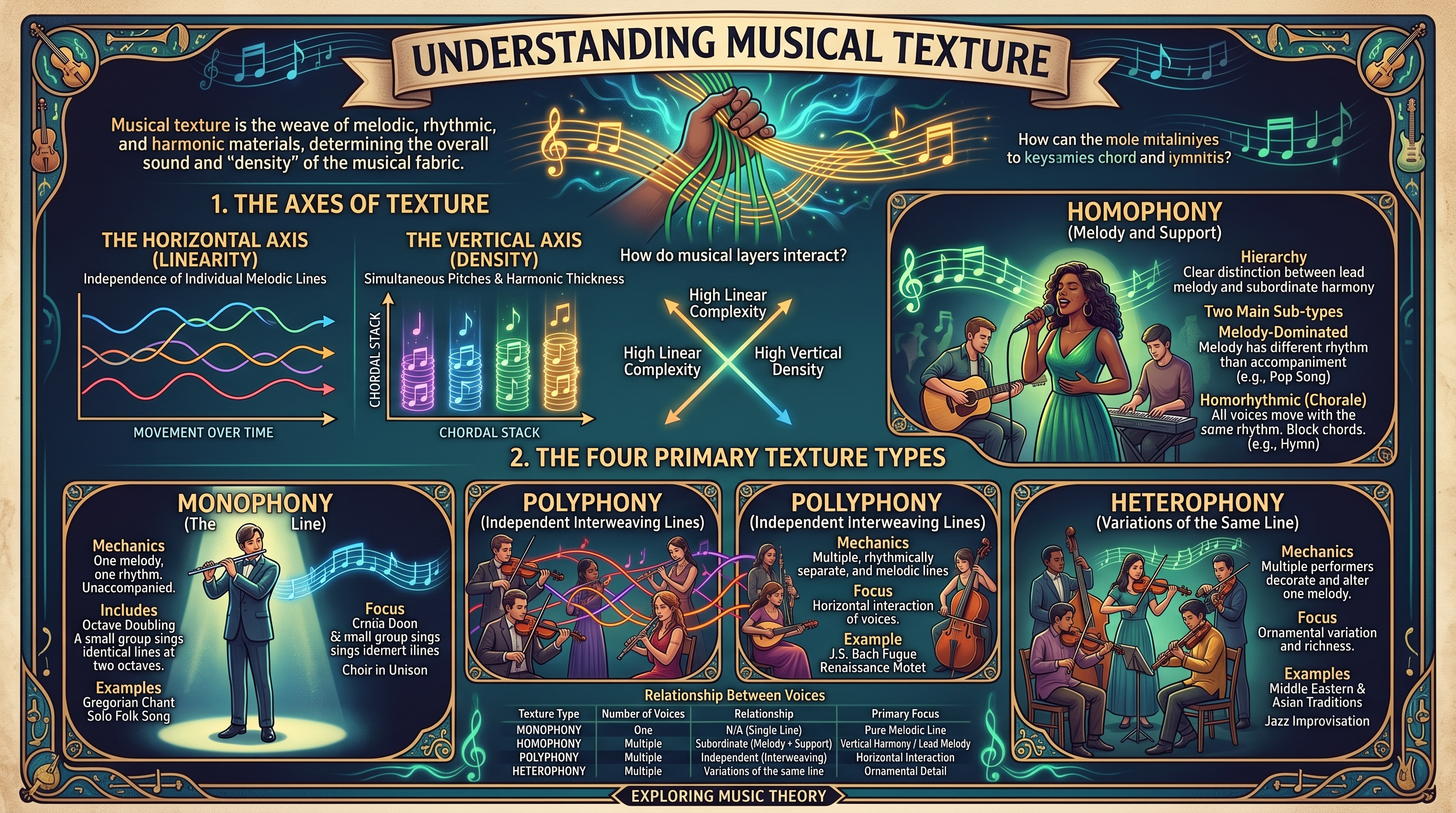
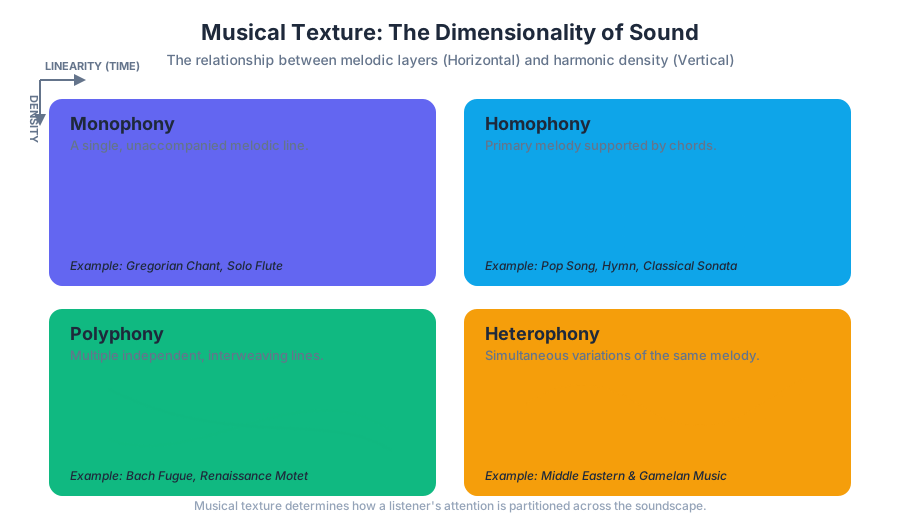
Musical Form and Phrasing
Key concepts: Musical Form · Strophic Form · Rondo · Antecedent and Consequent · Period
The structural blueprint of music, from small phrases to large-scale organization.
Musical Form and Phrasing
In the study of musicology and composition, Musical Form represents the architectural blueprint of a piece—the "big picture" organization that governs how a listener perceives time. While melody and harmony provide the immediate sensory data, form provides the cognitive framework that allows a listener to make sense of repetition, contrast, and variation. Without form, music remains a stream of consciousness; with form, it becomes a structured narrative.
At its most granular level, form is built from Phrases, which are organized into Periods, which in turn aggregate into larger sections labeled by letters (A, B, C). This hierarchical system allows for the creation of everything from a simple four-chord folk song to a complex mahlerian symphony.
Phrasing: The Syntax of Music
A Phrase is the smallest complete musical thought. Much like a sentence in prose, a phrase has a beginning, a middle, and an end. It is defined not just by its melodic content, but by its Cadence—the point of arrival or rest that signals the conclusion of the thought.
Melodic Contour and Motion
The internal logic of a phrase is often defined by its Contour (the shape of the melody) and its Motion.
- Conjunct Motion: The melody moves by small, stepwise intervals (e.g., C to D). This creates a smooth, lyrical feel.
- Disjunct Motion: The melody moves by large leaps (e.g., C to G). This creates a sense of tension or drama.
- Range: The distance between the lowest and highest notes. A Narrow Range is typical of folk songs, while a Wide Range is common in operatic arias.
Antecedent and Consequent
In Western classical music, phrases rarely exist in isolation. They are typically paired in a "call and response" relationship known as Antecedent and Consequent.
Definition: The Antecedent is the "questioning" phrase, usually ending on a weak or "open" cadence (like a Half Cadence). The Consequent is the "answering" phrase, which resolves the tension by ending on a strong or "closed" cadence (like an Authentic Cadence).
| Feature | Antecedent Phrase | Consequent Phrase |
|---|---|---|
| Function | Proposes a musical idea; creates tension. | Completes the idea; resolves tension. |
| Harmonic Goal | Often ends on the Dominant (V) chord. | Ends on the Tonic (I) chord. |
| Punctuation | Half Cadence (Comma). | Authentic Cadence (Period). |
| Listener Expectation | Expectation of continuation. | Sense of finality or arrival. |
Implementation: Algorithmic Phrase Detection
In computational musicology, identifying phrases often involves analyzing "local boundary markers" such as long note durations or rests.
import numpy as np

def detect_phrase_boundaries(midi_data, threshold_ratio=2.0):
    """
    Detects potential phrase boundaries in a sequence of MIDI notes
    based on the Inter-Onset Interval (IOI) and duration.
    """
    boundaries = []
    durations = [n.duration for n in midi_data]
    intervals = [midi_data[i+1].start - midi_data[i].start for i in range(len(midi_data)-1)]

    avg_duration = np.mean(durations)

    for i, interval in enumerate(intervals):
        # If the gap between notes is significantly larger than the average note duration,
        # or if the current note is held significantly longer, mark as boundary.
        if interval > (avg_duration * threshold_ratio) or durations[i] > (avg_duration * threshold_ratio):
            boundaries.append({
                "index": i,
                "timestamp": midi_data[i].end,
                "type": "Cadential Pause"
            })

    return boundaries

# Example usage:
# phrases = detect_phrase_boundaries(sonata_k331_theme)
The Period: Structural Symmetry
When an antecedent and a consequent phrase are joined together, they form a Period. The period is the fundamental building block of "Classical" style, providing a sense of balance and symmetry.
Types of Periods
- Parallel Period: The two phrases begin with the same or very similar melodic material. If the first phrase is
a, the second isa'. - Contrasting Period: The two phrases are melodically distinct. If the first phrase is
a, the second isb. - Double Period: A larger structure consisting of four phrases, where the first two act as a large antecedent and the last two act as a large consequent.
Cadential Hierarchy
The integrity of a period depends on the Cadential Hierarchy. For a period to be perceived as a single unit, the final cadence of the second phrase must be stronger than the cadence of the first phrase. If the first phrase ends on a Perfect Authentic Cadence (PAC), the second phrase cannot "resolve" it further, and the sense of a two-phrase unit is lost.
| Period Type | Phrase 1 Cadence | Phrase 2 Cadence | Melodic Relationship |
|---|---|---|---|
| Parallel | Half Cadence (HC) | Perfect Authentic (PAC) | Similar (a, a') |
| Contrasting | Half Cadence (HC) | Perfect Authentic (PAC) | Different (a, b) |
| Interrupted | PAC in new key | PAC in home key | Variable |
Sectional Forms: The Architecture of Repetition
Once we move beyond the phrase and period, we enter the realm of Sectional Form. These are the structures used to organize entire movements or songs. We use capital letters (A, B, C) to denote these large sections.
Strophic Form (AAA...)
Strophic Form is the simplest structural design. In this form, the same music is repeated for every stanza of text. While the lyrics change, the melody, harmony, and rhythm remain constant.
- Usage: Hymns, folk songs, and most "verse-only" popular music.
- Pros: Highly memorable; focuses the listener's attention on the text.
- Cons: Can become monotonous if the melody is not sufficiently engaging.
Binary Form (AB)
Binary Form consists of two contrasting sections.
- Section A: Usually moves from the tonic to a related key (like the dominant).
- Section B: Usually moves back to the tonic.
In many Baroque dances (Allemande, Courante), both sections are repeated:
||: A :||: B :||.
Ternary Form (ABA)
Ternary Form introduces the concept of Statement, Contrast, and Return.
- A: The initial statement.
- B: A contrasting section (different key, mood, or texture).
- A: A return to the original material, providing closure.
Key Insight: The return of 'A' in Ternary form is psychologically powerful. It satisfies the listener's desire for symmetry and resolution, a principle that underpins almost all Western art music.
Formal Grammar Representation
We can represent these structures using a formal grammar (Backus-Naur Form) to show the recursive nature of musical organization.
<piece>         ::= <strophic> | <binary> | <ternary> | <rondo>
<strophic>      ::= <section_A> <strophic> | <section_A>
<binary>        ::= <section_A> <section_B>
<ternary>       ::= <section_A> <section_B> <section_A_prime>
<rondo_5_part>  ::= <section_A> <section_B> <section_A> <section_C> <section_A>

<section_A>     ::= <period> | <phrase_group>
<period>        ::= <antecedent> <consequent>
<antecedent>    ::= <motive> <half_cadence>
<consequent>    ::= <motive_variant> <authentic_cadence>
Rondo Form: The Principle of the Refrain
The Rondo is a form characterized by a recurring main theme (the Refrain) that alternates with contrasting episodes. It is often described as a "musical sandwich" where the bread (A) keeps coming back.
Structure of a Rondo
The most common patterns are:
- 5-Part Rondo: A B A C A
- 7-Part Rondo: A B A C A B A (also known as the Sonata-Rondo)
The A section (Refrain) is typically in the tonic key and is tuneful and easily recognizable. The B and C sections (Episodes) explore different keys and often feature more virtuosic or developmental material.
| Element | Role | Key Characteristics |
|---|---|---|
| Refrain (A) | The "Home Base" | Tonic key, catchy melody, stable structure. |
| Episode (B) | First Contrast | Usually in a closely related key (Dominant or Relative Major). |
| Episode (C) | Second Contrast | Often more dramatic, distant key, or rhythmic shift. |
| Transitions | The "Glue" | Lead the listener from the Refrain to the Episode. |
| Retransition | The "Return" | Specifically designed to prepare the return of the Tonic for the Refrain. |
Real-World Example: Beethoven’s "Für Elise"
"Für Elise" is a classic example of a Five-part Rondo (A B A C A).
- A: The famous main theme in A minor.
- B: A brighter, more playful section in F major.
- A: Return of the main theme.
- C: A stormy, agitated section with repeated bass notes.
- A: Final return of the main theme.
Implementation: Rondo Structure in ABC Notation
ABC notation is a shorthand for rendering music. A Rondo can be structured using part labels.
% Example of a Rondo Structure in ABC Notation
X:1
T:Simple Rondo Example
M:4/4
L:1/8
P:ABACA
K:C
%%partname A
P:A
|: "C"c2 G2 E2 G2 | "G7"F2 D2 "C"C4 :|
%%partname B
P:B
| "G"d2 d2 B2 d2 | "D7"c2 A2 "G"G4 | "G7"F2 D2 B2 d2 | "G7"g4 G4 |
%%partname A
P:A
| "C"c2 G2 E2 G2 | "G7"F2 D2 "C"C4 |
%%partname C
P:C
| "Am"A2 e2 c2 e2 | "E7"^G2 e2 B2 e2 | "Am"A2 e2 c2 e2 | "E7"E4 A4 |
%%partname A
P:A
| "C"c2 G2 E2 G2 | "G7"F2 D2 "C"C4 |]
Motive, Theme, and Leitmotif
While phrasing deals with the length of musical thoughts, Thematic Development deals with the "characters" within those thoughts.
- Motive: The smallest identifiable musical fragment. It can be a rhythmic pattern, a melodic interval, or both. Think of the four-note opening of Beethoven's 5th Symphony (Short-Short-Short-Long).
- Theme: A longer musical idea, often a full phrase or period, that serves as the basis for a composition.
- Leitmotif: A motive or theme associated with a specific person, object, idea, or emotion. This is a core technique in Wagnerian opera and modern film scoring (e.g., John Williams' Star Wars themes).
Variation Techniques
How do composers keep a form interesting? They vary the motives.
- Inversion: Turning the melody upside down.
- Retrograde: Playing the melody backwards.
- Augmentation: Doubling the note values (slowing it down).
- Diminution: Halving the note values (speeding it up).
- Fragmentation: Using only a small piece of the original motive.
Common Pitfalls in Analyzing Form
- Confusing "Section" with "Phrase": A section is a large-scale division (like a verse or chorus), while a phrase is a single "sentence" within that section.
- Ignoring the Cadence: You cannot determine the end of a phrase by counting measures alone. You must listen for the harmonic arrival. Some phrases are 3 measures long; others are 9.
- Over-reliance on Letters: While
ABAis a helpful shorthand, music is fluid. Sometimes a section is "A-ish" but has changed so much it might as well beC. Context matters. - The "Ternary vs. Rounded Binary" Trap: In Rounded Binary (
||: A :||: B A' :||), the return of A happens within the second repeated section. In true Ternary (A B A), the sections are usually more independent and self-contained.
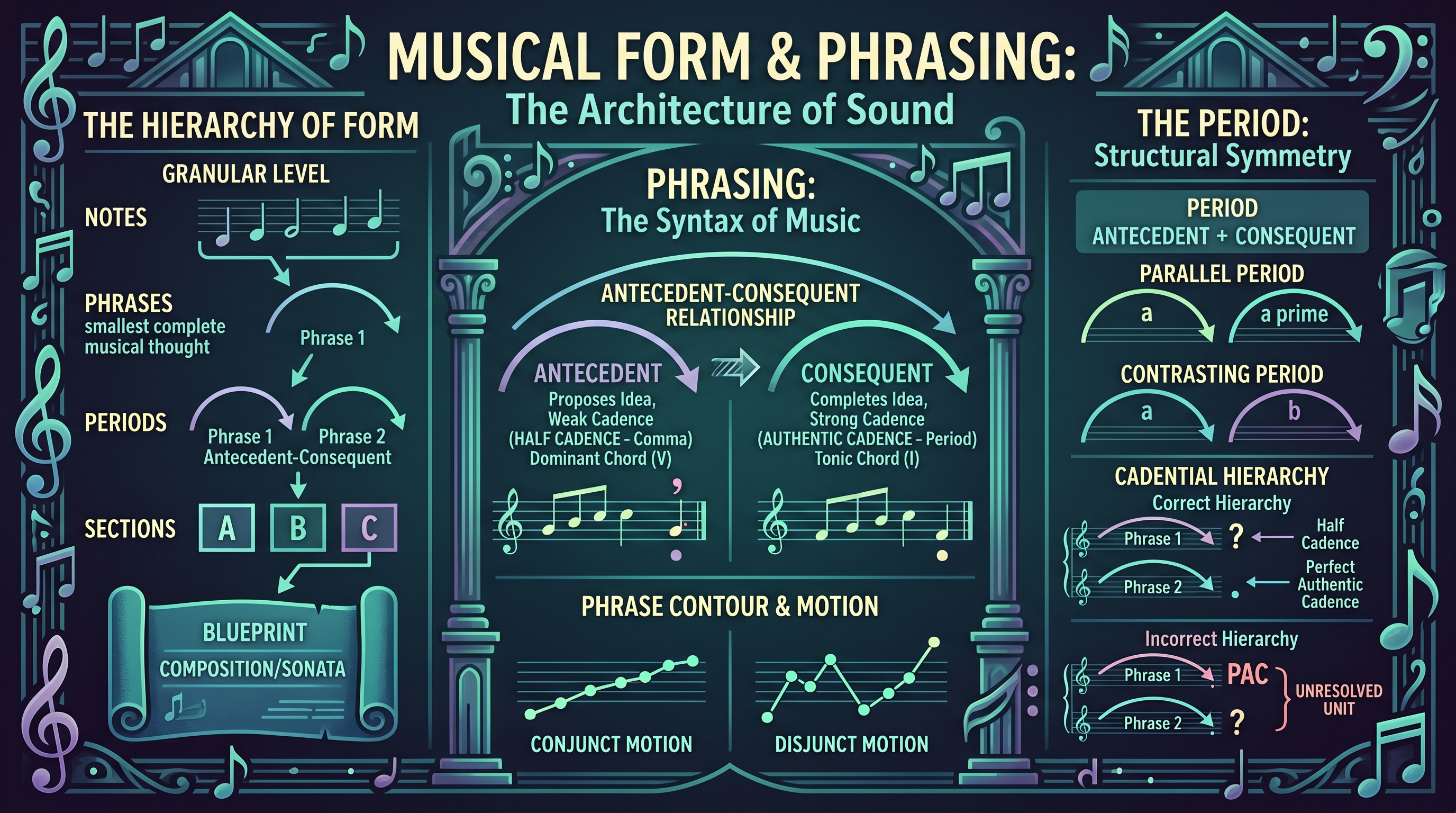

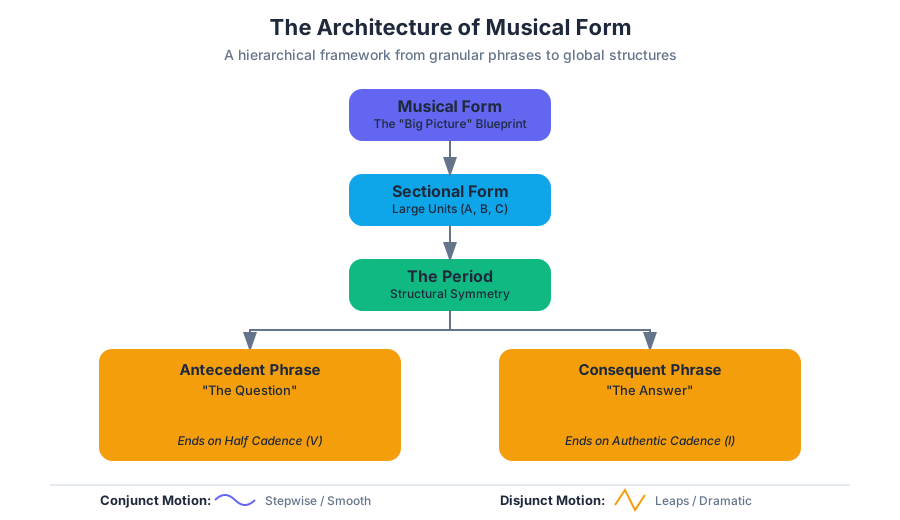
Motifs and Theme & Variations
Key concepts: Motif (Motive) · Leitmotif · Theme and Variations · Musical Development
How small musical ideas are developed and varied throughout a composition.
Motifs and Theme & Variations: The Architecture of Musical Development
In the study of musicology and composition, the transition from a simple sequence of notes to a coherent, large-scale masterpiece is governed by the principles of Musical Development. While melody and harmony provide the "colors" and "textures" of a piece, the Motif and the Theme and Variations form provide the "blueprint" and "engineering" required to sustain a listener's interest over time.
At its core, musical development is the process of taking a singular musical idea—a "seed"—and subjecting it to various transformations to explore its full potential. This section explores the hierarchy of musical units, the psychological power of recurring symbols, and the formal structures that allow a single theme to wear a thousand different masks.
The Motif (Motive): The Atomic Unit of Composition
A Motif (or motive) is the smallest recognizable structural unit in music. It is a short musical fragment—often just a few notes or a distinct rhythmic pattern—that retains its identity even when modified.
What it is
Technically, a motif must possess a distinct contour (the shape of its melody) and a specific rhythmic profile. While a melody is a complete "sentence," a motif is a "word" or even a "syllable."
Definition: A Motif is a recurring fragment or successive sequence of notes that has symbolic importance in or is characteristic of a composition. It is the "DNA" of a musical work.
Why it matters
Motifs provide unity and economy. Instead of writing five minutes of entirely new material, a composer like Beethoven can build an entire movement out of a four-note motif. This creates a sense of "organic growth," where the music feels like it is evolving naturally from a single source.
How it works: The Anatomy of a Motif
A motif is defined by three primary vectors:
- Intervalic Content: The specific distance between the pitches (e.g., a perfect fifth followed by a minor second).
- Rhythmic Identity: The pattern of durations (e.g., short-short-short-long).
- Harmonic Context: The underlying chordal structure that gives the pitches their "tension" or "resolution."
| Feature | Description | Example (Beethoven's 5th) |
|---|---|---|
| Pitch Contour | The "shape" of the notes (up, down, static). | Three repeated notes, then a drop of a major third. |
| Rhythmic Cell | The smallest unit of time organization. | $\delta \delta \delta \text{--} \eta$ (Three eighths and a half note). |
| Harmonic Implication | The suggested tonality. | Implies C Minor, though the first four notes are tonally ambiguous. |
| Developmental Potential | How easily it can be changed. | High; can be inverted, stretched, or layered. |
The Leitmotif: Music as Narrative Symbol
While all leitmotifs are motifs, not all motifs are leitmotifs. The Leitmotif (leading motive) is a functional evolution of the motif, popularized by Richard Wagner in his "Ring Cycle" operas.
What it is
A Leitmotif is a recurring musical theme associated with a specific person, object, place, or abstract idea. It functions as a "musical label." When the audience hears the "Sword Motif," they think of the physical sword, even if it isn't visible on stage.
How it works: Semantic Association
The power of the leitmotif lies in the brain's ability to form associative memories.
- Initial Presentation: The motif is played while the character/object is introduced.
- Transformation: As the character changes (e.g., becomes corrupted or heroic), the leitmotif is altered (e.g., shifted from a Major scale to a Chromatic or Minor scale).
- Subconscious Cueing: The leitmotif can be played softly in the background to suggest a character's thoughts or a hidden presence.
Concrete Example: Modern Film Scoring
John Williams' score for Star Wars is the most famous modern application of leitmotifs.
- The Force Theme: A yearning, ascending melody in a minor key that suggests destiny and mystery.
- Imperial March: A rigid, disjunct, and rhythmically driving motif that represents Darth Vader and the mechanical nature of the Empire.
Musical Development: The "Evolutionary" Algorithm
Musical Development is the engine that drives a motif forward. Composers use a specific set of "operations" to transform a motif while keeping it recognizable to the listener.
Transformation Techniques
| Technique | Description | Mathematical/Logical Analogy |
|---|---|---|
| Repetition | Playing the motif again at the same pitch. | $f(x) = x$ |
| Sequence | Repeating the motif at a higher or lower pitch level. | $f(x) = x + n$ |
| Inversion | Flipping the motif upside down (intervals move in the opposite direction). | $f(x) = -x$ |
| Retrograde | Playing the motif backward. | $f(x) = x_{reverse}$ |
| Augmentation | Stretching the rhythms (e.g., doubling the length of every note). | $f(t) = 2t$ |
| Diminution | Compressing the rhythms (e.g., halving the length of every note). | $f(t) = 0.5t$ |
| Fragmentation | Using only a small piece of the original motif. | $f(x) = x[0:2]$ |
Implementation: Pitch-Class Inversion Algorithm
In modern music theory and computational musicology, we can represent these transformations as operations on a set of integers (where C=0, C#=1, etc.).
def invert_motif(pitches, axis):
    """
    Inverts a musical motif around a specific pitch axis.
    pitches: List of integers representing pitch classes (0-11)
    axis: The pitch class to invert around (e.g., 6 for F#)
    """
    inverted = []
    for p in pitches:
        # The formula for inversion is: (Axis * 2 - Pitch) % 12
        new_pitch = (axis * 2 - p) % 12
        inverted.append(new_pitch)
    return inverted

# Example: A simple "Major Third" motif [0, 4] (C to E)
# Inverted around C (0)
original_motif = [0, 4, 7] # C Major Triad
inverted_motif = invert_motif(original_motif, 0)

print(f"Original: {original_motif}") # [0, 4, 7]
print(f"Inverted: {inverted_motif}") # [0, 8, 5] -> (C, Ab, F) - A Minor shape
Theme and Variations: The Structural Framework
Theme and Variations is a formal technique where a composer presents a self-contained musical idea (the Theme) and then follows it with a series of modified versions (the Variations).
The Structure: $A - A^1 - A^2 - A^3 ... A^n$
The theme is usually a complete melody with a clear phrase structure (often Antecedent and Consequent phrases). Each variation typically maintains the same length and basic harmonic structure as the theme but changes one or more "parameters."
Parameters of Variation
A variation can alter any of the fundamental elements of music:
- Melodic Variation: Adding ornaments (trills, turns) or changing the contour from conjunct to disjunct motion.
- Rhythmic Variation: Changing the meter (e.g., from 4/4 simple time to 6/8 compound time) or adding syncopation.
- Harmonic Variation: Changing the underlying chords (e.g., substituting a Major triad with a Diminished 7th chord) or shifting the tonal center (Key).
- Textural Variation: Changing the "thickness" of the music (e.g., moving from a single melodic line to a complex polyphonic web).
Mathematical Representation of Variation Complexity
We can view the "distance" of a variation from its theme as a function of the number of parameters changed.
\text{Variation Distance} (D) = \sum_{i=1}^{n} w_i |P_{theme, i} - P_{var, i}|
Where:
- $P_i$ represents a musical parameter (Pitch, Rhythm, Dynamics, Texture).
- $w_i$ is the "weight" or importance of that parameter to the listener's recognition.
Comparison of Variation Types
| Type | Focus | Complexity | Listener Experience |
|---|---|---|---|
| Ornamental | Embellishing the melody. | Low | "The theme is wearing jewelry." |
| Character | Changing the mood (e.g., a march to a waltz). | Medium | "The theme is in a different world." |
| Harmonic | Keeping the melody but changing the chords. | High | "The theme feels darker or more tense." |
| Contrapuntal | Adding overlapping melodies (Fugue/Canon). | Very High | "The theme is talking to itself." |
Case Study: The "Fate" Motif in Beethoven’s 5th Symphony
To understand how these concepts synthesize, we must look at the first movement of Beethoven's Symphony No. 5.
- The Motif: $G-G-G-Eb$. (Short-Short-Short-Long).
- Initial Development: Beethoven immediately uses a Sequence, repeating the motif one step lower ($F-F-F-D$).
- Expansion: He then uses Fragmentation, taking just the two-note drop and repeating it across different instruments (Violins to Violas to Cellos).
- Harmonic Tension: He places the motif over a Dissonant chord to create a sense of urgency, eventually resolving it to the Tonic (C Minor).
- Thematic Integration: Later in the movement, the "Fate" rhythm appears in the horns as a background accompaniment to a new, lyrical melody. This is a brilliant use of a motif to provide structural "glue."
Common Pitfalls in Analysis
- Confusing Motif with Melody: A melody is a complete thought; a motif is a fragment. If you can't "hum" it as a finished song, it's likely a motif.
- Over-identifying Leitmotifs: Not every recurring note is a leitmotif. To be a leitmotif, there must be a clear, consistent extramusical association (e.g., a character or an emotion).
- Missing the Harmonic Skeleton: In Theme and Variations, students often focus only on the melody. However, the most sophisticated variations often keep the chords the same while completely discarding the original melody.
Technical Implementation: Representing a Theme in Notation Software
When composing or analyzing variations, professionals use notation languages like LilyPond to programmatically define musical structures.
% A simple theme (C Major) followed by a rhythmic variation
\relative c' {
  \key c \major
  \time 4/4

  % The Original Theme (Simple Melody)
  \sectionLabel "Theme"
  c4 e g c | b a g2 |

  % Variation 1: Rhythmic Diminution and Ornamentation
  \sectionLabel "Variation 1"
  c8 d e f g a b c | b16 c b a g8 f e2 |
}
Summary of Musical Organization
The organization of music is a hierarchical system. Notes form intervals; intervals form motifs; motifs form phrases; phrases form themes; and themes are developed into entire movements.
Key Insight: Musical development is the art of balancing Repetition (which provides comfort and recognition) with Variation (which provides surprise and interest).
Glossary of Terms for Review
- Antecedent/Consequent: A pair of musical phrases that function like a question and answer.
- Conjunct Motion: Melodic movement by small steps (adjacent notes on a scale).
- Disjunct Motion: Melodic movement by large leaps (skipping notes).
- Tertian Harmony: Chords built primarily using intervals of thirds (the basis of Western harmony).
- Tonic: The "home" note or tonal center of a scale (the '1' in a 1-7 scale).
- Consonance: Intervals that sound stable and restful (e.g., Octaves, Perfect Fifths).
- Dissonance: Intervals that sound tense and require resolution (e.g., Tritones, Minor Seconds).
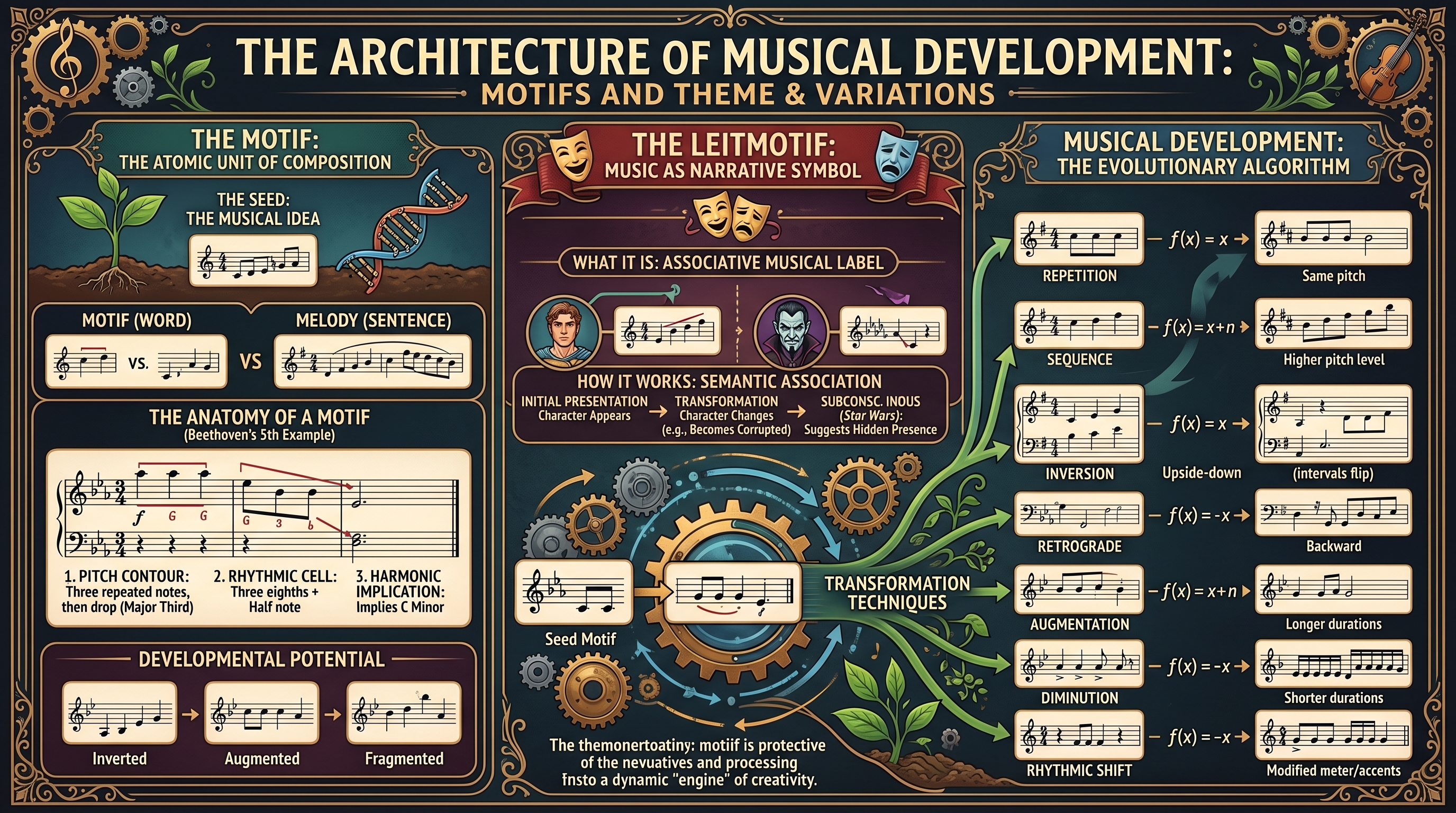
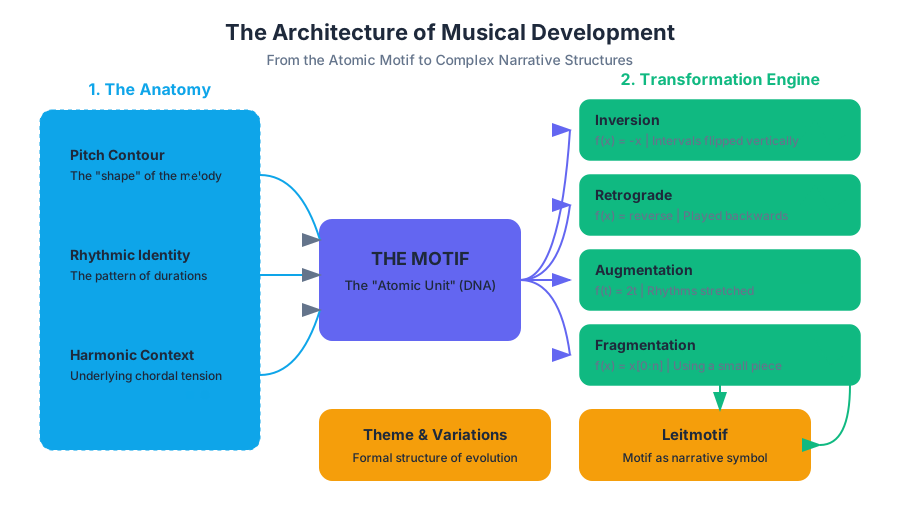
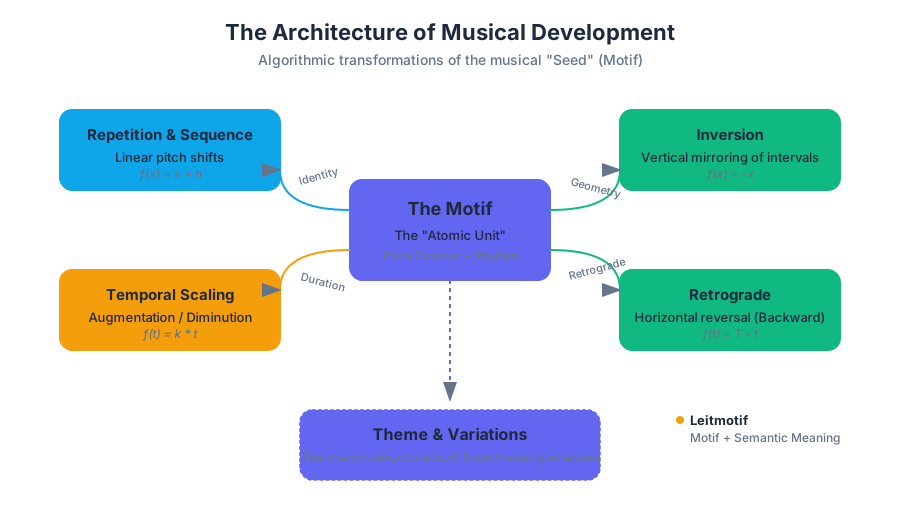
Musical Expression: Tempo and Dynamics
Key concepts: Tempo · Dynamics · BPM · Italian Terms · Metronome
The expressive elements of music that dictate speed and volume.
Musical Expression: Tempo and Dynamics
Musical expression represents the "how" of a musical performance—the layer of interpretive metadata that transforms a static sequence of pitches and durations into a communicative art form. While melody, harmony, and rhythm provide the structural blueprint, Tempo and Dynamics serve as the primary vectors for emotional affect and narrative tension. In technical terms, if pitch is the frequency and rhythm is the clock-gate, expression is the modulation envelope that defines the character of the signal.
The Architecture of Tempo
Tempo (from the Italian word for "time") is the perceived speed or pace of a given piece of music. It functions as the fundamental "clock" of the composition, establishing the rate at which the underlying pulse or beat occurs. In modern musicology and engineering, tempo is quantified through BPM (Beats Per Minute), though historically, it was communicated through subjective Italian descriptors.
Defining the Pulse: BPM and Frequency
Mathematically, tempo is the frequency of the beat. If $T$ is the period between beats in seconds, the BPM is calculated as: $$BPM = \frac{60}{T}$$ A tempo of 120 BPM implies a beat every 0.5 seconds (2 Hz). This "clock" is not merely a mechanical constraint; it dictates the physiological response of the listener, often aligning with human heart rates (60–100 BPM) or walking cadences.
The Italian Tempo Spectrum
Before the invention of the metronome, composers relied on a standardized set of Italian terms to indicate both speed and character. These terms are not fixed values but rather "zones" of temporal density.
| Term | Literal Meaning | Approximate BPM | Character/Mood |
|---|---|---|---|
| Grave | Solemn/Heavy | 25–45 | Extremely slow, serious, and weighty. |
| Largo | Broad | 40–60 | Stately, expansive, and slow. |
| Adagio | At ease | 66–76 | Leisurely, often used for lyrical movements. |
| Andante | Walking | 76–108 | A moderate, flowing pace; rhythmic but relaxed. |
| Moderato | Moderately | 108–120 | Neutral speed; the "default" human pace. |
| Allegro | Cheerful/Fast | 120–156 | Bright, spirited, and energetic. |
| Vivace | Lively | 156–176 | Quick, brisk, and sharp. |
| Presto | Very Fast | 168–200+ | Rapid, driving, often the climax of a work. |
Key Insight: The transition from Italian terms to BPM markings represented a shift from affective instruction (how the music should feel) to mechanical instruction (how the clock should run). A modern performer must synthesize both: playing "Allegro" at 120 BPM requires a different articulation than playing "Moderato" at the same speed.
Implementation: High-Precision Timing in Digital Systems
In software engineering, specifically within Digital Audio Workstations (DAWs) or game engines, maintaining tempo requires high-precision timers to avoid "jitter," which the human ear perceives as rhythmic instability.
// Low-level implementation of a high-precision metronome pulse in Rust
// Using a monotonic clock to ensure stability against system time changes.

use std::time::{Duration, Instant};
use std::thread::sleep;

struct Metronome {
    bpm: f64,
    interval: Duration,
}

impl Metronome {
    fn new(bpm: f64) -> Self {
        let seconds_per_beat = 60.0 / bpm;
        let interval = Duration::from_secs_f64(seconds_per_beat);
        Metronome { bpm, interval }
    }

    fn start_engine(&self) {
        let mut next_tick = Instant::now();
        println!("Metronome started at {} BPM", self.bpm);

        loop {
            // Trigger the beat event (e.g., MIDI clock or audio click)
            self.trigger_beat();

            // Calculate the next tick time to prevent drift accumulation
            next_tick += self.interval;
            let now = Instant::now();

            if next_tick > now {
                sleep(next_tick - now);
            } else {
                // Handle "late" ticks if the system lags
                next_tick = now;
            }
        }
    }

    fn trigger_beat(&self) {
        // Output pulse logic goes here
    }
}
Temporal Flux: Changes in Tempo
Music is rarely static. The manipulation of tempo over time is a critical expressive tool used to signal the end of a section, build excitement, or provide "breath" to a melody.
- Accelerando: A gradual increase in tempo. This creates a sense of rising tension or "chase."
- Ritardando (or Rallentando): A gradual decrease in tempo. Often used at the end of a phrase or movement to provide a sense of resolution.
- A Tempo: A command to return to the original speed after a temporary change.
- Rubato: Literally "stolen time." The performer subtly speeds up and slows down within a phrase for emotional effect, "paying back" the stolen time later to keep the overall pulse intact.
Mathematical Representation of Tempo Curves
An accelerando is not typically a linear jump but a curve. In a linear tempo ramp, the BPM at time $t$ can be expressed as:
$$BPM(t) = BPM_{start} + \left( \frac{BPM_{end} - BPM_{start}}{\Delta T} \right) \cdot t$$
Where $\Delta T$ is the duration of the transition. However, most musical software uses exponential curves to make the transition feel more "natural" to the human ear.
Dynamics: The Dimension of Volume
Dynamics refer to the relative loudness or softness of the music. In physics, this corresponds to the amplitude of the sound wave. In music, dynamics are not absolute decibel (dB) levels but are relative to the instrument, the performance space, and the surrounding musical context.
The Dynamic Scale
Dynamics are indicated using abbreviations of Italian terms, ranging from a whisper to a shout.
| Symbol | Term | Meaning | Perceived Intensity |
|---|---|---|---|
| ppp | Pianississimo | Extremely soft | Barely audible; atmospheric. |
| pp | Pianissimo | Very soft | Intimate, hushed. |
| p | Piano | Soft | Gentle, relaxed. |
| mp | Mezzo-piano | Moderately soft | "Half-soft"; a neutral, quiet volume. |
| mf | Mezzo-forte | Moderately loud | "Half-loud"; standard speaking volume. |
| f | Forte | Loud | Strong, assertive. |
| ff | Fortissimo | Very loud | Powerful, commanding. |
| fff | Fortississimo | Extremely loud | Maximum intensity; often used for impact. |
The "Terraced Dynamics" Concept: In the Baroque era (approx. 1600–1750), instruments like the harpsichord could not easily produce gradual volume changes. Consequently, composers used "terraced dynamics"—sudden shifts from p to f without transition, creating a stark, architectural contrast.
Dynamic Transitions and Accents
Just as tempo can fluctuate, dynamics move between levels to create "shape."
- Crescendo (<): Gradually getting louder.
- Decrescendo / Diminuendo (>): Gradually getting softer.
- Sforzando (sfz): A sudden, strong accent on a single note or chord.
- Subito: Meaning "suddenly" (e.g., subito piano—suddenly soft).
Implementation: Logarithmic Volume Scaling
In digital audio, volume is often represented by a "Gain" value. However, human hearing is logarithmic, not linear. Increasing a signal's amplitude by 2.0 does not sound "twice as loud" to a human.
/**
 * Web Audio API Example: Implementing a Linear vs. Exponential Crescendo
 * @param {AudioParam} gainNodeParam - The gain parameter to automate
 * @param {number} targetVolume - The target gain (0.0 to 1.0)
 * @param {number} duration - Time in seconds for the crescendo
 */
function applyCrescendo(gainNodeParam, targetVolume, duration, context) {
    const now = context.currentTime;

    // Linear ramp: Often sounds "unnatural" as it stays quiet too long
    // gainNodeParam.linearRampToValueAtTime(targetVolume, now + duration);

    // Exponential ramp: Mimics human perception of loudness growth
    // Note: Exponential ramps cannot start at 0.0, so we use a tiny value.
    gainNodeParam.setValueAtTime(0.001, now);
    gainNodeParam.exponentialRampToValueAtTime(targetVolume, now + duration);
}
The Metronome: From Mechanical Pendulum to Digital Quartz
The Metronome is the primary tool for regulating tempo. Patented by Johann Nepomuk Maelzel in 1815 (based on a design by Dietrich Nikolaus Winkel), it allowed composers to mark their scores with specific "M.M." (Maelzel's Metronome) numbers.
The Impact of the Metronome
Before the metronome, "Allegro" in London might be significantly faster than "Allegro" in Vienna. The metronome provided a universal standard. Beethoven was one of the first major composers to embrace it, though his specific markings remain a subject of intense musicological debate—many find them impossibly fast, leading to theories that his metronome was faulty or that he interpreted the markings differently.
Modern Metronomic Practice
In contemporary recording, most music is recorded to a "click track"—a digital metronome. This ensures that different takes can be edited together seamlessly and that tempo-synced effects (like delays or arpeggiators) remain in phase.
| Metronome Type | Mechanism | Precision | Use Case |
|---|---|---|---|
| Mechanical | Inverted pendulum with sliding weight | Variable (affected by gravity/leveling) | Traditional practice, visual cue. |
| Quartz/Electronic | Crystal oscillator | High | Portable practice, tuning. |
| Software/DAW | Sample-accurate CPU clock | Absolute | Professional recording, sequencing. |
Synthesis: The "Affect" of Expression
The interplay between tempo and dynamics defines the Affect (the emotional character) of a piece. High-tempo, high-dynamic music is often perceived as aggressive or jubilant. Low-tempo, low-dynamic music is often perceived as mournful or serene.
MIDI Velocity: The Digital Proxy for Dynamics
In the world of MIDI (Musical Instrument Digital Interface), dynamics are primarily handled through Velocity. When a key is pressed, the "velocity" (how fast the key was struck) is measured on a scale from 0 to 127.
# Example MIDI Event Stream (Conceptual)
# Note On: Channel 1, Pitch 60 (Middle C), Velocity 100 (Forte)
90 3C 64

# Note On: Channel 1, Pitch 60 (Middle C), Velocity 32 (Piano)
90 3C 20

# Note Off: Channel 1, Pitch 60
80 3C 00
In sophisticated virtual instruments, velocity doesn't just change the volume; it changes the timbre. A piano string struck harder (high velocity) has more high-frequency overtones than one struck softly.
Common Pitfalls and Misconceptions
- Tempo vs. Rhythm: A common mistake is confusing a fast tempo with a complex rhythm. A piece can have a very slow tempo (Grave) but contain many fast-moving notes (32nd notes), making it feel busy while the pulse remains slow.
- Absolute vs. Relative Dynamics: Forte on a flute is significantly quieter than forte on a pipe organ. Dynamics are instructions for the performer to reach a certain level of effort and intensity relative to their instrument's capabilities.
- The "Metronome Prison": While the metronome is a vital tool, strict adherence to it can result in "mechanical" or "soulless" performances. Professional musicians use the metronome to find the center of the beat, then utilize rubato to move around it expressively.
- Crescendo = Accelerando?: Beginners often accidentally speed up when they get louder. Maintaining a steady tempo while increasing volume is a hallmark of technical mastery.
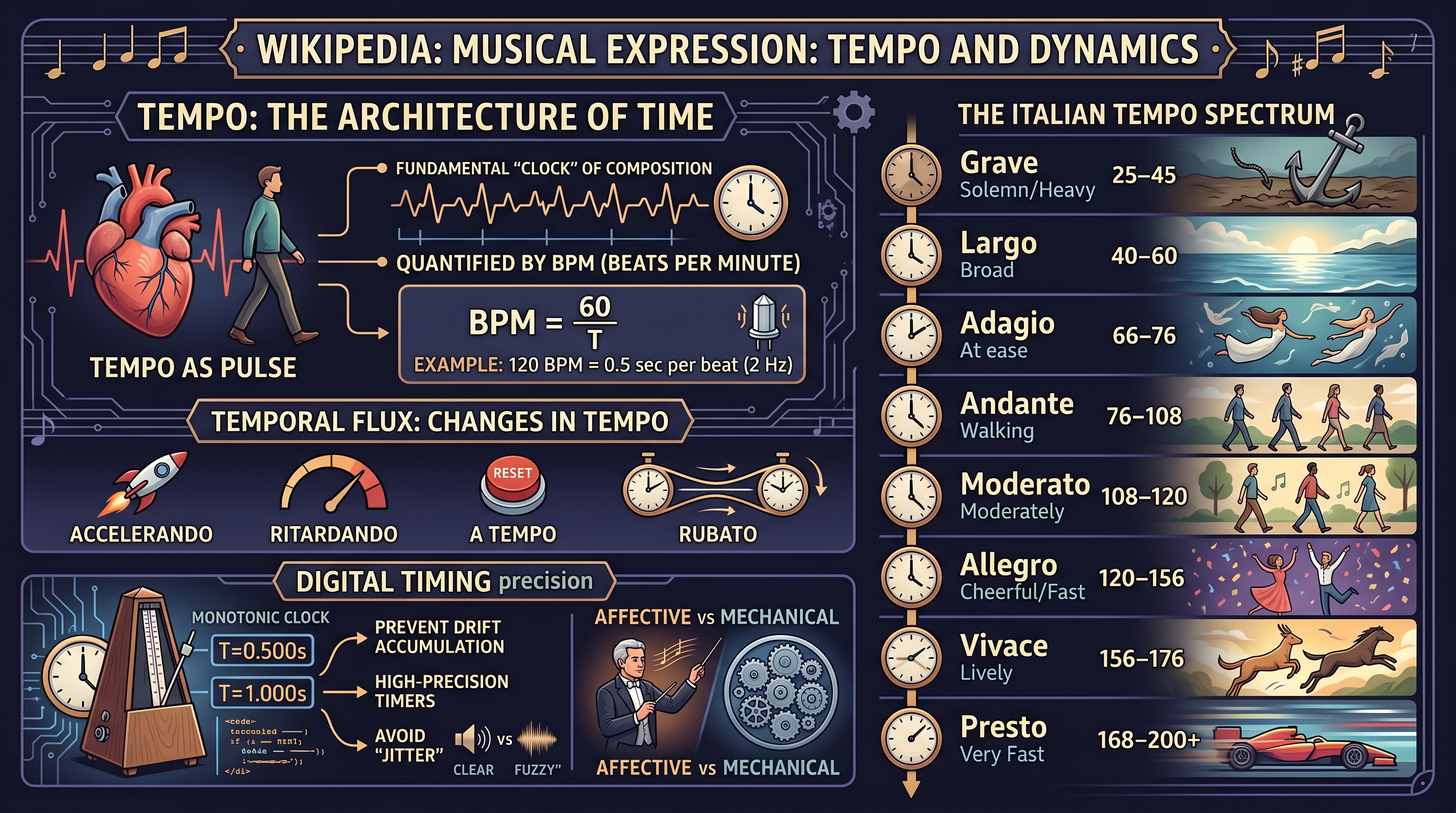

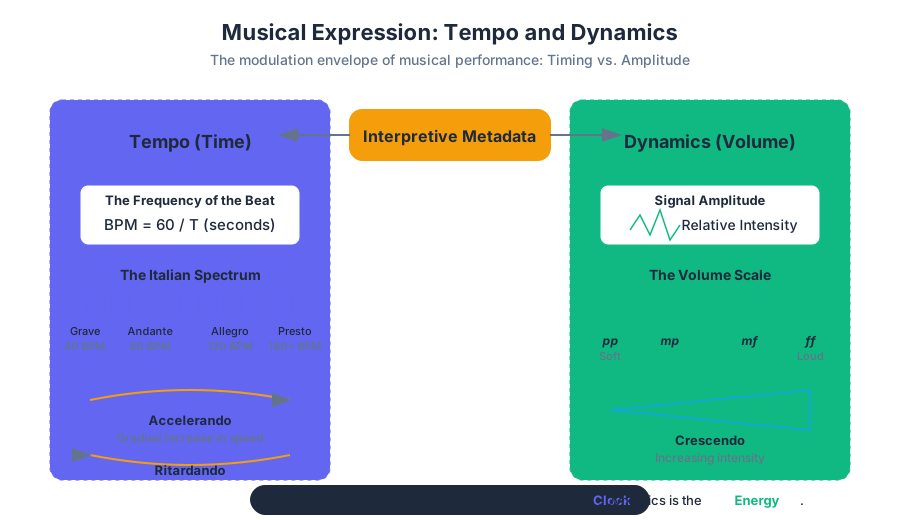
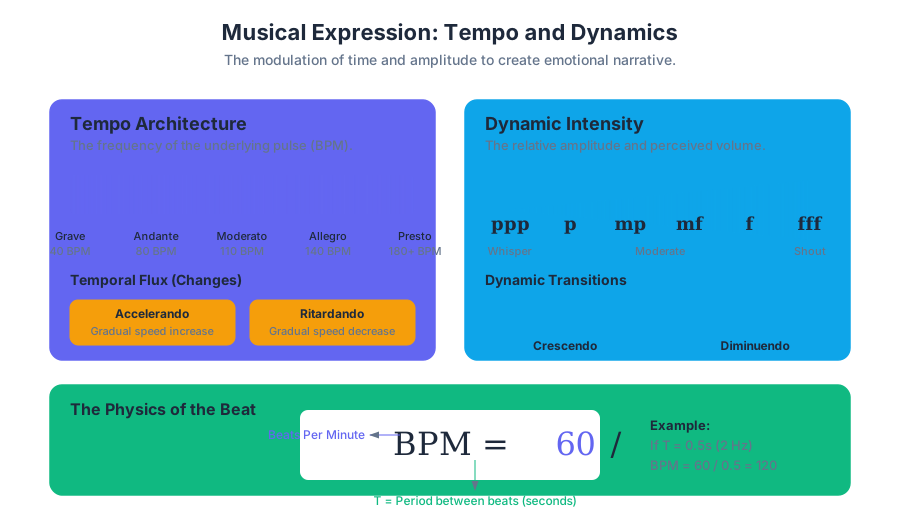
Case Studies: Score Analysis
Key concepts: Sonata Form · Adagio cantabile · Performance Markings · Beethoven · Chopin
Applying theoretical knowledge to actual musical scores by Beethoven and Chopin.
Case Studies: Score Analysis
Score analysis is the process of reverse-engineering a musical composition to understand its structural, harmonic, and expressive DNA. It is the bridge between theoretical knowledge—scales, intervals, and rhythm—and the practical realization of a performance. In this section, we move beyond the "what" of music theory into the "how" of musical architecture, focusing on the works of Ludwig van Beethoven and Frédéric Chopin.
The Analytical Framework: Structural and Semantic Layers
Analyzing a score requires a multi-layered approach. We distinguish between the Structural Layer (the formal architecture like Sonata Form), the Harmonic Layer (the vertical alignment of pitches), and the Semantic Layer (performance markings and expressive intent).
| Layer | Primary Focus | Key Elements | Analytical Goal |
|---|---|---|---|
| Structural | Macro-form | Exposition, Development, Recapitulation | Identify the "roadmap" and thematic evolution. |
| Harmonic | Verticality | Cadences, Modulations, Non-chord tones | Map the tension and release cycles (tonal gravity). |
| Rhythmic | Temporality | Meter, Syncopation, Hemiola | Understand the drive and "heartbeat" of the piece. |
| Semantic | Expression | p, ff, sfz, Adagio, Rubato |
Interpret the composer’s emotional instructions. |
Analysis 1: Beethoven’s Piano Sonata No. 8 in C Minor, Op. 13 ("Pathétique")
Beethoven’s Pathétique (1798) represents a pivotal moment in the transition from the Classical to the Romantic era. It challenges the traditional constraints of the Sonata Form by introducing a slow, dramatic introduction that reappears throughout the movement.
Movement I: Grave – Allegro di molto e con brio
The first movement is a masterclass in contrast. The Grave introduction is characterized by heavy, dotted rhythms and extreme dynamic shifts, specifically the fp (fortepiano) marking, which demands an immediate drop from loud to soft.
Definition: Sonata Form A structural blueprint typically consisting of three main sections: the Exposition (themes are introduced), the Development (themes are fragmented and transformed), and the Recapitulation (themes return in the home key).
The Problem-Solving Approach: Identifying the Pivot When analyzing the Pathétique, the analyst must determine if the Grave is merely an introduction or a thematic core. Beethoven proves the latter by re-inserting the Grave material at the start of the development and again in the coda.
Common Pitfall: Misinterpreting sf (Sforzando)
In Beethoven’s scores, sf or sfz indicates a sudden, strong accent on a single note or chord. A common mistake is to play the subsequent notes loudly as well. The sf is a localized "spike" in energy, not a change in the overall dynamic level.
Movement II: Adagio cantabile
The second movement shifts to A-flat major and adopts an Adagio cantabile (slow, singing style) marking. Here, the challenge is maintaining a Legato (smooth, connected) line while managing a three-layered texture:
- The Melody: The top voice, which must "sing."
- The Accompaniment: Middle-voice triplets providing harmonic movement.
- The Bass: Grounding the harmony.
| Feature | Description | Technical Requirement |
|---|---|---|
| Time Signature | 2/4 | Maintaining a slow but steady pulse without dragging. |
| Texture | Homophonic | Balancing the melody so it sits "above" the accompaniment. |
| Form | Rondo (A-B-A-C-A) | Differentiating the character of the contrasting sections. |
Analysis 2: Chopin’s Prelude in E Minor, Op. 28, No. 4
If Beethoven is the architect of structure, Chopin is the master of Harmonic Color. The Prelude No. 4 is a study in chromaticism and micro-dynamics.
The Mechanics of "Dying Away"
The piece is marked Largo (very slow) and features a repetitive melodic motif that sits atop a series of descending, chromatic block chords. The primary expressive marking here is smorzando, which literally means "extinguishing" or "dying away."
Analytical Step-by-Step: The Harmonic Descent
- Identify the Static Element: The right-hand melody consists mostly of long, sustained notes with narrow intervals.
- Analyze the Kinetic Element: The left-hand chords descend by half-steps (chromaticism).
- Locate the Climax: The
stretto(speeding up) leading to theff(fortissimo) chord near the end, followed by a sudden silence (Grand Pause).
Performance Markings in Chopin
Chopin uses specific Italian terms to dictate the "breath" of the music:
- Espressivo: Play with extra feeling, often implying a slight flexibility in tempo.
- Rubato: "Stolen time"—the practice of slightly speeding up and slowing down for expressive effect while keeping the overall pulse.
- Sotto voce: "Under the voice"—a hushed, whispered quality.
Computational Score Analysis: The "Senior Engineer" View
In modern musicology, we often use computational tools to analyze scores. This allows us to quantify "harmonic entropy" or "thematic density" across thousands of measures.
Implementation: Feature Extraction with Python
Using the music21 library, we can programmatically identify every instance of a specific dynamic marking or interval pattern in a Beethoven sonata.
import music21

def analyze_dynamic_density(score_path):
    """
    Analyzes the frequency and distribution of dynamic markings
    in a MusicXML score to identify structural pivots.
    """
    score = music21.converter.parse(score_path)
    dynamics_map = []

    # Flatten the score to iterate through all elements
    for el in score.recurse():
        if isinstance(el, music21.dynamics.Dynamic):
            dynamics_map.append({
                'offset': el.offset,
                'value': el.value,
                'measure': el.measureNumber
            })

    # Calculate 'Dynamic Volatility'
    volatility = len(dynamics_map) / len(score.parts[0].getElementsByClass('Measure'))
    return dynamics_map, volatility

# Example usage for Beethoven's Op. 13
# dynamics, vol = analyze_dynamic_density('beethoven_pathetique_mvt1.xml')
# print(f"Dynamic changes per measure: {vol:.2f}")
Mathematical Representation of Harmonic Tension
We can model the "tension" of a chord based on its distance from the tonic in the Circle of Fifths and its internal dissonance.
T(c) = \sum_{i=1}^{n} D(p_i, p_{i+1}) + \omega \cdot dist(k_{root}, k_{tonic})
Where:
- $T(c)$ is the tension of chord $c$.
- $D$ is the dissonance function between pitches $p$.
- $\omega$ is a weighting constant for the key distance.
- $dist(k_{root}, k_{tonic})$ is the distance on the Circle of Fifths.
CLI Workflow: Batch Processing Scores
For large-scale analysis, a researcher might use a shell script to convert MIDI files to a readable format for analysis.
#!/bin/bash
# Batch convert MIDI performances to MusicXML for structural analysis

INPUT_DIR="./midi_performances"
OUTPUT_DIR="./xml_scores"

mkdir -p "$OUTPUT_DIR"

for file in "$INPUT_DIR"/*.mid; do
    filename=$(basename "$file" .mid)
    echo "Processing $filename..."

    # Use mid2xml utility (hypothetical) to extract score data
    mid2xml "$file" -o "$OUTPUT_DIR/$filename.xml" --strip-velocity
done

echo "Batch conversion complete. Analyzing harmonic density..."
python3 analyze_corpus.py "$OUTPUT_DIR"
Comparison: Beethoven vs. Chopin Score Characteristics
Analyzing these two composers side-by-side reveals the evolution of the piano as a medium.
| Feature | Beethoven (Op. 13) | Chopin (Op. 28, No. 4) |
|---|---|---|
| Primary Form | Strict Sonata-Allegro / Rondo | Free-form Prelude |
| Dynamic Range | Extreme (pp to ff) |
Subtle gradations within p |
| Harmonic Language | Functional, Diatonic-focused | Chromatic, Color-focused |
| Pedal Usage | Structural (often not marked) | Essential (highly specific markings) |
| Rhythmic Feel | Driving, Motoric | Fluid, Rubato-heavy |
Advanced Concept: The "False Recapitulation"
A common "trick" in score analysis is identifying the False Recapitulation. This occurs when the composer brings back the main theme in the "wrong" key during the Development section, tricking the listener into thinking the piece is ending.
How to spot it:
- Check the Key: Is the theme in the Tonic (the home key)? If it's in the Dominant or a remote key, it's likely a false recapitulation.
- Check the Instrumentation: Does the texture feel "thin" compared to the actual Exposition?
- Check the Sequence: Does the theme immediately dissolve into further development?
Insight: The "Pathétique" Pivot In the first movement of Op. 13, Beethoven uses the Grave material as a structural "gatekeeper." Every time the music becomes too chaotic or reaches a formal boundary, the Grave returns to reset the emotional state. This was a radical departure from the Mozartian "clean break" between sections.
Common Pitfalls in Score Analysis
- Over-Analyzing "Accidental" Notes: Not every sharp or flat is a modulation. Often, they are Chromatic Passing Tones used for melodic smoothness.
- Ignoring the "Tacet": Silence is a musical element. In the Chopin Prelude, the final three chords are preceded by a rest that is just as important as the notes themselves.
- Literalism with Tempo: Markings like Adagio or Allegro are relative. An Adagio in 1800 (Beethoven) might be significantly faster than an Adagio in 1890 (Mahler).
- Dynamics vs. Balance: A
p(piano) marking for the whole score doesn't mean every note is equal. The melody must always be slightly louder than the accompaniment to maintain the Homophonic texture.
Summary of Performance Markings
| Term | Category | Meaning | Execution Tip |
|---|---|---|---|
| Cantabile | Style | Singing | Use a "weighty" touch on the keys to sustain the tone. |
| Sforzando (sf) | Dynamic | Sudden force | Sharp attack followed by immediate return to previous dynamic. |
| Smorzando | Dynamic/Tempo | Dying away | Gradually decrease volume and slightly slow down. |
| Con Brio | Style | With spirit | Emphasize rhythmic precision and brightness. |
| Largo | Tempo | Very slow/Broad | Focus on the space between the notes. |
- Sonata Form: A three-part musical structure: Exposition, Development, Recapitulation.
- Adagio cantabile: A slow tempo performed in a lyrical, singing style.
- Fortepiano (fp): A dynamic marking indicating a loud attack followed immediately by a soft sustain.
- Chromaticism: The use of notes outside the standard major or minor scale for harmonic color.
- Rubato: The flexible manipulation of tempo for expressive purposes.
- Smorzando: A performance instruction to let the sound gradually fade away and the tempo slow down.
- Sforzando (sfz): A sudden, strong emphasis on a specific note or chord.
-
In Beethoven's Pathétique Movement I, what is the primary function of the Grave introduction?
- (A) To provide a simple warmup for the pianist.
- (B) To act as a structural anchor that returns at key formal transitions.
- (C) To establish a light, dance-like mood.
- (D) To modulate to a distant, unrelated key immediately. Correct: B
-
Which term best describes the left-hand movement in Chopin's Prelude Op. 28, No. 4?
- (A) Arpeggiated triads
- (B) Diatonic scales
- (C) Chromatic descent
- (D) Alberti bass Correct: C
-
What is a "False Recapitulation"?
- (A) When the pianist forgets to play the repeat sign.
- (B) When the main theme returns in a key other than the tonic during the development.
- (C) When the piece ends in a different key than it started.
- (D) A section where the melody is played upside down. Correct: B
-
How does
smorzandodiffer from a simplediminuendo?- (A) It only refers to volume.
- (B) It implies both a decrease in volume and a slowing of tempo (fading away).
- (C) It means to play as loudly as possible.
- (D) It indicates a change in the instrument's tuning. Correct: B
-
In the context of Adagio cantabile, what is the "analytical problem" of the piano?
- (A) The piano cannot play more than one note at a time.
- (B) The piano is a percussion instrument whose sound decays immediately after a string is struck.
- (C) The piano is too loud for a singing style.
- (D) The piano has no pedals. Correct: B
Core Objectives
- Master the structural components of Sonata Form (Exposition, Development, Recapitulation).
- Distinguish between the architectural rigor of Beethoven and the harmonic fluidity of Chopin.
- Interpret Italian performance markings (
sf,fp,smorzando) within their historical and stylistic contexts. - Apply computational logic to score analysis (e.g., identifying patterns and dynamic volatility).
Key Scores to Memorize
- Beethoven, Op. 13 (Pathétique): Focus on the contrast between the Grave and Allegro.
- Chopin, Op. 28, No. 4: Focus on the chromatic descent and the use of
smorzando.
Analytical Checklist
- Identify the Home Key and the Time Signature.
- Map the Macro-Structure (Is it Sonata, Rondo, or Binary?).
- Locate Pivot Points (Modulations, tempo changes, or thematic returns).
- Analyze Micro-Dynamics (Specific accents like
sforfp). - Evaluate the Texture (Is the melody clearly differentiated from the accompaniment?).
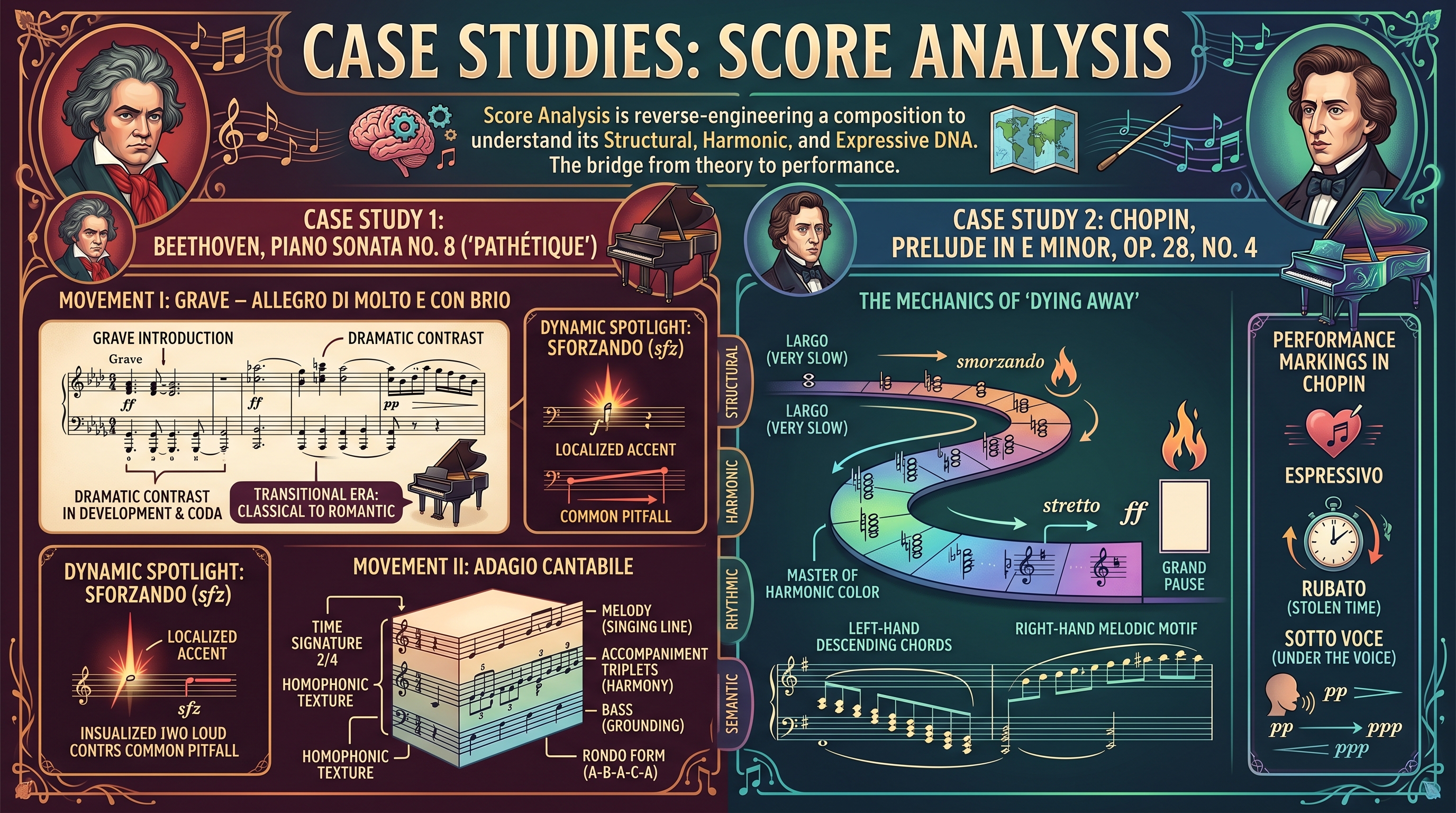
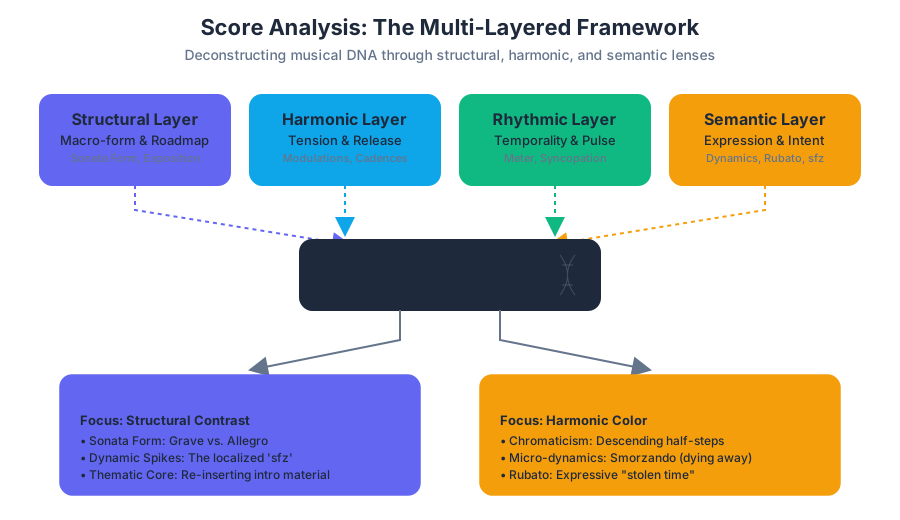
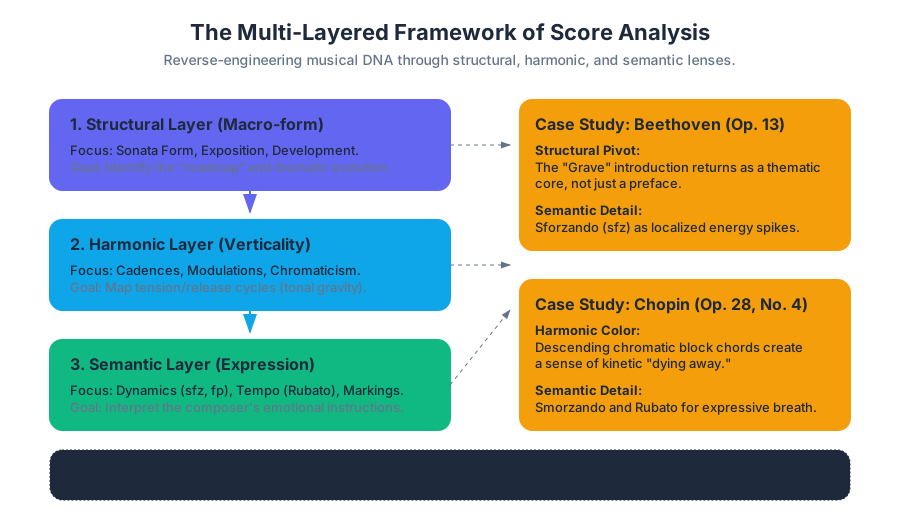
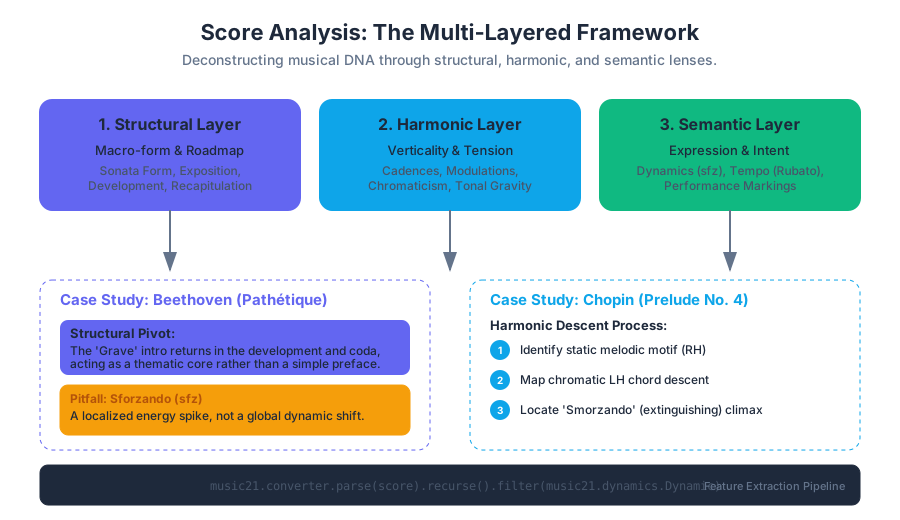
Source Materials
Study Music Appreciation 1 with AI — Free on Lykke
Sign up for free to generate personalized flashcards, quizzes, and study guides from this course. Chat with an AI tutor that knows the material.
Get Started FreeView this course wiki on Lykke · Browse all public course wikis