From the free course Music Appreciation 1 on Lykke
Rhythm, Meter, and Duration
Key concepts: Rhythm · Meter · Note Duration · Rests · Beats
How music is organized in time through beats, rests, and patterns of stress.
Rhythm, Meter, and Duration
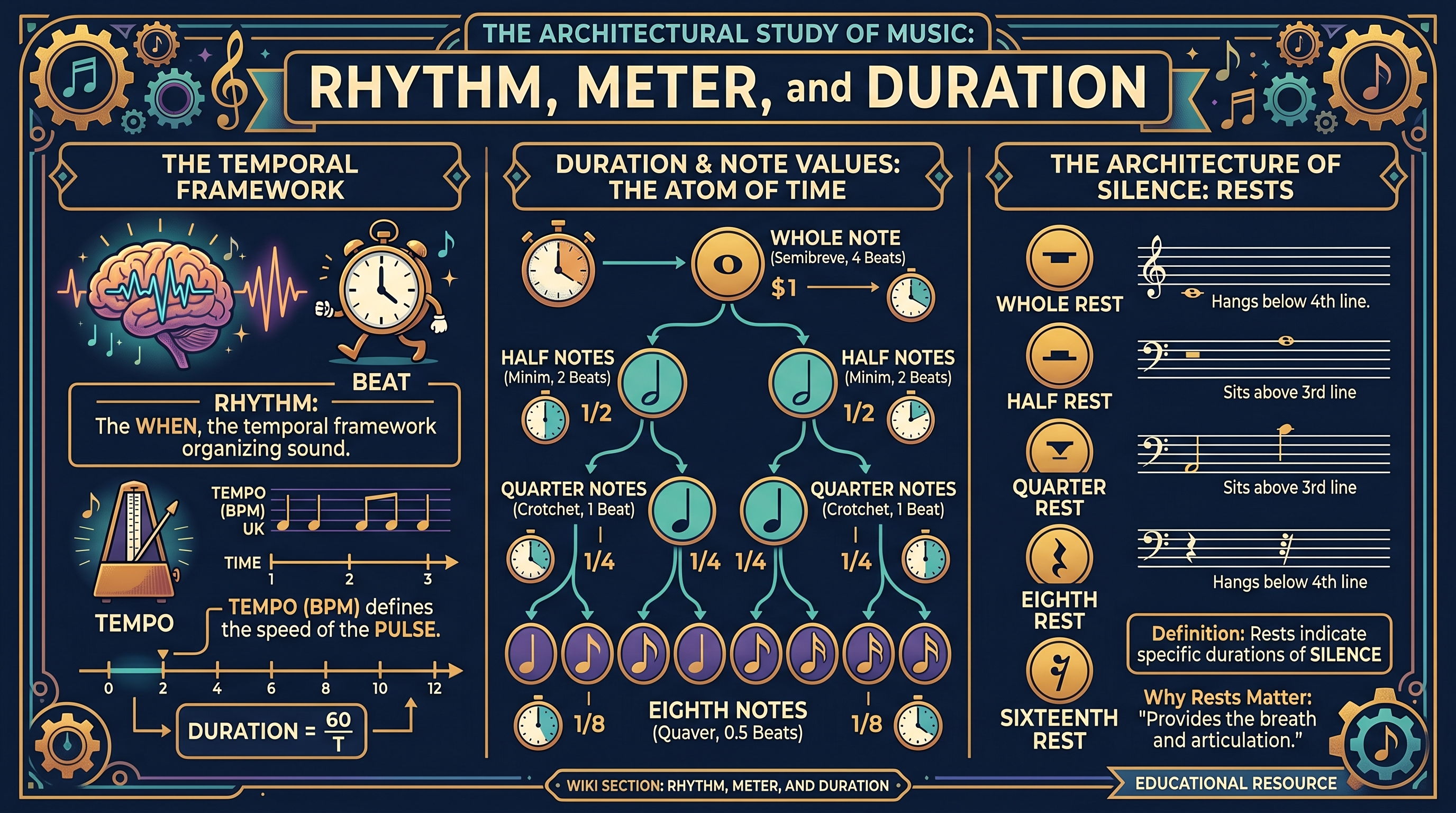
In the architectural study of music, if melody represents the "what" (the pitch) and harmony represents the "depth" (the vertical stack), then rhythm is the "when"—the fundamental temporal framework that organizes sound across the horizontal axis of time. Without rhythm, music is merely a static frequency; with it, music becomes a dynamic, moving force.
This section explores the mechanics of musical time, from the atomic level of duration to the structural level of meter. We will examine how silence is quantified through rests, how the beat serves as the isochronous pulse of a composition, and how complex rhythmic patterns are derived from simple mathematical subdivisions.
The Atom of Time: Duration and Note Values
Duration is the specific length of time a sound (or silence) persists. In Western music theory, duration is not measured in absolute units like seconds or milliseconds, but in relative units. This relative system allows a piece of music to be performed at different speeds (tempos) while maintaining the proportional relationships between the notes.
The Binary Hierarchy
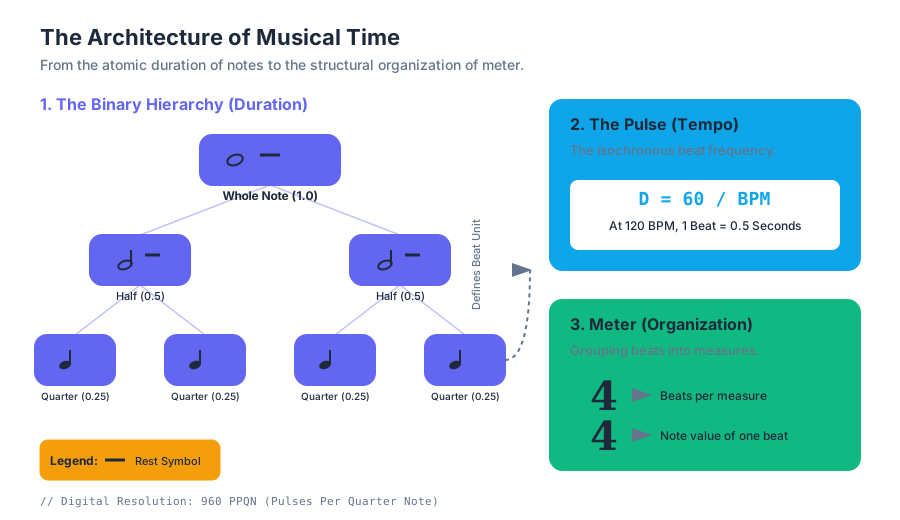
The standard system of note values is based on a power-of-two subdivision. Each successive note value is exactly half the duration of the one preceding it.
Definition: The Whole Note (Semibreve) The reference unit for duration in a standard measure of 4/4 time. All other note values are expressed as fractions of the whole note ($1, 1/2, 1/4, 1/8, 1/16, 1/32$).
| Note Name (US) | Note Name (UK) | Relative Duration | Logic/Division |
|---|---|---|---|
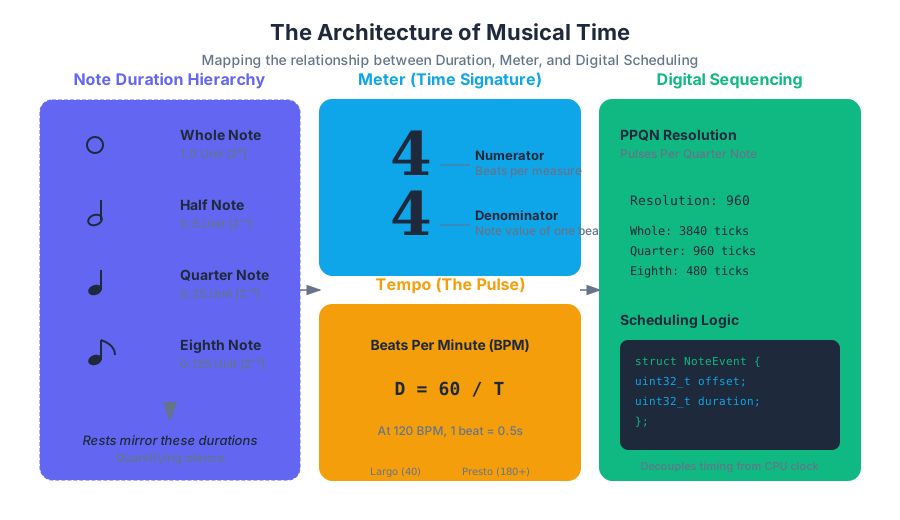
| Whole Note | Semibreve | 1.0 | The fundamental unit ($2^0$) |
| Half Note | Minim | 0.5 | $1/2$ of a whole note ($2^{-1}$) |
| Quarter Note | Crotchet | 0.25 | $1/4$ of a whole note ($2^{-2}$) |
| Eighth Note | Quaver | 0.125 | $1/8$ of a whole note ($2^{-3}$) |
| Sixteenth Note | Semiquaver | 0.0625 | $1/16$ of a whole note ($2^{-4}$) |
| Thirty-second Note | Demisemiquaver | 0.03125 | $1/32$ of a whole note ($2^{-5}$) |
The Architecture of Silence: Rests
Music is as much about the absence of sound as it is about its presence. Rests are symbols used to indicate specific durations of silence. They follow the exact same hierarchical logic as note values.
Why Rests Matter
Rests provide the "breath" in a musical phrase. In vocal music, they indicate where a singer should inhale; in instrumental music, they provide the necessary separation (articulation) that allows a melody to be perceived as a series of distinct ideas rather than a continuous drone.
| Rest Type | Symbol Equivalent | Duration (in 4/4) | Visual Description |
|---|---|---|---|
| Whole Rest | Whole Note | 4 Beats | Hangs below the 4th staff line |
| Half Rest | Half Note | 2 Beats | Sits above the 3rd staff line |
| Quarter Rest | Quarter Note | 1 Beat | A squiggly vertical line |
| Eighth Rest | Eighth Note | 0.5 Beats | A diagonal stroke with one flag |
| Sixteenth Rest | Sixteenth Note | 0.25 Beats | A diagonal stroke with two flags |
The Pulse: Beats and Tempo
The beat is the basic unit of time in music—the underlying pulse that listeners tap their feet to. While rhythm can be irregular and syncopated, the beat is typically isochronous (evenly spaced).
Tempo: The Speed of the Pulse
Tempo defines the frequency of the beat, usually measured in Beats Per Minute (BPM).
The Tempo Formula To calculate the duration ($D$) of a single beat in seconds given a tempo ($T$) in BPM: $$D = \frac{60}{T}$$ For example, at 120 BPM, each beat lasts exactly $0.5$ seconds.
Common Tempo Markings
Historically, composers used Italian terms to describe tempo, which provide both a speed and a "mood" or character.
| Term | Meaning | Approximate BPM |
|---|---|---|
| Largo | Broad, very slow | 40–60 |
| Adagio | Slow, at ease | 66–76 |
| Andante | At a walking pace | 76–108 |
| Moderato | Moderately | 108–120 |
| Allegro | Fast, quickly, bright | 120–168 |
| Presto | Very, very fast | 168–200+ |
Meter: The Organization of Beats
Meter is the grouping of beats into regular patterns of strong and weak pulses. This grouping creates a sense of "measure" or "bar" in music.
Time Signatures
Meter is denoted by a time signature at the beginning of a piece. It consists of two numbers stacked vertically:
- Top Number (Numerator): Indicates how many beats are in each measure.
- Bottom Number (Denominator): Indicates which note value receives one beat.
Classification of Meters
Meters are classified by the number of beats per measure:
- Duple Meter: Two beats per measure (Strong-weak). Example: 2/4.
- Triple Meter: Three beats per measure (Strong-weak-weak). Example: 3/4 (Waltz).
- Quadruple Meter: Four beats per measure (Strong-weak-less strong-weak). Example: 4/4 (Common time).
Simple vs. Compound Meter
- Simple Meter: The beat is subdivided into two equal parts (e.g., a quarter note divides into two eighth notes).
- Compound Meter: The beat is subdivided into three equal parts (e.g., a dotted quarter note divides into three eighth notes). 6/8 is the most common compound meter.
\text{Simple Quadruple (4/4): } \underbrace{\bullet \circ}_{\text{Beat 1}} \underbrace{\bullet \circ}_{\text{Beat 2}} \underbrace{\bullet \circ}_{\text{Beat 3}} \underbrace{\bullet \circ}_{\text{Beat 4}}
\\
\text{Compound Duple (6/8): } \underbrace{\bullet \circ \circ}_{\text{Beat 1}} \underbrace{\bullet \circ \circ}_{\text{Beat 2}}
Advanced Rhythmic Concepts: Beyond the Grid
While the basic hierarchy covers most Western music, advanced rhythm involves breaking or stretching the grid.
1. Tuplets (Triplets, Quintuplets)
A tuplet is a rhythm that plays a certain number of notes in the time usually occupied by a different number of notes. The most common is the triplet, where three notes are played in the space of two.
2. Syncopation
Syncopation involves placing emphasis (accents) on the "off-beats" or weak parts of the pulse. This creates a sense of surprise and drive, foundational to Jazz, Funk, and Afro-Cuban music.
3. Polyrhythm
A polyrhythm occurs when two different rhythmic subdivisions happen simultaneously. A "3 against 2" polyrhythm features one part playing triplets while another plays eighth notes over the same duration.
Rhythmic Analysis: A Worked Example
Consider a measure of 4/4 time containing:
- One Quarter Note (Beat 1)
- Two Eighth Notes (Beat 2)
- One Quarter Rest (Beat 3)
- Four Sixteenth Notes (Beat 4)
Derivation of Total Duration:
- Beat 1: $1 \times 0.25 = 0.25$
- Beat 2: $2 \times 0.125 = 0.25$
- Beat 3: $1 \times 0.25 = 0.25$ (Silence)
- Beat 4: $4 \times 0.0625 = 0.25$ Total: $0.25 + 0.25 + 0.25 + 0.25 = 1.0$ (One full measure)
Common Pitfalls and Misconceptions
- Confusing Rhythm with Meter: Rhythm is the specific pattern of long and short sounds. Meter is the theoretical grid those sounds sit on. You can play many different rhythms within the same meter.
- The "6/8 vs 3/4" Fallacy: Both time signatures contain six eighth notes. However, 3/4 is Simple Triple (3 beats of 2 eighths each: 1-and-2-and-3-and), while 6/8 is Compound Duple (2 beats of 3 eighths each: 1-and-a-2-and-a). Mixing these up changes the "feel" or "lilt" of the music entirely.
- Ignoring the Tactus: The tactus is the perceived level of the beat. Beginners often focus on the smallest note value (the sixteenth notes) and lose track of the larger pulse (the quarter note). Always practice with a metronome to internalize the tactus.
- Quantization Errors: In digital production, "quantizing" snaps notes to a perfect grid. While this fixes timing errors, it can remove the "human" element—the micro-variations in timing (rubato) that give music its emotional resonance.
Source Materials
Study Music Appreciation 1 on Lykke
This course page is free to open: signed out, you can read its first two sections, and signing in, on any plan, opens the rest. The free Lykke Chrome extension syncs your own Canvas courses, so ChatGPT, Claude and Muse can answer from your classes and deadlines. It only reads Canvas.
Add the free extensionSign in to open every sectionAll sections of Music Appreciation 1 · Browse more course pages