From the free course Music Appreciation 1 on Lykke
Musical Texture
Key concepts: Monophony · Homophony · Polyphony · Heterophony · Counterpoint
The layers of sound in a piece and how they interact with one another.
Musical Texture
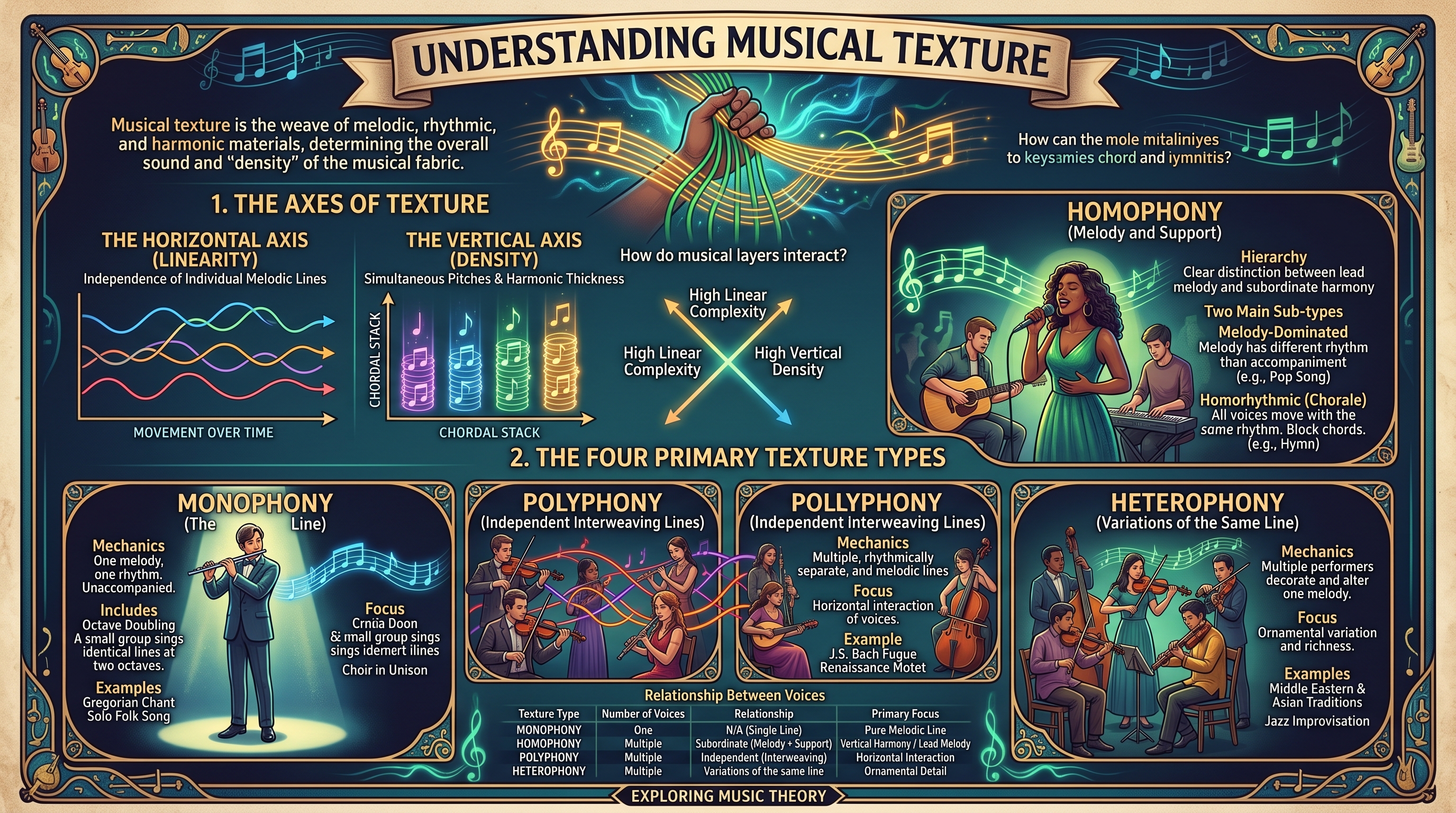
Musical texture is the specific manner in which melodic, rhythmic, and harmonic materials are combined in a composition, determining the overall quality of the sound and the "density" of the musical fabric. If melody is the horizontal thread and harmony is the vertical stack, texture is the resulting weave. In technical terms, texture describes the relationship between various layers of a musical ensemble: how many layers exist, what their individual functions are, and how they interact with one another.
Understanding texture is critical for both analysis and composition because it dictates how a listener’s attention is partitioned. A dense polyphonic texture requires the brain to track multiple independent streams, whereas a homophonic texture allows the listener to focus on a singular "lead" while processing the accompaniment as a unified background.
The Dimensionality of Texture
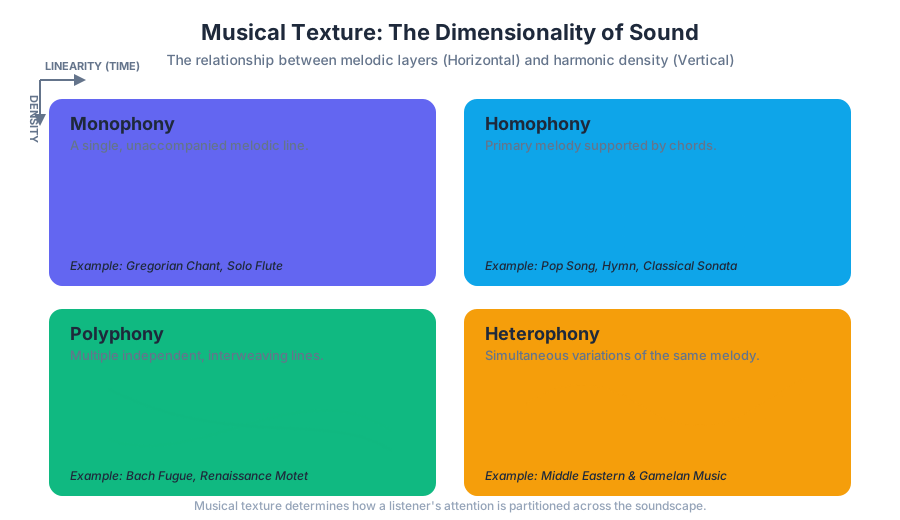
Texture is often analyzed through two primary axes:
- The Horizontal Axis (Linearity): The independence and movement of individual melodic lines over time.
- The Vertical Axis (Density): The simultaneous occurrence of different pitches and the harmonic thickness created by chords.
| Texture Type | Number of Voices | Relationship Between Voices | Primary Focus |
|---|---|---|---|
| Monophony | One | N/A (Single line) | Pure Melodic Line |
| Homophony | Multiple | Subordinate (Melody + Support) | Vertical Harmony / Lead Melody |
| Polyphony | Multiple | Independent (Interweaving lines) | Horizontal Interaction |
| Heterophony | Multiple | Variations of the same line | Ornamental Detail |
Monophony: The Singular Line
Monophony is the simplest musical texture, consisting of a single melodic line without any accompaniment or harmonic support. The term is derived from the Greek mono (one) and phōnē (sound/voice).
Mechanics and Characteristics
In a monophonic texture, every performer plays or sings the exact same pitches and rhythms. It is important to note that monophony is not limited to a solo performer. A choir of 100 people singing the same melody in unison—or in octaves—is still considered monophonic.
Definition: Monophony is a texture comprising a single, unaccompanied melodic line. Doubling at the octave does not change the texture to polyphony, as the melodic content remains functionally identical.
Historical and Cultural Context
- Gregorian Chant: The foundational music of the Western Christian Church was almost exclusively monophonic for centuries.
- Traditional Folk Music: Many indigenous singing traditions rely on pure monophony to emphasize the narrative of the lyrics.
- Solo Instruments: A solo flute or cello suite (like those by J.S. Bach) often utilizes monophony, though they may use "implied harmony" by arpeggiating chords quickly.
Common Pitfalls
A common mistake is assuming that "one instrument" equals monophony. A piano playing a melody with the right hand and chords with the left is homophonic, not monophonic, because there are multiple distinct pitches sounding simultaneously to create harmony.
Homophony: Melody and Support
Homophony is the most prevalent texture in Western music, particularly in Classical, Pop, Rock, and Jazz. It features one clear, dominant melodic line (the "tune") supported by an accompaniment that provides harmonic context.
The Hierarchy of Voices
In homophony, there is a clear distinction between the primary voice and the subordinate voices. The accompaniment's role is to fill out the harmony using triads, seventh chords, and other vertical structures, often following the "Tertian" (built on thirds) system.
Sub-types of Homophony
- Melody-Dominated Homophony: A distinct melody with a rhythmically different accompaniment (e.g., a singer with a strumming guitar).
- Homorhythm (Chorale Texture): All voices move with the same, or very similar, rhythm. This creates a "block chord" effect. This is common in church hymns and barbershop quartets.
| Parameter | Melody-Dominated | Homorhythmic (Chorale) |
|---|---|---|
| Rhythmic Independence | High (Melody differs from backing) | Low (All voices move together) |
| Focus | Linear (The "Lead") | Vertical (The "Chord") |
| Typical Example | Pop Song / Violin Concerto | Protestant Hymn |
Polyphony: The Independent Weave
Polyphony (Greek for "many sounds") occurs when two or more independent melodic lines are sounded simultaneously. Unlike homophony, there is no single "lead" voice; instead, the interest is distributed across multiple layers that compete for the listener's attention.
Imitative vs. Non-Imitative Polyphony
- Imitative Polyphony: A melodic idea is presented in one voice and then restated (imitated) by another voice shortly after. The most rigid form is a Canon or Round (e.g., "Row, Row, Row Your Boat"). The most complex form is the Fugue.
- Non-Imitative Polyphony: The simultaneous voices are completely different in melody and rhythm (e.g., the "Jazz New Orleans" style where the trumpet, clarinet, and trombone all improvise different lines at once).
The Mechanics of Counterpoint
The technical discipline used to create polyphony is called Counterpoint (from punctus contra punctum, "point against point"). It involves the relationship between voices that are harmonically interdependent yet independent in rhythm and contour.
The Golden Rule of Polyphony: Each voice must be a satisfying melody in its own right, while the vertical intervals created between them must remain consonant according to the prevailing harmonic rules.
Mathematical Representation of a Canon
A canon can be viewed as a time-shifted transformation of a single function. If $M(t)$ is the melody at time $t$, a two-voice canon can be represented as:
S(t) = M(t) + M(t - \delta)
Where:
- $S(t)$ is the resulting polyphonic signal.
- $M(t)$ is the original melody.
- $\delta$ is the time delay (the "offset") at which the second voice enters.
- In more complex canons, the second voice might be transformed by frequency (transposition) or time-reversal (retrograde).
Counterpoint: The Engine of Polyphony
While "polyphony" describes the resulting texture, counterpoint is the active technique of composition. In Western music theory, this is often taught through "Species Counterpoint," a system developed by Johann Joseph Fux in his 1725 treatise Gradus ad Parnassum.
The Five Species of Counterpoint
To master the independence of lines, students progress through levels of rhythmic complexity:
| Species | Description | Rhythmic Ratio (Cantus Firmus : Counterpoint) |
|---|---|---|
| 1st Species | Note-against-note | 1:1 |
| 2nd Species | Two notes against one | 1:2 |
| 3rd Species | Four notes against one | 1:4 |
| 4th Species | Syncopation / Suspensions | Tied notes creating tension/resolution |
| 5th Species | Florid Counterpoint | A mix of all the above |
Heterophony: Variation in Unison
Heterophony is a texture where multiple performers sing or play the same melody, but with simultaneous variations. While one performer plays the "plain" version of the tune, another might add ornaments, trills, or slight rhythmic shifts.
Characteristics
- Non-Western Prevalence: It is a hallmark of Middle Eastern, Native American, and South Asian musical traditions.
- Accidental vs. Intentional: In some folk traditions, heterophony arises naturally because different performers have slightly different "versions" of a song in their memory.
- Complexity: It creates a "blurred" or "thickened" melodic line that is more complex than monophony but lacks the distinct harmonic layers of homophony.
Synthesis: Comparing Textures in Context
A single piece of music rarely stays in one texture. Composers use textural change to create drama and structural boundaries.
Example: Handel's "Hallelujah Chorus"
- Homophony: The opening "Hallelujah" is block chords (homorhythmic).
- Monophony: "For the Lord God Omnipotent reigneth" is often sung in unison.
- Polyphony: When different sections of the choir sing different phrases ("And He shall reign...") simultaneously, the texture becomes imitative polyphony.
Textural Density and Complexity
The "thickness" of a texture is determined by:
- Range: The distance between the lowest and highest notes.
- Spacing: How far apart the individual voices are.
- Timbre: The variety of instruments used (a brass quintet sounds "thicker" than a string quintet).
| Texture | Cognitive Load | Structural Function |
|---|---|---|
| Monophony | Low | Clarity, focus, introduction, or starkness. |
| Homophony | Medium | Emotional expression, storytelling (lyrics), stability. |
| Polyphony | High | Development, climax, intellectual complexity. |
| Heterophony | Medium-High | Ornamentation, communal expression, ritual. |
Common Pitfalls and Misconceptions
- Confusing Polyphony with Harmony: Harmony is a component of texture. You can have harmony in homophony (chords) and polyphony (intervals between lines). The difference is in the independence of the lines.
- Octaves and Monophony: Beginners often think that if men and women sing together, it is not monophony. If they are singing the same melody, even an octave apart, it is still monophonic because they are not creating independent melodic or harmonic parts.
- The "Accompaniment" Trap: Not all accompaniment is homophonic. If a piano plays a complex, independent melody against a singer, the texture is actually polyphonic. If the piano just plays chords, it is homophonic.
Summary of Musical Organization
Texture is the final layer of musical organization that brings melody, harmony, and rhythm together. By manipulating the number of voices and their relationships, composers control the listener's focus, moving from the stark clarity of monophony to the lush support of homophony and the intricate clockwork of polyphony.
Source Materials
Study Music Appreciation 1 on Lykke
This course page is free to open: signed out, you can read its first two sections, and signing in, on any plan, opens the rest. The free Lykke Chrome extension syncs your own Canvas courses, so ChatGPT, Claude and Muse can answer from your classes and deadlines. It only reads Canvas.
Add the free extensionSign in to open every sectionAll sections of Music Appreciation 1 · Browse more course pages