From the free course Music Appreciation 1 on Lykke
Musical Notation and the Staff
Key concepts: Staff · Clefs · Ledger Lines · Accidentals
The visual representation of music, including the staff, clefs, and accidentals.
Musical Notation and the Staff: The Architecture of Sound
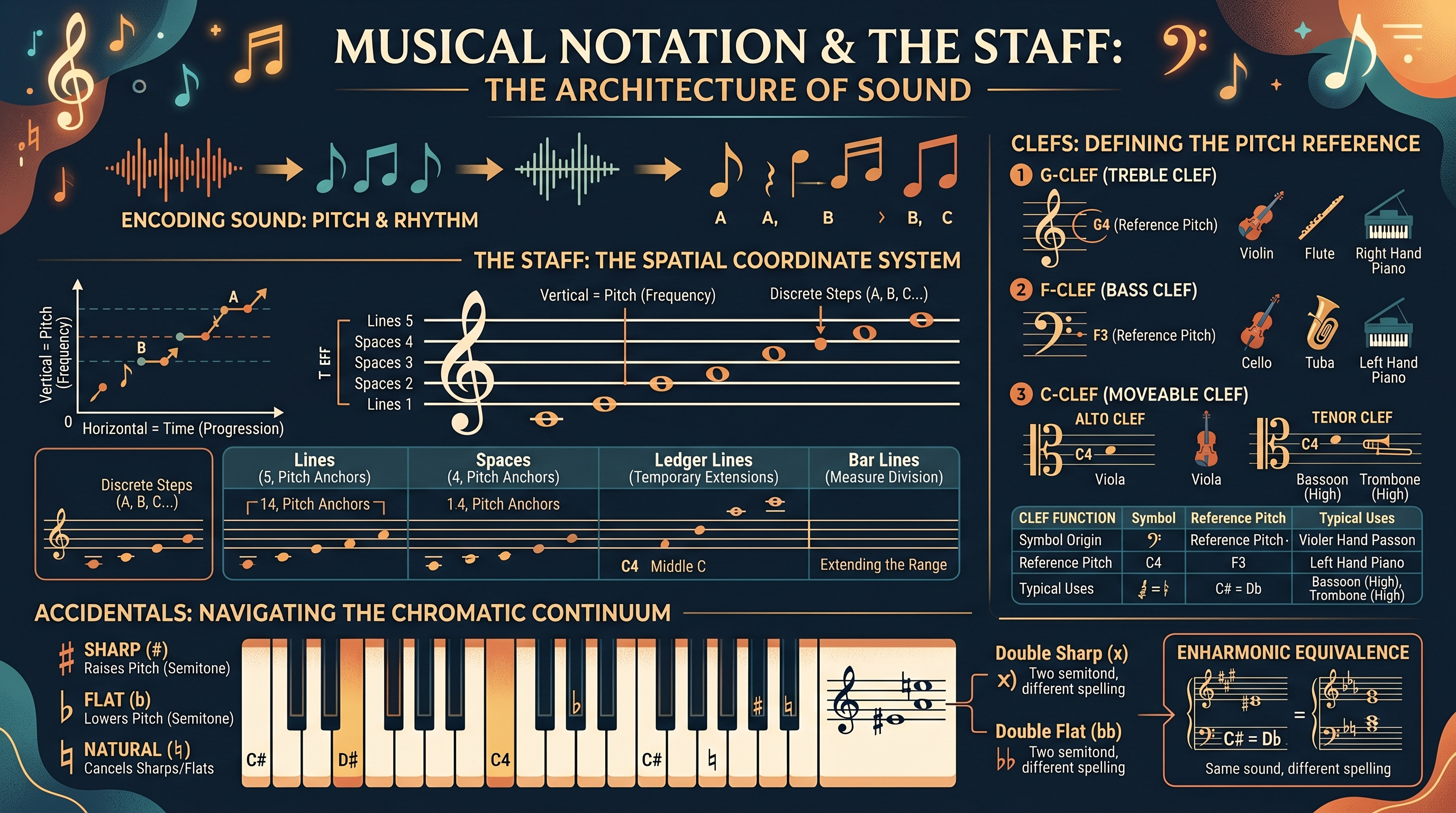
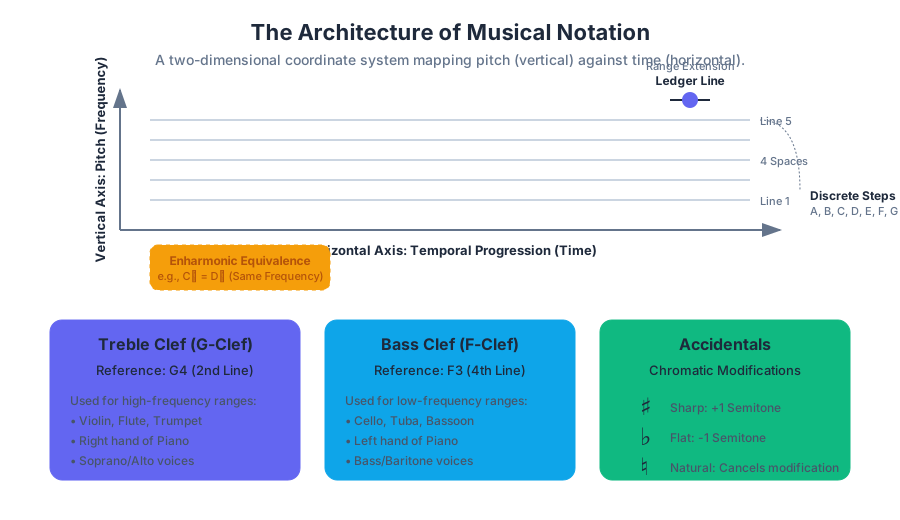
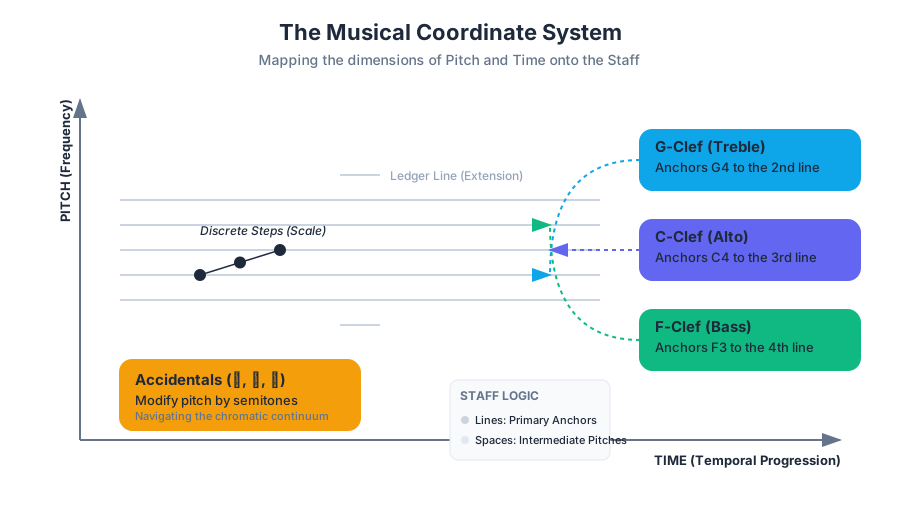
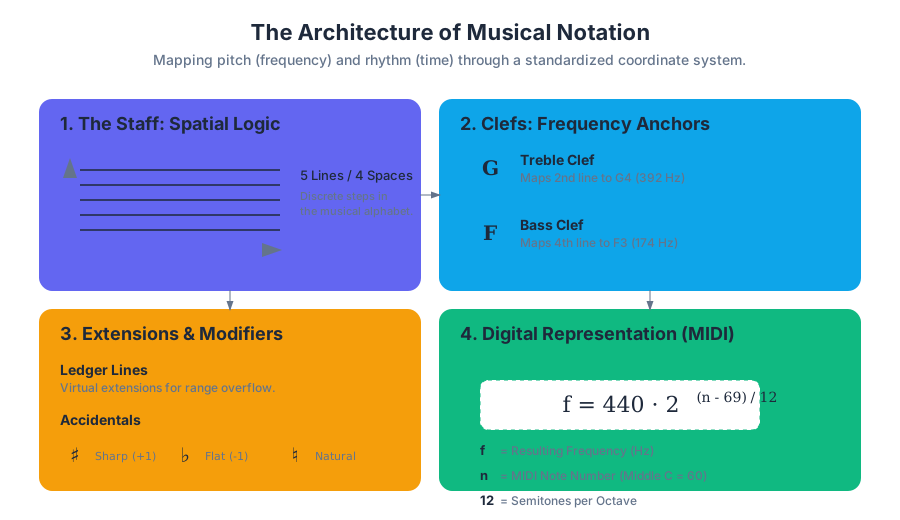
Musical notation is a sophisticated symbolic language designed to encode the two primary dimensions of sound: pitch (frequency) and rhythm (time). At its core, Western notation functions as a two-dimensional coordinate system where the vertical axis represents pitch height and the horizontal axis represents temporal progression. By standardizing these elements, notation allows for the preservation, transmission, and complex synchronization of musical ideas across time and geography.
Definition: Musical notation is a discrete representation of a continuous acoustic spectrum. It transforms the fluid nature of sound into a set of actionable instructions for performers, balancing precision with the interpretive flexibility required for artistic expression.
The Staff: The Spatial Coordinate System
The staff (plural: staves) is the foundational grid of Western music. It consists of five equidistant horizontal lines and the four intervening spaces. Each line and space represents a specific pitch within a given musical scale.
Mechanics of the Staff
The staff operates on a relative-pitch basis until a clef is applied. Without a clef, a note on the middle line is simply "the middle line." Once a clef is assigned, that line is mapped to a specific frequency.
- Verticality: Moving upward on the staff corresponds to an increase in frequency (higher pitch).
- Horizontality: Moving from left to right corresponds to the passage of time.
- Discrete Steps: Each adjacent line and space represents a "step" in the musical alphabet (A, B, C, D, E, F, G).
| Component | Function | Capacity |
|---|---|---|
| Lines | Primary pitch anchors | 5 lines per staff |
| Spaces | Intermediate pitch anchors | 4 spaces per staff |
| Ledger Lines | Temporary extensions | Infinite (theoretically), typically 1-5 |
| Bar Lines | Temporal grouping | Divides staff into measures (bars) |
Ledger Lines: Extending the Range
Because the human hearing range and instrument capabilities far exceed the nine pitches available on a single five-line staff, ledger lines are employed. These are short, horizontal lines drawn above or below the staff to accommodate notes that fall outside its primary boundaries. They function as "virtual" extensions of the staff, maintaining the same spacing and logic as the permanent lines.
Clefs: Defining the Pitch Reference
A clef is a graphical symbol placed at the beginning of a staff that assigns a specific pitch to one of the lines, thereby "locking" the entire staff into a specific frequency range.
The Three Primary Clef Families
- G-Clef (Treble Clef): The curl of the G-clef circles the second line from the bottom, designating it as G4 (the G above middle C). It is used for high-range instruments like the violin, flute, and the right hand of the piano.
- F-Clef (Bass Clef): The two dots of the F-clef surround the fourth line from the bottom, designating it as F3 (the F below middle C). It is used for low-range instruments like the cello, tuba, and the left hand of the piano.
- C-Clef (Moveable Clef): The center of the C-clef points to Middle C (C4). Unlike G and F clefs, the C-clef is "moveable." When centered on the third line, it is the Alto Clef (used by the viola); when on the fourth line, it is the Tenor Clef (used by bassoons and trombones in their upper registers).
| Clef Name | Symbol Origin | Reference Pitch | Primary Use Cases |
|---|---|---|---|
| Treble | Stylized 'G' | G4 (2nd line) | Soprano voices, Guitar, Trumpet |
| Bass | Stylized 'F' | F3 (4th line) | Bass voices, Double Bass, Timpani |
| Alto | Stylized 'C' | C4 (3rd line) | Viola, Alto Trombone |
| Tenor | Stylized 'C' | C4 (4th line) | Cello (high), Bassoon (high) |
Accidentals: Navigating the Chromatic Continuum
While the staff and clef define the "natural" notes (the white keys on a piano), music frequently requires pitches that fall between these steps. Accidentals are symbols placed to the left of a note head to modify its pitch by a semitone (half-step).
Types of Accidentals
- Sharp (#): Raises the pitch by one semitone.
- Flat (b): Lowers the pitch by one semitone.
- Natural (♮): Cancels a previous sharp or flat, returning the note to its "natural" state.
- Double Sharp (x) / Double Flat (bb): Raises or lowers the pitch by two semitones (a whole step).
The Principle of Enharmonic Equivalence
Because Western music typically uses Equal Temperament, some pitches can be "spelled" in different ways despite sounding the same frequency. For example, C# and Db are enharmonically equivalent. The choice of spelling depends on the musical context (the key signature or the direction of the melodic line).
Key Insight: Accidentals follow a "measure-wide" scope. An accidental applied to a note remains in effect for that specific pitch for the remainder of the measure, unless cancelled by another accidental or a bar line.
Intervals: The Distance Between Pitches
An interval is the measurement of the distance in pitch between two notes. Intervals are the building blocks of both melody (horizontal) and harmony (vertical).
Classification and Quality
Intervals are defined by two components:
- Quantity (Number): The number of staff positions (lines and spaces) the interval spans.
- Quality: The specific character of the interval (Major, Minor, Perfect, Augmented, Diminished), determined by the exact number of semitones.
The Overtone Series and Consonance
The concept of consonance (stability) and dissonance (tension) is rooted in the physics of the Natural Overtone Series. When a string vibrates, it produces a fundamental frequency plus a series of higher partials. Intervals with simple mathematical ratios (e.g., Octave 2:1, Perfect Fifth 3:2) are perceived as more consonant.
| Interval Name | Semitones | Frequency Ratio | Consonance Level |
|---|---|---|---|
| Unison | 0 | 1:1 | Perfect Consonance |
| Octave | 12 | 2:1 | Perfect Consonance |
| Perfect 5th | 7 | 3:2 | Perfect Consonance |
| Major 3rd | 4 | 5:4 | Imperfect Consonance |
| Minor 2nd | 1 | 16:15 | Sharp Dissonance |
| Tritone | 6 | √2:1 | Ambiguous/Dissonant |
Scales and Tonality: The Pitch Set
A scale is an ordered collection of pitches that provides the raw material for a piece of music. Most Western music is tonal, meaning it revolves around a central pitch called the tonic.
The Diatonic Framework
The most common scales are diatonic, consisting of seven notes. The structure of these scales is defined by a specific pattern of Whole steps (W) and Half steps (H).
- Major Scale Pattern: W - W - H - W - W - W - H
- Natural Minor Scale Pattern: W - H - W - W - H - W - W
Mathematical Derivation of Scales
We can represent the construction of a Major scale as a sequence of semitone offsets from the tonic $P_0$.
$$P_{scale} = {P_0, P_0+2, P_0+4, P_0+5, P_0+7, P_0+9, P_0+11, P_0+12}$$
Where $P_0$ is the MIDI index of the starting note.
Melody and Harmony: Linear vs. Vertical Organization
Music organizes pitches in two directions:
- Melody (Horizontal): A sequence of notes perceived as a single entity. Melodies are characterized by their contour (ascending, descending, arch-shaped) and motion (conjunct/stepwise vs. disjunct/leaping).
- Harmony (Vertical): The simultaneous sounding of two or more pitches. In Western music, harmony is primarily tertian, meaning it is built by stacking intervals of a third.
Chords and Triads
The most basic unit of harmony is the triad, a three-note chord consisting of a root, a third, and a fifth.
- Major Triad: Root + Major 3rd + Perfect 5th (Bright, stable)
- Minor Triad: Root + Minor 3rd + Perfect 5th (Dark, somber)
- Diminished Triad: Root + Minor 3rd + Diminished 5th (Tense, unstable)
Structural Units
- Motive: A short, recurring musical fragment (e.g., the four-note opening of Beethoven's 5th).
- Phrase: A musical "sentence" ending in a cadence (a point of rest).
- Theme: A longer melodic idea that serves as the basis for a composition.
Rhythm and Meter: The Temporal Grid
While the staff handles pitch, the time signature and meter handle the organization of time.
Time Signatures
A time signature consists of two numbers:
- Top Number: How many beats are in each measure.
- Bottom Number: Which note value receives one beat (4 = quarter note, 8 = eighth note, etc.).
Meter Types
- Simple Meter: The beat is divided into two equal parts (e.g., 2/4, 3/4, 4/4).
- Compound Meter: The beat is divided into three equal parts (e.g., 6/8, 9/8, 12/8).
- Duple, Triple, and Quadruple: Refers to the number of beats per measure (2, 3, or 4).
| Meter Type | Time Signature | Beat Division | Stress Pattern |
|---|---|---|---|
| Simple Duple | 2/4 | 1 & 2 & | Strong - weak |
| Simple Triple | 3/4 | 1 & 2 & 3 & | Strong - weak - weak |
| Compound Duple | 6/8 | 1-2-3, 4-5-6 | Strong - weak |
| Common Time | 4/4 (C) | 1 & 2 & 3 & 4 & | Strong - weak - Semi-strong - weak |
Common Pitfalls and Misconceptions
- Clef Misreading: A common error for beginners is forgetting that the same line on a Treble staff is a different pitch on a Bass staff. Always check the clef first.
- Accidental Scope: Forgetting that an accidental persists through the measure. If a C# appears in beat 1, any C in beat 3 of the same measure is also C# unless marked with a natural sign.
- Enharmonic Confusion: Writing a D# in the key of F Major. While D# and Eb sound the same, F Major requires an Eb to maintain the correct "alphabetical" sequence of the scale (F-G-A-Bb-C-D-E).
- Beat vs. Rhythm: Rhythm is the actual pattern of durations; meter is the underlying "pulse" or grid. You can have a complex rhythm over a very simple meter.
Conclusion: The Unified Protocol
Musical notation is more than just "dots on a page." It is a highly optimized data protocol that has evolved over a millennium to solve the problem of synchronizing human performance. By combining the spatial logic of the staff, the frequency-locking power of clefs, the chromatic flexibility of accidentals, and the temporal discipline of meter, notation provides a complete framework for the most complex of human expressions.
Source Materials
Study Music Appreciation 1 on Lykke
This course page is free to open: signed out, you can read its first two sections, and signing in, on any plan, opens the rest. The free Lykke Chrome extension syncs your own Canvas courses, so ChatGPT, Claude and Muse can answer from your classes and deadlines. It only reads Canvas.
Add the free extensionSign in to open every sectionAll sections of Music Appreciation 1 · Browse more course pages