From the free course Music Appreciation 1 on Lykke
Musical Form and Phrasing
Key concepts: Musical Form · Strophic Form · Rondo · Antecedent and Consequent · Period
The structural blueprint of music, from small phrases to large-scale organization.
Musical Form and Phrasing
In the study of musicology and composition, Musical Form represents the architectural blueprint of a piece—the "big picture" organization that governs how a listener perceives time. While melody and harmony provide the immediate sensory data, form provides the cognitive framework that allows a listener to make sense of repetition, contrast, and variation. Without form, music remains a stream of consciousness; with form, it becomes a structured narrative.
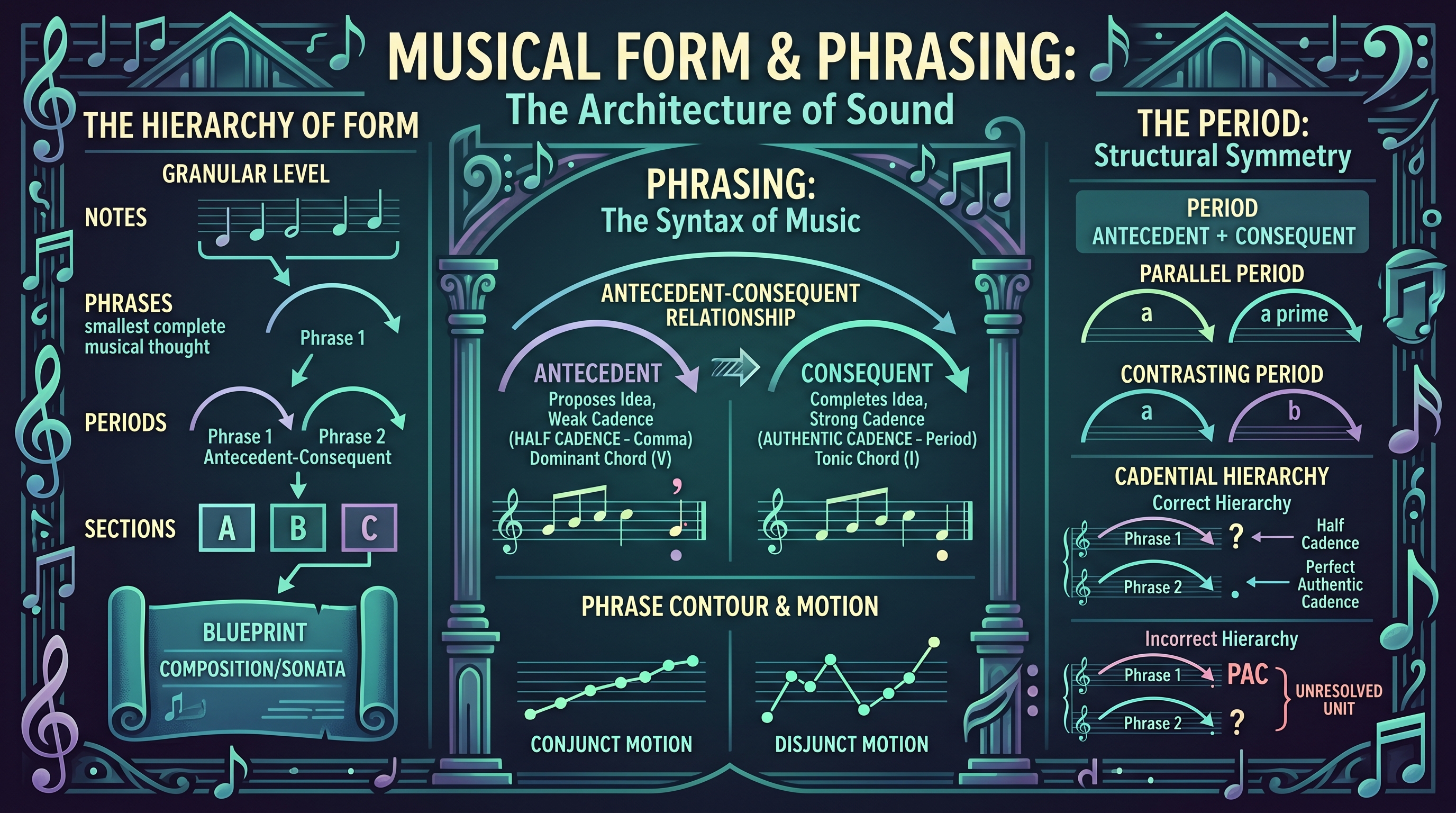
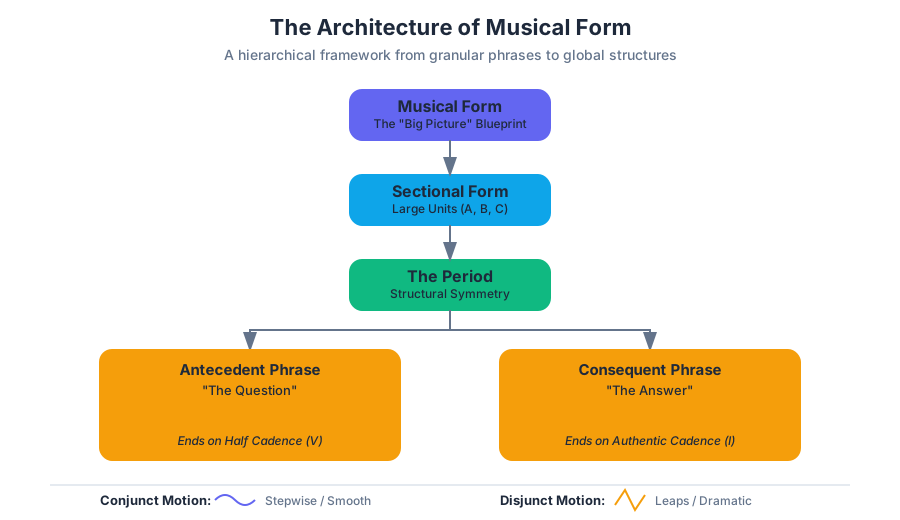
At its most granular level, form is built from Phrases, which are organized into Periods, which in turn aggregate into larger sections labeled by letters (A, B, C). This hierarchical system allows for the creation of everything from a simple four-chord folk song to a complex mahlerian symphony.
Phrasing: The Syntax of Music
A Phrase is the smallest complete musical thought. Much like a sentence in prose, a phrase has a beginning, a middle, and an end. It is defined not just by its melodic content, but by its Cadence—the point of arrival or rest that signals the conclusion of the thought.
Melodic Contour and Motion
The internal logic of a phrase is often defined by its Contour (the shape of the melody) and its Motion.
- Conjunct Motion: The melody moves by small, stepwise intervals (e.g., C to D). This creates a smooth, lyrical feel.
- Disjunct Motion: The melody moves by large leaps (e.g., C to G). This creates a sense of tension or drama.
- Range: The distance between the lowest and highest notes. A Narrow Range is typical of folk songs, while a Wide Range is common in operatic arias.
Antecedent and Consequent
In Western classical music, phrases rarely exist in isolation. They are typically paired in a "call and response" relationship known as Antecedent and Consequent.
Definition: The Antecedent is the "questioning" phrase, usually ending on a weak or "open" cadence (like a Half Cadence). The Consequent is the "answering" phrase, which resolves the tension by ending on a strong or "closed" cadence (like an Authentic Cadence).
| Feature | Antecedent Phrase | Consequent Phrase |
|---|---|---|
| Function | Proposes a musical idea; creates tension. | Completes the idea; resolves tension. |
| Harmonic Goal | Often ends on the Dominant (V) chord. | Ends on the Tonic (I) chord. |
| Punctuation | Half Cadence (Comma). | Authentic Cadence (Period). |
| Listener Expectation | Expectation of continuation. | Sense of finality or arrival. |
The Period: Structural Symmetry
When an antecedent and a consequent phrase are joined together, they form a Period. The period is the fundamental building block of "Classical" style, providing a sense of balance and symmetry.
Types of Periods
- Parallel Period: The two phrases begin with the same or very similar melodic material. If the first phrase is
a, the second isa'. - Contrasting Period: The two phrases are melodically distinct. If the first phrase is
a, the second isb. - Double Period: A larger structure consisting of four phrases, where the first two act as a large antecedent and the last two act as a large consequent.
Cadential Hierarchy
The integrity of a period depends on the Cadential Hierarchy. For a period to be perceived as a single unit, the final cadence of the second phrase must be stronger than the cadence of the first phrase. If the first phrase ends on a Perfect Authentic Cadence (PAC), the second phrase cannot "resolve" it further, and the sense of a two-phrase unit is lost.
| Period Type | Phrase 1 Cadence | Phrase 2 Cadence | Melodic Relationship |
|---|---|---|---|
| Parallel | Half Cadence (HC) | Perfect Authentic (PAC) | Similar (a, a') |
| Contrasting | Half Cadence (HC) | Perfect Authentic (PAC) | Different (a, b) |
| Interrupted | PAC in new key | PAC in home key | Variable |
Sectional Forms: The Architecture of Repetition
Once we move beyond the phrase and period, we enter the realm of Sectional Form. These are the structures used to organize entire movements or songs. We use capital letters (A, B, C) to denote these large sections.
Strophic Form (AAA...)
Strophic Form is the simplest structural design. In this form, the same music is repeated for every stanza of text. While the lyrics change, the melody, harmony, and rhythm remain constant.
- Usage: Hymns, folk songs, and most "verse-only" popular music.
- Pros: Highly memorable; focuses the listener's attention on the text.
- Cons: Can become monotonous if the melody is not sufficiently engaging.
Binary Form (AB)
Binary Form consists of two contrasting sections.
- Section A: Usually moves from the tonic to a related key (like the dominant).
- Section B: Usually moves back to the tonic.
In many Baroque dances (Allemande, Courante), both sections are repeated:
||: A :||: B :||.
Ternary Form (ABA)
Ternary Form introduces the concept of Statement, Contrast, and Return.
- A: The initial statement.
- B: A contrasting section (different key, mood, or texture).
- A: A return to the original material, providing closure.
Key Insight: The return of 'A' in Ternary form is psychologically powerful. It satisfies the listener's desire for symmetry and resolution, a principle that underpins almost all Western art music.
Formal Grammar Representation
We can represent these structures using a formal grammar (Backus-Naur Form) to show the recursive nature of musical organization.
Rondo Form: The Principle of the Refrain
The Rondo is a form characterized by a recurring main theme (the Refrain) that alternates with contrasting episodes. It is often described as a "musical sandwich" where the bread (A) keeps coming back.
Structure of a Rondo
The most common patterns are:
- 5-Part Rondo: A B A C A
- 7-Part Rondo: A B A C A B A (also known as the Sonata-Rondo)
The A section (Refrain) is typically in the tonic key and is tuneful and easily recognizable. The B and C sections (Episodes) explore different keys and often feature more virtuosic or developmental material.
| Element | Role | Key Characteristics |
|---|---|---|
| Refrain (A) | The "Home Base" | Tonic key, catchy melody, stable structure. |
| Episode (B) | First Contrast | Usually in a closely related key (Dominant or Relative Major). |
| Episode (C) | Second Contrast | Often more dramatic, distant key, or rhythmic shift. |
| Transitions | The "Glue" | Lead the listener from the Refrain to the Episode. |
| Retransition | The "Return" | Specifically designed to prepare the return of the Tonic for the Refrain. |
Real-World Example: Beethoven’s "Für Elise"
"Für Elise" is a classic example of a Five-part Rondo (A B A C A).
- A: The famous main theme in A minor.
- B: A brighter, more playful section in F major.
- A: Return of the main theme.
- C: A stormy, agitated section with repeated bass notes.
- A: Final return of the main theme.
Motive, Theme, and Leitmotif
While phrasing deals with the length of musical thoughts, Thematic Development deals with the "characters" within those thoughts.
- Motive: The smallest identifiable musical fragment. It can be a rhythmic pattern, a melodic interval, or both. Think of the four-note opening of Beethoven's 5th Symphony (Short-Short-Short-Long).
- Theme: A longer musical idea, often a full phrase or period, that serves as the basis for a composition.
- Leitmotif: A motive or theme associated with a specific person, object, idea, or emotion. This is a core technique in Wagnerian opera and modern film scoring (e.g., John Williams' Star Wars themes).
Variation Techniques
How do composers keep a form interesting? They vary the motives.
- Inversion: Turning the melody upside down.
- Retrograde: Playing the melody backwards.
- Augmentation: Doubling the note values (slowing it down).
- Diminution: Halving the note values (speeding it up).
- Fragmentation: Using only a small piece of the original motive.
Common Pitfalls in Analyzing Form
- Confusing "Section" with "Phrase": A section is a large-scale division (like a verse or chorus), while a phrase is a single "sentence" within that section.
- Ignoring the Cadence: You cannot determine the end of a phrase by counting measures alone. You must listen for the harmonic arrival. Some phrases are 3 measures long; others are 9.
- Over-reliance on Letters: While
ABAis a helpful shorthand, music is fluid. Sometimes a section is "A-ish" but has changed so much it might as well beC. Context matters. - The "Ternary vs. Rounded Binary" Trap: In Rounded Binary (
||: A :||: B A' :||), the return of A happens within the second repeated section. In true Ternary (A B A), the sections are usually more independent and self-contained.

Source Materials
Study Music Appreciation 1 on Lykke
This course page is free to open: signed out, you can read its first two sections, and signing in, on any plan, opens the rest. The free Lykke Chrome extension syncs your own Canvas courses, so ChatGPT, Claude and Muse can answer from your classes and deadlines. It only reads Canvas.
Add the free extensionSign in to open every sectionAll sections of Music Appreciation 1 · Browse more course pages