From the free course Music Appreciation 1 on Lykke
Motifs and Theme & Variations
Key concepts: Motif (Motive) · Leitmotif · Theme and Variations · Musical Development
How small musical ideas are developed and varied throughout a composition.
Motifs and Theme & Variations: The Architecture of Musical Development
In the study of musicology and composition, the transition from a simple sequence of notes to a coherent, large-scale masterpiece is governed by the principles of Musical Development. While melody and harmony provide the "colors" and "textures" of a piece, the Motif and the Theme and Variations form provide the "blueprint" and "engineering" required to sustain a listener's interest over time.
At its core, musical development is the process of taking a singular musical idea—a "seed"—and subjecting it to various transformations to explore its full potential. This section explores the hierarchy of musical units, the psychological power of recurring symbols, and the formal structures that allow a single theme to wear a thousand different masks.
The Motif (Motive): The Atomic Unit of Composition
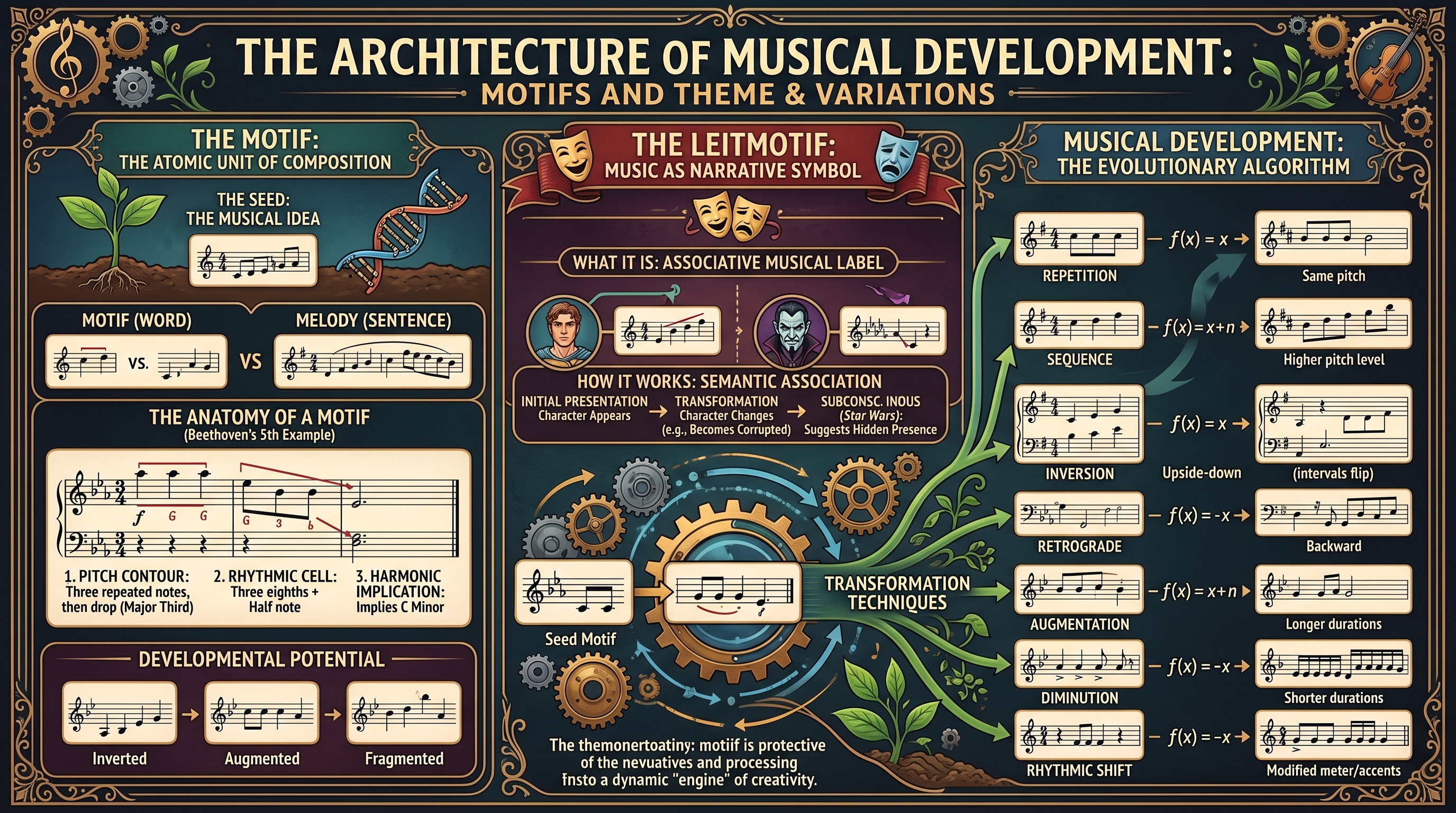
A Motif (or motive) is the smallest recognizable structural unit in music. It is a short musical fragment—often just a few notes or a distinct rhythmic pattern—that retains its identity even when modified.
What it is
Technically, a motif must possess a distinct contour (the shape of its melody) and a specific rhythmic profile. While a melody is a complete "sentence," a motif is a "word" or even a "syllable."
Definition: A Motif is a recurring fragment or successive sequence of notes that has symbolic importance in or is characteristic of a composition. It is the "DNA" of a musical work.
Why it matters
Motifs provide unity and economy. Instead of writing five minutes of entirely new material, a composer like Beethoven can build an entire movement out of a four-note motif. This creates a sense of "organic growth," where the music feels like it is evolving naturally from a single source.
How it works: The Anatomy of a Motif
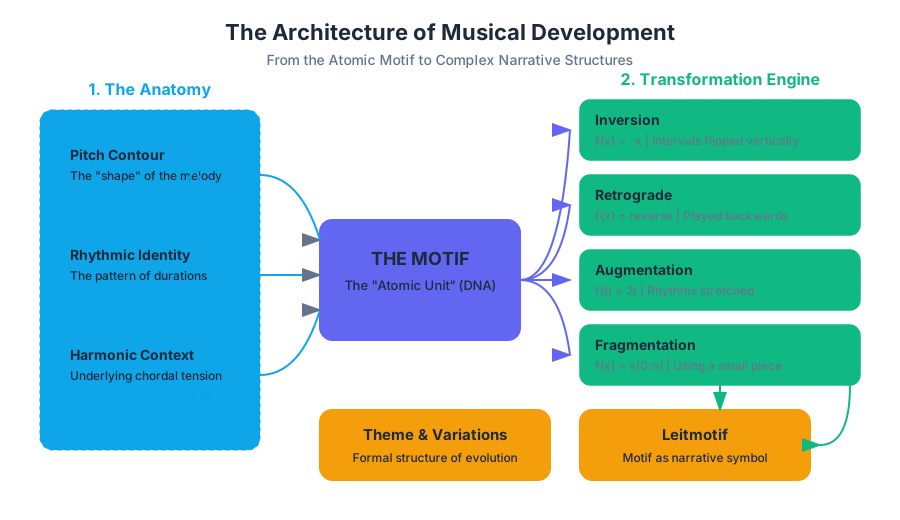
A motif is defined by three primary vectors:
- Intervalic Content: The specific distance between the pitches (e.g., a perfect fifth followed by a minor second).
- Rhythmic Identity: The pattern of durations (e.g., short-short-short-long).
- Harmonic Context: The underlying chordal structure that gives the pitches their "tension" or "resolution."
| Feature | Description | Example (Beethoven's 5th) |
|---|---|---|
| Pitch Contour | The "shape" of the notes (up, down, static). | Three repeated notes, then a drop of a major third. |
| Rhythmic Cell | The smallest unit of time organization. | $\delta \delta \delta \text{--} \eta$ (Three eighths and a half note). |
| Harmonic Implication | The suggested tonality. | Implies C Minor, though the first four notes are tonally ambiguous. |
| Developmental Potential | How easily it can be changed. | High; can be inverted, stretched, or layered. |
The Leitmotif: Music as Narrative Symbol
While all leitmotifs are motifs, not all motifs are leitmotifs. The Leitmotif (leading motive) is a functional evolution of the motif, popularized by Richard Wagner in his "Ring Cycle" operas.
What it is
A Leitmotif is a recurring musical theme associated with a specific person, object, place, or abstract idea. It functions as a "musical label." When the audience hears the "Sword Motif," they think of the physical sword, even if it isn't visible on stage.
How it works: Semantic Association
The power of the leitmotif lies in the brain's ability to form associative memories.
- Initial Presentation: The motif is played while the character/object is introduced.
- Transformation: As the character changes (e.g., becomes corrupted or heroic), the leitmotif is altered (e.g., shifted from a Major scale to a Chromatic or Minor scale).
- Subconscious Cueing: The leitmotif can be played softly in the background to suggest a character's thoughts or a hidden presence.
Concrete Example: Modern Film Scoring
John Williams' score for Star Wars is the most famous modern application of leitmotifs.
- The Force Theme: A yearning, ascending melody in a minor key that suggests destiny and mystery.
- Imperial March: A rigid, disjunct, and rhythmically driving motif that represents Darth Vader and the mechanical nature of the Empire.
Musical Development: The "Evolutionary" Algorithm
Musical Development is the engine that drives a motif forward. Composers use a specific set of "operations" to transform a motif while keeping it recognizable to the listener.
Transformation Techniques
| Technique | Description | Mathematical/Logical Analogy |
|---|---|---|
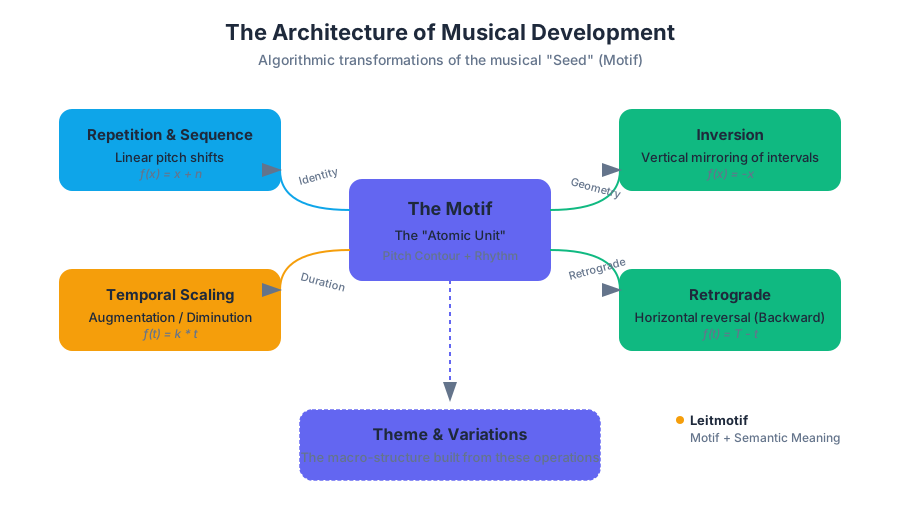
| Repetition | Playing the motif again at the same pitch. | $f(x) = x$ |
| Sequence | Repeating the motif at a higher or lower pitch level. | $f(x) = x + n$ |
| Inversion | Flipping the motif upside down (intervals move in the opposite direction). | $f(x) = -x$ |
| Retrograde | Playing the motif backward. | $f(x) = x_{reverse}$ |
| Augmentation | Stretching the rhythms (e.g., doubling the length of every note). | $f(t) = 2t$ |
| Diminution | Compressing the rhythms (e.g., halving the length of every note). | $f(t) = 0.5t$ |
| Fragmentation | Using only a small piece of the original motif. | $f(x) = x[0:2]$ |
Theme and Variations: The Structural Framework
Theme and Variations is a formal technique where a composer presents a self-contained musical idea (the Theme) and then follows it with a series of modified versions (the Variations).
The Structure: $A - A^1 - A^2 - A^3 ... A^n$
The theme is usually a complete melody with a clear phrase structure (often Antecedent and Consequent phrases). Each variation typically maintains the same length and basic harmonic structure as the theme but changes one or more "parameters."
Parameters of Variation
A variation can alter any of the fundamental elements of music:
- Melodic Variation: Adding ornaments (trills, turns) or changing the contour from conjunct to disjunct motion.
- Rhythmic Variation: Changing the meter (e.g., from 4/4 simple time to 6/8 compound time) or adding syncopation.
- Harmonic Variation: Changing the underlying chords (e.g., substituting a Major triad with a Diminished 7th chord) or shifting the tonal center (Key).
- Textural Variation: Changing the "thickness" of the music (e.g., moving from a single melodic line to a complex polyphonic web).
Mathematical Representation of Variation Complexity
We can view the "distance" of a variation from its theme as a function of the number of parameters changed.
\text{Variation Distance} (D) = \sum_{i=1}^{n} w_i |P_{theme, i} - P_{var, i}|
Where:
- $P_i$ represents a musical parameter (Pitch, Rhythm, Dynamics, Texture).
- $w_i$ is the "weight" or importance of that parameter to the listener's recognition.
Comparison of Variation Types
| Type | Focus | Complexity | Listener Experience |
|---|---|---|---|
| Ornamental | Embellishing the melody. | Low | "The theme is wearing jewelry." |
| Character | Changing the mood (e.g., a march to a waltz). | Medium | "The theme is in a different world." |
| Harmonic | Keeping the melody but changing the chords. | High | "The theme feels darker or more tense." |
| Contrapuntal | Adding overlapping melodies (Fugue/Canon). | Very High | "The theme is talking to itself." |
Case Study: The "Fate" Motif in Beethoven’s 5th Symphony
To understand how these concepts synthesize, we must look at the first movement of Beethoven's Symphony No. 5.
- The Motif: $G-G-G-Eb$. (Short-Short-Short-Long).
- Initial Development: Beethoven immediately uses a Sequence, repeating the motif one step lower ($F-F-F-D$).
- Expansion: He then uses Fragmentation, taking just the two-note drop and repeating it across different instruments (Violins to Violas to Cellos).
- Harmonic Tension: He places the motif over a Dissonant chord to create a sense of urgency, eventually resolving it to the Tonic (C Minor).
- Thematic Integration: Later in the movement, the "Fate" rhythm appears in the horns as a background accompaniment to a new, lyrical melody. This is a brilliant use of a motif to provide structural "glue."
Common Pitfalls in Analysis
- Confusing Motif with Melody: A melody is a complete thought; a motif is a fragment. If you can't "hum" it as a finished song, it's likely a motif.
- Over-identifying Leitmotifs: Not every recurring note is a leitmotif. To be a leitmotif, there must be a clear, consistent extramusical association (e.g., a character or an emotion).
- Missing the Harmonic Skeleton: In Theme and Variations, students often focus only on the melody. However, the most sophisticated variations often keep the chords the same while completely discarding the original melody.
Summary of Musical Organization
The organization of music is a hierarchical system. Notes form intervals; intervals form motifs; motifs form phrases; phrases form themes; and themes are developed into entire movements.
Key Insight: Musical development is the art of balancing Repetition (which provides comfort and recognition) with Variation (which provides surprise and interest).
Glossary of Terms for Review
- Antecedent/Consequent: A pair of musical phrases that function like a question and answer.
- Conjunct Motion: Melodic movement by small steps (adjacent notes on a scale).
- Disjunct Motion: Melodic movement by large leaps (skipping notes).
- Tertian Harmony: Chords built primarily using intervals of thirds (the basis of Western harmony).
- Tonic: The "home" note or tonal center of a scale (the '1' in a 1-7 scale).
- Consonance: Intervals that sound stable and restful (e.g., Octaves, Perfect Fifths).
- Dissonance: Intervals that sound tense and require resolution (e.g., Tritones, Minor Seconds).
Source Materials
Study Music Appreciation 1 on Lykke
This course page is free to open: signed out, you can read its first two sections, and signing in, on any plan, opens the rest. The free Lykke Chrome extension syncs your own Canvas courses, so ChatGPT, Claude and Muse can answer from your classes and deadlines. It only reads Canvas.
Add the free extensionSign in to open every sectionAll sections of Music Appreciation 1 · Browse more course pages