From the free course Music Appreciation 1 on Lykke
Melody: Characteristics and Structure
Key concepts: Contour · Conjunct vs. Disjunct · Range · Phrases · Motives
Detailed exploration of melodic lines, including contour, motion, and the units that form a melody.
Melody: Characteristics and Structure
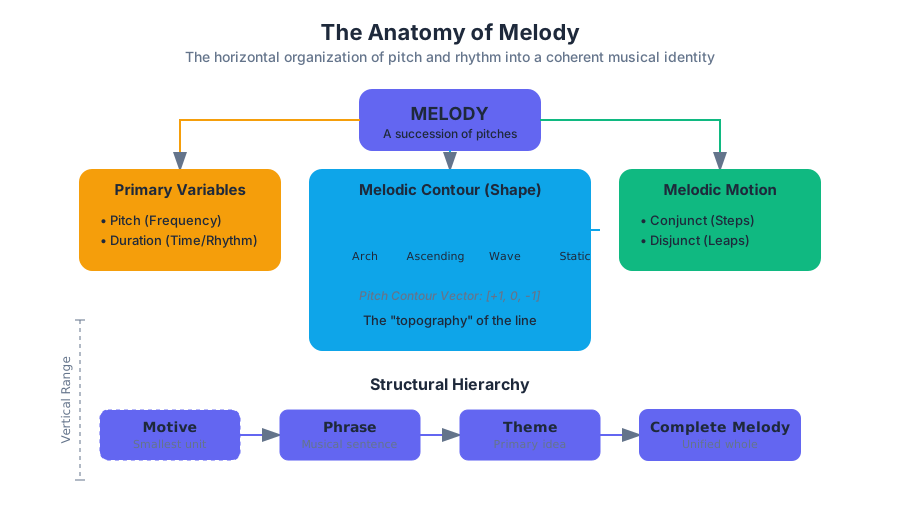
Melody is the primary "horizontal" axis of musical organization. While harmony deals with the vertical stacking of pitches (chords), melody is a timely arranged linear sequence of pitched sounds that the listener perceives as a single, coherent entity. It is the "identity" of a musical work—the element most easily remembered, hummed, or whistled. From a structural perspective, a melody is not merely a random string of notes; it is a sophisticated system of intervals, rhythms, and shapes that follow specific psychological and physical constraints.
The Fundamental Nature of Melody
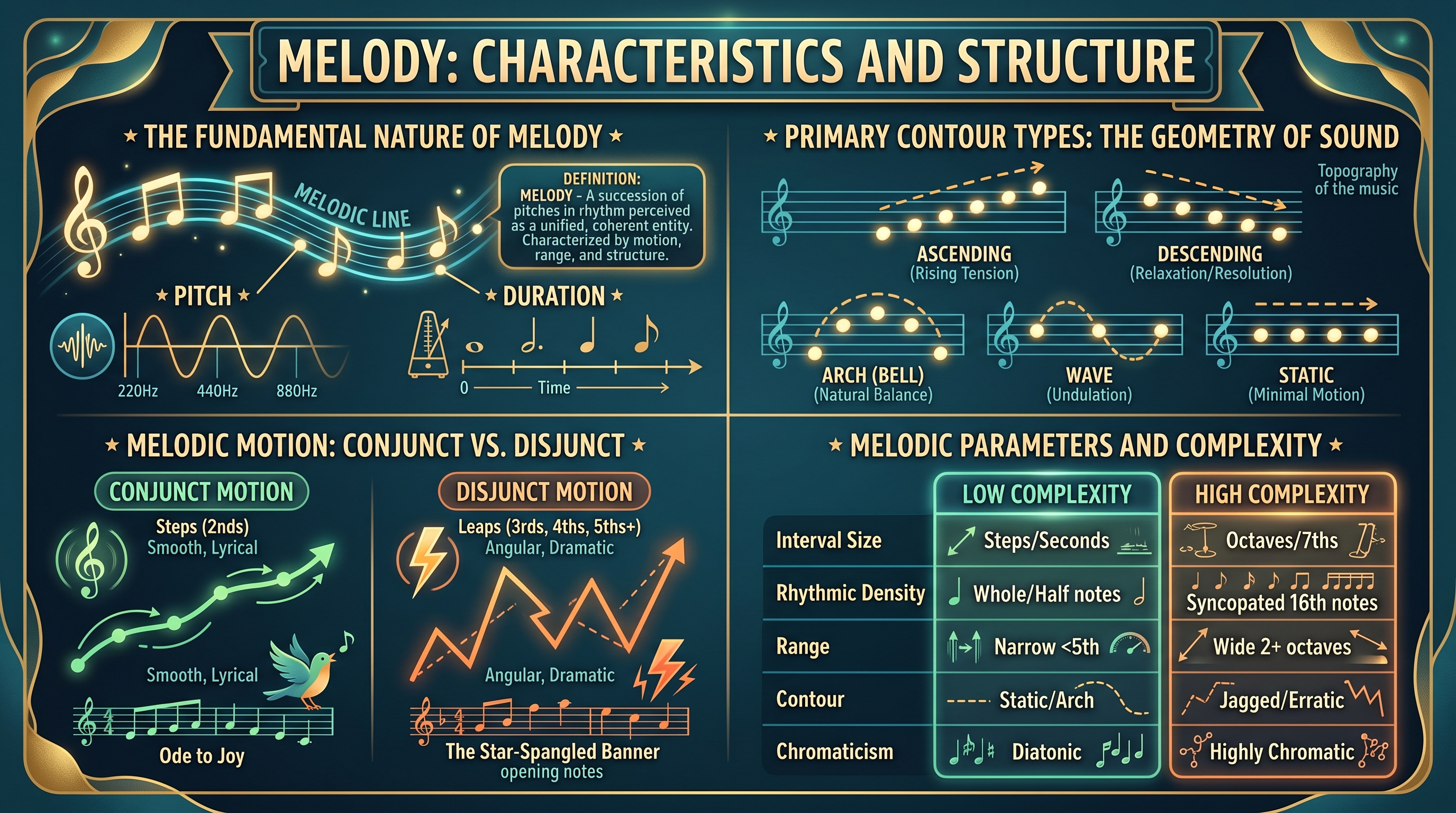
At its most basic level, a melody consists of two variables: pitch (the frequency of the sound) and duration (the length of time the sound lasts). When these are strung together, the human brain performs "auditory scene analysis," grouping these individual events into a continuous "line." This is why we refer to a "melodic line"—it implies a physical path through musical space.
Definition: Melody A melody is a succession of pitches in rhythm that the mind perceives as a unified whole. It is characterized by its motion, range, and structural organization into phrases and motives.
Melodic Parameters and Complexity
The complexity of a melody can be quantified by several parameters, which determine its "singability" and emotional character.
| Parameter | Low Complexity | High Complexity |
|---|---|---|
| Interval Size | Seconds (Steps) | Octaves, 7ths (Leaps) |
| Rhythmic Density | Whole/Half notes | Syncopated 16th notes |
| Range | Narrow (within a 5th) | Wide (2+ octaves) |
| Contour | Static or Arch | Jagged/Erratic |
| Chromaticism | Diatonic (within the scale) | Highly Chromatic |
Melodic Contour: The Geometry of Sound
Contour refers to the overall shape of the melodic line as it moves up and down in pitch. It is the "topography" of the music. When we visualize a melody on a staff, the contour is the line created by connecting the noteheads.
Primary Contour Types
- Ascending: The melody moves from lower pitches to higher pitches. This often creates a sense of rising tension or expectation.
- Descending: The melody moves from higher to lower pitches. This is frequently associated with relaxation, resolution, or "sighing" (the lamento motif).
- Arch (Bell): The melody rises to a peak (climax) and then descends. This is the most common structure in Western classical music, providing a natural sense of balance.
- Wave: A melody that rises and falls repeatedly, creating a sense of undulation.
- Static: The melody stays around a single pitch or moves very little (e.g., a "reciting tone").
Mathematical Representation of Contour
In computational musicology, contour is often represented as a Pitch Contour Vector, where the relationship between successive notes is reduced to a simple directional change (+1 for up, -1 for down, 0 for same).
Melodic Motion: Conjunct vs. Disjunct
Melodic motion describes the distance between individual notes in the sequence. This is the "texture" of the movement.
Conjunct Motion
Conjunct motion occurs when a melody moves in small, connected intervals—primarily steps (major or minor seconds).
- Why it matters: Conjunct melodies are easier to sing because they mimic the natural limitations of the human voice.
- Example: "Ode to Joy" (Beethoven) or "Mary Had a Little Lamb."
Disjunct Motion
Disjunct motion occurs when a melody moves by leaps (intervals larger than a second, such as thirds, fifths, or octaves).
- Why it matters: Disjunct motion adds drama, energy, and virtuosity. It is often used to signal a change in emotional state or to highlight a specific word in vocal music.
- Example: "The Star-Spangled Banner" (which begins with a disjunct downward leap and continues with wide intervals).
| Feature | Conjunct Motion | Disjunct Motion |
|---|---|---|
| Intervals | Steps (2nds) | Leaps (3rds, 4ths, 5ths, etc.) |
| Feel | Smooth, flowing, lyrical | Jagged, angular, dramatic |
| Vocal Ease | High (Natural) | Low (Requires training) |
| Function | Stability, folk-like simplicity | Tension, climax, instrumental brilliance |
Melodic Range: The Vertical Span
The Range of a melody is the total distance between its lowest and highest notes. This is often described in terms of intervals (e.g., "a range of an octave").
- Narrow Range: Common in nursery rhymes, folk songs, and chants. These melodies usually stay within a 5th or 6th.
- Wide Range: Common in operatic arias and instrumental solos. These melodies may span two or three octaves, requiring significant technical skill to perform.
Tessitura vs. Range
While range defines the absolute boundaries, tessitura refers to where the melody "lies" most of the time. A melody might have a wide range but a low tessitura, meaning it occasionally hits high notes but mostly stays in the lower register.
Structural Units: Phrases, Motives, and Themes
Melodies are hierarchical. Just as a book is divided into chapters, paragraphs, and sentences, a melody is divided into structural units that provide logic and "breath."
1. Phrases
A phrase is a musical sentence. It is a unit of meaning within a larger melody that ends with a sense of pause, known as a cadence.
- Antecedent Phrase: The "question" phrase. It usually ends on a note that feels unfinished (often the 5th scale degree).
- Consequent Phrase: The "answer" phrase. It resolves the tension of the antecedent, usually ending on the tonic (the 1st scale degree).
2. Motives (Motifs)
A motive is the smallest recognizable structural unit of a melody. It is a short melodic or rhythmic fragment that is repeated and transformed throughout a piece.
- The "DNA" of Music: A motive can be as short as two notes.
- Example: The famous four-note opening of Beethoven’s Symphony No. 5 (Short-Short-Short-Long).
3. Themes
A theme is a longer melodic idea that serves as the basis for an entire movement or work. It is more complete than a motive but can be broken down into motives for development.
4. Leitmotif
A leitmotif is a specific type of motive associated with a particular person, place, thing, or idea. This concept was popularized by Richard Wagner and is the foundation of modern film scoring (e.g., the "Imperial March" in Star Wars).
Mathematical Derivation of Melodic Intervals
To understand the "distance" in melody, we must look at the frequency ratios. An interval is the ratio between two frequencies $f_1$ and $f_2$.
$$Interval (cents) = 1200 \cdot \log_2\left(\frac{f_2}{f_1}\right)$$
In Western Equal Temperament, every semitone is exactly $100$ cents. A melody can be viewed as a vector of semitone distances from a starting reference point.
\text{Melody Vector } M = \{n_0, n_1, n_2, \dots, n_k\}
\text{Interval Vector } I = \{n_1 - n_0, n_2 - n_1, \dots, n_k - n_{k-1}\}
Where $n$ represents the pitch in semitones. A positive value in the Interval Vector indicates ascending motion, while a negative value indicates descending motion.
Ornaments and Embellishments
Ornaments are "extra" notes added to a melody to provide decoration, expressiveness, or to showcase a performer's virtuosity. They are often notated with small symbols rather than full-sized notes.
| Ornament | Symbol/Name | Description |
|---|---|---|
| Trill | tr | Rapid alternation between the written note and the note above it. |
| Mordent | $\sim$ | A single rapid alternation with the note below (lower) or above (upper). |
| Turn | $S$ | A "wrap-around" the note: above, principal, below, principal. |
| Appoggiatura | Lean | A "leaning" note that takes half the value of the main note, creating dissonance. |
| Glissando | Slide | A continuous slide from one pitch to another. |
Encoding Melody with ABC Notation
ABC notation is a shorthand for representing melodies in a text-based format, often used in folk music databases and web applications.
Common Pitfalls in Melodic Analysis
- Confusing Melody with Range: A melody with many notes is not necessarily a "wide range" melody. If all those notes are within the same octave, the range is narrow.
- Ignoring Rhythm: A melody is not just a sequence of pitches. Changing the rhythm of a melody can make it unrecognizable, even if the pitches remain the same.
- Misidentifying Phrases: Listeners often mistake a motive for a phrase. A phrase must have a "breath" or a sense of completion (cadence) at the end. A motive is usually too short to stand alone as a complete thought.
- Overlooking Implied Harmony: In many melodies, the notes chosen "outline" a chord. This is called arpeggiation. Even without accompaniment, a melody can suggest its own harmony.
Summary of Melodic Structure
Melody is the "story" of the music. By manipulating contour, motion, and range, composers create emotional arcs. By organizing these lines into motives and phrases, they create a logical structure that the human ear can follow. Whether it is a simple folk tune or a complex symphonic theme, the principles of melodic construction remain the same: a balance between repetition (to provide familiarity) and variation (to provide interest).
Key Terms for Review
- Tonic: The "home" note of a melody.
- Cadence: The resting point at the end of a phrase.
- Sequence: The repetition of a melodic motive at a higher or lower pitch level.
- Inversion: Turning a melody upside down (intervals that went up now go down).
- Retrograde: Playing a melody backward.
- Augmentation: Lengthening the rhythmic values of a melody.
- Diminution: Shortening the rhythmic values of a melody.
Source Materials
Study Music Appreciation 1 on Lykke
This course page is free to open: signed out, you can read its first two sections, and signing in, on any plan, opens the rest. The free Lykke Chrome extension syncs your own Canvas courses, so ChatGPT, Claude and Muse can answer from your classes and deadlines. It only reads Canvas.
Add the free extensionSign in to open every sectionAll sections of Music Appreciation 1 · Browse more course pages