From the free course Music Appreciation 1 on Lykke
Introduction to Melody, Harmony, and Scales
Key concepts: Melody · Harmony · Scales · Musical Organization
An overview of the foundational elements of musical structure and how sounds are organized into recognizable patterns.
Introduction to Melody, Harmony, and Scales
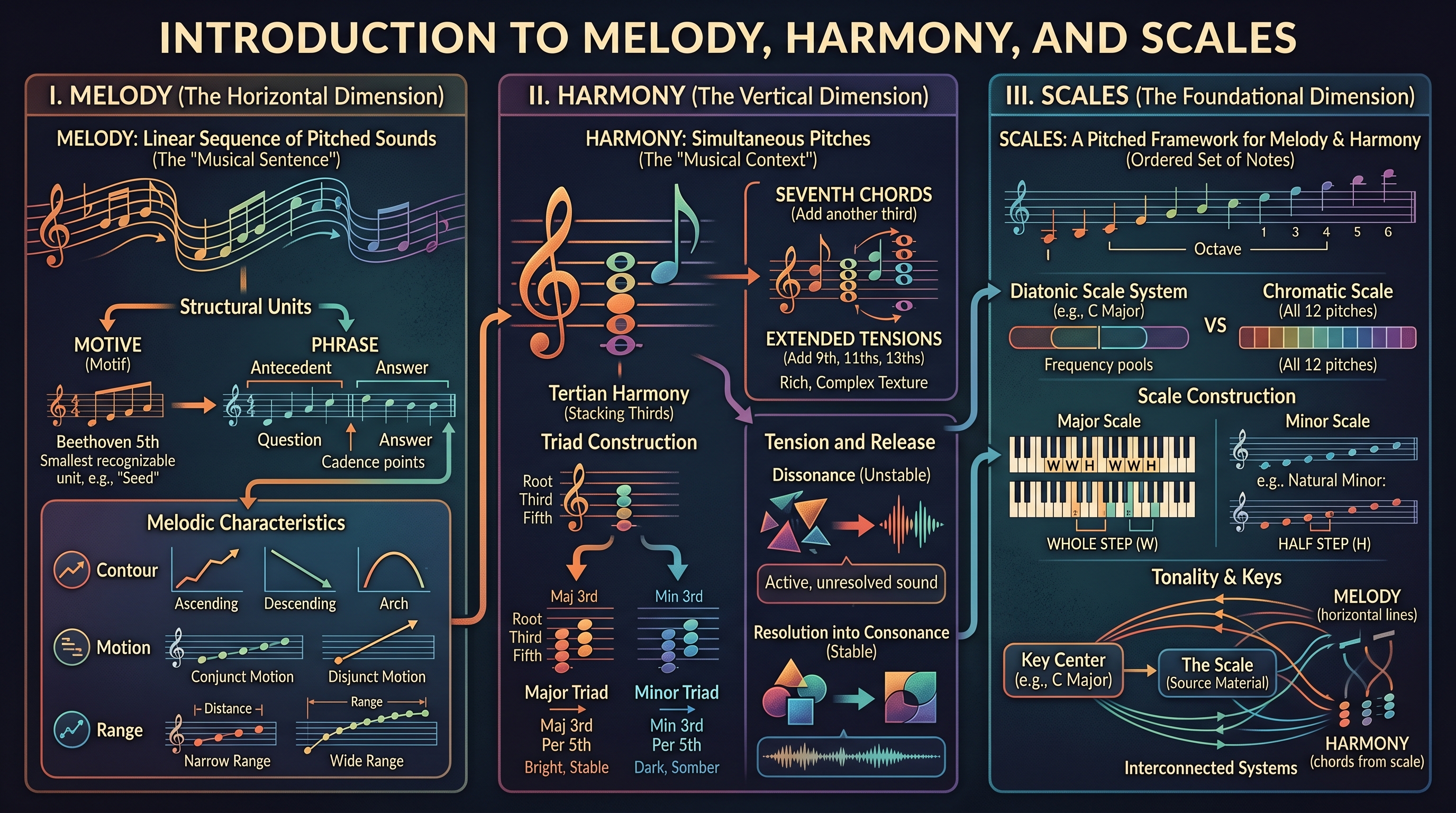
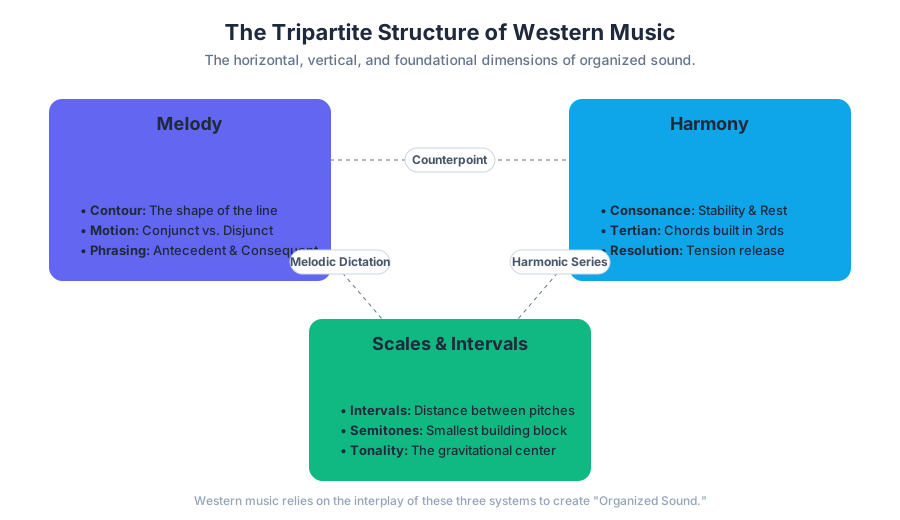
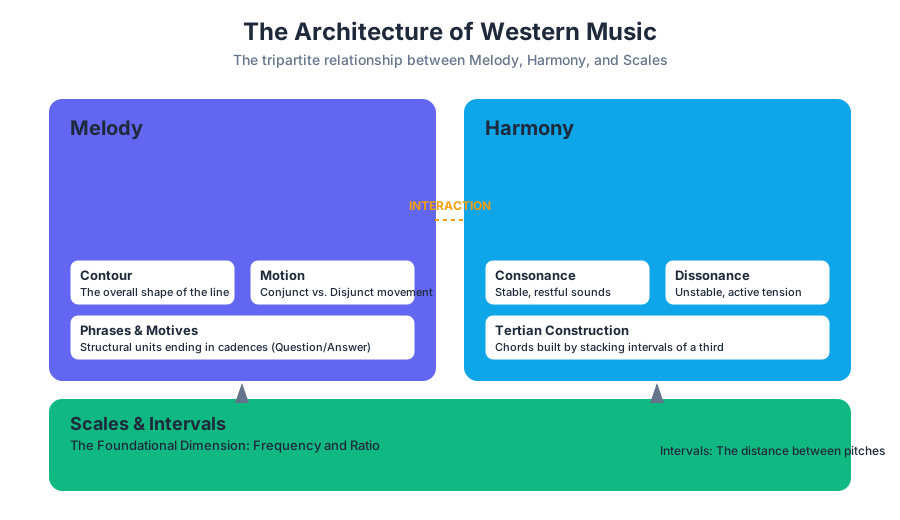
Music is frequently defined as "organized sound." While rhythm provides the temporal framework, the structural integrity of Western music relies on the tripartite relationship between Melody, Harmony, and Scales. These elements represent the horizontal, vertical, and foundational dimensions of musical composition, respectively. To understand music at an expert level is to recognize that these are not isolated silos but interconnected systems of frequency, ratio, and perception.
The Horizontal Dimension: Melody and Melodic Line
A Melody is a timely arranged linear sequence of pitched sounds that the listener perceives as a single, cohesive entity. If music were a language, the melody would be the sentence—a succession of "words" (notes) that conveys a specific thought or emotion.
1. Melodic Characteristics
Melodies are defined by their shape and the way they move through pitch-space. We categorize these movements using several parameters:
- Contour: The overall "shape" of the melodic line.
- Ascending: Moving from lower to higher pitches, often associated with rising tension.
- Descending: Moving from higher to lower pitches, often suggesting resolution or relaxation.
- Arch: A melody that rises to a peak and then descends.
- Motion: The distance between successive notes.
- Conjunct Motion: Smooth, stepwise movement (e.g., "Joy to the World").
- Disjunct Motion: Movement characterized by large leaps or intervals (e.g., "The Star-Spangled Banner").
- Range: The distance between the lowest and highest notes of a melody. A "narrow" range is easy to sing (folk songs), while a "wide" range requires technical virtuosity (operatic arias).
| Parameter | Type | Description | Perceptual Effect |
|---|---|---|---|
| Contour | Arch | Rises to a climax and falls | Balanced, symmetrical |
| Motion | Conjunct | Stepwise (intervals of a 2nd) | Flowing, lyrical, easy to follow |
| Motion | Disjunct | Leaping (intervals of a 3rd or more) | Angular, dramatic, energetic |
| Range | Wide | Spans two octaves or more | Expansive, technically demanding |
| Range | Narrow | Spans less than an octave | Intimate, folk-like |
2. Structural Units: Phrases and Motives
Melodies are rarely continuous streams; they are broken into digestible units.
- Phrase: A musical "clause" that ends with a sense of pause, known as a cadence. In many classical structures, phrases work in pairs: the Antecedent (the "question" phrase, ending with unresolved tension) and the Consequent (the "answer" phrase, providing resolution).
- Motive (Motif): The smallest recognizable melodic or rhythmic unit. A motive is a "seed" from which a larger work grows (e.g., the four-note opening of Beethoven’s 5th Symphony).
- Leitmotif: A recurring motive associated with a specific person, place, or idea, popularized by Richard Wagner and ubiquitous in modern film scoring.
Definition: The Melodic Theme A Theme is a complete melodic idea that serves as the basis for an entire musical composition or section. Unlike a motive, which is a fragment, a theme is a fully realized musical "subject."
The Vertical Dimension: Harmony and Tonality
While melody moves horizontally across time, Harmony occurs when two or more pitches sound simultaneously. This is the "vertical" aspect of music. Harmony provides the color, depth, and emotional context for a melody.
1. Consonance and Dissonance
The core of harmonic movement is the interplay between tension and release.
- Consonance: Intervals or chords that sound stable, restful, and pleasing to the ear.
- Dissonance: Intervals or chords that sound unstable, harsh, or "active." Dissonance creates a psychological need for Resolution into a consonant sound.
2. Chord Construction: Tertian Harmony
In Western music, harmony is primarily Tertian, meaning chords are built by stacking intervals of a third.
- Triad: The basic unit of Western harmony, consisting of three notes: the Root, the Third, and the Fifth.
- Seventh Chords: A triad with an additional third stacked on top (a 7th above the root), adding complexity and "drive" toward resolution.
- Extended Tensions: In jazz and modern classical music, composers add 9ths, 11ths, and 13ths to create rich, dense harmonic textures.
| Chord Type | Structure (Intervals from Root) | Example (in C) | Character |
|---|---|---|---|
| Major Triad | Major 3rd, Perfect 5th | C - E - G | Bright, stable |
| Minor Triad | Minor 3rd, Perfect 5th | C - Eb - G | Dark, somber |
| Diminished | Minor 3rd, Diminished 5th | C - Eb - Gb | Highly unstable, tense |
| Dominant 7th | Maj 3rd, P5th, Min 7th | C - E - G - Bb | Strong pull to resolve |
3. Harmonic Perspectives: Coordinate vs. Subordinate
Historically, harmony evolved from Polyphony (multiple independent melodies) to Homophony (a single melody supported by chords).
- Coordinate Harmony: Found in early counterpoint, where harmony is a byproduct of intersecting melodic lines (horizontal focus).
- Subordinate Harmony: Found in the Common Practice Period, where the melody is clearly supported by a functional chord progression (vertical focus).
The Building Blocks: Intervals and the Overtone Series
To understand how melodies and harmonies are built, we must look at the Interval—the distance between two pitches.
1. The Semitone and the Staff
The smallest interval in Western music is the Semitone (or half-step). On a piano, this is the distance between any two adjacent keys.
- Accidentals: Symbols used to modify pitch. A Sharp (
#) raises a pitch by a semitone; a Flat (b) lowers it. - The Staff: A system of five lines and four spaces used to represent pitch. Clefs (Treble/G, Bass/F, Alto/C) calibrate the staff to specific pitch ranges.
2. The Physics of Consonance: The Overtone Series
Why do some intervals sound "perfect" while others sound "clashing"? The answer lies in physics. When a string vibrates, it doesn't just vibrate at its fundamental frequency ($f$); it also vibrates in halves ($2f$), thirds ($3f$), fourths ($4f$), and so on.
f_n = n \cdot f_0
Where $f_0$ is the fundamental frequency and $n$ is the harmonic number.
- Octave (2:1 ratio): The most fundamental interval. Two notes an octave apart sound like the "same" note at different registers.
- Perfect Fifth (3:2 ratio): The most stable non-octave interval, found early in the overtone series.
3. Interval Classification
Intervals are classified by their quantity (number of staff positions) and quality (Major, Minor, Perfect, Augmented, Diminished).
| Interval Name | Semitones | Ratio | Classification |
|---|---|---|---|
| Unison | 0 | 1:1 | Perfect Consonance |
| Minor 2nd | 1 | 16:15 | Sharp Dissonance |
| Major 3rd | 4 | 5:4 | Imperfect Consonance |
| Perfect 5th | 7 | 3:2 | Perfect Consonance |
| Tritone | 6 | 45:32 | "Diabolus in Musica" (Dissonance) |
The Palette: Scales and Tonality
A Scale is an orderly arrangement of pitches within an octave that provides the raw material for a piece of music. The choice of scale determines the "flavor" or Key of the music.
1. The Diatonic System
The most common scales in Western music are Diatonic, consisting of seven notes.
- Major Scale: Associated with happiness or stability. It follows the pattern: W-W-H-W-W-W-H (Whole step, Half step).
- Minor Scale: Associated with sadness or drama. It features a lowered third degree.
2. Other Scale Types
- Chromatic Scale: Uses all twelve available semitones. It lacks a tonal center and feels "shifting" or "unstable."
- Pentatonic Scale: A five-note scale common in folk music and blues. It is highly consonant and lacks the "tension" notes of the major scale.
3. The Tonic and Tonal Center
Most music is Tonal, meaning it revolves around a central note called the Tonic. The tonic acts as a "home base." No matter how far the melody or harmony wanders, the listener expects a return to the tonic for a sense of finality.
Algorithmic Music Theory
In modern computational musicology, we represent these concepts using mathematical models. Below are examples of how melody, harmony, and scales are handled in software.
2. Mathematical Representation: Interval Ratios
Intervals can be viewed as frequency ratios. In Just Intonation (based on the overtone series), these are simple fractions. In Equal Temperament (modern standard), they are powers of the 12th root of 2.
% Just Intonation Ratios vs Equal Temperament
\text{Perfect 5th (Just)} = \frac{3}{2} = 1.5
\text{Perfect 5th (12-TET)} = 2^{7/12} \approx 1.4983

\text{Major 3rd (Just)} = \frac{5}{4} = 1.25
\text{Major 3rd (12-TET)} = 2^{4/12} \approx 1.2599
Common Pitfalls and Misconceptions
- Melody vs. Harmony: A common mistake is thinking they are separate entities. In reality, a melody often "implies" a harmony. For example, if a melody outlines the notes C, E, and G, the listener's brain automatically fills in the C Major harmony.
- The "Sad" Minor Scale: While minor scales are often associated with sadness, this is a cultural convention, not a physical law. Many cultures use minor-sounding scales for celebratory music, and many "happy" songs use minor chords for depth.
- Perfect Pitch vs. Relative Pitch: Many believe great musicians must have Perfect Pitch (the ability to identify a note in isolation). However, Relative Pitch (the ability to identify the relationship/interval between notes) is far more critical for understanding melody and harmony.
- Consonance is Subjective: What was considered a "dissonance" in the 1400s (like the Major 3rd) became a "consonance" by the 1700s. Musical "rules" are actually descriptions of stylistic trends, not immutable laws of nature.
Summary of Musical Organization
Musical organization is the process of selecting specific frequencies (Scales), arranging them in a sequence (Melody), and layering them for depth (Harmony).
- Melody provides the narrative and identity.
- Harmony provides the emotional environment and structural support.
- Scales provide the linguistic constraints and tonal "gravity."
When these three elements are synchronized with Rhythm and Meter, the result is a complex, multi-dimensional system capable of expressing the full range of human experience.
Source Materials
Study Music Appreciation 1 on Lykke
This course page is free to open: signed out, you can read its first two sections, and signing in, on any plan, opens the rest. The free Lykke Chrome extension syncs your own Canvas courses, so ChatGPT, Claude and Muse can answer from your classes and deadlines. It only reads Canvas.
Add the free extensionSign in to open every sectionAll sections of Music Appreciation 1 · Browse more course pages