From the free course Introductory Biology on Lykke
Recombinant DNA Technology
Key concepts: Restriction Enzymes · Plasmid Vectors · PCR · Sanger Sequencing · Genomic vs. cDNA Libraries
Tools and techniques for manipulating DNA, including cloning, PCR, and sequencing.
Recombinant DNA Technology
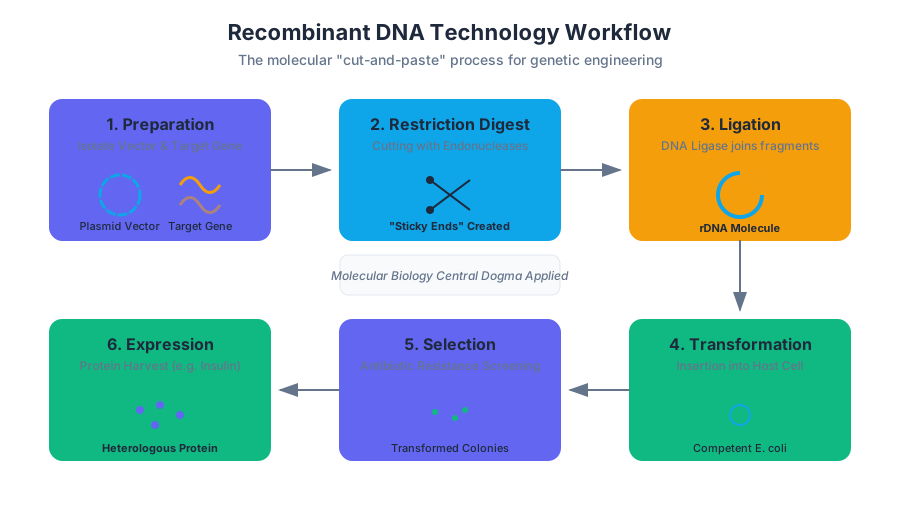
Recombinant DNA (rDNA) technology represents the pinnacle of the "Molecular Biology Revolution," transitioning biology from a purely descriptive science to a manipulative, engineering-oriented discipline. At its core, rDNA technology involves the joining together of DNA molecules from different species and the subsequent insertion of this hybrid DNA into a host organism to produce new genetic combinations. This "cut-and-paste" capability allows scientists to isolate specific genes, amplify them, and express their encoded proteins in heterologous systems, such as producing human insulin in Escherichia coli.
The Molecular Toolkit: Restriction Endonucleases
Before we can manipulate DNA, we must be able to cut it at precise, predictable locations. In nature, Restriction Endonucleases (or restriction enzymes) serve as a primitive immune system for bacteria, "restricting" the entry of foreign viral DNA by cleaving it.
What it is
Restriction enzymes are proteins that recognize specific, usually palindromic, DNA sequences (4–8 base pairs in length) and catalyze the hydrolysis of the phosphodiester backbone.
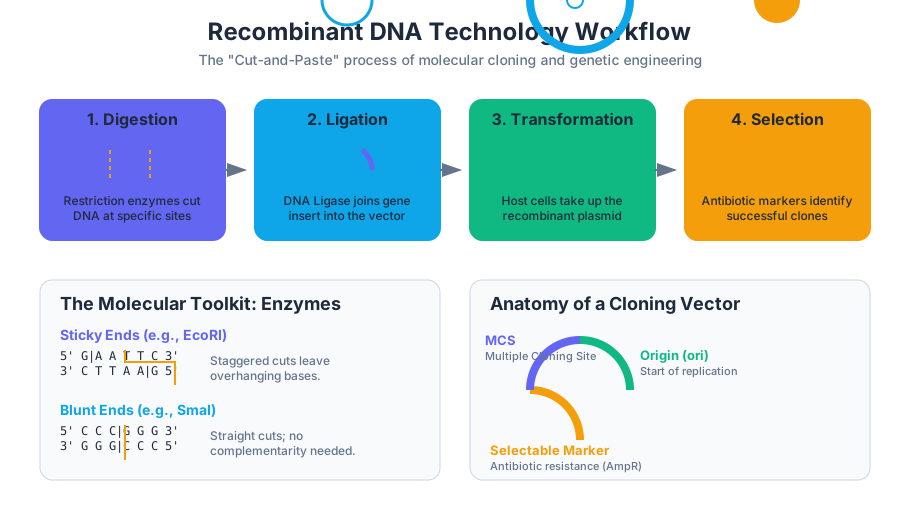
Definition: Palindromic Symmetry In the context of double-stranded DNA, a palindrome occurs when the sequence of the "top" strand (5' to 3') is identical to the "bottom" strand (5' to 3'). For example: 5'-GAATTC-3' 3'-CTTAAG-5'
How it works: Sticky vs. Blunt Ends
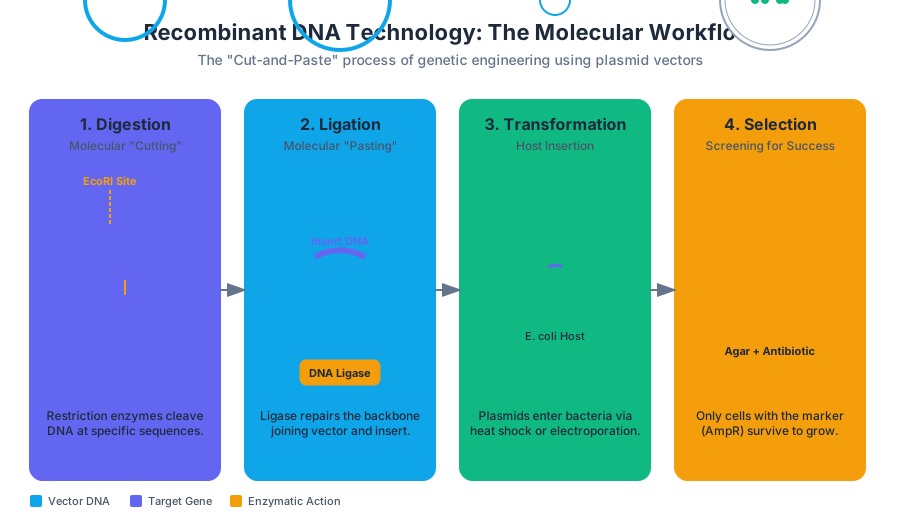
Enzymes like EcoRI make staggered cuts, leaving short, single-stranded overhangs known as sticky ends. These ends are highly useful because they can spontaneously re-anneal via hydrogen bonding with any other DNA fragment cut by the same enzyme. Conversely, enzymes like SmaI cut straight across the helix, producing blunt ends, which are harder to ligate but more versatile as they do not require sequence complementarity.
| Enzyme | Source Organism | Recognition Sequence (5'→3') | Cut Type |
|---|---|---|---|
| EcoRI | Escherichia coli | G^AATTC | Sticky (5' overhang) |
| HindIII | Haemophilus influenzae | A^AGCTT | Sticky (5' overhang) |
| PstI | Providencia stuartii | CTGCA^G | Sticky (3' overhang) |
| SmaI | Serratia marcescens | CCC^GGG | Blunt |
| NotI | Nocardia otitidis | GC^GGCCGC | Sticky (Rare cutter) |
Plasmid Vectors: The Vehicles of Cloning
Once a gene of interest is isolated, it must be placed into a Vector—a DNA molecule capable of autonomous replication within a host cell. The most common vectors are Plasmids, small, circular, extrachromosomal DNA molecules found in bacteria.
Anatomy of a Cloning Vector
A functional cloning vector must possess three essential features:
- Origin of Replication (ori): A specific DNA sequence where replication begins. This determines the "copy number" (how many plasmids exist per cell).
- Selectable Marker: Usually an antibiotic resistance gene (e.g., $Amp^R$). This allows researchers to kill off any bacteria that did not successfully take up the plasmid.
- Multiple Cloning Site (MCS): A short region containing several unique restriction sites, providing a "docking port" for the insertion of foreign DNA.
The Ligation Reaction
The process of joining the vector and the insert is called Ligation, catalyzed by the enzyme DNA Ligase. Ligase uses ATP to repair the phosphate backbone between the 3'-OH of one fragment and the 5'-PO$_4$ of another.
| Vector Type | Insert Capacity | Primary Use |
|---|---|---|
| Plasmid | < 10 kb | General cloning, protein expression |
| Bacteriophage λ | 10–20 kb | Genomic library construction |
| Cosmid | 30–45 kb | Large genomic fragments |
| BAC (Bacterial Artificial Chromosome) | 100–300 kb | Genome sequencing projects |
| YAC (Yeast Artificial Chromosome) | 200–2000 kb | Mapping complex eukaryotic genomes |
Pitfall: Vector Self-Ligation
A common failure mode in cloning is the vector re-closing on itself without the insert. To prevent this, researchers often treat the cut vector with Alkaline Phosphatase, which removes the 5' phosphates. Since ligase requires a 5' phosphate to work, the vector cannot recircularize until it meets the insert (which still has its phosphates).
PCR: Exponential Amplification
The Polymerase Chain Reaction (PCR) is arguably the most impactful technique in biotechnology. It allows for the in vitro amplification of a specific DNA segment from a complex mixture, requiring only the flanking sequences to be known.
The Three-Step Cycle
PCR operates through thermal cycling, typically consisting of 25–35 repeats of three temperatures:
- Denaturation (~95°C): The hydrogen bonds between DNA strands are broken, resulting in single-stranded DNA (ssDNA).
- Annealing (~55–65°C): Synthetic oligonucleotide primers bind to their complementary sequences on the ssDNA.
- Extension (~72°C): A thermostable DNA polymerase (like Taq Polymerase) synthesizes a new DNA strand starting from the primers.
The Mathematics of PCR
The theoretical yield of PCR follows an exponential growth curve. If $N_0$ is the initial number of template molecules and $n$ is the number of cycles, the final number of molecules $N_n$ is:
$$N_n = N_0 \times (1 + E)^n$$
Where $E$ is the efficiency of the reaction (ideally $E=1$, representing 100% efficiency).
\begin{aligned}
&\text{Let } n = 30 \text{ cycles, } E = 0.95, \text{ and } N_0 = 100 \text{ copies.} \\
&N_{30} = 100 \times (1.95)^{30} \\
&N_{30} \approx 100 \times 4.7 \times 10^8 \\
&N_{30} \approx 4.7 \times 10^{10} \text{ molecules.}
\end{aligned}
Pseudocode: PCR Thermal Logic
FUNCTION PCR_Protocol(template_DNA, primers, polymerase, cycles):
    SET current_DNA = template_DNA

    FOR cycle FROM 1 TO cycles:
        // Step 1: Denaturation
        HEAT_TO(95°C) FOR 30_seconds
        current_DNA = SPLIT_STRANDS(current_DNA)

        // Step 2: Annealing
        // Tm is calculated based on primer GC content
        SET Tm = (4 * (G + C)) + (2 * (A + T))
        COOL_TO(Tm - 5°C) FOR 30_seconds
        BIND_PRIMERS(primers, current_DNA)

        // Step 3: Extension
        HEAT_TO(72°C) FOR (length_of_target / 1000) * 60_seconds
        current_DNA = SYNTHESIZE_NEW_STRANDS(polymerase, current_DNA)

    RETURN current_DNA
Sanger Sequencing: Reading the Code
While PCR amplifies DNA, Sanger Sequencing (the dideoxy chain-termination method) allows us to read the precise order of nucleotides.
The Dideoxy Secret
The key to Sanger sequencing is the use of ddNTPs (dideoxynucleoside triphosphates). Unlike normal dNTPs, ddNTPs lack a 3'-OH group. When a DNA polymerase incorporates a ddNTP into a growing chain, the reaction terminates because no further phosphodiester bond can be formed.
The Process
- A DNA sample is divided into four reactions (or one reaction with fluorescent tags).
- Each reaction contains DNA polymerase, a primer, all four standard dNTPs, and a small amount of one specific ddNTP (ddATP, ddTTP, ddCTP, or ddGTP).
- Over time, a collection of fragments of every possible length is generated, each ending at a specific base.
- These fragments are separated by size using Capillary Electrophoresis.
Genomic vs. cDNA Libraries
A Library is a collection of cloned DNA fragments that represents the entire genetic complement of an organism or a specific tissue.
Genomic Libraries
A genomic library contains all the DNA of an organism, including coding (exons) and non-coding (introns, promoters, intergenic) regions. It is created by partially digesting the total genomic DNA and ligating the fragments into vectors.
cDNA Libraries
A cDNA (complementary DNA) library represents only the genes that were being actively expressed (transcribed into mRNA) at the time of sampling.
The cDNA Synthesis Pipeline:
- mRNA Isolation: Using oligo-dT beads to capture poly-A tails.
- Reverse Transcription: Using Reverse Transcriptase to create a DNA strand from the RNA template.
- Second Strand Synthesis: Using DNA Polymerase to create double-stranded DNA.
- Ligation: Inserting the ds-cDNA into a vector.
| Feature | Genomic Library | cDNA Library |
|---|---|---|
| Starting Material | Total Genomic DNA | mRNA |
| Enzymes Used | Restriction Enzymes, Ligase | Reverse Transcriptase, DNA Pol, Ligase |
| Includes Introns? | Yes | No |
| Includes Promoters? | Yes | No |
| Tissue Specific? | No (same for all cells) | Yes (varies by expression) |
| Primary Use | Studying gene structure/regulation | Studying protein-coding sequences |
Insight: Why use cDNA for Bacteria? Bacteria do not have the cellular machinery (spliceosomes) to remove introns from eukaryotic genes. If you want to express a human protein in E. coli, you must use a cDNA version of the gene, as the bacterium cannot process the raw genomic sequence.
Common Pitfalls in Recombinant DNA Technology
- Primer Dimers in PCR: If primers have complementarity to each other, they will anneal and amplify themselves, depleting reagents and yielding a ~50bp "junk" band.
- Star Activity: Under non-optimal conditions (wrong pH or salt concentration), restriction enzymes may lose specificity and cut at sequences similar, but not identical, to their recognition site.
- Codon Bias: When expressing a human gene in bacteria, the "preferred" codons for certain amino acids may differ. This can lead to stalled translation and low protein yield.
- Toxic Gene Products: Sometimes the protein encoded by the recombinant DNA is toxic to the host cell, requiring the use of "inducible" promoters (like the lac operon) to delay expression until the cell culture is sufficiently dense.
Source Materials
Study Introductory Biology on Lykke
This course page is free to open: signed out, you can read its first two sections, and signing in, on any plan, opens the rest. The free Lykke Chrome extension syncs your own Canvas courses, so ChatGPT, Claude and Muse can answer from your classes and deadlines. It only reads Canvas.
Add the free extensionSign in to open every sectionAll sections of Introductory Biology · Browse more course pages