From the free course Introductory Biology on Lykke
Mendelian Genetics and Meiosis
Key concepts: Law of Segregation · Independent Assortment · Meiosis I and II · Nondisjunction · Pedigree Analysis
Principles of inheritance, chromosomal segregation, and pedigree analysis.
Mendelian Genetics and Meiosis
The transition from molecular biochemistry—the study of lipids, proteins, and nucleic acids—to organismal biology is bridged by the mechanics of inheritance. While DNA provides the blueprint, the cellular machinery of meiosis and the statistical laws of Mendelian genetics dictate how that blueprint is partitioned, shuffled, and transmitted across generations. This section explores the rigorous logic of heredity, treating the genome not as a static library, but as a dynamic system of discrete units (alleles) governed by the laws of probability and chromosomal movement.
The Cellular Engine: Meiosis
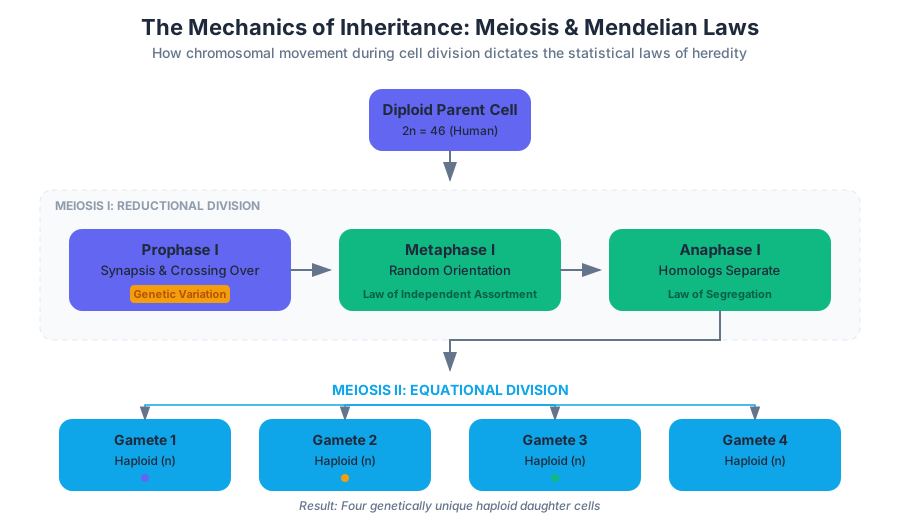
Meiosis is a specialized form of cell division that reduces the chromosome number by half, resulting in the production of haploid gametes (sperm and eggs). Unlike mitosis, which aims for clonal fidelity, meiosis is designed for genetic variation. It consists of one round of DNA replication followed by two successive rounds of nuclear division: Meiosis I and Meiosis II.
Meiosis I: The Reductional Division
In Meiosis I, homologous chromosomes—pairs of chromosomes containing the same genes but potentially different alleles—pair up and then separate. This stage is "reductional" because it reduces the ploidy from diploid ($2n$) to haploid ($n$).
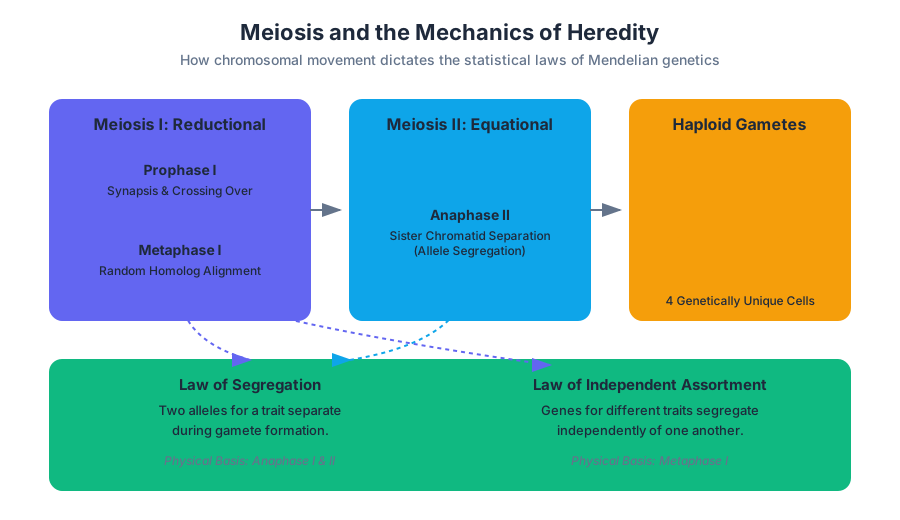
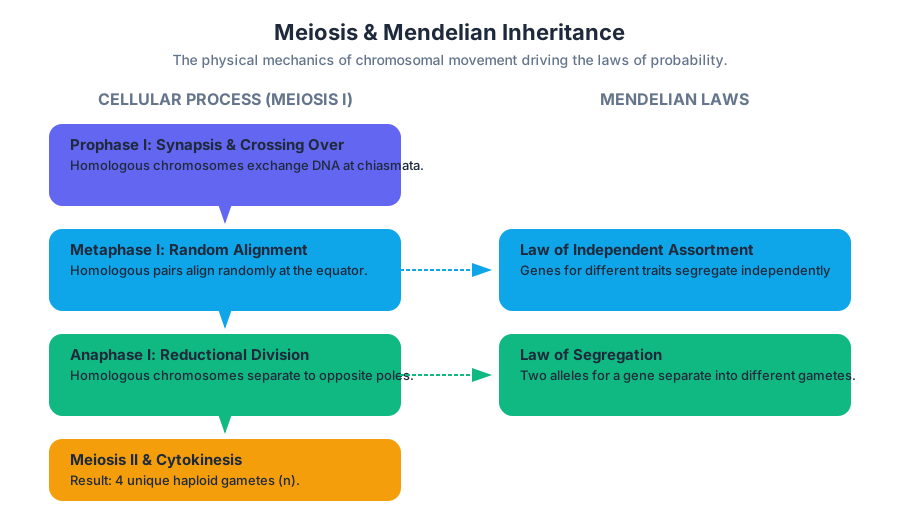
- Prophase I: This is the most complex phase. Homologous chromosomes undergo synapsis, forming a tetrad (or bivalent). During this time, crossing over (recombination) occurs at sites called chiasmata. This is the physical exchange of genetic material between non-sister chromatids.
- Metaphase I: Homologous pairs align at the metaphase plate. Crucially, the orientation of each pair is random—a phenomenon that forms the physical basis for Mendel’s Law of Independent Assortment.
- Anaphase I: Homologous chromosomes are pulled to opposite poles. Note that sister chromatids remain attached at their centromeres.
- Telophase I and Cytokinesis: Two haploid daughter cells form, each containing one chromosome from every homologous pair.
Meiosis II: The Equational Division
Meiosis II resembles mitosis. The sister chromatids, which are no longer identical due to crossing over in Prophase I, are finally separated.
- Prophase II: Spindle apparatus reforms.
- Metaphase II: Chromosomes align at the equator.
- Anaphase II: Centromeres dissolve, and sister chromatids move to opposite poles.
- Telophase II: Nuclear envelopes reform, resulting in four genetically distinct haploid cells.
| Feature | Mitosis | Meiosis I | Meiosis II |
|---|---|---|---|
| Purpose | Somatic growth / Repair | Diversity / Ploidy reduction | Gamete maturation |
| Homologous Pairing | No | Yes (Synapsis) | No |
| Crossing Over | No | Yes (Prophase I) | No |
| Outcome | 2 Identical Diploid ($2n$) | 2 Unique Haploid ($n$) | 4 Unique Haploid ($n$) |
| Chromatid Separation | Anaphase | Anaphase II | Anaphase II |
Mendelian Laws of Inheritance
Gregor Mendel’s work in the mid-19th century transformed biology into a predictive science. By studying discrete traits in Pisum sativum, he deduced that inheritance is "particulate"—driven by discrete units we now call genes.
The Law of Segregation
Theorem: During gamete formation, the two alleles for a heritable character segregate (separate) from each other and end up in different gametes.
This law corresponds to the separation of homologous chromosomes during Anaphase I. If an organism has the genotype $Aa$, 50% of its gametes will receive the $A$ allele and 50% will receive the $a$ allele.
The Law of Independent Assortment
Theorem: Each pair of alleles segregates independently of each other pair of alleles during gamete formation.
This law applies only to genes located on different chromosomes (or very far apart on the same chromosome). It is the direct result of the random orientation of homologous pairs during Metaphase I.
Mathematical Framework of Mendelian Crosses
To predict outcomes, we use the Product Rule (for independent events: $P(A \text{ and } B) = P(A) \times P(B)$) and the Sum Rule (for mutually exclusive events: $P(A \text{ or } B) = P(A) + P(B)$).
Chromosomal Errors: Nondisjunction
The fidelity of meiosis is paramount. When the machinery fails to separate chromosomes or chromatids correctly, the result is nondisjunction. This leads to aneuploidy, a condition where cells have an abnormal number of chromosomes.
Mechanisms of Nondisjunction
- Meiosis I Nondisjunction: Homologous chromosomes fail to separate. Result: All four gametes are abnormal ($n+1, n+1, n-1, n-1$).
- Meiosis II Nondisjunction: Sister chromatids fail to separate. Result: Two normal gametes, two abnormal ($n+1, n-1, n, n$).
| Condition | Genotype | Clinical Manifestation |
|---|---|---|
| Down Syndrome | Trisomy 21 | Cognitive impairment, distinct facial features, heart defects. |
| Klinefelter Syndrome | XXY | Male phenotype, sterile, some female secondary characteristics. |
| Turner Syndrome | X0 | Female phenotype, sterile, short stature (only viable monosomy). |
| Patau Syndrome | Trisomy 13 | Severe neurological and circulatory defects; short life expectancy. |
Pedigree Analysis: The Logic of Inheritance
In human genetics, we cannot perform controlled crosses. Instead, we use pedigrees—diagrams showing the phenotypes of family members across generations—to deduce genotypes and inheritance patterns.
Key Patterns to Recognize
- Autosomal Dominant: The trait appears in every generation. Every affected person has at least one affected parent.
- Autosomal Recessive: The trait can skip generations. Affected individuals are often born to unaffected (carrier) parents.
- X-Linked Recessive: More common in males. Affected fathers pass the allele to all daughters (who become carriers) but no sons.
- X-Linked Dominant: Affected fathers pass the trait to all daughters and no sons.
\begin{aligned}
&\text{Probability Logic for Pedigrees:} \\
&\text{If } P(\text{Carrier Parent 1}) = p \text{ and } P(\text{Carrier Parent 2}) = q, \\
&\text{Then } P(\text{Affected Child}) = p \times q \times \frac{1}{4} \text{ (for Autosomal Recessive)} \\
\\
&\text{Bayes' Theorem Application:} \\
&P(\text{Carrier} | \text{Unaffected}) = \frac{P(\text{Unaffected} | \text{Carrier})P(\text{Carrier})}{P(\text{Unaffected})}
\end{aligned}
Worked Example: Pedigree Logic
Suppose a couple is unaffected, but the man's brother has an autosomal recessive disease (genotype $aa$). What is the probability their first child will be affected?
- The man's parents must be carriers ($Aa \times Aa$).
- The man is unaffected, so his possible genotypes are $AA$ or $Aa$. The probability he is a carrier ($Aa$) is $2/3$ (since we exclude $aa$).
- We must know the carrier frequency of the woman. If she is from the general population where the carrier frequency is $1/50$:
- $P(\text{Affected child}) = P(\text{Father is } Aa) \times P(\text{Mother is } Aa) \times P(\text{Child is } aa | \text{Parents } Aa)$
- $P = (2/3) \times (1/50) \times (1/4) = 2/600 = 1/300$.
Real-World Application: Variant Calling
In modern bioinformatics, Mendelian laws are used to filter "noise" in DNA sequencing data. When sequencing a "trio" (mother, father, and child), any variant in the child that does not follow Mendelian inheritance (e.g., child is $AA$ while both parents are $aa$) is flagged as a potential sequencing error or a de novo mutation.
Common Pitfalls and Edge Cases
- Linked Genes: Mendel’s Second Law (Independent Assortment) fails if genes are close together on the same chromosome. They will be inherited together unless a crossover event occurs between them.
- Incomplete Dominance vs. Codominance: In incomplete dominance, the heterozygote has an intermediate phenotype (e.g., pink flowers from red and white parents). In codominance, both alleles are expressed fully (e.g., AB blood type).
- Lethal Alleles: Some genotypes (usually homozygous dominant or recessive) result in prenatal death, which skews the observed Mendelian ratios (e.g., a 2:1 ratio instead of 3:1).
- Nondisjunction Timing: Students often confuse the results of Meiosis I vs. Meiosis II nondisjunction. Remember: Meiosis I failure results in gametes with both homologs; Meiosis II failure results in gametes with two copies of the same sister chromatid.
Source Materials
Study Introductory Biology on Lykke
This course page is free to open: signed out, you can read its first two sections, and signing in, on any plan, opens the rest. The free Lykke Chrome extension syncs your own Canvas courses, so ChatGPT, Claude and Muse can answer from your classes and deadlines. It only reads Canvas.
Add the free extensionSign in to open every sectionAll sections of Introductory Biology · Browse more course pages