From the free course Introductory Biology on Lykke
Gene Expression and Regulation
Key concepts: Transcription Factors · mRNA Splicing · Epigenetics · Ribosome Function · Genetic Code
The processes of transcription and translation, including epigenetic and transcriptional control.
Gene Expression and Regulation
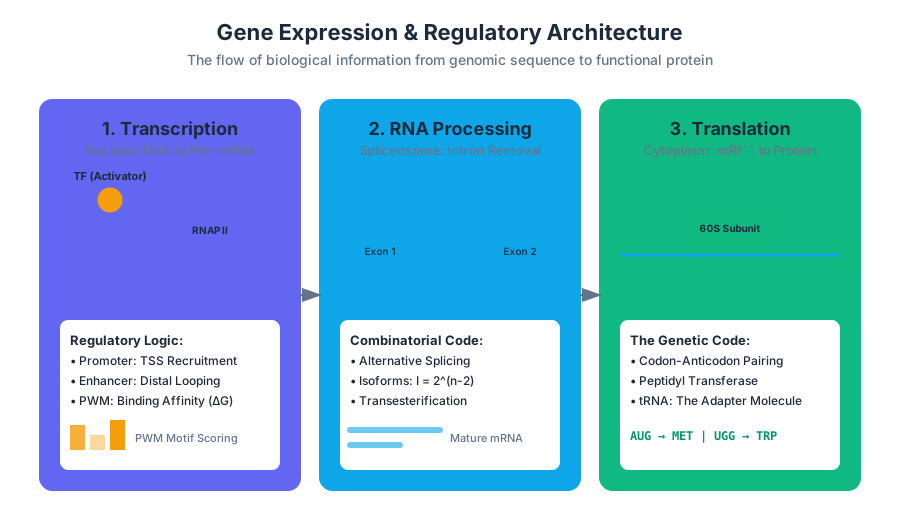
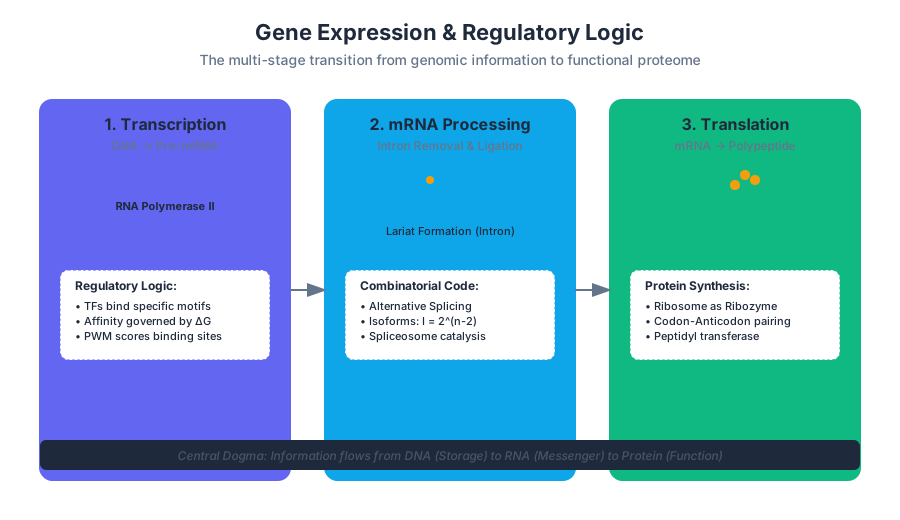
The transition of biology from a descriptive discipline to an information science is most evident in the study of Gene Expression and Regulation. At its core, this field examines the "Central Dogma"—the flow of biological information from DNA to RNA to Protein—while accounting for the sophisticated regulatory layers that allow a single genome to produce the diverse cellular phenotypes found in a multicellular organism.
The Logic of Transcription and Transcription Factors
Transcription is the first stage of gene expression, where a specific segment of DNA is copied into RNA by the enzyme RNA Polymerase (RNAP). In eukaryotes, this process is not a simple "on/off" switch but a complex integration of signals processed by Transcription Factors (TFs).
The Thermodynamics of TF Binding
Transcription factors are proteins that bind to specific DNA sequences (motifs) to either recruit or block RNA Polymerase. The affinity of a TF for its binding site is governed by the Gibbs Free Energy ($\Delta G$) of the interaction. The probability $P$ of a site being occupied can be modeled using a Boltzmann distribution:
$$P_{bound} = \frac{1}{1 + e^{\frac{\Delta G - \mu}{kT}}}$$
where $\mu$ is the chemical potential of the TF in the nucleoplasm. This relationship implies that small changes in TF concentration or binding affinity (via mutation or modification) can lead to non-linear shifts in gene expression.
Enhancers and Promoters: The Regulatory Architecture
The regulatory landscape of a gene consists of:
- Promoters: Located immediately upstream of the transcription start site (TSS).
- Enhancers: Distal regulatory elements that can be thousands of base pairs away, brought into proximity with the promoter through DNA looping.
| Element | Location | Function | Interaction Method |
|---|---|---|---|
| Core Promoter | -35 to +35 bp from TSS | Recruits General Transcription Factors (GTFs) | Direct binding of TATA-binding protein (TBP) |
| Proximal Promoter | Up to -250 bp | Fine-tunes transcription frequency | Binding of cell-specific TFs |
| Enhancer | Distal (Upstream/Downstream) | Amplifies transcription levels | DNA looping via Mediator complex |
| Silencer | Distal | Represses transcription | Recruitment of Histone Deacetylases (HDACs) |
mRNA Splicing: The Combinatorial Code
In eukaryotes, the primary transcript (pre-mRNA) contains non-coding regions called introns and coding regions called exons. Splicing is the process of removing introns and ligating exons together to form a mature mRNA.
The Spliceosome Mechanics
The spliceosome, a massive ribonucleoprotein complex, catalyzes two successive transesterification reactions.
- The 2'-OH of an adenine residue at the branch point attacks the 5' splice site.
- The 3'-OH of the upstream exon attacks the 3' splice site, releasing the intron as a "lariat" structure.
Alternative Splicing: One Gene, Many Proteins
Alternative splicing allows a single gene to encode multiple protein isoforms, vastly increasing proteomic complexity without increasing genome size. This is a primary driver of evolutionary innovation in higher eukaryotes.
The Splicing Rule: The selection of splice sites is determined by a "splicing code" consisting of cis-acting elements (Exonic Splicing Enhancers/Silencers) and trans-acting factors (SR proteins and hnRNPs).
Mathematical Representation of Splicing Complexity
If a gene has $n$ exons that can be independently included or excluded, the theoretical number of isoforms $I$ is: $$I = 2^{(n-2)}$$ (Assuming the first and last exons are constitutive). For the Drosophila Dscam gene, which has 95 alternative exons, this results in over 38,000 potential protein isoforms—more than the total number of genes in the fly genome.
\text{Reaction 1: } \text{Exon1-G} + \text{A(branch)} \rightarrow \text{Exon1-OH} + \text{G-A(lariat)}
\text{Reaction 2: } \text{Exon1-OH} + \text{G-Exon2} \rightarrow \text{Exon1-Exon2} + \text{Lariat}
Ribosome Function and the Genetic Code
Translation is the process where the mature mRNA is decoded by the ribosome to synthesize a polypeptide chain. This represents the final stage of information transfer, converting a nucleotide sequence into a functional amino acid sequence.
The Ribosome as a Ribozyme
The ribosome is composed of two subunits (60S and 40S in eukaryotes). Crucially, the catalytic heart of the ribosome—the peptidyl transferase center—is composed of RNA, not protein. This supports the "RNA World" hypothesis, suggesting that life's fundamental machinery evolved from self-replicating RNA molecules.
Decoding the Genetic Code
The genetic code is:
- Triplet: Three nucleotides (a codon) specify one amino acid.
- Degenerate: Multiple codons can code for the same amino acid (e.g., leucine is coded by six different codons).
- Non-overlapping: The reading frame is set by the start codon (AUG).
| Feature | Description | Biological Significance |
|---|---|---|
| Wobble Base Pairing | Flexible pairing at the 3rd codon position | Allows one tRNA to recognize multiple codons |
| Kinetic Proofreading | Delay in GTP hydrolysis during tRNA selection | Increases translation fidelity to 1 error per $10^4$ amino acids |
| Ribosome Profiling | Sequencing of ribosome-protected fragments | Allows for "snapshots" of global translation activity |
Example: Translation Initiation Pipeline
Translation initiation is the rate-limiting step of protein synthesis. In eukaryotes, this involves the recognition of the 5' cap and the scanning for the Kozak sequence.
Epigenetics: The Software of the Genome
Epigenetics refers to heritable changes in gene expression that do not involve alterations to the underlying DNA sequence. If DNA is the "hardware," epigenetics is the "software" that determines which programs are run.
DNA Methylation
In vertebrates, DNA methylation occurs almost exclusively at CpG dinucleotides. The addition of a methyl group to the 5th carbon of cytosine (5mC) by DNA Methyltransferases (DNMTs) is generally associated with gene silencing.
Histone Modifications and Chromatin Remodeling
DNA is wrapped around histone octamers to form nucleosomes. The N-terminal tails of histones are subject to various post-translational modifications (PTMs):
- Acetylation (H3K9ac): Neutralizes the positive charge of histones, loosening the DNA-histone interaction and promoting transcription.
- Methylation (H3K27me3): Often associated with the formation of heterochromatin (tightly packed, inactive DNA).
| Modification | Enzyme | Effect on Chromatin | Transcriptional State |
|---|---|---|---|
| Acetylation | HAT (Histone Acetyltransferase) | Open (Euchromatin) | Active |
| Deacetylation | HDAC (Histone Deacetylase) | Closed (Heterochromatin) | Repressed |
| Trimethylation (H3K4me3) | HMT (Histone Methyltransferase) | Open | Active (Promoter) |
| Trimethylation (H3K27me3) | PRC2 Complex | Closed | Silenced |
The Epigenetic Landscape
Waddington’s "epigenetic landscape" describes how a pluripotent cell "rolls" down valleys of differentiation. As the cell matures, its epigenetic profile becomes increasingly locked, restricting its potential to change identity.
Systems Biology of Gene Regulation
Gene regulation is not a collection of isolated events but a networked system. Gene Regulatory Networks (GRNs) behave like electronic circuits, utilizing feedback loops to maintain homeostasis or drive developmental transitions.
Feedback Loops and Bistability
- Negative Feedback: A protein inhibits its own production, leading to oscillations or stable steady states (e.g., the circadian clock).
- Positive Feedback: A protein promotes its own production, creating a "bistable" switch where a cell can flip between two distinct states (e.g., cell fate determination).
Worked Example: The Lac Operon Logic
The lac operon in E. coli is the classic example of biological logic. It functions as an AND NOT gate:
- Condition A: Lactose is present (Inactivates the repressor).
- Condition B: Glucose is absent (Activates the CAP activator via cAMP).
- Result: Transcription occurs only if (Lactose) AND NOT (Glucose).
Common Pitfalls and Misconceptions
- "DNA is Destiny": This ignores the massive influence of the environment on the epigenome. Identical twins have the same DNA but different epigenetic profiles as they age.
- "One Gene = One Protein": Alternative splicing and post-translational modifications mean a single gene can produce hundreds of distinct functional entities.
- "Junk DNA": Previously thought to be useless, non-coding DNA contains the majority of the genome's regulatory instructions (enhancers, silencers, and non-coding RNAs).
- Transcription = Expression: A gene can be transcribed but never translated due to miRNA interference or riboswitch regulation.
Source Materials
Study Introductory Biology on Lykke
This course page is free to open: signed out, you can read its first two sections, and signing in, on any plan, opens the rest. The free Lykke Chrome extension syncs your own Canvas courses, so ChatGPT, Claude and Muse can answer from your classes and deadlines. It only reads Canvas.
Add the free extensionSign in to open every sectionAll sections of Introductory Biology · Browse more course pages