From the free course Introduction to OpenStax U.S. History and Historiography on Lykke
Social History: Race, Class, and Gender
Key concepts: Social History · Lived Experiences · Intersectionality
Exploring the lived experiences of diverse groups and their impact on the American narrative.
Social History: Race, Class, and Gender
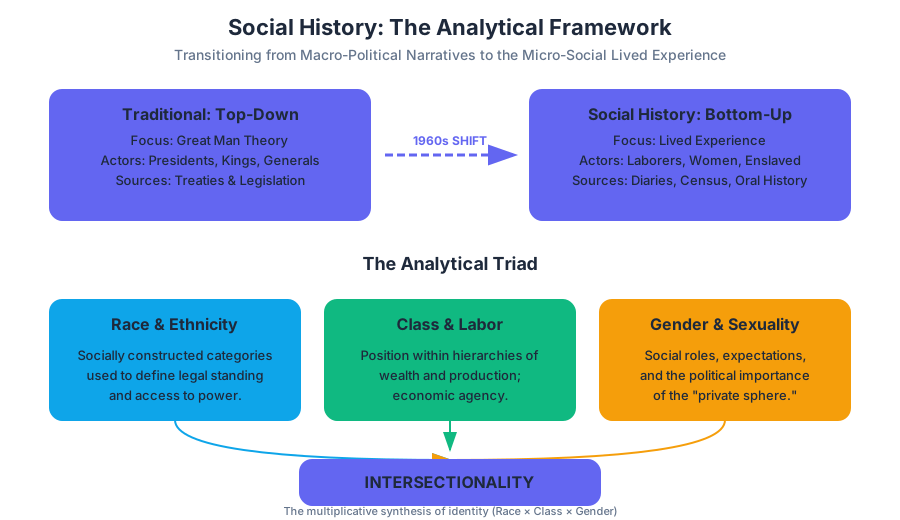
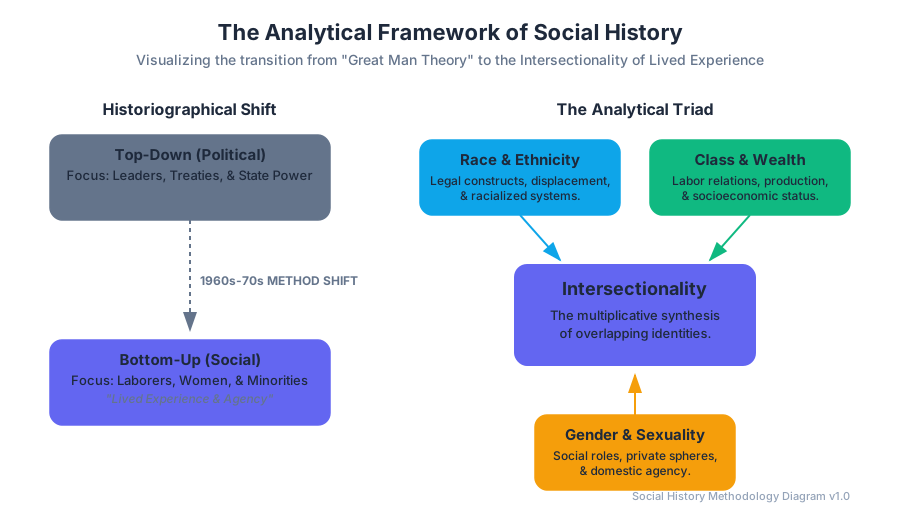
The study of history has undergone a seismic shift over the last half-century, moving from a "Top-Down" chronicle of Great Men and high politics to a "Bottom-Up" investigation of the masses. This transition is codified in the discipline of Social History, a methodology that prioritizes the Lived Experiences of ordinary individuals over the administrative records of the state. By applying the analytical lenses of Race, Class, and Gender, historians can deconstruct the "monolithic" American narrative to reveal a complex, often contradictory tapestry of agency, oppression, and survival.
The Historiographical Shift: Top-Down vs. Bottom-Up
To understand Social History, one must first understand what it replaced. Traditional historiography—often called Political History—focused on the "Great Man Theory," which posited that history is shaped primarily by the decisions of influential leaders, generals, and monarchs. In contrast, Social History (or "The New Social History") emerged in the 1960s and 70s, influenced by the Civil Rights Movement and second-wave feminism, to ask how the "silent majority" shaped the world.
Definition: Social History A subfield of historical study that focuses on the daily lives, social structures, and cultural movements of ordinary people. It utilizes quantitative data (census records, tax rolls) and qualitative fragments (diaries, oral histories) to reconstruct the past from the perspective of those traditionally excluded from power.
Comparison of Historical Perspectives
| Feature | Top-Down (Political History) | Bottom-Up (Social History) |
|---|---|---|
| Primary Actors | Presidents, Generals, CEOs, Monarchs | Laborers, Enslaved People, Women, Immigrants |
| Key Sources | Treaties, Legislation, Executive Orders | Diaries, Census Data, Folk Songs, Parish Records |
| Core Question | How did the state exercise power? | How did people experience and resist power? |
| Scale | Macro (National/International) | Micro (Community/Household/Individual) |
| Narrative Style | Linear, Progress-oriented | Fragmented, Conflict-oriented, Multi-vocal |
The Analytical Triad: Race, Class, and Gender
Social historians do not view the past as a single stream of events. Instead, they use a tripartite framework to "slice" through historical moments. These three pillars—Race, Class, and Gender—are not merely categories of identity but are analytical variables that determine an individual's access to resources, legal standing, and social agency.
1. Race and Ethnicity
In the American context, race is a social construct with very real material consequences. Historians examine how racial categories were legally defined (e.g., the "one-drop rule") and how these definitions were used to justify systems like chattel slavery, Jim Crow, and indigenous displacement.
2. Class and Socioeconomics
Class refers to an individual's position within a hierarchy of production and wealth. Social history examines the "Class Consciousness" of the working poor, the rise of the middle class during industrialization, and the ways in which economic status dictates one's ability to participate in the democratic process.
3. Gender and Sexuality
Gender history moves beyond "women's history" to examine the social roles and expectations placed on all individuals. It looks at the "private sphere" (the home) as a site of political importance and analyzes how notions of masculinity and femininity have been used to reinforce or challenge power structures.
Intersectionality: The Synthesis of Identity
While Race, Class, and Gender are powerful lenses individually, they are most effective when used together. This approach is known as Intersectionality. Coined by legal scholar Kimberlé Crenshaw, intersectionality posits that social identities do not exist in isolation; rather, they overlap and intersect to create unique modes of discrimination and privilege.
The Principle of Intersectionality An analytical framework for understanding how aspects of a person's social and political identities combine to create different modes of discrimination and privilege. It is not an additive model (Race + Class + Gender) but a multiplicative one (Race × Class × Gender), where the resulting experience is qualitatively different from its component parts.
The Intersectionality Matrix: A Comparative Example
| Identity Intersection | Historical Context | Lived Experience / Constraint |
|---|---|---|
| White, Male, Elite | Antebellum South | High agency; political power; control over labor/capital. |
| White, Female, Elite | Antebellum South | Social prestige but limited legal agency (Coverture laws). |
| Black, Male, Enslaved | Antebellum South | Total loss of bodily autonomy; labor exploitation; racialized violence. |
| Black, Female, Enslaved | Antebellum South | Intersection of racialized slavery and gendered violence (reproductive exploitation). |
Implementing Historical Data Analysis
In modern digital humanities, social history is often "computed" by analyzing large datasets.
Lived Experiences and the "Agency" Problem
A central theme in Social History is Agency—the capacity of individuals to act independently and make their own free choices. Historians argue that even within oppressive systems (like slavery or patriarchy), marginalized people exercised agency through resistance, cultural preservation, and the creation of "counter-publics."
The Mechanics of Agency
- Overt Resistance: Strikes, rebellions, legal challenges.
- Covert Resistance: Sabotage, feigning illness, secret education, "the grapevine" (informal communication networks).
- Cultural Persistence: Maintaining linguistic traditions, religious practices, and family structures despite external pressure to assimilate or dissolve.
Mathematical Representation of Social Constraint
We can represent the "Lived Experience" of an individual as a function of their identity markers within a specific historical environment ($H$). If $E$ is the total experienced agency:
$$E = \int_{t_0}^{t_1} [A(R, C, G) - S(P, L)] dt$$
Where:
- $A$: Innate Agency (a function of Race, Class, and Gender).
- $S$: Structural Suppression (a function of Policy $P$ and Law $L$).
- $t$: Time (representing the duration of the historical era).
In this model, the "Lived Experience" is the net area under the curve of individual action minus systemic restriction.
\begin{aligned}
\text{Intersectionality Index } (I) &= \prod_{i=1}^{n} w_i \cdot \phi_i \\
\text{where } w &= \text{weight of identity marker} \\
\phi &= \text{social value assigned by the State}
\end{aligned}
OpenStax and the Democratization of History
The OpenStax U.S. History curriculum is a prime example of Open Educational Resources (OER). By utilizing a Creative Commons Attribution License (CC BY), it allows for the free distribution and modification of historical knowledge. This is not just a matter of cost; it is a social history project in its own right.
Why OER Matters for Social History
Traditional textbooks are often "gatekept" by expensive publishers and can be slow to incorporate new social history research. OER allows for:
- Rapid Iteration: Updating narratives as new archaeological or archival evidence emerges.
- LMS Integration: Using tools like OpenStax Assignable to bring primary source analysis directly into the digital classroom.
- Diverse Perspectives: Allowing instructors to "remix" the content to highlight local social histories (e.g., the history of labor in a specific city).
Common Pitfalls in Social History Analysis
While Social History provides a more complete picture of the past, it is susceptible to several analytical errors:
- Presentism: Judging historical actors by modern moral standards. For example, criticizing 19th-century suffragists for not having a 21st-century understanding of intersectionality.
- Essentialism: Assuming that all members of a group (e.g., "all women" or "all workers") had the same experiences or goals.
- The "Veneer" of Progress: Assuming that history is a steady march toward greater equality. Social history often reveals "backslides" where rights were gained and then violently stripped away (e.g., the end of Reconstruction).
- Data Siloing: Focusing so heavily on one pillar (like Class) that the influence of others (like Race) is obscured.
Comparison of Methodological Pitfalls
| Pitfall | Description | Example | Mitigation Strategy |
|---|---|---|---|
| Essentialism | Homogenizing a diverse group. | "The Black experience in the 1920s." | Use sub-variables (Class, Region, Gender). |
| Romanticization | Portraying marginalized groups as purely heroic. | Ignoring internal conflicts within labor unions. | Acknowledge internal hierarchies and friction. |
| Over-Quantification | Relying solely on numbers, losing the "human" element. | Using only mortality rates to describe a plague. | Supplement data with qualitative primary sources. |
Case Study: The Industrial Revolution through Three Lenses
To see Social History in action, consider the American Industrial Revolution (c. 1820–1870).
- The Lens of Class: Focuses on the transition from "artisan labor" to "wage slavery." It examines the rise of the factory system and the birth of the first labor unions (e.g., the Knights of Labor).
- The Lens of Gender: Focuses on the "Lowell Mill Girls"—young women who left farms for factory work. It analyzes how this provided economic independence while simultaneously enforcing strict moral codes and grueling 12-hour shifts.
- The Lens of Race: Focuses on how industrialization in the North was inextricably linked to the slave-based cotton economy of the South. It also examines how Irish and German immigrants were pitted against free Black workers to keep wages low.
Historical Data: Wage Comparison (Circa 1850)
| Demographic | Typical Role | Weekly Wage (Approx. 1850 USD) | Legal Status |
|---|---|---|---|
| White Male (Skilled) | Machinist / Overseer | $12.00 - $15.00 | Full Citizen |
| White Female (Unskilled) | Textile Weaver | $3.00 - $5.00 | Limited (No Vote) |
| Immigrant Male (Unskilled) | Rail Laborer | $5.00 - $7.00 | Naturalizing |
| Free Black Male | Stevedore / Porter | $3.00 - $4.00 | Restricted (Dred Scott era) |
Summary of Methodology
Social history does not seek to delete the "Great Men" from the record; rather, it seeks to place them in context. A President's proclamation is only half the story; the other half is how that proclamation was read, resisted, or reimagined by the people in the streets, the fields, and the factories. By utilizing the analytical triad of Race, Class, and Gender, and by leveraging the democratizing power of OER tools like OpenStax, we arrive at a version of history that is not only more accurate but more profoundly human.
- Social History: The study of history from the perspective of ordinary people and social structures.
- Agency: The capacity of individuals to act and exert power within a system.
- Intersectionality: The overlapping of social identities (race, class, gender) to create unique experiences of oppression or privilege.
- Top-Down History: Traditional history focusing on elites and political leaders.
- Bottom-Up History: Social history focusing on marginalized or "invisible" populations.
- OER (Open Educational Resources): Free, openly licensed educational materials (e.g., OpenStax).
- Coverture: A legal doctrine where a woman's legal rights were subsumed by those of her husband.
- Class Consciousness: The self-awareness of a social class regarding its common interests and role in the economic system.
-
Which of the following best describes the "Agency" of an enslaved person in the 19th century?
- A) The legal right to vote and hold property.
- B) The ability to resist through covert means like cultural preservation and sabotage. (Correct)
- C) The total lack of any influence over their own life.
- D) The formal power to negotiate labor contracts.
-
In the "Intersectionality Matrix," why is a multiplicative model (Race × Class × Gender) preferred over an additive one?
- Because identities combine to create qualitatively different experiences that aren't just the sum of their parts. (Correct)
-
How does OpenStax utilize the Creative Commons Attribution License (CC BY)?
- A) By charging a subscription fee for access.
- B) By allowing anyone to use, remix, and redistribute the content as long as they provide credit. (Correct)
- C) By restricting the content to government-approved institutions only.
-
What is the primary source of data for a "New Social Historian"?
- A) Official state treaties.
- B) Census records, diaries, and parish logs. (Correct)
- C) Biographies of Kings and Queens.
Key Themes to Master:
- The Shift in Historiography: Be able to explain why the 1960s were a turning point for how we write history.
- The Triad of Analysis: Practice applying Race, Class, and Gender to a single event (e.g., The Great Depression).
- Intersectionality: Understand that identity is not a monolith. A wealthy Black woman's experience in 1920 is different from a poor Black woman's experience.
- Digital Humanities: Recognize how tools like Python, SQL, and LTI are used to analyze and distribute social history today.
- Agency vs. Structure: Identify the tension between individual choice and systemic oppression.
Source Materials
Study Introduction to OpenStax U.S. History and Historiography on Lykke
This course page is free to open: signed out, you can read its first two sections, and signing in, on any plan, opens the rest. The free Lykke Chrome extension syncs your own Canvas courses, so ChatGPT, Claude and Muse can answer from your classes and deadlines. It only reads Canvas.
Add the free extensionSign in to open every sectionAll sections of Introduction to OpenStax U.S. History and Historiography · Browse more course pages