From the free course Introduction to OpenStax U.S. History and Historiography on Lykke
Introduction to OER and OpenStax
Key concepts: Open Educational Resources (OER) · Creative Commons Attribution License · Educational Accessibility
An introduction to the mission of OpenStax and the principles of Open Educational Resources (OER).
Introduction to OER and OpenStax
The landscape of modern higher education is currently undergoing a structural transformation driven by the intersection of digital distribution, intellectual property reform, and a pedagogical shift toward inclusivity. At the center of this movement is Open Educational Resources (OER), a paradigm that challenges the traditional "all rights reserved" model of textbook publishing. OpenStax, a non-profit initiative based at Rice University, represents the most significant institutional effort to scale this movement, providing peer-reviewed, professional-grade textbooks to millions of students globally at zero cost.
The OER Paradigm: Definitions and Frameworks
At its core, OER is defined not merely by its price point (which is typically free) but by the legal permissions granted to the end-user. While "free" resources may be available for reading online, OER permits a range of interactions that traditional copyrighted materials forbid.
Definition: Open Educational Resources (OER) OER are teaching, learning, and research materials in any medium—digital or otherwise—that reside in the public domain or have been released under an open license that permits no-cost access, use, adaptation, and redistribution by others with no or limited restrictions.
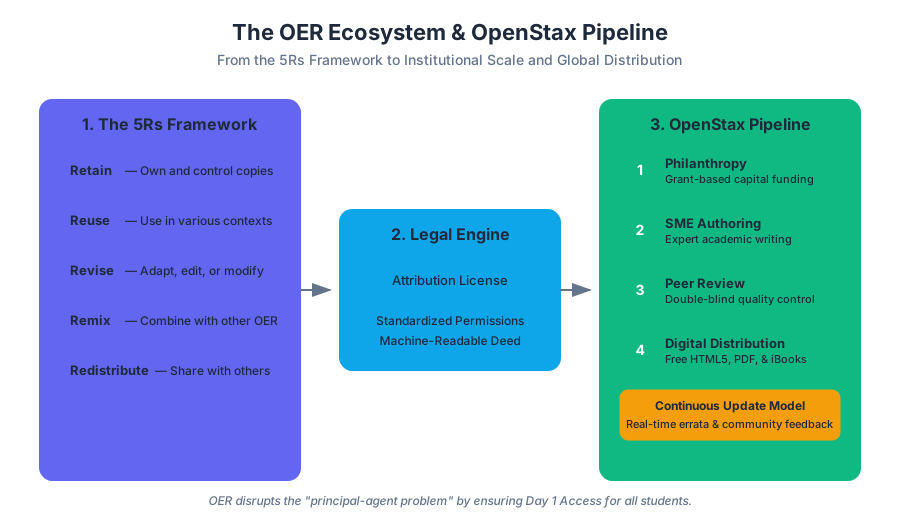
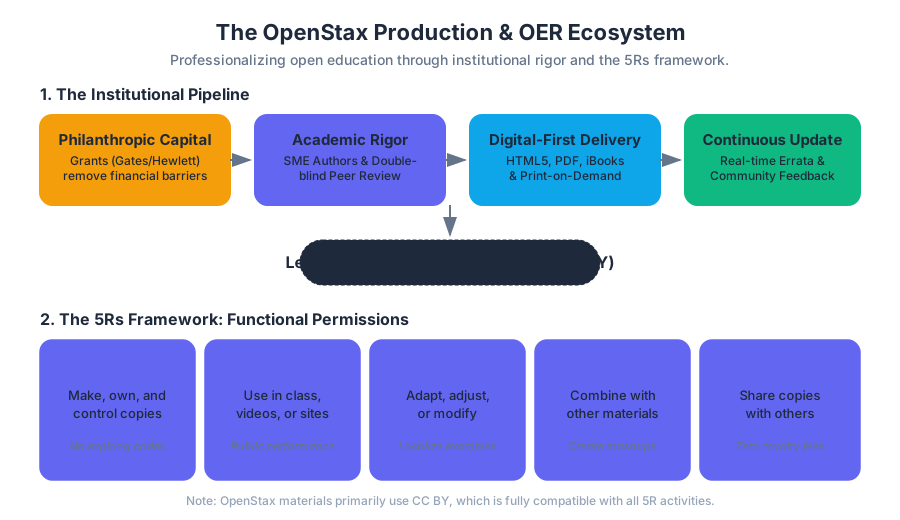
To understand the technical utility of OER, practitioners use the 5Rs Framework, developed by David Wiley. This framework defines the functional requirements of a truly "open" resource:
| Activity | Description | Technical Implication |
|---|---|---|
| Retain | The right to make, own, and control copies of the content. | No "expiring" digital access codes or DRM. |
| Reuse | The right to use the content in a wide range of ways. | Use in class, on a website, in a video, or as a handout. |
| Revise | The right to adapt, adjust, modify, or alter the content. | Translating text or changing examples to fit local contexts. |
| Remix | The right to combine the original or revised content with other material. | Creating a "mashup" of two different OER chapters. |
| Redistribute | The right to share copies of the original content, your revisions, or your remixes. | Giving a copy to a colleague or student without royalty fees. |
The Economic Motivation for OER
The traditional textbook market is characterized by asymmetric information and a principal-agent problem: the person choosing the product (the professor) is not the person paying for it (the student). This has led to textbook prices outstripping inflation by over 800% since the late 1970s. OER disrupts this by removing the "toll-gate" to knowledge, ensuring that "Day 1 Access" is a financial reality for all students, regardless of socioeconomic status.
Licensing Mechanics: The Creative Commons Attribution License
The legal engine of OER is the Creative Commons (CC) licensing suite. Most OpenStax materials are released under the CC BY (Attribution) license. This is the most permissive of the CC licenses, requiring only that the user provide credit to the original creator.
Legal Logic of CC BY
Traditional copyright is "Opt-In" for protection but "Opt-Out" for sharing. CC BY flips this by providing a standardized, machine-readable legal deed that grants permissions upfront. For a senior developer or architect, this is analogous to Open Source Software (OSS) licenses like MIT or Apache 2.0.
| License Component | Requirement | Impact on Educator |
|---|---|---|
| Attribution (BY) | Credit must be given to the creator. | Must cite OpenStax/Rice University in the syllabus or footer. |
| ShareAlike (SA) | Adaptations must be shared under the same license. | Prevents "proprietary forks" of the content. |
| Non-Commercial (NC) | The material cannot be used for primary commercial gain. | Limits the ability of for-profit publishers to resell the work. |
| NoDerivatives (ND) | The material cannot be edited or remixed. | Incompatible with the "Revise" and "Remix" pillars of OER. |
OpenStax: Institutionalizing Openness
While the OER movement began as a grassroots effort (often involving individual professors sharing PDFs), OpenStax introduced a "top-down" professionalization of the process. Founded by Richard Baraniuk in 1999 (originally as Connexions), OpenStax adopted the rigorous production standards of "Big Three" publishers (Pearson, McGraw-Hill, Cengage) while maintaining an open-source philosophy.
The OpenStax Production Pipeline
- Grant Funding: Initial capital is raised via philanthropic organizations (e.g., Bill & Melinda Gates Foundation, William and Flora Hewlett Foundation).
- Subject Matter Expert (SME) Recruitment: Leading professors are hired to write content, ensuring academic rigor.
- Peer Review: Each textbook undergoes a double-blind peer-review process identical to traditional academic publishing.
- Digital-First Distribution: Books are rendered in HTML5, PDF, and iBooks formats simultaneously.
- Errata Management: Unlike traditional "editions" that force students to buy new books every three years, OpenStax uses a continuous update model where community-reported errata are corrected in the digital master file in real-time.
Historiographical Perspectives: Top-Down vs. Bottom-Up
The OpenStax U.S. History text serves as a primary example of how OER can facilitate a more modern, inclusive approach to pedagogy. In historical scholarship, there is a fundamental tension between Top-Down and Bottom-Up narratives.
Top-Down History (Traditional)
This perspective focuses on "Great Men," political leaders, and macro-economic shifts. It prioritizes the actions of presidents, generals, and CEOs, viewing history as a series of policy decisions and military victories.
Bottom-Up History (Social History)
Also known as "History from Below," this approach focuses on the lived experiences of the marginalized—slaves, women, immigrants, and the working class. It examines how social movements and cultural shifts at the grassroots level eventually force changes at the top.
| Feature | Top-Down Perspective | Bottom-Up (Social History) |
|---|---|---|
| Primary Actors | Presidents, Monarchs, Diplomats. | Laborers, Enslaved People, Women, Minorities. |
| Key Sources | Treaties, Executive Orders, Official Proclamations. | Diaries, Folk Songs, Census Data, Court Records. |
| Narrative Focus | Power, Sovereignty, National Identity. | Race, Class, Gender, Resistance, Daily Life. |
| OpenStax Approach | Integrated: Uses the political timeline as a skeleton. | Integrated: Fleshes out the skeleton with diverse voices. |
Technical Integration: LMS and OpenStax Assignable
A common critique of early OER was the lack of "ancillaries"—the test banks, slide decks, and homework systems that accompany traditional textbooks. OpenStax solved this through OpenStax Assignable and LTI (Learning Tools Interoperability) integration.
LTI 1.3 and Deep Linking
OpenStax uses the LTI standard to "handshake" with Learning Management Systems (LMS) like Canvas, Blackboard, and Moodle. This allows instructors to embed specific chapters or assessments directly into their course modules without requiring students to create separate accounts.
\text{LTI Handshake Logic:} \\
\text{1. Tool Provider (OpenStax) } \xleftarrow{\text{OIDC Login Request}} \text{ Platform (Canvas)} \\
\text{2. Platform } \xrightarrow{\text{Authentication Response}} \text{ Tool Provider} \\
\text{3. Tool Provider } \xrightarrow{\text{Resource Link Request}} \text{ Platform} \\
\text{Result: Seamless authenticated access to OER content within the LMS iframe.}
OpenStax Assignable
This is a specialized toolset that allows for:
- Auto-graded assessments: Reducing the administrative burden on instructors.
- Engagement Tracking: Monitoring which sections students are reading and where they are struggling.
- Customization: Allowing instructors to reorder chapters to match their specific syllabus (the "Remix" and "Revise" pillars).
Educational Accessibility and Universal Design
OER is intrinsically linked to Universal Design for Learning (UDL). Because the source code (HTML) of OpenStax books is open, it can be optimized for screen readers, high-contrast displays, and other assistive technologies more effectively than "locked" proprietary PDFs.
Dimensions of Accessibility
- Financial Accessibility: Elimination of the "textbook or groceries" dilemma.
- Geographic Accessibility: Available in low-bandwidth areas via downloadable PDFs.
- Technological Accessibility: Responsive design that works on mobile phones (crucial for students without home computers).
- Linguistic Accessibility: CC BY licenses allow for community-driven translations into Spanish, French, and other languages.
Common Pitfalls and Misconceptions
Despite its growth, OER faces several hurdles in adoption:
- The "Quality" Myth: There is a lingering perception that "free" means "low quality." OpenStax counters this with its rigorous peer-review and SME hiring process.
- Sustainability Concerns: How does a non-profit survive? OpenStax uses a freemium model—the core content is free, while optional premium services (like advanced homework platforms or printed copies) generate revenue to supplement philanthropic grants.
- Copyright Confusion: Instructors often mistakenly believe that "Fair Use" is the same as "Open." Fair Use is a legal defense for limited use; OER is a proactive grant of rights for broad use.
| Concept | Misconception | Reality |
|---|---|---|
| Public Domain | Everything on the internet is Public Domain. | Most internet content is copyrighted; OER requires specific licenses. |
| Fair Use | I can use any book if I'm a teacher. | Fair Use is limited and legally risky; OER provides explicit permission. |
| Cost | OER is always $0. | While the digital version is $0, print-on-demand copies have a nominal cost. |
| Stability | OER links break or change. | OpenStax uses persistent identifiers and versioning to ensure stability. |
Conclusion: The Future of the Open Movement
The trajectory of OER, led by institutions like OpenStax, suggests a future where the "textbook" is no longer a static product but a dynamic, community-governed resource. As AI and machine learning continue to evolve, the open availability of high-quality, structured academic data (like the OpenStax library) will be essential for training the next generation of educational tools without the constraints of restrictive licensing.
Source Materials
Study Introduction to OpenStax U.S. History and Historiography on Lykke
This course page is free to open: signed out, you can read its first two sections, and signing in, on any plan, opens the rest. The free Lykke Chrome extension syncs your own Canvas courses, so ChatGPT, Claude and Muse can answer from your classes and deadlines. It only reads Canvas.
Add the free extensionSign in to open every sectionAll sections of Introduction to OpenStax U.S. History and Historiography · Browse more course pages