From the free course Introduction to OpenStax U.S. History and Historiography on Lykke
Historical Methodologies: Top-Down vs. Bottom-Up
Key concepts: Top-down Historical Perspectives · Bottom-up Historical Perspectives · Historiography
Comparing the different lenses through which American history is analyzed and taught.
Historical Methodologies: Top-Down vs. Bottom-Up
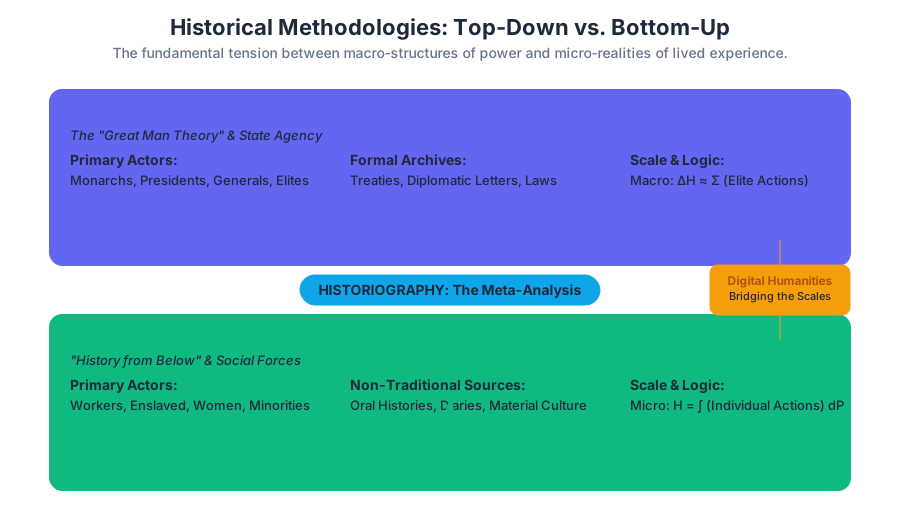
In the rigorous study of the past, the methodology employed by the historian determines not only the narrative produced but the very "truth" that is surfaced. Historiography—the study of how history is written—reveals a fundamental tension between two primary lenses: Top-Down Historical Perspectives and Bottom-Up Historical Perspectives. While the former focuses on the macro-structures of power, the latter investigates the micro-realities of the lived experience.
Historiography: The Meta-Analysis of the Past
Before diving into specific methodologies, we must define Historiography. If history is the study of the past, historiography is the study of the study of the past. It examines the techniques, theories, and biases inherent in historical writing.
Definition: Historiography The academic discipline that analyzes the development of historical methods, the evolution of historical interpretations, and the socio-political contexts in which historians operate. It treats historical narratives not as static facts, but as "constructed models" subject to revision.
Historically, the dominant model was the Rankean approach (after Leopold von Ranke), which emphasized "telling it as it actually was" (wie es eigentlich gewesen) through official state documents. This naturally led to a top-down bias. The 1960s and 70s saw a "Social Turn," where historians began to question the validity of a history that ignored 99% of the population, giving rise to the bottom-up approach.
Top-Down Historical Perspectives
The Top-Down approach, often associated with the "Great Man Theory," posits that history is primarily driven by the decisions and actions of those at the apex of social, political, and economic hierarchies. In this model, the "unit of analysis" is the state, the monarch, the general, or the CEO.
Mechanics of Top-Down Analysis
Top-down history relies on formal archives. These include:
- Diplomatic Correspondence: Letters between heads of state.
- Legislative Records: The text of laws, treaties, and decrees.
- Military Dispatches: Command-level orders and strategic maps.
- Macro-Economic Data: National GDP, trade balances, and central bank policies.
The "Great Man" Derivation
In a top-down framework, we can model historical change as a function of elite agency. If $H$ represents the historical state and $A_e$ represents the actions of the elite, the top-down perspective suggests:
$$ \frac{dH}{dt} \approx \sum_{i=1}^{n} w_i A_{e,i} $$
Where $w_i$ is the "weight" or power of the individual leader $i$. This suggests that a few high-value variables (leaders) account for the majority of the variance in historical outcomes.
| Feature | Top-Down Perspective |
|---|---|
| Primary Actor | Monarchs, Presidents, Generals, Intellectual Elites |
| Data Sources | Official State Archives, Treaties, Memoirs of Leaders |
| Scale | Macro (National/International) |
| Narrative Focus | Power dynamics, War, Legislation, Institutional change |
| Common Pitfall | Determinism; ignoring the agency of the masses |
Example: The American Revolution (Top-Down)
A top-down analysis of the American Revolution focuses on the intellectual debates of the Founding Fathers, the tactical decisions of George Washington, and the diplomatic maneuvering of Benjamin Franklin in the French court. The "cause" is seen as a conflict over legal jurisdiction and Enlightenment philosophy among the colonial elite.
Bottom-Up Historical Perspectives
Bottom-Up Historical Perspectives, or "History from Below," shift the focus to the marginalized, the working class, and the disenfranchised. This methodology argues that macro-level changes are often the result of aggregate micro-level pressures—social movements, labor strikes, and cultural shifts.
Mechanics of Bottom-Up Analysis
Because the "ordinary person" rarely leaves behind a formal archive, bottom-up historians must use non-traditional sources:
- Social History Data: Parish registers, census records, and tax rolls.
- Material Culture: Tools, clothing, and housing layouts.
- Oral Histories: Recorded testimonies from survivors of events.
- Ephemera: Pamphlets, folk songs, and personal diaries.
The Social Force Derivation
Conversely to the top-down model, the bottom-up perspective views history as an emergent property of a complex system. If $P$ is the population and $a_j$ is the action of an individual $j$:
$$ H(t) = \int_{P} f(a_j, \text{context}) dP $$
Here, history is the integral of millions of small actions. Change occurs when the "lower-level" agents synchronize their behavior (e.g., a revolution or a cultural shift).
| Feature | Bottom-Up Perspective |
|---|---|
| Primary Actor | Workers, Enslaved people, Women, Minority groups |
| Data Sources | Oral histories, Census data, Material culture, Diaries |
| Scale | Micro to Meso (Community/Social Movement) |
| Narrative Focus | Lived experience, Resistance, Culture, Identity |
| Common Pitfall | Fragmentation; losing sight of the "big picture" |
Example: The American Revolution (Bottom-Up)
A bottom-up analysis looks at the "mobs" in Boston, the role of women in boycotting British goods (the Daughters of Liberty), and the experiences of enslaved people who sought freedom by joining either side. The "cause" is seen as a broad-based social crisis involving land hunger, debt, and class tension.
Technical Deep-Dive: Quantifying History
Modern historiography often uses Digital Humanities to bridge these two perspectives. By applying computational methods to historical data, we can "see" the bottom-up patterns within top-down structures.
2. Mathematical Derivation: The Influence Weighting Model
How do we decide if a historical event was "Top-Down" or "Bottom-Up"? We can use a Heuristic Weighting Model to categorize events based on the source of the impetus.
Let $I$ be the total impetus for a historical event. Let $E$ be the set of Elite actors and $M$ be the set of Mass actors. The Historiographical Ratio ($R_h$) is defined as:
$$ R_h = \frac{\sum_{i \in E} \text{Agency}(i)}{\sum_{j \in M} \text{Agency}(j)} $$
- If $R_h \gg 1$, the event is Top-Down dominant (e.g., The Louisiana Purchase).
- If $R_h \ll 1$, the event is Bottom-Up dominant (e.g., The Great Migration).
- If $R_h \approx 1$, the event is a Synthesized struggle (e.g., The Civil Rights Movement).
Social History: Race, Class, and Gender
A critical subset of the bottom-up approach is Social History. This methodology explicitly uses the variables of Race, Class, and Gender as analytical tools to deconstruct the past.
Race in Historiography
Traditional history often treated race as a static category or ignored it entirely. Modern bottom-up history treats race as a social construct that is actively negotiated. For example, the "White" identity in the U.S. changed over time to include Irish and Italian immigrants who were previously excluded.
Class and Labor
Influenced by Marxist historiography, this lens examines the relationship between the "means of production" and social hierarchy. It looks at strikes, unionization, and the transition from agrarian to industrial labor.
Gender and Intersectionality
Gender history is not just "history about women." It is the study of how definitions of masculinity and femininity have shaped power structures. Intersectionality (a term coined by Kimberlé Crenshaw) is the crucial refinement here, arguing that a Black woman's historical experience cannot be understood by looking at "Black history" and "Women's history" separately.
| Analytical Lens | Key Question | Example Study |
|---|---|---|
| Race | How did racial hierarchies justify economic exploitation? | The construction of "Whiteness" in 19th-century labor unions. |
| Class | How did the shift to wage labor change the family structure? | The impact of the Lowell Mill system on New England farmers. |
| Gender | How did the "Cult of Domesticity" limit political agency? | The role of the "Republican Motherhood" after the Revolution. |
OpenStax and the Democratization of History
The OpenStax U.S. History textbook represents a modern synthesis of these methodologies. By utilizing Open Educational Resources (OER), it applies a "bottom-up" philosophy to the distribution of knowledge itself.
Why OER Matters for Methodology
- Accessibility: High-quality historical analysis is no longer locked behind a $300 paywall, allowing a broader demographic of students (the "bottom-up" actors of academia) to engage with the material.
- Creative Commons Attribution (CC BY): This license allows historians to "fork" the textbook, adding local histories or marginalized perspectives that the original authors might have missed.
- LMS Integration: Tools like OpenStax Assignable allow for data-driven insights into how students learn history, creating a feedback loop between the "top-down" curriculum and "bottom-up" student performance.
Common Pitfalls in Historical Methodology
Even expert historians fall into traps when choosing a perspective:
- The "Great Man" Fallacy: Attributing a complex social shift (like the end of the Cold War) entirely to one person (like Ronald Reagan or Mikhail Gorbachev) while ignoring the systemic economic failures of the USSR.
- Romanticizing the Subaltern: Assuming that "bottom-up" actors are always heroic or unified. In reality, marginalized groups often have internal conflicts and hierarchies.
- Anachronism: Applying modern values (e.g., 21st-century views on gender) to 17th-century actors.
- Data Overfitting: In digital history, finding a correlation in census data and assuming it proves a "social law" without qualitative archival support.
The Synthesis Theorem The most robust historical narratives are those that demonstrate how Top-Down structures (laws, wars, economies) create the constraints within which Bottom-Up actors (individuals, movements) exercise their agency, and how that agency, in turn, reshapes the structures.
Source Materials
Study Introduction to OpenStax U.S. History and Historiography on Lykke
This course page is free to open: signed out, you can read its first two sections, and signing in, on any plan, opens the rest. The free Lykke Chrome extension syncs your own Canvas courses, so ChatGPT, Claude and Muse can answer from your classes and deadlines. It only reads Canvas.
Add the free extensionSign in to open every sectionAll sections of Introduction to OpenStax U.S. History and Historiography · Browse more course pages