Introduction to OpenStax U.S. History and Historiography
Institution: MIT
1 study materials · 4 sections
OpenStax provides high-quality, peer-reviewed, and openly licensed college textbooks designed to increase educational accessibility and affordability. This course focuses on the OpenStax U.S. History curriculum, which offers a comprehensive and balanced overview of the American narrative. By integrating traditional political history with social history, the course emphasizes the lived experiences of diverse groups across race, class, and gender while leveraging modern digital tools for classroom integration.
Course Sections
Introduction to OER and OpenStax
Key concepts: Open Educational Resources (OER) · Creative Commons Attribution License · Educational Accessibility
An introduction to the mission of OpenStax and the principles of Open Educational Resources (OER).
Introduction to OER and OpenStax
The landscape of modern higher education is currently undergoing a structural transformation driven by the intersection of digital distribution, intellectual property reform, and a pedagogical shift toward inclusivity. At the center of this movement is Open Educational Resources (OER), a paradigm that challenges the traditional "all rights reserved" model of textbook publishing. OpenStax, a non-profit initiative based at Rice University, represents the most significant institutional effort to scale this movement, providing peer-reviewed, professional-grade textbooks to millions of students globally at zero cost.
The OER Paradigm: Definitions and Frameworks
At its core, OER is defined not merely by its price point (which is typically free) but by the legal permissions granted to the end-user. While "free" resources may be available for reading online, OER permits a range of interactions that traditional copyrighted materials forbid.
Definition: Open Educational Resources (OER) OER are teaching, learning, and research materials in any medium—digital or otherwise—that reside in the public domain or have been released under an open license that permits no-cost access, use, adaptation, and redistribution by others with no or limited restrictions.
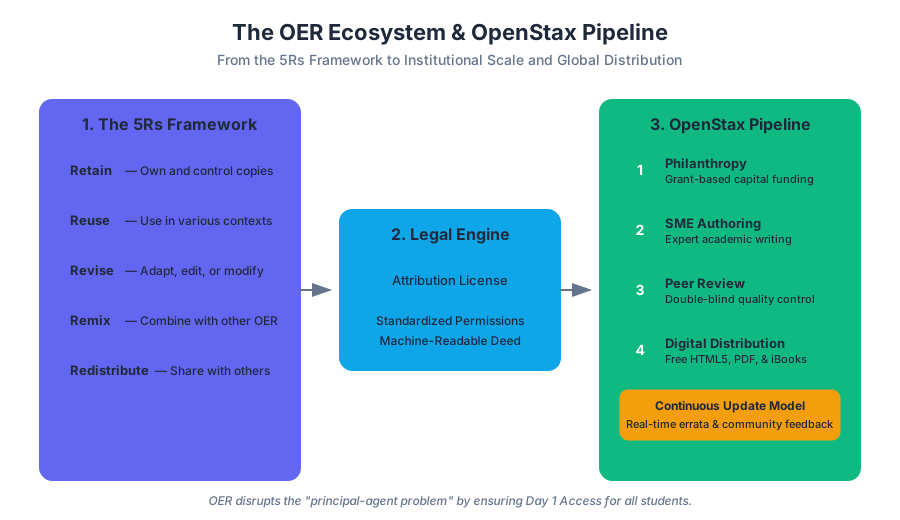
To understand the technical utility of OER, practitioners use the 5Rs Framework, developed by David Wiley. This framework defines the functional requirements of a truly "open" resource:
| Activity | Description | Technical Implication |
|---|---|---|
| Retain | The right to make, own, and control copies of the content. | No "expiring" digital access codes or DRM. |
| Reuse | The right to use the content in a wide range of ways. | Use in class, on a website, in a video, or as a handout. |
| Revise | The right to adapt, adjust, modify, or alter the content. | Translating text or changing examples to fit local contexts. |
| Remix | The right to combine the original or revised content with other material. | Creating a "mashup" of two different OER chapters. |
| Redistribute | The right to share copies of the original content, your revisions, or your remixes. | Giving a copy to a colleague or student without royalty fees. |
The Economic Motivation for OER
The traditional textbook market is characterized by asymmetric information and a principal-agent problem: the person choosing the product (the professor) is not the person paying for it (the student). This has led to textbook prices outstripping inflation by over 800% since the late 1970s. OER disrupts this by removing the "toll-gate" to knowledge, ensuring that "Day 1 Access" is a financial reality for all students, regardless of socioeconomic status.
Licensing Mechanics: The Creative Commons Attribution License
The legal engine of OER is the Creative Commons (CC) licensing suite. Most OpenStax materials are released under the CC BY (Attribution) license. This is the most permissive of the CC licenses, requiring only that the user provide credit to the original creator.
Legal Logic of CC BY
Traditional copyright is "Opt-In" for protection but "Opt-Out" for sharing. CC BY flips this by providing a standardized, machine-readable legal deed that grants permissions upfront. For a senior developer or architect, this is analogous to Open Source Software (OSS) licenses like MIT or Apache 2.0.
| License Component | Requirement | Impact on Educator |
|---|---|---|
| Attribution (BY) | Credit must be given to the creator. | Must cite OpenStax/Rice University in the syllabus or footer. |
| ShareAlike (SA) | Adaptations must be shared under the same license. | Prevents "proprietary forks" of the content. |
| Non-Commercial (NC) | The material cannot be used for primary commercial gain. | Limits the ability of for-profit publishers to resell the work. |
| NoDerivatives (ND) | The material cannot be edited or remixed. | Incompatible with the "Revise" and "Remix" pillars of OER. |
OpenStax: Institutionalizing Openness
While the OER movement began as a grassroots effort (often involving individual professors sharing PDFs), OpenStax introduced a "top-down" professionalization of the process. Founded by Richard Baraniuk in 1999 (originally as Connexions), OpenStax adopted the rigorous production standards of "Big Three" publishers (Pearson, McGraw-Hill, Cengage) while maintaining an open-source philosophy.
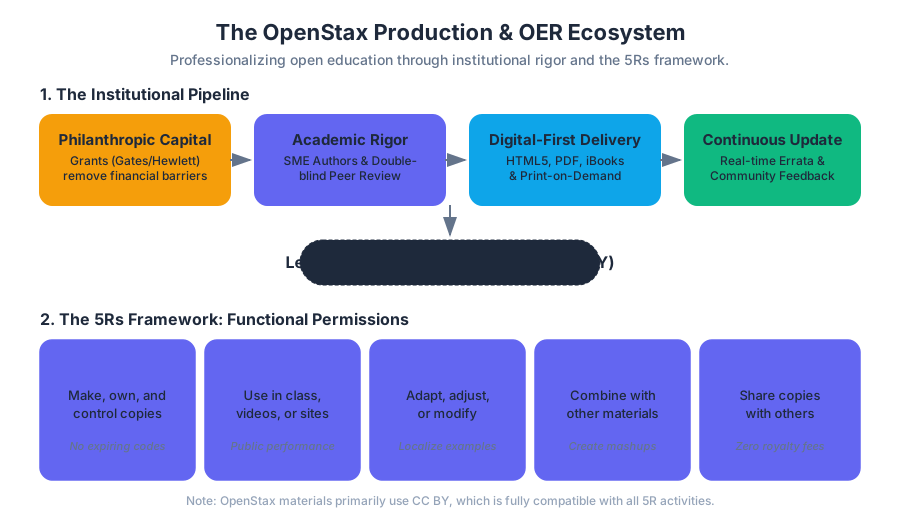
The OpenStax Production Pipeline
- Grant Funding: Initial capital is raised via philanthropic organizations (e.g., Bill & Melinda Gates Foundation, William and Flora Hewlett Foundation).
- Subject Matter Expert (SME) Recruitment: Leading professors are hired to write content, ensuring academic rigor.
- Peer Review: Each textbook undergoes a double-blind peer-review process identical to traditional academic publishing.
- Digital-First Distribution: Books are rendered in HTML5, PDF, and iBooks formats simultaneously.
- Errata Management: Unlike traditional "editions" that force students to buy new books every three years, OpenStax uses a continuous update model where community-reported errata are corrected in the digital master file in real-time.
# Example: A simplified script to check for OpenStax book metadata via a hypothetical API
# This demonstrates how OER platforms expose data for programmatic accessibility.

import requests

def get_openstax_metadata(book_slug):
    """
    Fetches metadata for an OpenStax textbook to verify licensing and versioning.
    """
    base_url = "https://openstax.org/api/v2/pages/"
    params = {
        "slug": book_slug,
        "format": "json"
    }

    try:
        response = requests.get(base_url, params=params)
        response.raise_for_status()
        data = response.json()

        # Extracting key OER attributes
        metadata = {
            "title": data.get("title"),
            "license": data.get("license", "CC BY 4.0"),
            "last_updated": data.get("modified"),
            "version": data.get("version_history", [{}])[0].get("id")
        }
        return metadata
    except Exception as e:
        return {"error": str(e)}

# Usage: Fetching metadata for the "U.S. History" textbook
history_meta = get_openstax_metadata("us-history")
print(f"Book: {history_meta['title']} | License: {history_meta['license']}")
Historiographical Perspectives: Top-Down vs. Bottom-Up
The OpenStax U.S. History text serves as a primary example of how OER can facilitate a more modern, inclusive approach to pedagogy. In historical scholarship, there is a fundamental tension between Top-Down and Bottom-Up narratives.
Top-Down History (Traditional)
This perspective focuses on "Great Men," political leaders, and macro-economic shifts. It prioritizes the actions of presidents, generals, and CEOs, viewing history as a series of policy decisions and military victories.
Bottom-Up History (Social History)
Also known as "History from Below," this approach focuses on the lived experiences of the marginalized—slaves, women, immigrants, and the working class. It examines how social movements and cultural shifts at the grassroots level eventually force changes at the top.
| Feature | Top-Down Perspective | Bottom-Up (Social History) |
|---|---|---|
| Primary Actors | Presidents, Monarchs, Diplomats. | Laborers, Enslaved People, Women, Minorities. |
| Key Sources | Treaties, Executive Orders, Official Proclamations. | Diaries, Folk Songs, Census Data, Court Records. |
| Narrative Focus | Power, Sovereignty, National Identity. | Race, Class, Gender, Resistance, Daily Life. |
| OpenStax Approach | Integrated: Uses the political timeline as a skeleton. | Integrated: Fleshes out the skeleton with diverse voices. |
Technical Integration: LMS and OpenStax Assignable
A common critique of early OER was the lack of "ancillaries"—the test banks, slide decks, and homework systems that accompany traditional textbooks. OpenStax solved this through OpenStax Assignable and LTI (Learning Tools Interoperability) integration.
LTI 1.3 and Deep Linking
OpenStax uses the LTI standard to "handshake" with Learning Management Systems (LMS) like Canvas, Blackboard, and Moodle. This allows instructors to embed specific chapters or assessments directly into their course modules without requiring students to create separate accounts.
\text{LTI Handshake Logic:} \\
\text{1. Tool Provider (OpenStax) } \xleftarrow{\text{OIDC Login Request}} \text{ Platform (Canvas)} \\
\text{2. Platform } \xrightarrow{\text{Authentication Response}} \text{ Tool Provider} \\
\text{3. Tool Provider } \xrightarrow{\text{Resource Link Request}} \text{ Platform} \\
\text{Result: Seamless authenticated access to OER content within the LMS iframe.}
OpenStax Assignable
This is a specialized toolset that allows for:
- Auto-graded assessments: Reducing the administrative burden on instructors.
- Engagement Tracking: Monitoring which sections students are reading and where they are struggling.
- Customization: Allowing instructors to reorder chapters to match their specific syllabus (the "Remix" and "Revise" pillars).
# Example: Deploying a local mirror of OER content for offline access
# Using a simple Docker configuration to host a static OER library

docker run --name oer-library-mirror \
  -v /path/to/openstax/pdfs:/usr/share/nginx/html:ro \
  -p 8080:80 \
  -d nginx:alpine

echo "OER Library is now accessible at http://localhost:8080"
Educational Accessibility and Universal Design
OER is intrinsically linked to Universal Design for Learning (UDL). Because the source code (HTML) of OpenStax books is open, it can be optimized for screen readers, high-contrast displays, and other assistive technologies more effectively than "locked" proprietary PDFs.
Dimensions of Accessibility
- Financial Accessibility: Elimination of the "textbook or groceries" dilemma.
- Geographic Accessibility: Available in low-bandwidth areas via downloadable PDFs.
- Technological Accessibility: Responsive design that works on mobile phones (crucial for students without home computers).
- Linguistic Accessibility: CC BY licenses allow for community-driven translations into Spanish, French, and other languages.
Common Pitfalls and Misconceptions
Despite its growth, OER faces several hurdles in adoption:
- The "Quality" Myth: There is a lingering perception that "free" means "low quality." OpenStax counters this with its rigorous peer-review and SME hiring process.
- Sustainability Concerns: How does a non-profit survive? OpenStax uses a freemium model—the core content is free, while optional premium services (like advanced homework platforms or printed copies) generate revenue to supplement philanthropic grants.
- Copyright Confusion: Instructors often mistakenly believe that "Fair Use" is the same as "Open." Fair Use is a legal defense for limited use; OER is a proactive grant of rights for broad use.
| Concept | Misconception | Reality |
|---|---|---|
| Public Domain | Everything on the internet is Public Domain. | Most internet content is copyrighted; OER requires specific licenses. |
| Fair Use | I can use any book if I'm a teacher. | Fair Use is limited and legally risky; OER provides explicit permission. |
| Cost | OER is always $0. | While the digital version is $0, print-on-demand copies have a nominal cost. |
| Stability | OER links break or change. | OpenStax uses persistent identifiers and versioning to ensure stability. |
Conclusion: The Future of the Open Movement
The trajectory of OER, led by institutions like OpenStax, suggests a future where the "textbook" is no longer a static product but a dynamic, community-governed resource. As AI and machine learning continue to evolve, the open availability of high-quality, structured academic data (like the OpenStax library) will be essential for training the next generation of educational tools without the constraints of restrictive licensing.
Historical Methodologies: Top-Down vs. Bottom-Up
Key concepts: Top-down Historical Perspectives · Bottom-up Historical Perspectives · Historiography
Comparing the different lenses through which American history is analyzed and taught.
Historical Methodologies: Top-Down vs. Bottom-Up
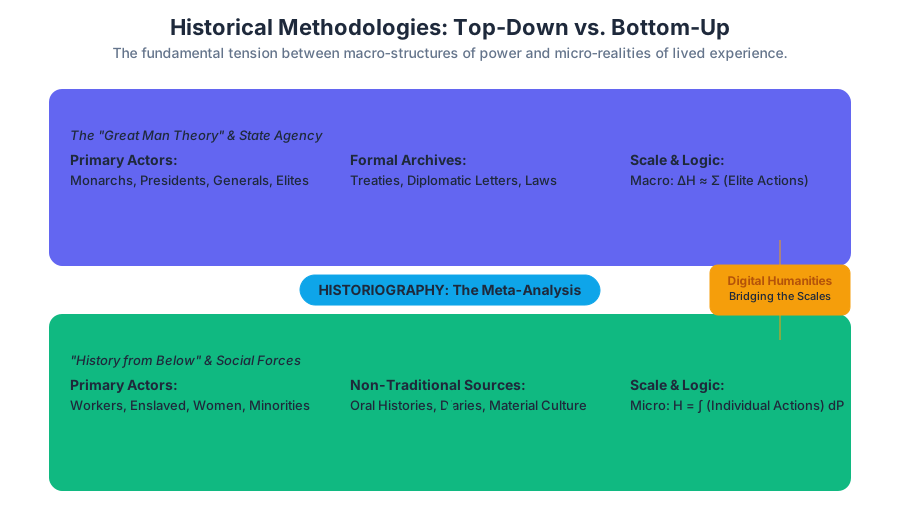
In the rigorous study of the past, the methodology employed by the historian determines not only the narrative produced but the very "truth" that is surfaced. Historiography—the study of how history is written—reveals a fundamental tension between two primary lenses: Top-Down Historical Perspectives and Bottom-Up Historical Perspectives. While the former focuses on the macro-structures of power, the latter investigates the micro-realities of the lived experience.
Historiography: The Meta-Analysis of the Past
Before diving into specific methodologies, we must define Historiography. If history is the study of the past, historiography is the study of the study of the past. It examines the techniques, theories, and biases inherent in historical writing.
Definition: Historiography The academic discipline that analyzes the development of historical methods, the evolution of historical interpretations, and the socio-political contexts in which historians operate. It treats historical narratives not as static facts, but as "constructed models" subject to revision.
Historically, the dominant model was the Rankean approach (after Leopold von Ranke), which emphasized "telling it as it actually was" (wie es eigentlich gewesen) through official state documents. This naturally led to a top-down bias. The 1960s and 70s saw a "Social Turn," where historians began to question the validity of a history that ignored 99% of the population, giving rise to the bottom-up approach.
Top-Down Historical Perspectives
The Top-Down approach, often associated with the "Great Man Theory," posits that history is primarily driven by the decisions and actions of those at the apex of social, political, and economic hierarchies. In this model, the "unit of analysis" is the state, the monarch, the general, or the CEO.
Mechanics of Top-Down Analysis
Top-down history relies on formal archives. These include:
- Diplomatic Correspondence: Letters between heads of state.
- Legislative Records: The text of laws, treaties, and decrees.
- Military Dispatches: Command-level orders and strategic maps.
- Macro-Economic Data: National GDP, trade balances, and central bank policies.
The "Great Man" Derivation
In a top-down framework, we can model historical change as a function of elite agency. If $H$ represents the historical state and $A_e$ represents the actions of the elite, the top-down perspective suggests:
$$ \frac{dH}{dt} \approx \sum_{i=1}^{n} w_i A_{e,i} $$
Where $w_i$ is the "weight" or power of the individual leader $i$. This suggests that a few high-value variables (leaders) account for the majority of the variance in historical outcomes.
| Feature | Top-Down Perspective |
|---|---|
| Primary Actor | Monarchs, Presidents, Generals, Intellectual Elites |
| Data Sources | Official State Archives, Treaties, Memoirs of Leaders |
| Scale | Macro (National/International) |
| Narrative Focus | Power dynamics, War, Legislation, Institutional change |
| Common Pitfall | Determinism; ignoring the agency of the masses |
Example: The American Revolution (Top-Down)
A top-down analysis of the American Revolution focuses on the intellectual debates of the Founding Fathers, the tactical decisions of George Washington, and the diplomatic maneuvering of Benjamin Franklin in the French court. The "cause" is seen as a conflict over legal jurisdiction and Enlightenment philosophy among the colonial elite.
Bottom-Up Historical Perspectives
Bottom-Up Historical Perspectives, or "History from Below," shift the focus to the marginalized, the working class, and the disenfranchised. This methodology argues that macro-level changes are often the result of aggregate micro-level pressures—social movements, labor strikes, and cultural shifts.
Mechanics of Bottom-Up Analysis
Because the "ordinary person" rarely leaves behind a formal archive, bottom-up historians must use non-traditional sources:
- Social History Data: Parish registers, census records, and tax rolls.
- Material Culture: Tools, clothing, and housing layouts.
- Oral Histories: Recorded testimonies from survivors of events.
- Ephemera: Pamphlets, folk songs, and personal diaries.
The Social Force Derivation
Conversely to the top-down model, the bottom-up perspective views history as an emergent property of a complex system. If $P$ is the population and $a_j$ is the action of an individual $j$:
$$ H(t) = \int_{P} f(a_j, \text{context}) dP $$
Here, history is the integral of millions of small actions. Change occurs when the "lower-level" agents synchronize their behavior (e.g., a revolution or a cultural shift).
| Feature | Bottom-Up Perspective |
|---|---|
| Primary Actor | Workers, Enslaved people, Women, Minority groups |
| Data Sources | Oral histories, Census data, Material culture, Diaries |
| Scale | Micro to Meso (Community/Social Movement) |
| Narrative Focus | Lived experience, Resistance, Culture, Identity |
| Common Pitfall | Fragmentation; losing sight of the "big picture" |
Example: The American Revolution (Bottom-Up)
A bottom-up analysis looks at the "mobs" in Boston, the role of women in boycotting British goods (the Daughters of Liberty), and the experiences of enslaved people who sought freedom by joining either side. The "cause" is seen as a broad-based social crisis involving land hunger, debt, and class tension.
Technical Deep-Dive: Quantifying History
Modern historiography often uses Digital Humanities to bridge these two perspectives. By applying computational methods to historical data, we can "see" the bottom-up patterns within top-down structures.
1. Low-Level Implementation: Parsing Historical Census Data
To reconstruct the lives of ordinary people, historians often write scripts to normalize messy archival data. The following Python snippet demonstrates how a historian might process a 19th-century census CSV to calculate the "Social Mobility Index" of a specific immigrant group.
import pandas as pd
import numpy as np

def calculate_social_mobility(df, group_name):
    """
    Calculates the intergenerational wealth gap for a specific
    ethnic or social group in historical census data.
    """
    # Filter for the specific group
    group_data = df[df['ethnicity'] == group_name]

    # Calculate Mean Wealth for Fathers (1850) and Sons (1880)
    # Assuming the dataset has linked individuals across years
    father_avg_wealth = group_data['wealth_1850'].mean()
    son_avg_wealth = group_data['wealth_1880'].mean()

    # Growth rate as a proxy for mobility
    mobility_index = (son_avg_wealth - father_avg_wealth) / father_avg_wealth

    return {
        "group": group_name,
        "n_samples": len(group_data),
        "mobility_index": round(mobility_index, 4),
        "significant": mobility_index > df['national_avg_growth'].iloc[0]
    }

# Example usage with a hypothetical archival dataset
# census_df = pd.read_csv("boston_1850_1880_linked.csv")
# print(calculate_social_mobility(census_df, "Irish"))
2. Mathematical Derivation: The Influence Weighting Model
How do we decide if a historical event was "Top-Down" or "Bottom-Up"? We can use a Heuristic Weighting Model to categorize events based on the source of the impetus.
Let $I$ be the total impetus for a historical event. Let $E$ be the set of Elite actors and $M$ be the set of Mass actors. The Historiographical Ratio ($R_h$) is defined as:
$$ R_h = \frac{\sum_{i \in E} \text{Agency}(i)}{\sum_{j \in M} \text{Agency}(j)} $$
- If $R_h \gg 1$, the event is Top-Down dominant (e.g., The Louisiana Purchase).
- If $R_h \ll 1$, the event is Bottom-Up dominant (e.g., The Great Migration).
- If $R_h \approx 1$, the event is a Synthesized struggle (e.g., The Civil Rights Movement).
3. Real-World Usage: SQL for Archival Research
Historians often query massive relational databases like the Trans-Atlantic Slave Trade Database. This requires complex joins to connect ship manifests (Top-Down) with individual names and origins (Bottom-Up).
-- Querying for the correlation between ship ownership (Elite)
-- and the mortality rate of the enslaved (Mass/Social)
SELECT
    v.vessel_name,
    v.owner_name,
    v.year_of_arrival,
    (v.slaves_embarked - v.slaves_disembarked) AS mortality_count,
    CAST((v.slaves_embarked - v.slaves_disembarked) AS FLOAT) / v.slaves_embarked * 100 AS mortality_rate
FROM
    transatlantic_voyages v
WHERE
    v.year_of_arrival BETWEEN 1780 AND 1800
    AND v.slaves_embarked > 0
ORDER BY
    mortality_rate DESC
LIMIT 20;
Social History: Race, Class, and Gender
A critical subset of the bottom-up approach is Social History. This methodology explicitly uses the variables of Race, Class, and Gender as analytical tools to deconstruct the past.
Race in Historiography
Traditional history often treated race as a static category or ignored it entirely. Modern bottom-up history treats race as a social construct that is actively negotiated. For example, the "White" identity in the U.S. changed over time to include Irish and Italian immigrants who were previously excluded.
Class and Labor
Influenced by Marxist historiography, this lens examines the relationship between the "means of production" and social hierarchy. It looks at strikes, unionization, and the transition from agrarian to industrial labor.
Gender and Intersectionality
Gender history is not just "history about women." It is the study of how definitions of masculinity and femininity have shaped power structures. Intersectionality (a term coined by Kimberlé Crenshaw) is the crucial refinement here, arguing that a Black woman's historical experience cannot be understood by looking at "Black history" and "Women's history" separately.
| Analytical Lens | Key Question | Example Study |
|---|---|---|
| Race | How did racial hierarchies justify economic exploitation? | The construction of "Whiteness" in 19th-century labor unions. |
| Class | How did the shift to wage labor change the family structure? | The impact of the Lowell Mill system on New England farmers. |
| Gender | How did the "Cult of Domesticity" limit political agency? | The role of the "Republican Motherhood" after the Revolution. |
OpenStax and the Democratization of History
The OpenStax U.S. History textbook represents a modern synthesis of these methodologies. By utilizing Open Educational Resources (OER), it applies a "bottom-up" philosophy to the distribution of knowledge itself.
Why OER Matters for Methodology
- Accessibility: High-quality historical analysis is no longer locked behind a $300 paywall, allowing a broader demographic of students (the "bottom-up" actors of academia) to engage with the material.
- Creative Commons Attribution (CC BY): This license allows historians to "fork" the textbook, adding local histories or marginalized perspectives that the original authors might have missed.
- LMS Integration: Tools like OpenStax Assignable allow for data-driven insights into how students learn history, creating a feedback loop between the "top-down" curriculum and "bottom-up" student performance.
Common Pitfalls in Historical Methodology
Even expert historians fall into traps when choosing a perspective:
- The "Great Man" Fallacy: Attributing a complex social shift (like the end of the Cold War) entirely to one person (like Ronald Reagan or Mikhail Gorbachev) while ignoring the systemic economic failures of the USSR.
- Romanticizing the Subaltern: Assuming that "bottom-up" actors are always heroic or unified. In reality, marginalized groups often have internal conflicts and hierarchies.
- Anachronism: Applying modern values (e.g., 21st-century views on gender) to 17th-century actors.
- Data Overfitting: In digital history, finding a correlation in census data and assuming it proves a "social law" without qualitative archival support.
The Synthesis Theorem The most robust historical narratives are those that demonstrate how Top-Down structures (laws, wars, economies) create the constraints within which Bottom-Up actors (individuals, movements) exercise their agency, and how that agency, in turn, reshapes the structures.
Social History: Race, Class, and Gender
Key concepts: Social History · Lived Experiences · Intersectionality
Exploring the lived experiences of diverse groups and their impact on the American narrative.
Social History: Race, Class, and Gender
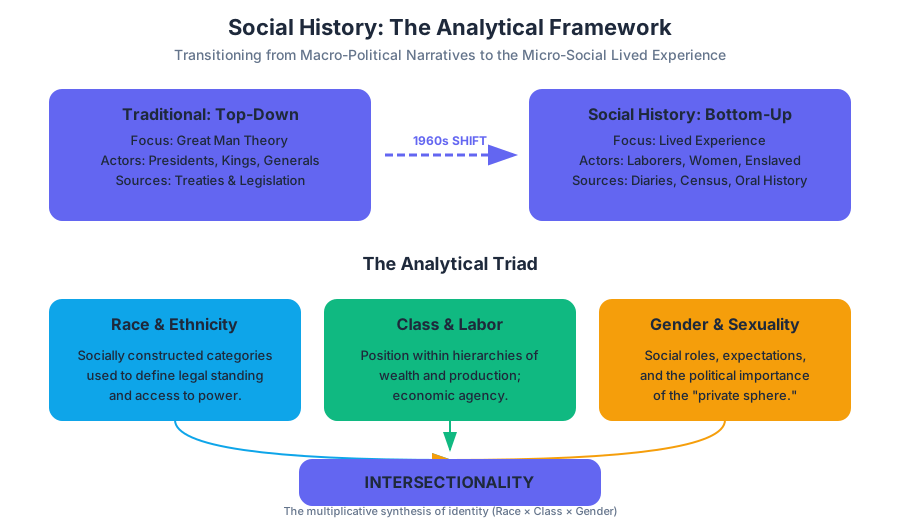
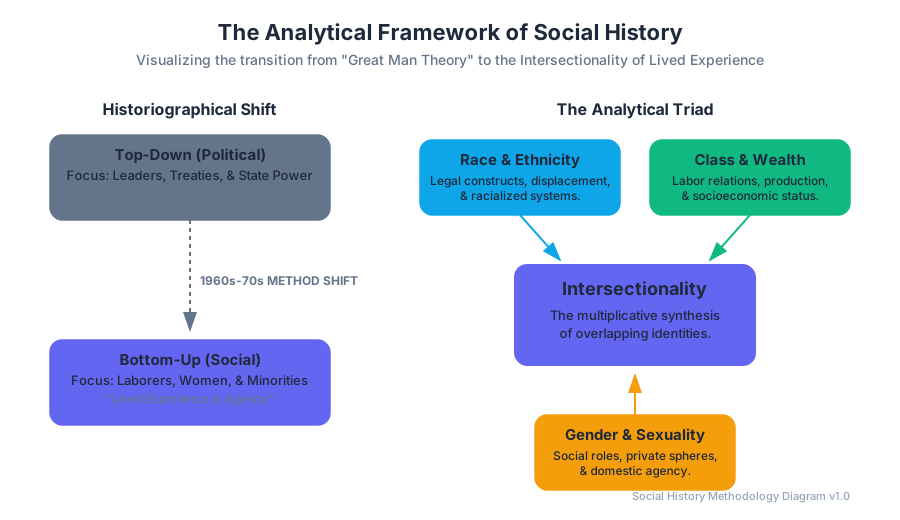
The study of history has undergone a seismic shift over the last half-century, moving from a "Top-Down" chronicle of Great Men and high politics to a "Bottom-Up" investigation of the masses. This transition is codified in the discipline of Social History, a methodology that prioritizes the Lived Experiences of ordinary individuals over the administrative records of the state. By applying the analytical lenses of Race, Class, and Gender, historians can deconstruct the "monolithic" American narrative to reveal a complex, often contradictory tapestry of agency, oppression, and survival.
The Historiographical Shift: Top-Down vs. Bottom-Up
To understand Social History, one must first understand what it replaced. Traditional historiography—often called Political History—focused on the "Great Man Theory," which posited that history is shaped primarily by the decisions of influential leaders, generals, and monarchs. In contrast, Social History (or "The New Social History") emerged in the 1960s and 70s, influenced by the Civil Rights Movement and second-wave feminism, to ask how the "silent majority" shaped the world.
Definition: Social History A subfield of historical study that focuses on the daily lives, social structures, and cultural movements of ordinary people. It utilizes quantitative data (census records, tax rolls) and qualitative fragments (diaries, oral histories) to reconstruct the past from the perspective of those traditionally excluded from power.
Comparison of Historical Perspectives
| Feature | Top-Down (Political History) | Bottom-Up (Social History) |
|---|---|---|
| Primary Actors | Presidents, Generals, CEOs, Monarchs | Laborers, Enslaved People, Women, Immigrants |
| Key Sources | Treaties, Legislation, Executive Orders | Diaries, Census Data, Folk Songs, Parish Records |
| Core Question | How did the state exercise power? | How did people experience and resist power? |
| Scale | Macro (National/International) | Micro (Community/Household/Individual) |
| Narrative Style | Linear, Progress-oriented | Fragmented, Conflict-oriented, Multi-vocal |
The Analytical Triad: Race, Class, and Gender
Social historians do not view the past as a single stream of events. Instead, they use a tripartite framework to "slice" through historical moments. These three pillars—Race, Class, and Gender—are not merely categories of identity but are analytical variables that determine an individual's access to resources, legal standing, and social agency.
1. Race and Ethnicity
In the American context, race is a social construct with very real material consequences. Historians examine how racial categories were legally defined (e.g., the "one-drop rule") and how these definitions were used to justify systems like chattel slavery, Jim Crow, and indigenous displacement.
2. Class and Socioeconomics
Class refers to an individual's position within a hierarchy of production and wealth. Social history examines the "Class Consciousness" of the working poor, the rise of the middle class during industrialization, and the ways in which economic status dictates one's ability to participate in the democratic process.
3. Gender and Sexuality
Gender history moves beyond "women's history" to examine the social roles and expectations placed on all individuals. It looks at the "private sphere" (the home) as a site of political importance and analyzes how notions of masculinity and femininity have been used to reinforce or challenge power structures.
Intersectionality: The Synthesis of Identity
While Race, Class, and Gender are powerful lenses individually, they are most effective when used together. This approach is known as Intersectionality. Coined by legal scholar Kimberlé Crenshaw, intersectionality posits that social identities do not exist in isolation; rather, they overlap and intersect to create unique modes of discrimination and privilege.
The Principle of Intersectionality An analytical framework for understanding how aspects of a person's social and political identities combine to create different modes of discrimination and privilege. It is not an additive model (Race + Class + Gender) but a multiplicative one (Race × Class × Gender), where the resulting experience is qualitatively different from its component parts.
The Intersectionality Matrix: A Comparative Example
| Identity Intersection | Historical Context | Lived Experience / Constraint |
|---|---|---|
| White, Male, Elite | Antebellum South | High agency; political power; control over labor/capital. |
| White, Female, Elite | Antebellum South | Social prestige but limited legal agency (Coverture laws). |
| Black, Male, Enslaved | Antebellum South | Total loss of bodily autonomy; labor exploitation; racialized violence. |
| Black, Female, Enslaved | Antebellum South | Intersection of racialized slavery and gendered violence (reproductive exploitation). |
Implementing Historical Data Analysis
In modern digital humanities, social history is often "computed" by analyzing large datasets. Below is a Python implementation showing how a historian might programmatically analyze a census dataset to identify correlations between occupation (class) and literacy (social capital) across different racial groups.
import pandas as pd
import numpy as np

def analyze_social_stratification(census_df):
    """
    Analyzes the intersection of Race and Class (via Literacy)
    in a historical census dataset.
    """
    # Grouping by Race and Literacy status
    stratification_map = census_df.groupby(['race', 'literacy_status']).size().unstack(fill_value=0)

    # Calculate Literacy Rate as a proxy for 'Social Capital'
    stratification_map['literacy_rate'] = (
        stratification_map['Literate'] /
        (stratification_map['Literate'] + stratification_map['Illiterate'])
    ) * 100

    # Calculate the 'Social Agency Score' (Hypothetical Metric)
    # Formula: (Literacy Rate * 0.6) + (Property_Ownership_Rate * 0.4)
    stratification_map['agency_score'] = stratification_map['literacy_rate'].apply(
        lambda x: np.log1p(x) * 10 # Logarithmic scaling for social mobility
    )

    return stratification_map.sort_values(by='agency_score', ascending=False)

# Example Usage with mock 1870 Census Data
data = {
    'race': ['White', 'White', 'Black', 'Black', 'Asian', 'Asian'],
    'literacy_status': ['Literate', 'Illiterate', 'Literate', 'Illiterate', 'Literate', 'Illiterate'],
    'count': [4500, 500, 1200, 3800, 300, 700]
}
# Note: Real historical data would be loaded from a CSV or SQL database
# df = pd.read_csv('1870_census_sample.csv')
Lived Experiences and the "Agency" Problem
A central theme in Social History is Agency—the capacity of individuals to act independently and make their own free choices. Historians argue that even within oppressive systems (like slavery or patriarchy), marginalized people exercised agency through resistance, cultural preservation, and the creation of "counter-publics."
The Mechanics of Agency
- Overt Resistance: Strikes, rebellions, legal challenges.
- Covert Resistance: Sabotage, feigning illness, secret education, "the grapevine" (informal communication networks).
- Cultural Persistence: Maintaining linguistic traditions, religious practices, and family structures despite external pressure to assimilate or dissolve.
Mathematical Representation of Social Constraint
We can represent the "Lived Experience" of an individual as a function of their identity markers within a specific historical environment ($H$). If $E$ is the total experienced agency:
$$E = \int_{t_0}^{t_1} [A(R, C, G) - S(P, L)] dt$$
Where:
- $A$: Innate Agency (a function of Race, Class, and Gender).
- $S$: Structural Suppression (a function of Policy $P$ and Law $L$).
- $t$: Time (representing the duration of the historical era).
In this model, the "Lived Experience" is the net area under the curve of individual action minus systemic restriction.
\begin{aligned}
\text{Intersectionality Index } (I) &= \prod_{i=1}^{n} w_i \cdot \phi_i \\
\text{where } w &= \text{weight of identity marker} \\
\phi &= \text{social value assigned by the State}
\end{aligned}
OpenStax and the Democratization of History
The OpenStax U.S. History curriculum is a prime example of Open Educational Resources (OER). By utilizing a Creative Commons Attribution License (CC BY), it allows for the free distribution and modification of historical knowledge. This is not just a matter of cost; it is a social history project in its own right.
Why OER Matters for Social History
Traditional textbooks are often "gatekept" by expensive publishers and can be slow to incorporate new social history research. OER allows for:
- Rapid Iteration: Updating narratives as new archaeological or archival evidence emerges.
- LMS Integration: Using tools like OpenStax Assignable to bring primary source analysis directly into the digital classroom.
- Diverse Perspectives: Allowing instructors to "remix" the content to highlight local social histories (e.g., the history of labor in a specific city).
Technical Implementation: LTI and Metadata
To integrate these social history concepts into a modern Learning Management System (LMS) like Canvas or Moodle, developers use the Learning Tools Interoperability (LTI) standard. Below is an example of a configuration file for an OpenStax-compatible LTI tool.
# LTI 1.3 Configuration for OpenStax Assignable
platform_configuration:
  client_id: "openstax-history-001"
  deployment_id: "social-history-unit-4"
  target_link_uri: "https://assignable.openstax.org/launch"
  public_key_type: "JWK"

  # Custom Parameters for Social History Module
  custom_parameters:
    primary_lens: "intersectionality"
    data_source: "US_Census_1880"
    focus_demographic: "immigrant_labor"

  # Scopes for accessing student engagement with social history content
  scopes:
    - "https://purl.imsglobal.org/spec/lti-ags/scope/lineitem"
    - "https://purl.imsglobal.org/spec/lti-nrps/scope/contextmembership.readonly"
Common Pitfalls in Social History Analysis
While Social History provides a more complete picture of the past, it is susceptible to several analytical errors:
- Presentism: Judging historical actors by modern moral standards. For example, criticizing 19th-century suffragists for not having a 21st-century understanding of intersectionality.
- Essentialism: Assuming that all members of a group (e.g., "all women" or "all workers") had the same experiences or goals.
- The "Veneer" of Progress: Assuming that history is a steady march toward greater equality. Social history often reveals "backslides" where rights were gained and then violently stripped away (e.g., the end of Reconstruction).
- Data Siloing: Focusing so heavily on one pillar (like Class) that the influence of others (like Race) is obscured.
Comparison of Methodological Pitfalls
| Pitfall | Description | Example | Mitigation Strategy |
|---|---|---|---|
| Essentialism | Homogenizing a diverse group. | "The Black experience in the 1920s." | Use sub-variables (Class, Region, Gender). |
| Romanticization | Portraying marginalized groups as purely heroic. | Ignoring internal conflicts within labor unions. | Acknowledge internal hierarchies and friction. |
| Over-Quantification | Relying solely on numbers, losing the "human" element. | Using only mortality rates to describe a plague. | Supplement data with qualitative primary sources. |
Case Study: The Industrial Revolution through Three Lenses
To see Social History in action, consider the American Industrial Revolution (c. 1820–1870).
- The Lens of Class: Focuses on the transition from "artisan labor" to "wage slavery." It examines the rise of the factory system and the birth of the first labor unions (e.g., the Knights of Labor).
- The Lens of Gender: Focuses on the "Lowell Mill Girls"—young women who left farms for factory work. It analyzes how this provided economic independence while simultaneously enforcing strict moral codes and grueling 12-hour shifts.
- The Lens of Race: Focuses on how industrialization in the North was inextricably linked to the slave-based cotton economy of the South. It also examines how Irish and German immigrants were pitted against free Black workers to keep wages low.
Historical Data: Wage Comparison (Circa 1850)
| Demographic | Typical Role | Weekly Wage (Approx. 1850 USD) | Legal Status |
|---|---|---|---|
| White Male (Skilled) | Machinist / Overseer | $12.00 - $15.00 | Full Citizen |
| White Female (Unskilled) | Textile Weaver | $3.00 - $5.00 | Limited (No Vote) |
| Immigrant Male (Unskilled) | Rail Laborer | $5.00 - $7.00 | Naturalizing |
| Free Black Male | Stevedore / Porter | $3.00 - $4.00 | Restricted (Dred Scott era) |
Summary of Methodology
Social history does not seek to delete the "Great Men" from the record; rather, it seeks to place them in context. A President's proclamation is only half the story; the other half is how that proclamation was read, resisted, or reimagined by the people in the streets, the fields, and the factories. By utilizing the analytical triad of Race, Class, and Gender, and by leveraging the democratizing power of OER tools like OpenStax, we arrive at a version of history that is not only more accurate but more profoundly human.
- Social History: The study of history from the perspective of ordinary people and social structures.
- Agency: The capacity of individuals to act and exert power within a system.
- Intersectionality: The overlapping of social identities (race, class, gender) to create unique experiences of oppression or privilege.
- Top-Down History: Traditional history focusing on elites and political leaders.
- Bottom-Up History: Social history focusing on marginalized or "invisible" populations.
- OER (Open Educational Resources): Free, openly licensed educational materials (e.g., OpenStax).
- Coverture: A legal doctrine where a woman's legal rights were subsumed by those of her husband.
- Class Consciousness: The self-awareness of a social class regarding its common interests and role in the economic system.
-
Which of the following best describes the "Agency" of an enslaved person in the 19th century?
- A) The legal right to vote and hold property.
- B) The ability to resist through covert means like cultural preservation and sabotage. (Correct)
- C) The total lack of any influence over their own life.
- D) The formal power to negotiate labor contracts.
-
In the "Intersectionality Matrix," why is a multiplicative model (Race × Class × Gender) preferred over an additive one?
- Because identities combine to create qualitatively different experiences that aren't just the sum of their parts. (Correct)
-
How does OpenStax utilize the Creative Commons Attribution License (CC BY)?
- A) By charging a subscription fee for access.
- B) By allowing anyone to use, remix, and redistribute the content as long as they provide credit. (Correct)
- C) By restricting the content to government-approved institutions only.
-
What is the primary source of data for a "New Social Historian"?
- A) Official state treaties.
- B) Census records, diaries, and parish logs. (Correct)
- C) Biographies of Kings and Queens.
Key Themes to Master:
- The Shift in Historiography: Be able to explain why the 1960s were a turning point for how we write history.
- The Triad of Analysis: Practice applying Race, Class, and Gender to a single event (e.g., The Great Depression).
- Intersectionality: Understand that identity is not a monolith. A wealthy Black woman's experience in 1920 is different from a poor Black woman's experience.
- Digital Humanities: Recognize how tools like Python, SQL, and LTI are used to analyze and distribute social history today.
- Agency vs. Structure: Identify the tension between individual choice and systemic oppression.
Digital Integration and LMS Tools
Key concepts: LMS Integration · OpenStax Assignable · Digital Pedagogy
Utilizing digital tools and Learning Management Systems to enhance the learning experience.
Digital Integration and LMS Tools
The transition from static Open Educational Resources (OER) to dynamic, integrated learning environments represents a paradigm shift in educational technology. In the context of OpenStax, this evolution is realized through sophisticated LMS Integration and the OpenStax Assignable ecosystem. These tools do not merely "host" content; they transform the textbook from a passive reference into an active participant in the instructional workflow.
Digital integration addresses the "fragmentation problem" in modern education, where students and instructors must navigate a disjointed landscape of PDFs, external quiz platforms, and gradebooks. By leveraging industry-standard protocols like LTI (Learning Tools Interoperability), OpenStax embeds high-quality, peer-reviewed content directly into the instructor’s primary workspace—the Learning Management System (LMS).
LMS Integration: The Interoperability Layer
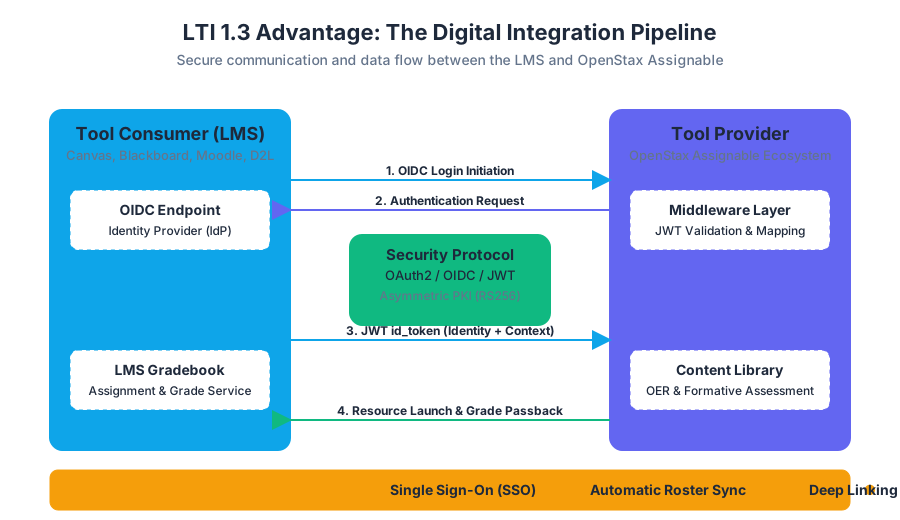
LMS Integration is the technical framework that allows an external tool (a Tool Provider, like OpenStax) to communicate securely with a platform (a Tool Consumer, like Canvas, Blackboard, Moodle, or D2L Brightspace).
What it is
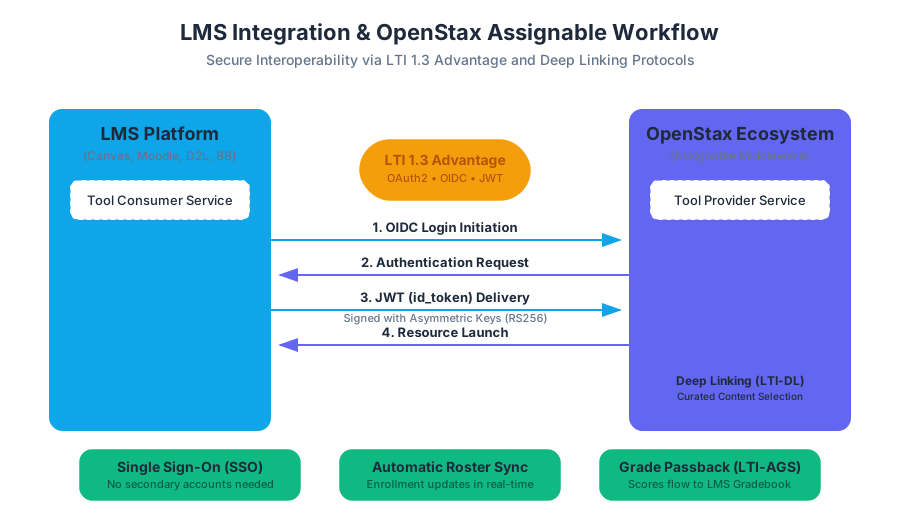
At its core, LMS integration is governed by the LTI 1.3 Advantage standard. This is a security-first protocol built on OAuth2, OpenID Connect (OIDC), and JSON Web Tokens (JWT). Unlike its predecessors, LTI 1.3 moves away from simple shared secrets toward a robust public/private key infrastructure (PKI), ensuring that student data remains encrypted and authenticated throughout the session.
Why it matters
Without integration, instructors face a "data silo" issue. Student performance on OER quizzes is invisible to the LMS gradebook unless manually exported and imported—a process prone to human error and latency. Integration enables:
- Single Sign-On (SSO): Students access materials without secondary accounts.
- Automatic Roster Sync: Enrollment changes in the LMS are reflected in the tool.
- Grade Passback: Scores from interactive modules flow directly into the LMS gradebook.
How it works: The LTI 1.3 Handshake
The integration process follows a strict sequence of redirects and token exchanges to verify identity and permissions.
- OIDC Login Initiation: The LMS sends a request to the OpenStax OIDC endpoint.
- Authentication Request: OpenStax redirects the user back to the LMS for authentication.
- Authentication Response: The LMS sends a JWT (id_token) to OpenStax containing user identity and context (course ID, role).
- Resource Launch: OpenStax validates the JWT and renders the specific textbook chapter or assignment.
| Feature | LTI 1.1 (Legacy) | LTI 1.3 Advantage (Current) |
|---|---|---|
| Security Model | OAuth 1.0a (Shared Secret) | OAuth2 / OIDC (Asymmetric Keys) |
| Data Privacy | Limited; often sent in URL | High; encapsulated in signed JWTs |
| Grade Sync | Basic (one-way passback) | Advanced (LTI-AGS: Assignment & Grade Service) |
| Content Discovery | Manual linking | Deep Linking (LTI-DL) |
| Scalability | Difficult to manage across clusters | High; designed for cloud-native apps |
Implementation Example: JWT Validation
The following TypeScript snippet demonstrates the low-level logic required to verify an incoming LTI launch request. A senior engineer must ensure the state and nonce parameters are validated to prevent replay attacks.
import * as jwt from 'jsonwebtoken';
import { jksClient } from './jwks-config';

/**
 * Validates an LTI 1.3 Launch Token (JWT)
 * @param token The raw JWT string from the LMS
 * @param expectedNonce The nonce stored in the session during OIDC initiation
 */
async function validateLtiLaunch(token: string, expectedNonce: string): Promise<any> {
    const decodedHeader = jwt.decode(token, { complete: true });
    if (!decodedHeader || !decodedHeader.header.kid) {
        throw new Error('Invalid JWT Header: Missing Key ID (kid)');
    }

    // Fetch the public key from the LMS JWKS endpoint
    const key = await jksClient.getSigningKey(decodedHeader.header.kid);
    const publicKey = key.getPublicKey();

    const options: jwt.VerifyOptions = {
        algorithms: ['RS256'],
        issuer: process.env.LMS_ISSUER_URL,
        audience: process.env.OPENSTAX_CLIENT_ID,
    };

    const payload = jwt.verify(token, publicKey, options) as any;

    // Critical Security Check: Prevent Replay Attacks
    if (payload.nonce !== expectedNonce) {
        throw new Error('Security Violation: Nonce mismatch');
    }

    return payload;
}
OpenStax Assignable: The Curated Experience
OpenStax Assignable is an additional layer built atop the standard integration. It allows instructors to select specific sections of a textbook and pair them with formative assessments to create a cohesive "assignment" that exists as a single link within the LMS.
What it is
Assignable is a middleware application that maps OpenStax's content library to the LMS's assignment structure. It utilizes the LTI Deep Linking (LTI-DL) service, allowing instructors to browse the OpenStax library from inside their LMS and "pull" content into their course modules.
Mechanics of Assignment Creation
When an instructor uses Assignable, the system generates a unique resource_link_id. This ID maps to a specific configuration in the OpenStax database, which might include:
- A specific range of textbook pages (e.g., U.S. History, Chapter 5.1–5.3).
- A set of interactive "Check Your Understanding" questions.
- Metadata regarding point values and due dates.
Mathematical Representation of Scoring
In Assignable, scores are often calculated using a weighted average of formative attempts. If an assignment consists of $n$ questions, each with a weight $w_i$, the final score $S$ passed back to the LMS is:
$$S = \frac{\sum_{i=1}^{n} (q_i \cdot w_i)}{\sum_{i=1}^{n} w_i} \times 100$$
Where $q_i \in [0, 1]$ represents the accuracy of the student's response on question $i$. In many digital pedagogy models, $q_i$ is modified by an attempt penalty $p$ for multiple tries:
$$q_i = \max(0, \text{base_score} - (attempts \times p))$$
Configuration Example: LTI Deep Linking Response
The following JSON structure represents the message sent from OpenStax back to the LMS after an instructor selects a chapter. This tells the LMS how to create the link.
{
  "https://purl.imsglobal.org/spec/lti/claim/message_type": "LtiDeepLinkingResponse",
  "https://purl.imsglobal.org/spec/lti/claim/version": "1.3.0",
  "https://purl.imsglobal.org/spec/lti-dl/claim/content_items": [
    {
      "type": "ltiResourceLink",
      "title": "Chapter 5: The American Revolution",
      "url": "https://assignable.openstax.org/launch/us-history/ch5",
      "lineItem": {
        "scoreMaximum": 100,
        "label": "Chapter 5 Quiz",
        "resourceId": "os-hist-ch5-001"
      },
      "available": {
        "startDateTime": "2023-09-01T00:00:00Z"
      }
    }
  ]
}
Digital Pedagogy: The Science of Integration
Digital Pedagogy is the study and practice of using digital tools to enhance learning outcomes. Within the OpenStax ecosystem, this involves moving beyond "digitized paper" toward Active Learning and Data-Driven Instruction.
Why it matters
Traditional textbooks are "black boxes." An instructor has no way of knowing if a student read Chapter 4 until the midterm exam—at which point it is too late to intervene. Digital pedagogy, supported by LMS tools, provides telemetry.
Key Pedagogical Strategies
- Scaffolding: Using Assignable to break down a 50-page chapter into five 10-page "chunks," each followed by a low-stakes quiz.
- Immediate Feedback: Digital assessments provide instant corrections, which is crucial for the "Testing Effect" (the finding that long-term memory is increased when some of the learning period is devoted to retrieving information).
- Just-in-Time Teaching (JiTT): Instructors review the LMS gradebook before class to identify which concepts students struggled with in the digital assignment, tailoring the lecture accordingly.
| Pedagogical Goal | Digital Tool/Feature | Implementation Method |
|---|---|---|
| Knowledge Retention | Spaced Repetition | Assignable modules scheduled at intervals. |
| Metacognition | Self-Assessment Quizzes | Non-graded "Check Your Understanding" blocks. |
| Accessibility | ARIA-compliant Web Views | Responsive design and screen-reader support. |
| Engagement | Interactive Timelines/Maps | Embedded H5P or custom JS widgets in text. |
Data Analysis for Instructors
A senior professor might use the data exported from an LMS to identify "bottleneck" concepts. Using Python and Pandas, one can quickly visualize which sections of the OpenStax text correlate with poor performance.
import pandas as pd
import matplotlib.pyplot as plt

# Load student performance data from LMS export
df = pd.read_csv('course_analytics.csv')

# Calculate average score per assignment
assignment_means = df.groupby('assignment_name')['score'].mean()

# Identify assignments where the mean is 1 standard deviation below the course average
threshold = assignment_means.mean() - assignment_means.std()
bottlenecks = assignment_means[assignment_means < threshold]

print("Concepts requiring intervention:")
print(bottlenecks)

# Visualizing the 'Engagement Gap'
plt.scatter(df['time_spent_minutes'], df['score'])
plt.title('Time Spent in OpenStax vs. Performance')
plt.xlabel('Minutes Engaged')
plt.ylabel('Quiz Score')
plt.show()
Implementation Mechanics and Common Pitfalls
Integrating OpenStax Assignable into an institutional LMS is a multi-step process involving both IT administrators and faculty.
The Deployment Pipeline
- Registration: The institution registers their LMS (Client ID) with OpenStax.
- Deployment: The admin adds the OpenStax "Tool" to the LMS global settings using the provided Deployment ID.
- Placement: The tool is made available in the "External Tools" menu for instructors.
- Launch: The instructor creates a link, triggering the LTI handshake.
Common Pitfalls
- Cookie Blocking: LTI 1.3 relies on cross-site cookies or the "Storage Access API." Modern browsers (Safari, Chrome) often block these by default, leading to "Session Not Found" errors.
- Solution: Use the OIDC POST method or ensure the tool is launched in a new window rather than an iFrame.
- Role Mismatch: An instructor might be enrolled as a "Designer" in the LMS, which doesn't map to the "Instructor" role in the LTI claim.
- Solution: Map custom LMS roles to standard LIS (Learning Information Services) roles.
- Gradebook Sync Lag: Grades are often sent asynchronously. Instructors may panic when scores don't appear instantly.
- Solution: Implement a "Sync Status" indicator or a manual "Refresh Grades" button using the LTI-AGS endpoint.
CLI Troubleshooting
For systems administrators, testing the connection without a full LMS UI can be done via curl to simulate the OIDC initiation.
# Simulate an OIDC Login Initiation from the LMS to OpenStax
curl -X POST https://assignable.openstax.org/api/lti/login \
     -d "iss=https://canvas.instructure.com" \
     -d "login_hint=user_12345" \
     -d "target_link_uri=https://assignable.openstax.org/launch" \
     -d "lti_message_hint=eyJhY2NvdW50X2lkIjogMX0=" \
     -i
Variations and Extensions
While the standard integration focuses on the textbook, the ecosystem can be extended:
- Custom OER Remixes: Using the OpenStax API to pull content into a custom-built site while still using LTI for the gradebook.
- Learning Analytics Interoperability (Caliper/xAPI): Moving beyond grades to track how students read—which pages they linger on, which videos they skip.
- AI-Assisted Tutoring: Integrating LLM-based tutors that have "read" the OpenStax text and can provide context-aware hints within the LMS interface.
Key Insight: The goal of digital integration is "invisibility." The most successful implementations are those where the student doesn't realize they have left the LMS, allowing them to focus entirely on the cognitive load of the subject matter rather than the technical load of the platform.
Source Materials
Study Introduction to OpenStax U.S. History and Historiography with AI — Free on Lykke
Sign up for free to generate personalized flashcards, quizzes, and study guides from this course. Chat with an AI tutor that knows the material.
Get Started FreeView this course wiki on Lykke · Browse all public course wikis