From the free course Introduction to CUDA and Modern C++ Programming on Lykke
Modern Syntax & Literal Extensions
Key concepts: Lambda Expressions · User-defined Literals · Binary Literals · Digit Separators · Long Long Type
Discusses quality-of-life improvements in C++ syntax, including lambdas, user-defined literals, and binary representations.
Modern Syntax & Literal Extensions
The evolution of C++ from a "better C" to a multi-paradigm powerhouse is most visible in its syntactic refinements. Modern C++ (C++11 through C++23) has introduced features that do not merely provide "syntactic sugar" but fundamentally alter how engineers express intent, manage state, and interact with hardware. In high-performance domains like GPGPU programming with CUDA, these extensions bridge the gap between high-level abstraction and low-level efficiency.
This section explores the mechanics of Lambda Expressions, User-defined Literals (UDLs), Binary Literals, Digit Separators, and the Long Long type. We will examine their formal definitions, compiler-level implementations, and their specific utility in systems programming.
AI_SVGI_SVG## Lambda Expressions: The Calculus of Closures
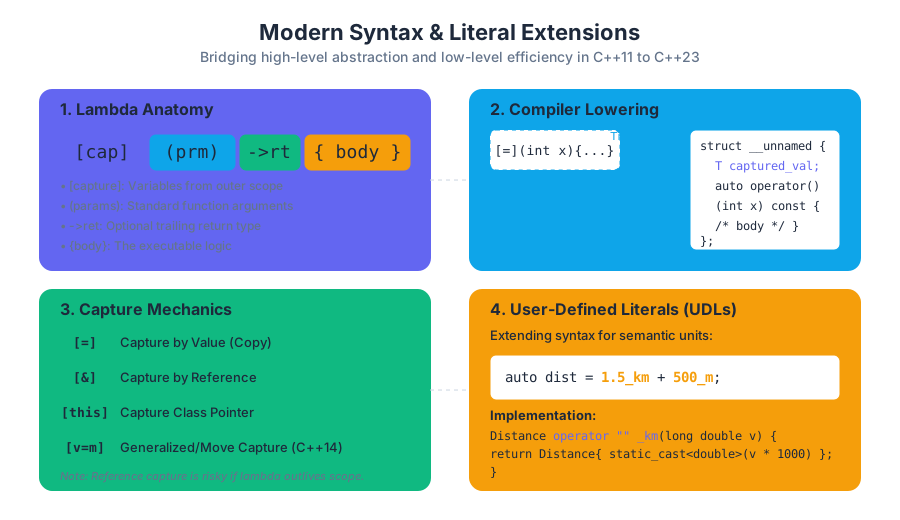
At its core, a Lambda Expression is a definition of an anonymous function object (a closure) capable of capturing variables from its surrounding scope. While they appear as inline functions, the compiler treats them as unique, unnamed class types (functors).
1. Formal Definition and Syntax
A lambda expression is defined by the following components:
[ capture-list ] ( params ) specifiers -> ret { body }
Definition: Closure Object A closure is a temporary object created by a lambda expression. It contains the code defined in the lambda body and the data captured from the surrounding environment. The type of a closure is a unique, unnamed non-union class type.
2. The Mechanics of Capture
The "magic" of lambdas lies in the capture-list. This defines how variables from the outer scope are made available inside the lambda's body.
| Capture Syntax | Mechanism | Description |
|---|---|---|
[] |
No capture | The lambda can only access global variables or parameters passed to it. |
[=] |
Capture by value | Creates local copies of all used variables within the closure. |
[&] |
Capture by reference | Stores references to variables in the outer scope. Risky if the lambda outlives the scope. |
[x, &y] |
Mixed capture | Captures x by value and y by reference. |
[this] |
Member access | Captures the this pointer, allowing access to class members. |
[...args = std::move(p)] |
Generalized capture | (C++14) Allows capturing by move or initializing new variables in the capture block. |
3. Lambda Lowering: How the Compiler Sees It
To understand performance, one must understand "lowering"—the process by which the compiler transforms high-level syntax into intermediate representations.
// Block 1: Low-level Implementation (C++ / CUDA)
// Demonstrating a device-side lambda used in a parallel transform
#include <cuda_runtime.h>
#include <thrust/device_vector.h>
#include <thrust/transform.h>

template <typename T>
void apply_threshold(thrust::device_vector<T>& vec, T threshold, T replacement) {
    // A __device__ lambda captured by value for GPU execution
    // The [=] ensures 'threshold' and 'replacement' are copied to the GPU constant memory/registers
    thrust::transform(vec.begin(), vec.end(), vec.begin(),
        [=] __device__ (T val) -> T {
            return (val > threshold) ? replacement : val;
        }
    );
}

// Manual "Lowering" of the above lambda (Simplified)
struct __unnamed_lambda_id {
    float threshold;
    float replacement;

    __unnamed_lambda_id(float t, float r) : threshold(t), replacement(r) {}

    __device__ float operator()(float val) const {
        return (val > threshold) ? replacement : val;
    }
};
The transformation above demonstrates that a lambda is not a function pointer; it is an object. This is why lambdas are often faster than function pointers: the compiler can inline the operator() call because the type of the functor is known at the call site.
// Block 2: Mathematical Derivation of Lambda Binding
// Let L be a lambda expression defined in scope S.
// Let V = {v1, v2, ..., vn} be the set of variables in S used by L.

L(V) \rightarrow \mathcal{C} \{
    \text{Type: } \tau_{unique}
    \text{State: } \{ \sigma(v_i) \mid v_i \in V \}
    \text{Behavior: } f(params, \text{State})
\}

// Where \sigma(v_i) is the mapping function:
// \sigma_{val}(v) = v_{copy}
// \sigma_{ref}(v) = \&v
4. Generic Lambdas and Variadic Packs
With C++14 and C++20, lambdas gained the ability to use auto in parameters and even template parameter lists. This allows them to interact with Variadic Templates (as seen in N2242).
// Block 3: Real-world Usage (C++20 Template Lambdas)
// A logging utility that handles variadic arguments using a template lambda
auto logger = []<typename... Args>(Args&&... args) {
    (std::cout << ... << std::forward<Args>(args)) << std::endl;
};

// Usage in a system initialization sequence
logger("Initializing system...", " Version: ", 2.1, " Status: OK");
User-Defined Literals (UDLs)
C++ has always had built-in literals like 1.0f (float) or 0x10 (hexadecimal). User-defined Literals allow developers to extend this syntax to custom types, providing a way to attach units or semantic meaning to raw numbers and strings.
1. The Literal Operator
A UDL is implemented via a literal operator. The syntax is:
ReturnType operator "" _suffix(unsigned long long val);
ReturnType operator "" _suffix(long double val);
ReturnType operator "" _suffix(const char* str, size_t len);
2. Cooked vs. Raw Literals
- Cooked Literals: The compiler parses the literal into a standard type (like
intordouble) and passes that value to the operator. - Raw Literals: The compiler passes the literal as a raw string (
const char*), allowing the developer to perform custom parsing (e.g., for arbitrary-precision arithmetic).
| Literal Type | Operator Signature | Example Input |
|---|---|---|
| Integer | operator "" _suffix(unsigned long long) |
123_unit |
| Floating-point | operator "" _suffix(long double) |
3.14_unit |
| String | operator "" _suffix(const char*, size_t) |
"hello"_unit |
| Character | operator "" _suffix(char) |
'c'_unit |
3. Application: Physical Quantities and Memory
In systems programming, UDLs are invaluable for preventing unit errors (e.g., passing milliseconds where seconds are expected).
// Block 4: Edge Case - Memory Unit UDLs
// Preventing overflow and ensuring type safety in memory allocation
constexpr size_t operator "" _KiB(unsigned long long v) { return v * 1024; }
constexpr size_t operator "" _MiB(unsigned long long v) { return v * 1024 * 1024; }
constexpr size_t operator "" _GiB(unsigned long long v) { return v * 1024 * 1024 * 1024; }

void allocate_gpu_buffer(size_t bytes) {
    void* ptr;
    cudaMalloc(&ptr, bytes);
    // ...
}

int main() {
    // Highly readable and type-safe
    allocate_gpu_buffer(2_GiB + 512_MiB);
}
AI_DEMOI_DEMO## Binary Literals and Digit Separators
While high-level abstractions are useful, systems engineers often work at the bit level. Historically, C++ required programmers to translate binary masks into hexadecimal or octal mentally.
1. Binary Literals (0b)
C++14 introduced the 0b (or 0B) prefix to represent binary constants directly. This eliminates the translation layer when defining bitmasks for hardware registers.
2. Digit Separators (')
As constants grow in size, they become harder to read. The single quote ' acts as a digit separator. It is purely for human readability and is ignored by the compiler.
| Format | Representation | Readability Level |
|---|---|---|
| Decimal | 4294967295 |
Low (hard to count digits) |
| Hexadecimal | 0xFFFFFFFF |
Medium (requires hex-to-bin conversion) |
| Binary (Old) | 0xAAAA |
Low (masking intent is hidden) |
| Modern Binary | 0b1010'1010'1010'1010 |
High (clear bit patterns) |
| Large Decimal | 4'294'967'295 |
High (clear magnitude) |
3. Practical Masking Example
Consider a hardware status register where bits 0-3 are error codes, bit 4 is a "ready" flag, and bits 5-7 are revision numbers.
// Block 5: Before vs. After (Readability Comparison)
// Traditional approach using Hex
const uint8_t STATUS_MASK_OLD = 0x1F; // What does this even mean?

// Modern approach using Binary Literals and Separators
const uint8_t ERR_CODE_MASK = 0b0000'1111;
const uint8_t READY_FLAG    = 0b0001'0000;
const uint8_t REV_NUM_MASK  = 0b1110'0000;

// Large constants are also much clearer
const uint64_t MAX_ADDR = 0xFFFF'FFFF'0000'0000ULL;
const double PLANCK_CONST = 6.626'070'15e-34;
Long Long and Extended Integer Types
The long long type was a long-standing extension in many compilers (like GCC and MSVC) before being formally standardized in C++11. It guarantees a minimum width of 64 bits.
1. Data Ranges and Portability
In the context of CUDA and 64-bit computing, long long is the standard way to represent large address spaces or high-precision timestamps.
| Type | Minimum Width | Typical Range |
|---|---|---|
int |
16 bits | $\pm 32,767$ |
long |
32 bits | $\pm 2,147,483,647$ |
long long |
64 bits | $\pm 9,223,372,036,854,775,807$ |
2. Extended Integers
The standard also allows for "implementation-defined" extended integer types. These are accessed via <cstdint> (e.g., int128_t in some environments). In CUDA, long long is critical for atomic operations on 64-bit values, which are essential for global counters in kernels.
Common Pitfalls and Best Practices
- Lambda Capture Hazards: Capturing by reference
[&]in an asynchronous context (like a CUDA stream or astd::asynccall) is a leading cause of "use-after-free" bugs. Always prefer capturing by value[=]for asynchronous GPU kernels. - UDL Namespace Pollution: Literal operators should be placed in dedicated namespaces (e.g.,
namespace my_project::literals) to avoid naming collisions. Users should then useusing namespace ...explicitly. - Binary Literal Length: While
0bis helpful, very long binary literals (e.g., 64-bit) can still be hard to read. Use digit separators every 4 or 8 bits to maintain clarity. - Auto and Multi-declarators: As noted in N1737, using
autowith multiple variables in one line (e.g.,auto x = 5, *y = &x;) is legal but can be confusing. Modern style guides often suggest one declaration per line.
AI_FLASHCARDSI_FLASHCARDS Closure: The temporary object generated by a lambda expression.
- Literal Operator: The function that implements a user-defined literal (e.g.,
operator "" _s). - Capture-by-value: Creating a copy of a variable inside a lambda closure using
[=]. - Digit Separator: The
'character used to group digits for readability. - Binary Literal: A constant prefixed with
0brepresenting a base-2 number. - Generic Lambda: A lambda that uses
autoor template parameters for its arguments.
AI_QUIZI_QUIZ. Which capture mode is safest for a lambda being passed to a background thread or a GPU kernel?
- A)
[&] - B)
[=] - C)
[this] - Answer: B. Capture by value ensures the data exists even if the original scope is destroyed.
-
What is the return type of a literal operator for a string UDL?
- A)
std::string - B)
const char* - C) Any user-defined type.
- Answer: C. UDLs are designed to return custom types (like
DistanceorJSON).
- A)
-
True or False: The digit separator
'changes the numerical value of a constant.- Answer: False. It is ignored by the compiler.
-
Why are lambdas often faster than function pointers?
- Answer: Because each lambda has a unique type, allowing the compiler to perform devirtualization and inlining.
AI_STUDY_GUIDEI_STUDY_GUIDE*Summary of Modern Syntax Extensions**
- Lambdas: Use them for short-lived logic and callbacks. In CUDA, use
[=] __device__to pass data to kernels. Understand the "functor lowering" to appreciate the zero-cost abstraction. - UDLs: Use them to enforce unit safety (e.g.,
_ms,_bytes). Avoid overusing them for trivial cases. - Binary/Separators: Use
0bfor bitmasks and'for any constant longer than 4 digits. - Type Deduction: Use
autoto simplify complex iterator types, but be wary of its interaction withinitializer_list. - Variadic Templates: When combined with lambdas, they allow for powerful, generic factory functions and logging utilities.
Recommended Practice: Refactor an existing piece of code that uses #define for bitmasks to use constexpr binary literals with digit separators. Observe the improvement in readability.
Source Materials
Study Introduction to CUDA and Modern C++ Programming on Lykke
This course page is free to open: signed out, you can read its first two sections, and signing in, on any plan, opens the rest. The free Lykke Chrome extension syncs your own Canvas courses, so ChatGPT, Claude and Muse can answer from your classes and deadlines. It only reads Canvas.
Add the free extensionSign in to open every sectionAll sections of Introduction to CUDA and Modern C++ Programming · Browse more course pages