From the free course Introduction to CUDA and Modern C++ Programming on Lykke
Performance, Attributes, & Memory Alignment
Key concepts: constexpr · alignas / alignof · General Attributes · Strongly Typed Enums · Explicit Conversion Operators
Focuses on language features that provide fine-grained control over hardware behavior, including alignment, constant expressions, and attributes.
Performance, Attributes, & Memory Alignment
In the pursuit of computational excellence, the boundary between high-level abstraction and low-level hardware reality often thins. For the systems engineer, the C++ language is not merely a tool for logic, but a sophisticated interface for managing the physical resources of the machine: the CPU cycles, the cache lines, and the memory bus. This section explores the advanced mechanisms—constexpr, memory alignment, attributes, and type safety—that allow developers to write code that is both expressive and ruthlessly efficient.
AI_SVGI_SVG## The Philosophy of Zero-Cost Abstractions
At the heart of modern C++ lies the "Zero-Cost Abstraction" principle: you don't pay for what you don't use, and what you do use, you couldn't hand-code any better. To achieve this, the compiler requires hints and constraints. By utilizing constexpr for compile-time evaluation and alignas for memory layout, we shift the burden of calculation from the user's runtime to the developer's compile-time, while ensuring that the data resides in a format the hardware can ingest with minimal latency.
constexpr: Shifting Computation to Compile-Time
What it is
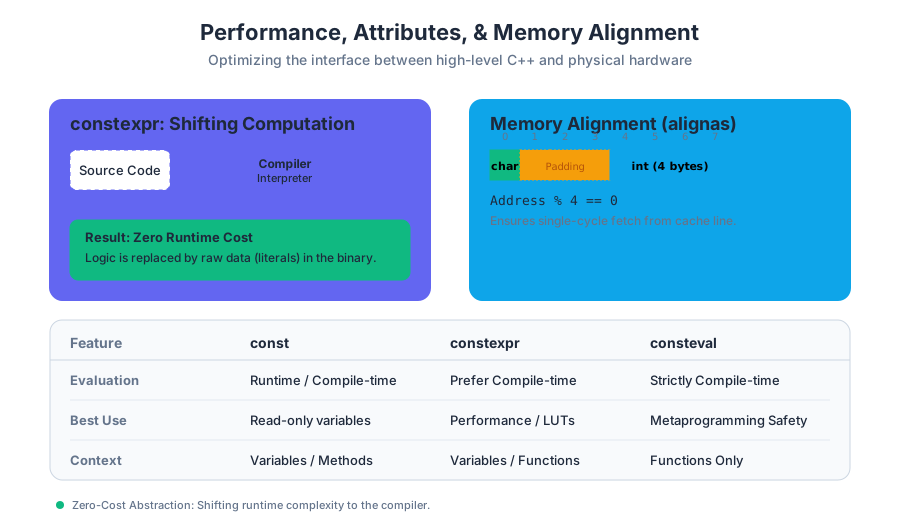
The constexpr specifier declares that it is possible to evaluate the value of the function or variable at compile-time. Introduced in C++11 and significantly expanded in C++14, C++17, and C++20, it allows the compiler to replace a function call or a variable access with a literal constant.
Why it matters In high-performance contexts like CUDA kernel configuration or real-time signal processing, runtime calculations are "stolen" cycles. If a value can be known before the program even executes, it should be. This leads to:
- Reduced Binary Size: Eliminating complex initialization logic.
- Performance: Replacing instructions with immediate values in the instruction stream.
- Safety: Allowing constants to be used in contexts requiring constant expressions, such as array bounds or template parameters.
How it works
When the compiler encounters a constexpr entity, it attempts to execute the logic within its own internal interpreter. For a function to be constexpr, it must satisfy strict requirements: it cannot call non-constexpr functions, it cannot perform I/O, and (prior to C++20) it had limited support for dynamic memory allocation.
| Feature | const |
constexpr |
consteval (C++20) |
|---|---|---|---|
| Evaluation | Runtime or Compile-time | Preferably Compile-time | Strictly Compile-time |
| Context | Variables/Methods | Variables/Functions | Functions only |
| Initialization | Can be dynamic | Must be a constant expression | Must be a constant expression |
| Usage | Read-only data | Metadata/Optimization | Metaprogramming/Safety |
Code Block 1: Low-Level Implementation (C++)
The following example demonstrates a constexpr implementation of a Look-Up Table (LUT) generation. Instead of calculating trigonometric values at runtime, we bake them into the binary.
#include <iostream>
#include <array>
#include <cmath>

// A constexpr-compatible math utility (simplified)
// Note: In C++20, many <cmath> functions are still not constexpr,
// so we implement a Taylor series approximation.
constexpr double constexpr_sin(double x) {
    double res = 0.0;
    double term = x;
    double x2 = x * x;
    for (int i = 1; i <= 10; ++i) {
        res += term;
        term *= -x2 / (2 * i * (2 * i + 1));
    }
    return res;
}

// Generate a LUT at compile time
template<std::size_t N>
struct SineTable {
    std::array<double, N> values;

    constexpr SineTable() : values{} {
        for (std::size_t i = 0; i < N; ++i) {
            values[i] = constexpr_sin(2.0 * 3.141592653589793 * i / N);
        }
    }
};

// This variable is evaluated entirely by the compiler.
// The resulting assembly will contain only the raw data.
static constexpr auto global_sine_lut = SineTable<360>();

int main() {
    // Zero runtime cost for calculation
    std::cout << "Sin(90): " << global_sine_lut.values[90] << std::endl;
    return 0;
}
Memory Alignment: alignas and alignof
What it is
Memory alignment refers to the restriction that data of a certain type must be stored at a memory address that is a multiple of a specific power of two. The alignof operator queries the alignment requirements of a type, while the alignas specifier allows a developer to force a stricter alignment on a variable or class.
Why it matters Modern CPUs and GPUs do not read memory byte-by-byte; they read in "chunks" (typically 32, 64, or 128 bits).
- Hardware Requirements: Certain instructions (like SSE/AVX on x86 or vectorized loads in CUDA) require data to be aligned to 16 or 32-byte boundaries. Accessing unaligned data can cause a hardware exception or a significant performance penalty.
- Cache Line Efficiency: By aligning data to the size of a cache line (usually 64 bytes), we prevent "false sharing" and ensure that a single data structure doesn't straddle two cache lines, which would require two memory fetches instead of one.
How it works: The Mathematics of Padding
When you define a struct, the compiler automatically inserts "padding" bytes to ensure that each member starts at an address compatible with its alignment requirement.
Code Block 2: Mathematical Derivation of Alignment
The address of a member $M$ in a structure must satisfy the condition: $$\text{Address}(M) \equiv 0 \pmod{\text{alignof}(M)}$$
If we have a structure with a char (1 byte) followed by an int (4 bytes), the compiler must insert 3 bytes of padding.
Structure Layout Derivation:
Let S be a struct { char a; int b; }
1. Offset of 'a' = 0. (0 % 1 == 0). Valid.
2. Next available byte = 1.
3. Required alignment of 'b' (int) = 4.
4. Padding = (Alignment - (CurrentOffset % Alignment)) % Alignment
   Padding = (4 - (1 % 4)) % 4 = 3 bytes.
5. Offset of 'b' = 1 + 3 = 4. (4 % 4 == 0). Valid.
6. Total Size = Offset of 'b' + sizeof(b) = 4 + 4 = 8 bytes.
| Type | Typical Size (bytes) | Typical Alignment (bytes) |
|---|---|---|
char |
1 | 1 |
short |
2 | 2 |
int / float |
4 | 4 |
double / long long |
8 | 8 |
float4 (SIMD/CUDA) |
16 | 16 |
Cache Line |
64 | 64 |
Code Block 3: Real-World Usage (CUDA Shared Memory)
In CUDA programming, aligning data in shared memory is critical to avoid bank conflicts and enable vectorized memory access.
// CUDA Kernel demonstrating forced alignment for performance
__global__ void aligned_kernel(float* data) {
    // Force the shared memory array to be aligned to 128 bytes
    // to match the cache line size or vectorized load requirements.
    alignas(128) __shared__ float shared_buffer[256];

    int tid = threadIdx.x;

    // Perform a vectorized load if the hardware supports it
    // float4 requires 16-byte alignment
    if (tid < 64) {
        float4* v_ptr = reinterpret_cast<float4*>(&shared_buffer[tid * 4]);
        float4* g_ptr = reinterpret_cast<float4*>(&data[tid * 4]);
        *v_ptr = *g_ptr; // Single instruction 128-bit load/store
    }
    __syncthreads();

    // ... processing ...
}
AI_DEMOI_DEMO--
General Attributes: [[attribute]]
What it is
Attributes provide a standardized, extensible syntax for providing implementation-defined information to the compiler. Introduced in C++11, they replaced various vendor-specific keywords like __attribute__((...)) (GCC/Clang) and __declspec(...) (MSVC).
Why it matters Attributes allow the developer to communicate intent that the type system cannot express. This can lead to better optimizations (e.g., branch prediction hints) or better static analysis (e.g., warning about ignored return values).
Key Standard Attributes
[[nodiscard]]: Issues a warning if the return value of a function is ignored. Crucial for functions returning error codes or resources (likestd::unique_ptr).[[maybe_unused]]: Suppresses warnings about unused variables, common in template code orassert-heavy builds.[[fallthrough]]: Indicates that a missingbreakin aswitchstatement is intentional.[[likely]]/[[unlikely]](C++20): Provides hints to the compiler's branch predictor about which path aniforswitchis more likely to take.
| Attribute | Purpose | Impact |
|---|---|---|
[[nodiscard]] |
Safety | Prevents resource leaks or ignored errors. |
[[noreturn]] |
Optimization | Tells compiler the function never returns (e.g., exit()), allowing stack cleanup elision. |
[[deprecated]] |
Maintenance | Marks code as obsolete; provides a custom message during compilation. |
[[likely]] |
Performance | Reorders assembly instructions to favor the "hot" path. |
Strongly Typed Enums: enum class
What it is
C-style enums (enum Color { RED, BLUE };) are essentially integers. They leak their names into the surrounding scope and implicitly convert to int. Strongly typed enums (enum class Color { RED, BLUE };) solve these issues by requiring explicit scoping and forbidding implicit conversions.
Why it matters
- Namespace Pollution: In large systems, two different enums might both want a member named
NoneorDefault.enum classkeeps these names encapsulated. - Type Safety: You cannot accidentally add a
Color::REDto aSpeed::FAST. - Forward Declaration: Unlike C-style enums,
enum classhas a fixed underlying type (defaulting toint), allowing them to be forward-declared, which reduces header dependencies and compile times.
Code Block 4: Comparison and Pitfalls (C++ vs. Assembly-ish)
Consider the difference in how the compiler treats these two types.
// OLD: C-style
enum Status { OK, ERROR };
// NEW: Scoped
enum class NetStatus : uint8_t { OK, ERROR };

void process(int code) { /* ... */ }

int main() {
    Status s1 = OK;
    process(s1); // Works, but is it safe? s1 is just 0.

    NetStatus s2 = NetStatus::OK;
    // process(s2); // COMPILER ERROR: cannot convert NetStatus to int

    process(static_cast<int>(s2)); // Explicit intent required
}
Explicit Conversion Operators
What it is
By default, a single-argument constructor or a conversion operator allows the compiler to perform an implicit conversion. The explicit keyword prevents the compiler from using that constructor or operator for implicit type-casting.
Why it matters Implicit conversions are a frequent source of "hidden" performance costs and logic bugs.
- Hidden Allocations: Passing a
const char*to a function expecting astd::stringtriggers a hidden heap allocation. - Logic Errors: A
SmartPointerclass might implicitly convert to abool. While useful forif (ptr), it might allowptr + 5if theboolis treated as an integer.
How it works
By marking a constructor or operator as explicit, you force the user to use direct initialization or an explicit static_cast.
Code Block 5: Performance Implications of Implicit Conversions
#include <vector>

struct Buffer {
    size_t size;
    // Without 'explicit', Buffer b = 10; would create a buffer of size 10.
    explicit Buffer(size_t s) : size(s) { /* allocate memory */ }
};

void handleBuffer(Buffer b) { /* ... */ }

int main() {
    // handleBuffer(1024); // ERROR: prevented an accidental expensive allocation.

    Buffer b(1024);      // OK: Direct initialization
    handleBuffer(b);     // OK
}
Integration: The Performance Synergy
When we combine these features, we create a "Fortress of Efficiency."
constexprcalculates the optimal buffer size for a specific hardware architecture.alignasensures that buffer is placed on a 64-byte boundary to maximize cache throughput.[[nodiscard]]ensures the developer handles the result of the buffer allocation.enum classdefines the state of the buffer (Empty, Filling, Full) without polluting the global namespace.explicitensures that integers aren't accidentally promoted to "Buffer" objects, preventing catastrophic memory churn.
The Theorem of Static Constraints: The more information the compiler possesses about the alignment, lifetime, and value of data at compile-time, the closer the generated machine code approaches the theoretical limit of the hardware.
AI_FLASHCARDSI_FLASHCARDS constexpr: A specifier indicating that a value or function can be computed during compilation.
- alignas: A specifier used to set the memory alignment requirement of a variable or type.
- alignof: An operator that returns the alignment (in bytes) required for a given type.
- [[nodiscard]]: An attribute that warns the user if a return value is ignored.
- enum class: A scoped, strongly-typed enumeration that prevents implicit integer conversion.
- explicit: A keyword that prevents the compiler from using a constructor or conversion operator for implicit type transformations.
- Padding: Extra bytes inserted by the compiler between structure members to satisfy alignment requirements.
- Bank Conflict: A performance bottleneck in GPU shared memory occurring when multiple threads access different addresses in the same memory bank.
AI_QUIZI_QUIZ. Question: Why does sizeof(struct { char a; int b; }) usually return 8 instead of 5?
- Answer: Because the
intmemberbrequires 4-byte alignment, the compiler inserts 3 bytes of padding afterchar ato ensurebstarts at an offset that is a multiple of 4.
-
Question: Can a
constexprfunction call a non-constexprfunction?- Answer: No. A
constexprcontext requires that all branches of execution be evaluatable at compile-time.
- Answer: No. A
-
Question: What is the primary advantage of
enum classover a standardenumregarding header files?- Answer:
enum classhas a fixed underlying type, allowing it to be forward-declared. This breaks circular dependencies and reduces the need to include the full definition in every header.
- Answer:
-
Question: How does
[[likely]]affect the generated assembly?- Answer: It suggests to the compiler to arrange the assembly code so that the "likely" branch follows the conditional jump immediately (falling through), which is more efficient for the CPU's fetch-and-decode pipeline.
AI_STUDY_GUIDEI_STUDY_GUIDE*Deep-Dive Checklist:**
- Review the padding rules for nested structures.
- Experiment with
std::is_constant_evaluated()to provide different logic for runtime vs. compile-time. - Use
objdumporCompiler Explorer(godbolt.org) to verify thatalignasactually changes the stack pointer offsets in assembly. - Refactor a C-style
enumto anenum classin a medium-sized project to observe how many hidden type-mismatch bugs are caught. - Audit a codebase for constructors taking a single argument; determine which should be marked
explicit.
Source Materials
Study Introduction to CUDA and Modern C++ Programming on Lykke
This course page is free to open: signed out, you can read its first two sections, and signing in, on any plan, opens the rest. The free Lykke Chrome extension syncs your own Canvas courses, so ChatGPT, Claude and Muse can answer from your classes and deadlines. It only reads Canvas.
Add the free extensionSign in to open every sectionAll sections of Introduction to CUDA and Modern C++ Programming · Browse more course pages