From the free course Introduction to CUDA and Modern C++ Programming on Lykke
Object Lifecycle & Advanced Language Rules
Key concepts: Delegating Constructors · Unrestricted Unions · Extended Friend Declarations · Conditionally-supported Behavior · Ill-formed Programs
Examines complex language behaviors such as delegating constructors, unrestricted unions, and the classification of undefined behavior.
Object Lifecycle & Advanced Language Rules
The C++ object model is not merely a description of memory layout; it is a formal state machine governed by strict temporal and semantic boundaries. As we move into the "dark corners" of the ISO C++ Standard, we encounter rules that define the very fabric of how programs are constructed, validated, and executed. This section explores the sophisticated mechanisms of the object lifecycle—from the delegation of construction to the manual management of unrestricted unions—and the rigorous taxonomy of program validity that distinguishes a portable application from a "broken" binary.
AI_SVGI_SVG## Delegating Constructors
Prior to the C++11 standard, C++ suffered from a "constructor proliferation" problem. If a class had multiple constructors with overlapping initialization logic, developers were forced to either duplicate code or move shared logic into a private init() member function. The latter approach was suboptimal because init() cannot initialize constants (const) or references, nor can it utilize the member initializer list, leading to double-initialization of complex objects.
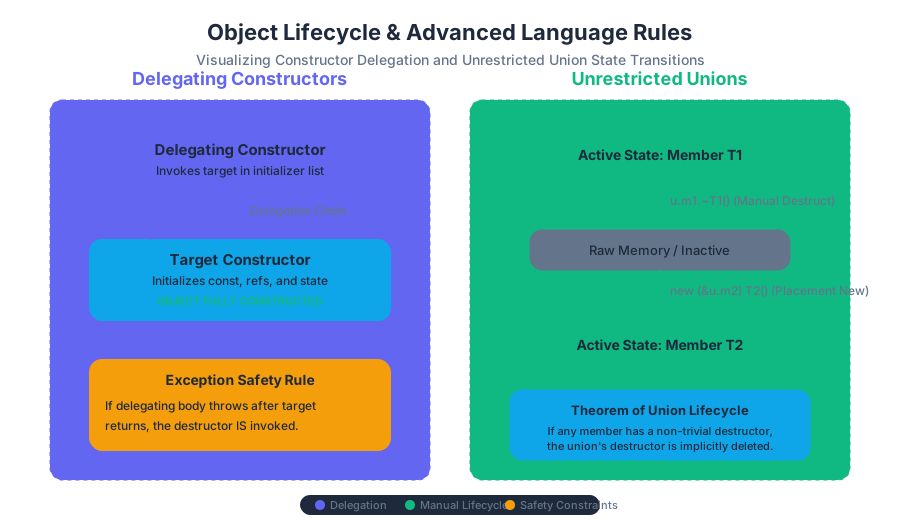
Delegating Constructors solve this by allowing one constructor (the delegating constructor) to invoke another constructor (the target constructor) from the same class within the initializer list.
Mechanics and Rules
A constructor is considered a delegating constructor if its initializer list contains a single mem-initializer where the identifier is the class name itself.
- The "Complete" Object: Once the target constructor returns, the object is considered "fully constructed." This has profound implications for exception handling. If an exception occurs in the body of the delegating constructor after the target constructor has finished, the destructor for the object will be called.
- Mutual Exclusion: A delegating constructor cannot have any other member initializers. The target constructor is responsible for the entire initialization of the object's state.
- Recursion: Infinite delegation (Constructor A calls B, B calls A) is a compile-time error (ill-formed), though the standard does not require a diagnostic for complex indirect recursion.
| Feature | init() Method Pattern |
Delegating Constructors |
|---|---|---|
Initializes const members |
No | Yes |
| Initializes references | No | Yes |
| Performance | Potential double-init | Single-pass initialization |
| Exception Safety | Manual cleanup often required | Automatic destructor invocation |
| Syntax | this->init(args) in body |
ClassName(args) in init-list |
Low-Level Implementation
In the following example, we demonstrate a high-performance NetworkBuffer that manages memory through various allocation strategies, using delegation to centralize the memory-mapping logic.
#include <iostream>
#include <stdexcept>
#include <sys/mman.h>

class NetworkBuffer {
private:
    void*  m_data;
    size_t m_size;
    int    m_flags;
    bool   m_is_mapped;

public:
    // The Target Constructor: Handles the heavy lifting of mmap
    NetworkBuffer(size_t size, int prot, int flags)
        : m_size(size), m_flags(flags), m_is_mapped(true) {

        m_data = mmap(nullptr, m_size, prot, flags | MAP_ANONYMOUS, -1, 0);
        if (m_data == MAP_FAILED) {
            throw std::runtime_error("mmap failed");
        }
        std::cout << "Target Constructor: Memory mapped at " << m_data << std::endl;
    }

    // Delegating Constructor 1: Default permissions (Read/Write)
    NetworkBuffer(size_t size)
        : NetworkBuffer(size, PROT_READ | PROT_WRITE, MAP_PRIVATE) {
        std::cout << "Delegating Constructor: Default permissions applied." << std::endl;
    }

    // Delegating Constructor 2: Read-only buffer
    NetworkBuffer(size_t size, bool read_only)
        : NetworkBuffer(size, read_only ? PROT_READ : (PROT_READ | PROT_WRITE), MAP_PRIVATE) {
        std::cout << "Delegating Constructor: Read-only status set to " << read_only << std::endl;
    }

    ~NetworkBuffer() {
        if (m_is_mapped && m_data != MAP_FAILED) {
            munmap(m_data, m_size);
            std::cout << "Destructor: Memory unmapped." << std::endl;
        }
    }
};
Unrestricted Unions
In C++98, unions were restricted to "POD" (Plain Old Data) types. You could not have a member with a non-trivial constructor, destructor, or assignment operator. This limitation made unions nearly useless for modern C++ resource management (like std::string or std::vector).
Unrestricted Unions lift these constraints. A union can now contain any type, provided it is not a reference. However, this power comes with a significant burden: the compiler no longer knows which member is "active," and therefore cannot automatically call constructors or destructors.
The Lifecycle Challenge
When a union member has a non-trivial special member function, the compiler deletes the corresponding special member function of the union itself. If you have a union containing a std::string, the union's destructor is deleted. You must define it yourself.
Theorem of Union Lifecycle: For a union $U$ with members $m_1, m_2, \dots, m_n$, if any $m_i$ has a non-trivial destructor, the destructor $U::\sim U()$ is implicitly deleted unless explicitly defined by the user to handle the destruction of the currently active member.
Mathematical Representation of Union State
We can model the state of an unrestricted union as a tuple $(S, \sigma)$, where $S$ is the set of possible types ${T_1, T_2, \dots, T_n}$ and $\sigma \in S$ is the currently active type.
\begin{aligned}
\text{Let } \mathcal{U} \text{ be the union object.} \\
\text{Initialization: } \text{placement\_new}(\mathcal{U}.m_i) \implies \sigma \leftarrow T_i \\
\text{Transition: } \mathcal{U}.m_i.\sim T_i() \text{ followed by } \text{placement\_new}(\mathcal{U}.m_j) \implies \sigma \leftarrow T_j \\
\text{Validity Requirement: } \forall \text{ access } \mathcal{U}.m_k, \sigma = T_k
\end{aligned}
Concrete Example: A Variant-like Type
The following code demonstrates the manual lifecycle management required for an unrestricted union.
#include <string>
#include <vector>
#include <new> // for placement new

union S3Holder {
    std::string str;
    std::vector<int> vec;
    int integer;

    // We MUST define the constructor because members have non-trivial ctors
    S3Holder() : integer(0) {}

    // We MUST define the destructor
    ~S3Holder() {}
};

struct ManagedUnion {
    enum { IS_STR, IS_VEC, IS_INT } tag;
    S3Holder storage;

    ~ManagedUnion() {
        if (tag == IS_STR) storage.str.~basic_string();
        else if (tag == IS_VEC) storage.vec.~vector();
    }

    void set_string(const char* s) {
        if (tag == IS_VEC) storage.vec.~vector();
        new (&storage.str) std::string(s); // Placement new
        tag = IS_STR;
    }
};
AI_DEMOI_DEMO## Extended Friend Declarations
The friend keyword has historically been rigid, requiring a specific class or function name. In template-heavy code, this created a "circular dependency" or "naming" problem. Extended Friend Declarations allow for more flexible syntax, specifically supporting:
- Template Parameters:
friend T;whereTis a template parameter. - Typedefs:
friend AliasedName;. - Non-elaborated types: You no longer need the
classorstructkeyword if the name is already in scope.
Why it Matters in Metaprogramming
Consider a generic "Wrapper" or "Proxy" class. To allow the underlying type T to access the private members of the wrapper (or vice versa), the wrapper needs to declare T as a friend. In C++98, friend T; was illegal because T was not an "elaborated-type-specifier" (like friend class T;). However, if T turned out to be a primitive like int, friend class T; would fail because int is not a class.
| Syntax | C++98/03 | C++11 and later |
|---|---|---|
friend class T; |
Valid if T is a class | Valid (but errors if T is int) |
friend T; |
Invalid | Valid (ignored if T is not a class/struct) |
friend MyTypedef; |
Invalid | Valid |
Conditionally-supported Behavior & Ill-formed Programs
To understand how a compiler treats code, we must categorize the code based on the Standard's taxonomy. This is critical for systems like CUDA, where the nvcc compiler must bridge the gap between standard C++ and device-specific constraints.
The Taxonomy of Code Validity
- Well-defined: The Standard specifies exactly what happens.
- Implementation-defined: The behavior varies (e.g., size of
int), but the compiler must document it. - Undefined Behavior (UB): Anything can happen. The compiler assumes UB never occurs to optimize code.
- Conditionally-supported Behavior: A feature that is not required by all implementations (e.g.,
__asm__blocks or specific pragmas). If a compiler supports it, it must follow the rules; if not, it must issue a diagnostic. - Ill-formed: The code violates the syntax or semantic rules of the language.
- Diagnostic Required: The compiler must give an error or warning (e.g., a syntax error).
- No Diagnostic Required (NDR): The code is technically illegal, but the compiler isn't required to catch it (e.g., ODR violations across different translation units).
Ill-formed vs. Undefined: The Shift
Modern C++ has moved several "Undefined" behaviors into the "Ill-formed" category. For example, in C++98, certain overflows in constant expressions were undefined. In modern C++, they are often ill-formed, forcing a compile-time error rather than a runtime crash.
Compiler Diagnostic Levels (Conceptual)
# Example of checking for conditionally-supported features or ill-formed code
# using a modern compiler (GCC/Clang/NVCC)

# 1. Attempting to compile ill-formed code (Diagnostic Required)
echo "int main() { int x = ; }" > test.cpp
g++ test.cpp # Result: error: expected expression before ';' token

# 2. Checking for conditionally-supported __asm__ blocks
# Some compilers might not support specific assembly syntaxes
echo "int main() { __asm__('nop'); }" > asm_test.cpp
g++ -std=c++11 -pedantic asm_test.cpp # Might issue a warning if non-standard

# 3. NVCC handling of device-side lifecycle (CUDA specific)
# nvcc will flag ill-formed code that attempts to use host-only features on device
nvcc -arch=sm_80 device_code.cu -c
Integration: Object Lifecycle in CUDA
In the context of CUDA and the NVIDIA C++ Programming Guide, these rules become the boundary between the Host (CPU) and the Device (GPU).
- Construction on Device: Objects created in global memory on the GPU follow the same lifecycle rules as host objects, but their constructors are executed in a SIMT (Single Instruction, Multiple Threads) fashion.
- Variadic Templates and Lifecycle: As seen in N2242, variadic templates allow for the creation of generic "Factory" patterns. In CUDA, this is used to pass an arbitrary number of arguments to a kernel, which then constructs objects in
__shared__memory. - Auto and Type Deduction: The
autokeyword (N1984/N1737) is vital in CUDA for handling the complex return types of math functions and device-side iterators.
CUDA Memory and Lifecycle Constraints
| Memory Type | Constructor Execution | Destructor Execution | Persistence |
|---|---|---|---|
__device__ (Global) |
At module load (Host-side trigger) | At module unload | Lifetime of the application |
__shared__ |
Per-block (Manual initialization) | Manual (if needed) | Lifetime of the thread block |
__local__ (Stack) |
Per-thread (Automatic) | Per-thread (Automatic) | Lifetime of the kernel |
Real-World Usage: Variadic Kernel Dispatcher
This example combines variadic templates (N2242) with object lifecycle management to create a generic kernel launcher.
# A Python-based simulation of how a C++ compiler might expand
# a variadic template for a CUDA kernel launch.

def simulate_pack_expansion(kernel_name, *args):
    """
    Simulates the logic of N2242 (Variadic Templates) for kernel arguments.
    """
    print(f"Generating PTX for kernel: {kernel_name}")

    # Pack expansion logic: sizeof...(args)
    num_args = len(args)
    print(f"Argument pack contains {num_args} elements.")

    # Simulating the 'auto' deduction for each argument
    for i, arg in enumerate(args):
        arg_type = type(arg).__name__
        print(f"  Arg[{i}]: Type={arg_type}, Value={arg}")

# Usage
simulate_pack_expansion("VectorAdd", [1.0, 2.0], [3.0, 4.0], 2)
Common Pitfalls
- Delegation Loops: Creating a cycle in delegating constructors. While the compiler should catch direct cycles, indirect cycles (A -> B -> C -> A) can lead to stack overflows during compilation or undefined behavior if the compiler fails to detect it.
- Union Member Mismanagement: Forgetting to call the destructor of a union member before switching to a new one. This is a "silent" resource leak.
- Friendship is not Transitive: If Class A is a friend of Class B, and Class B is a friend of Class C, Class A is not automatically a friend of Class C. Extended friend declarations do not change this fundamental security rule.
- Assuming NDR means "Safe": Just because a compiler isn't required to issue a diagnostic for an ill-formed program (NDR) doesn't mean the program is valid. It usually means the error is too expensive to detect at compile-time (like a violation of the One Definition Rule).
AI_QUIZI_STUDY_GUIDE-- End of Section: Object Lifecycle & Advanced Language Rules This article is part of the DeepWiki C++ Standard Series. For further reading, see the sections on "Memory Models" and "Template Metaprogramming."
Source Materials
Study Introduction to CUDA and Modern C++ Programming on Lykke
This course page is free to open: signed out, you can read its first two sections, and signing in, on any plan, opens the rest. The free Lykke Chrome extension syncs your own Canvas courses, so ChatGPT, Claude and Muse can answer from your classes and deadlines. It only reads Canvas.
Add the free extensionSign in to open every sectionAll sections of Introduction to CUDA and Modern C++ Programming · Browse more course pages