Introduction to CUDA and Modern C++ Programming
Institution: MIT
29 study materials · 6 sections
This course provides a comprehensive introduction to the CUDA parallel computing platform alongside the modern C++ features that underpin high-performance GPU programming. Students will explore the CUDA programming model, including thread and memory hierarchies, while mastering C++11/14/17 standards such as variadic templates, type deduction, and constexpr. By the end of the course, learners will understand how to leverage both hardware-specific abstractions and advanced language features to build efficient, scalable, and type-safe accelerated applications.
Course Sections
The CUDA Programming Model & Architecture
Key concepts: Kernels · Thread Hierarchy · Memory Hierarchy · SIMT Architecture · NVCC Compilation
An introduction to the fundamental concepts of GPU computing, focusing on the thread hierarchy, memory models, and the SIMT architecture.
The CUDA Programming Model & Architecture
The emergence of General-Purpose computing on Graphics Processing Units (GPGPU) represents one of the most significant shifts in high-performance computing (HPC) over the last two decades. At the heart of this revolution is CUDA (Compute Unified Device Architecture), NVIDIA’s parallel computing platform and programming model.
CUDA is not merely a language extension; it is a comprehensive hardware-software co-design. It exposes the GPU’s massive parallelism through a familiar C++ syntax while abstracting the underlying complexities of many-core hardware. To master CUDA, one must move beyond thinking in terms of sequential loops and embrace a hierarchy of threads, memories, and execution units that operate under the SIMT (Single Instruction, Multiple Threads) paradigm.
Kernels: The Entry Point to Parallelism
In the CUDA programming model, the Kernel is the fundamental unit of execution. Unlike a standard C++ function that executes once when called, a CUDA kernel is a function that, when invoked, is executed $N$ times in parallel by $N$ different CUDA threads.
What it is
A kernel is defined using the __global__ declaration specifier. The execution configuration for a kernel is defined at call time using the execution configuration syntax <<<...>>>, which specifies the number of threads and their organization.
Definition: The CUDA Kernel A kernel is a C++ function that executes on the device (GPU). It is characterized by its ability to perform the same operation on different subsets of data simultaneously, driven by unique coordinates provided by the hardware.
Why it matters
Kernels allow developers to express data-level parallelism explicitly. By offloading data-intensive portions of an application to the GPU, the CPU (host) is freed to handle sequential logic and I/O, while the GPU (device) handles the "heavy lifting" of throughput-oriented tasks.
How it works: The Execution Configuration
The <<<G, B>>> syntax defines the Grid (G) and Block (B) dimensions. Each thread executing the kernel is assigned a unique thread ID that it uses to compute memory addresses and make control-flow decisions.
// Block 1: Low-level CUDA C++ Implementation
// Example: Tiled Matrix Multiplication using Shared Memory
// This demonstrates kernel definition, shared memory usage, and synchronization.

#include <cuda_runtime.h>
#include <iostream>

#define TILE_WIDTH 16

__global__ void MatrixMulKernel(float* d_A, float* d_B, float* d_C, int Width) {
    // Allocate shared memory for tiles
    __shared__ float ds_A[TILE_WIDTH][TILE_WIDTH];
    __shared__ float ds_B[TILE_WIDTH][TILE_WIDTH];

    int bx = blockIdx.x;  int by = blockIdx.y;
    int tx = threadIdx.x; int ty = threadIdx.y;

    // Identify the row and column of the d_C element to work on
    int Row = by * TILE_WIDTH + ty;
    int Col = bx * TILE_WIDTH + tx;

    float Pvalue = 0;

    // Loop over the d_A and d_B tiles required to compute the d_C element
    for (int m = 0; m < (Width / TILE_WIDTH); ++m) {
        // Collaborative loading of tiles into shared memory
        ds_A[ty][tx] = d_A[Row * Width + (m * TILE_WIDTH + tx)];
        ds_B[ty][tx] = d_B[(m * TILE_WIDTH + ty) * Width + Col];

        // Synchronize to ensure all threads have finished loading the tile
        __syncthreads();

        for (int k = 0; k < TILE_WIDTH; ++k) {
            Pvalue += ds_A[ty][k] * ds_B[k][tx];
        }

        // Synchronize to ensure computation is done before loading next tile
        __syncthreads();
    }
    d_C[Row * Width + Col] = Pvalue;
}
Thread Hierarchy: Organizing Massive Parallelism
CUDA threads are not flat; they are organized into a three-level hierarchy to match the physical architecture of the GPU. This hierarchy consists of Threads, Blocks, and Grids.
The Hierarchy Levels
| Level | Description | Max Dimensions | Scope |
|---|---|---|---|
| Thread | The smallest unit of execution. | N/A | Local registers and private memory. |
| Block | A group of threads that can cooperate via shared memory and barriers. | (1024, 1024, 64) | Shared memory within the block. |
| Grid | A collection of blocks that execute the same kernel. | ($2^{31}-1$, 65535, 65535) | Global memory across the whole GPU. |
Thread Indexing Math
To map a thread to a specific data element, we use built-in variables: threadIdx, blockIdx, and blockDim. For a 1D grid of 1D blocks, the unique global index $i$ is calculated as:
i = blockIdx.x \times blockDim.x + threadIdx.x
For a 2D grid, the derivation becomes more complex, mapping a 2D coordinate $(x, y)$ to a linear memory address.
// Block 2: Mathematical Derivation of Indexing
// Mapping a 2D thread hierarchy to a 1D linear array index

Given:
  - threadIdx.x, threadIdx.y (Thread coordinates within a block)
  - blockIdx.x,  blockIdx.y  (Block coordinates within a grid)
  - blockDim.x,  blockDim.y  (Dimensions of a block)
  - gridDim.x                (Number of blocks in the x-direction)

The global column index (j):
  j = blockIdx.x * blockDim.x + threadIdx.x

The global row index (i):
  i = blockIdx.y * blockDim.y + threadIdx.y

The linear index (Idx) for a matrix of width 'W':
  Idx = i * W + j

Proof of Uniqueness:
  Since 0 <= threadIdx.x < blockDim.x
  And 0 <= blockIdx.x < gridDim.x
  The range of 'j' is [0, gridDim.x * blockDim.x - 1].
  Every combination of (blockIdx, threadIdx) maps to a unique integer.
AI_DEMOI_DEMO## Memory Hierarchy: Managing Latency and Bandwidth
A common mistake among novice CUDA developers is treating GPU memory as a monolithic block. In reality, CUDA defines several distinct memory spaces, each with different capacities, latencies, and caching behaviors.
Memory Types and Characteristics
| Memory | Location | Cached | Access | Scope | Lifetime |
|---|---|---|---|---|---|
| Register | On-chip | No | R/W | 1 Thread | Thread |
| Local | Off-chip | Yes | R/W | 1 Thread | Thread |
| Shared | On-chip | N/A | R/W | All threads in block | Block |
| Global | Off-chip | Yes | R/W | All threads + Host | Application |
| Constant | Off-chip | Yes | R | All threads + Host | Application |
Shared Memory and Bank Conflicts
Shared Memory is a high-bandwidth, low-latency memory space located on the Streaming Multiprocessor (SM). It is effectively a user-managed L1 cache. However, it is divided into 32 equally sized modules called banks. If multiple threads in a warp attempt to access different addresses that map to the same bank, a bank conflict occurs, and the accesses are serialized.
Theorem: The Conflict-Free Condition A shared memory access is conflict-free if every thread in a warp accesses an address in a different bank, or if all threads access the same address (broadcast).
SIMT Architecture: Single Instruction, Multiple Threads
The GPU hardware executes threads using the SIMT (Single Instruction, Multiple Threads) architecture. While similar to SIMD (Single Instruction, Multiple Data) found in CPUs (like AVX), SIMT is more flexible.
Warps: The Unit of Execution
In SIMT, the hardware groups 32 threads into a unit called a Warp. All threads in a warp start together at the same program address, but each has its own instruction address counter and register state. This allows them to branch independently.
Branch Divergence
When threads within a warp take different paths in a conditional statement (if-else), the warp serially executes each branch path, disabling threads that are not on that path. This is known as Branch Divergence and can significantly degrade performance.
Coalescing Global Memory
When threads in a warp access global memory, the hardware attempts to combine these into a single memory transaction. This is called Coalescing. If thread $i$ accesses address $Base + i$, the hardware can fetch the data for the entire warp in one go. If the access pattern is scattered, the hardware must issue multiple transactions, wasting bandwidth.
NVCC Compilation: The Path from Source to Binary
Compiling CUDA code is more complex than standard C++ because the source file (.cu) contains both CPU code (Host) and GPU code (Device). NVIDIA provides the nvcc compiler driver to handle this.
The Compilation Pipeline
- Separation:
nvccseparates the host code from the device code. - Device Compilation: The device code is compiled into an assembly-like intermediate representation called PTX (Parallel Thread Execution).
- Host Compilation: The host code is modified to replace kernel calls with the CUDA Runtime function calls necessary to launch the kernel.
- Assembly: The PTX is further compiled into SASS (Streaming Assembler), which is the machine code specific to a particular GPU architecture (e.g., Ampere, Hopper).
Fatbinaries
nvcc can produce fatbinaries, which contain both PTX and SASS for multiple GPU architectures. This ensures that the application can run on older GPUs (via SASS) and future GPUs (by JIT-compiling the PTX at runtime).
# Block 3: Real-world Usage - CLI and Build Pipeline
# Compiling for multiple architectures and profiling

# Compile for Compute Capability 8.0 (Ampere) and 9.0 (Hopper)
# -gencode generates SASS for specific architectures
# -ptx generates the intermediate PTX file for inspection
nvcc -O3 -arch=sm_80 \
    -gencode arch=compute_80,code=sm_80 \
    -gencode arch=compute_90,code=sm_90 \
    -Xcompiler -Wall \
    main.cu -o matrix_mul_app

# Profile the application to check for occupancy and memory throughput
nsys profile --stats=true ./matrix_mul_app

# Use ncu (NVIDIA Compute Profiler) to look for bank conflicts in the kernel
ncu --metrics l1tex__data_bank_conflicts_pipe_lsu_mem_shared_op_ld.sum ./matrix_mul_app
Modern CUDA: Variadic Templates and Type Deduction
As the C++ standard evolved (C++11, 14, 17, 20), CUDA adopted many of its features. This allows for much more expressive and generic parallel code.
Variadic Kernels
Using variadic templates (as proposed in N2242), developers can create generic kernel launchers that accept an arbitrary number of arguments, significantly reducing boilerplate code.
Auto and Type Deduction
The redefinition of auto (N1984) is particularly useful in CUDA for handling complex iterator types or results of template-heavy math libraries like thrust or cutlass.
// Block 4: Modern CUDA C++ - Variadic Template Kernel Launcher
// Demonstrating how C++11/14 features simplify CUDA development

template<typename... Args>
__global__ void generic_kernel(Args... args) {
    // Pack expansion to process arguments
    auto process = [](auto val) { /* ... do something ... */ };
    (process(args), ...); // Fold expression (C++17)
}

template<typename... Args>
void launch_helper(int blocks, int threads, Args... args) {
    // Using auto for the grid/block dimensions
    auto grid = dim3(blocks);
    auto block = dim3(threads);

    // Launching the variadic kernel
    generic_kernel<<<grid, block>>>(args...);

    // Check for launch errors
    cudaError_t err = cudaGetLastError();
    if (err != cudaSuccess) {
        std::cerr << "CUDA Error: " << cudaGetErrorString(err) << std::endl;
    }
}
Common Pitfalls and Best Practices
- Ignoring Error Codes: CUDA kernel launches are asynchronous. Always check
cudaGetLastError()and the return values of API calls likecudaMalloc. - Over-using Global Memory: Global memory is slow. If you access the same data multiple times within a block, load it into Shared Memory first.
- Low Occupancy: If your kernel uses too many registers or too much shared memory per thread, the hardware cannot schedule enough warps to hide memory latency. This is known as low Occupancy.
- Host-Device Synchronization: Frequent transfers between CPU and GPU memory (
cudaMemcpy) are the most common bottleneck. Keep data on the GPU as long as possible. - Thread Divergence in Loops: Be careful with loops where different threads might iterate a different number of times; this causes the same performance penalty as a divergent
ifstatement.
AI_FLASHCARDSI_FLASHCARDS Kernel: A GPU-executed function marked with __global__.
- Warp: A group of 32 threads executing in SIMT fashion.
- Shared Memory: On-chip, user-managed cache shared by threads in a block.
- Coalescing: Combining multiple global memory accesses into one transaction.
- PTX: Parallel Thread Execution; a low-level virtual machine and instruction set.
- Occupancy: Ratio of active warps to the maximum possible warps on an SM.
- Bank Conflict: When multiple threads in a warp access different addresses in the same shared memory bank.
AI_QUIZI_QUIZ. Why does CUDA use a 3D hierarchy (Grid/Block/Thread) instead of a simple 1D array of threads?
- Answer: To naturally map to multidimensional data (images, volumes, matrices) and to optimize data locality within the hardware's Streaming Multiprocessors.
-
What is the primary difference between SIMD and SIMT?
- Answer: SIMD requires the programmer to explicitly pack data into vectors. SIMT allows threads to be written as scalar code, with the hardware handling the parallel execution and branching.
-
If a kernel uses 64 registers per thread on a GPU with a limit of 65,536 registers per SM, what is the maximum number of threads that can run on that SM?
- Answer: $65,536 / 64 = 1,024$ threads.
-
How does
__syncthreads()differ from a standard CPU barrier?- Answer:
__syncthreads()only synchronizes threads within a single block, not the entire grid.
- Answer:
AI_STUDY_GUIDEI_STUDY_GUIDE*Key Objectives for Mastery:**
- Index Mapping: Practice converting 2D and 3D coordinates into linear memory addresses for various data layouts (Row-major vs. Column-major).
- Memory Optimization: Write a kernel that uses shared memory to perform a reduction (e.g., summing an array) and optimize it to eliminate bank conflicts.
- Profiling: Use
nsysandncuto identify the bottleneck in a slow kernel—is it "Compute Bound" (math limited) or "Memory Bound" (bandwidth limited)? - Architecture Awareness: Research the differences between NVIDIA architectures (e.g., Pascal vs. Ampere) regarding shared memory size and L2 cache behavior.
- Modern C++ Integration: Experiment with
thrust::device_vectorandstd::execution::par_unseqto see how high-level abstractions map to the CUDA primitives discussed here.
Modern C++ Type Deduction & Safety
Key concepts: Type Deduction (auto) · decltype Operator · nullptr · Template Aliases · Contextual Conversions
Explores the evolution of type deduction in C++, including auto, decltype, and the introduction of nullptr to improve code clarity and safety.
Modern C++ Type Deduction & Safety
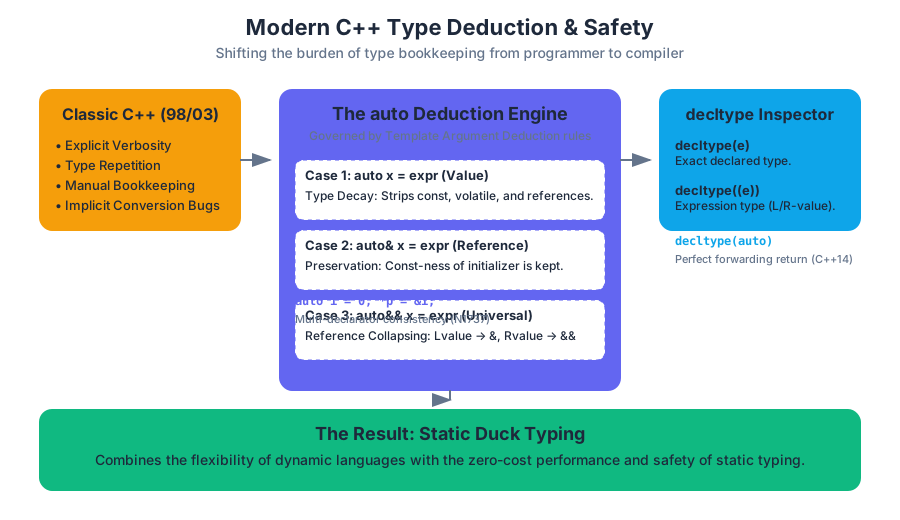
The evolution of C++ from the "Classic" era (C++98/03) to the "Modern" era (C++11 and beyond) is defined largely by a fundamental shift in how the language handles types. In classic C++, types were almost always explicit, leading to verbose code, "type-repetition" (e.g., std::vector<int>::iterator it = v.begin();), and subtle bugs arising from implicit conversions or ambiguous null pointers.
Modern C++ introduces a sophisticated type deduction system that moves the burden of type bookkeeping from the programmer to the compiler. This is not merely "syntactic sugar"; it is a robust framework for building generic, high-performance libraries—such as those used in CUDA parallel computing and template metaprogramming—where types are often too complex to name manually. By leveraging the compiler's internal knowledge of expression results, Modern C++ achieves a "Static Duck Typing" effect: the flexibility of dynamic languages with the zero-cost performance and safety of static typing.
AI_SVGI_SVG## Type Deduction: The auto Keyword
The auto keyword, redefined in C++11 (via proposal N1984), instructs the compiler to deduce the type of a variable from its initializer. While it appears simple, the underlying mechanics are governed by the same rules as Template Argument Deduction.
The Mechanics of auto
When a variable is declared as auto, the compiler treats the declaration as if it were a template function call. The type specifier auto acts as the template parameter T, and the initializer acts as the function argument.
Definition: Given a declaration
auto x = e;, the type ofxis determined by the rules of template type deduction for a hypothetical functiontemplate<typename T> void f(ParamType param).
There are three primary cases for auto deduction, depending on the decorators (pointers, references, const) applied to it:
- Case 1: The type specifier is a pointer or reference, but not a universal reference.
- The "reference-ness" of the initializer is ignored.
- The type is deduced by matching the initializer against the pattern.
- Case 2: The type specifier is a universal reference (
auto&&).- If the initializer is an lvalue, both
Tand the deduced type become lvalue references (Reference Collapsing). - If the initializer is an rvalue, normal rules apply.
- If the initializer is an lvalue, both
- Case 3: The type specifier is neither a pointer nor a reference.
- The "reference-ness" and "const-ness" of the initializer are stripped (decay).
| Declaration | Initializer Type | Deduced Type of x |
Reason |
|---|---|---|---|
auto x = expr; |
const int& |
int |
Ref and const are stripped (decay). |
const auto x = expr; |
int |
const int |
Explicit const is applied. |
auto& x = expr; |
const int |
const int& |
Const is preserved in reference deduction. |
auto&& x = expr; |
int (lvalue) |
int& |
Universal reference collapses to lvalue ref. |
auto&& x = 10; |
int (rvalue) |
int&& |
Universal reference stays rvalue ref. |
Low-Level Implementation (C++)
The following example demonstrates how auto interacts with complex types in a systems context, specifically handling memory-mapped registers or hardware abstractions where volatile and const qualifiers are critical.
#include <iostream>
#include <type_traits>
// Simulation of a hardware register
struct HW_Register {
uint32_t value;
void write(uint32_t v) { value = v; }
};
int main() {
HW_Register reg{0xDEADBEEF};
const HW_Register* const reg_ptr = ®
// 1. Basic auto: Strips const and pointer-ness if not specified
auto val = *reg_ptr;
static_assert(std::is_same_v<decltype(val), HW_Register>, "Type must be HW_Register");
// 2. auto& : Preserves const-ness of the underlying object
auto& ref = *reg_ptr;
static_assert(std::is_same_v<decltype(ref), const HW_Register&>, "Type must be const HW_Register&");
// 3. auto&& : Forwarding reference (Universal Reference)
auto&& univ_ref = reg; // Lvalue passed -> univ_ref is HW_Register&
univ_ref.write(0x1234);
auto&& rval_ref = HW_Register{0x0}; // Rvalue passed -> rval_ref is HW_Register&&
return 0;
}
Multi-declarator auto
As proposed in N1737, C++ allows multiple variables in a single auto statement, provided they deduce to the same base type. This is particularly useful in for loops.
// Valid: both deduce to int
auto i = 0, *p = &i;

// Invalid: 'i' deduces to int, 'd' deduces to double
// auto i = 0, d = 1.0;
The decltype Operator
While auto deduces a type for a variable being initialized, decltype yields the type of an expression without actually evaluating it. This is essential for generic programming where the return type of a function depends on its template arguments.
decltype(e) vs decltype((e))
A subtle but critical distinction exists in how decltype handles parenthesized expressions:
- If
eis a simple name (an id-expression),decltype(e)is the type of that name as declared. - If
eis an expression of typeT, andeis an lvalue,decltype((e))isT&. Ifeis an xvalue, it isT&&.
Mathematical Formalization of Type Deduction
We can represent the mapping of an expression to its decltype result as a function $\mathcal{D}(e)$:
$$ \mathcal{D}(e) = \begin{cases} T & \text{if } e \text{ is an unparenthesized id-expression of type } T \ T& & \text{if } e \text{ is an lvalue of type } T \ T&& & \text{if } e \text{ is an xvalue of type } T \ T & \text{if } e \text{ is a prvalue of type } T \end{cases} $$
Trailing Return Types and decltype(auto)
In C++11, decltype was often used with trailing return types. In C++14, decltype(auto) was introduced to simplify this, allowing a function to return exactly the type of an expression, including its reference-ness.
// C++11 Trailing Return Type
template<typename T, typename U>
auto add(T t, U u) -> decltype(t + u) {
    return t + u;
}

// C++14 decltype(auto)
// Returns by value if (t+u) is a prvalue,
// or by reference if the expression were an lvalue.
template<typename T>
decltype(auto) access_element(T& container, int i) {
    return container[i]; // If operator[] returns int&, decltype(auto) is int&
}
AI_DEMOI_DEMO## The nullptr Constant
Before C++11, the "null pointer" was represented by the integer 0 or the macro NULL (which usually expanded to 0 or 0L). This created significant ambiguity during function overloading.
The Overload Problem
Consider a function overloaded for int and char*. Calling f(NULL) would often resolve to f(int), which is counter-intuitive and error-prone.
| Call | f(int) |
f(void*) |
Result in C++98 | Result in Modern C++ |
|---|---|---|---|---|
f(0) |
Match | No Match | f(int) |
f(int) |
f(NULL) |
Match | Potential Match | Ambiguous/f(int) |
Ambiguous/f(int) |
f(nullptr) |
No Match | Match | N/A | f(void*) |
std::nullptr_t
nullptr is a literal of type std::nullptr_t. It is not an integer, but it is implicitly convertible to any pointer type or pointer-to-member type. It cannot be converted to an integral type (except bool).
Template Aliases (using)
In classic C++, typedef was used to create type synonyms. However, typedef has a significant limitation: it cannot be templated. To create a "template typedef" in C++98, one had to wrap a typedef inside a struct.
Comparison: typedef vs using
The using syntax (Template Aliases) is not only more readable (putting the name on the left) but also supports template parameters directly.
| Feature | typedef |
using (Alias) |
|---|---|---|
| Syntax | typedef T Name; |
using Name = T; |
| Templates | Not supported (requires wrapper) | Supported (Alias Templates) |
| Readability | Obscure for function pointers | Clear for function pointers |
| Dependent Types | Requires typename keyword |
Requires typename keyword |
Real-World Usage: CUDA Memory Management
In high-performance computing, we often need to manage different memory spaces (Host vs. Device). Template aliases allow us to define clean interfaces for these types.
// Configuration for a CUDA-accelerated pipeline
#include <vector>
#include <memory>

// A custom allocator for GPU pinned memory
template <typename T>
struct CudaPinnedAllocator {
    using value_type = T;
    // ... implementation ...
};

// Template Alias: Simplifies complex nested types
template <typename T>
using HostVector = std::vector<T, CudaPinnedAllocator<T>>;

// Usage in a real-world pipeline
void process_data() {
    // Instead of: std::vector<float, CudaPinnedAllocator<float>> buffer;
    HostVector<float> buffer;
    buffer.push_back(1.0f);
}

// Alias for a complex function pointer (Callback)
using DeviceCallback = void(*)(int, float*);
Contextual Conversions
Modern C++ refined how types are converted in specific contexts, particularly focusing on the "Boolean context."
The explicit operator bool()
In C++98, if you wanted a class to be usable in an if statement, you provided an operator bool(). However, this allowed the object to be implicitly converted to an int, leading to nonsense like my_object + 5.
C++11 introduced explicit conversion operators. An explicit operator bool() allows the object to be used in "contextually converted to bool" locations (like if, while, for, and logical operators) but forbids it from being used in general implicit conversions.
Logic Table: Contextual Conversion Locations
The following table defines where an explicit operator bool will still trigger a conversion:
| Context | Example | Conversion Triggered? |
|---|---|---|
| If Statement | if (obj) |
Yes |
| Logical NOT | !obj |
Yes |
| Logical AND/OR | obj && true |
Yes |
| Arithmetic | int x = obj + 1; |
No (Compile Error) |
| Assignment | bool b = obj; |
No (Compile Error) |
Interaction with Variadic Templates
The power of type deduction is most evident when combined with Variadic Templates (N2242). When a function template takes a parameter pack, the compiler must deduce the types of all arguments in the pack simultaneously.
Pack Expansion and Deduction
As detailed in N2555, the rules for template argument deduction were extended to allow a template parameter pack to match a sequence of individual template parameters. This is the foundation of std::make_unique and std::forward.
// Pseudocode for Variadic Deduction Logic
// Function: template<typename... Args> void log(Args... args)

1.  Identify call site: log(1, 2.5, "hello")
2.  Map arguments to parameters:
    - arg1 (int) -> Args[0]
    - arg2 (double) -> Args[1]
    - arg3 (const char*) -> Args[2]
3.  Deduce pack Args = {int, double, const char*}
4.  Instantiate function: log<int, double, const char*>(1, 2.5, "hello")
Pitfalls and Edge Cases
- The Braced-Init-List Surprise:
auto x = { 1 };deducesxasstd::initializer_list<int>. However,template<typename T> void f(T x)cannot deduceTfrom{ 1 }. This is a unique inconsistency in the C++ standard. - The
decltype(auto)and Parentheses Trap:int x = 0; decltype(auto) f1() { return x; } // Returns int decltype(auto) f2() { return (x); } // Returns int& (DANGEROUS: returns ref to local/stack) - Array Decay:
autostrips array extent, turningint arr[10]intoint*. To preserve the array type, useauto&.
AI_FLASHCARDSI_FLASHCARDS auto: Deduces type from initializer using template deduction rules.
- decltype: Queries the type of an expression without evaluating it.
- nullptr: Type-safe null pointer literal of type
std::nullptr_t. - Template Alias:
usingsyntax that allows templated type synonyms. - Universal Reference:
auto&&, which can bind to lvalues or rvalues via reference collapsing. - Explicit Operator Bool: Prevents accidental arithmetic with objects intended only for boolean checks.
AI_QUIZI_QUIZ. What is the deduced type of x in const auto& x = 10;?
2. Why does decltype((x)) result in a reference if x is an lvalue?
3. How does nullptr solve the ambiguity of f(int) vs f(void*)?
4. True/False: auto always preserves the const qualifier of the initializer.
5. What is the result of auto x = {1, 2, 3};?
AI_STUDY_GUIDEI_STUDY_GUIDE*Key Objectives:**
- Master the three cases of
autodeduction (Value, Reference, Universal Reference). - Understand the "unevaluated context" of
decltypeand its role in generic return types. - Implement
explicit operator boolin custom classes to ensure type safety. - Replace all
typedefdeclarations withusingaliases for consistency and template support. - Use
nullptrexclusively to eliminate pointer/integer ambiguity.
Further Reading:
- ISO/IEC N1984: Deducing the type of variable from its initializer.
- ISO/IEC N2555: Extending Variadic Template Template Parameters.
- "Effective Modern C++" by Scott Meyers (Items 1-6 cover deduction in extreme detail).
Advanced Templates & Metaprogramming
Key concepts: Variadic Templates · Parameter Packs · Variable Templates · Template Template Parameters · Pack Expansion
Covers variadic templates, variable templates, and template template parameters to enable highly generic and reusable GPU code.
Advanced Templates & Metaprogramming
In the hierarchy of software engineering, Metaprogramming represents the transition from writing code that manipulates data to writing code that manipulates code itself. In the context of C++ and high-performance frameworks like CUDA, metaprogramming is not merely an academic exercise in abstraction; it is a critical tool for performance optimization. By shifting computations from runtime to compile-time, developers can eliminate branching, unroll loops, and generate specialized kernel instances that are perfectly tailored to the underlying hardware architecture.
This article explores the sophisticated mechanisms of the C++ template system, focusing on the evolution from simple generics to the Turing-complete functional language that exists within the compiler today. We will dissect Variadic Templates, the mechanics of Pack Expansion, and the nuanced application of Template Template Parameters, particularly as they apply to massive parallelization and GPU computing.
AI_SVGI_SVG## Variadic Templates and Parameter Packs
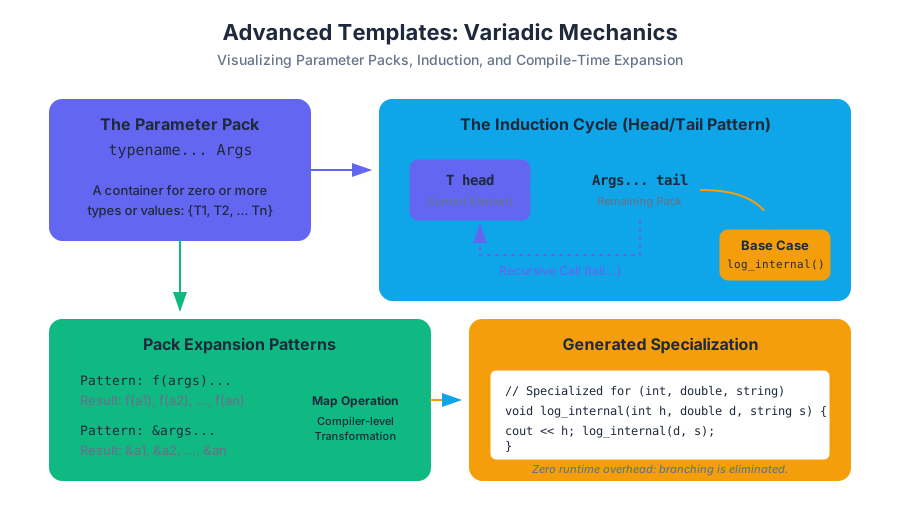
Introduced in C++11 and refined in subsequent standards (C++14/17/20), Variadic Templates solved the "N-argument problem." Before their inception, developers had to resort to tedious overloads or preprocessor macros to handle functions or classes with a variable number of arguments (e.g., std::tuple or printf-style formatting).
A Parameter Pack is a template parameter that accepts zero or more template arguments. There are two primary types of packs:
- Template Parameter Pack: Represents zero or more types or non-type values in a template declaration.
- Function Parameter Pack: Represents zero or more function arguments in a function signature.
Definition: A parameter pack is declared using the ellipsis
...to the left of the identifier. Conversely, when the ellipsis appears to the right of an expression containing a pack, it triggers a Pack Expansion, transforming the single expression into a comma-separated list of elements.
The Mechanics of Induction
Variadic templates are inherently recursive in nature. To process a pack, the compiler typically uses a "head/tail" idiom, where the first element is stripped off and processed, and the remaining pack is passed to a recursive call. This process terminates at a base-case overload.
| Term | Syntax | Description |
|---|---|---|
| Pack Declaration | typename... Args |
Declares a pack named Args containing zero or more types. |
| Pack Expansion | Args... |
Expands the pack into a comma-separated list of its constituent elements. |
| Sizeof... Operator | sizeof...(Args) |
Returns the number of elements in the pack as a std::size_t constant. |
| Fold Expression | (... + args) |
(C++17) Reduces a pack using a binary operator without explicit recursion. |
Implementation: A Type-Safe Variadic Logger
The following implementation demonstrates a low-level, type-safe logging mechanism. Unlike printf, which relies on runtime format string parsing and unsafe va_list pointers, this approach resolves types at compile-time.
#include <iostream>
#include <string_view>

/**
 * @brief Base case for the recursive variadic expansion.
 * This terminates the recursion when no arguments remain.
 */
void log_internal() {
    std::cout << std::endl;
}

/**
 * @brief Recursive step for variadic template expansion.
 * @tparam T The type of the current head element.
 * @tparam Args The types of the remaining tail elements.
 */
template <typename T, typename... Args>
void log_internal(T head, Args... tail) {
    // Process the current element
    std::cout << "[" << head << "] ";

    // Recurse with the remainder of the pack
    // The ellipsis here triggers the expansion of 'tail'
    log_internal(tail...);
}

/**
 * @brief Entry point for the variadic logger.
 * Demonstrates the 'Head/Tail' pattern common in C++11/14.
 */
template <typename... Args>
void debug_log(std::string_view prefix, Args... args) {
    std::cout << prefix << ": ";
    log_internal(args...);
}

int main() {
    // The compiler generates a specialized version of log_internal
    // for (int, double, const char*)
    debug_log("SYSTEM", 404, 3.14159, "Kernel Panic");
    return 0;
}
Pack Expansion Patterns
Pack expansion is more versatile than simple comma-separation. The pattern to the left of the ... is applied to every element in the pack. This allows for complex transformations during the expansion process.
Mathematical Derivation of Expansion
Consider a parameter pack $P = {t_1, t_2, \dots, t_n}$. When we apply a pattern $f(x)$ to this pack, the expansion results in:
f(P\dots) \rightarrow f(t_1), f(t_2), \dots, f(t_n)
This is functionally equivalent to a "map" operation in functional programming, but executed by the compiler's template instantiation engine.
Common Expansion Patterns
The following table outlines how different patterns change the resulting code:
| Pattern Expression | Resulting Expansion | Use Case |
|---|---|---|
&args... |
&a1, &a2, ..., &an |
Taking addresses of all arguments. |
std::forward<Args>(args)... |
std::forward<T1>(a1), ... |
Perfect forwarding in wrappers. |
func(args)... |
func(a1), func(a2), ... |
Calling a function on each element. |
Class<Args...> |
Class<T1, T2, ..., Tn> |
Passing a pack to another template. |
(args + 1)... |
(a1 + 1), (a2 + 1), ... |
Element-wise arithmetic. |
Pseudocode: The Expansion Logic
To understand how the compiler views a pack expansion, we can represent the internal "unrolling" logic in pseudocode:
PROCEDURE ExpandPack(Pattern P, Pack Args)
    IF Args is Empty THEN
        RETURN Empty
    END IF

    ResultList = []
    FOR EACH element E IN Args
        Instance = Substitute(P, x -> E)
        APPEND Instance TO ResultList
    END FOR

    RETURN CommaSeparate(ResultList)
END PROCEDURE

// Example: f(&args...) where args = {x, y}
// 1. Substitute(f(&x), x -> x) => f(&x)
// 2. Substitute(f(&x), x -> y) => f(&y)
// Result: f(&x), f(&y)
Variable Templates
Introduced in C++14, Variable Templates allow for the definition of a family of variables. Prior to this, constants that depended on a template parameter had to be wrapped inside a struct as a static constexpr member (e.g., std::numeric_limits<T>::max()).
Variable templates simplify the syntax significantly, especially for mathematical constants and type traits.
Motivation: Mathematical Precision
In high-performance computing, we often need constants (like $\pi$ or $e$) defined at different precisions (float, double, quad). Variable templates allow us to define these once.
// Definition of a variable template
template<typename T>
constexpr T pi = T(3.1415926535897932385L);

// Usage
auto circle_area_f = pi<float> * r * r;
auto circle_area_d = pi<double> * r * r;
Advanced Use: Type Traits
Variable templates are frequently used to create "aliases" for type traits, reducing the verbosity of typename Trait<T>::value.
| Traditional (C++11) | Variable Template (C++14+) |
|---|---|
std::is_floating_point<T>::value |
std::is_floating_point_v<T> |
std::is_same<T, U>::value |
std::is_same_v<T, U> |
std::numeric_limits<T>::is_signed |
is_signed_v<T> (Custom) |
Template Template Parameters
A Template Template Parameter is a template parameter that is itself a template. This allows a class or function to accept a generic container or factory without being tied to a specific instantiation of that container.
The N2555 Evolution
Historically, template template parameters were notoriously rigid. They required an exact match in "type and form." If a template expected a template<typename> class Container, it would fail if passed std::vector, because std::vector actually has two parameters (the type and the allocator), even though the second has a default value.
The N2555 proposal (and subsequent adoption in C++17) loosened these rules. Now, a template parameter pack can match a sequence of individual template parameters, making metaprogramming libraries far more robust.
Real-World Usage: The Generic Wrapper
Consider a scenario where we want to write a Buffer class for a CUDA kernel that can use different underlying storage strategies (e.g., std::vector for host memory or a custom CudaDeviceVector for GPU memory).
#include <vector>
#include <iostream>

// A custom allocator-like structure for CUDA
template <typename T>
struct CudaDeviceAllocator { /* ... */ };

// A template that accepts another template as an argument
// 'Container' is the Template Template Parameter
template <typename T, template <typename...> class Container>
class DataProcessor {
    Container<T> data;

public:
    void push(T val) {
        // Works whether Container is std::vector or a custom list
        data.push_back(val);
    }

    size_t size() const { return data.size(); }
};

int main() {
    // std::vector has multiple template parameters (Type, Allocator)
    // C++17 allows this to match template <typename...> class Container
    DataProcessor<int, std::vector> hostProcessor;
    hostProcessor.push(10);

    std::cout << "Host buffer size: " << hostProcessor.size() << std::endl;
    return 0;
}
AI_DEMOI_DEMO## Metaprogramming in CUDA: Performance Specialization
In CUDA development, templates are used to achieve Kernel Specialization. A single source-code kernel can be compiled into dozens of optimized versions, each specifically tuned for a particular data type or block size.
The Problem: Runtime Branching
If a kernel contains a switch statement to handle different data types or algorithms, the GPU must evaluate that branch for every thread. This can lead to thread divergence and wasted cycles.
The Solution: Compile-Time Dispatch
By using variadic templates and if constexpr (C++17), we can move the logic to the compiler. The compiler generates specialized machine code that contains only the relevant path for that specific instantiation.
/**
 * @brief A specialized CUDA kernel using Template Metaprogramming.
 * @tparam BlockSize The number of threads per block (known at compile time).
 * @tparam UseAtomic Whether to use atomic additions for reduction.
 */
template <int BlockSize, bool UseAtomic, typename T>
__global__ void optimized_reduction(T* g_data, T* g_out) {
    // Shared memory size is fixed at compile time based on template arg
    __shared__ T sdata[BlockSize];

    unsigned int tid = threadIdx.x;
    unsigned int i = blockIdx.x * BlockSize + threadIdx.x;
    sdata[tid] = g_data[i];
    __syncthreads();

    // Unroll the reduction loop at compile time
    // The compiler knows 'BlockSize', so it can eliminate the loop overhead
    #pragma unroll
    for (unsigned int s = BlockSize / 2; s > 0; s >>= 1) {
        if (tid < s) {
            sdata[tid] += sdata[tid + s];
        }
        __syncthreads();
    }

    // Compile-time branching: No runtime 'if' overhead on the GPU
    if (tid == 0) {
        if constexpr (UseAtomic) {
            atomicAdd(g_out, sdata[0]);
        } else {
            *g_out = sdata[0];
        }
    }
}

// Host-side invocation
void launch_kernel(int n, float* d_in, float* d_out) {
    // Launching a specific specialization
    optimized_reduction<256, true, float><<<n/256, 256>>>(d_in, d_out);
}
Common Pitfalls and Limitations
While powerful, advanced templates introduce significant complexity into the development lifecycle.
- Code Bloat (Binary Size): Every unique combination of template arguments generates a new instantiation. In CUDA, this can lead to massive binaries and increased compilation times (often referred to as "Template Explosion").
- Error Messages: Template errors are notoriously verbose. A single missing
>or a type mismatch in a deep variadic expansion can produce pages of "candidate" failures. - SFINAE Complexity: Before C++20 Concepts, restricting templates based on properties (e.g., "only allow floating point types") required SFINAE (Substitution Failure Is Not An Error) using
std::enable_if. This is syntactically dense and difficult to debug. - Header-Only Requirement: Templates must generally be defined in header files so the compiler can see the full definition during instantiation. This can lead to circular dependency issues in large projects.
| Pitfall | Impact | Mitigation |
|---|---|---|
| Template Explosion | Increased binary size and compile time. | Use extern template to prevent redundant instantiations. |
| Opaque Errors | Hard to debug compile-time failures. | Use C++20 Concepts to provide clear constraints. |
| Recursive Depth | Compiler limits on recursion depth. | Use Fold Expressions instead of recursive templates where possible. |
| Divergent Code | GPU performance loss if not careful. | Use if constexpr to ensure branches are resolved at compile-time. |
Summary of Metaprogramming Evolution
The transition from C++98 to C++20 has seen templates evolve from a simple "find and replace" macro-like system to a robust, type-safe, and expressive language.
- C++98/03: Basic templates, partial specialization, and the discovery of Template Metaprogramming (TMP) as a Turing-complete system.
- C++11: Variadic templates and
static_assertmake TMP practical for library authors. - C++14: Variable templates and relaxed
constexprrules allow more logic to move to compile-time. - C++17: Fold expressions and
if constexprdrastically simplify the syntax for pack expansion and conditional compilation. - C++20: Concepts and
requiresclauses replace SFINAE, making template constraints a first-class citizen of the language.
AI_FLASHCARDSI_FLASHCARDS. Parameter Pack: A template or function parameter that represents a sequence of zero or more arguments.
2. Pack Expansion: The process of applying a pattern to every element in a parameter pack, denoted by ....
3. Variable Template: A template that defines a family of variables, often used for mathematical constants or type traits.
4. Template Template Parameter: A template parameter that is itself a template, allowing for higher-order generic programming.
5. Fold Expression: A C++17 feature that allows reducing a parameter pack using a binary operator (e.g., +, &&) without recursion.
6. SFINAE: Substitution Failure Is Not An Error; a rule where an invalid substitution during template instantiation does not cause a hard error but simply removes that candidate from the overload set.
7. Perfect Forwarding: The technique of passing arguments to another function while preserving their value category (lvalue/rvalue) using std::forward and universal references.
AI_QUIZI_QUIZ. Question: What is the primary difference between a template parameter pack and a function parameter pack?
- Answer: A template parameter pack exists in the template header (e.g.,
template<typename... Args>) and represents types or values. A function parameter pack exists in the function signature (e.g.,void func(Args... args)) and represents the actual objects passed to the function.
-
Question: How does
if constexprimprove performance in CUDA kernels compared to a standardifstatement?- Answer:
if constexpris evaluated at compile-time. The compiler discards the branch that is not taken, meaning the final machine code contains no branching logic for that condition, preventing warp divergence on the GPU.
- Answer:
-
Question: Given a pack
Args... argscontaining{1, 2, 3}, what does the expansion(args * 2)...produce?- Answer: It produces the comma-separated sequence
2, 4, 6.
- Answer: It produces the comma-separated sequence
-
Question: Why was the loosening of Template Template Parameter rules in N2555 important for the Standard Template Library (STL)?
- Answer: It allowed templates to match containers like
std::vectororstd::mapmore easily, even though those containers have hidden default template parameters (like allocators or comparators) that previously caused mismatch errors.
- Answer: It allowed templates to match containers like
-
Question: What operator is used to determine the number of elements in a parameter pack at compile-time?
- Answer: The
sizeof...(pack_name)operator.
- Answer: The
AI_STUDY_GUIDE*Core Concepts to Master:**
- The Ellipsis (
...): Understand its three distinct roles: declaring a pack, expanding a pack, and fold expressions. - Recursive Decomposition: Practice the "Head/Tail" idiom for processing variadic packs in pre-C++17 environments.
- Specialization vs. Overloading: Learn when to partially specialize a class template versus overloading a variadic function.
- Compile-Time Logic: Master
std::conditional,std::enable_if(or Concepts), andif constexprto control code generation.
Recommended Practice:
- Implement a
make_vectorfunction that takes a variadic number of arguments and returns astd::vectorcontaining them. - Create a
PrintTuplehelper that uses variadic templates to print all elements of astd::tupletostd::cout. - Write a variable template
is_pointer_vthat replicates the behavior ofstd::is_pointer<T>::value. - (Advanced) Implement a compile-time string hasher using
constexprand variadic templates.
Further Reading:
- C++ Templates: The Complete Guide by Vandevoorde, Josuttis, and Gregor.
- Modern C++ Design by Andrei Alexandrescu (for historical context on Policy-Based Design).
- NVIDIA CUDA C++ Programming Guide (Section on Template Integration).
Performance, Attributes, & Memory Alignment
Key concepts: constexpr · alignas / alignof · General Attributes · Strongly Typed Enums · Explicit Conversion Operators
Focuses on language features that provide fine-grained control over hardware behavior, including alignment, constant expressions, and attributes.
Performance, Attributes, & Memory Alignment
In the pursuit of computational excellence, the boundary between high-level abstraction and low-level hardware reality often thins. For the systems engineer, the C++ language is not merely a tool for logic, but a sophisticated interface for managing the physical resources of the machine: the CPU cycles, the cache lines, and the memory bus. This section explores the advanced mechanisms—constexpr, memory alignment, attributes, and type safety—that allow developers to write code that is both expressive and ruthlessly efficient.
AI_SVGI_SVG## The Philosophy of Zero-Cost Abstractions
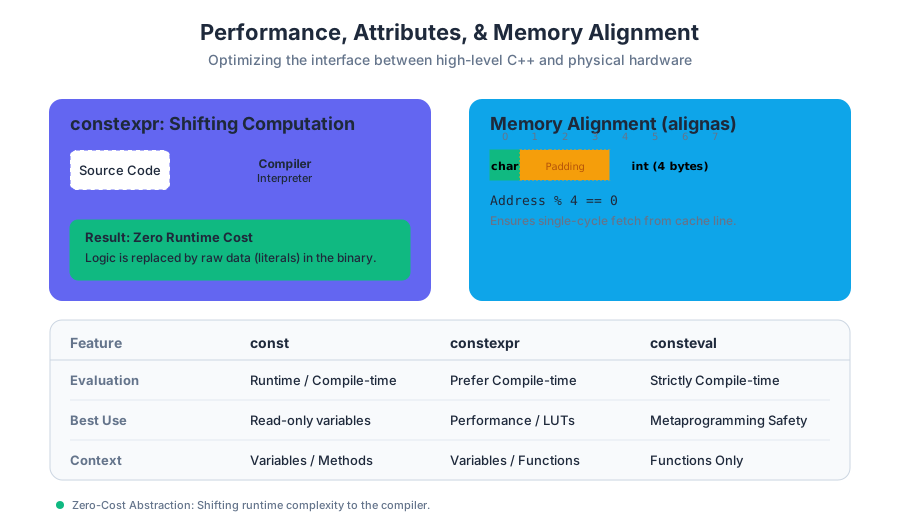
At the heart of modern C++ lies the "Zero-Cost Abstraction" principle: you don't pay for what you don't use, and what you do use, you couldn't hand-code any better. To achieve this, the compiler requires hints and constraints. By utilizing constexpr for compile-time evaluation and alignas for memory layout, we shift the burden of calculation from the user's runtime to the developer's compile-time, while ensuring that the data resides in a format the hardware can ingest with minimal latency.
constexpr: Shifting Computation to Compile-Time
What it is
The constexpr specifier declares that it is possible to evaluate the value of the function or variable at compile-time. Introduced in C++11 and significantly expanded in C++14, C++17, and C++20, it allows the compiler to replace a function call or a variable access with a literal constant.
Why it matters In high-performance contexts like CUDA kernel configuration or real-time signal processing, runtime calculations are "stolen" cycles. If a value can be known before the program even executes, it should be. This leads to:
- Reduced Binary Size: Eliminating complex initialization logic.
- Performance: Replacing instructions with immediate values in the instruction stream.
- Safety: Allowing constants to be used in contexts requiring constant expressions, such as array bounds or template parameters.
How it works
When the compiler encounters a constexpr entity, it attempts to execute the logic within its own internal interpreter. For a function to be constexpr, it must satisfy strict requirements: it cannot call non-constexpr functions, it cannot perform I/O, and (prior to C++20) it had limited support for dynamic memory allocation.
| Feature | const |
constexpr |
consteval (C++20) |
|---|---|---|---|
| Evaluation | Runtime or Compile-time | Preferably Compile-time | Strictly Compile-time |
| Context | Variables/Methods | Variables/Functions | Functions only |
| Initialization | Can be dynamic | Must be a constant expression | Must be a constant expression |
| Usage | Read-only data | Metadata/Optimization | Metaprogramming/Safety |
Code Block 1: Low-Level Implementation (C++)
The following example demonstrates a constexpr implementation of a Look-Up Table (LUT) generation. Instead of calculating trigonometric values at runtime, we bake them into the binary.
#include <iostream>
#include <array>
#include <cmath>

// A constexpr-compatible math utility (simplified)
// Note: In C++20, many <cmath> functions are still not constexpr,
// so we implement a Taylor series approximation.
constexpr double constexpr_sin(double x) {
    double res = 0.0;
    double term = x;
    double x2 = x * x;
    for (int i = 1; i <= 10; ++i) {
        res += term;
        term *= -x2 / (2 * i * (2 * i + 1));
    }
    return res;
}

// Generate a LUT at compile time
template<std::size_t N>
struct SineTable {
    std::array<double, N> values;

    constexpr SineTable() : values{} {
        for (std::size_t i = 0; i < N; ++i) {
            values[i] = constexpr_sin(2.0 * 3.141592653589793 * i / N);
        }
    }
};

// This variable is evaluated entirely by the compiler.
// The resulting assembly will contain only the raw data.
static constexpr auto global_sine_lut = SineTable<360>();

int main() {
    // Zero runtime cost for calculation
    std::cout << "Sin(90): " << global_sine_lut.values[90] << std::endl;
    return 0;
}
Memory Alignment: alignas and alignof
What it is
Memory alignment refers to the restriction that data of a certain type must be stored at a memory address that is a multiple of a specific power of two. The alignof operator queries the alignment requirements of a type, while the alignas specifier allows a developer to force a stricter alignment on a variable or class.
Why it matters Modern CPUs and GPUs do not read memory byte-by-byte; they read in "chunks" (typically 32, 64, or 128 bits).
- Hardware Requirements: Certain instructions (like SSE/AVX on x86 or vectorized loads in CUDA) require data to be aligned to 16 or 32-byte boundaries. Accessing unaligned data can cause a hardware exception or a significant performance penalty.
- Cache Line Efficiency: By aligning data to the size of a cache line (usually 64 bytes), we prevent "false sharing" and ensure that a single data structure doesn't straddle two cache lines, which would require two memory fetches instead of one.
How it works: The Mathematics of Padding
When you define a struct, the compiler automatically inserts "padding" bytes to ensure that each member starts at an address compatible with its alignment requirement.
Code Block 2: Mathematical Derivation of Alignment
The address of a member $M$ in a structure must satisfy the condition: $$\text{Address}(M) \equiv 0 \pmod{\text{alignof}(M)}$$
If we have a structure with a char (1 byte) followed by an int (4 bytes), the compiler must insert 3 bytes of padding.
Structure Layout Derivation:
Let S be a struct { char a; int b; }
1. Offset of 'a' = 0. (0 % 1 == 0). Valid.
2. Next available byte = 1.
3. Required alignment of 'b' (int) = 4.
4. Padding = (Alignment - (CurrentOffset % Alignment)) % Alignment
   Padding = (4 - (1 % 4)) % 4 = 3 bytes.
5. Offset of 'b' = 1 + 3 = 4. (4 % 4 == 0). Valid.
6. Total Size = Offset of 'b' + sizeof(b) = 4 + 4 = 8 bytes.
| Type | Typical Size (bytes) | Typical Alignment (bytes) |
|---|---|---|
char |
1 | 1 |
short |
2 | 2 |
int / float |
4 | 4 |
double / long long |
8 | 8 |
float4 (SIMD/CUDA) |
16 | 16 |
Cache Line |
64 | 64 |
Code Block 3: Real-World Usage (CUDA Shared Memory)
In CUDA programming, aligning data in shared memory is critical to avoid bank conflicts and enable vectorized memory access.
// CUDA Kernel demonstrating forced alignment for performance
__global__ void aligned_kernel(float* data) {
    // Force the shared memory array to be aligned to 128 bytes
    // to match the cache line size or vectorized load requirements.
    alignas(128) __shared__ float shared_buffer[256];

    int tid = threadIdx.x;

    // Perform a vectorized load if the hardware supports it
    // float4 requires 16-byte alignment
    if (tid < 64) {
        float4* v_ptr = reinterpret_cast<float4*>(&shared_buffer[tid * 4]);
        float4* g_ptr = reinterpret_cast<float4*>(&data[tid * 4]);
        *v_ptr = *g_ptr; // Single instruction 128-bit load/store
    }
    __syncthreads();

    // ... processing ...
}
AI_DEMOI_DEMO--
General Attributes: [[attribute]]
What it is
Attributes provide a standardized, extensible syntax for providing implementation-defined information to the compiler. Introduced in C++11, they replaced various vendor-specific keywords like __attribute__((...)) (GCC/Clang) and __declspec(...) (MSVC).
Why it matters Attributes allow the developer to communicate intent that the type system cannot express. This can lead to better optimizations (e.g., branch prediction hints) or better static analysis (e.g., warning about ignored return values).
Key Standard Attributes
[[nodiscard]]: Issues a warning if the return value of a function is ignored. Crucial for functions returning error codes or resources (likestd::unique_ptr).[[maybe_unused]]: Suppresses warnings about unused variables, common in template code orassert-heavy builds.[[fallthrough]]: Indicates that a missingbreakin aswitchstatement is intentional.[[likely]]/[[unlikely]](C++20): Provides hints to the compiler's branch predictor about which path aniforswitchis more likely to take.
| Attribute | Purpose | Impact |
|---|---|---|
[[nodiscard]] |
Safety | Prevents resource leaks or ignored errors. |
[[noreturn]] |
Optimization | Tells compiler the function never returns (e.g., exit()), allowing stack cleanup elision. |
[[deprecated]] |
Maintenance | Marks code as obsolete; provides a custom message during compilation. |
[[likely]] |
Performance | Reorders assembly instructions to favor the "hot" path. |
Strongly Typed Enums: enum class
What it is
C-style enums (enum Color { RED, BLUE };) are essentially integers. They leak their names into the surrounding scope and implicitly convert to int. Strongly typed enums (enum class Color { RED, BLUE };) solve these issues by requiring explicit scoping and forbidding implicit conversions.
Why it matters
- Namespace Pollution: In large systems, two different enums might both want a member named
NoneorDefault.enum classkeeps these names encapsulated. - Type Safety: You cannot accidentally add a
Color::REDto aSpeed::FAST. - Forward Declaration: Unlike C-style enums,
enum classhas a fixed underlying type (defaulting toint), allowing them to be forward-declared, which reduces header dependencies and compile times.
Code Block 4: Comparison and Pitfalls (C++ vs. Assembly-ish)
Consider the difference in how the compiler treats these two types.
// OLD: C-style
enum Status { OK, ERROR };
// NEW: Scoped
enum class NetStatus : uint8_t { OK, ERROR };

void process(int code) { /* ... */ }

int main() {
    Status s1 = OK;
    process(s1); // Works, but is it safe? s1 is just 0.

    NetStatus s2 = NetStatus::OK;
    // process(s2); // COMPILER ERROR: cannot convert NetStatus to int

    process(static_cast<int>(s2)); // Explicit intent required
}
Explicit Conversion Operators
What it is
By default, a single-argument constructor or a conversion operator allows the compiler to perform an implicit conversion. The explicit keyword prevents the compiler from using that constructor or operator for implicit type-casting.
Why it matters Implicit conversions are a frequent source of "hidden" performance costs and logic bugs.
- Hidden Allocations: Passing a
const char*to a function expecting astd::stringtriggers a hidden heap allocation. - Logic Errors: A
SmartPointerclass might implicitly convert to abool. While useful forif (ptr), it might allowptr + 5if theboolis treated as an integer.
How it works
By marking a constructor or operator as explicit, you force the user to use direct initialization or an explicit static_cast.
Code Block 5: Performance Implications of Implicit Conversions
#include <vector>

struct Buffer {
    size_t size;
    // Without 'explicit', Buffer b = 10; would create a buffer of size 10.
    explicit Buffer(size_t s) : size(s) { /* allocate memory */ }
};

void handleBuffer(Buffer b) { /* ... */ }

int main() {
    // handleBuffer(1024); // ERROR: prevented an accidental expensive allocation.

    Buffer b(1024);      // OK: Direct initialization
    handleBuffer(b);     // OK
}
Integration: The Performance Synergy
When we combine these features, we create a "Fortress of Efficiency."
constexprcalculates the optimal buffer size for a specific hardware architecture.alignasensures that buffer is placed on a 64-byte boundary to maximize cache throughput.[[nodiscard]]ensures the developer handles the result of the buffer allocation.enum classdefines the state of the buffer (Empty, Filling, Full) without polluting the global namespace.explicitensures that integers aren't accidentally promoted to "Buffer" objects, preventing catastrophic memory churn.
The Theorem of Static Constraints: The more information the compiler possesses about the alignment, lifetime, and value of data at compile-time, the closer the generated machine code approaches the theoretical limit of the hardware.
AI_FLASHCARDSI_FLASHCARDS constexpr: A specifier indicating that a value or function can be computed during compilation.
- alignas: A specifier used to set the memory alignment requirement of a variable or type.
- alignof: An operator that returns the alignment (in bytes) required for a given type.
- [[nodiscard]]: An attribute that warns the user if a return value is ignored.
- enum class: A scoped, strongly-typed enumeration that prevents implicit integer conversion.
- explicit: A keyword that prevents the compiler from using a constructor or conversion operator for implicit type transformations.
- Padding: Extra bytes inserted by the compiler between structure members to satisfy alignment requirements.
- Bank Conflict: A performance bottleneck in GPU shared memory occurring when multiple threads access different addresses in the same memory bank.
AI_QUIZI_QUIZ. Question: Why does sizeof(struct { char a; int b; }) usually return 8 instead of 5?
- Answer: Because the
intmemberbrequires 4-byte alignment, the compiler inserts 3 bytes of padding afterchar ato ensurebstarts at an offset that is a multiple of 4.
-
Question: Can a
constexprfunction call a non-constexprfunction?- Answer: No. A
constexprcontext requires that all branches of execution be evaluatable at compile-time.
- Answer: No. A
-
Question: What is the primary advantage of
enum classover a standardenumregarding header files?- Answer:
enum classhas a fixed underlying type, allowing it to be forward-declared. This breaks circular dependencies and reduces the need to include the full definition in every header.
- Answer:
-
Question: How does
[[likely]]affect the generated assembly?- Answer: It suggests to the compiler to arrange the assembly code so that the "likely" branch follows the conditional jump immediately (falling through), which is more efficient for the CPU's fetch-and-decode pipeline.
AI_STUDY_GUIDEI_STUDY_GUIDE*Deep-Dive Checklist:**
- Review the padding rules for nested structures.
- Experiment with
std::is_constant_evaluated()to provide different logic for runtime vs. compile-time. - Use
objdumporCompiler Explorer(godbolt.org) to verify thatalignasactually changes the stack pointer offsets in assembly. - Refactor a C-style
enumto anenum classin a medium-sized project to observe how many hidden type-mismatch bugs are caught. - Audit a codebase for constructors taking a single argument; determine which should be marked
explicit.
Modern Syntax & Literal Extensions
Key concepts: Lambda Expressions · User-defined Literals · Binary Literals · Digit Separators · Long Long Type
Discusses quality-of-life improvements in C++ syntax, including lambdas, user-defined literals, and binary representations.
Modern Syntax & Literal Extensions
The evolution of C++ from a "better C" to a multi-paradigm powerhouse is most visible in its syntactic refinements. Modern C++ (C++11 through C++23) has introduced features that do not merely provide "syntactic sugar" but fundamentally alter how engineers express intent, manage state, and interact with hardware. In high-performance domains like GPGPU programming with CUDA, these extensions bridge the gap between high-level abstraction and low-level efficiency.
This section explores the mechanics of Lambda Expressions, User-defined Literals (UDLs), Binary Literals, Digit Separators, and the Long Long type. We will examine their formal definitions, compiler-level implementations, and their specific utility in systems programming.
AI_SVGI_SVG## Lambda Expressions: The Calculus of Closures
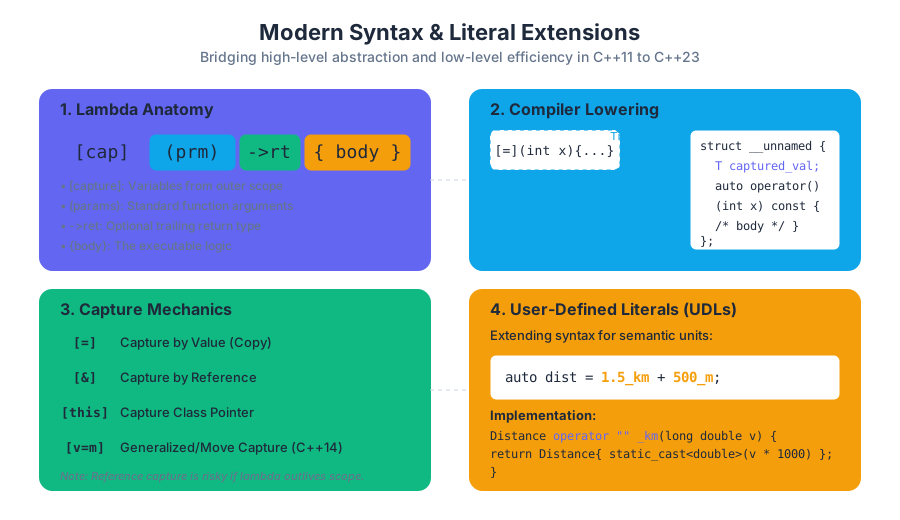
At its core, a Lambda Expression is a definition of an anonymous function object (a closure) capable of capturing variables from its surrounding scope. While they appear as inline functions, the compiler treats them as unique, unnamed class types (functors).
1. Formal Definition and Syntax
A lambda expression is defined by the following components:
[ capture-list ] ( params ) specifiers -> ret { body }
Definition: Closure Object A closure is a temporary object created by a lambda expression. It contains the code defined in the lambda body and the data captured from the surrounding environment. The type of a closure is a unique, unnamed non-union class type.
2. The Mechanics of Capture
The "magic" of lambdas lies in the capture-list. This defines how variables from the outer scope are made available inside the lambda's body.
| Capture Syntax | Mechanism | Description |
|---|---|---|
[] |
No capture | The lambda can only access global variables or parameters passed to it. |
[=] |
Capture by value | Creates local copies of all used variables within the closure. |
[&] |
Capture by reference | Stores references to variables in the outer scope. Risky if the lambda outlives the scope. |
[x, &y] |
Mixed capture | Captures x by value and y by reference. |
[this] |
Member access | Captures the this pointer, allowing access to class members. |
[...args = std::move(p)] |
Generalized capture | (C++14) Allows capturing by move or initializing new variables in the capture block. |
3. Lambda Lowering: How the Compiler Sees It
To understand performance, one must understand "lowering"—the process by which the compiler transforms high-level syntax into intermediate representations.
// Block 1: Low-level Implementation (C++ / CUDA)
// Demonstrating a device-side lambda used in a parallel transform
#include <cuda_runtime.h>
#include <thrust/device_vector.h>
#include <thrust/transform.h>

template <typename T>
void apply_threshold(thrust::device_vector<T>& vec, T threshold, T replacement) {
    // A __device__ lambda captured by value for GPU execution
    // The [=] ensures 'threshold' and 'replacement' are copied to the GPU constant memory/registers
    thrust::transform(vec.begin(), vec.end(), vec.begin(),
        [=] __device__ (T val) -> T {
            return (val > threshold) ? replacement : val;
        }
    );
}

// Manual "Lowering" of the above lambda (Simplified)
struct __unnamed_lambda_id {
    float threshold;
    float replacement;

    __unnamed_lambda_id(float t, float r) : threshold(t), replacement(r) {}

    __device__ float operator()(float val) const {
        return (val > threshold) ? replacement : val;
    }
};
The transformation above demonstrates that a lambda is not a function pointer; it is an object. This is why lambdas are often faster than function pointers: the compiler can inline the operator() call because the type of the functor is known at the call site.
// Block 2: Mathematical Derivation of Lambda Binding
// Let L be a lambda expression defined in scope S.
// Let V = {v1, v2, ..., vn} be the set of variables in S used by L.

L(V) \rightarrow \mathcal{C} \{
    \text{Type: } \tau_{unique}
    \text{State: } \{ \sigma(v_i) \mid v_i \in V \}
    \text{Behavior: } f(params, \text{State})
\}

// Where \sigma(v_i) is the mapping function:
// \sigma_{val}(v) = v_{copy}
// \sigma_{ref}(v) = \&v
4. Generic Lambdas and Variadic Packs
With C++14 and C++20, lambdas gained the ability to use auto in parameters and even template parameter lists. This allows them to interact with Variadic Templates (as seen in N2242).
// Block 3: Real-world Usage (C++20 Template Lambdas)
// A logging utility that handles variadic arguments using a template lambda
auto logger = []<typename... Args>(Args&&... args) {
    (std::cout << ... << std::forward<Args>(args)) << std::endl;
};

// Usage in a system initialization sequence
logger("Initializing system...", " Version: ", 2.1, " Status: OK");
User-Defined Literals (UDLs)
C++ has always had built-in literals like 1.0f (float) or 0x10 (hexadecimal). User-defined Literals allow developers to extend this syntax to custom types, providing a way to attach units or semantic meaning to raw numbers and strings.
1. The Literal Operator
A UDL is implemented via a literal operator. The syntax is:
ReturnType operator "" _suffix(unsigned long long val);
ReturnType operator "" _suffix(long double val);
ReturnType operator "" _suffix(const char* str, size_t len);
2. Cooked vs. Raw Literals
- Cooked Literals: The compiler parses the literal into a standard type (like
intordouble) and passes that value to the operator. - Raw Literals: The compiler passes the literal as a raw string (
const char*), allowing the developer to perform custom parsing (e.g., for arbitrary-precision arithmetic).
| Literal Type | Operator Signature | Example Input |
|---|---|---|
| Integer | operator "" _suffix(unsigned long long) |
123_unit |
| Floating-point | operator "" _suffix(long double) |
3.14_unit |
| String | operator "" _suffix(const char*, size_t) |
"hello"_unit |
| Character | operator "" _suffix(char) |
'c'_unit |
3. Application: Physical Quantities and Memory
In systems programming, UDLs are invaluable for preventing unit errors (e.g., passing milliseconds where seconds are expected).
// Block 4: Edge Case - Memory Unit UDLs
// Preventing overflow and ensuring type safety in memory allocation
constexpr size_t operator "" _KiB(unsigned long long v) { return v * 1024; }
constexpr size_t operator "" _MiB(unsigned long long v) { return v * 1024 * 1024; }
constexpr size_t operator "" _GiB(unsigned long long v) { return v * 1024 * 1024 * 1024; }

void allocate_gpu_buffer(size_t bytes) {
    void* ptr;
    cudaMalloc(&ptr, bytes);
    // ...
}

int main() {
    // Highly readable and type-safe
    allocate_gpu_buffer(2_GiB + 512_MiB);
}
AI_DEMOI_DEMO## Binary Literals and Digit Separators
While high-level abstractions are useful, systems engineers often work at the bit level. Historically, C++ required programmers to translate binary masks into hexadecimal or octal mentally.
1. Binary Literals (0b)
C++14 introduced the 0b (or 0B) prefix to represent binary constants directly. This eliminates the translation layer when defining bitmasks for hardware registers.
2. Digit Separators (')
As constants grow in size, they become harder to read. The single quote ' acts as a digit separator. It is purely for human readability and is ignored by the compiler.
| Format | Representation | Readability Level |
|---|---|---|
| Decimal | 4294967295 |
Low (hard to count digits) |
| Hexadecimal | 0xFFFFFFFF |
Medium (requires hex-to-bin conversion) |
| Binary (Old) | 0xAAAA |
Low (masking intent is hidden) |
| Modern Binary | 0b1010'1010'1010'1010 |
High (clear bit patterns) |
| Large Decimal | 4'294'967'295 |
High (clear magnitude) |
3. Practical Masking Example
Consider a hardware status register where bits 0-3 are error codes, bit 4 is a "ready" flag, and bits 5-7 are revision numbers.
// Block 5: Before vs. After (Readability Comparison)
// Traditional approach using Hex
const uint8_t STATUS_MASK_OLD = 0x1F; // What does this even mean?

// Modern approach using Binary Literals and Separators
const uint8_t ERR_CODE_MASK = 0b0000'1111;
const uint8_t READY_FLAG    = 0b0001'0000;
const uint8_t REV_NUM_MASK  = 0b1110'0000;

// Large constants are also much clearer
const uint64_t MAX_ADDR = 0xFFFF'FFFF'0000'0000ULL;
const double PLANCK_CONST = 6.626'070'15e-34;
Long Long and Extended Integer Types
The long long type was a long-standing extension in many compilers (like GCC and MSVC) before being formally standardized in C++11. It guarantees a minimum width of 64 bits.
1. Data Ranges and Portability
In the context of CUDA and 64-bit computing, long long is the standard way to represent large address spaces or high-precision timestamps.
| Type | Minimum Width | Typical Range |
|---|---|---|
int |
16 bits | $\pm 32,767$ |
long |
32 bits | $\pm 2,147,483,647$ |
long long |
64 bits | $\pm 9,223,372,036,854,775,807$ |
2. Extended Integers
The standard also allows for "implementation-defined" extended integer types. These are accessed via <cstdint> (e.g., int128_t in some environments). In CUDA, long long is critical for atomic operations on 64-bit values, which are essential for global counters in kernels.
Common Pitfalls and Best Practices
- Lambda Capture Hazards: Capturing by reference
[&]in an asynchronous context (like a CUDA stream or astd::asynccall) is a leading cause of "use-after-free" bugs. Always prefer capturing by value[=]for asynchronous GPU kernels. - UDL Namespace Pollution: Literal operators should be placed in dedicated namespaces (e.g.,
namespace my_project::literals) to avoid naming collisions. Users should then useusing namespace ...explicitly. - Binary Literal Length: While
0bis helpful, very long binary literals (e.g., 64-bit) can still be hard to read. Use digit separators every 4 or 8 bits to maintain clarity. - Auto and Multi-declarators: As noted in N1737, using
autowith multiple variables in one line (e.g.,auto x = 5, *y = &x;) is legal but can be confusing. Modern style guides often suggest one declaration per line.
AI_FLASHCARDSI_FLASHCARDS Closure: The temporary object generated by a lambda expression.
- Literal Operator: The function that implements a user-defined literal (e.g.,
operator "" _s). - Capture-by-value: Creating a copy of a variable inside a lambda closure using
[=]. - Digit Separator: The
'character used to group digits for readability. - Binary Literal: A constant prefixed with
0brepresenting a base-2 number. - Generic Lambda: A lambda that uses
autoor template parameters for its arguments.
AI_QUIZI_QUIZ. Which capture mode is safest for a lambda being passed to a background thread or a GPU kernel?
- A)
[&] - B)
[=] - C)
[this] - Answer: B. Capture by value ensures the data exists even if the original scope is destroyed.
-
What is the return type of a literal operator for a string UDL?
- A)
std::string - B)
const char* - C) Any user-defined type.
- Answer: C. UDLs are designed to return custom types (like
DistanceorJSON).
- A)
-
True or False: The digit separator
'changes the numerical value of a constant.- Answer: False. It is ignored by the compiler.
-
Why are lambdas often faster than function pointers?
- Answer: Because each lambda has a unique type, allowing the compiler to perform devirtualization and inlining.
AI_STUDY_GUIDEI_STUDY_GUIDE*Summary of Modern Syntax Extensions**
- Lambdas: Use them for short-lived logic and callbacks. In CUDA, use
[=] __device__to pass data to kernels. Understand the "functor lowering" to appreciate the zero-cost abstraction. - UDLs: Use them to enforce unit safety (e.g.,
_ms,_bytes). Avoid overusing them for trivial cases. - Binary/Separators: Use
0bfor bitmasks and'for any constant longer than 4 digits. - Type Deduction: Use
autoto simplify complex iterator types, but be wary of its interaction withinitializer_list. - Variadic Templates: When combined with lambdas, they allow for powerful, generic factory functions and logging utilities.
Recommended Practice: Refactor an existing piece of code that uses #define for bitmasks to use constexpr binary literals with digit separators. Observe the improvement in readability.
Object Lifecycle & Advanced Language Rules
Key concepts: Delegating Constructors · Unrestricted Unions · Extended Friend Declarations · Conditionally-supported Behavior · Ill-formed Programs
Examines complex language behaviors such as delegating constructors, unrestricted unions, and the classification of undefined behavior.
Object Lifecycle & Advanced Language Rules
The C++ object model is not merely a description of memory layout; it is a formal state machine governed by strict temporal and semantic boundaries. As we move into the "dark corners" of the ISO C++ Standard, we encounter rules that define the very fabric of how programs are constructed, validated, and executed. This section explores the sophisticated mechanisms of the object lifecycle—from the delegation of construction to the manual management of unrestricted unions—and the rigorous taxonomy of program validity that distinguishes a portable application from a "broken" binary.
AI_SVGI_SVG## Delegating Constructors
Prior to the C++11 standard, C++ suffered from a "constructor proliferation" problem. If a class had multiple constructors with overlapping initialization logic, developers were forced to either duplicate code or move shared logic into a private init() member function. The latter approach was suboptimal because init() cannot initialize constants (const) or references, nor can it utilize the member initializer list, leading to double-initialization of complex objects.
Delegating Constructors solve this by allowing one constructor (the delegating constructor) to invoke another constructor (the target constructor) from the same class within the initializer list.
Mechanics and Rules
A constructor is considered a delegating constructor if its initializer list contains a single mem-initializer where the identifier is the class name itself.
- The "Complete" Object: Once the target constructor returns, the object is considered "fully constructed." This has profound implications for exception handling. If an exception occurs in the body of the delegating constructor after the target constructor has finished, the destructor for the object will be called.
- Mutual Exclusion: A delegating constructor cannot have any other member initializers. The target constructor is responsible for the entire initialization of the object's state.
- Recursion: Infinite delegation (Constructor A calls B, B calls A) is a compile-time error (ill-formed), though the standard does not require a diagnostic for complex indirect recursion.
| Feature | init() Method Pattern |
Delegating Constructors |
|---|---|---|
Initializes const members |
No | Yes |
| Initializes references | No | Yes |
| Performance | Potential double-init | Single-pass initialization |
| Exception Safety | Manual cleanup often required | Automatic destructor invocation |
| Syntax | this->init(args) in body |
ClassName(args) in init-list |
Low-Level Implementation
In the following example, we demonstrate a high-performance NetworkBuffer that manages memory through various allocation strategies, using delegation to centralize the memory-mapping logic.
#include <iostream>
#include <stdexcept>
#include <sys/mman.h>

class NetworkBuffer {
private:
    void*  m_data;
    size_t m_size;
    int    m_flags;
    bool   m_is_mapped;

public:
    // The Target Constructor: Handles the heavy lifting of mmap
    NetworkBuffer(size_t size, int prot, int flags)
        : m_size(size), m_flags(flags), m_is_mapped(true) {

        m_data = mmap(nullptr, m_size, prot, flags | MAP_ANONYMOUS, -1, 0);
        if (m_data == MAP_FAILED) {
            throw std::runtime_error("mmap failed");
        }
        std::cout << "Target Constructor: Memory mapped at " << m_data << std::endl;
    }

    // Delegating Constructor 1: Default permissions (Read/Write)
    NetworkBuffer(size_t size)
        : NetworkBuffer(size, PROT_READ | PROT_WRITE, MAP_PRIVATE) {
        std::cout << "Delegating Constructor: Default permissions applied." << std::endl;
    }

    // Delegating Constructor 2: Read-only buffer
    NetworkBuffer(size_t size, bool read_only)
        : NetworkBuffer(size, read_only ? PROT_READ : (PROT_READ | PROT_WRITE), MAP_PRIVATE) {
        std::cout << "Delegating Constructor: Read-only status set to " << read_only << std::endl;
    }

    ~NetworkBuffer() {
        if (m_is_mapped && m_data != MAP_FAILED) {
            munmap(m_data, m_size);
            std::cout << "Destructor: Memory unmapped." << std::endl;
        }
    }
};
Unrestricted Unions
In C++98, unions were restricted to "POD" (Plain Old Data) types. You could not have a member with a non-trivial constructor, destructor, or assignment operator. This limitation made unions nearly useless for modern C++ resource management (like std::string or std::vector).
Unrestricted Unions lift these constraints. A union can now contain any type, provided it is not a reference. However, this power comes with a significant burden: the compiler no longer knows which member is "active," and therefore cannot automatically call constructors or destructors.
The Lifecycle Challenge
When a union member has a non-trivial special member function, the compiler deletes the corresponding special member function of the union itself. If you have a union containing a std::string, the union's destructor is deleted. You must define it yourself.
Theorem of Union Lifecycle: For a union $U$ with members $m_1, m_2, \dots, m_n$, if any $m_i$ has a non-trivial destructor, the destructor $U::\sim U()$ is implicitly deleted unless explicitly defined by the user to handle the destruction of the currently active member.
Mathematical Representation of Union State
We can model the state of an unrestricted union as a tuple $(S, \sigma)$, where $S$ is the set of possible types ${T_1, T_2, \dots, T_n}$ and $\sigma \in S$ is the currently active type.
\begin{aligned}
\text{Let } \mathcal{U} \text{ be the union object.} \\
\text{Initialization: } \text{placement\_new}(\mathcal{U}.m_i) \implies \sigma \leftarrow T_i \\
\text{Transition: } \mathcal{U}.m_i.\sim T_i() \text{ followed by } \text{placement\_new}(\mathcal{U}.m_j) \implies \sigma \leftarrow T_j \\
\text{Validity Requirement: } \forall \text{ access } \mathcal{U}.m_k, \sigma = T_k
\end{aligned}
Concrete Example: A Variant-like Type
The following code demonstrates the manual lifecycle management required for an unrestricted union.
#include <string>
#include <vector>
#include <new> // for placement new

union S3Holder {
    std::string str;
    std::vector<int> vec;
    int integer;

    // We MUST define the constructor because members have non-trivial ctors
    S3Holder() : integer(0) {}

    // We MUST define the destructor
    ~S3Holder() {}
};

struct ManagedUnion {
    enum { IS_STR, IS_VEC, IS_INT } tag;
    S3Holder storage;

    ~ManagedUnion() {
        if (tag == IS_STR) storage.str.~basic_string();
        else if (tag == IS_VEC) storage.vec.~vector();
    }

    void set_string(const char* s) {
        if (tag == IS_VEC) storage.vec.~vector();
        new (&storage.str) std::string(s); // Placement new
        tag = IS_STR;
    }
};
AI_DEMOI_DEMO## Extended Friend Declarations
The friend keyword has historically been rigid, requiring a specific class or function name. In template-heavy code, this created a "circular dependency" or "naming" problem. Extended Friend Declarations allow for more flexible syntax, specifically supporting:
- Template Parameters:
friend T;whereTis a template parameter. - Typedefs:
friend AliasedName;. - Non-elaborated types: You no longer need the
classorstructkeyword if the name is already in scope.
Why it Matters in Metaprogramming
Consider a generic "Wrapper" or "Proxy" class. To allow the underlying type T to access the private members of the wrapper (or vice versa), the wrapper needs to declare T as a friend. In C++98, friend T; was illegal because T was not an "elaborated-type-specifier" (like friend class T;). However, if T turned out to be a primitive like int, friend class T; would fail because int is not a class.
| Syntax | C++98/03 | C++11 and later |
|---|---|---|
friend class T; |
Valid if T is a class | Valid (but errors if T is int) |
friend T; |
Invalid | Valid (ignored if T is not a class/struct) |
friend MyTypedef; |
Invalid | Valid |
Conditionally-supported Behavior & Ill-formed Programs
To understand how a compiler treats code, we must categorize the code based on the Standard's taxonomy. This is critical for systems like CUDA, where the nvcc compiler must bridge the gap between standard C++ and device-specific constraints.
The Taxonomy of Code Validity
- Well-defined: The Standard specifies exactly what happens.
- Implementation-defined: The behavior varies (e.g., size of
int), but the compiler must document it. - Undefined Behavior (UB): Anything can happen. The compiler assumes UB never occurs to optimize code.
- Conditionally-supported Behavior: A feature that is not required by all implementations (e.g.,
__asm__blocks or specific pragmas). If a compiler supports it, it must follow the rules; if not, it must issue a diagnostic. - Ill-formed: The code violates the syntax or semantic rules of the language.
- Diagnostic Required: The compiler must give an error or warning (e.g., a syntax error).
- No Diagnostic Required (NDR): The code is technically illegal, but the compiler isn't required to catch it (e.g., ODR violations across different translation units).
Ill-formed vs. Undefined: The Shift
Modern C++ has moved several "Undefined" behaviors into the "Ill-formed" category. For example, in C++98, certain overflows in constant expressions were undefined. In modern C++, they are often ill-formed, forcing a compile-time error rather than a runtime crash.
Compiler Diagnostic Levels (Conceptual)
# Example of checking for conditionally-supported features or ill-formed code
# using a modern compiler (GCC/Clang/NVCC)

# 1. Attempting to compile ill-formed code (Diagnostic Required)
echo "int main() { int x = ; }" > test.cpp
g++ test.cpp # Result: error: expected expression before ';' token

# 2. Checking for conditionally-supported __asm__ blocks
# Some compilers might not support specific assembly syntaxes
echo "int main() { __asm__('nop'); }" > asm_test.cpp
g++ -std=c++11 -pedantic asm_test.cpp # Might issue a warning if non-standard

# 3. NVCC handling of device-side lifecycle (CUDA specific)
# nvcc will flag ill-formed code that attempts to use host-only features on device
nvcc -arch=sm_80 device_code.cu -c
Integration: Object Lifecycle in CUDA
In the context of CUDA and the NVIDIA C++ Programming Guide, these rules become the boundary between the Host (CPU) and the Device (GPU).
- Construction on Device: Objects created in global memory on the GPU follow the same lifecycle rules as host objects, but their constructors are executed in a SIMT (Single Instruction, Multiple Threads) fashion.
- Variadic Templates and Lifecycle: As seen in N2242, variadic templates allow for the creation of generic "Factory" patterns. In CUDA, this is used to pass an arbitrary number of arguments to a kernel, which then constructs objects in
__shared__memory. - Auto and Type Deduction: The
autokeyword (N1984/N1737) is vital in CUDA for handling the complex return types of math functions and device-side iterators.
CUDA Memory and Lifecycle Constraints
| Memory Type | Constructor Execution | Destructor Execution | Persistence |
|---|---|---|---|
__device__ (Global) |
At module load (Host-side trigger) | At module unload | Lifetime of the application |
__shared__ |
Per-block (Manual initialization) | Manual (if needed) | Lifetime of the thread block |
__local__ (Stack) |
Per-thread (Automatic) | Per-thread (Automatic) | Lifetime of the kernel |
Real-World Usage: Variadic Kernel Dispatcher
This example combines variadic templates (N2242) with object lifecycle management to create a generic kernel launcher.
# A Python-based simulation of how a C++ compiler might expand
# a variadic template for a CUDA kernel launch.

def simulate_pack_expansion(kernel_name, *args):
    """
    Simulates the logic of N2242 (Variadic Templates) for kernel arguments.
    """
    print(f"Generating PTX for kernel: {kernel_name}")

    # Pack expansion logic: sizeof...(args)
    num_args = len(args)
    print(f"Argument pack contains {num_args} elements.")

    # Simulating the 'auto' deduction for each argument
    for i, arg in enumerate(args):
        arg_type = type(arg).__name__
        print(f"  Arg[{i}]: Type={arg_type}, Value={arg}")

# Usage
simulate_pack_expansion("VectorAdd", [1.0, 2.0], [3.0, 4.0], 2)
Common Pitfalls
- Delegation Loops: Creating a cycle in delegating constructors. While the compiler should catch direct cycles, indirect cycles (A -> B -> C -> A) can lead to stack overflows during compilation or undefined behavior if the compiler fails to detect it.
- Union Member Mismanagement: Forgetting to call the destructor of a union member before switching to a new one. This is a "silent" resource leak.
- Friendship is not Transitive: If Class A is a friend of Class B, and Class B is a friend of Class C, Class A is not automatically a friend of Class C. Extended friend declarations do not change this fundamental security rule.
- Assuming NDR means "Safe": Just because a compiler isn't required to issue a diagnostic for an ill-formed program (NDR) doesn't mean the program is valid. It usually means the error is too expensive to detect at compile-time (like a violation of the One Definition Rule).
AI_QUIZI_STUDY_GUIDE-- End of Section: Object Lifecycle & Advanced Language Rules This article is part of the DeepWiki C++ Standard Series. For further reading, see the sections on "Memory Models" and "Template Metaprogramming."
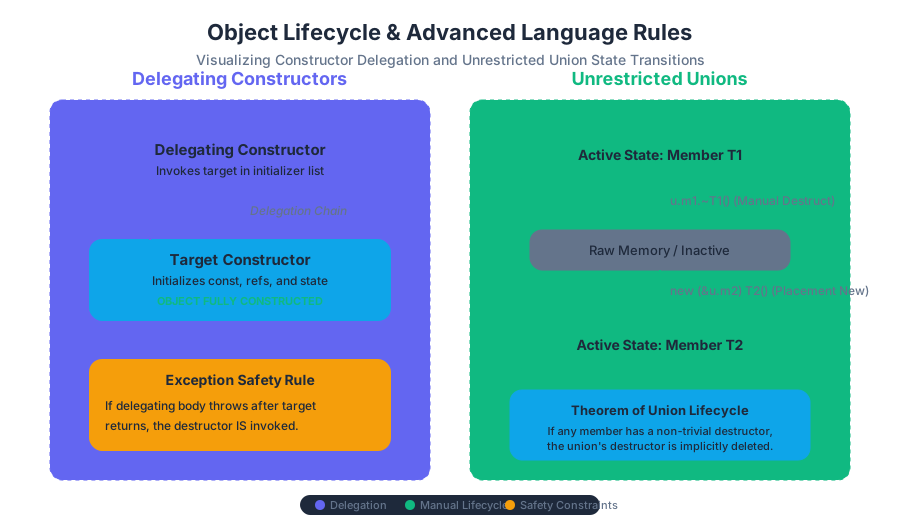
Source Materials
Study Introduction to CUDA and Modern C++ Programming with AI — Free on Lykke
Sign up for free to generate personalized flashcards, quizzes, and study guides from this course. Chat with an AI tutor that knows the material.
Get Started FreeView this course wiki on Lykke · Browse all public course wikis