Introduction Sociology 3e
Institution: MIT
1 study materials · 5 sections
Introduction to Sociology 3e is a comprehensive, open-access course designed to provide foundational sociological theories and explore the complexities of human societal interactions. The curriculum focuses on fostering critical thinking and civic engagement while addressing the causes and impacts of discrimination across various social institutions. Students will explore how individual experiences are shaped by broader social structures and learn to apply the sociological perspective to contemporary global issues.
Course Sections
Foundations of the Sociological Perspective
Key concepts: Sociological Imagination · Functionalism · Conflict Theory · Symbolic Interactionism · Empirical Research
An introduction to the discipline of sociology, its history, and the primary theoretical frameworks used to analyze society.
Foundations of the Sociological Perspective
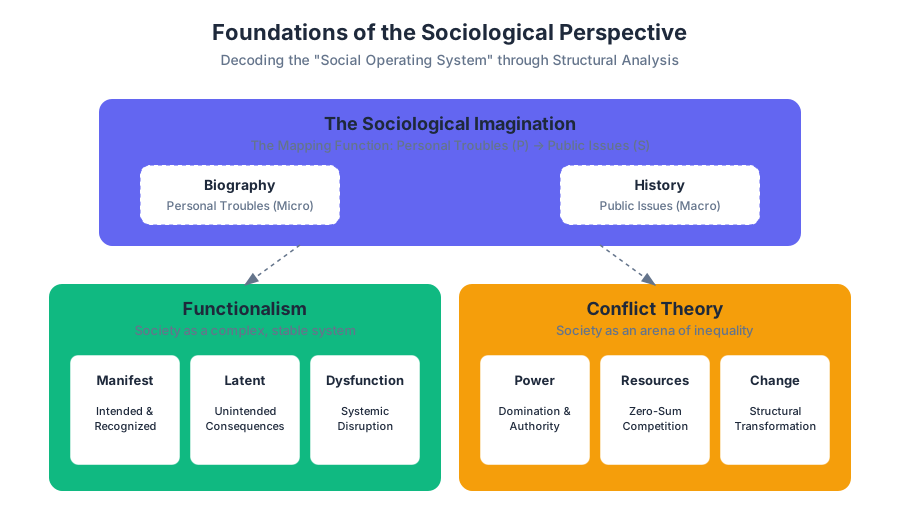
Sociology is the systematic and scientific study of society, social institutions, and social relationships. Far from being a mere collection of observations about human behavior, it is a rigorous discipline that seeks to decode the "social operating system"—the underlying structures, protocols, and feedback loops that govern human interaction. By moving beyond individualistic explanations, sociology provides a framework for understanding how macro-level forces (history, economics, and law) intersect with micro-level experiences (identity, conversation, and daily routine).
The Sociological Imagination: Bridging Biography and History
What it is
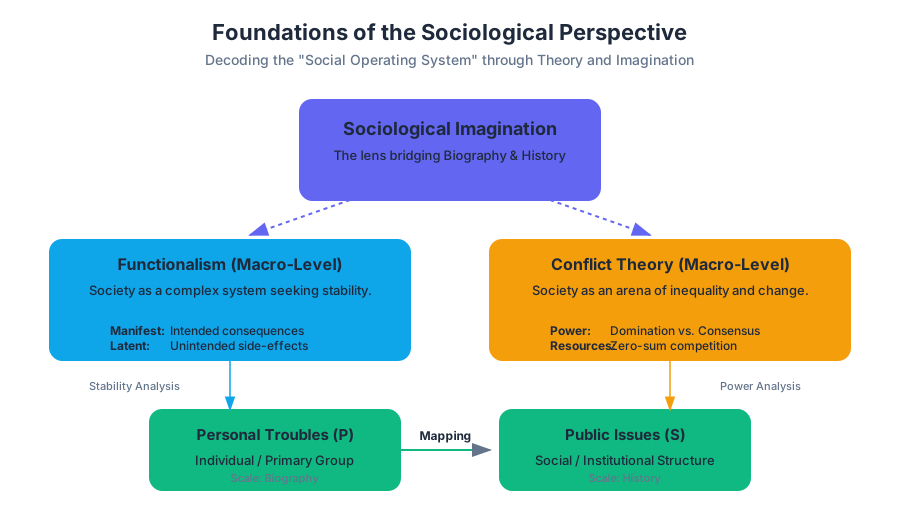
The Sociological Imagination is a conceptual lens first articulated by C. Wright Mills in 1959. It is defined as the vivid awareness of the relationship between personal experience and the wider society. Mathematically, it can be conceptualized as a mapping function $f: P \to S$, where $P$ represents the "personal troubles" of an individual and $S$ represents the "public issues" of the social structure.
"Neither the life of an individual nor the history of a society can be understood without understanding both." — C. Wright Mills
Why it matters
Without the sociological imagination, individuals often internalize systemic failures as personal defects. For instance, an individual’s inability to find a job is viewed as a personal failure (a "trouble"). However, when 15 million people are unemployed, it becomes a "public issue" rooted in the collapse of the economic infrastructure. This perspective is the "root access" of sociological analysis; it allows the observer to see the structural constraints that limit or enable individual agency.
How it works: The Trouble vs. Issue Framework
To apply the sociological imagination, one must deconstruct a phenomenon into two distinct layers:
| Dimension | Personal Trouble | Public Issue |
|---|---|---|
| Scale | Individual / Primary Group | Society / Institutional |
| Resolution | Individual change (willpower, skill acquisition) | Policy change (legislation, economic reform) |
| Example: Divorce | A couple's inability to communicate. | Shifting gender roles and economic independence of women. |
| Example: Debt | Overspending on luxury items. | Stagnant wages relative to the rising cost of education and housing. |
Common Pitfalls
The most common error is Individualistic Reductionism, where complex social phenomena are reduced to the psychological traits of the participants. The sociological imagination prevents this by forcing the analyst to look at the "historical coordinates" of the situation.
Theoretical Frameworks: The Engines of Analysis
Sociological theory provides the "logic" through which data is interpreted. These frameworks are not mutually exclusive but function like different debugging tools—one might look at memory leaks (Conflict Theory), while another looks at the overall system architecture (Functionalism).
1. Functionalism (Structural-Functional Theory)
Functionalism is a macro-level orientation that views society as a complex system whose parts work together to promote solidarity and stability. It is often compared to a biological organism where each organ (institution) serves a specific function to keep the body (society) alive.
- Manifest Functions: The recognized and intended consequences of any social pattern.
- Latent Functions: The unrecognized and unintended consequences of any social pattern.
- Dysfunctions: Social patterns that have undesirable consequences for the operation of society.
Implementation Example: Analyzing Education
In a functionalist model, the "Education" module has specific outputs:
# A functionalist simulation of the Education System
class EducationSystem:
    def __init__(self, students):
        self.students = students
        self.labor_market_readiness = 0
        self.social_cohesion = 0

    def manifest_function(self):
        """Intended output: Skill acquisition and certification."""
        for s in self.students:
            s.skills += 10
            s.certified = True
        self.labor_market_readiness += len(self.students) * 0.8

    def latent_function(self):
        """Unintended output: Childcare and social networking."""
        # Keeps youth off the streets and allows parents to work
        self.social_cohesion += len(self.students) * 0.5
        # Facilitates peer-group formation (finding a spouse/partner)
        self.matchmaking_index = len(self.students) * 0.2

    def dysfunction(self):
        """Negative output: Creating a 'credential inflation' bubble."""
        if self.labor_market_readiness > 1000:
            return "Degree devaluation: Supply exceeds demand."

# Execution
edu = EducationSystem(students=[...])
edu.manifest_function()
edu.latent_function()
2. Conflict Theory
Conflict Theory views society as an arena of inequality that generates conflict and change. Rooted in the work of Karl Marx, it focuses on how social patterns benefit some people while hurting others. It rejects the functionalist notion of "equilibrium," arguing instead that social order is maintained by domination and power rather than consensus.
Mathematical Representation of Resource Competition
In a Conflict Theory model, the distribution of power $P$ can be viewed as a zero-sum game where the dominant class $C_d$ extracts surplus value $V$ from the subordinate class $C_s$.
$$ P(C_d) \propto \frac{R_{total}}{R_{access}(C_s)} $$
Where $R$ represents resources (capital, prestige, authority). As the access of the subordinate class to resources decreases, the power of the dominant class increases exponentially.
Comparison: Functionalism vs. Conflict Theory
| Feature | Functionalism | Conflict Theory |
|---|---|---|
| View of Society | A stable system of interrelated parts. | An arena of inequality and struggle. |
| Driving Force | Consensus and shared values. | Coercion and power dynamics. |
| Social Change | Incremental, evolutionary. | Radical, revolutionary. |
| View of Inequality | Necessary for motivating talent. | Unfair and detrimental to society. |
3. Symbolic Interactionism
Symbolic Interactionism is a micro-level theory that focuses on the relationships among individuals within a society. It posits that people make sense of their social worlds through communication—the exchange of meaning through language and symbols.
How it works: The Social Construction of Reality
This perspective suggests that "reality" is not an objective constant but a dynamic process that is negotiated in every interaction. Herbert Blumer set out three basic premises:
- Humans act toward things on the basis of the meanings they ascribe to those things.
- The meaning of such things is derived from, or arises out of, the social interaction that one has with others and the society.
- These meanings are handled in, and modified through, an interpretative process used by the person in dealing with the things he/she encounters.
Real-World Usage: The Dramaturgical Analysis
Erving Goffman, a key interactionist, proposed the Dramaturgical Analysis, where social life is viewed as a theatrical performance. Individuals manage "front stage" and "back stage" personas to maintain social order.
-- Schema for a Dramaturgical Interaction Log
CREATE TABLE social_interactions (
    interaction_id INT PRIMARY KEY,
    actor_id INT,
    setting_context VARCHAR(255), -- 'Front Stage' or 'Back Stage'
    performance_type VARCHAR(100), -- 'Professional', 'Casual', 'Intimate'
    impression_management_score FLOAT, -- 0.0 to 1.0 (effort to control perception)
    symbols_exchanged TEXT, -- JSON of gestures, clothing, language
    outcome_status VARCHAR(50) -- 'Successful validation' or 'Social faux pas'
);

-- Query to find instances of 'Role Strain'
SELECT actor_id, COUNT(*)
FROM social_interactions
WHERE performance_type = 'Professional'
AND setting_context = 'Back Stage'
GROUP BY actor_id;
Empirical Research: The Verification Layer
Sociology is an empirical science, meaning it relies on evidence rather than intuition. The research process follows a strict pipeline to ensure that findings are both reliable (consistent) and valid (accurate).
The Research Pipeline
- Define the Question: Identify a social pattern or anomaly.
- Literature Review: Audit existing research to avoid redundancy.
- Hypothesis Formation: Define dependent and independent variables.
- Research Design: Select a methodology (Survey, Ethnography, Experiment).
- Data Collection: Execute the gathering of raw data.
- Analysis: Use statistical or thematic tools to interpret data.
- Conclusion: Report findings and address limitations.
Methodological Parameters
| Method | Type | Strength | Weakness |
|---|---|---|---|
| Survey | Quantitative | High generalizability, large N. | Low depth, "social desirability" bias. |
| Field Work | Qualitative | High depth, "thick description." | Low generalizability, researcher bias. |
| Experiment | Quantitative | Establishes causality. | Ethical constraints, artificiality. |
| Secondary Analysis | Mixed | Cost-effective, longitudinal. | Data may be outdated or incomplete. |
Data Processing Example
Sociologists often use the Gini Coefficient to measure inequality. Below is a shell script approach to calculating a simplified Gini index from a CSV of household incomes.
#!/bin/bash
# Calculate a simplified Gini Coefficient from a list of incomes
# Usage: ./gini.sh incomes.csv

INPUT_FILE=$1

# Sort incomes and calculate total
SORTED_INCOMES=$(sort -n $INPUT_FILE)
TOTAL_INCOME=$(awk '{sum+=$1} END {print sum}' $INPUT_FILE)
COUNT=$(wc -l < $INPUT_FILE)

# Calculate the Gini using the formula: G = (2 * sum(i * yi) / (n * sum(yi))) - (n + 1) / n
SUM_PRODUCT=$(echo "$SORTED_INCOMES" | awk -v n=$COUNT 'BEGIN{i=1} {sum+=(i*$1); i++} END {print sum}')

GINI=$(awk -v sp=$SUM_PRODUCT -v n=$COUNT -v ti=$TOTAL_INCOME \
'BEGIN { print ((2 * sp) / (n * ti)) - ((n + 1) / n) }')

echo "Calculated Gini Coefficient: $GINI"
Synthesis: Comparing the Three Paradigms
To truly master the sociological perspective, one must be able to switch between these frameworks fluently. A single social phenomenon, such as the Internet, looks radically different through each lens:
- Functionalist view: The Internet serves as a global nervous system, facilitating rapid communication, e-commerce, and the dissemination of knowledge, thereby increasing social integration.
- Conflict view: The Internet is a tool for digital surveillance and capital accumulation. It creates a "digital divide" where those without access are further marginalized, and platforms are owned by a small elite (the "technostructure").
- Interactionist view: The Internet is a space for identity construction. People use avatars, emojis, and profiles to perform versions of themselves, creating new forms of "symbolic reality" that exist entirely online.
The Concept Map of Sociology
Axiom of Social Structure: Social structures are both the medium and the outcome of the practices they recursively organize. (Anthony Giddens, Structuration Theory)
Common Pitfalls in Sociological Analysis
- The Ecological Fallacy: Assuming that what is true for a group is automatically true for every individual in that group. (e.g., "This neighborhood is high-crime, therefore this specific person is a criminal.")
- Correlation vs. Causality: Observing that two variables move together (e.g., ice cream sales and drowning rates) and assuming one causes the other (ignoring the "lurking variable" of summer heat).
- Ethnocentrism: Evaluating another culture based on the standards of one's own culture, rather than understanding it within its own context (Cultural Relativism).
Final Summary
The foundations of the sociological perspective rest on the ability to de-center the self and view the social world as a structured environment. By utilizing the Sociological Imagination, applying the three core Theoretical Frameworks, and adhering to Empirical Research standards, we can move from "common sense" to "social science." This transition is essential for effective civic engagement and the resolution of the persistent "public issues" that define our era.
Social Interaction, Culture, and Socialization
Key concepts: Culture · Socialization · Social Roles · Groups and Organizations
Explores how culture shapes our reality and how individuals are socialized into their respective societies.
Social Interaction, Culture, and Socialization
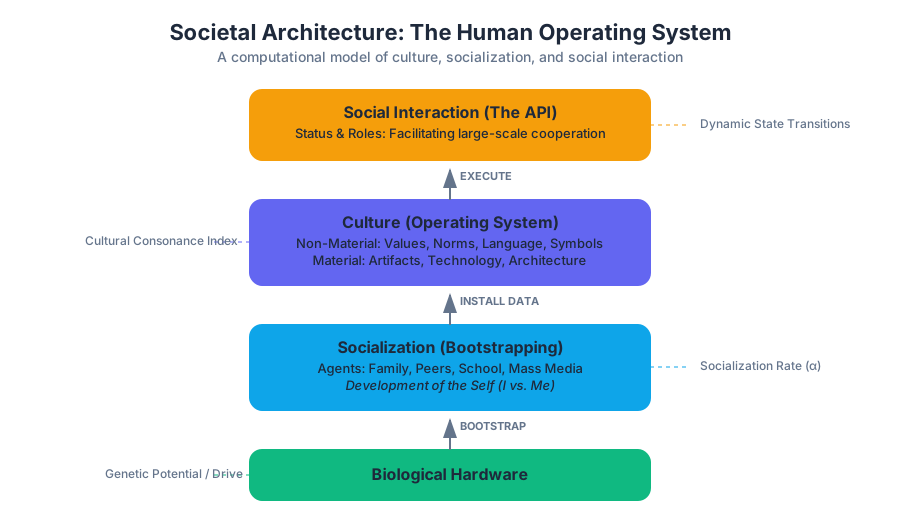
In the architectural hierarchy of human existence, if biology provides the hardware, then culture and socialization constitute the operating system and the network protocols. This section explores the mechanisms through which individual human units are programmed into functional societal nodes, the shared data structures (culture) they utilize, and the complex APIs of interaction (social roles) that facilitate large-scale cooperation and conflict.
1. Culture: The Societal Software Stack
Culture is defined as the shared beliefs, values, and practices that participants must learn to function within a group. It is not merely a collection of "traditions" but a comprehensive system of meaning that dictates how reality is perceived and navigated.
Definition: Culture is the sum of a group's shared practices, values, and beliefs. It encompasses everything from daily routines to the most fundamental convictions about the nature of existence.
1.1 Material vs. Non-Material Culture
Sociologists distinguish between the physical artifacts of a society and the intangible ideas that govern it.
| Category | Definition | Examples | System Analogy |
|---|---|---|---|
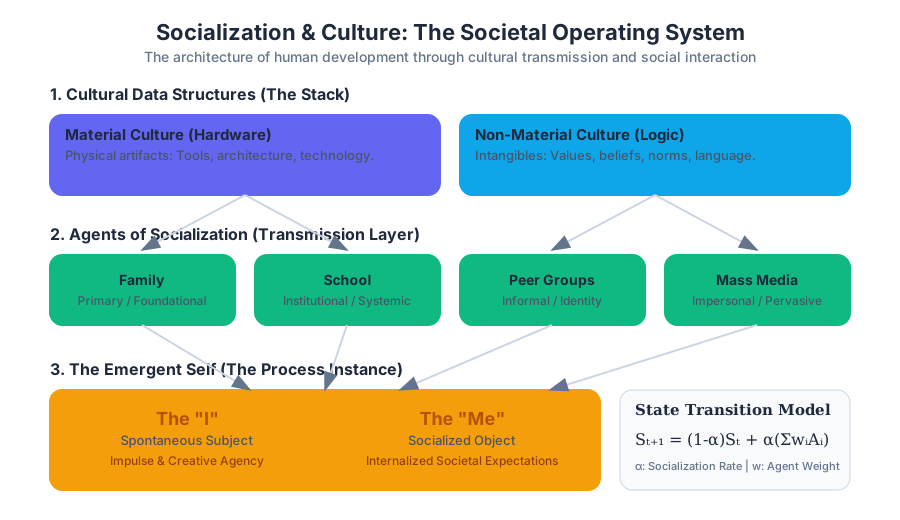
| Material Culture | Physical objects or artifacts created/used by a society. | Tools, architecture, technology, clothing, art. | Hardware / Peripherals |
| Non-Material Culture | The ideas, attitudes, and beliefs of a society. | Language, norms, values, symbols, religion. | Logic / Algorithms |
1.2 The Components of Culture
Culture functions through several key components that ensure stability and predictability:
- Values: Abstract standards of what is "good" or "just."
- Beliefs: Specific tenets that people hold to be true.
- Norms: The visible and invisible rules of conduct.
- Mores: Norms based on moral ethical principles (e.g., laws against theft).
- Folkways: Norms without moral underpinnings (e.g., table manners).
- Symbols: Anything that carries a particular meaning recognized by people who share a culture.
- Language: A symbolic system through which people communicate and through which culture is transmitted.
1.3 Cultural Analysis via Computational Sociology
To understand the "distance" between cultures or the rate of cultural change, sociologists often use quantitative measures. The following Python example demonstrates a simplified approach to calculating Cultural Consonance—the degree to which an individual's behavior aligns with the cultural consensus.
import numpy as np

def calculate_cultural_consonance(individual_profile, cultural_consensus_model):
    """
    Calculates the alignment of an individual's practices with the
    dominant cultural model using a weighted Euclidean distance.

    :param individual_profile: np.array of behavioral frequencies
    :param cultural_consensus_model: np.array of 'ideal' cultural behaviors
    :return: float (0.0 to 1.0, where 1.0 is perfect alignment)
    """
    # Normalize profiles
    ind_norm = individual_profile / np.linalg.norm(individual_profile)
    cul_norm = cultural_consensus_model / np.linalg.norm(cultural_consensus_model)

    # Calculate Cosine Similarity as a proxy for consonance
    similarity = np.dot(ind_norm, cul_norm)

    return np.clip(similarity, 0, 1)

# Example: Values on a 1-10 scale for [Individualism, Collectivism, Authority, Innovation]
consensus = np.array([8.5, 2.1, 4.0, 9.2])
user_a = np.array([7.9, 3.0, 3.5, 8.8])

consonance_score = calculate_cultural_consonance(user_a, consensus)
print(f"Cultural Consonance Index: {consonance_score:.4f}")
2. Socialization: The Bootstrapping Process
If culture is the software, socialization is the installation process. It is the lifelong social experience by which people develop their human potential and learn culture.
2.1 The Development of Self
A core question in sociology is how the "Self" emerges. Unlike biological traits, the self is a social product.
- Charles Horton Cooley: The Looking-Glass Self: We perceive ourselves based on how we think others see us.
- George Herbert Mead: The I and the Me: The self has two parts: the I (the spontaneous, impulsive subject) and the Me (the socialized object that evaluates the "I" based on societal expectations).
2.2 Agents of Socialization
Socialization occurs through various "agents" that transmit cultural data.
| Agent | Type | Primary Function | Impact Level |
|---|---|---|---|
| Family | Primary | Initial language acquisition, basic values, emotional ties. | High (Foundational) |
| Peer Groups | Informal | Identity formation, subcultural norms, independence. | High (Adolescence) |
| School | Institutional | Hidden curriculum (competition, bureaucracy), specialized knowledge. | Medium (Systemic) |
| Mass Media | Impersonal | Distribution of impersonal information, reinforcement of stereotypes. | Variable (Pervasive) |
2.3 Mathematical Modeling of Social Influence
Socialization can be modeled as a state-transition system where an individual's internal state $S$ is updated based on the influence of external agents $A$.
S_{t+1} = (1 - \alpha) S_t + \alpha \left( \sum_{i=1}^{n} w_i A_{i,t} \right)
Where:
- $S_t$: The individual's cultural state at time $t$.
- $\alpha$: The Socialization Rate (susceptibility to change).
- $w_i$: The weight/authority of Agent $i$.
- $A_{i,t}$: The cultural value being transmitted by Agent $i$ at time $t$.
3. Social Interaction and Social Roles
Social interaction is the process by which people act and react in relation to others. This interaction is governed by Social Structure, the stable patterns of social behavior.
3.1 Status and Role
- Status: A social position that a person holds (e.g., "Professor," "Student," "Parent").
- Ascribed Status: Received at birth or involuntarily (e.g., age, race).
- Achieved Status: Taken on voluntarily through effort (e.g., doctor, athlete).
- Role: The behavior expected of someone who holds a particular status.
3.2 Role Dynamics
Interaction is rarely seamless. Conflicts arise when the demands of different statuses collide.
| Concept | Definition | Example |
|---|---|---|
| Role Strain | Tension among the roles connected to a single status. | A professor who must teach well but also publish high-level research. |
| Role Conflict | Conflict among the roles connected to two or more statuses. | A parent who is also a CEO needing to attend a board meeting during a child's play. |
| Role Exit | The process of disengaging from important social roles. | Retiring from a lifelong career or leaving a religious order. |
3.3 Erving Goffman: Dramaturgical Analysis
Goffman proposed that social interaction is a theatrical performance. People manage "front stage" behavior (public) and "back stage" behavior (private) to maintain a specific image, a process called Impression Management.
4. Groups and Organizations
As social interactions scale, they form Groups and Formal Organizations. These are the "network topologies" of society.
4.1 Group Types
- Primary Groups: Small, personal, and lasting (e.g., family).
- Secondary Groups: Large, impersonal, and goal-oriented (e.g., a university class).
- In-Groups vs. Out-Groups: Groups to which one feels loyalty versus groups toward which one feels opposition.
4.2 Formal Organizations and Bureaucracy
Modern society relies on Formal Organizations, large secondary groups organized to achieve goals efficiently. Max Weber identified Bureaucracy as the ideal type of formal organization.
| Characteristic | Description | Potential Failure Mode |
|---|---|---|
| Hierarchy of Authority | Clear chain of command. | Information silos; communication lag. |
| Division of Labor | Specialized tasks for efficiency. | Alienation; "Not my job" syndrome. |
| Explicit Rules | Standard Operating Procedures (SOPs). | Red tape; inability to handle edge cases. |
| Impersonality | Treatment of clients/employees as cases, not individuals. | Loss of human empathy; rigidness. |
4.3 The McDonaldization of Society
George Ritzer expanded on Weber’s ideas, noting that the principles of the fast-food industry—Efficiency, Calculability, Predictability, and Control—are dominating more sectors of society. This leads to the "irrationality of rationality," where systems designed to be efficient end up being dehumanizing or inefficient in complex scenarios.
4.4 Data Schema for Social Organizations
In a technical sense, an organization can be represented as a graph database where nodes are individuals and edges represent roles and reporting lines.
-- Schema for a Social Organization Hierarchy
CREATE TABLE statuses (
    status_id INT PRIMARY KEY,
    title VARCHAR(255) NOT NULL,
    is_ascribed BOOLEAN DEFAULT FALSE
);

CREATE TABLE individuals (
    user_id INT PRIMARY KEY,
    name VARCHAR(255) NOT NULL,
    primary_culture_id INT
);

CREATE TABLE roles (
    role_id INT PRIMARY KEY,
    user_id INT REFERENCES individuals(user_id),
    status_id INT REFERENCES statuses(status_id),
    superior_role_id INT REFERENCES roles(role_id), -- Hierarchy
    expected_behavior_metadata JSONB -- Encapsulated role expectations
);

-- Query to find Role Conflict: Users with more than 3 active roles
SELECT name, COUNT(role_id) as role_count
FROM individuals i
JOIN roles r ON i.user_id = r.user_id
GROUP BY name
HAVING COUNT(role_id) > 3;
5. Theoretical Perspectives on Interaction
How we interpret these structures depends on the sociological lens we use.
- Functionalism: Culture and socialization are necessary to maintain social stability. Socialization ensures the "consensus" required for a society to function.
- Conflict Theory: Culture is seen as a tool for the dominant class to maintain power. Socialization reinforces inequality (e.g., gender roles, class-based expectations).
- Symbolic Interactionism: Focuses on the micro-level. Culture is something created and recreated every day through individual interactions and the meanings we assign to symbols.
5.1 The Thomas Theorem
"If men define situations as real, they are real in their consequences."
This theorem highlights that our behavior is not a response to objective reality, but to our subjective interpretation of reality. If a group believes a "bank run" is happening (even if the bank is solvent), the resulting behavior (withdrawing money) creates the reality of the bank failing.
6. Common Pitfalls and Misconceptions
- Biological Determinism: The mistake of thinking all human behavior is "hard-wired." Sociology shows that while biology provides the capacity, socialization provides the content.
- Ethnocentrism vs. Cultural Relativism: Ethnocentrism is judging another culture by the standards of one's own. Cultural Relativism is the practice of assessing a culture by its own standards. A common pitfall is assuming cultural relativism means "anything goes"; in sociology, it is a tool for objective analysis, not necessarily a moral endorsement.
- Static Culture Fallacy: Culture is often viewed as a fixed "legacy" system. In reality, culture is a dynamic stream, constantly undergoing Cultural Lag (where material culture changes faster than non-material culture).
Summary of Key Parameters
| Parameter | Impact on Social System | High Value Result | Low Value Result |
|---|---|---|---|
| Social Cohesion | The strength of bonds between members. | High stability, low innovation. | High conflict, high volatility. |
| Socialization Latency | Time taken for a new norm to be internalized. | Rapid adaptation to change. | Generational gap, cultural lag. |
| Role Density | Number of roles per individual. | High social capital, high stress. | Low social integration, isolation. |
| Bureaucratic Rigidity | Adherence to explicit rules over outcomes. | Predictability, fairness. | Inefficiency, "Iron Cage" effect. |
This article provides the foundational framework for understanding how human beings operate within the complex, invisible architectures of society. By viewing culture as data and socialization as the transmission protocol, we can better analyze the failures and successes of our social systems.
Social Inequality and Stratification
Key concepts: Social Stratification · Discrimination · Prejudice · Race and Ethnicity · Gender Roles
A critical look at the causes and impacts of discrimination and social stratification based on class, race, and gender.
Social Inequality and Stratification
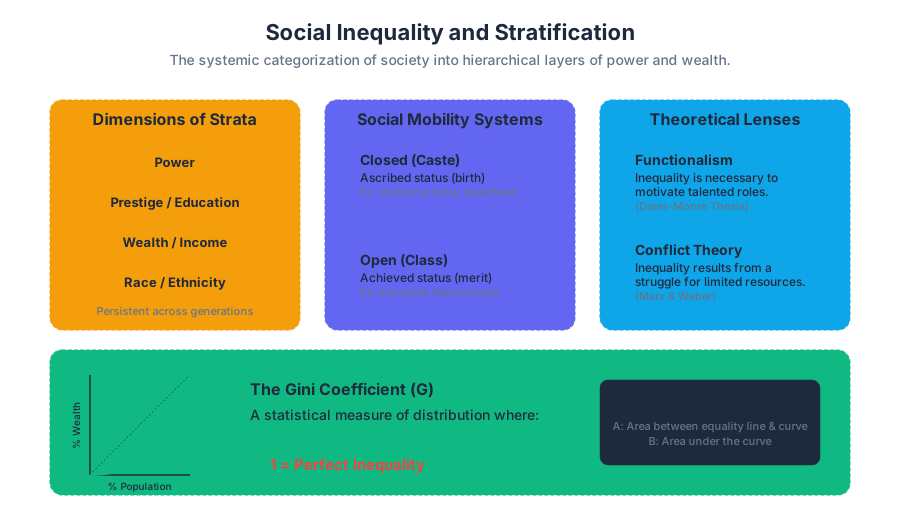
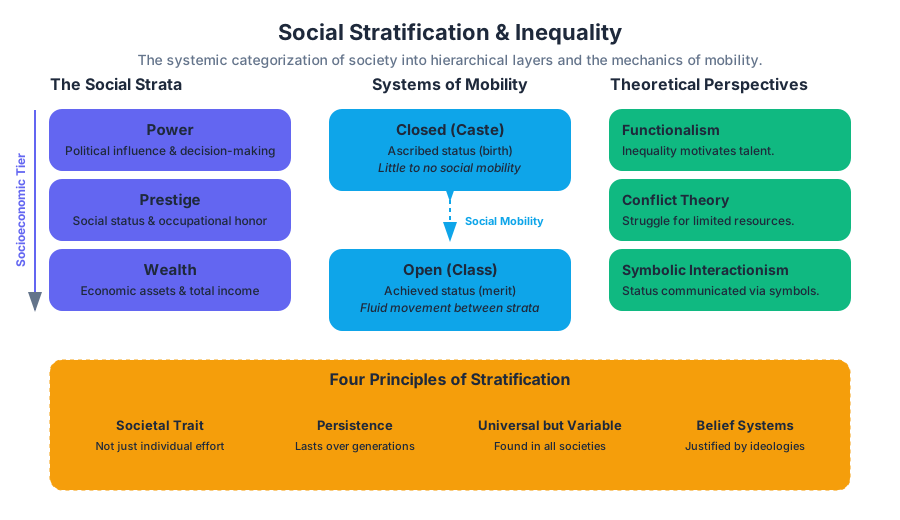
Social stratification refers to a society’s categorization of its people into rankings of socioeconomic tiers based on factors like wealth, income, race, education, and power. In sociology, the term "stratification" is borrowed from the geological concept of rock layers (strata); just as the earth’s layers reveal a history of physical change, a society’s layers reveal a history of social development and systemic inequality.
The Mechanics of Social Stratification
Stratification is not merely a reflection of individual differences but is a social system that confers unequal access to resources. This system is characterized by four key principles:
- Societal Trait: It is a characteristic of society, not just a reflection of individual talent or effort.
- Persistence: It persists over generations through social reproduction.
- Universal but Variable: While found in all societies, the criteria for ranking vary.
- Belief Systems: It is supported by ideologies that justify why some people have more than others.
Systems of Stratification: Closed vs. Open
Societies vary in their level of social mobility—the ability of individuals to move between different strata.
| System Type | Mobility Level | Basis of Status | Example |
|---|---|---|---|
| Closed (Caste) | Extremely Low | Ascribed status (birth) | Historical Indian Caste System, Apartheid |
| Open (Class) | Moderate to High | Achieved status (effort/merit) | Modern Industrial Democracies |
| Meritocracy | Theoretical Maximum | Purely personal effort/merit | Idealized (non-existent in pure form) |
Measuring Inequality: The Gini Coefficient
To quantify stratification, sociologists and economists use the Gini Coefficient, a statistical measure of distribution. It ranges from 0 (perfect equality) to 1 (perfect inequality).
Definition: The Gini Coefficient ($G$) is derived from the Lorenz Curve, which plots the cumulative percentages of total income received against the cumulative number of recipients, starting with the poorest individual or household.
import numpy as np

def calculate_gini(array):
    """
    Calculate the Gini coefficient of a numpy array (wealth/income distribution).
    Implementation based on the mean absolute difference.
    """
    # Ensure the array is non-negative and non-zero
    if np.amin(array) < 0:
        array -= np.amin(array)
    array += 0.0000001

    array = np.sort(array) # Values must be sorted
    index = np.arange(1, array.shape[0] + 1)
    n = array.shape[0]

    # Gini formula: (2 * sum(i * y_i) / (n * sum(y_i))) - (n + 1) / n
    return ((2 * np.dot(index, array)) / (n * np.sum(array))) - (n + 1) / n

# Example: A highly stratified population
wealth_distribution = np.array([100, 200, 500, 1000, 50000])
gini_score = calculate_gini(wealth_distribution)
print(f"Gini Coefficient: {gini_score:.4f}")
Theoretical Perspectives on Stratification
Sociologists use different lenses to understand why stratification exists and how it functions.
1. Functionalism (Davis-Moore Thesis)
Functionalists argue that stratification is a social necessity. Certain roles (e.g., brain surgeons) require more training and are more important for society than others (e.g., cashiers). Therefore, unequal rewards are required to motivate the most talented individuals to fill the most difficult positions.
2. Conflict Theory (Marxist and Weberian)
Conflict theorists view stratification as a result of a struggle for limited resources.
- Karl Marx focused on the relationship to the means of production (Bourgeoisie vs. Proletariat).
- Max Weber expanded this to a three-component theory: Class (economic), Status (prestige), and Power (political influence).
3. Symbolic Interactionism
This micro-level perspective examines how stratification affects people's daily interactions and how social standing is communicated through conspicuous consumption—the purchase and use of certain products to make a social statement about status.
Prejudice and Discrimination
While stratification describes the structure of inequality, prejudice and discrimination describe the mechanisms of exclusion.
Prejudice: Biased thoughts, feelings, or attitudes held about a group that are not based on actual experience. Discrimination: Prejudiced action against a group of people.
Merton’s Typology of Prejudice and Discrimination
Robert Merton identified that prejudice and discrimination do not always occur together.
| Type | Prejudiced? | Discriminates? | Description |
|---|---|---|---|
| All-Weather Liberal | No | No | Believes in equality and practices it. |
| Fair-Weather Liberal | No | Yes | May discriminate due to social pressure (e.g., a landlord who isn't prejudiced but fears neighbors). |
| Timid Bigot | Yes | No | Holds prejudices but does not act on them due to legal or social sanctions. |
| Active Bigot | Yes | Yes | Openly holds prejudices and actively discriminates. |
Institutional vs. Individual Discrimination
- Individual Discrimination: One person treating another unfairly (e.g., a manager using a slur).
- Institutional Discrimination: Systematic bias embedded in the operation of society's institutions (e.g., "redlining" in real estate, biased standardized testing, or sentencing disparities in the legal system).
\text{Institutional Bias} = \sum_{i=1}^{n} (\text{Policy}_i \times \text{Disparate Impact}_i) - \text{Individual Intent}
Race and Ethnicity
Sociologists distinguish between race and ethnicity, viewing both as social constructs rather than biological imperatives.
- Race: A category of people who share certain inherited physical characteristics, such as skin color, facial features, and stature.
- Ethnicity: Shared culture, which may include heritage, language, religion, and more.
Racial Formation Theory
Proposed by Omi and Winant, Racial Formation is the sociohistorical process by which racial identities are created, lived out, transformed, and destroyed. It suggests that race is a "template" for social identity that is constantly being renegotiated through political struggle.
Minority Groups
In sociology, a minority group is defined not by numerical count, but by a lack of power. Louis Wirth defined a minority group as "any group of people who, because of their physical or cultural characteristics, are singled out from the others in the society in which they live for differential and unequal treatment."
Gender Roles and Stratification
Gender stratification refers to the unequal distribution of wealth, power, and privilege between men and women.
The Social Construction of Gender
Sociologists distinguish between sex (biological characteristics) and gender (socially learned behaviors and expectations).
- Gender Roles: Society’s concept of how men and women are expected to look and how they should behave.
- The Second Shift: Arlie Hochschild's term for the unpaid housework and childcare often expected of women after they return home from their paid jobs.
Economic Disparities
The "Gender Wage Gap" is a persistent metric of stratification. Even when controlling for education and experience, women often earn less than men.
-- Analyzing the Gender Wage Gap in a hypothetical HR database
SELECT
    job_title,
    gender,
    COUNT(*) as employee_count,
    ROUND(AVG(annual_salary), 2) as avg_salary,
    ROUND(AVG(years_experience), 1) as avg_exp
FROM
    corporate_payroll
WHERE
    employment_status = 'Full-Time'
GROUP BY
    job_title, gender
HAVING
    COUNT(*) > 5
ORDER BY
    job_title, avg_salary DESC;
Intersectionality: The Matrix of Domination
Coined by Kimberlé Crenshaw and expanded by Patricia Hill Collins, Intersectionality is the study of how various social categories (race, class, gender, sexuality, ability) intersect at the level of individual experience to create unique modes of discrimination and privilege.
Key Insight: One cannot understand the experience of a "Black woman" by simply adding the experience of a "Black person" to the experience of a "woman." The intersection creates a distinct social location with unique systemic obstacles.
The Multi-Dimensional Model
Intersectionality suggests that we occupy multiple statuses simultaneously. An individual might be privileged in one dimension (e.g., being White) but marginalized in another (e.g., being working class or LGBTQ+).
Global Stratification and Inequality
Stratification also exists on a global scale, where nations are ranked by their economic and political power.
World Systems Theory
Immanuel Wallerstein’s theory proposes that the global economy is a complex system where some nations benefit while others are exploited.
| Category | Role | Characteristics | Examples |
|---|---|---|---|
| Core Nations | Dominant | Highly industrialized, technological, hold the most global wealth. | USA, Germany, Japan |
| Semi-Peripheral | Middle-man | In-between nations; expanding industrial base, provide labor/raw materials to core. | Brazil, India, Mexico |
| Peripheral Nations | Exploited | Very little industrialization; often depend on core nations for jobs and aid. | Afghanistan, Ethiopia |
Dependency Theory vs. Modernization Theory
- Modernization Theory: Suggests that low-income countries can improve their global economic standing by industrialization and adopting "modern" cultural values.
- Dependency Theory: Argues that global inequality is caused by core nations exploiting peripheral nations, creating a cycle of dependence that prevents development.
Common Pitfalls in Analyzing Inequality
- The Individualistic Fallacy: Assuming that because one person "made it" out of poverty, the system is fair. This ignores the statistical reality of social reproduction.
- Conflating Race and Class: While they are correlated, they are distinct. A wealthy person of color still experiences racial prejudice, and a poor White person still benefits from racial privilege.
- Biological Essentialism: The mistaken belief that social differences (like the wage gap or crime rates) are caused by innate biological differences rather than social structures.
# Simulation Parameter Example: Schelling's Model of Segregation
# This model shows how even slight individual preferences for
# "neighbors like me" can lead to total systemic segregation.

simulation_params:
  grid_size: [50, 50]
  population_density: 0.8
  groups:
    - name: "Group_A"
      ratio: 0.5
      color: "#3498db"
    - name: "Group_B"
      ratio: 0.5
      color: "#e74c3c"
  threshold_of_unhappiness: 0.33 # If < 33% of neighbors are "like me", I move.
  max_iterations: 1000
Social Institutions
Key concepts: Family · Religion · Education · Government and Politics · Economy
An examination of the major systems that organize social life, including family, religion, education, and government.
Social Institutions
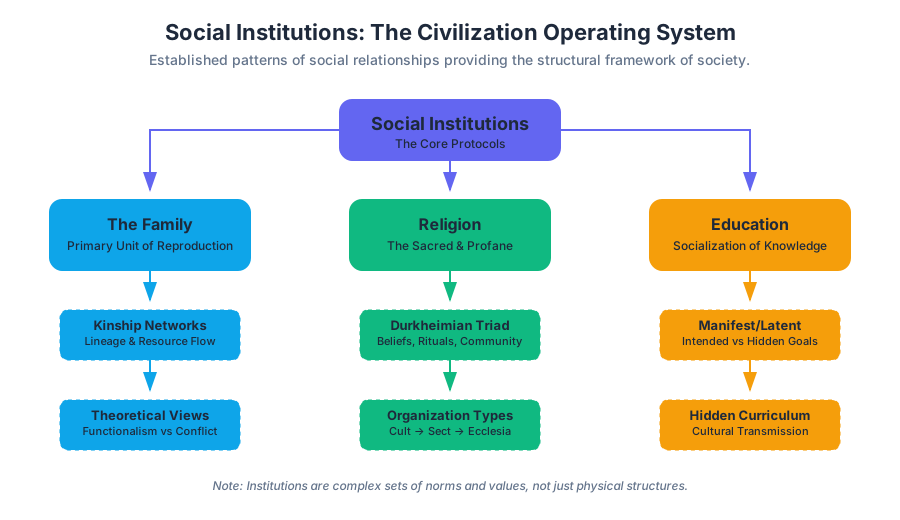
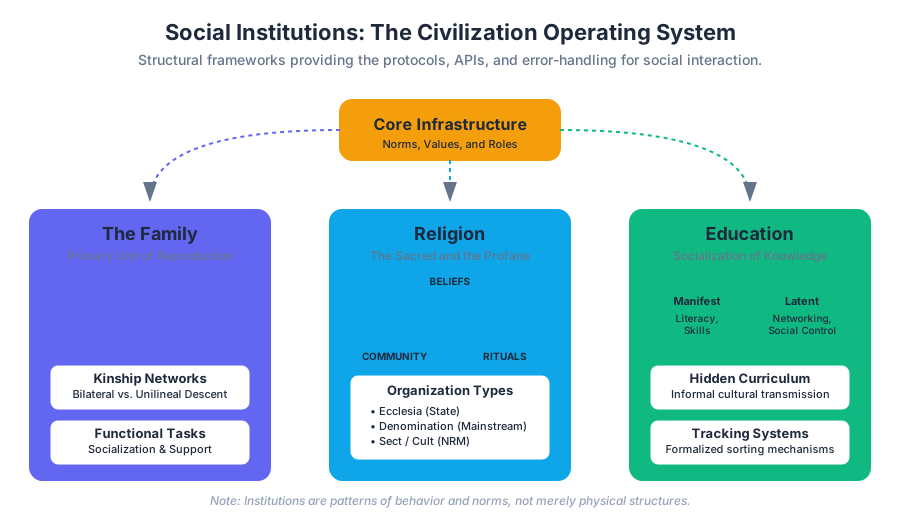
Social institutions are the "operating system" of a civilization. They represent established, predictable, and enduring patterns of social relationships that organize social life and meet basic social needs. Rather than being physical buildings, institutions are complex integrated sets of norms, roles, values, and behaviors that function as the structural framework of a society. From a systems-engineering perspective, social institutions provide the protocols for interaction, the APIs for resource distribution, and the error-handling mechanisms for social deviance.
The Family: The Primary Unit of Social Reproduction
The Family is often cited as the most fundamental social institution. Sociologically, it is defined as a socially recognized group (usually joined by blood, marriage, cohabitation, or adoption) that forms an emotional connection and serves as an economic unit of society.
Kinship and Lineage Systems
Kinship is the web of social relationships that form an important part of the lives of all humans in all societies. It is not merely biological; it is a cultural construct.
| Kinship Pattern | Description | Inheritance/Descent |
|---|---|---|
| Patrilineal | Follows the father's line only. | Property and name pass to sons. |
| Matrilineal | Follows the mother's line only. | Common in Native American groups like the Crow and Cherokee. |
| Ambilineal | Follows either the father's or mother's side exclusively. | Choice depends on prestige or resource access. |
| Bilateral | Follows both the father's and mother's sides. | Standard in most modernized, industrial societies. |
Theoretical Perspectives on Family
- Functionalism: The family performs vital tasks, including socializing the young and providing emotional and financial support.
- Conflict Theory: The family is a microcosm of the power struggles in the larger society, often reinforcing gender inequality through the "second shift" (unpaid domestic labor).
- Symbolic Interactionism: Focuses on how family members negotiate their roles and the subjective meanings they attach to family life.
Implementation: Modeling Kinship Networks
In computational sociology, we can represent kinship as a directed acyclic graph (DAG) to analyze the flow of resources or genetic traits.
import networkx as nx

class KinshipGraph:
    """
    A low-level implementation of a kinship tracking system
    to analyze lineage and inheritance patterns.
    """
    def __init__(self):
        self.G = nx.DiGraph()

    def add_relation(self, parent, child, relation_type='biological'):
        self.G.add_edge(parent, child, relation=relation_type)

    def get_descendants(self, ancestor):
        # Returns all nodes reachable from the ancestor
        return list(nx.descendants(self.G, ancestor))

    def calculate_coefficient_of_relationship(self, person_a, person_b):
        # Simplified Wright's Path Coefficient logic
        paths = list(nx.all_simple_paths(self.G.to_undirected(), source=person_a, target=person_b))
        if not paths: return 0
        # Logic for path-based relatedness (2^-n)
        return sum(0.5**len(path) for path in paths)

# Example: Constructing a small patrilineal lineage
kg = KinshipGraph()
kg.add_relation("John_Sr", "John_Jr")
kg.add_relation("John_Jr", "John_III")
print(f"Descendants of John_Sr: {kg.get_descendants('John_Sr')}")
Religion: The Sacred and the Profane
Religion is a unified system of beliefs and practices relative to sacred things—things set apart and forbidden. For sociologists, the "truth" of a religion is less important than its social impact: how it binds people together, provides meaning, and exerts social control.
The Durkheimian Framework
Émile Durkheim identified three essential elements of religion:
- Beliefs: Ideas that some things are sacred.
- Practices (Rituals): Actions centered on the things considered sacred.
- A Moral Community (Church): A group resulting from shared beliefs and practices.
Types of Religious Organizations
Sociologists categorize religious groups based on their integration into society:
| Type | Characteristics | Example |
|---|---|---|
| Ecclesia | A religious group to which most members of a society belong; often the state religion. | Islam in Saudi Arabia; Lutheranism in Sweden (historically). |
| Denomination | A large, mainstream religious organization, but does not claim to be official or state-sponsored. | Baptist, Catholic, Methodist. |
| Sect | A relatively small group that has broken away from an established denomination to renew what it views as the original purity of the faith. | The Amish, Jehovah's Witnesses. |
| Cult (NRM) | New Religious Movements; small, secretive organizations that represent either a new religion or a major innovation of an existing one. | Scientology, Heaven's Gate. |
Education: The Socialization of Knowledge
Education is the social institution through which a society's children are taught basic academic knowledge, learning skills, and cultural norms. It serves both manifest functions (intended goals like literacy) and latent functions (unintended consequences like "babysitting" or social networking).
The Hidden Curriculum
Beyond the syllabus, schools transmit the Hidden Curriculum: the nonacademic knowledge that students learn through informal learning and cultural transmission. This includes obedience to authority, competition, and the internalizing of social hierarchies.
Educational Inequality and Tracking
Tracking is a formalized sorting system that places students on "tracks" (advanced, low achievers) that perpetuate inequalities. Conflict theorists argue that this reinforces the status quo by preparing students for different levels of the labor market based on socioeconomic status rather than innate ability.
Formalizing Educational Outcomes
We can model the probability of educational attainment using a logistic regression framework, where $P(Y=1)$ represents the probability of graduating college.
\text{logit}(p) = \ln\left(\frac{p}{1-p}\right) = \beta_0 + \beta_1(\text{SES}) + \beta_2(\text{Parental\_Edu}) + \beta_3(\text{School\_Funding}) + \epsilon
The Pierre Bourdieu Insight: Education is the primary mechanism for the transmission of Cultural Capital—the social assets of a person (education, intellect, style of speech) that promote social mobility in a stratified society.
Government and Politics: Power and Authority
Politics is the social institution through which power is acquired and exercised by some people and groups. Government is the formal organization that has the legal and political authority to regulate the relationships among members of a society and between the society and those outside its borders.
Weber’s Tripartite Classification of Authority
Max Weber distinguished between three types of legitimate authority:
- Traditional Authority: Power legitimized by respect for long-standing cultural patterns (e.g., Monarchy).
- Charismatic Authority: Power legitimized by extraordinary personal abilities that inspire devotion and obedience (e.g., Joan of Arc, MLK Jr.).
- Rational-Legal Authority: Power legitimized by legally enacted rules and regulations (e.g., Modern Bureaucracy, The Presidency).
Power Models: Pluralism vs. Elite Theory
- Pluralist Model: Power is dispersed among many competing interest groups. No single group dominates.
- Elite Model (C. Wright Mills): Power is concentrated in the hands of a small group of elites (the "Power Elite") consisting of top military, corporate, and political leaders.
Real-World Usage: Querying Political Data
To analyze institutional stability, researchers often use APIs like the World Bank or the V-Dem (Varieties of Democracy) dataset.
# Example: Fetching the 'Government Effectiveness' index for a specific country
# using a hypothetical REST API for institutional research.

curl -X GET "https://api.worldbank.org/v2/country/USA/indicator/GE.EST?format=json" \
     -H "Accept: application/json" \
     | jq '.[1][0] | {country: .country.value, year: .date, effectiveness_score: .value}'
The Economy: Provisioning and Distribution
The Economy is the social institution that ensures the maintenance of society through the production, distribution, and consumption of goods and services.
Sectors of the Economy
Modern economies are divided into four distinct sectors:
- Primary Sector: Extraction of raw materials (farming, mining).
- Secondary Sector: Transformation of raw materials into finished goods (manufacturing).
- Tertiary Sector: Provision of services (healthcare, education, retail).
- Quaternary Sector: Knowledge-based services (IT, research, management).
Comparative Economic Systems
| Feature | Capitalism | Socialism |
|---|---|---|
| Ownership | Private ownership of means of production. | Public/State ownership of means of production. |
| Goal | Profit maximization. | Meeting collective social needs. |
| Market | Market competition determines price/supply. | Central planning or regulated distribution. |
| Critique | Leads to inequality and commodification. | Can lead to inefficiency and lack of incentive. |
Convergence Theory
Convergence Theory suggests that as a nation's economy develops, its social organization becomes more like that of other industrialized nations. For example, capitalist nations may adopt social safety nets (socialist traits), while socialist nations may adopt market incentives (capitalist traits).
Institutional Interdependence and "Institutional Lag"
Institutions do not exist in isolation. A change in the Economy (e.g., the shift to remote work) forces changes in the Family (home-life balance) and Education (online learning).
Institutional Lag occurs when one social institution changes more rapidly than others, creating a period of maladjustment. For example, the legal system (Government) often struggles to keep pace with technological advancements in the Economy (e.g., AI copyright laws or crypto-currency regulation).
Common Pitfalls in Institutional Analysis
- Biological Determinism: Assuming family structures are purely biological rather than socially constructed.
- The "Meritocracy Myth": Overlooking how the institution of Education can reinforce existing class structures while appearing neutral.
- Secularization Thesis Over-simplification: Assuming religion will inevitably disappear in modern societies; instead, it often transforms (e.g., the rise of "spirituality" or "civil religion").
Summary of Key Perspectives
Functionalist View: Institutions are the organs of the social body, each performing a specific function to maintain homeostasis. Conflict View: Institutions are tools used by the dominant class to maintain power and manage the "underclass." Interactionist View: Institutions are the sum of our daily interactions and the meanings we assign to them; they are "socially constructed" and can be "deconstructed."
By understanding these five pillars—Family, Religion, Education, Government, and Economy—we gain a blueprint of the social architecture that defines human experience. Whether we are analyzing the code of a smart contract or the laws of a nation-state, we are engaging with the fundamental logic of social institutions.
Social Change and Modern Society
Key concepts: Urbanization · Social Movements · Demography · Technology and Media
Explores the dynamics of population, the environment, and social movements in the modern world.
Social Change and Modern Society
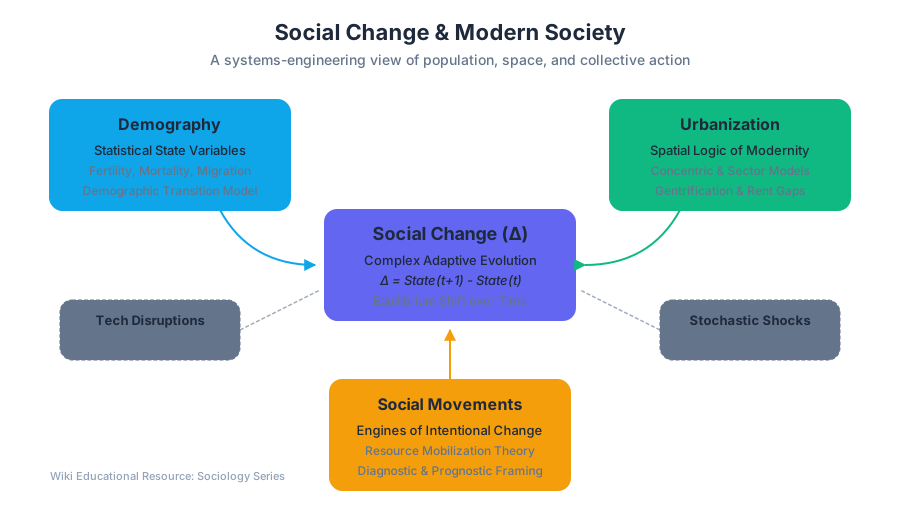
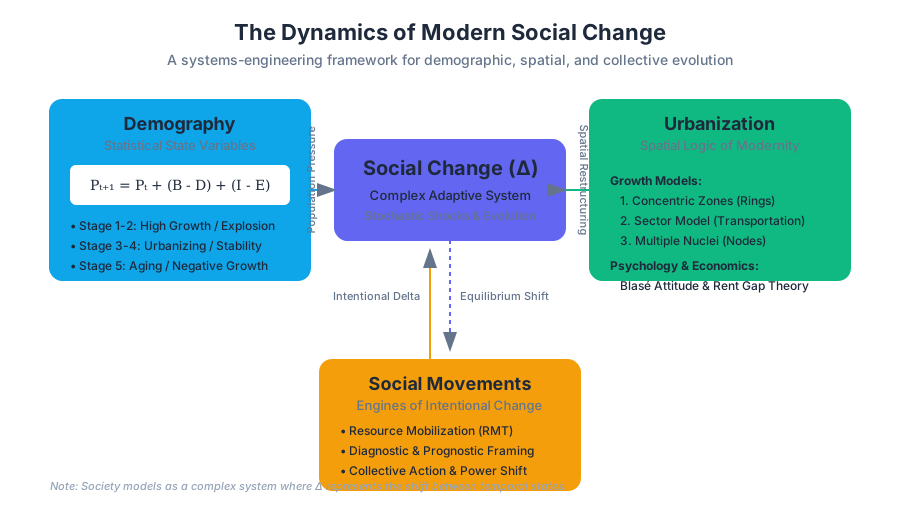
Social change is the transformation of culture, behavior, social institutions, and social structure over time. In a systems-engineering view, society is a complex, adaptive system where "change" is the delta ($\Delta$) between two temporal states of equilibrium. This evolution is rarely linear; it is driven by stochastic shocks (natural disasters, pandemics), technological disruptions, and intentional collective action.
Demography: The Statistical State of the Population
Demography is the formal, statistical study of human populations. It provides the "state variables" for any sociological analysis, focusing on three primary components: fertility, mortality, and migration. Understanding these variables allows sociologists to predict infrastructure needs, economic shifts, and potential social unrest.
The Demographic Transition Model (DTM)
The DTM describes the historical shift from high birth and death rates to low birth and death rates as a country develops from a pre-industrial to an industrialized economic system.
| Stage | Description | Birth Rate | Death Rate | Population Growth |
|---|---|---|---|---|
| Stage 1 | Pre-industrial; high infectious disease | High | High | Stable/Low |
| Stage 2 | Developing; improved food/water | High | Falling Rapidly | Very High (Explosion) |
| Stage 3 | Urbanizing; increased contraception | Falling | Falling Slowly | Slowing Down |
| Stage 4 | Post-industrial; stable economy | Low | Low | Stable/Low |
| Stage 5 | Declining; aging population | Very Low | Low | Negative Growth |
Population Dynamics and Projections
To model population change, demographers use the Basic Demographic Equation: $$P_{t+1} = P_t + (B - D) + (I - E)$$ Where $P$ is population, $B$ is births, $D$ is deaths, $I$ is immigration, and $E$ is emigration.
For a more granular analysis of age-structure, sociologists utilize the Leslie Matrix, a discrete-time, age-structured model of population growth.
import numpy as np

def simulate_population_growth(initial_pop, fertility_rates, survival_rates, steps):
    """
    Implements a Leslie Matrix model to project population age-structure.
    initial_pop: 1D array of population counts per age group
    fertility_rates: 1D array of expected offspring per age group
    survival_rates: 1D array of probability of surviving to the next age group
    """
    n = len(initial_pop)
    # Construct the Leslie Matrix
    L = np.zeros((n, n))

    # Top row is fertility
    L[0, :] = fertility_rates

    # Sub-diagonal is survival
    for i in range(n - 1):
        L[i + 1, i] = survival_rates[i]

    # Projection loop
    history = [initial_pop]
    current_pop = initial_pop
    for _ in range(steps):
        current_pop = np.dot(L, current_pop)
        history.append(current_pop)

    return np.array(history)

# Example: 3 age groups (Young, Middle, Old)
pop_0 = np.array([100, 50, 20])
f = [0, 2.1, 0] # Only middle age reproduces
s = [0.9, 0.8]  # 90% survive to middle, 80% survive to old

projection = simulate_population_growth(pop_0, f, s, 10)
print(f"Projected Population at t=10: {projection[-1].sum():.2f}")
Urbanization: The Spatial Logic of Modernity
Urbanization is the study of the social, political, and economic relationships in cities. It is not merely the movement of people from rural to urban areas, but the fundamental restructuring of human interaction.
Models of Urban Growth
Sociologists from the Chicago School developed several models to explain how cities expand and how social classes are distributed spatially.
| Model | Proponent | Core Logic |
|---|---|---|
| Concentric Zone Model | Ernest Burgess | The city grows outward from a central business district (CBD) in a series of rings. |
| Sector Model | Homer Hoyt | Growth occurs in wedge-shaped sectors along transportation corridors (rail/highways). |
| Multiple Nuclei Model | Harris & Ullman | Cities lack a single center; they develop around several independent nodes (universels, airports). |
The "Blasé Attitude" and Urban Psychology
Georg Simmel argued that the sensory overload of the city creates a blasé attitude—a psychological defense mechanism where individuals become indifferent to their surroundings to preserve their mental energy. This leads to the paradox of the city: being surrounded by millions yet experiencing profound alienation.
Gentrification and Displacement
Gentrification occurs when middle- and upper-class residents move into historically less affluent urban areas, resulting in increased property values and the displacement of original inhabitants. This is often modeled as a "Rent Gap" theory, where the gap between current ground rent and potential land value becomes wide enough to attract speculative capital.
-- Analyzing Gentrification Risk via SQL
-- Identifying census tracts with rising property values but low median income
SELECT
    tract_id,
    (avg_property_value_2023 - avg_property_value_2018) / avg_property_value_2018 AS value_growth,
    median_household_income,
    percent_renters
FROM
    urban_census_data
WHERE
    median_household_income < (SELECT AVG(median_household_income) FROM urban_census_data)
    AND percent_renters > 0.60
ORDER BY
    value_growth DESC
LIMIT 50;
Social Movements: The Engines of Change
A Social Movement is a purposeful, organized group striving toward a common goal. These movements are the primary mechanism through which marginalized groups exert power against established institutions.
Theoretical Frameworks
- Resource Mobilization Theory (RMT): Argues that movements succeed based on their ability to acquire and deploy resources (money, labor, media access) rather than the intensity of their grievances.
- Diagnostic, Prognostic, and Motivation Framing: Movements must "frame" their cause to align with the values of potential recruits.
- Diagnostic: Identifying the problem.
- Prognostic: Proposing a solution.
- Motivational: A call to action.
Stages of Social Movements
Herbert Blumer and Armand Mauss identified a four-stage lifecycle for movements:
- Emergence: The initial perception that something is wrong.
- Coalescence: "Joining forces" and organizing; defining strategy.
- Bureaucratization: The movement becomes a formal organization (NGOs, political parties).
- Decline: Can result from success, failure, co-optation, or repression.
The Threshold Model of Collective Behavior
Mark Granovetter proposed that an individual's decision to join a riot or movement depends on a threshold: the number of other people who must join before they feel safe or compelled to do so.
Granovetter's Threshold Equation: Let $x_i$ be the threshold for individual $i$. An individual joins the movement at time $t+1$ if the proportion of the population already participating at time $t$ ($P_t$) satisfies: $$P_t \ge x_i$$ This explains why movements can remain dormant for years and then "explode" suddenly when a single person's threshold is met, triggering a cascade.
Technology and Media: The Digital Infrastructure
Technology is a primary driver of social change, acting as both a tool for liberation and a mechanism for control. In modern society, the distinction between "online" and "offline" has largely collapsed, leading to the concept of Cyber-Urbanism.
The Digital Divide
The Digital Divide refers to the uneven access to technology along lines of race, class, and geography. This is categorized into two levels:
- First-Level: Access to hardware and high-speed internet.
- Second-Level: The "knowledge gap"—the ability to use technology effectively for economic or social gain.
Media Consolidation and the Panopticon
As media outlets consolidate into a few mega-corporations (e.g., Disney, Warner Bros. Discovery), the diversity of viewpoints decreases. Simultaneously, the rise of Surveillance Capitalism (as defined by Shoshana Zuboff) uses technology to monitor behavior for the purpose of predicting and controlling future actions.
Decentralization as Social Resistance
In response to centralized control, social movements and tech-activists (hacktivists) have moved toward decentralized protocols. This is a technical solution to a sociological problem (censorship and de-platforming).
# Example: Configuration for a Decentralized Social Media Node (ActivityPub/Mastodon)
# This represents a shift from centralized 'Town Squares' to federated 'Communities'
version: '3'
services:
  db:
    image: postgres:14-alpine
    healthcheck:
      test: ["CMD-SHELL", "pg_isready -U postgres"]
  redis:
    image: redis:7-alpine
  web:
    image: tootsuite/mastodon
    env_file: .env.production
    command: bundle exec rails s -p 3000
    ports:
      - "3000:3000"
    depends_on:
      - db
      - redis
    volumes:
      - ./public/system:/mastodon/public/system
Environmental Sociology: The Metabolic Rift
Environmental sociology examines the interaction between human societies and the physical environment. A key concept here is the Metabolic Rift, a term derived from Karl Marx, describing the rupture in the ecological interaction between humanity and the rest of nature.
The Tragedy of the Commons
Garrett Hardin’s "Tragedy of the Commons" suggests that individuals, acting in their own self-interest, will deplete shared resources (air, water, forests), even if it is not in anyone's long-term interest.
| Concept | Definition | Sociological Impact |
|---|---|---|
| Environmental Racism | Burdening minority neighborhoods with toxic waste or pollution. | Leads to health disparities and "sacrifice zones." |
| Sustainable Development | Growth that meets present needs without compromising the future. | Requires a shift from "Treadmill of Production" logic. |
| Climate Refugees | People forced to migrate due to environmental degradation. | Triggers Stage 5 demographic shifts and urban strain. |
Synthesis: The Feedback Loops of Change
Social change is rarely the result of a single factor. Instead, it is a series of feedback loops:
- Technological Shift: The invention of the smartphone.
- Demographic Shift: Increased connectivity allows rural youth to see urban opportunities, accelerating Urbanization.
- Social Movement: Urban density and digital tools allow for the rapid Coalescence of movements (e.g., the Arab Spring).
- Institutional Response: Governments implement new surveillance tech, leading to a new state of equilibrium or further unrest.
Glossary of Key Terms
- Malthusian Theory: The belief that population growth will inevitably outpace food production, leading to catastrophe.
- Cornucopian Theory: The belief that human ingenuity will always develop new technologies to overcome resource constraints.
- Mechanical Solidarity: Social cohesion based on shared traditions and common beliefs (pre-industrial).
- Organic Solidarity: Social cohesion based on mutual interdependence in a complex division of labor (industrial).
- New Social Movement (NSM) Theory: A perspective that focuses on identity, culture, and quality of life rather than purely economic concerns.
Source Materials
Study Introduction Sociology 3e with AI — Free on Lykke
Sign up for free to generate personalized flashcards, quizzes, and study guides from this course. Chat with an AI tutor that knows the material.
Get Started FreeView this course wiki on Lykke · Browse all public course wikis