From the free course Introduction Sociology 3e on Lykke
Social Institutions
Key concepts: Family · Religion · Education · Government and Politics · Economy
An examination of the major systems that organize social life, including family, religion, education, and government.
Social Institutions
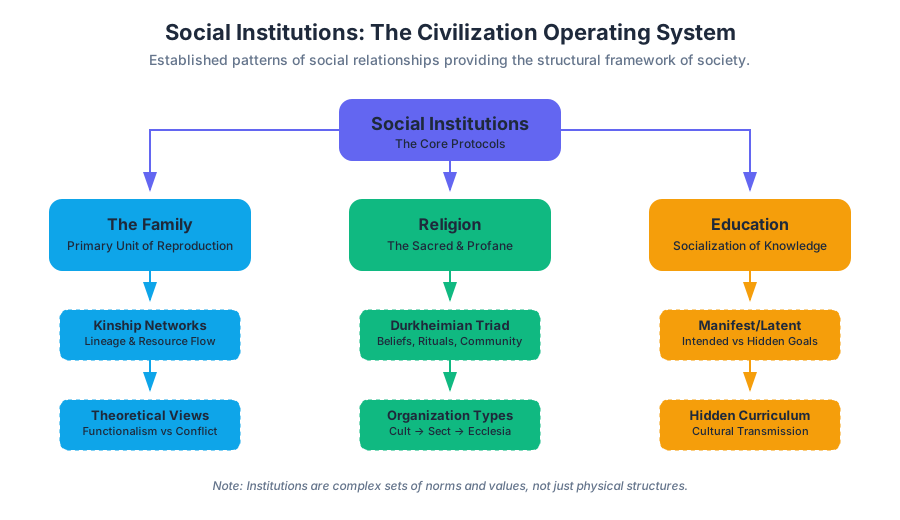
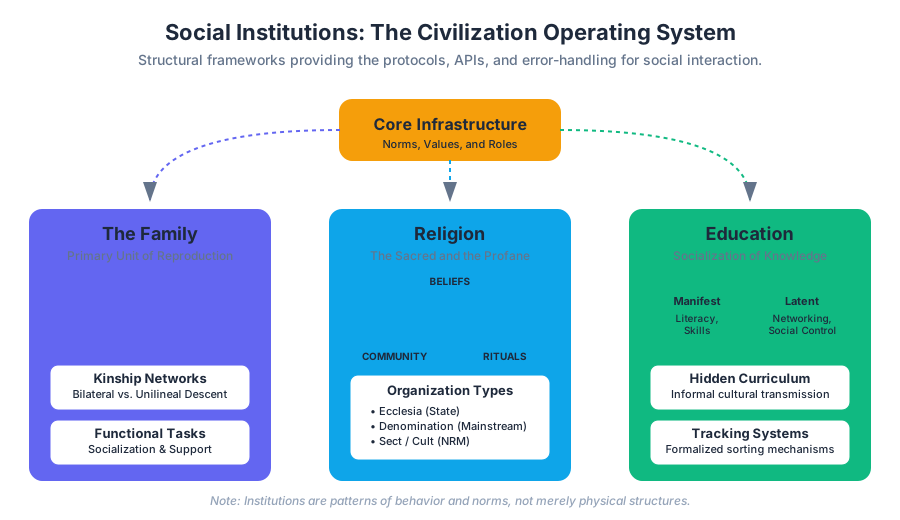
Social institutions are the "operating system" of a civilization. They represent established, predictable, and enduring patterns of social relationships that organize social life and meet basic social needs. Rather than being physical buildings, institutions are complex integrated sets of norms, roles, values, and behaviors that function as the structural framework of a society. From a systems-engineering perspective, social institutions provide the protocols for interaction, the APIs for resource distribution, and the error-handling mechanisms for social deviance.
The Family: The Primary Unit of Social Reproduction
The Family is often cited as the most fundamental social institution. Sociologically, it is defined as a socially recognized group (usually joined by blood, marriage, cohabitation, or adoption) that forms an emotional connection and serves as an economic unit of society.
Kinship and Lineage Systems
Kinship is the web of social relationships that form an important part of the lives of all humans in all societies. It is not merely biological; it is a cultural construct.
| Kinship Pattern | Description | Inheritance/Descent |
|---|---|---|
| Patrilineal | Follows the father's line only. | Property and name pass to sons. |
| Matrilineal | Follows the mother's line only. | Common in Native American groups like the Crow and Cherokee. |
| Ambilineal | Follows either the father's or mother's side exclusively. | Choice depends on prestige or resource access. |
| Bilateral | Follows both the father's and mother's sides. | Standard in most modernized, industrial societies. |
Theoretical Perspectives on Family
- Functionalism: The family performs vital tasks, including socializing the young and providing emotional and financial support.
- Conflict Theory: The family is a microcosm of the power struggles in the larger society, often reinforcing gender inequality through the "second shift" (unpaid domestic labor).
- Symbolic Interactionism: Focuses on how family members negotiate their roles and the subjective meanings they attach to family life.
Religion: The Sacred and the Profane
Religion is a unified system of beliefs and practices relative to sacred things—things set apart and forbidden. For sociologists, the "truth" of a religion is less important than its social impact: how it binds people together, provides meaning, and exerts social control.
The Durkheimian Framework
Émile Durkheim identified three essential elements of religion:
- Beliefs: Ideas that some things are sacred.
- Practices (Rituals): Actions centered on the things considered sacred.
- A Moral Community (Church): A group resulting from shared beliefs and practices.
Types of Religious Organizations
Sociologists categorize religious groups based on their integration into society:
| Type | Characteristics | Example |
|---|---|---|
| Ecclesia | A religious group to which most members of a society belong; often the state religion. | Islam in Saudi Arabia; Lutheranism in Sweden (historically). |
| Denomination | A large, mainstream religious organization, but does not claim to be official or state-sponsored. | Baptist, Catholic, Methodist. |
| Sect | A relatively small group that has broken away from an established denomination to renew what it views as the original purity of the faith. | The Amish, Jehovah's Witnesses. |
| Cult (NRM) | New Religious Movements; small, secretive organizations that represent either a new religion or a major innovation of an existing one. | Scientology, Heaven's Gate. |
Education: The Socialization of Knowledge
Education is the social institution through which a society's children are taught basic academic knowledge, learning skills, and cultural norms. It serves both manifest functions (intended goals like literacy) and latent functions (unintended consequences like "babysitting" or social networking).
The Hidden Curriculum
Beyond the syllabus, schools transmit the Hidden Curriculum: the nonacademic knowledge that students learn through informal learning and cultural transmission. This includes obedience to authority, competition, and the internalizing of social hierarchies.
Educational Inequality and Tracking
Tracking is a formalized sorting system that places students on "tracks" (advanced, low achievers) that perpetuate inequalities. Conflict theorists argue that this reinforces the status quo by preparing students for different levels of the labor market based on socioeconomic status rather than innate ability.
Formalizing Educational Outcomes
We can model the probability of educational attainment using a logistic regression framework, where $P(Y=1)$ represents the probability of graduating college.
\text{logit}(p) = \ln\left(\frac{p}{1-p}\right) = \beta_0 + \beta_1(\text{SES}) + \beta_2(\text{Parental\_Edu}) + \beta_3(\text{School\_Funding}) + \epsilon
The Pierre Bourdieu Insight: Education is the primary mechanism for the transmission of Cultural Capital—the social assets of a person (education, intellect, style of speech) that promote social mobility in a stratified society.
Government and Politics: Power and Authority
Politics is the social institution through which power is acquired and exercised by some people and groups. Government is the formal organization that has the legal and political authority to regulate the relationships among members of a society and between the society and those outside its borders.
Weber’s Tripartite Classification of Authority
Max Weber distinguished between three types of legitimate authority:
- Traditional Authority: Power legitimized by respect for long-standing cultural patterns (e.g., Monarchy).
- Charismatic Authority: Power legitimized by extraordinary personal abilities that inspire devotion and obedience (e.g., Joan of Arc, MLK Jr.).
- Rational-Legal Authority: Power legitimized by legally enacted rules and regulations (e.g., Modern Bureaucracy, The Presidency).
Power Models: Pluralism vs. Elite Theory
- Pluralist Model: Power is dispersed among many competing interest groups. No single group dominates.
- Elite Model (C. Wright Mills): Power is concentrated in the hands of a small group of elites (the "Power Elite") consisting of top military, corporate, and political leaders.
The Economy: Provisioning and Distribution
The Economy is the social institution that ensures the maintenance of society through the production, distribution, and consumption of goods and services.
Sectors of the Economy
Modern economies are divided into four distinct sectors:
- Primary Sector: Extraction of raw materials (farming, mining).
- Secondary Sector: Transformation of raw materials into finished goods (manufacturing).
- Tertiary Sector: Provision of services (healthcare, education, retail).
- Quaternary Sector: Knowledge-based services (IT, research, management).
Comparative Economic Systems
| Feature | Capitalism | Socialism |
|---|---|---|
| Ownership | Private ownership of means of production. | Public/State ownership of means of production. |
| Goal | Profit maximization. | Meeting collective social needs. |
| Market | Market competition determines price/supply. | Central planning or regulated distribution. |
| Critique | Leads to inequality and commodification. | Can lead to inefficiency and lack of incentive. |
Convergence Theory
Convergence Theory suggests that as a nation's economy develops, its social organization becomes more like that of other industrialized nations. For example, capitalist nations may adopt social safety nets (socialist traits), while socialist nations may adopt market incentives (capitalist traits).
Institutional Interdependence and "Institutional Lag"
Institutions do not exist in isolation. A change in the Economy (e.g., the shift to remote work) forces changes in the Family (home-life balance) and Education (online learning).
Institutional Lag occurs when one social institution changes more rapidly than others, creating a period of maladjustment. For example, the legal system (Government) often struggles to keep pace with technological advancements in the Economy (e.g., AI copyright laws or crypto-currency regulation).
Common Pitfalls in Institutional Analysis
- Biological Determinism: Assuming family structures are purely biological rather than socially constructed.
- The "Meritocracy Myth": Overlooking how the institution of Education can reinforce existing class structures while appearing neutral.
- Secularization Thesis Over-simplification: Assuming religion will inevitably disappear in modern societies; instead, it often transforms (e.g., the rise of "spirituality" or "civil religion").
Summary of Key Perspectives
Functionalist View: Institutions are the organs of the social body, each performing a specific function to maintain homeostasis. Conflict View: Institutions are tools used by the dominant class to maintain power and manage the "underclass." Interactionist View: Institutions are the sum of our daily interactions and the meanings we assign to them; they are "socially constructed" and can be "deconstructed."
By understanding these five pillars—Family, Religion, Education, Government, and Economy—we gain a blueprint of the social architecture that defines human experience. Whether we are analyzing the code of a smart contract or the laws of a nation-state, we are engaging with the fundamental logic of social institutions.
Source Materials
Study Introduction Sociology 3e on Lykke
This course page is free to open: signed out, you can read its first two sections, and signing in, on any plan, opens the rest. The free Lykke Chrome extension syncs your own Canvas courses, so ChatGPT, Claude and Muse can answer from your classes and deadlines. It only reads Canvas.
Add the free extensionSign in to open every sectionAll sections of Introduction Sociology 3e · Browse more course pages