From the free course Introduction Sociology 3e on Lykke
Social Inequality and Stratification
Key concepts: Social Stratification · Discrimination · Prejudice · Race and Ethnicity · Gender Roles
A critical look at the causes and impacts of discrimination and social stratification based on class, race, and gender.
Social Inequality and Stratification
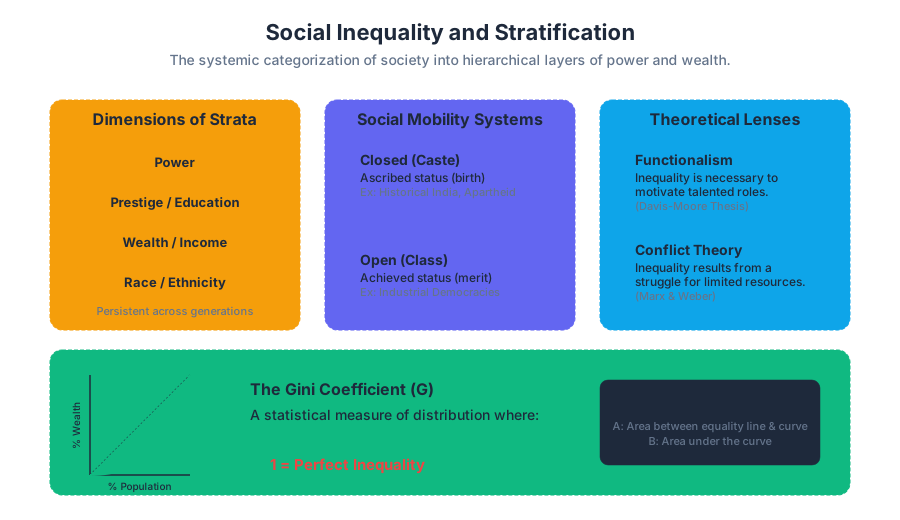
Social stratification refers to a society’s categorization of its people into rankings of socioeconomic tiers based on factors like wealth, income, race, education, and power. In sociology, the term "stratification" is borrowed from the geological concept of rock layers (strata); just as the earth’s layers reveal a history of physical change, a society’s layers reveal a history of social development and systemic inequality.
The Mechanics of Social Stratification
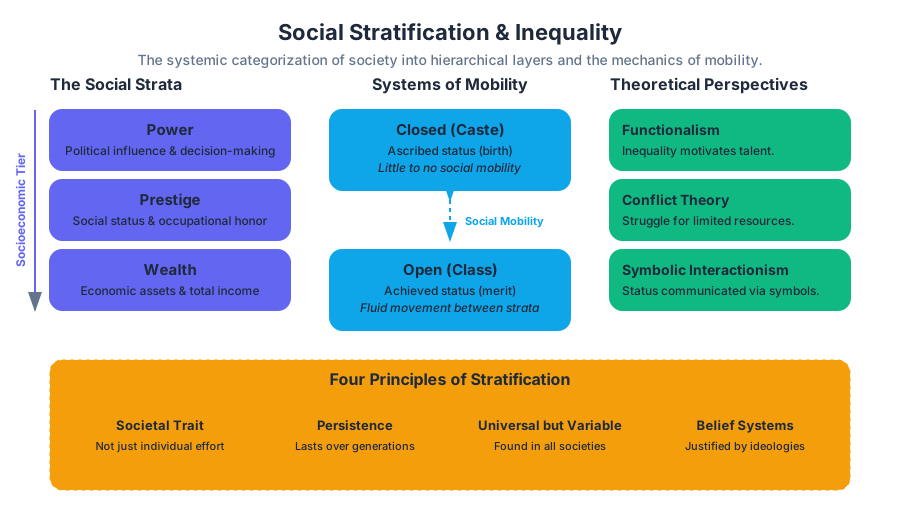
Stratification is not merely a reflection of individual differences but is a social system that confers unequal access to resources. This system is characterized by four key principles:
- Societal Trait: It is a characteristic of society, not just a reflection of individual talent or effort.
- Persistence: It persists over generations through social reproduction.
- Universal but Variable: While found in all societies, the criteria for ranking vary.
- Belief Systems: It is supported by ideologies that justify why some people have more than others.
Systems of Stratification: Closed vs. Open
Societies vary in their level of social mobility—the ability of individuals to move between different strata.
| System Type | Mobility Level | Basis of Status | Example |
|---|---|---|---|
| Closed (Caste) | Extremely Low | Ascribed status (birth) | Historical Indian Caste System, Apartheid |
| Open (Class) | Moderate to High | Achieved status (effort/merit) | Modern Industrial Democracies |
| Meritocracy | Theoretical Maximum | Purely personal effort/merit | Idealized (non-existent in pure form) |
Measuring Inequality: The Gini Coefficient
To quantify stratification, sociologists and economists use the Gini Coefficient, a statistical measure of distribution. It ranges from 0 (perfect equality) to 1 (perfect inequality).
Definition: The Gini Coefficient ($G$) is derived from the Lorenz Curve, which plots the cumulative percentages of total income received against the cumulative number of recipients, starting with the poorest individual or household.
Theoretical Perspectives on Stratification
Sociologists use different lenses to understand why stratification exists and how it functions.
1. Functionalism (Davis-Moore Thesis)
Functionalists argue that stratification is a social necessity. Certain roles (e.g., brain surgeons) require more training and are more important for society than others (e.g., cashiers). Therefore, unequal rewards are required to motivate the most talented individuals to fill the most difficult positions.
2. Conflict Theory (Marxist and Weberian)
Conflict theorists view stratification as a result of a struggle for limited resources.
- Karl Marx focused on the relationship to the means of production (Bourgeoisie vs. Proletariat).
- Max Weber expanded this to a three-component theory: Class (economic), Status (prestige), and Power (political influence).
3. Symbolic Interactionism
This micro-level perspective examines how stratification affects people's daily interactions and how social standing is communicated through conspicuous consumption—the purchase and use of certain products to make a social statement about status.
Prejudice and Discrimination
While stratification describes the structure of inequality, prejudice and discrimination describe the mechanisms of exclusion.
Prejudice: Biased thoughts, feelings, or attitudes held about a group that are not based on actual experience. Discrimination: Prejudiced action against a group of people.
Merton’s Typology of Prejudice and Discrimination
Robert Merton identified that prejudice and discrimination do not always occur together.
| Type | Prejudiced? | Discriminates? | Description |
|---|---|---|---|
| All-Weather Liberal | No | No | Believes in equality and practices it. |
| Fair-Weather Liberal | No | Yes | May discriminate due to social pressure (e.g., a landlord who isn't prejudiced but fears neighbors). |
| Timid Bigot | Yes | No | Holds prejudices but does not act on them due to legal or social sanctions. |
| Active Bigot | Yes | Yes | Openly holds prejudices and actively discriminates. |
Institutional vs. Individual Discrimination
- Individual Discrimination: One person treating another unfairly (e.g., a manager using a slur).
- Institutional Discrimination: Systematic bias embedded in the operation of society's institutions (e.g., "redlining" in real estate, biased standardized testing, or sentencing disparities in the legal system).
\text{Institutional Bias} = \sum_{i=1}^{n} (\text{Policy}_i \times \text{Disparate Impact}_i) - \text{Individual Intent}
Race and Ethnicity
Sociologists distinguish between race and ethnicity, viewing both as social constructs rather than biological imperatives.
- Race: A category of people who share certain inherited physical characteristics, such as skin color, facial features, and stature.
- Ethnicity: Shared culture, which may include heritage, language, religion, and more.
Racial Formation Theory
Proposed by Omi and Winant, Racial Formation is the sociohistorical process by which racial identities are created, lived out, transformed, and destroyed. It suggests that race is a "template" for social identity that is constantly being renegotiated through political struggle.
Minority Groups
In sociology, a minority group is defined not by numerical count, but by a lack of power. Louis Wirth defined a minority group as "any group of people who, because of their physical or cultural characteristics, are singled out from the others in the society in which they live for differential and unequal treatment."
Gender Roles and Stratification
Gender stratification refers to the unequal distribution of wealth, power, and privilege between men and women.
The Social Construction of Gender
Sociologists distinguish between sex (biological characteristics) and gender (socially learned behaviors and expectations).
- Gender Roles: Society’s concept of how men and women are expected to look and how they should behave.
- The Second Shift: Arlie Hochschild's term for the unpaid housework and childcare often expected of women after they return home from their paid jobs.
Economic Disparities
The "Gender Wage Gap" is a persistent metric of stratification. Even when controlling for education and experience, women often earn less than men.
Intersectionality: The Matrix of Domination
Coined by Kimberlé Crenshaw and expanded by Patricia Hill Collins, Intersectionality is the study of how various social categories (race, class, gender, sexuality, ability) intersect at the level of individual experience to create unique modes of discrimination and privilege.
Key Insight: One cannot understand the experience of a "Black woman" by simply adding the experience of a "Black person" to the experience of a "woman." The intersection creates a distinct social location with unique systemic obstacles.
The Multi-Dimensional Model
Intersectionality suggests that we occupy multiple statuses simultaneously. An individual might be privileged in one dimension (e.g., being White) but marginalized in another (e.g., being working class or LGBTQ+).
Global Stratification and Inequality
Stratification also exists on a global scale, where nations are ranked by their economic and political power.
World Systems Theory
Immanuel Wallerstein’s theory proposes that the global economy is a complex system where some nations benefit while others are exploited.
| Category | Role | Characteristics | Examples |
|---|---|---|---|
| Core Nations | Dominant | Highly industrialized, technological, hold the most global wealth. | USA, Germany, Japan |
| Semi-Peripheral | Middle-man | In-between nations; expanding industrial base, provide labor/raw materials to core. | Brazil, India, Mexico |
| Peripheral Nations | Exploited | Very little industrialization; often depend on core nations for jobs and aid. | Afghanistan, Ethiopia |
Dependency Theory vs. Modernization Theory
- Modernization Theory: Suggests that low-income countries can improve their global economic standing by industrialization and adopting "modern" cultural values.
- Dependency Theory: Argues that global inequality is caused by core nations exploiting peripheral nations, creating a cycle of dependence that prevents development.
Common Pitfalls in Analyzing Inequality
- The Individualistic Fallacy: Assuming that because one person "made it" out of poverty, the system is fair. This ignores the statistical reality of social reproduction.
- Conflating Race and Class: While they are correlated, they are distinct. A wealthy person of color still experiences racial prejudice, and a poor White person still benefits from racial privilege.
- Biological Essentialism: The mistaken belief that social differences (like the wage gap or crime rates) are caused by innate biological differences rather than social structures.
Source Materials
Study Introduction Sociology 3e on Lykke
This course page is free to open: signed out, you can read its first two sections, and signing in, on any plan, opens the rest. The free Lykke Chrome extension syncs your own Canvas courses, so ChatGPT, Claude and Muse can answer from your classes and deadlines. It only reads Canvas.
Add the free extensionSign in to open every sectionAll sections of Introduction Sociology 3e · Browse more course pages