From the free course Introduction Sociology 3e on Lykke
Social Change and Modern Society
Key concepts: Urbanization · Social Movements · Demography · Technology and Media
Explores the dynamics of population, the environment, and social movements in the modern world.
Social Change and Modern Society
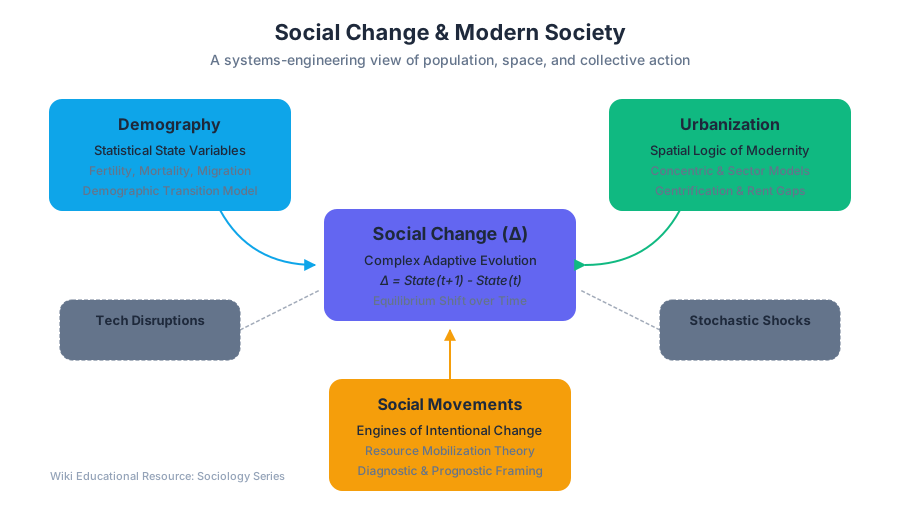
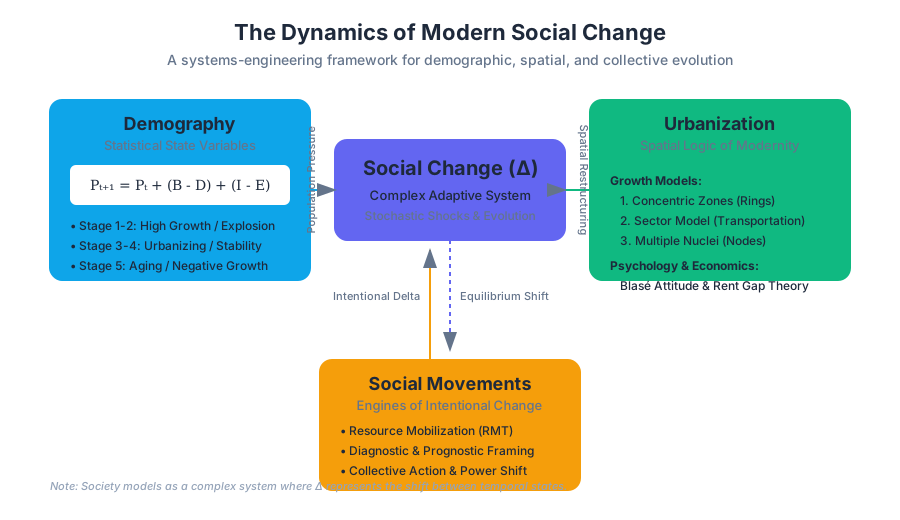
Social change is the transformation of culture, behavior, social institutions, and social structure over time. In a systems-engineering view, society is a complex, adaptive system where "change" is the delta ($\Delta$) between two temporal states of equilibrium. This evolution is rarely linear; it is driven by stochastic shocks (natural disasters, pandemics), technological disruptions, and intentional collective action.
Demography: The Statistical State of the Population
Demography is the formal, statistical study of human populations. It provides the "state variables" for any sociological analysis, focusing on three primary components: fertility, mortality, and migration. Understanding these variables allows sociologists to predict infrastructure needs, economic shifts, and potential social unrest.
The Demographic Transition Model (DTM)
The DTM describes the historical shift from high birth and death rates to low birth and death rates as a country develops from a pre-industrial to an industrialized economic system.
| Stage | Description | Birth Rate | Death Rate | Population Growth |
|---|---|---|---|---|
| Stage 1 | Pre-industrial; high infectious disease | High | High | Stable/Low |
| Stage 2 | Developing; improved food/water | High | Falling Rapidly | Very High (Explosion) |
| Stage 3 | Urbanizing; increased contraception | Falling | Falling Slowly | Slowing Down |
| Stage 4 | Post-industrial; stable economy | Low | Low | Stable/Low |
| Stage 5 | Declining; aging population | Very Low | Low | Negative Growth |
Population Dynamics and Projections
To model population change, demographers use the Basic Demographic Equation: $$P_{t+1} = P_t + (B - D) + (I - E)$$ Where $P$ is population, $B$ is births, $D$ is deaths, $I$ is immigration, and $E$ is emigration.
For a more granular analysis of age-structure, sociologists utilize the Leslie Matrix, a discrete-time, age-structured model of population growth.
Urbanization: The Spatial Logic of Modernity
Urbanization is the study of the social, political, and economic relationships in cities. It is not merely the movement of people from rural to urban areas, but the fundamental restructuring of human interaction.
Models of Urban Growth
Sociologists from the Chicago School developed several models to explain how cities expand and how social classes are distributed spatially.
| Model | Proponent | Core Logic |
|---|---|---|
| Concentric Zone Model | Ernest Burgess | The city grows outward from a central business district (CBD) in a series of rings. |
| Sector Model | Homer Hoyt | Growth occurs in wedge-shaped sectors along transportation corridors (rail/highways). |
| Multiple Nuclei Model | Harris & Ullman | Cities lack a single center; they develop around several independent nodes (universels, airports). |
The "Blasé Attitude" and Urban Psychology
Georg Simmel argued that the sensory overload of the city creates a blasé attitude—a psychological defense mechanism where individuals become indifferent to their surroundings to preserve their mental energy. This leads to the paradox of the city: being surrounded by millions yet experiencing profound alienation.
Gentrification and Displacement
Gentrification occurs when middle- and upper-class residents move into historically less affluent urban areas, resulting in increased property values and the displacement of original inhabitants. This is often modeled as a "Rent Gap" theory, where the gap between current ground rent and potential land value becomes wide enough to attract speculative capital.
Social Movements: The Engines of Change
A Social Movement is a purposeful, organized group striving toward a common goal. These movements are the primary mechanism through which marginalized groups exert power against established institutions.
Theoretical Frameworks
- Resource Mobilization Theory (RMT): Argues that movements succeed based on their ability to acquire and deploy resources (money, labor, media access) rather than the intensity of their grievances.
- Diagnostic, Prognostic, and Motivation Framing: Movements must "frame" their cause to align with the values of potential recruits.
- Diagnostic: Identifying the problem.
- Prognostic: Proposing a solution.
- Motivational: A call to action.
Stages of Social Movements
Herbert Blumer and Armand Mauss identified a four-stage lifecycle for movements:
- Emergence: The initial perception that something is wrong.
- Coalescence: "Joining forces" and organizing; defining strategy.
- Bureaucratization: The movement becomes a formal organization (NGOs, political parties).
- Decline: Can result from success, failure, co-optation, or repression.
The Threshold Model of Collective Behavior
Mark Granovetter proposed that an individual's decision to join a riot or movement depends on a threshold: the number of other people who must join before they feel safe or compelled to do so.
Granovetter's Threshold Equation: Let $x_i$ be the threshold for individual $i$. An individual joins the movement at time $t+1$ if the proportion of the population already participating at time $t$ ($P_t$) satisfies: $$P_t \ge x_i$$ This explains why movements can remain dormant for years and then "explode" suddenly when a single person's threshold is met, triggering a cascade.
Technology and Media: The Digital Infrastructure
Technology is a primary driver of social change, acting as both a tool for liberation and a mechanism for control. In modern society, the distinction between "online" and "offline" has largely collapsed, leading to the concept of Cyber-Urbanism.
The Digital Divide
The Digital Divide refers to the uneven access to technology along lines of race, class, and geography. This is categorized into two levels:
- First-Level: Access to hardware and high-speed internet.
- Second-Level: The "knowledge gap"—the ability to use technology effectively for economic or social gain.
Media Consolidation and the Panopticon
As media outlets consolidate into a few mega-corporations (e.g., Disney, Warner Bros. Discovery), the diversity of viewpoints decreases. Simultaneously, the rise of Surveillance Capitalism (as defined by Shoshana Zuboff) uses technology to monitor behavior for the purpose of predicting and controlling future actions.
Decentralization as Social Resistance
In response to centralized control, social movements and tech-activists (hacktivists) have moved toward decentralized protocols. This is a technical solution to a sociological problem (censorship and de-platforming).
Environmental Sociology: The Metabolic Rift
Environmental sociology examines the interaction between human societies and the physical environment. A key concept here is the Metabolic Rift, a term derived from Karl Marx, describing the rupture in the ecological interaction between humanity and the rest of nature.
The Tragedy of the Commons
Garrett Hardin’s "Tragedy of the Commons" suggests that individuals, acting in their own self-interest, will deplete shared resources (air, water, forests), even if it is not in anyone's long-term interest.
| Concept | Definition | Sociological Impact |
|---|---|---|
| Environmental Racism | Burdening minority neighborhoods with toxic waste or pollution. | Leads to health disparities and "sacrifice zones." |
| Sustainable Development | Growth that meets present needs without compromising the future. | Requires a shift from "Treadmill of Production" logic. |
| Climate Refugees | People forced to migrate due to environmental degradation. | Triggers Stage 5 demographic shifts and urban strain. |
Synthesis: The Feedback Loops of Change
Social change is rarely the result of a single factor. Instead, it is a series of feedback loops:
- Technological Shift: The invention of the smartphone.
- Demographic Shift: Increased connectivity allows rural youth to see urban opportunities, accelerating Urbanization.
- Social Movement: Urban density and digital tools allow for the rapid Coalescence of movements (e.g., the Arab Spring).
- Institutional Response: Governments implement new surveillance tech, leading to a new state of equilibrium or further unrest.
Glossary of Key Terms
- Malthusian Theory: The belief that population growth will inevitably outpace food production, leading to catastrophe.
- Cornucopian Theory: The belief that human ingenuity will always develop new technologies to overcome resource constraints.
- Mechanical Solidarity: Social cohesion based on shared traditions and common beliefs (pre-industrial).
- Organic Solidarity: Social cohesion based on mutual interdependence in a complex division of labor (industrial).
- New Social Movement (NSM) Theory: A perspective that focuses on identity, culture, and quality of life rather than purely economic concerns.
Source Materials
Study Introduction Sociology 3e on Lykke
This course page is free to open: signed out, you can read its first two sections, and signing in, on any plan, opens the rest. The free Lykke Chrome extension syncs your own Canvas courses, so ChatGPT, Claude and Muse can answer from your classes and deadlines. It only reads Canvas.
Add the free extensionSign in to open every sectionAll sections of Introduction Sociology 3e · Browse more course pages