From the free course Introduction Philosophy on Lykke
Value Theory: Ethics and Aesthetics
Key concepts: Normative Ethics · Metaethics · Social Contract · Aesthetics
An examination of how humans assign value to actions, objects, and social structures, covering ethics, political philosophy, and aesthetics.
Value Theory: Ethics and Aesthetics
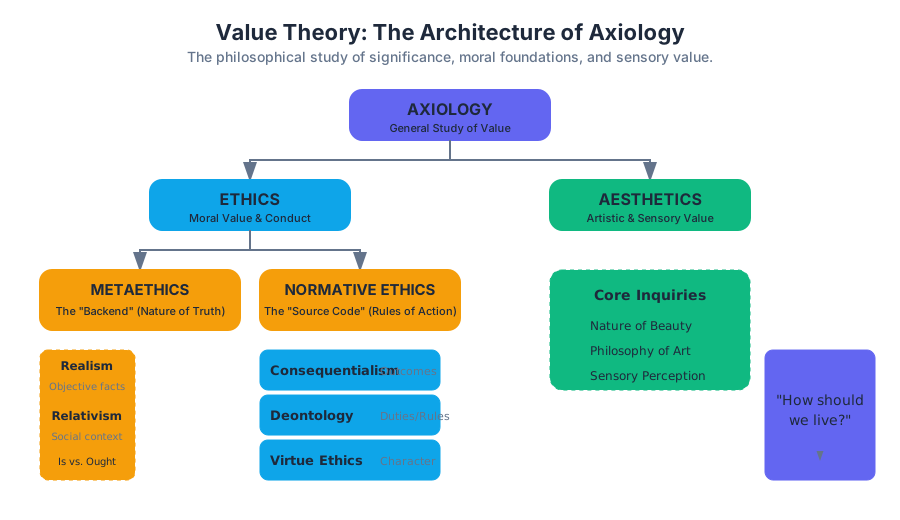
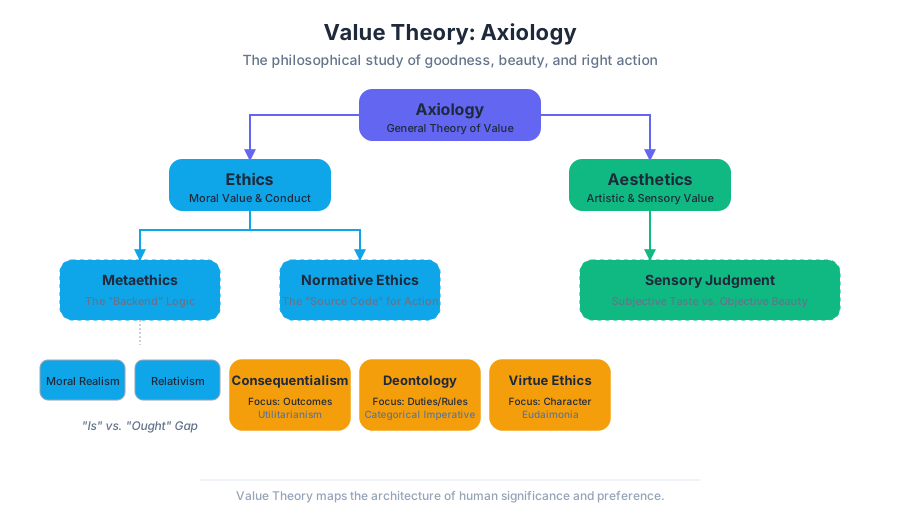
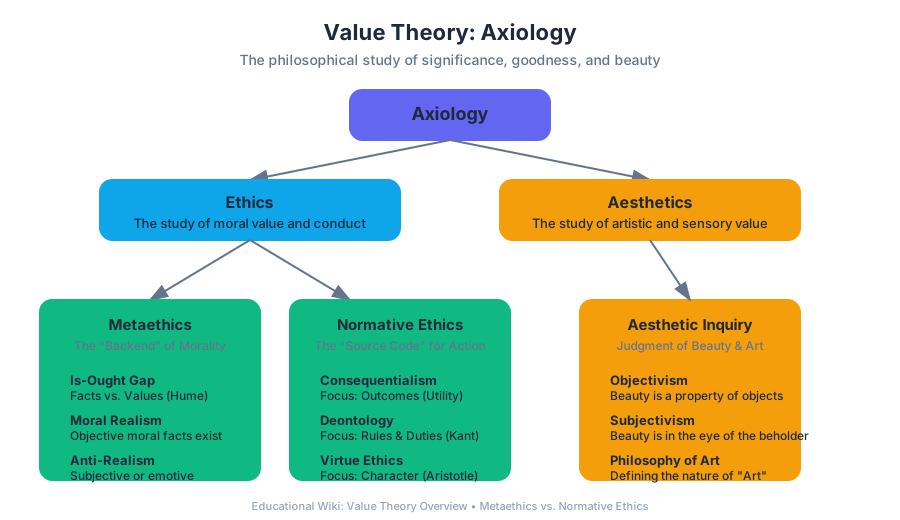
Value Theory, or Axiology, is the philosophical study of value. It encompasses a broad range of inquiries into what humans find significant, how we determine the "goodness" or "badness" of actions, and how we define beauty. While epistemology asks "What do we know?" and metaphysics asks "What is real?", value theory asks "What should we care about?" and "How should we live?"
In the modern analytical tradition, value theory is bifurcated into two primary domains: Ethics (the study of moral value) and Aesthetics (the study of artistic or sensory value). These are not merely matters of opinion; they involve rigorous logical frameworks, ontological commitments, and social architectures.
Metaethics: The Foundations of Moral Reality
Before we can determine if an action is "right," we must understand what "rightness" actually is. Metaethics is the "backend" of moral philosophy. It does not ask "Should I lie?"; instead, it asks "What does the word 'should' mean?" and "Are moral facts as real as physical facts?"
The Fact-Value Distinction
A central problem in metaethics is the Is-Ought Gap, famously articulated by David Hume. Hume argued that one cannot logically derive a statement of value (what ought to be) from a statement of fact (what is).
Hume’s Law: "In every system of morality, which I have hitherto met with, I have always remarked, that the author proceeds for some time in the ordinary way of reasoning... when of a sudden I am surprised to find, that instead of the usual copulations of propositions, is, and is not, I meet with no proposition that is not connected with an ought, or an ought not."
Metaethical Taxonomies
Metaethical positions are generally categorized based on their stance on moral truth and the nature of moral language.
| Position | Category | Core Tenet | Key Implication |
|---|---|---|---|
| Moral Realism | Objectivism | Moral facts exist independently of human opinion. | "Murder is wrong" is as true as "2+2=4." |
| Ethical Subjectivism | Anti-Realism | Moral statements describe individual feelings or attitudes. | Morality is a matter of personal preference. |
| Moral Relativism | Anti-Realism | Moral truths are relative to cultural or social contexts. | No culture's ethics are superior to another's. |
| Emotivism | Non-Cognitivism | Moral statements are expressions of emotion, not facts. | "Stealing is bad" means "Boo stealing!" |
| Error Theory | Anti-Realism | All moral claims are false because moral properties don't exist. | We are systematically mistaken about morality. |
Modeling Metaethical Logic
In a computational sense, metaethics can be viewed as the "type system" for moral propositions. If we were to implement a moral evaluator, we would first need to define the return type of a moral judgment.
Normative Ethics: Frameworks for Conduct
While metaethics deals with the nature of morality, Normative Ethics provides the actual "source code" for behavior. It attempts to establish a set of rules or principles that guide us in determining right from wrong.
Consequentialism (Utilitarianism)
Consequentialism argues that the morality of an action is determined solely by its outcomes. The most prominent form is Utilitarianism, championed by Jeremy Bentham and John Stuart Mill. The core metric is the Greatest Happiness Principle.
The Greatest Happiness Principle: Actions are right in proportion as they tend to promote happiness, wrong as they tend to produce the reverse of happiness.
In mathematical terms, Utilitarianism functions as an optimization problem:
$$U(a) = \sum_{i=1}^{n} (H_i - S_i)$$
Where $U(a)$ is the total utility of action $a$, $H$ is the happiness produced for individual $i$, and $S$ is the suffering produced.
Deontology (Duty-Based Ethics)
Deontology, most famously associated with Immanuel Kant, rejects the idea that consequences matter. Instead, morality is about following universal rules. Kant proposed the Categorical Imperative, a test for whether an action is permissible.
- Universalizability: Act only according to that maxim whereby you can, at the same time, will that it should become a universal law.
- Humanity as an End: Act in such a way that you treat humanity, whether in your own person or in the person of any other, never merely as a means to an end, but always at the same time as an end.
Virtue Ethics
Derived from Aristotle’s Nicomachean Ethics, Virtue Ethics shifts the focus from what to do to who to be. It emphasizes the cultivation of character traits (virtues) like courage, temperance, and wisdom. The goal is Eudaimonia (often translated as "flourishing" or "living well").
| Feature | Utilitarianism | Deontology | Virtue Ethics |
|---|---|---|---|
| Focus | Consequences/Outcomes | Rules/Duties | Character/Habit |
| Primary Question | What produces the most good? | What is my duty? | What would a virtuous person do? |
| Core Proponent | J.S. Mill | Immanuel Kant | Aristotle |
| Weakness | Can justify harming minorities. | Can be too rigid (no lying to save a life). | Vague on specific actions. |
Formalizing the Categorical Imperative
We can represent Kant's Universalizability test as a logic check in pseudocode.
FUNCTION IsActionMoral(Action, Maxim):
    // Step 1: Universalize the maxim
    UniversalMaxim = "Everyone does " + Action + " whenever " + Maxim

    // Step 2: Check for logical contradiction
    IF UniversalMaxim.CreatesLogicalContradiction() THEN
        RETURN False // Perfect Duty violation (e.g., Lying)

    // Step 3: Check for contradiction in will
    IF UniversalMaxim.IsUnreasonableToWill() THEN
        RETURN False // Imperfect Duty violation (e.g., Not helping others)

    RETURN True
END FUNCTION
Social Contract Theory: The Ethics of Statehood
Social Contract Theory bridges the gap between individual ethics and political philosophy. It asks: Why do we have governments, and what gives them the right to tell us what to do? The theory posits that individuals consent, either explicitly or tacitly, to surrender some freedoms to an authority in exchange for the protection of their remaining rights.
The State of Nature
To understand the social contract, philosophers imagine a State of Nature—a hypothetical condition before organized society.
- Thomas Hobbes: Described the state of nature as a "war of all against all" where life is "solitary, poor, nasty, brutish, and short." For Hobbes, the social contract is a survival pact, requiring an absolute sovereign (The Leviathan) to maintain order.
- John Locke: Argued that the state of nature is governed by natural law, where individuals have rights to "Life, Liberty, and Property." The contract is a limited agreement to protect these rights. If the state fails, the people have a right to revolution.
- Jean-Jacques Rousseau: Believed humans were "noble savages" corrupted by society. His contract emphasizes the General Will—the collective interest of the citizens.
Modern Social Contract: John Rawls
John Rawls updated the theory with the Veil of Ignorance. He argued that a just society is one we would design if we didn't know our place in it (our race, gender, wealth, or talents). This leads to the Difference Principle: inequalities are only permitted if they benefit the least advantaged members of society.
Simulating Resource Contention in the State of Nature
In a system with no rules, agents compete for resources.
Aesthetics: The Nature of Beauty and Art
Aesthetics is often dismissed as "subjective," but in value theory, it is treated with the same analytical rigor as ethics. It explores the nature of aesthetic judgments and the definition of art.
The Standard of Taste
David Hume addressed the subjectivity of beauty in "Of the Standard of Taste." He acknowledged that beauty is in the eye of the beholder, but argued that some "eyes" are better than others. A True Critic possesses:
- Delicacy of imagination.
- Practice in viewing art.
- Comparison between different works.
- Freedom from prejudice.
- Good sense.
Theories of Art
What makes something a "work of art"? Philosophers have proposed several definitions:
| Theory | Definition | Example |
|---|---|---|
| Mimetic Theory | Art is an imitation of reality (Mimesis). | A realistic landscape painting. |
| Expressionism | Art is the communication of the artist's emotions. | Van Gogh’s Starry Night. |
| Formalism | Art is defined by its formal qualities (line, color, shape). | Jackson Pollock’s drip paintings. |
| Institutional Theory | Art is whatever the "Artworld" (galleries, critics) says it is. | Marcel Duchamp’s Fountain (a urinal). |
Aesthetic Properties as Metadata
In modern digital design, aesthetics are often codified into "Design Systems." We can think of an aesthetic judgment as a set of parameters applied to an object.
The Sublime vs. The Beautiful
Edmund Burke and Immanuel Kant distinguished between the Beautiful (which is small, smooth, and pleasing) and the Sublime (which is vast, powerful, and potentially terrifying). The Sublime reminds us of our own insignificance and the greatness of nature or the divine.
Synthesis: The Intersection of Values
Value theory is not a collection of isolated silos. Ethics, politics, and aesthetics constantly overlap.
- Ethical Aesthetics: Can a "bad" person create "good" art? (The "Cancel Culture" debate).
- Political Aesthetics: How is art used for propaganda or social change? (Socialist Realism vs. Street Art).
- The Ethics of Beauty: Does the pursuit of aesthetic perfection (e.g., in architecture or plastic surgery) lead to ethical harms?
As we move into an era of Artificial Intelligence, value theory becomes a technical requirement. We must encode "values" into alignment algorithms, determine the "aesthetic" of AI-generated content, and decide the "social contract" between humans and autonomous systems.
Source Materials
Study Introduction Philosophy on Lykke
This course page is free to open: signed out, you can read its first two sections, and signing in, on any plan, opens the rest. The free Lykke Chrome extension syncs your own Canvas courses, so ChatGPT, Claude and Muse can answer from your classes and deadlines. It only reads Canvas.
Add the free extensionSign in to open every sectionAll sections of Introduction Philosophy · Browse more course pages