From the free course Introduction Philosophy on Lykke
Metaphysics: The Nature of Reality
Key concepts: Ontology · Dualism · Materialism · Free Will vs. Determinism
An investigation into the fundamental nature of existence, reality, and the relationship between mind and matter.
Metaphysics: The Nature of Reality
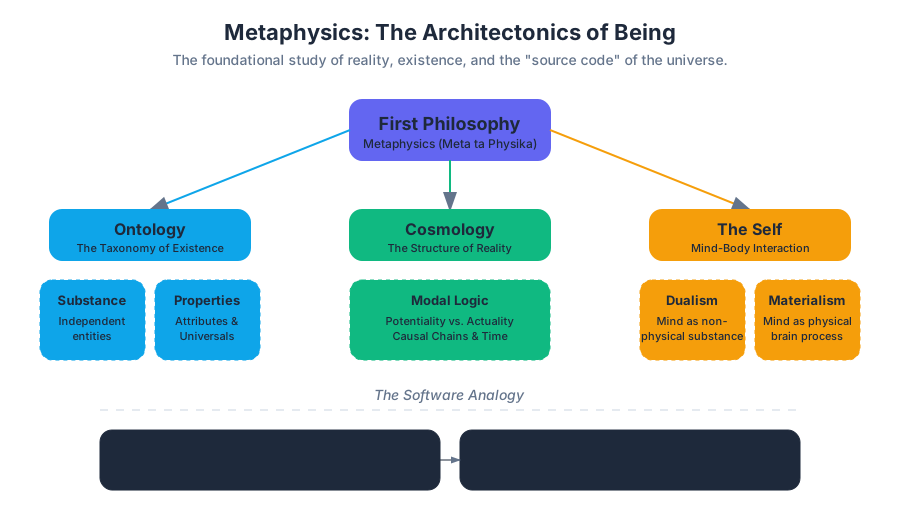
Metaphysics is the branch of philosophy concerned with the fundamental nature of reality, including the relationship between mind and matter, between substance and attribute, and between potentiality and actuality. Often termed "First Philosophy" by Aristotle, it functions as the foundational layer upon which all other inquiries—scientific, ethical, and epistemological—are built. While physics investigates the laws governing the behavior of matter within the universe, metaphysics investigates the very nature of "being" and the categories of existence that make such a universe possible.
Overview: The Architectonics of Being
At its core, metaphysics addresses the "Why" and "What" of existence that precede empirical observation. If we view the universe as a complex software system, physics describes the runtime behavior and API calls, while metaphysics describes the underlying source code, the data structures, and the hardware architecture that define what can and cannot happen.
Definition: Metaphysics Derived from the Greek meta ta physika ("after the things of nature"), metaphysics is the systematic study of the fundamental principles of reality. It seeks to define the nature of existence (Ontology), the structure of the universe (Cosmology), and the nature of the self and consciousness.
Metaphysical inquiry is not merely speculative; it is a rigorous analytical process. It utilizes modal logic to explore "possible worlds," mereology to understand parts and wholes, and causal theory to map the chain of events that constitute history.
### Ontology: The Taxonomy of Existence
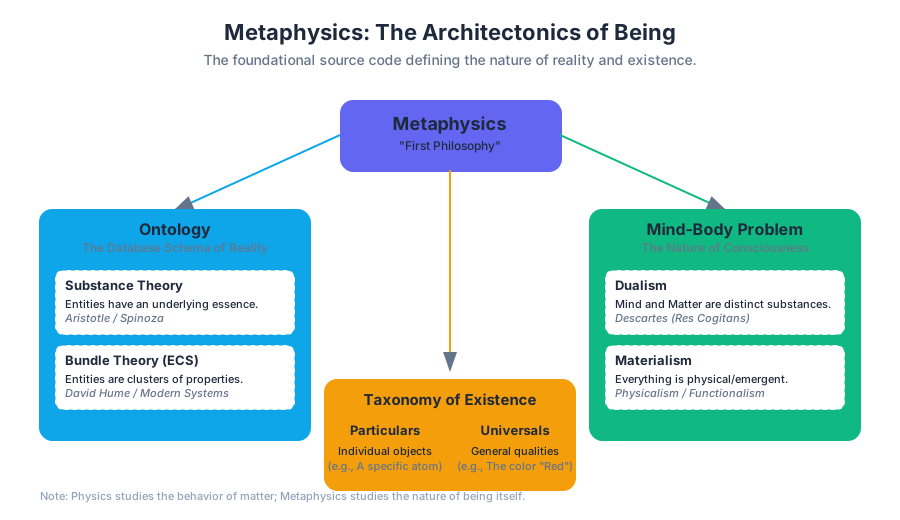
Ontology is the formal study of what exists. It is the "database schema" of reality. In ontology, we ask: What are the fundamental categories of things? Do numbers exist in the same way that rocks do? Are properties (like the color "red") real entities, or just linguistic shortcuts?
1. What it is
Ontology seeks to establish a "Complete Inventory of the Universe." It distinguishes between Particulars (individual things like a specific chair) and Universals (general qualities like "chairness" or "redness").
2. Why it matters
Without an ontological framework, we cannot perform coherent science or mathematics. For instance, if a scientist claims a "force" exists, they are making an ontological commitment. In computer science, an "ontology" is a formal naming and definition of the types, properties, and interrelationships of the entities that exist for a particular domain of discourse.
3. How it works: Substance vs. Properties
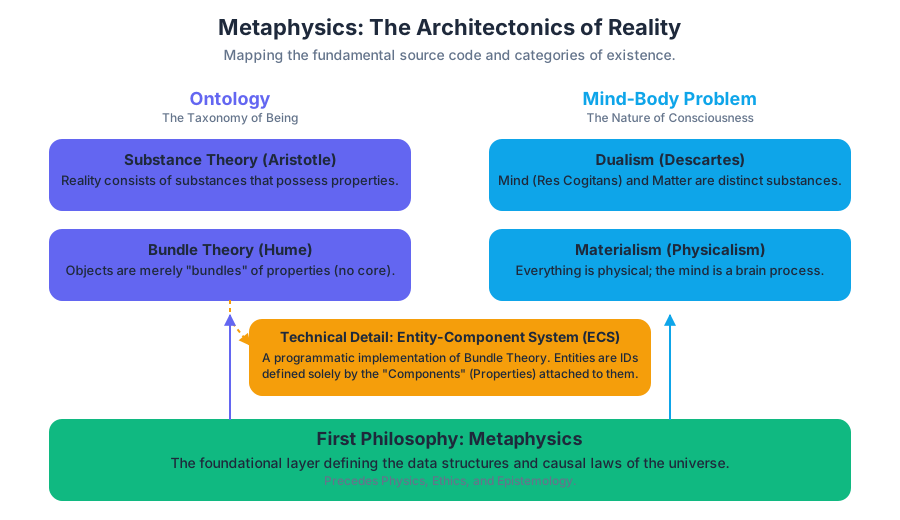
The most common ontological distinction is between Substance (that which exists in itself) and Properties (qualities that belong to a substance).
| Theory | Description | Key Proponent |
|---|---|---|
| Substance Theory | Reality consists of substances that possess properties. | Aristotle / Spinoza |
| Bundle Theory | Objects are merely "bundles" of properties with no underlying substance. | David Hume |
| Process Ontology | Change and dynamic processes are the fundamental elements of reality. | A.N. Whitehead |
| Nominalism | Universals (like "redness") do not exist; only individual particulars exist. | William of Ockham |
4. Concrete Example: The Entity-Component System (ECS)
In systems programming, we often model ontology through an Entity-Component System. This mirrors the metaphysical debate between Substance and Bundle theory.
5. Common Pitfalls: The Reification Fallacy
A common error in ontology is Reification—treating an abstract concept (like "The Economy" or "Justice") as if it were a concrete physical substance. Metaphysicians must be careful to distinguish between linguistic constructs and ontological primitives.
### Dualism vs. Materialism: The Mind-Body Problem
The most contentious debate in metaphysics concerns the nature of the "Self." Is the mind a physical process of the brain, or is it a non-physical substance?
1. What it is
- Dualism: The view that reality consists of two distinct substances: the Res Extensa (extended material things) and the Res Cogitans (thinking, non-extended things).
- Materialism (Physicalism): The view that everything that exists is physical or is dependent on physical processes. There is no "soul" or "mind" separate from the brain.
2. Why it matters
This debate defines the limits of Artificial Intelligence, the ethics of medical brain death, and the possibility of "uploading" consciousness. If Materialism is true, a perfect simulation of a brain is a mind. If Dualism is true, the simulation lacks the "mental substance."
3. How it works: The Interaction Problem
The primary challenge for Dualism is the Interaction Problem: How can a non-physical mind cause a physical arm to move? Conversely, the challenge for Materialism is the Hard Problem of Consciousness: How do physical neurons produce the subjective "feel" (Qualia) of the color red?
| Perspective | Core Thesis | Primary Challenge |
|---|---|---|
| Substance Dualism | Mind and Body are different "stuff." | How do they interact? |
| Property Dualism | One substance (brain) has two types of properties (physical/mental). | Epiphenomenalism (Mind has no power). |
| Reductive Physicalism | Mental states are brain states. | Explanatory Gap (Qualia). |
| Functionalism | Mind is what the brain does (software/hardware). | The Chinese Room Argument. |
4. Concrete Example: Functionalism in Logic
Functionalism suggests that a mental state is defined by its causal role (inputs, outputs, and transitions) rather than its physical makeup. We can represent this using a Finite State Machine (FSM).
\begin{aligned}
& \text{Let } M \text{ be a mental state (e.g., Pain).} \\
& \text{Functionalist Definition of } M: \\
& M(i, s) \rightarrow (o, s') \\
& \text{where: } \\
& i = \text{Input (e.g., Tissue damage)} \\
& s = \text{Current internal state} \\
& o = \text{Output (e.g., "Ouch!", withdrawal reflex)} \\
& s' = \text{Next state (e.g., Anxiety, Caution)}
\end{aligned}
5. Variations: Panpsychism
An emerging alternative is Panpsychism, which suggests that consciousness is a fundamental property of all matter, much like mass or charge. This attempts to bridge the gap between Materialism and Dualism by making "mind" a universal primitive.
### Free Will vs. Determinism: The Causal Chain
If every event in the universe is caused by a preceding event according to the laws of physics, do humans have the power to choose their actions?
1. What it is
- Determinism: Every event, including human action, is necessitated by antecedent events and the laws of nature.
- Libertarianism: The belief that humans have free will and that some actions are not determined by prior causes.
- Compatibilism: The view that free will and determinism are not mutually exclusive. We are "free" if we act according to our desires, even if those desires are determined.
2. Why it matters
This is the foundation of the legal system and moral responsibility. If a murderer was "programmed" by their biology and environment to kill, can we justify punishment?
3. How it works: Laplace’s Demon
In 1814, Pierre-Simon Laplace proposed a thought experiment: If an intellect (a "Demon") knew the precise position and momentum of every atom in the universe at one moment, it could calculate the entire past and future.
4. Concrete Example: Deterministic vs. Stochastic Systems
In computing, we can simulate a deterministic "universe" vs. one with "free" (stochastic) elements.
5. Common Pitfalls: Confusing Determinism with Fatalism
Fatalism is the idea that "whatever will happen, will happen," regardless of your actions. Determinism is different: it says your actions do matter, but your actions themselves are caused. If you decide to study, you will pass; but your decision to study was determined by your personality and history.
### The Problem of Universals: Realism vs. Nominalism
Do general concepts like "The Circle" exist in a transcendent realm, or are they just names we give to groups of similar things?
1. What it is
- Platonic Realism: Universals exist as "Forms" in a non-physical realm. A physical circle is just an imperfect shadow of the "Ideal Circle."
- Nominalism: Only individuals exist. "Circle" is just a word (a nomen) used to categorize objects that look similar.
2. Why it matters
This affects how we view mathematics and logic. Are mathematical truths "discovered" (Realism) or "invented" (Nominalism)?
| Feature | Realism | Nominalism | Conceptualism |
|---|---|---|---|
| Status of "Red" | Exists independently of red things. | Just a label for a set of objects. | Exists as a mental construct. |
| Math | Numbers are real entities. | Math is a useful language. | Math is a structure of the mind. |
| Discovery | We discover objective truths. | We create useful frameworks. | We map our cognitive limits. |
3. How it works: The Schema Mapping
In database design, we deal with this daily. Is a Table a real entity, or just a collection of Rows?
### Summary of Metaphysical Frameworks
To navigate the landscape of reality, one must choose a "stack." Most modern scientists operate on a stack of Physicalism + Determinism + Nominalism, while many religious or spiritual frameworks operate on Dualism + Libertarianism + Realism.
| Concept | Materialist Stack | Idealist/Dualist Stack |
|---|---|---|
| Ontology | Monism (Matter only) | Dualism (Mind & Matter) |
| Mind | Emergent Property | Independent Substance |
| Agency | Determinism / Compatibilism | Libertarian Free Will |
| Abstracts | Nominalism (Labels) | Realism (Forms/Ideas) |
Metaphysics remains the "final frontier" of human knowledge. As we move closer to creating sentient machines and understanding the quantum foundations of the universe, these ancient questions about substance, cause, and being become more than just academic exercises—they become the design specifications for the future of intelligence.
Source Materials
Study Introduction Philosophy on Lykke
This course page is free to open: signed out, you can read its first two sections, and signing in, on any plan, opens the rest. The free Lykke Chrome extension syncs your own Canvas courses, so ChatGPT, Claude and Muse can answer from your classes and deadlines. It only reads Canvas.
Add the free extensionSign in to open every sectionAll sections of Introduction Philosophy · Browse more course pages