From the free course Introduction Philosophy on Lykke
Logic and Critical Thinking
Key concepts: Deductive Reasoning · Inductive Reasoning · Logical Fallacies · Syllogisms
An introduction to the formal and informal tools of philosophical inquiry, focusing on the structure of arguments and the methods of reasoning.
Logic and Critical Thinking
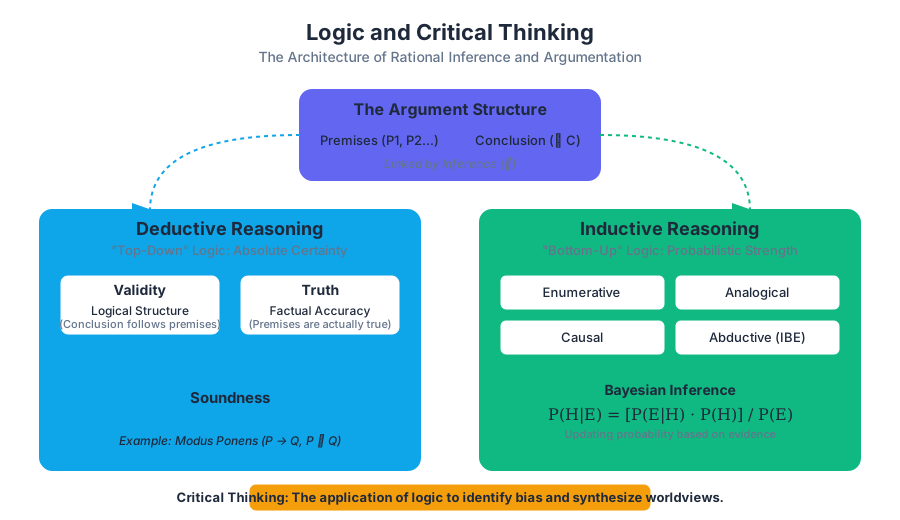
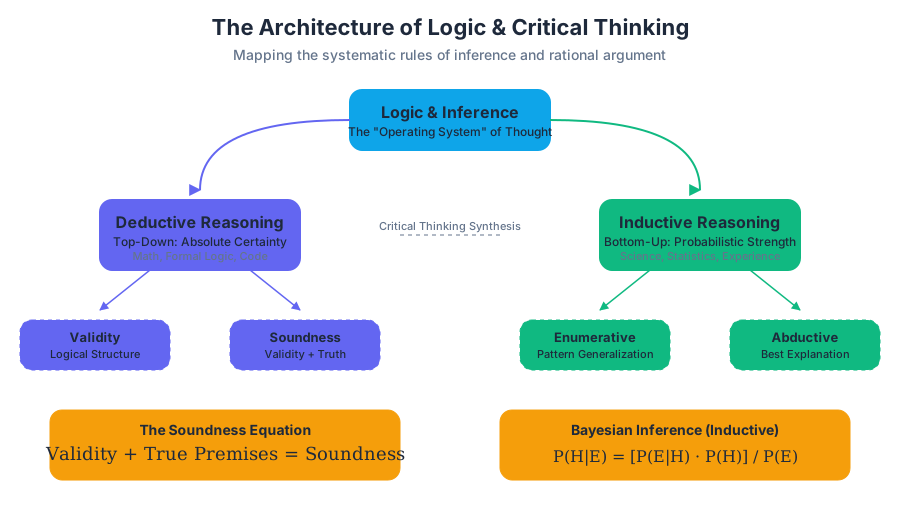
Logic is the systematic study of the rules of inference—the process by which we derive new information from existing data. In the context of philosophy and cognitive science, logic serves as the "operating system" for rational thought. It provides the formal structures necessary to evaluate whether a conclusion follows from its premises, regardless of the specific subject matter. Critical thinking is the application of these logical structures to real-world scenarios, enabling the identification of biases, the deconstruction of complex arguments, and the synthesis of coherent worldviews.
The Architecture of Arguments
At its core, an argument is a set of statements (the premises) intended to provide support or evidence for another statement (the conclusion). The relationship between these components determines the argument's quality.
Definition: Inferential Strength The degree to which the premises of an argument provide support for the conclusion. In formal systems, this is a binary (valid/invalid); in informal systems, it exists on a spectrum (weak to strong).
Structural Components of Logic
| Component | Description | Formal Symbol |
|---|---|---|
| Premise | A proposition supporting a conclusion. | $P_1, P_2, ... P_n$ |
| Conclusion | The statement being argued for. | $C$ or $\therefore$ |
| Inference | The move from premises to conclusion. | $\vdash$ (Syntactic) or $\vDash$ (Semantic) |
| Logical Operator | Connectives like "and," "or," "not," and "if...then." | $\land, \lor, \neg, \rightarrow$ |
Deductive Reasoning
Deductive reasoning is a "top-down" logic where the conclusion is claimed to follow with absolute necessity from the premises. If the structure is correct and the premises are true, the conclusion cannot be false. This is the domain of mathematics, formal geometry, and computer science.
Validity vs. Soundness
A common point of confusion in deductive logic is the distinction between validity and soundness.
- Validity: Refers strictly to the structure of the argument. An argument is valid if, assuming the premises are true, the conclusion must follow.
- Soundness: Refers to a valid argument that also possesses actually true premises.
The Soundness Equation:
Validity + True Premises = Soundness
Syllogisms
The most famous form of deductive reasoning is the syllogism, pioneered by Aristotle. A categorical syllogism consists of exactly three categorical propositions (two premises and a conclusion) and three terms, each of which appears twice.
Classic Example (Modus Ponens):
- If it is raining, the ground is wet. ($P \rightarrow Q$)
- It is raining. ($P$)
- Therefore, the ground is wet. ($\therefore Q$)
Inductive Reasoning
Unlike deduction, inductive reasoning is "bottom-up." It involves using specific observations to reach a general conclusion. Induction does not deal in certainty; it deals in probability and strength.
The Problem of Induction
David Hume famously argued that induction cannot be rationally justified because it relies on the "Uniformity of Nature"—the assumption that the future will resemble the past. Since this assumption itself is based on induction, the reasoning is circular. However, induction remains the backbone of the scientific method.
Types of Inductive Arguments
| Type | Mechanism | Example |
|---|---|---|
| Enumerative | Generalizing from a sample to a population. | "Every swan I've seen is white; therefore, all swans are white." |
| Analogical | Comparing two similar things and inferring a shared trait. | "Drug A worked in mice; mice are mammals; Drug A will work in humans." |
| Causal | Inferring a cause-and-effect relationship based on correlation. | "The light turns on every time I flip this switch." |
| Abductive | Inference to the best explanation (IBE). | "The grass is wet; it most likely rained (rather than a giant sprayer passing by)." |
Mathematical Representation: Bayesian Inference
In modern logic, induction is often modeled using Bayes' Theorem, which updates the probability of a hypothesis ($H$) as more evidence ($E$) becomes available.
P(H|E) = \frac{P(E|H) \cdot P(H)}{P(E)}
- $P(H|E)$: Posterior probability (Probability of hypothesis given evidence).
- $P(E|H)$: Likelihood (Probability of evidence given hypothesis).
- $P(H)$: Prior probability (Initial probability of hypothesis).
- $P(E)$: Marginal likelihood (Total probability of evidence).
Logical Fallacies
A fallacy is a flaw in reasoning that renders an argument invalid (deductive) or weak (inductive). Fallacies are categorized into Formal and Informal.
Formal Fallacies
These occur when the very structure of the argument is flawed.
- Affirming the Consequent: If $P$ then $Q$; $Q$; therefore $P$. (Invalid because $Q$ could happen for other reasons).
- Denying the Antecedent: If $P$ then $Q$; not $P$; therefore not $Q$.
Informal Fallacies
These relate to the content and context of the argument.
| Fallacy | Description | Example |
|---|---|---|
| Ad Hominem | Attacking the person instead of the argument. | "You're wrong because you're a jerk." |
| Straw Man | Misrepresenting an opponent's position to make it easier to attack. | "You want to reduce military spending? Why do you want our country to be defenseless?" |
| False Dilemma | Presenting only two options when more exist. | "Either we go to war, or we are cowards." |
| Begging the Question | Circular reasoning where the conclusion is in the premise. | "The Bible is true because God wrote it, and we know God exists because the Bible says so." |
| Slippery Slope | Claiming a small step will lead to a chain of disastrous events. | "If we let students use calculators, eventually they won't be able to do basic addition." |
Critical Thinking and Cognitive Biases
Logic provides the rules, but critical thinking is the discipline of applying them while being aware of human cognitive limitations. Even with perfect logic, human brains are prone to heuristics—mental shortcuts that lead to systematic errors.
The Dual-Process Theory
Psychologists (notably Daniel Kahneman) suggest two systems of thought:
- System 1: Fast, instinctive, and emotional. (Prone to fallacies).
- System 2: Slower, more deliberative, and logical. (Where formal logic resides).
Key Biases to Mitigate
- Confirmation Bias: The tendency to search for, interpret, and recall information in a way that confirms one's pre-existing beliefs.
- Dunning-Kruger Effect: A cognitive bias where people with low ability at a task overestimate their ability.
- Availability Heuristic: Overestimating the importance of information that is easy to recall (e.g., fearing shark attacks more than heart disease).
Advanced Logic: Modal and Predicate Logic
While basic logic deals with simple propositions, advanced logic expands the scope to include "possibility" and "quantification."
Predicate Logic (First-Order Logic)
Introduces quantifiers:
- Universal Quantifier ($\forall$): "For all..."
- Existential Quantifier ($\exists$): "There exists at least one..."
Example: $\forall x (Human(x) \rightarrow Mortal(x))$ — For all $x$, if $x$ is human, then $x$ is mortal.
Modal Logic
Introduces operators for necessity and possibility:
- $\Box P$: It is necessary that $P$.
- $\Diamond P$: It is possible that $P$.
Summary of Logical Systems
| Feature | Deductive Logic | Inductive Logic | Abductive Logic |
|---|---|---|---|
| Goal | Certainty / Necessity | Probability / Strength | Plausibility / Best Fit |
| Information | Conclusion is "contained" in premises. | Conclusion goes beyond premises. | Conclusion explains premises. |
| Evaluation | Valid / Invalid | Strong / Weak | Cogent / Non-cogent |
| Primary Use | Math, Code, Formal Proofs | Science, Statistics | Diagnosis, Detectives |
Source Materials
Study Introduction Philosophy on Lykke
This course page is free to open: signed out, you can read its first two sections, and signing in, on any plan, opens the rest. The free Lykke Chrome extension syncs your own Canvas courses, so ChatGPT, Claude and Muse can answer from your classes and deadlines. It only reads Canvas.
Add the free extensionSign in to open every sectionAll sections of Introduction Philosophy · Browse more course pages