From the free course Introduction Business on Lykke
Foundations of Business and Decision Making
Key concepts: Decision making · Customer satisfaction
This section introduces the fundamental principles of business operations, focusing on how organizations create value and make strategic decisions to ensure customer satisfaction.
Foundations of Business and Decision Making
Every successful business begins with a clear understanding of how to create value for its stakeholders. This section explores the core functions of business and the systematic approach required to make effective decisions in a competitive marketplace. In the modern era, business is no longer a static exercise in resource management; it is a dynamic process of navigating uncertainty, leveraging data, and aligning organizational goals with human psychology.
Decision Making: The Architecture of Choice
Decision making is the cognitive process of identifying problems and opportunities and selecting a specific course of action from among several alternatives. In a business context, this is rarely a solitary event but rather a continuous cycle of data ingestion, risk assessment, and strategic execution.
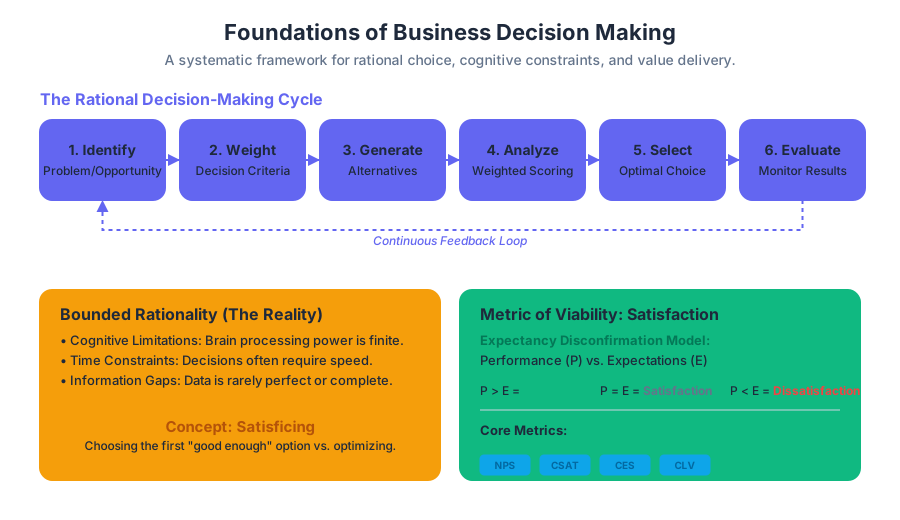
The Rational Decision-Making Model
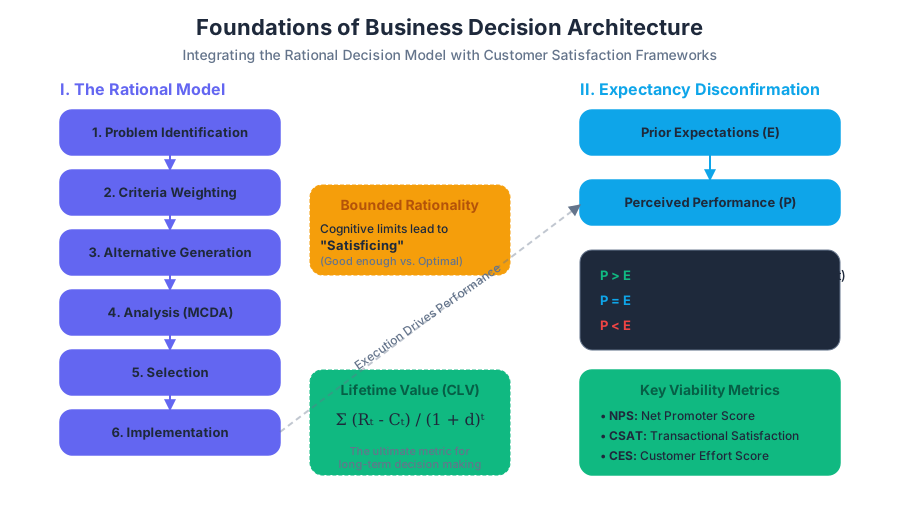
The classical view of decision-making assumes that managers act as "rational actors" who maximize utility through a structured sequence. This model is foundational for understanding how organizations should behave, even if human limitations often interfere.
- Problem Identification: Recognizing a discrepancy between the current state and the desired state.
- Criteria Weighting: Determining which factors (cost, speed, quality) are most important.
- Alternative Generation: Developing a comprehensive list of potential solutions.
- Analysis: Evaluating each alternative against the weighted criteria.
- Selection: Choosing the alternative with the highest calculated value.
- Implementation and Evaluation: Executing the choice and monitoring results to close the feedback loop.
The Principle of Bounded Rationality: Proposed by Herbert Simon, this concept suggests that human decision-making is limited by the information available, the cognitive limitations of the mind, and the finite amount of time. Instead of "optimizing," managers often "satisfice"—choosing the first solution that meets the minimum threshold of acceptability.
Comparative Decision Frameworks
| Feature | Rational Model | Bounded Rationality | Intuitive Model |
|---|---|---|---|
| Information | Perfect/Complete | Incomplete/Fragmented | Experience-based/Pattern recognition |
| Goal | Optimization (Best) | Satisficing (Good enough) | Speed and "Gut feel" |
| Context | Stable, predictable | Complex, time-constrained | High-pressure, expert domain |
| Risk | Quantified and mitigated | Accepted as a constraint | Managed through heuristic |
Multi-Criteria Decision Analysis (MCDA)
To move beyond intuition, businesses use weighted scoring models.
Customer Satisfaction: The Metric of Viability
Customer Satisfaction (CSAT) is a measure of how products and services supplied by a company meet or surpass customer expectations. It is not merely a "feel-good" metric; it is a leading indicator of customer retention, lifetime value, and brand equity.
Expectancy Disconfirmation Theory
The most widely accepted psychological model for satisfaction is Expectancy Disconfirmation. It posits that satisfaction is the result of a comparison between prior expectations ($E$) and perceived performance ($P$).
- Positive Disconfirmation: $P > E$ (Delight)
- Confirmation: $P = E$ (Satisfaction)
- Negative Disconfirmation: $P < E$ (Dissatisfaction)
Key Satisfaction Metrics
Businesses quantify satisfaction through several standardized instruments. Choosing the right metric depends on whether the goal is to measure a specific transaction or the overall relationship.
| Metric | Definition | Calculation | Use Case |
|---|---|---|---|
| NPS | Net Promoter Score | % Promoters - % Detractors | Brand loyalty and word-of-mouth |
| CSAT | Customer Satisfaction Score | Average score on a 1-5 or 1-10 scale | Post-transaction feedback |
| CES | Customer Effort Score | "How easy was it to solve your problem?" | Support and service optimization |
| Churn Rate | Rate of attrition | (Lost Customers / Total Customers) | Long-term viability |
Mathematical Foundation: Customer Lifetime Value (CLV)
Decision-making regarding customer satisfaction often centers on the Customer Lifetime Value (CLV). This formula helps businesses decide how much they can afford to spend on customer acquisition (CAC) and retention.
CLV = \sum_{t=1}^{n} \frac{(R_t - C_t)}{(1 + d)^t}
Where:
- $R_t$: Revenue from the customer at time $t$
- $C_t$: Cost to serve the customer at time $t$
- $d$: Discount rate (cost of capital)
- $n$: Expected duration of the relationship
The Intersection: Ethics and Decision Making
Modern business theory emphasizes that decision-making does not occur in a moral vacuum. The Triple Bottom Line (People, Planet, Profit) framework suggests that customer satisfaction is inextricably linked to corporate social responsibility (CSR) and ethical conduct.
Ethical Frameworks for Managers
When faced with a "wicked problem"—a decision with no clear right answer—managers apply different ethical lenses:
- Utilitarianism: Seeking the greatest good for the greatest number of people.
- Deontology: Following a set of moral rules or duties (e.g., "never lie to customers").
- Virtue Ethics: Focusing on the character of the decision-maker and what a "virtuous" person would do.
- Justice Approach: Ensuring that the benefits and burdens of a decision are distributed fairly.
Ethical Decision Matrix
| Framework | Focus | Business Application |
|---|---|---|
| Utilitarian | Outcomes/Consequences | Cost-benefit analysis for product safety |
| Rights-Based | Individual Protections | Data privacy and GDPR compliance |
| Fairness | Equity/Justice | Pay transparency and equitable hiring |
| Common Good | Community Well-being | Environmental sustainability initiatives |
Managing Change and Uncertainty
Business environments are characterized by VUCA (Volatility, Uncertainty, Complexity, and Ambiguity). Effective decision-making requires frameworks to manage change, particularly when technological shifts (like Artificial Intelligence) disrupt existing models.
Lewin’s Three-Step Change Model
- Unfreezing: Preparing the organization to accept that change is necessary; breaking down existing status quo.
- Changing: The transition period where new behaviors, processes, or ways of thinking are implemented.
- Refreezing: Stabilizing the organization after the change to ensure the new state becomes the norm.
Common Pitfalls in Business Decisions
- Confirmation Bias: Seeking out information that supports our pre-existing beliefs while ignoring contradictory evidence.
- Sunk Cost Fallacy: Continuing to invest in a failing project or customer segment because of the resources already committed.
- Groupthink: The tendency of highly cohesive groups to suppress dissenting opinions to reach a consensus, often leading to disastrous outcomes.
- Over-reliance on Data: Ignoring qualitative "human" factors (like employee morale or brand sentiment) because they are harder to quantify than spreadsheet metrics.
Advanced Application: AI-Augmented Decision Making
The integration of Artificial Intelligence into the decision-making pipeline represents the most significant shift in business theory in decades. AI moves from Descriptive Analytics (what happened?) to Prescriptive Analytics (what should we do?).
The AI Decision Pipeline
- Ingestion: Aggregating customer touchpoints, market trends, and internal logs.
- Inference: Using machine learning models to predict customer churn or demand spikes.
- Optimization: Running simulations (Monte Carlo) to find the most efficient resource allocation.
- Human-in-the-loop: The manager reviews AI-generated recommendations, applying ethical and contextual judgment that the machine lacks.
Key Insight: AI does not replace the manager; it replaces the drudgery of data processing, allowing the manager to focus on high-level strategy and human-centric customer satisfaction.
Source Materials
Study Introduction Business on Lykke
This course page is free to open: signed out, you can read its first two sections, and signing in, on any plan, opens the rest. The free Lykke Chrome extension syncs your own Canvas courses, so ChatGPT, Claude and Muse can answer from your classes and deadlines. It only reads Canvas.
Add the free extensionSign in to open every sectionAll sections of Introduction Business · Browse more course pages