From the free course Introduction Business on Lykke
Entrepreneurship and Technological Innovation
Key concepts: Entrepreneurship · Artificial intelligence
This section covers the entrepreneurial mindset and the impact of emerging technologies, such as artificial intelligence, on business models.
Entrepreneurship and Technological Innovation
The intersection of entrepreneurship and artificial intelligence (AI) represents the most significant shift in the global economic landscape since the Industrial Revolution. While entrepreneurship provides the framework for identifying market inefficiencies and mobilizing resources, AI offers a new "general-purpose technology" (GPT) that drastically reduces the cost of prediction, automation, and personalization. This synergy allows for the creation of scalable business models that were previously impossible due to human cognitive limitations or labor costs.
The Entrepreneurial Framework
At its core, entrepreneurship is the process of creating value by bringing together a unique package of resources to exploit an opportunity. It is not merely "starting a business" but a specific mindset oriented toward innovation, risk-taking, and proactive growth.
Definitions and Typologies
Entrepreneurship: The pursuit of opportunity beyond resources controlled. This involves the identification, evaluation, and exploitation of opportunities to create future goods and services.
Entrepreneurs are often categorized by their growth intent and the nature of the innovation they bring to the market.
| Dimension | Small Business Entrepreneurship | Scalable Startup Entrepreneurship | Corporate Entrepreneurship (Intrapreneurship) |
|---|---|---|---|
| Primary Goal | Stability and local market service | Rapid growth and market disruption | Innovation within an existing firm |
| Funding | Personal savings, small bank loans | Venture Capital (VC), Angel investors | Internal corporate budget |
| Risk Profile | Moderate; based on proven models | High; based on unproven innovations | Moderate to High; protected by corporate assets |
| Exit Strategy | Longevity or family succession | IPO or Acquisition | Integration into core business |
Artificial Intelligence: The New Factor of Production
In the modern entrepreneurial context, Artificial Intelligence is defined as the simulation of human intelligence processes by machines. For a founder, AI is less about "robots" and more about probabilistic logic—moving away from hard-coded "if-then" business rules toward systems that learn patterns from data.
The AI Hierarchy of Needs for Startups
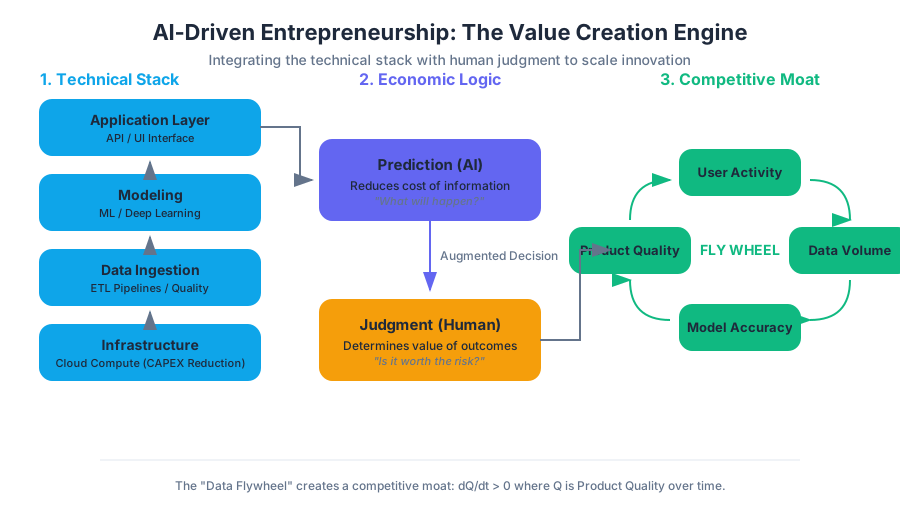
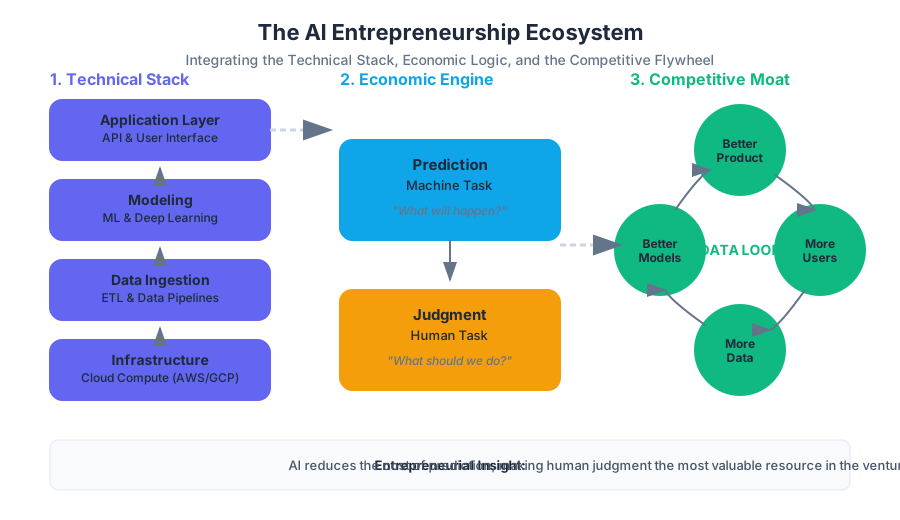
Before an entrepreneur can leverage AI, they must navigate a technical stack that ensures data integrity and model relevance.
| Layer | Component | Entrepreneurial Significance |
|---|---|---|
| Infrastructure | Cloud Compute (AWS/GCP/Azure) | Eliminates high upfront CAPEX for hardware. |
| Data Ingestion | ETL Pipelines (Extract, Transform, Load) | The "fuel" for AI; determines the quality of insights. |
| Modeling | Machine Learning (ML) / Deep Learning | The engine that generates predictions or content. |
| Application | API / UI Layer | How the end-user interacts with the AI's output. |
Predictive Demand Modeling
A common entrepreneurial challenge is inventory management.
The Economics of AI in Entrepreneurship
The primary economic impact of AI is the reduction in the cost of prediction. As prediction becomes cheap, it is used more frequently, and the value of its complements—human judgment and data—increases.
The Prediction-Judgment Decomposition
Entrepreneurs must decompose business problems into prediction tasks and judgment tasks.
- Prediction: Using data to generate information about the unknown (e.g., "Will this customer churn?").
- Judgment: Determining the value or utility of a specific outcome (e.g., "Is it worth offering a 20% discount to prevent that churn?").
Mathematical Representation of the AI Flywheel
The "Data Flywheel" is a core concept in AI entrepreneurship. More users lead to more data, which improves the AI model, which leads to a better product, which attracts more users.
\text{Product Quality} (Q) \propto \text{Model Accuracy} (A)
\text{Model Accuracy} (A) = f(\text{Data Volume } D, \text{Compute } C)
\text{Data Volume} (D) = \int_{0}^{t} \text{User Activity}(u) \, dt
\therefore \frac{dQ}{dt} > 0 \implies \text{Competitive Moat}
This relationship suggests that the first-mover advantage in AI is not just about the code, but about the proprietary data loop established early in the venture's lifecycle.
Decision Making and Managing Change
Entrepreneurship requires constant decision-making under uncertainty. AI enhances this by providing Augmented Intelligence, where the machine handles the data-heavy computation and the human handles the strategic "pivot."
The Pivot vs. Persevere Decision
In the Lean Startup methodology, entrepreneurs use a Build-Measure-Learn loop. AI accelerates the "Measure" and "Learn" phases.
| Phase | Traditional Approach | AI-Enhanced Approach |
|---|---|---|
| Build | Manual MVP development | Low-code/Generative AI prototyping |
| Measure | Lagging financial indicators | Real-time sentiment and behavioral analytics |
| Learn | Qualitative interviews (slow) | Automated A/B testing and cohort analysis |
Ethical Considerations and Global Business
As AI-driven startups scale globally, they encounter diverse regulatory and ethical landscapes. Business ethics in AI is no longer a peripheral concern but a core component of risk management.
Key Ethical Dimensions
- Algorithmic Bias: If the training data contains historical prejudices, the AI will amplify them (e.g., biased hiring algorithms).
- Transparency (The Black Box Problem): The inability to explain why an AI made a specific decision, which is problematic in regulated industries like finance or healthcare.
- Labor Displacement: The entrepreneurial drive for efficiency through AI can lead to significant shifts in the workforce, requiring a focus on "upskilling" as part of corporate social responsibility.
Comparative Global AI Regulations
| Region | Regulatory Approach | Primary Focus |
|---|---|---|
| European Union (AI Act) | Risk-based classification | Human rights and safety |
| United States | Sector-specific / Decentralized | Innovation and market competition |
| China | State-aligned / Algorithmic governance | Social stability and national priority |
Common Pitfalls in AI Entrepreneurship
Even with advanced technology, many ventures fail due to common misconceptions:
- The "Hammer Looking for a Nail": Developing a complex AI solution for a problem that could be solved with a simple spreadsheet or better customer service.
- Underestimating Data Cleaning: Spending 90% of resources on model architecture while the underlying data is noisy or biased.
- Ignoring Technical Debt: Building "quick and dirty" AI integrations that become impossible to maintain as the startup scales.
- The Overfitting Trap: A model that performs perfectly on historical data but fails in the "wild" because it hasn't captured the true underlying market dynamics.
Managing Technological Change
For established businesses, the challenge is Managing Change. This involves transitioning from legacy systems to AI-integrated workflows without disrupting current revenue streams.
Ambidextrous Organization: A firm that is capable of simultaneously exploiting existing competencies (efficiency) and exploring new opportunities (innovation).
Entrepreneurs within large firms (intrapreneurs) must balance these two forces. Success requires a culture that views failure not as a setback, but as a data point in the learning process.
Summary of the AI-Entrepreneurship Nexus
The modern entrepreneur is a "systems orchestrator." They do not need to be the best coder or the best salesperson, but they must understand how to leverage AI to automate the mundane, predict the future, and provide hyper-personalized value to a global audience. The barriers to entry have never been lower, but the requirements for ethical clarity and strategic judgment have never been higher.
Source Materials
Study Introduction Business on Lykke
This course page is free to open: signed out, you can read its first two sections, and signing in, on any plan, opens the rest. The free Lykke Chrome extension syncs your own Canvas courses, so ChatGPT, Claude and Muse can answer from your classes and deadlines. It only reads Canvas.
Add the free extensionSign in to open every sectionAll sections of Introduction Business · Browse more course pages