From the free course Introduction Business on Lykke
Business Ethics and Social Responsibility
Key concepts: Business ethics
An exploration of the moral frameworks that guide business conduct and the importance of maintaining ethical standards in a global economy.
Business Ethics and Social Responsibility
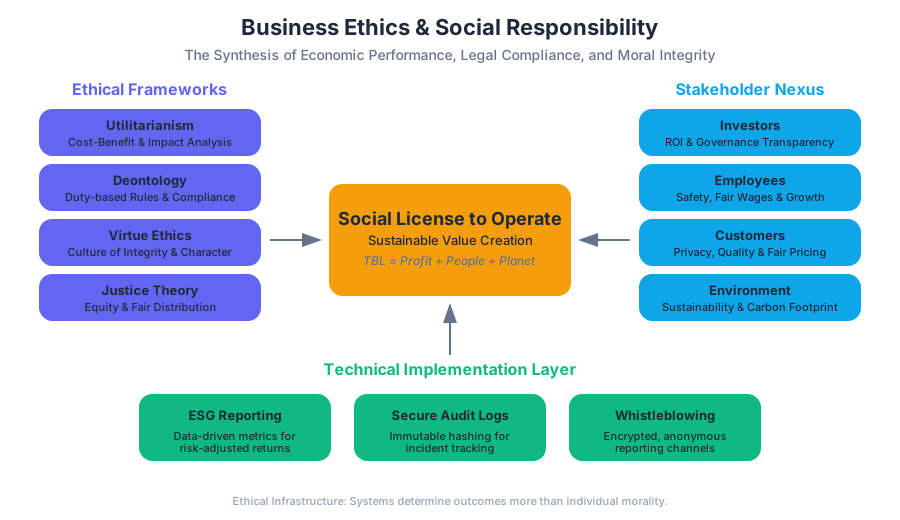
Modern business is no longer a vacuum of pure profit maximization. The contemporary landscape demands a sophisticated synthesis of economic performance, legal compliance, and moral integrity. This section examines the ethical frameworks that guide corporate behavior, the evolution of Corporate Social Responsibility (CSR), and the technical mechanisms used to implement these values in a globalized, tech-driven economy.
The Foundations of Business Ethics
Business Ethics is the systematic study of how moral standards apply to the complexities of organizational life. It is not merely a "feel-good" initiative; it is a critical governance framework designed to mitigate risk, ensure long-term sustainability, and maintain the "social license to operate."
Ethical Frameworks in Practice
To navigate ethical dilemmas, managers rely on established normative theories. These are not just philosophical abstractions; they serve as the "logic gates" for corporate decision-making.
| Theory | Core Principle | Business Application | Potential Flaw |
|---|---|---|---|
| Utilitarianism | The greatest good for the greatest number. | Cost-Benefit Analysis (CBA) and impact assessments. | May sacrifice the rights of a minority for the majority. |
| Deontology | Duty-based ethics; follow universal rules regardless of outcome. | Strict compliance with law and "Code of Conduct" policies. | Can be too rigid in complex, "gray area" scenarios. |
| Virtue Ethics | Focus on the character of the actor rather than the act. | Building a "Culture of Integrity" and leadership development. | Subjective; depends on what a "virtuous" person is defined as. |
| Justice Theory | Fairness and equity in the distribution of benefits/burdens. | Equitable pay scales and diversity, equity, and inclusion (DEI). | Defining "fairness" is politically and socially contested. |
The Slippery Slope and Moral Decoupling
In a technical sense, ethical failure often begins with incrementalism—the "slippery slope" where small, questionable decisions normalize deviant behavior. This is often facilitated by moral decoupling, a psychological process where an individual separates a person's moral character from their professional performance (e.g., "He's a shark in business, but a great family man").
Key Insight: Ethical behavior is a systemic property, not just an individual one. An organization's "Ethical Infrastructure" (communication, surveillance, and sanctioning systems) determines the probability of ethical outcomes more than the personal morality of any single employee.
Corporate Social Responsibility (CSR) and Stakeholder Theory
While ethics focuses on the individual or managerial level, Corporate Social Responsibility (CSR) refers to the organizational level of obligation.
From Shareholder Primacy to Stakeholder Theory
For decades, the "Friedman Doctrine" (Shareholder Primacy) argued that the only social responsibility of business is to increase profits. Modern theory has shifted toward Stakeholder Theory, which posits that a corporation is a nexus of contracts between various groups, all of whom have a "stake" in the firm's operations.
| Stakeholder Group | Primary Interest | Risk of Neglect |
|---|---|---|
| Investors | ROI, Transparency, Governance | Short-termism, financial fraud. |
| Employees | Safety, Fair Wages, Growth | High turnover, labor strikes, burnout. |
| Customers | Quality, Privacy, Fair Pricing | Brand boycott, litigation, regulatory fines. |
| Environment | Sustainability, Carbon Footprint | Ecological collapse, "Greenwashing" backlash. |
| Community | Jobs, Infrastructure, Philanthropy | Loss of "Social License," local opposition. |
The Triple Bottom Line (TBL)
The technical implementation of CSR often follows the Triple Bottom Line framework, which expands the traditional reporting framework to include social and environmental performance.
$$TBL = \sum (Profit + People + Planet)$$
In practice, this is quantified through ESG (Environmental, Social, and Governance) metrics. These metrics allow investors to treat "responsibility" as a data point in a risk-adjusted return calculation.
Implementing Ethics: The Technical Layer
To move from "values on a wall" to "values in the workflow," organizations must implement technical controls. This involves creating systems for whistleblowing, auditing, and algorithmic fairness.
Whistleblowing and Anonymity Systems
A robust ethical culture requires a "fail-safe" for reporting misconduct. This is often implemented via encrypted, third-party managed reporting channels.
Ethical Decision-Making Algorithms
When faced with a dilemma, managers can use a structured heuristic. This "Ethical Filter" ensures that decisions are vetted through multiple lenses before execution.
ALGORITHM Ethical_Filter(Decision D):
    1. LEGAL_CHECK: Does D violate any local or international laws?
       IF True -> REJECT(D, "Illegal")
    2. POLICY_CHECK: Does D violate the Corporate Code of Conduct?
       IF True -> REJECT(D, "Policy Violation")
    3. STAKEHOLDER_IMPACT:
       Calculate Impact(D) for {Employees, Customers, Environment, Shareholders}
       IF Impact(D).Environment < Threshold -> FLAG(D, "Environmental Risk")
    4. THE_NEWSPAPER_TEST: If this decision were on the front page tomorrow,
       would the CEO be comfortable?
       IF False -> REJECT(D, "Reputational Risk")
    5. RETURN APPROVE(D)
Global Business Ethics
In a globalized economy, ethics becomes exponentially more complex due to Cultural Relativism—the idea that no culture's ethics are superior to another's. However, businesses must often balance this against Ethical Imperialism, which is the attempt to impose one's own ethical standards on a host country.
The Foreign Corrupt Practices Act (FCPA)
The FCPA is a landmark piece of U.S. legislation that prohibits companies from bribing foreign officials. It creates a "level playing field" but also presents significant compliance challenges in regions where "facilitation payments" (grease payments) are culturally normalized.
Global CSR Standards
To standardize behavior, several international frameworks have emerged:
- UN Global Compact: A voluntary initiative based on CEO commitments to implement universal sustainability principles.
- ISO 26000: Provides guidance on how businesses and organizations can operate in a socially responsible way.
- GRI (Global Reporting Initiative): The most widely used standards for sustainability reporting.
Modern Challenges: AI, Data, and ESG
As we move into the "Fourth Industrial Revolution," the ethical landscape is shifting toward data and automation.
Algorithmic Bias and AI Ethics
When businesses use AI for hiring, lending, or pricing, they risk automating human bias. Algorithmic Accountability requires that these models be transparent and auditable.
The Rise of ESG Investing
Environmental, Social, and Governance (ESG) criteria are a set of standards for a company’s operations that socially conscious investors use to screen potential investments.
| Pillar | Key Metrics | Technical Implementation |
|---|---|---|
| Environmental | Carbon Intensity, Water Usage, Waste Management | IoT sensors for real-time emission tracking. |
| Social | Employee Turnover, Safety Incidents, Pay Gap | HRIS (Human Resource Information Systems) auditing. |
| Governance | Board Diversity, Executive Compensation, Audit Quality | Proxy voting records and blockchain-based cap tables. |
Common Pitfalls in Business Ethics
- Greenwashing: Spending more time and money on marketing being "green" than on actually implementing environmentally sound practices.
- Compliance vs. Integrity: Treating ethics as a "checkbox" (Compliance) rather than a core value (Integrity). Compliance-only systems often fail because they don't address the spirit of the law.
- The "Ethics Premium" Myth: The belief that being ethical always costs more. In reality, ethical companies often have lower costs of capital and higher employee retention.
- Diffusion of Responsibility: In large hierarchies, individuals may feel that "someone else" is responsible for the ethical outcome, leading to systemic failure (e.g., the Wells Fargo cross-selling scandal).
Summary of the Ethical Evolution
The trajectory of business ethics has moved from simple legal compliance to a strategic imperative. Organizations that fail to integrate social responsibility into their core "operating system" face existential risks in an era of radical transparency and stakeholder empowerment.
Theorem of Ethical Resilience: The long-term stability of a firm ($S$) is directly proportional to the alignment between its stated values ($V_s$) and its operationalized actions ($A_o$), divided by the friction of its compliance overhead ($C$). $$S \propto \frac{V_s \cap A_o}{C}$$
Study Guide: Business Ethics and Social Responsibility
1. Core Definitions
- Business Ethics: The application of moral standards to business behavior.
- Corporate Social Responsibility (CSR): The obligation of a business to contribute to the well-being of society.
- Stakeholders: Any individual or group that can affect or be affected by an organization’s actions.
- ESG: Environmental, Social, and Governance metrics used to measure sustainability.
2. Key Frameworks
- Utilitarianism: Focus on outcomes (greatest good).
- Deontology: Focus on rules and duties.
- Triple Bottom Line: Measuring success via Profit, People, and Planet.
- Stakeholder Theory: Moving beyond just shareholders to include employees, customers, and the community.
3. Critical Legislation & Standards
- FCPA (1977): Prohibits U.S. firms from bribing foreign officials.
- Sarbanes-Oxley Act (2002): Mandates strict financial reporting and internal controls.
- ISO 26000: International standard for social responsibility.
4. Modern Ethical Dilemmas
- AI Bias: Ensuring algorithms don't discriminate.
- Data Privacy: Balancing personalization with consumer rights.
- Climate Change: Decarbonizing supply chains and operations.
5. Implementation Strategies
- Code of Ethics: A formal document outlining an organization's values.
- Whistleblower Protection: Systems to allow safe reporting of misconduct.
- Ethical Audits: Systematic evaluation of an organization's ethical performance.
Source Materials
Study Introduction Business on Lykke
This course page is free to open: signed out, you can read its first two sections, and signing in, on any plan, opens the rest. The free Lykke Chrome extension syncs your own Canvas courses, so ChatGPT, Claude and Muse can answer from your classes and deadlines. It only reads Canvas.
Add the free extensionSign in to open every sectionAll sections of Introduction Business · Browse more course pages