From the free course Information Systems - A Manager's Guide to Harnessing Technology on Lykke
Zara: Fast Fashion from Savvy Systems
Key concepts: Fast Fashion · Vertical Integration · Data-Driven Decision Making · Supply Chain Management
A case study on how Zara leverages information systems and data-driven decision-making to revolutionize the fashion industry.
Zara: Fast Fashion from Savvy Systems
Zara, the flagship brand of the Spanish conglomerate Inditex, represents the definitive case study in how information systems (IS) can transform a legacy industry. While traditional fashion retailers operate on seasonal cycles planned months in advance, Zara has pioneered a model of Fast Fashion—a high-velocity, data-driven approach to design, production, and distribution. By treating clothing as a perishable commodity—much like fresh produce—Zara leverages Vertical Integration and real-time data to achieve industry-leading margins and minimal inventory risk.
The core of Zara’s success is not merely "better technology" in a vacuum, but the seamless integration of technology into a unique business process. This article explores the architectural underpinnings of the Zara model, from the handheld devices used by store managers to the automated logistics of "The Cube."
The Fast Fashion Paradigm: Speed as a Competitive Advantage
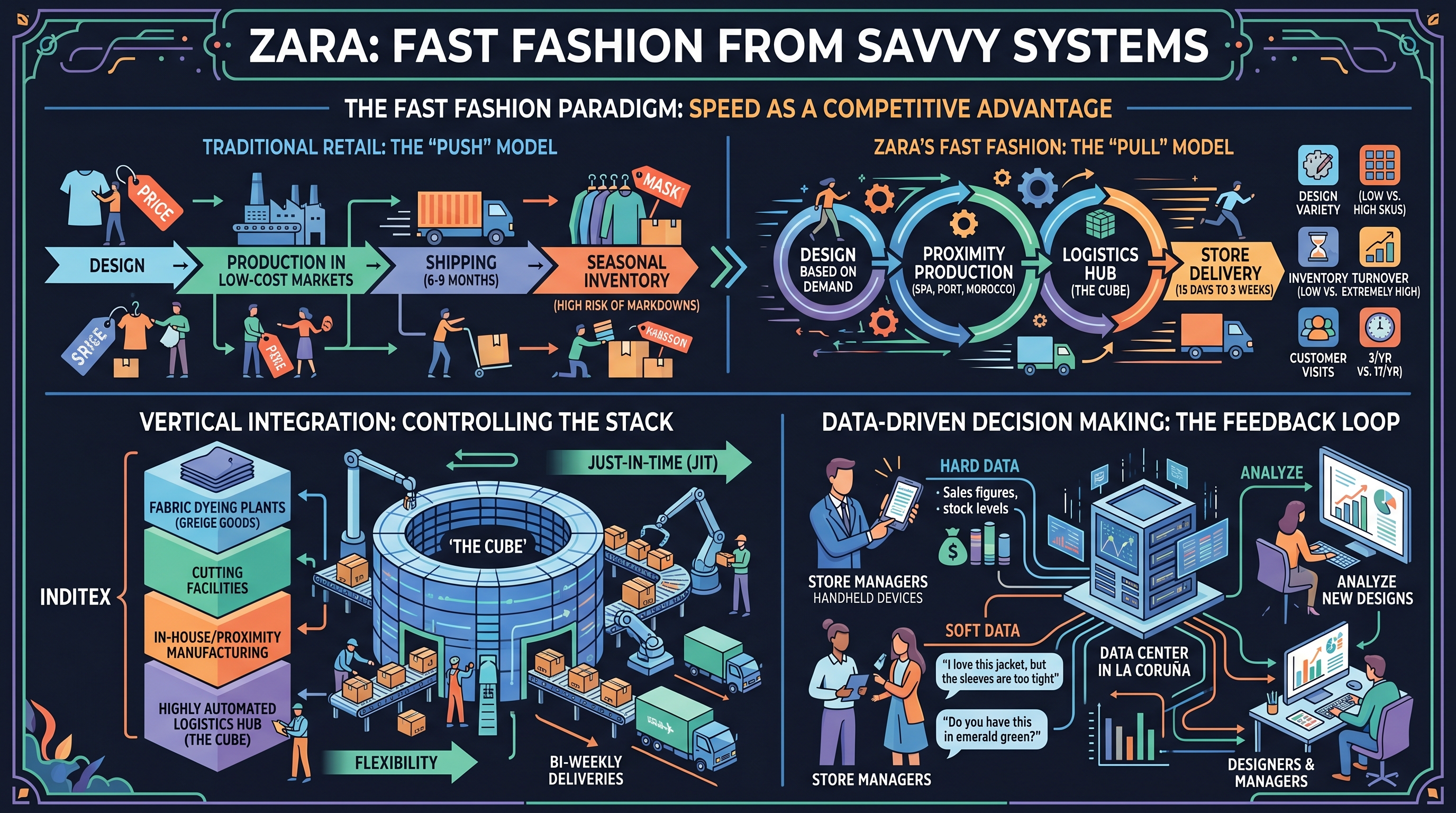
In the traditional retail model, designers predict trends nearly a year in advance. This "push" model relies on massive production runs in low-cost labor markets (e.g., Southeast Asia) to achieve economies of scale. However, this leads to significant Inventory Risk: if the trend fails to materialize, the retailer is forced to use deep markdowns to clear stock.
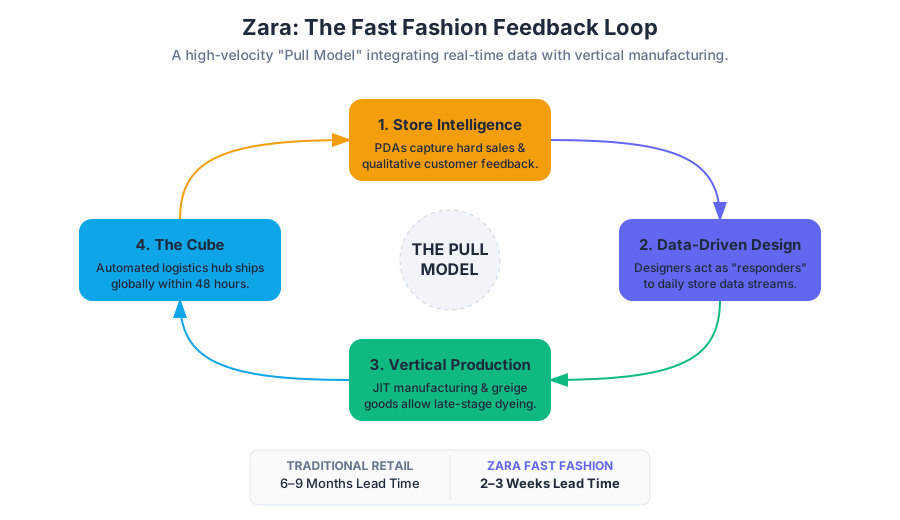
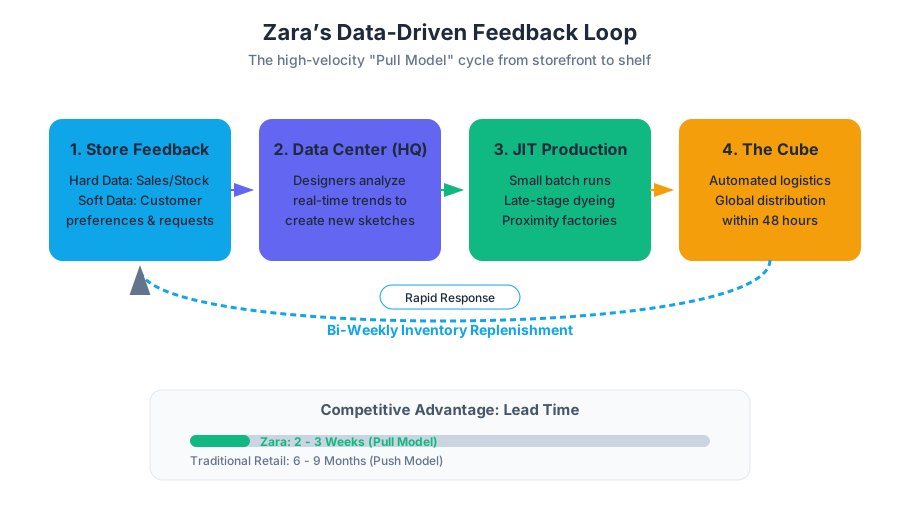
Zara utilizes a Pull Model, where production is driven by actual customer demand captured in real-time. This reduces the need for advertising and markdowns, as the products in-store are precisely what customers are asking for at that moment.
Comparison: Traditional Retail vs. Zara
| Metric | Traditional Retail | Zara (Fast Fashion) |
|---|---|---|
| Design-to-Shelf Lead Time | 6 to 9 months | 15 days to 3 weeks |
| Design Variety | 2,000 – 4,000 SKUs/year | 12,000 – 30,000 SKUs/year |
| Manufacturing Location | Outsourced (Low-cost/Far) | In-house/Proximity (Spain, Portugal, Morocco) |
| Inventory Turnover | Low (Seasonal batches) | Extremely High (Bi-weekly deliveries) |
| Markdown Rate | 50% – 70% of inventory | ~15% of inventory |
| Customer Store Visits | 3 times per year | 17 times per year |
Definition: Fast Fashion A retail strategy focused on the rapid transition of high-fashion trends from the catwalk to the consumer. It relies on compressed supply chains, small-batch production, and high-frequency inventory turnover.
Vertical Integration: Controlling the Stack
While most competitors outsource manufacturing to third parties to minimize capital expenditure, Zara is highly Vertically Integrated. Inditex owns its own fabric dyeing plants, cutting facilities, and logistics hubs.
The Strategic Logic of "Make" over "Buy"
In management theory, the "Make vs. Buy" decision usually favors "Buy" for non-core activities. Zara, however, views manufacturing speed as its core competency. By owning the production facilities, Zara avoids the friction of contract negotiations, shipping delays from overseas, and the lack of flexibility inherent in third-party agreements.
- Just-in-Time (JIT) Manufacturing: Zara produces roughly 60% of its merchandise in-house or in close proximity to its headquarters in La Coruña, Spain.
- Greige Goods: Zara purchases fabric in "greige" (undyed) form. This allows them to wait until the very last minute to dye the fabric based on which colors are trending in the current week.
- The "Cube": A massive, highly automated distribution center that serves as the central nervous system of the global operation.
Data-Driven Decision Making: The Feedback Loop
Zara’s "savvy systems" start on the shop floor. Store managers are equipped with custom handheld devices (originally PDAs, now specialized mobile apps) to capture two types of data:
- Hard Data: Real-time sales figures, inventory levels, and stockouts.
- Soft Data: Qualitative feedback from customers. (e.g., "I love this jacket, but the sleeves are too tight," or "Do you have this in emerald green?")
This information is beamed back to the Data Center in La Coruña, where designers and commercial managers analyze it daily. Unlike traditional firms where designers are "creative dictators," Zara designers are "data-driven responders."
Supply Chain Management: The Logistics of 48 Hours
Zara’s logistics are designed for speed, not cost-minimization. While shipping by sea is cheaper, Zara frequently uses air freight to ensure that a design created in Spain can be on a rack in Tokyo or New York within 48 hours.
The Logistics Pipeline
- Automated Cutting: Computer-controlled machines cut fabric with millimeter precision to minimize waste.
- Local Sewing Clusters: Pieces are sent to local cooperatives for sewing. This keeps the "atoms" close to the "bits" (the data).
- The Underground Tunnel System: In La Coruña, a 124-mile labyrinth of underground tracks moves finished garments from factories to the central distribution center.
- Pre-Labeled/Pre-Hangered: Clothes arrive at stores already on hangers with security tags and price tags attached. This allows store staff to move items from the delivery truck to the sales floor in minutes.
Mathematical Modeling of Lead Time
The advantage of Zara's vertical integration can be expressed through the relationship between lead time ($L$) and the standard deviation of demand ($\sigma_D$). In traditional supply chain theory, the required safety stock ($SS$) is:
SS = Z \times \sqrt{L \times \sigma_D^2 + D^2 \times \sigma_L^2}
Where:
- $Z$ is the service level factor.
- $L$ is the lead time.
- $\sigma_D$ is the volatility of demand.
- $\sigma_L$ is the volatility of lead time.
By reducing $L$ from months to days and minimizing $\sigma_L$ through vertical ownership, Zara mathematically reduces the amount of capital tied up in safety stock, allowing for a leaner, more responsive inventory.
Strategic Technology Use: Less is More
Interestingly, Zara spends significantly less on Information Technology as a percentage of revenue than the industry average (~0.5% vs. 2.0%). This is a crucial lesson in Information Systems Management: the value of IT is not in the budget size, but in the Strategic Alignment of the technology with the business process.
Zara’s IT Principles
- Targeted Deployment: Technology is only used where it directly speeds up the "Design-to-Shelf" cycle.
- Simplicity: Store systems are designed to be used by fashion-focused employees, not IT specialists.
- Proprietary Software: Instead of using generic "Off-the-Shelf" ERP systems that would force Zara to follow industry-standard (slow) processes, they build custom software that mirrors their unique workflow.
Challenges and the "Atoms to Bits" Transition
Despite its dominance, Zara faces emerging threats. The rise of Ultra-Fast Fashion (e.g., Shein) leverages even more aggressive data scraping and a purely digital storefront to undercut Zara’s lead times.
Common Pitfalls and Misconceptions
- The "Copycat" Risk: Zara’s model of responding to trends rather than setting them has led to numerous intellectual property lawsuits.
- Sustainability Concerns: The fast fashion model is inherently resource-intensive. Zara is currently investing in "Circular Fashion" and automated recycling to mitigate the environmental impact of its high-volume production.
- The Physical Footprint: While Zara’s stores act as showrooms and local distribution hubs, the shift to e-commerce (the transition from "Atoms to Bits") requires a re-evaluation of their expensive prime-real-estate strategy.
Summary of Strategic Frameworks
| Framework | Application to Zara |
|---|---|
| Porter’s Five Forces | Zara reduces the Bargaining Power of Buyers by creating "artificial scarcity" (if you don't buy it now, it's gone). |
| Resource-Based View (RBV) | Zara's supply chain is Valuable, Rare, Imperfectly Imitable, and Non-substitutable (VRIN), providing a sustainable advantage. |
| Value Chain Analysis | Zara optimizes the Inbound Logistics and Operations segments to a degree that competitors cannot match without radical restructuring. |
Artifacts Appendix
Flashcards
- Fast Fashion: A retail model based on rapid response to trends and high inventory turnover.
- Vertical Integration: When a firm owns multiple stages of its production/distribution chain.
- Just-In-Time (JIT): An inventory strategy that aligns raw-material orders from suppliers directly with production schedules.
- The Cube: Zara’s highly automated, centralized distribution hub in Spain.
- Inventory Risk: The financial risk that a retailer will be unable to sell its stock at the intended price.
- Greige Goods: Raw fabric that has not yet been bleached or dyed.
Quiz
- Why does Zara prefer to own its production facilities rather than outsource to low-cost regions?
- Answer: To maintain maximum flexibility and lead-time speed, which is more valuable than low labor costs in a fast-fashion model.
- How does Zara create "artificial scarcity"?
- Answer: By producing small batches and frequently changing inventory, encouraging customers to buy immediately.
- What is the primary role of a Zara store manager in the design process?
- Answer: To act as a data sensor, reporting both sales figures and qualitative customer feedback to designers.
- How does the "Greige Goods" strategy benefit Zara?
- Answer: It allows them to postpone the color-choice decision until the latest possible moment based on real-time trend data.
Study Guide: Zara and Information Systems
- Key Objective: Understand how technology enables a business process rather than just automating an old one.
- Core Concepts to Master:
- The difference between "Push" and "Pull" supply chains.
- The financial implications of high inventory turnover.
- The strategic trade-offs of vertical integration.
- The role of "Soft Data" in decision-making.
- Case Study Comparison: Compare Zara’s model to a traditional retailer like Gap or H&M. Note the differences in advertising spend and markdown frequency.
- Technical Focus: Review the impact of lead time on the safety stock formula and how automated logistics (RFID, automated sorting) reduce friction in the distribution phase.
Source Materials
- 3: Zara- Fast Fashion from Savvy Systems
- 11: The Data Asset- Databases, Business Intelligence, and Competitive Advantage
- Front Matter
- 1: Setting the Stage- Technology and the Modern Enterprise
- 4: Netflix- The Making of an E-commerce Giant and the Uncertain Future of Atoms to Bits
- 8: Facebook- Building a Business from the Social Graph
- 12: A Manager’s Guide to the Internet and Telecommunications
- Front Matter
Study Information Systems - A Manager's Guide to Harnessing Technology on Lykke
This course page is free to open: signed out, you can read its first two sections, and signing in, on any plan, opens the rest. The free Lykke Chrome extension syncs your own Canvas courses, so ChatGPT, Claude and Muse can answer from your classes and deadlines. It only reads Canvas.
Add the free extensionSign in to open every sectionAll sections of Information Systems - A Manager's Guide to Harnessing Technology · Browse more course pages