From the free course Information Systems - A Manager's Guide to Harnessing Technology on Lykke
Understanding Network Effects
Key concepts: Network Effects · Metcalfe's Law · One-Sided Markets · Two-Sided Markets
An introduction to how the value of products and services scales with the size of their user base.
Understanding Network Effects
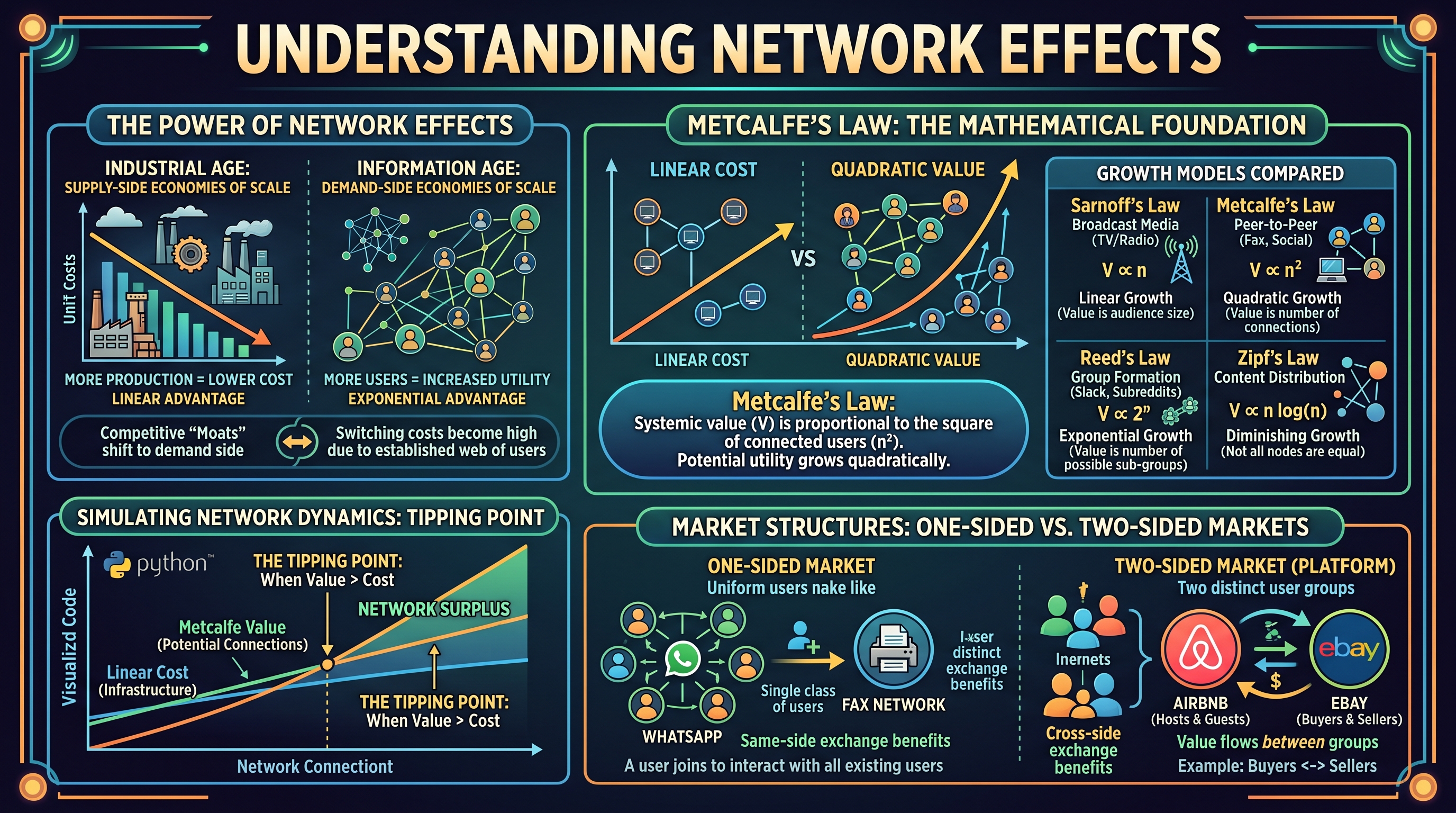
Network effects—often referred to as network externalities or demand-side economies of scale—represent a phenomenon where the value of a product or service increases as its user base grows. In the industrial age, competitive advantage was often driven by supply-side economies of scale: the more you produced, the lower your marginal costs. In the information age, the most powerful "moats" are built on the demand side. When a network is established, the cost for a user to switch to a competitor becomes prohibitively high, not because the competitor's software is bad, but because the competitor lacks the established web of users.
The Mathematical Foundation: Metcalfe’s Law
At the heart of network theory lies Metcalfe's Law, named after Robert Metcalfe, the co-inventor of Ethernet. The law provides a mathematical framework for understanding why networks scale in value so aggressively compared to linear businesses.
The Core Logic
Metcalfe’s Law states that the value of a telecommunications network is proportional to the square of the number of connected users of the system ($n^2$). While $n$ users generate $n$ costs, they create $n(n-1)/2$ potential connections. As $n$ grows large, the $n^2$ term dominates.
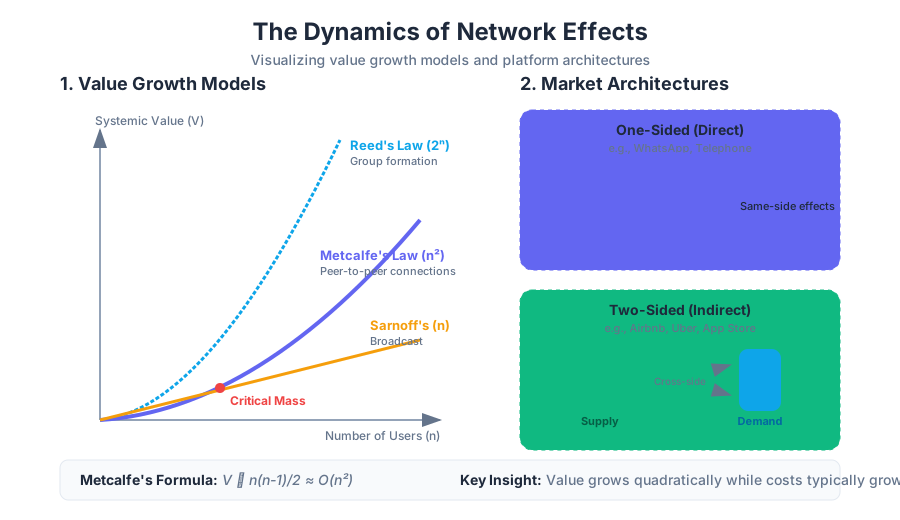
Definition: Metcalfe's Law The systemic value of a network is mathematically represented as $V \propto n(n-1)/2$, which simplifies to $O(n^2)$ in asymptotic notation. This implies that while costs grow linearly with the number of users, the potential utility grows exponentially.
Comparison of Growth Models
To understand the power of Metcalfe's Law, we must compare it to other valuation models used in information theory and broadcasting.
| Model | Formula | Context | Growth Characteristic |
|---|---|---|---|
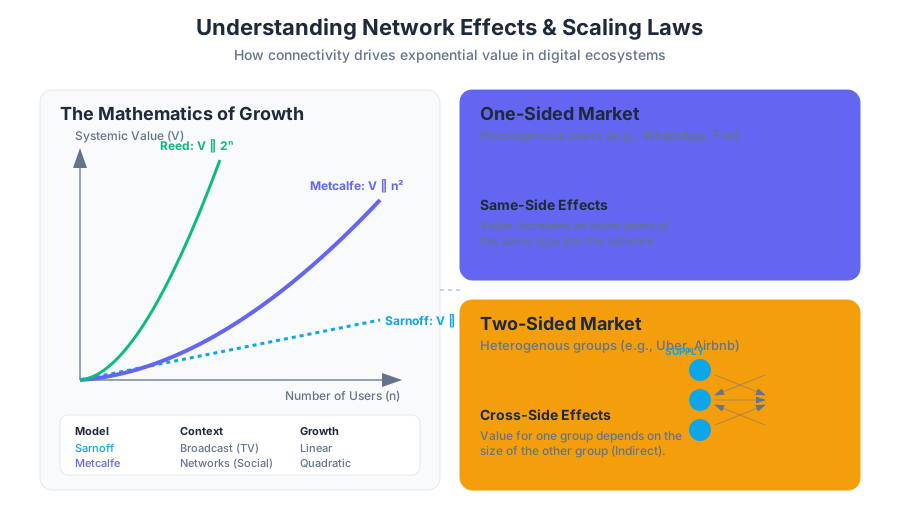
| Sarnoff’s Law | $V \propto n$ | Broadcast Media (TV/Radio) | Linear: Value is based on the size of the audience. |
| Metcalfe’s Law | $V \propto n^2$ | Peer-to-Peer (Fax, Phone, Social) | Quadratic: Value is based on the number of possible pairs. |
| Reed’s Law | $V \propto 2^n$ | Group Formation (Slack, Subreddits) | Exponential: Value is based on the number of possible sub-groups. |
| Zipf’s Law | $V \propto n \log(n)$ | Content/Usage Distribution | Diminishing: Accounts for the fact that not all nodes are equally valuable. |
Market Structures: One-Sided vs. Two-Sided Markets
Not all networks are structured the same way. The strategic approach to building a network depends heavily on whether the participants are homogenous or heterogenous.
One-Sided Markets
In a One-Sided Market, the value of the network is derived from a single class of users. Every new user added to the network can interact with every other user.
- Example: WhatsApp. A new user joins to message existing users; there is no distinction between "types" of users in the core transaction.
- Primary Driver: Same-side exchange benefits. The utility comes from the ability to reach more people within the same category.
Two-Sided Markets
A Two-Sided Market (or platform) involves two distinct categories of participants: Supply-side and Demand-side. Both groups are necessary for the network to function, and they provide value to each other.
- Example: Airbnb (Hosts and Guests), eBay (Buyers and Sellers), PlayStation (Developers and Gamers).
- Primary Driver: Cross-side exchange benefits. An increase in the number of users on one side (e.g., more Uber drivers) increases the value for users on the other side (e.g., shorter wait times for riders).
Comparison Table: Market Dynamics
| Feature | One-Sided Market | Two-Sided Market |
|---|---|---|
| User Roles | Homogenous (Users = Users) | Heterogenous (e.g., Buyers vs. Sellers) |
| Primary Effect | Same-side (Direct) | Cross-side (Indirect) |
| Growth Catalyst | Viral loops, utility | Subsidies, "Chicken-and-Egg" resolution |
| Switching Costs | High (Loss of all contacts) | Variable (Depends on multi-homing) |
| Example | Telegram, Fax machines | Amazon Marketplace, iOS App Store |
The Mechanics of Cross-Side Effects
In two-sided markets, the relationship between the two sides is often asymmetrical. Managers must decide which side to subsidize and which side to monetize.
- The Subsidy Side: This group is highly price-sensitive and is critical for attracting the other side. (e.g., Adobe gives away the Acrobat Reader for free to ensure there is a massive audience for PDF creators).
- The Money Side: This group is willing to pay to access the subsidy side. (e.g., Businesses pay for Adobe Acrobat Pro to create the documents that the subsidy side consumes).
Mathematical Derivation of Cross-Side Value
If $n_b$ is the number of buyers and $n_s$ is the number of sellers, the total value $V$ of the platform can be modeled as a function of the interactions between the two:
V = \alpha(n_b \cdot n_s)
Where $\alpha$ represents the "interaction efficiency" or the probability of a successful match. This highlights why two-sided markets are so difficult to start: if either $n_b$ or $n_s$ is zero, the total value is zero. This is the Cold Start Problem.
Strategic Implications: Winners, Losers, and Tipping Points
Network markets have a natural tendency toward "Winner-Take-All" or "Winner-Take-Most" outcomes. When one firm gains a lead, the self-reinforcing nature of network effects makes that lead increasingly difficult to overcome.
The Tipping Point
The Tipping Point is the moment when the momentum of a growing network becomes unstoppable. Once a firm reaches a certain market share, the collective switching costs of the user base become a barrier that competitors cannot breach, even with superior technology.
Factors Affecting "Winner-Take-All" Potential
Not every market with network effects tips toward a single monopoly. Several factors influence the outcome:
| Factor | High Tipping Potential | Low Tipping Potential |
|---|---|---|
| Network Strength | Strong, direct connections | Weak, indirect connections |
| Multi-homing Costs | High (Hard to use two platforms) | Low (Easy to use two platforms) |
| Niche Specialization | Low (Generic needs) | High (Users have unique needs) |
| Negative Effects | Minimal (Congestion is managed) | High (Network gets worse as it grows) |
Key Insight: The "Best" Product Fallacy In network markets, the "best" technical product frequently loses to the "best" network. Consider the classic battle between BetaMax and VHS. BetaMax was technically superior in video quality, but VHS built a larger network of rental tapes and hardware manufacturers, leading to a total market tip.
Common Pitfalls and Negative Network Effects
While positive network effects create value, they are not infinite. Managers must be wary of Negative Network Effects (or congestion), where the value of the network decreases as more users join.
1. Congestion and Latency
In physical networks (like roads or the early internet), too many users lead to traffic jams and slow speeds. In digital social networks, this manifests as "noise." If your LinkedIn feed is filled with 10,000 strangers posting irrelevant content, the value of the network to you decreases.
2. The "Groucho Marx" Effect
Named after the quote "I don't want to belong to any club that would have me as a member," this occurs when the "wrong" type of users join a network, driving away the "right" type. This is common in exclusive social clubs or dating apps where a gender imbalance can lead to a death spiral.
3. Security and Malware
As a network grows, it becomes a more attractive target for hackers. The "value" to a malicious actor also follows Metcalfe's Law. A platform with 1 billion users is a much more lucrative target for a virus than one with 1,000 users.
Case Study: The "Atoms to Bits" Transition
The shift from physical goods (Atoms) to digital goods (Bits) has accelerated network effects.
- Netflix: In its "Atoms" phase (DVD-by-mail), Netflix had limited network effects. The value was in the inventory. In its "Bits" phase (Streaming), it leverages data-driven network effects. Every user's viewing habits improve the recommendation engine for every other user, creating a virtuous cycle of engagement that competitors like Disney+ or HBO Max struggle to replicate despite having better legacy content.
- Zara: While primarily a physical retailer, Zara uses information systems to create a "feedback network" between store managers and designers. This internal network effect allows them to respond to fashion trends in weeks rather than months, effectively using bits to move atoms faster.
Summary of Strategic Frameworks
To successfully navigate a network-effect-driven market, a manager must execute on three fronts:
- Move Early: Since these markets tip, being the first to reach the critical mass is often more important than having a perfect feature set.
- Subsidize the "Hard" Side: Identify which side of the market is harder to get (usually the supply side in marketplaces) and offer incentives to join.
- Build Switching Costs: Use data, proprietary formats, or social capital to ensure that leaving the network is "expensive" for the user.
- Metcalfe's Law: The value of a network is proportional to the square of the number of users ($n^2$).
- One-Sided Market: A market deriving value from a single class of users (e.g., Instant Messaging).
- Two-Sided Market: A market requiring two distinct participant groups (e.g., Credit Cards - Merchants and Cardholders).
- Cross-Side Exchange Benefit: When an increase in one user group increases value for the other group in a two-sided market.
- Same-Side Exchange Benefit: When an increase in a user group increases value for that same group.
- Tipping Point: The critical mass at which network growth becomes self-sustaining and leads to market dominance.
- Multi-homing: When users participate in multiple competing networks simultaneously (e.g., using both Uber and Lyft).
- Switching Costs: The cost (time, money, psychological) a consumer incurs when moving from one product to a competitor.
-
Question: If a network grows from 10 users to 20 users, according to Metcalfe's Law, how has the potential value changed?
- A) It has doubled.
- B) It has tripled.
- C) It has quadrupled (roughly).
- D) It remains the same.
- Answer: C (Value goes from ~100 units to ~400 units).
-
Question: Which of the following is an example of a "Negative Network Effect"?
- A) A social network adding a "Dark Mode" feature.
- B) An eBay seller increasing their prices.
- C) A highway becoming so crowded that travel time increases.
- D) A developer writing an app for the iOS App Store.
- Answer: C.
-
Question: Why did the high-definition disc war end with Blu-ray winning over HD-DVD, despite both having similar technical specs?
- A) Blu-ray was cheaper to manufacture.
- B) Sony bundled Blu-ray players with the PlayStation 3, creating an instant "installed base" (network).
- C) HD-DVD had a lower storage capacity.
- D) Blu-ray discs were more scratch-resistant.
- Answer: B.
-
Question: In a two-sided market like Airbnb, which side is typically the "subsidy side"?
- A) The Guests (Demand)
- B) The Hosts (Supply)
- C) The Government regulators
- D) The Software Engineers
- Answer: B (Often, platforms must offer lower fees or tools to hosts to ensure there is enough inventory to attract guests).
Core Concepts to Master
- The $n^2$ Logic: Be able to explain why connections grow faster than nodes.
- Market Identification: Practice categorizing businesses (e.g., Is TikTok one-sided or two-sided? Hint: It's multi-sided involving creators, viewers, and advertisers.)
- The Cold Start Problem: Understand the strategies used to jumpstart a network (e.g., "Seeding" the market, leveraging "Atoms" before "Bits").
- Barriers to Entry: Analyze how network effects create high barriers to entry for startups, even if the startup has a "better" product.
- Convergence: Observe how different technologies (Mobile, Cloud, Social) converge to amplify network effects.
Recommended Reading & Analysis
- Compare the growth of the Telephone (Metcalfe's original context) with the growth of Facebook.
- Research the "Blue Ocean" strategy vs. "Network Tipping" strategy.
- Analyze the impact of Interoperability (e.g., can you send a text from Verizon to AT&T?) on the strength of network effects.
Source Materials
- 6: Understanding Network Effects
- 5: Moore’s Law- Fast, Cheap Computing and What It Means for the Manager
- 8: Facebook- Building a Business from the Social Graph
- 2: Strategy and Technology- Concepts and Frameworks for Understanding What Separates Winners from Losers
- 9: Understanding Software- A Primer for Managers
- Front Matter
- Save as PDF
- 1: Setting the Stage- Technology and the Modern Enterprise
Study Information Systems - A Manager's Guide to Harnessing Technology on Lykke
This course page is free to open: signed out, you can read its first two sections, and signing in, on any plan, opens the rest. The free Lykke Chrome extension syncs your own Canvas courses, so ChatGPT, Claude and Muse can answer from your classes and deadlines. It only reads Canvas.
Add the free extensionSign in to open every sectionAll sections of Information Systems - A Manager's Guide to Harnessing Technology · Browse more course pages