From the free course Information Systems - A Manager's Guide to Harnessing Technology on Lykke
Technology and the Modern Enterprise
Key concepts: Tech’s Tectonic Shift · Business Landscape Transformation · Technological Literacy · Modern Enterprise
An introduction to how technology is fundamentally reshaping the global business landscape and why technological literacy is essential for modern managers.
Technology and the Modern Enterprise
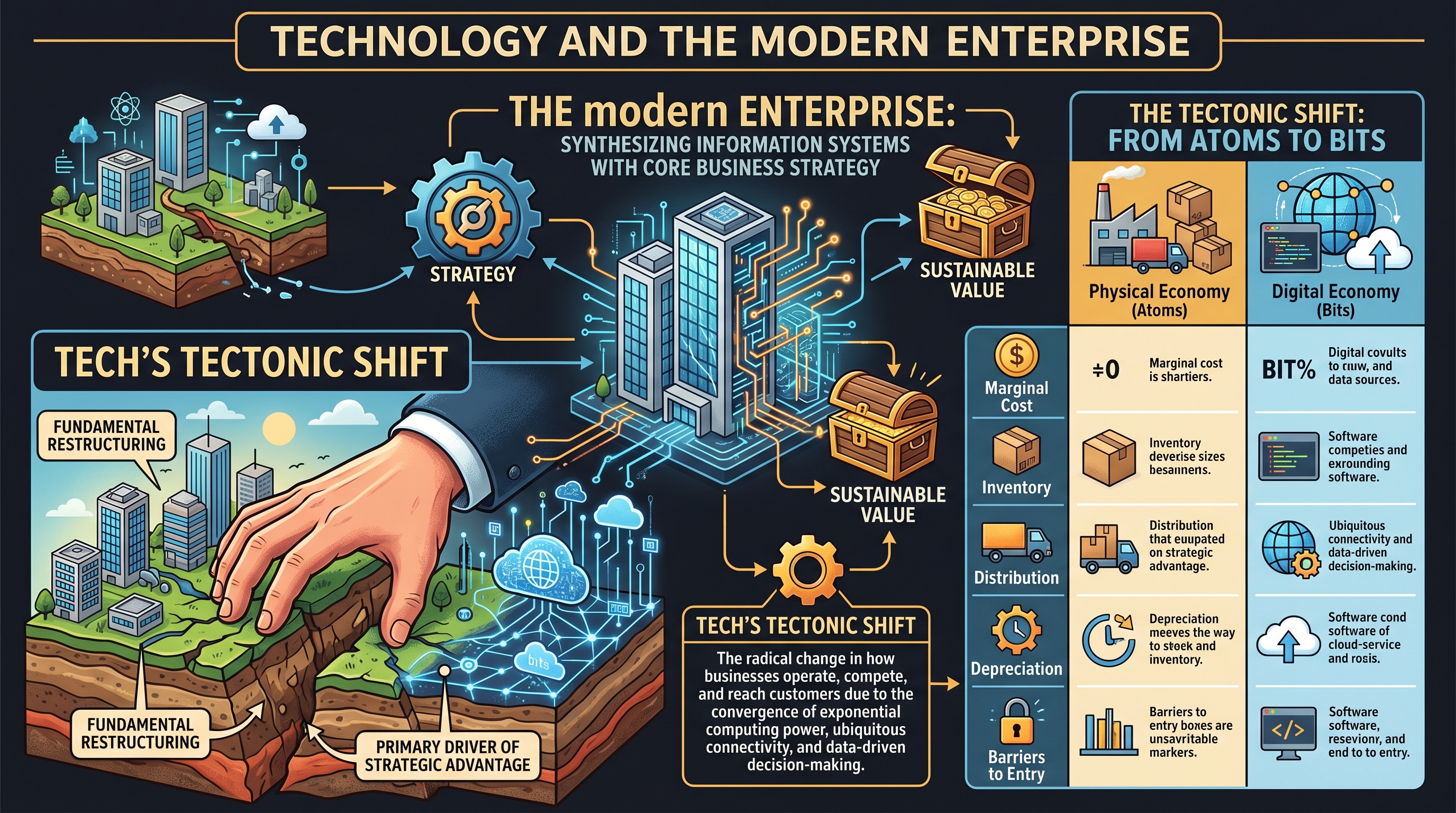
The contemporary business environment is currently undergoing what is described as Tech’s Tectonic Shift. This is not merely an incremental improvement in tools, but a fundamental restructuring of the global economy where technology has moved from a supporting "back-office" function to the primary driver of strategic advantage and market disruption. In this landscape, the Modern Enterprise is defined by its ability to synthesize information systems with core business strategy to create sustainable value.
The Tectonic Shift: From Atoms to Bits
The most profound driver of the modern enterprise is the transition from a physical-centric economy to a digital-centric one. This shift is often characterized as the move from Atoms to Bits. While physical goods (atoms) are subject to the laws of traditional logistics—shipping costs, inventory decay, and geographic limitations—digital goods (bits) operate under a different economic reality.
The Economics of Digital Transformation
In a digital economy, the marginal cost of producing an additional unit of a good often approaches zero. This allows for massive scalability that was previously impossible.
| Feature | Physical Economy (Atoms) | Digital Economy (Bits) |
|---|---|---|
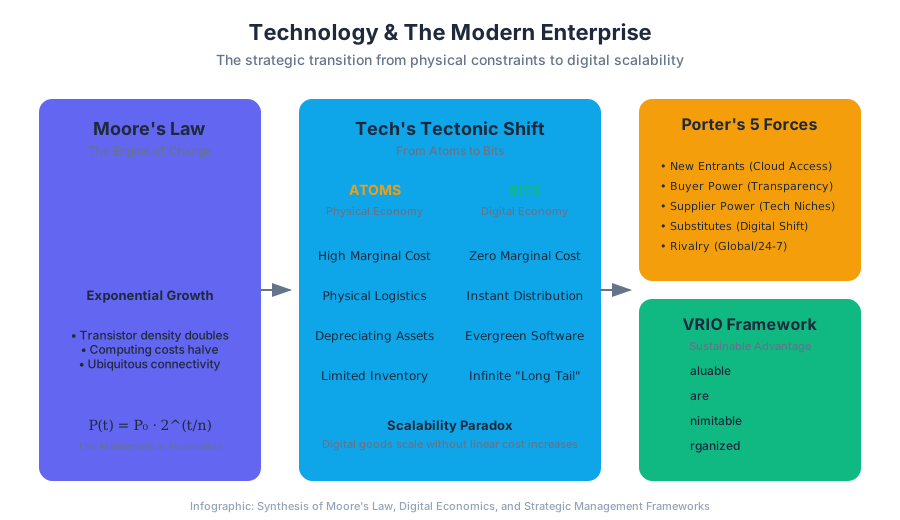
| Marginal Cost | Significant (Materials + Labor) | Near Zero (Bandwidth + Storage) |
| Inventory | Limited by shelf space | Virtually infinite (The Long Tail) |
| Distribution | Slow, physical logistics | Instantaneous, global |
| Depreciation | High (Physical wear/obsolescence) | Low (Software can be updated) |
| Barriers to Entry | High (Capital intensive) | Lower (Cloud infrastructure) |
Definition: Tech’s Tectonic Shift The radical change in how businesses operate, compete, and reach customers due to the convergence of exponential computing power, ubiquitous connectivity, and data-driven decision-making.
Moore’s Law: The Engine of Change
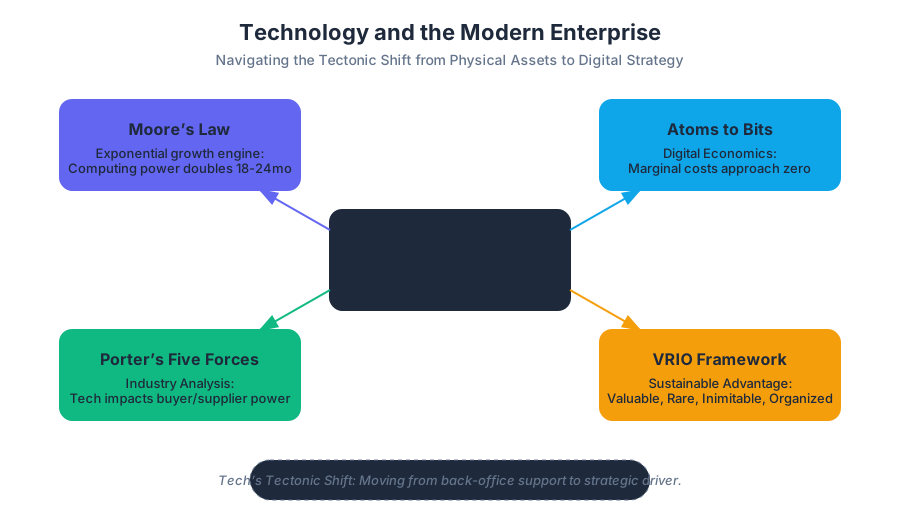
At the heart of this tectonic shift is Moore’s Law, the observation that the number of transistors on a chip doubles approximately every two years, while the cost of computing halves. This exponential growth has transformed computing from a rare, expensive resource into a cheap, ubiquitous commodity.
The Mathematical Foundation
Moore's Law is often expressed as a function of time $t$:
$$P(t) = P_0 \cdot 2^{(t/n)}$$
Where:
- $P(t)$ is the computing power at time $t$.
- $P_0$ is the initial computing power.
- $n$ is the doubling period (historically ~18 to 24 months).
For a manager, this means that the "impossible" calculation of today becomes the "standard" calculation of tomorrow. However, Moore's Law is facing physical limits, such as the Triple Threat of size, heat, and power consumption, leading to a shift toward multicore processors and cloud-based Grid Computing.
Strategic Frameworks for the Modern Enterprise
Technological literacy is not just about knowing how to code; it is about understanding how technology alters the competitive landscape. To analyze this, managers use frameworks like Porter’s Five Forces and the Resource-Based View (RBV).
Porter’s Five Forces in the Tech Age
Technology can either strengthen or weaken a firm's position within its industry.
| Force | Impact of Technology | Example |
|---|---|---|
| Threat of New Entrants | Decreased by high tech barriers; Increased by cloud accessibility. | Netflix's proprietary recommendation engine vs. new streaming startups. |
| Bargaining Power of Buyers | Increased by price transparency and switching ease. | Comparison shopping engines (Google Shopping). |
| Bargaining Power of Suppliers | Increased if the supplier provides a unique tech component. | Intel’s dominance in the PC processor market. |
| Threat of Substitutes | High; digital versions often replace physical ones. | Digital streaming replacing physical DVDs. |
| Rivalry Among Competitors | Intensified; competition is now global and 24/7. | Amazon vs. Walmart in e-commerce. |
Sustainable Competitive Advantage (VRIO)
For a technology to provide a Sustainable Competitive Advantage, it must meet the VRIO criteria. If a resource is merely valuable and rare, it may provide a temporary advantage, but it must be inimitable and organized to be sustainable.
% Logic for Sustainable Competitive Advantage
\text{IF } (Resource = \text{Valuable}) \text{ AND } (Resource = \text{Rare}) \text{ THEN} \\
\quad \text{IF } (Resource = \text{Inimitable}) \text{ AND } (Resource = \text{Organized}) \text{ THEN} \\
\quad \quad \text{Status} = \text{Sustainable Competitive Advantage} \\
\quad \text{ELSE} \\
\quad \quad \text{Status} = \text{Temporary Competitive Advantage} \\
\text{ELSE} \\
\quad \text{Status} = \text{Competitive Disadvantage or Parity}
Case Study: Zara and the Data-Driven Supply Chain
Zara, the flagship brand of the Inditex Group, serves as the quintessential example of using Information Systems to achieve a strategic advantage. While competitors like Gap and H&M rely on seasonal predictions (guessing what customers will want six months in advance), Zara uses a "pull" model driven by real-time data.
The Zara Feedback Loop
- Data Collection: Store managers use PDAs to record customer preferences and "misses" (what customers asked for but didn't find).
- Real-Time Analysis: Data is sent to "The Cube" (central command) where designers iterate on styles in days, not months.
- Vertical Integration: Zara owns its factories and distribution centers, allowing for rapid production.
- Just-in-Time Manufacturing: Small batches are produced to create a "sense of scarcity" and reduce the need for markdowns.
Case Study: Netflix and the Transition to Streaming
Netflix’s evolution from a DVD-by-mail service to a streaming giant highlights the challenges of the Atoms to Bits transition. Netflix leveraged its "Cinematch" recommendation engine to build a data asset that competitors could not easily replicate.
The Long Tail
In the physical world, Blockbuster was limited by shelf space, focusing only on "hits." Netflix used the Long Tail—a strategy of offering a near-limitless selection of niche content. Because the cost of "storing" a digital file is negligible, Netflix could profit from low-demand titles that, in aggregate, outweighed the hits.
Data Analysis: The Long Tail Distribution
"Hits" in a digital catalog.
Technological Literacy: The Managerial Imperative
In the modern enterprise, Technological Literacy is no longer the sole domain of the IT department. It is a core competency for every manager. Understanding how systems work allows managers to:
- Avoid "The Silver Bullet" Fallacy: Realizing that buying software doesn't solve process problems.
- Manage Risk: Understanding cybersecurity, data privacy, and the ethical implications of AI.
- Drive Innovation: Identifying opportunities to use technology to disrupt existing markets.
The Information Systems (IS) Components
A common pitfall is confusing "Information Technology" (IT) with "Information Systems" (IS). An Information System is a five-component framework:
- Hardware: The physical components (Moore's Law).
- Software: The instructions for the hardware.
- Data: The raw facts that serve as the "new oil."
- Procedures: The strategies and processes used by the organization.
- People: The most critical and often overlooked component.
Key Insight Technology is an accelerator of business success, but it is also an accelerator of failure. If you automate a broken process, you simply fail faster.
Modern Infrastructure: Cloud and DevOps
The modern enterprise increasingly relies on cloud-native architectures to maintain agility.
Common Pitfalls in Tech Management
- The "Me-Too" Strategy: Implementing technology just because a competitor did. This leads to competitive parity, not advantage.
- Ignoring Path Dependence: Failing to realize that early technical choices (technical debt) can constrain future strategic options.
- Underestimating the "People" Component: Focusing on the software while ignoring the training and cultural shifts required for digital transformation.
- Confusing Data with Insight: Having massive amounts of data (Big Data) without the analytical capability to turn it into actionable strategy.
Conclusion: The Future of the Enterprise
As Moore's Law continues to evolve and the tectonic shifts of AI and ubiquitous connectivity accelerate, the gap between "winners" and "losers" will be defined by Strategic Information Systems Management. The modern enterprise is not a company that uses technology, but a company that is technology.
Source Materials
- 1: Setting the Stage- Technology and the Modern Enterprise
- 11: The Data Asset- Databases, Business Intelligence, and Competitive Advantage
- 1.1: Tech’s Tectonic Shift- Radically Changing Business Landscapes
- 8: Facebook- Building a Business from the Social Graph
- 2: Strategy and Technology- Concepts and Frameworks for Understanding What Separates Winners from Losers
- 4: Netflix- The Making of an E-commerce Giant and the Uncertain Future of Atoms to Bits
- 5: Moore’s Law- Fast, Cheap Computing and What It Means for the Manager
- 7: Peer Production, Social Media, and Web 2.0
Study Information Systems - A Manager's Guide to Harnessing Technology on Lykke
This course page is free to open: signed out, you can read its first two sections, and signing in, on any plan, opens the rest. The free Lykke Chrome extension syncs your own Canvas courses, so ChatGPT, Claude and Muse can answer from your classes and deadlines. It only reads Canvas.
Add the free extensionSign in to open every sectionAll sections of Information Systems - A Manager's Guide to Harnessing Technology · Browse more course pages